Who am I in this crowd?

palm sunday

In the Name of the Father, the Son and the Holy Ghost.

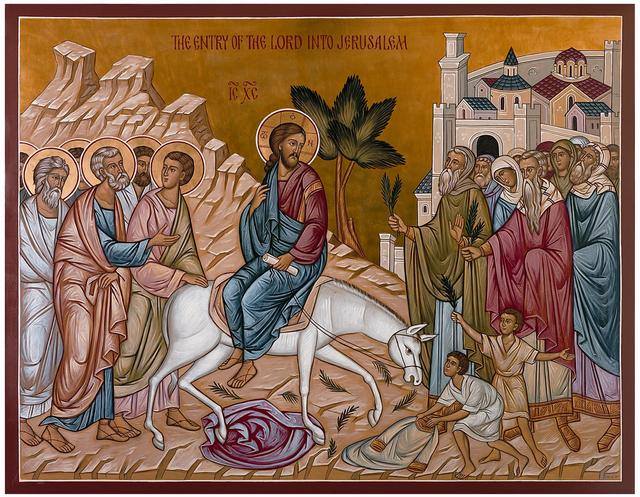
Today Christ enters the path not only of His sufferings but of that dreadful loneliness which enshrouds Him during all the days of Passion week. The loneliness begins with a misunderstanding; the people expect that the Lord’s entry into Jerusalem will be the triumphant procession of a political leader, of a leader who will free his people from oppression, from slavery, from what they consider godlessness – because all paganism or idol-worship is a denial of the living God. The loneliness will develop further into the dreadful loneliness of not being understood even by His disciples. At the Last Supper when the Saviour talks to them for the last time, they will be in constant doubt as to the meaning of His words. And later when He goes into the Garden of Gethsemane before the fearful death that is facing Him, His closest disciples, Peter, John and James – whom He chose to go with Him, fall asleep, depressed, tired, hopeless. The culmination of this loneliness will be Christ’s cry on the cross, “My God, My God, why hast Thou forsaken me?” Abandoned by men, rejected by the people of Israel He encounters the extreme of forsakenness and dies without God, without men, alone, with only His love for God and His love for mankind, dying for its sake and for God’s glory.

The beginning of Christ’s Passion is today’s triumphal procession. The people expected a king, a leader – and they found the Saviour of their souls. Nothing embitters a person so much as a lost, a disappointed hope; and that explains why people who could receive Him like that, who witnessed the raising of Lazarus, who saw Christ’s miracles and heard His teaching, admired every word, who were ready to become His disciples as long as He brought victory, broke away from Him, turned their backs on Him and a few days later shouted, “Crucify Him, crucify Him.” And Christ spent all those days in loneliness, knowing what was in store for Him, abandoned by every one except the Mother of God, who stood silently by, as She had done throughout her life, participating in His tragic ascent to the Cross; She who had accepted the Annunciation, the Good Tidings, but who also accepted in silence Simeon’s prophecy that a sword would pierce her heart.

During the coming days we shall be not just remembering, but be present at Christ’s Passion. We shall be part of the crowd surrounding Christ and the disciples and the Mother of God. As we hear the Gospel readings, as we listen to the prayers of the Church, as one image after another of these days of the Passion passes before our eyes, let each one of us ask himself the question, “Where do I stand, who am I in this crowd? A Pharisee? A Scribe? A traitor, a coward? Who? Or do I stand among the Apostles?” But they too were overcome by fear. Peter denied Him thrice, Judas betrayed Him, John, James and Peter went to sleep just when Christ most needed human love and support; the other disciples fled; no one remained except John and the Mother of God, those who were bound to Him by the kind of love which fears nothing and is ready to share in everything.

Once more let us ask ourselves who we are and where we stand, what our position in this crowd is. Do we stand with hope, or despair, or what? And if we stand with indifference, we too are part of that terrifying crowd that surrounded Christ, shuffling, listening, and then going away; as we shall go away from church. The Crucifix will be standing here on Thursday and we shall be reading the Gospel about the Cross, the Crucifixion and death – and then what will happen? The Cross will remain standing, but we shall go away for a rest, go home to have supper, to sleep, to prepare for the fatigues of the next day. And during this time Christ is on the Cross, Christ is in the tomb. How awful it is that, like the disciples in their day, we are not able to spend one night, one hour with Him. Let us think about this, and if we are incapable of doing anything, let us at least realise who we are and where we stand, and at the final hour turn to Christ with the cry, the appeal of the thief, Remember me, Lord, in Thy Kingdom! Amen.

Metropolitan Anthony of Sourozh
THE LORD’S ENTRY INTO JERUSALEM
1980, 30 March

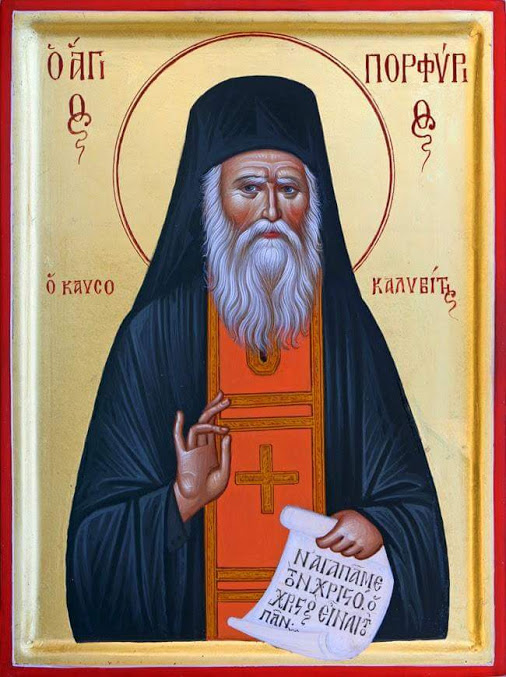
Saint Porphyrios’ Mobile Phone

By Nun Porphyria (Spyridoulas Moschou)
Because the Elder calls me on the phone every day from 4:00 to 6:00 in the morning and we read Matins, I thought that since the phone call is long-distance, he must be paying a lot of money to OTE [Hellenic Telecommunications Organization]. This is why when I got paid I put 50,000 drachmas in an envelope to give him.
“Elder, I brought some money, because your OTE bill must be big.”
“What are you talking about, foolish one? Here we are building a church and we’re gonna give so much money to OTE? Put it in the box we have for the building of the church.”
I put it in the box. But my thoughts kept telling me: It seems like OTE granted him a line of communication or someone else is paying for it.
“Lift me up. Give me my shoes to put on and tie them.”
He then took his cane and said to me: “Let’s go.”
I was surprised. As I held him I thought: Where are we going? We walked out of the balcony door and headed for the new building which was still a worksite. We went up some stairs and he showed me the new cells. He showed me the lightweight concrete that was being put as insulating material.
We then went up to a cell that had a built-in-bed where from the window was a view of the sea.
“Do you like it here?”
“Yes, it’s very beautiful, ascetical.”
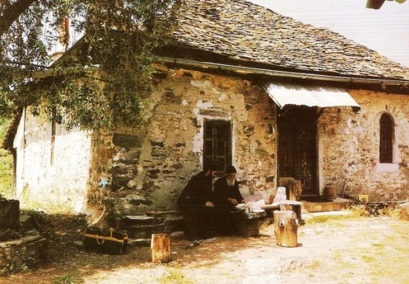
“I love the ascetics very much. This is why my mind is constantly at Kavsokalyva, but they don’t let me go. One day I will go and stay there.”
We returned to the balcony door and I waited for him to want to lie down and rest. He proceeded however towards the entrance of the cell and said to me:
“Now we will go to the old cells that are empty.”
Outside at the corridor many people were waiting and they thought I was in his cell with him all this time. They were waiting for me to leave that they may come in. When they saw the Elder standing in the corridor, they lost it. For some of them it was the first time they saw the Elder standing up. They were shocked and ran to receive his blessing. We proceeded forward and went up to the second floor. The doors of the cells were shut.
“In this cell they have incense.”
I thought: Perhaps he smelled it. He read my thoughts and saw my lack of faith.
“Here they spread out washed wheat to grind it for prosphora.”
Again my thoughts told me: Well, wet wheat also has a certain smell.”
The Elder caught my thoughts again and said about the third cell:
“Here the toilet tank has rusted because we don’t pull on it to flush. Go pour a little water inside.”
Indeed, I opened the door and when I pulled on the toilet tank, the water came out rusted. So I thought: Rust doesn’t smell.
As we returned I heard him answer a telephone call from someone.
“Hello, Go ahead! Yes, yes, do it like that….”
He was giving advice to someone. But there was no telephone in his hands. It was just the two of us. I was motionless. How is he talking to someone without a telephone? I asked myself.
“Alright, hang up now, and come by some day so we can see you.”
He then said to me:
“See, foolish one. He had need of asking me something. He was calling me downstairs in my cell, but since I wasn’t there, I answered it here.”
Then I woke up. Then I understood that the Elder was not talking to me through OTE. He talked to me in a spiritual manner, which is why he told me to put the money in the box for the building of the church.
“Come on, let’s go now.”
Source: From the book Μαθητεία στον Άγιο Πορφύριο, έκδοση “Η Μεταμόρφωσις του Σωτήρος”, Μήλεσι, 2017. Translated by John Sanidopoulos.

Contrition and Repentance

peter-denies-christ-bloch-carl_.jpg

Peter denies Christ, Bloch Carl (1834-1890)

“Thinking of my own sinfulness brings the need for contrition (μεταμέλεια). We are not speaking yet about repentance (μετάνοια), but about contrition. Repentance is a gift of the Holy Spirit. God will give it to me. For example, you did something and then say “Oh no! What have I done? Why did I not listen to the Gerondas? Now I will have to hear the Gerondas’ admonition!” This is being contrite. But when I call you and tell you, “My child, what have you done?” If you confess your error and say “Punish me, Geronta!”, and I don’t punish you, but rather grant you to take Communion, you will say, “How good is Geronta! How I am and how he is! Look at the Grace of God! Oh my soul does not suffer to sadden God!” Now repentance begins. Contrition is one thing, repentance is another.’

Elder Aimilianos of Simonopetra

… ” “

How The Departed Interceded For a Drunkard Priest

proskomidi

A Modern True Story

In Great Lent, a period of intensified prayer, the Church does not forget to pray for its departed children, because the driving force of prayer—love—overcomes all obstacles of time and space, not stopping even before the boundary of eternity, passing between the Church Militant and the Church Triumphant. The following instance that took place at the end of the twentieth century in one Greek diocese is a clear confirmation of this.

The bishop who told this story is still alive. It is genuine and has profound significance, because it speaks of the prayers of the living for the departed. God always hears these prayers, especially during the Divine Liturgy.

In the diocese of this bishop whom we have mentioned, there was a Papa Ioannis serving—a devout priest loved by all. He would somewhat linger during the proskomedia1 because he commemorated many names. But the priest had a terrible shortcoming: He loved to drink. As diligent as he was in the fulfillment of his priestly duties, so powerless was he before wine. Many implored him to overcome this passion, so unbecoming of a servant of God. The priest himself was aware of it, was furious with himself, and tried to quit drinking several times, although everything would start again within a few days.

Once, when this papouli2 had again surrendered to his passion, he went to church. Half-drunk, he exclaimed, “Blessed is the Kingdom…” and he began the Divine Liturgy. By God’s allowance, the priest slipped in the altar and dropped the Precious Gifts from his hands. He froze with horror! Dropping to the floor, he began to gather the Body and Blood of Christ with his tongue. He was choked with guilt, because it happened because of his intoxication.

The priest went to the bishop and confessed his terrible sin to him. The next day, the bishop, after much thought, sat down at the table and took a pen: He had to begin the process of defrocking Fr. Ioannis. The bishop’s hand was lingering in indecision when he beheld as if in a vision how thousands of people were coming out of the walls of the room. There was a burning pain in their eyes. Passing by the bishop, they cried out, “No, Vladyka, do not punish this priest! Do not defrock him! Forgive him!”

An endless stream of people passed in front of the bishop: men, women, children, well-dressed and poor—an entire demonstration of souls! And they all stretched out their hands to the bishop and cried out, imploring, “No, Your Grace, don’t do this; don’t expel our papouli! He remembers us and helps us at every Liturgy; he truly takes pity on us; he is our friend! Don’t remove him from his dignity! No, no, no!!!”

The vision continued for a long time. The stunned bishop watched the sea of faces pleading for the drunken priest. He realized that they were the souls of the reposed whom Fr. Ioannis commemorated at the Liturgy. And this commemoration greatly alleviates their lot, like water given to the thirsty in the summer heat. “This is a clear testimony that our prayers assuage the souls of the reposed,” the bishop thought.

He called for the priest.

“Fr. Ioannis, tell me, when you serve the Liturgy, do you commemorate a lot of names at proskomedia?”

“Hundreds of names, Your Grace. I haven’t counted them.”

“Why do you remember so many names and delay the Liturgy?” the bishop asked, as if angry.

“I pity the departed: They have no other help but the prayers of the Church. Therefore, I ask the Most-High to grant them rest. I have a book where I record all the names that are given to me for commemoration. I inherited this practice from my father, who was also a priest.”

“You do well,” the bishop agreed. “Their souls need it. Continue doing this. Just be careful, and don’t drink anymore—not a drop of wine, starting tomorrow! Such is your penance! You are forgiven.”

From that day, Fr. Ioannis was truly freed completely from the passion of drunkenness. And now he stands even longer at the proskomedia, commemorating the names of the departed.

From the book Miracles and Revelations of the Divine Liturgy, published by Paraclete Monastery (Oropos-Attica), 2012. Translated by Jesse Dominick

Pravoslavie.ru


1. The service of preparation before the Liturgy—Trans.

2. An affectionate term for a priest used by Greeks—Trans.

In the Womb

womb

A young couple once visited St. Gabriel (Urgebadze). The woman was pregnant. St. Gabriel blessed them and said, “My dears, be aware, a child understands everything, therefore read the word of God to him, so he will grow up properly from the very beginning.”

The husband was amazed by what St. Gabriel said and asked, “Yes, but Father, I don’t even understand what’s said through a half-closed door, so how will a child in the womb understand?”

St. Gabriel looked at the woman and addressed the child in his mother’s womb: “Hello baby, I ask you—do you hear the word of God?”

He had just finished saying it when the child began to move so much that the mother grabbed her stomach and couldn’t hide her emotions. Her husband, amazed and already believing what St. Gabriel had said, looked at his wife, astounded.

A Great Lent Story

geron-paisios5

A real story where the disciple thought he knew better than his spiritual father …


‘It was a day in Great Lent that the Elder saw from afar a burglar breaking into his cell.

This burglar was the same one like last year …

The Elder hid in the barn until the burglar completed his task.

When the Elder’s disciple later found out, he was furious and scolded his Elder:

– “Why did you not call me to catch him? This is the same burglar who broke into us last year and remains unrepentant!”

– “Who knows, my child”, answered the Elder. “Maybe he will repent this year …”

-“And if he repeats this again?”, the disciple burst out.

-“Then, my child, I must run, open the door and give him everything, so that he will not fall into temptation for a third time …”

The disciple knelt, kissed his spiritual father’s hand, and left in tears…’


Awed by the Beauty of thy Virginity

icon-sinai-annunciation

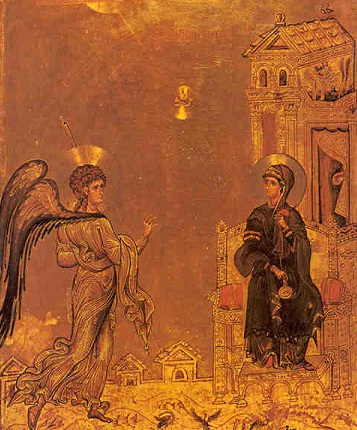
Iconography Trivia: The fact that Panagia is shown sitting in the presence of an angel illustrates that she is “higher than the Seraphim and beyond compare more glorious than the Cherubim”. I don’t think many would remain seated in the presence of an angel of God, but this icon testifies to the spiritual height of the Mother of God. (Not that she necessarily sat during this encounter – it depicts a spiritual reality more than a historical one)

The miracle depicted and described in this video is so awe-inspiring. The hymn, sung first in Greek and then in English, is so beautiful. It is the same hymn chanted at the end of the Akathist services held on Friday nights during Great Lent.

May we have her blessing!

Awed by the beauty of thy virginity, and the exceeding radiance of thy purity;

Gabriel called out unto thee, O Theotokos,

What worthy hymn of praise can I offer unto thee?

And what shall I name thee?

I am in doubt and stand in awe! Wherefore as commanded, I cry to thee:

Rejoice, O full of grace.

 Source: LESSONS FROM A MONASTERY here and here


rotonda_thessaloniki_web-thumb-large

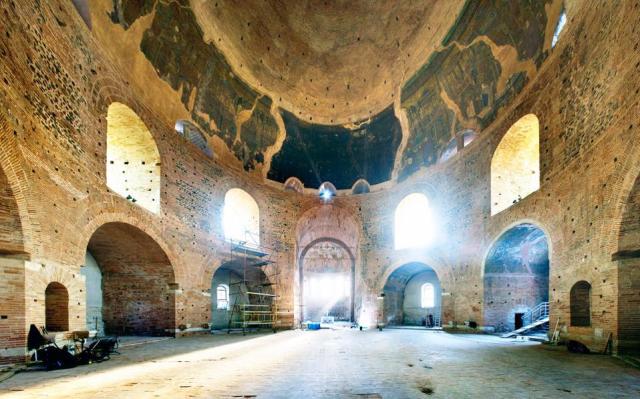
Rotunda, Thessaloniki, during restoration work

St. Nektarios, the unknown hermit and the raging demons

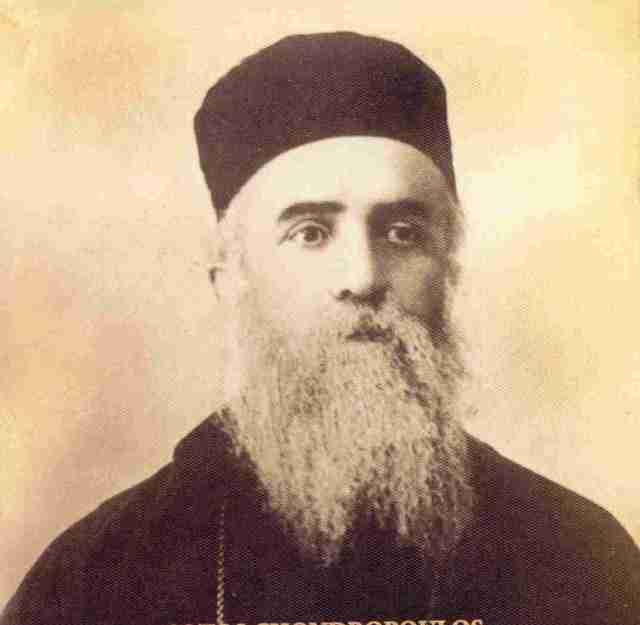
saint_nektarios_egina_1


A meeting of Saint Nektarios with a clairvoyant hermit on Mount Athos. Also, a recent miracle of the Saint in Romania.


St. Nektarios enjoys wide popularity amongst Orthodox throughout the world, yet his popularity in Romania has gained over the past few years. Portions of his relics can even be found in such places as Putna Monastery, Radu Voda Monastery in Bucharest, the Church of the Holy Hierarch Nektarios in Iasi, and the Hermitage of Saint John and Nektarios in Bradetu, Arges. Why do so many Romanians venerate Saint Nektarios and go to pilgrimage to his Monastery in Aegina? All this seems to be related to a recent, miraculous “visit” of the Saint to a village in Romania.

Below is the account as it was told by Romanians to Greeks:

“In a village of Romania there was no priest and the residents often went to the Patriarch with the problem in order to fill the empty spot. However the Patriarch did not have the means of satisfying the demand. The villagers often went to the Patriarch, but he would say the same thing, that he did not have a priest to send to the village.

Meanwhile people died unread (no funeral service), others had relationships and children without marriage vows, and the children and adults alike were unbaptized.

Then one day, outside of the church, a car stopped and out stepped a priest. The village was astonished and yelled out that a priest had come.

The villagers went to the church to greet him and asked him, “How did you come to the village after our Patriarch had said that he doesn’t have a priest to send us?”

The priest answered, “Isn’t this what you wanted? Did you not want a priest? Here I am.”

All the villagers were glad in the presence of the new priest.

The priest began immediately working. He went to all the graves and read the funeral service. He baptized and married everyone in the village and administered Holy Communion.

One day he invited all the villagers to church and told them, “I will leave now, my mission is done.”

The villagers were confused and asked, “Now that you came, you are leaving?”

However the priest did not listen to the villagers and proceeded with his decision.

When the villagers realized that their wasn’t anything they could do, they thanked him for his offering.

After a few days, the villagers went to the Patriarch and they thanked him for sending them a priest and to let him know that they would appreciate it if he could send them another priest soon, but the Patriarch didn’t know anything.

He said to them, “I didn’t send a priest because I don’t have one, however let me check with the chancellor to see if he had sent a priest to you to serve your needs.”

He phoned the chancellor, but he too didn’t send anyone.

The Patriarch inquired, “What did this priest do in your parish?”

The villagers answered, “He married us, baptized us, performed funerals for our parents, he did what any other priest would have performed for us.”

Then the Patriarch asked, “Well, didn’t he gave you any papers or log the Mysteries.

“Of course,” said the villagers, “he gave us papers and he wrote them in the church’s books.”

“Then did anyone see what he wrote? And with what name he signed?”

“All the documents were written in Romanian and we are not well educated and the signature he signed in a language we have not seen before.”

The Patriarch requested they go bring the books in order to see who was this clergyman.

When they returned with the book the Patriarch remained speechless. He couldn’t believe his eyes.

Indeed all the documents were written in Romanian while his name was written in Greek with the name of his signature,

Nektarios, Bishop of Pentapolis

For the original sources of the miracle and further information, all translated by John Sanidopoulos, go to Mystagogy. 


The Eight Means of Temptation

Parintele Cleopa de la Sihastria

By Elder Cleopa (Ilie) (1912-1998) of Sihastria Monastery in Romania

The Holy Fathers say (this is how Fr. Cleopa began to express concisely his spiritual experience to us, inherited from the Holy Fathers and personally experienced by him, as every one of his words clearly confirms) that on the path of salvation one is tempted by the devil from eight sides: from the front, from behind, from the left, from the right, from above, from below, from inside, and from the outside.

1. One is tempted from behind when one continuously remembers the sins and evil deeds one has committed in the past, recalling them anew in one’s mind, reshuffling them, engaging them, despairing because of them, and contemplating them sensually. Such a remembrance of how we have sinned in the past is a demonic temptation.

2. One is normally tempted from the front through fear at the thought of what the future holds: of what will happen to us or to the world; of how much longer we will live; of whether we will have anything to eat; of whether there will be a war or any other kind of serious and frightful event to come; and, in general, by making all kinds of guesses, predictions, prophecies, and everything else that induces fear of the future in us.

3. One is tempted by the devil from the left through the call to commit obvious sins and to behave and act in ways that are known to be sinful and evil, but which people do nonetheless. This temptation is a direct call to sin openly and consciously.

4. There are two ways in which the devil tempts from the right. The first is when one performs good deeds and actions, but with a bad or malicious intent and purpose. For example, if one does good or acts well out of vainglory, to receive praise, to obtain a position, to acquire fame, or in order to attain some benefit for oneself – it follows that one is doing such good out of vanity, avarice, and greed. The performance of good deeds for bad purposes is sinful and vain. The Holy Fathers liken such a performance of good deeds (such as fasting and almsgiving) to a body without a soul, inasmuch as the purpose for which a deed is accomplished is its soul, while the deed itself is its body. Therefore, the performance of good deeds with an ungodly purpose is essentially a temptation coming from the right, that is, coming under the guise of good. The second demonic temptation from the right comes through various apparitions and visions, when one receives visions of the devil in the form of God or an Angel of God. The Holy Fathers call trusting these specters from the devil, or accepting these demonic phenomena, delusion or deception [prelest].

5. Further, the devil tempts one from below when one is capable of performing good deeds or holy virtues but is too lazy to do so; or when one knows that one should make greater efforts and labors in ascetic struggles (in virtues and good deeds), and is capable of doing so, but does not do so out of laziness or because one is looking for excuses for one’s laziness. One thereby spiritually rejects these virtues by doing much less than one could in fact do.

6. Temptations from above (Elder Cleopa, in order better to explain this to us, demonstrated with his hands the direction from which one or another temptation came; he then briefly repeated what the direction of the temptation he had just described was) also come about in two ways. The first is when one takes upon oneself ascetic struggles that exceed one’s strength, thereby recklessly straining oneself. This happens, for instance, when one is sick but imposes a fast on oneself that is beyond one’s strength; or generally when one overdoes any ascetic struggle that is beyond one’s spiritual and physical capacity. Such obstinacy lacks humility and is unreasonably presumptuous.

Another temptation from above is when one strives to learn the mysteries of Holy Scripture (and of God’s mysteries in general), but does not do so according to one’s spiritual maturity. That is, when one wants to penetrate the mysteries of God in Holy Scripture (or in the saints, the world, and life in general) in order later to explain and teach these mysteries to other people when one is not spiritually mature enough to do so. The Holy Fathers say that such a person wants to chew through a bone with baby teeth. St. Gregory of Nyssa speaks about this in his work, The Life of Moses. He says that it was for this reason that God commanded the Israelites, who were imperfect, to eat only the meat (which is like milk for the teeth) from the Passover lamb – and, moreover, with bitter herbs – and not to break into pieces or to eat the bones, but rather to burn them in fire (cf. Exodus 12: 8, 10, 46). This means that we, too, should interpret only those mysteries in Holy Scripture (and in our faith in God generally) that correspond to our spiritual maturity and to eat (absorb) them with bitter herbs, that is, with everything that life brings us (suffering, grief); we should not bite into the mysteries of Holy Scripture, Divine knowledge, and God’s Providence, like so many hard bones, with our baby teeth; they are susceptible to fire only, that is, they become clear only in ripe spiritual maturity and in experienced souls that have been tested by grace-filled Divine fire.

7. One is tempted from within by that which one has in one’s heart and by that which proceeds from the heart. The Lord Jesus Christ clearly stated that it is from within, from one’s heart, that sinful and impure thoughts, desires, and lusts proceed (cf. Matthew 15:19) and tempt one. Temptations come not only from the devil, but also humanly, from the evil intentions and skills, lusts, evil desires, and inner love of sin that proceed from an unclean heart.

8. Finally, the eighth door to demonic temptation is opened from the outside, through external things and occasions, that is, through everything that enters from outside through one’s senses, which are the soul’s windows. These external things are not evil in and of themselves, but by means of them one’s feelings can be tempted and induced to evil and sin.

These, then, are the eight means by which everyone is tempted, regardless of whether one is in the world or in seclusion.

(Having completed listing all eight means by which one is tempted, Elder Cleopa briefly repeated them and then added the ways and means with which to combat each of these temptations.)

Against each of these temptations – from behind, from the front, from the left, from the right, from above, from below, from inside, and from the outside – one must fight by means of watchfulness (the Elder used precisely this Slavonic word [trezvenie]), that is, attentiveness, carefulness, and wakefulness of soul and body; wakefulness and vigilance of spirit; sobriety and discernment; attention to one’s thoughts and actions; or, in a word: judgment. On the other hand, by means of constant prayer that invokes the name of the Lord Jesus Christ, that is, through unceasing prayer. (Here Fr. Petronius added in Greek: “Prosochi kai prosefchi” – that is, as the Holy Fathers put it, “by attention and prayer.”)

In other words (the Elder added), the Holy Fathers said that the battle against all temptations and passions consists in the following: guarding all one’s mind, soul, and body from temptation – this is our ascetic struggle, from our human point of view; from the Divine side, one must continuously and prayerfully call upon the help of the All-Merciful Lord Jesus Christ – and this is that unceasing and primary prayer of the hesychasts called the Jesus Prayer: “Lord Jesus Christ, have mercy on me, a sinner!”