Dear Fathers, brothers and sisters,
Christ is in our midst. Please forgive my absence of nearly a month, but this was a time of intensive reflection after my first ’round’ of pilgrimages to monasteries so that we could decide what to do and where to go next. By the way, this month I also visited another monastery, which was so hesychastic and hidden that I did not have the blessing to share with you anything, be it photographs or discussions with the monastics there!
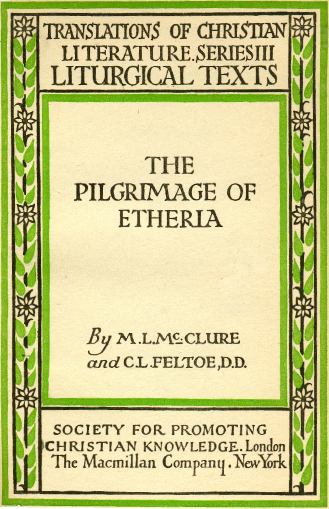
During these quiet weeks of reflection, hesychia and quiet, friends introduced me to the Travels of Egeria, alias Pilgrimage of Aetheria or Pilgrimage to the Holy Lands (Peregrinatio or Itinerarium Egeriae), the earliest extant graphic account of a Christian pilgrimage to the Holy Land about 381/2–384, from Mount Sinai to Constantinople.
Who is this Egeria, this Christian woman who took a journey lasting four years to the Middle East in the middle of the fourth century c.e. and wrote a journal of her travels?
Her manuscript lay dormant until the late 1800s. Other Latin writers made mention of her, so her accounts circulated among religious pilgrims before they were lost for centuries. Her name was Egeria (also known as Eutheria, Aetheria, and Silvia), and she was writing for other religious women who lived in Europe, perhaps on the Atlantic coast of Spain or France.
Most likely she was a nun commissioned by her community to put her curious and adventurous mind to work for the benefit of the spiritual life of her sisters. She went on pilgrimage to the most important sites of the Christian and Jewish world of her day.
Her account is one of the most valuable documents scholars have of the fourth-century world of travel, piety, early monasticism, women’s roles, and even the development of late Latin.
Her book has two parts. The first part is a travelogue and is simply her report of her pilgrimage. She tells her sisters of her visits to such hallowed and historical places as Jerusalem, Edessa, sites in Mesopotamia, Mount Sinai, Jericho, the Jordan River, Antioch, and Constantinople, and of meeting people (usually monks and mystics) serving the places.
She follows the itinerary of the people who made the places famous and prays there. Often her comments about the rustics at the sacred sites show a bit of dry humour.
Her tourist program has many other objectives, such as following the path of Moses through the desert to Mt. Sinai, her plan to visit the home of Abraham’s family (Carrhae or biblical Harran, southeast of Edessa), and her hope to go to Thomas the Apostle’s tomb in Edessa.
The travelogue is incomplete, for like any good pilgrim she concocted ever more schemes to visit other places like Ephesus to pray at the tomb of the John the “Beloved” Apostle. This part of her travels is missing from the manuscript.
The second part is more a journalistic report on the church of Jerusalem’s liturgical practices over the three years she lodged there. Her record of the practices surrounding daily life and prayer of the church is the first one that scholars have on the topic.
She also reports on how the church’s celebrations correspond to its unique location in the Holy Land. The liturgies she describes are hardly stationary ceremonies in one church location, but they involve processions from place to place according to the occasion. In addition, her descriptions are useful for historians of church architecture.
Her account allows modern readers to see things like the need for military escorts in various places of the Holy Land, the unfailing hospitality of the monasteries along the way, the road network, and the system of inns maintained by the empire.
She speaks of the monks, the nuns, and the religious laity in the Holy Land and their patterns of fasting and the instruction of the candidates for entrance into the church. Finally, she epitomises the heart of the pilgrim and shows pluck and pithiness as she describes each stage of her spiritual journey. Having done part of this pilgrimage myself, even the ascent of Sinai, I have to say how impressed I am by her fearlessness and stamina !
THE ASCENT OF SINAI
We reached the mountain late on the sabbath, and arriving at a certain monastery, the monks who dwelt there received us very kindly, showing us every kindness; there is also a church and a priest there. We stayed there that night, and early on the Lord’s Day, together with the priest and the monks who dwelt there, we began the ascent of the mountains one by one. These mountains are ascended with infinite toil, for you cannot go up gently by a spiral track, as we say snail-shell wise, but you climb straight up the whole way, as if up a wall, and you must come straight down each mountain until you reach the very foot of the middle one, which is specially called Sinai. By this way, then, at the bidding of Christ our God, and helped by the prayers of the holy men who accompanied us, we arrived at the fourth hour, at the summit of Sinai, the holy mountain of God, where the law was given, that is, at the place where the Glory of the Lord descended on the day when the mountain smoked.1 Thus the toil was great, for I had to go up on foot, the ascent being impossible in the saddle, and yet I did not feel the toil, on the side of the ascent, I say, the toil, because I realised that the desire which I had was being fulfilled at God’s bidding. In that place there is now a church, not great in size, for the place itself, that is the summit of the mountain, is not very great; nevertheless, the church itself is great in grace. When, therefore, at God’s bidding, we had arrived at the summit, and had reached the door of the church, lo, the priest who was appointed to the church came from his cell and met us, a hale old man, a monk from early life, and an ascetic as they say here, in short one worthy to be in that place; the other priests also met us, together with all the monks who dwelt on the mountain, that is, not hindered by age or infirmity. No one, however, dwells on the very summit of the central mountain; there is nothing there excepting only the church and the cave where holy Moses was.2 When the whole
1 Exod. xix. 18.
2 Exod. xxxiii. 22.
passage from the book of Moses had been read in that place, and when the oblation had been duly made, at which we communicated, and as we were coming out of the church, the priests of the place gave us eulogiae,1 that is, of fruits which grow on the mountain. … I began to ask them to show us the several sites. Thereupon the holy men immediately deigned to show us the various places. They showed us the cave where holy Moses was when he had gone up again into the mount of God,2 that he might receive the second tables after he had broken the former ones when the people sinned; they also deigned to show us the other sites which we desired to see, and those which they themselves well knew.
1 This word is still used in the Eastern Church for food which has been blessed by a priest, e. g. the first fruits from an orchard or a vineyard.
2 Exod. xxxiv. 4.
… From the summit of the central mountain, those mountains, which we could scarcely climb at first …From thence we saw Egypt and Palestine, and the Red Sea and the Parthenian Sea,1 which leads to Alexandria and the boundless territories of the Saracens, all so much below us as to be scarcely credible, but the holy men pointed out each one of them to us.”
This is a highly readable, exciting book, available as a full Audio Book, read by David Wales, and available online, which I strongly recommend you to have a look at, if you haven’t already.

 ORTHODOX CHRISTIAN FAITH AND LIFE
How wonderful to know that there is an audio version of this journal — I’ve been interested to read it for a long time, but my stack of print books is so tall. It’s nice to have a good book to listen to while I am ironing or cleaning.
Thanks for sharing about it!
LikeLiked by 1 person