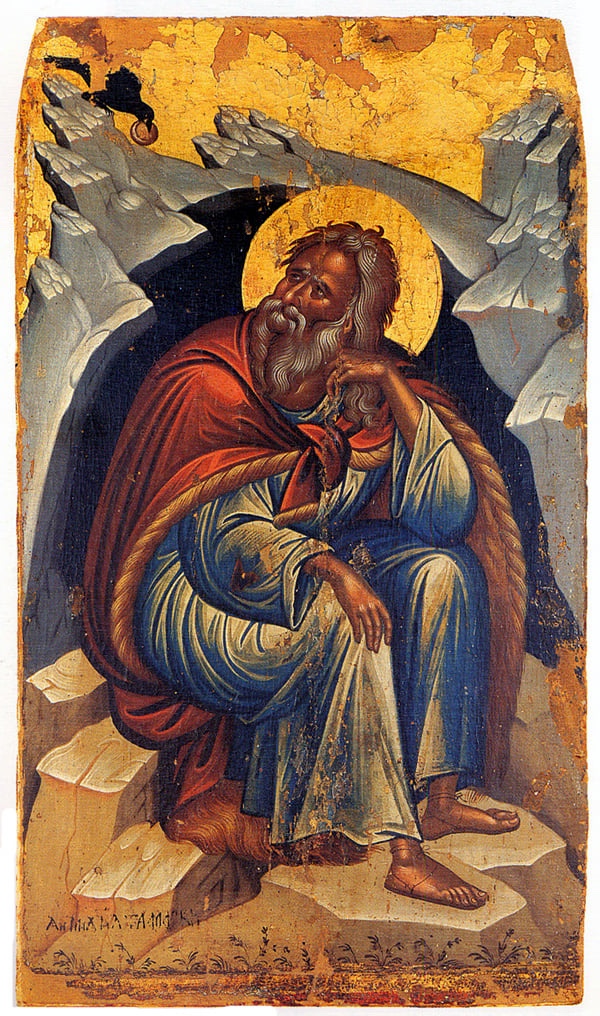
How an icon of Prophet Elijah (20th July) was a revelatory moment for Fr Jonathan Hemmings in his conversion to Orthodoxy
The grace bearing nature of Icons within Holy Orthodoxy means that we encounter a window into heaven. The veneration of an icon is the expression of the love we have for our Lord and Saviour, His most Holy Mother and His sanctified family, the righteous who foretold His coming and the saints who followed His example; it is the physical expression and consequence of our belief in the communion of saints. We venerate the prototype who is worthy and who in turn prays for us. The grace that is given to each Icon, which in its very formation and writing is the fruit of prayer rather than art, brings us to a deeper understanding of our own salvation.
I remember some years ago on the feast of the St. Elijah (Elias) looking at the Icon of the Prophet. I had read the story of this bold ambassador of God’s word as a student of the Old Testament years before; how he dared to speak the word of God to his own people who were following other gods and how he earned the wrath of the evil Queen Jezebel and her 400 hundred prophets of Baal. Exhausted by his labours the righteous prophet seeks refuge in a cave. There God sustains him through commanding ravens to feed his
servant. The Icon of the prophet shows him in a cave
with a black bird with food in his beak coming to
feed the prophet. 1 Kings 17:2-6 (New King James Version) 2Then the word of the LORD came to him,
saying, 3“Get away from here and turn eastward, and hide by the Brook Cherith, which flows into the Jordan. 4And it will be that you shall drink from the brook, and I have commanded the ravens to feed you
there.” 5So he went and did according to the
word of the LORD, for he went and stayed by the Brook Cherith, which flows into the Jordan. 6The ravens brought him bread and meat in the morning, and bread and meat in the evening; and he drank from the brook.
This for me, as I looked at the Icon was a revelatory moment. Exhausted spiritually, these words came back to me with great force for I too was hungry for spiritual food which was to be found in the East and God sent black robed priests from the west to come and feed me and others so that we could be strengthened and sustained.
Fr. Jonathan Hemmings
Orthodox Church of the Exaltation of the Precious and Life-Giving Cross:
www.orthodox-lancaster.org.uk
Fr. Jonathan Hemmings talks about his first encounter with Greece and Orthodoxy here

 ORTHODOX CHRISTIAN FAITH AND LIFE
You’re right that Orthodox Christianity in America has faced significant decline in membership over the past decades, though there are also signs of renewed interest among younger generations. The picture is mixed: long-term demographic shrinkage, but pockets of growth driven by converts and cultural shifts.📉 Evidence of Decline
🌱 Signs of Growth
⚖️ Reconciling the Contradiction
🧭 What It Means
In short: your perception of decline is backed by hard data, but there’s also a countercurrent of renewed interest that hasn’t yet translated into sustainable growth.
LikeLiked by 1 person
Thank you for your detailed feedback. Indeed, I see this happening. This surge of interest in Orthodoxy among young Americans is quite recent, whereas Father Jonathan’s miracle took place about 3 decades ago, if I am not mistaken. Your prayers
LikeLike