Allowed to See

The Bible: the center of Theology of Father Symeon Krayiopoulos

The Bible: Father Symeon’s Kragiopoulos Centre of Theology

His discourse was also theological. He never ignored dogma, never indulged in moralizing, empty verbiage or flights of fancy. He spoke well, was comprehensible, and used theology, not as a system of knowledge, but as the essence of life, which imbues the whole of human existence. The centre of his theology was the Bible, which he knew in depth. His sermons were, at bottom, Biblical and he recommended that his ‘children’ read the Scriptures, and, indeed, he set a chapter of the New Testament to be read every day, by all of them. He immersed himself in the Scriptures, engaging with the text and enjoying the interpretational footnotes, both Patristic and modern.

We would often speak at length on the telephone about one passage or a single word.

His theological discourse wasn’t superficial. He knew theology in depth, he was up-to-date with theological bibliography and followed developments in academic theology. He was usually present at conferences of the Greek Society for Biblical Studies and took part in the discussions, reminding people, through what he said, that theology isn’t merely knowledge, but also an experience, without which knowledge ‘is puffed up’. And all the days of the conferences, when Fr. Symeon circulated as an ordinary member, he emanated the fragrance of Christ with his words, his smile and his presence. At one such conference in Cyprus, during a break, a professor from Thessaloniki approached a group of a few young people who were talking to Fr. Symeon and said: ‘Do you know what a blessing this moment is for you. In Thessaloniki we get to enjoy Fr. Symeon’s presence in drips and drabs. You’ve got him here when and for as long as you want’.


‘If you’re a theologian, you’ll pray properly; and,

if you pray properly, you’re a theologian’ (On Prayer 61)


His theological discourse was also niptic. He enjoyed the niptic fathers and imitated them in word and deed. The saying attributed to Saint Neilos: ‘If you’re a theologian, you’ll pray properly; and if you pray properly, you’re a theologian’ (On Prayer 61) was a rule of life. The silent assemblies, of which we spoke above, are a small example of his desire to teach the method of the prayer of the heart. And even if these silent assemblies have not been generally adopted as his vigils have, they were of great benefit, because the idea spread of using a prayer-rope and saying the Jesus prayer. Until then, it had been unknown to the wider public, neglected or held to be something that was appropriate only for monastics.

I realized just how much Fr. Symeon was imbued with the spirit of the prayer of the heart, how much he was himself niptic, from a long discussion we had as we were returning from a conference of the Greek Society for Biblical Studies on Patmos, the first of a series, at the end of September, 1975.

As we were sitting in the stern of the ship, in the moonlight, returning from the island of the Revelation, he showed himself to be a great niptic father, a holy teacher of the prayer of the heart. He was taken up, speaking from another world, and I tried to follow him, drinking in his words. We parted past midnight, with the feeling that we weren’t done with the subject. How could we be when ‘perfection is never-ending’?

Fr. Symeon never advertised his work. He never challenged anyone in his homilies. You learned about him from other people. I recommended his talks to someone and he said to me afterwards: ‘You mean there’s somebody like him in Thessaloniki and you didn’t tell me earlier?’

*

“I thank you, my Lord, that you allowed me to see what I am”


The Bible: the center of Theology of Father Symeon Krayiopoulos


I thank you, my LordThe event of salvation is conscious. We should know this and not fear it at all. Further, we should beg God to reveal our true selves to us. Then God will see that we accept this not with words, but in practice. Therefore, when at some point, either we make a mistake or something else happens, and God allows all of our wickedness, and our whole diseased and bleak inner state to be revealed, we need to accept it. We need even to be thankful, saying: “My God, such a thing I had awithin me and I didn’t recognize it! I thank you, my Lord, that you allowed me to see what I am”. 

You must see this and embrace it. Not in the sense that you will hang onto it, but in the sense that you will acknowledge that you are the one that has this within you. You ought to acknowledge it without wanting to blame and pass the responsibility to someone else and without averting your eyes as though not wanting to see it. Some men and women who work at lowly jobs, whatever happens, they stoop and patiently do the work completely. On the contrary, a person may be fragile or delicate, and supposedly ashamed, supposedly disgusted and supposedly isn’t able to do such work. If he does this work though, it will be incomplete. Here, though, in our own case, it’s necessary that we see our sin. We must see this thing that we hold onto as if we want it, and within which our soul has been sunk for an entire life. We must see it, must feel it. We must see how difficult it is, nearly impossible, to escape from this state.  Therefore, someone is completely convinced, and thinks: “It’s over. I’m going to perish”. This is Hades. Namely, someone sees that he is in Hades.

However, we know that we have a Saviour, we know that Christ came to earth. Then we start to understand what it means that he came to save us, and we run to the Saviour. We run to the Lord with pain, with prayer, with a cry, with faith, with hope and a firm conviction that the Lord will accept us and will save us. The Lord wants us to approach things exactly like this. This is not our own daring or our own boldness.  He wants us act just like that, to entrust ourselves in this way, and for this reason he gave us promises. So someone does this work, and little by little the decay of his soul, that lies in the subconscious and the unconscious, emerges.

How long will this last for? A lifetime. Until the end of our life, this is the work we have to do. But grace is involved. It also happens every so often that when you enter within yourself or when you give yourself to God, the decay you have within emerges on its own, and you see it whether you want to or not.

It is a bleak state, a filthy state, but grace is involved since in exactly this way you are redeemed, once and for all, and are saved. And it is through this that you are delivered from this state.

 *

Is our disposition such that the Lord is able  to be moved to compassion for us?

 The Bible: the center of Theology of Father Symeon Krayiopoulos

“And when Jesus went out He saw a great multitude; and He was moved with compassion for them, and healed their sick.”

Then – as the Gospel passage tells us – since the multitude had followed him into the desert for many hours and were hungry, the Lord with five loaves and two fish, having blessed and multiplied them, fed five thousand men with twelve additional baskets taken up.

The compassion of Christ is not simply some sentimentality, but is a manifestation of His love toward His creation. God always loves the world, He loves every individual person, but for Him to be moved to compassion and to show it, it is also necessary for a person to be appropriately receptive to it.

It’s not enough to simply do some good works (to pray, to go to church, to study). Whatever we do we are sinners and unworthy of God. Consequently, we are unacceptable. All the same, we need to do these things precisely to show our good disposition, to show that we want to be saved, that we choose God, we seek Him, we love Him. But is not enough for these things to be done only because of habit.

That’s why it is good, wherever we find ourselves, to ask ourselves night and day whether our disposition is such that the Lord is able to be moved to compassion for us. It is not necessary for you to journey along many and distant roads, climbing and descending, in order to achieve this. God is the one who covers the distance that exists between us and Him.

All a person needs to do is one little thing, but a little thing which is great and which is everything: to humble himself, to repent, to have the fear of God within him, to not be puffed up, self-inflated, and conceited.

And then – O, the wonder! – God will be found wherever we are. Then irrespectively of how things arise in our lives, we will feel the compassion of God and see how God will provide all that our souls and bodies need. It is not difficult for God – not difficult even for God to heal you from sickness or to put in order other problems and situations in your life. He can take care of everything. But we need to adopt that disposition that will elicit His compassion toward us. (August 3rd, 2014)


Transcribed talks by Archimandrite Symeon Kragiopoulos

 From: Holy Hesychasterion “The Nativity of Theotokos” Publications.

Translated by fr. Matthew Penney


(To be continued …)


For Fr. Symeon Kragiopoulos: The Portrait of a Spiritual Father – I, The Theologian and the ‘Liturgical’ Being (his famous church services and vigils), go here

For Fr. Symeon Kragiopoulos: The Portrait of a Spiritual Father – IIThe ‘Silent’ Assemblies of Father Symeon Kragiopoulos, (his famous silent sessions of the Jesus prayer), go here

For Fr Symeon Krayiopoulos: The Portrait of a Spiritual Father – III, A Servant of the Holy Mystery of Confession, go here …

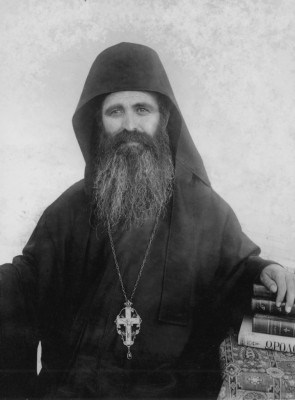
Blessed Elder Philotheos Zervakos: The Circle of Grace (1)

elder-philotheos


Blessed Elder Philotheos Zervakos was spiritual father to Photios Kontoglou, Sister Angeliki the Unmercenary (my spiritual mother),  and a spiritual child of St. Nectarios of Aegina. During his youth he chanted several times  at vigils served by the saintly Fr. Nicholas Planas. Elder Philotheos experienced two life-saving miracles in his life with St. Demetrios and visibly encountered the Saint.


  • This post marks the beginning of a series which has always fascinated me: The ‘inter-connection’ of the Saints, the faithful and members from my spiritual family in the Holy Spirit.  Glory to God! The circle of Grace expands like ripples in the pool!  “That they all may be one; as thou, Father, art in me, and I  in thee, that they also may be one in us ” (John 17:21, KJV) There will be no commentary or analysis on my part in this series; just a plain presentation of facts and accompanying hyperlinks. I would be greatly indebted to any of you who might point out to me further  ‘inter-connections’.

A Servant of the Holy Mystery of Confession

 Father Symeon : A Servant of the Holy Mystery of Confession

Father Symeon : A Servant of the Holy Mystery of Confession

In confession, as in the whole of his everyday behaviour, Fr. Symeon was all love. Love overflowed from within him. He radiated love, not with words, nor with actions, but with his mere gaze, his smile, with a single word. He was formal, but not a slave to formalities. I remember one incident in particular. He’d given me the number of his personal telephone, the one in his room. I would usually phone him between 11-12 in the evening, which was the best time for him because, as he explained: ‘Now it’s the afternoon for me’.

We’d speak without restraints of time, but he would still be up in the morning for his rule. One evening, around midnight, the son of a friend of mine, a spiritual son of Fr. Symeon’s, who was studying abroad, telephoned me. He was very upset and asked for help with a really important problem which needed to be resolved immediately. I was in no position to advise him. Only the Elder could do so, but how? At that time of night nobody would have answered a telephone call to the monastery. I hesitated to give his confidential telephone number, because he’d told me not to give it to anyone at all. The case was such, however, that I decided that I’d just have to go against his instructions. So I gave it. And the boy was saved. The father saved his son.  The next day I asked forgiveness for the infraction, but he told me not to worry and that I’d done the right thing.

That was Father Symeon. A discerning, consoling and enlightened advisor to whom we had recourse and to whom we referred people with difficulties, so they could find refuge.

*

In his sermons, in his discussions, in confession, Fr. Symeon didn’t avoid taking a position on burning questions which others didn’t dare to touch on so as not to come into conflict with the prevailing, unhealthy atmosphere. Let me explain. There was at one time much ado generated over 666 and this was an issue that threw people into turmoil. Father Symeon did not leave his spiritual children in the dark over this. He clarified the issue in a series of talks, reassuring those who were worried. He did the same for bar codes and other similar issue which aggravated ill-informed believers. In general, he dealt with important ecclesiastical and theological issues with clear thinking, theological depth and knowledge of the Patristic tradition. And all of this with sobriety, without any spirit of contention.  If ever I wanted a second opinion on my own articles on Church matters, I would submit them to him and he would always make useful observations. For example, if I used acerbic language, he would suggest I tone it down.

In general, his discourse was prophetic. He did not ignore dogma, he was never restricted to dry moralizing, he used neither clichés nor soaring rhetoric. Well-grounded, comprehensible, he spoke in the name of God, telling the truth, castigating lies and thus bringing the faithful to his way of thinking. Listening to him, you felt that you were listening to the word of God, that his discourse was official, authentic and valid. He didn’t impose himself through human coercion, but spoke rather ‘in the Holy Spirit’. Without prevarication, he went straight to the heart of the matter and didn’t mince his words in order to please people. He told the truth of the Church, without pulling any punches, however hard this seemed to many people. He was a prophet in the Biblical sense, shaking people up to get them to cast off the fripperies with which their egotism had burdened them, so that they could see naked reality clearly.

*

Pain is a shortcut to salvation

Father Symeon : A Servant of the Holy Mystery of Confession

It says in the Gerondikon: “In the morning you may be in hell and in the evening you can be in paradise”. What is meant is that in the morning man may have committed sins, but, as in the course of the day he came to his senses, showed reverence, repented and wept for his sins. As the sun sets, it is no big deal for God to place him in paradise. Things are easy and the road to salvation is short. We, by having the wrong attitude, make things hard and the road to salvation “un-short”.

Whatever your condition is, if you repent, God welcomes you and you are saved. All you need is to repent truly.

You may repent for something you have done, but you repent because your egoism has been hurt. You go to confession, for the one and only reason that your egoism has been wounded. Not because you have sinned in the eyes of God. You had a good impression of yourself. As you have sinned though, you can no longer have it. And that makes you suffer. This is not repentance, though.

*

(To be continued)

For Fr. Symeon Kragiopoulos: The Portrait of a Spiritual Father – IIThe ‘Silent’ Assemblies of Father Symeon Kragiopoulos, (his famous silent sessions of the Jesus prayer), go here

For Fr. Symeon Kragiopoulos: The Portrait of a Spiritual Father – I, The Theologian and the ‘Liturgical’ Being (his famous church services and vigils), go here

Spared Death Penalty … Twice!

St. Demetrios of Thessaloniki and Elder Philotheos Zervakos

st demetrios and elder philotheos zervakos:  two miracles 


Two Miracles

May St. Demetrios intercede for Us! Today is a very special day for my hometown Thessaloniki. +St. Demetrios of Thessaloniki, 26 October. Thessalonians and all the world are glorifying “the myrrh-gushing saint and courageous martyr, Demetrius, the commander”.  Indeed, St Velimirovich is so right! “St. Paul bedewed Thessalonica with tears, Demetrius watered it with his blood.” Below follow two miracles of St. Demetrios to Elder Philotheos Zervakos, a most venerable contemporary elder, of special significance to me, since he was a spiritual father of my spiritual mother, Sister Aggeliki the Unmercenary :


st demetrios and elder philotheos zervakos:  two miracles 

st demetrios and elder philotheos zervakos:  two miracles 

As a young man, Fr. Philotheos Zervakos (+1980), the well-known abbot of Paros and spiritual son of St. Nektarios of Aegina, was imprisoned twice by the Turks during the final years of the Ottoman occupation of Thessaloniki. In his time of trial St. Demetrios, his patron, was a ready helper, as we read below in his own words:


st demetrios and elder philotheos zervakos:  two miracles 


St. Demetrios Protects Elder Philotheos From Harm The First Time


When I fulfilled my military service and was released, I decided to become a soldier for our Heavenly King in accordance with the counsel that Father Eusebios had given me. I disclosed all my intentions to the holy Nektarios, the Bishop of Pentapolis, who then was also the director of the Rizareion Seminary in Athens (now in blessed repose), and he told me, “Your goal is good, but I advise you to go to no other monastery than the one at Paros (Lagouvardos), where the brethren are virtuous and plentiful.” However, I insisted, telling him that my desire was to go to the Holy Mountain. He then said, “If you stay in Greece, go to the Lagouvardos Monastery, but if you insist on going to the Holy Mountain, then go with my blessing….”

After attending a vigil on May 8, 1907…my friend Nickolas Mitropoulos and I boarded the steamship “Pinios”, and we departed for the Holy Mountain from Piraeus….

Two days later, we arrived in Thessaloniki, which was then occupied by the Turks (I had great reverence for St. Demetrios, the patron saint of Thessaloniki since I was a child). I invited my friend Nickolas to join me to go venerate the tomb of the Great Martyr, St. Demetrios the Myrrh-gusher. We then got off the ship and went to venerate his tomb with compunction. On our way back to the ship, we checked in at the Greek hotel and rested all day and night. The next day, we prepared to depart for the Holy Mountain and went to the Customs Office; however, they did not permit us to depart: “You will not leave”, they told us, “because you are spies!” We, of course, denied this and pointed out that since our passports had been cleared by the Turkish Consulate and the Embassy, they should allow us to leave. However, they would not pay any attention to our words.

They did not put us in jail but under close surveillance and soldiers stood guard outside our hotel, and they followed us whenever we went out. This went on for quite a few days and we began to worry because our money was running low. One day, I told Nickolas, “I am going to the ‘konaki’ (governor’s house), to appear before the ‘pasha’ (governor): he will probably allow us to leave.” I arose very early the next morning and went to venerate the tomb of St. Demetrios again before going to the konaki. With tears and compunction, I asked the Saint to intercede to the Lord that we be permitted to freely go to the Holy Mountain. After praying for quite a while and sitting down to rest, the martyrdom of St. Demetrios came to my mind: I thought about how he was pierced with a lance and died for the love of Christ and for our holy faith, and how he was glorified by God both on earth and in heaven, and will be glorified unto all ages.

As I considered all this, a longing came to me to give my life for the love of Christ and the Orthodox faith too, supposing there was a way. I then asked St. Demetrios to intercede to the Lord again, however, not for my freedom, but that I be rendered worthy to die a martyr’s death. I then thought of a way to accomplish this goal. I told myself, “I will go to the konaki and courageously appear before the Turks. I will give them a reason to question me about my faith and then I will bear witness to their heresy. They will probably tell me to deny my faith, but I will stand firm and prefer death. Thus I will have a Martyr’s end.”

I went to the konaki immediately and entered inside. While I was going up a hallway, a Turkish officer noticed me and asked me what I wanted:

“I want to see the pasha.””And why do you want to see him?”

“I have something to tell him.”

“I am the pasha’s representative. Tell me what you want openly.”

“Since you are the pasha’s representative, then tell me, why will you not allow us to go to the Holy Mountain?”

“I will not give you a reason.”

“You are not good people”, I told him courageously, “you are unjust. Why are you detaining and distressing us like this? We are not at fault, we are not bad people and our papers are in order. I do not understand. Now we have run out money. How shall we live in this foreign and unknown place? How would you like it if you went to Greece and we did to you what you are doing to us?”

These words irritated him and moved him to anger. He began ringing a bell loudly and 30-35 soldiers and officers gathered around us immediately. They grabbed me and dragged me off to the White Tower, for what purpose I did not know; I thought perhaps to imprison me … As we walked to the White Tower, I asked St. Demetrios to intercede to the Lord to grant me a martyr’s death, provided it is His will; and if it was not, to be delivered from the hands of these atheistic, bloodthirsty, wild and barbaric Saracens.

After we had gone a little ways, their superior appeared and spoke to them in Turkish. I did not understand what he had told them but I did perceive that he was angry. He then lifted up his rod and struck the officer responsible for my arrest on the shoulder and sent them all away. When they left, he approached me with a cheerful grin on his face, and kindly patted me on the shoulder. He then handed me over to the prudent soldier from Ioannina and ordered him to take me to the Greek steamship “Mikali”, which was in the port of Thessaloniki, so that I could return to Greece.

I asked the soldier who the man was that had given the orders, not having the faintest idea. He told me that he was the pasha. I then asked him why the pasha had struck his own personal secretary, and what he had said to him. The soldier explained, “The pasha scolded his secretary because he had condemned you to death without asking permission.” I then asked him where they had been taking me. “They were taking you to the White Tower to execute you there”, he said, “all those who are condemned to death are taken there – as for the others, they put them in chains and abandon them to die from hunger, from thirst and from the stench.” I then rejoiced that I had been delivered from the hands of those wild Saracens – for I was not sure whether it would have been for the question of my faith that they had killed me. However, I was sad because I missed the opportunity to give my life for the faith. Martyrdom, however, must take place according to the rules as the divine preacher, the Apostle Paul, tells us, “An athlete is not crowned unless he competes according to the rules” (2 Tim. 2:5)….

The soldier and I then stopped by the hotel, where I bid my beloved friend Nickolas farewell….

Apparently, it was not the will of God for me to go to the Holy Mountain, and this is the reason I encountered all these obstacles. I feel a great debt of gratitude to my protector, the Great Martyr, St. Demetrios, through whose intercessions and prayers, I was delivered from death.

I had no idea why the pasha had shown so much interest in me, so I sought to find out. It was not until about two years later, when I went on a pilgrimage to the Holy Mountain, that I finally learned why from my friend Nickolas, who had gone and had remained on the Holy Mountain. He told me why the pasha had set me free and sent me back to Greece:

“Two or three days after you departed Thessalonika for Greece, the adjutant officer of the pasha came up and greeted me…He was an acquaintance of mine…He took me to his home where he offered me hospitality, and the following day we went to go see the pasha together…The Pasha said to him:

‘Your friend there, he was accompanied by another young man. One morning, as I was sleeping peacefully, St. Demetrios entered my room wearing a generals uniform and bearing weapons. With an austere look he commanded me: “Immediately, stand up, get dressed, put your shoes on, and go to such and such a road in the city to free a young man who has been unjustly condemned to death by your own private secretary. After freeing him, send him to the steamship ‘Mikali’, which is in the port of Thessaloniki and preparing to sail off for Greece.”

I hastened at once to save the young man from danger, and sent him off to Greece.'”

It was then that I realized that my helper and my deliverer from death had been the Great Martyr, St. Demetrios the Myrrh-gusher.

The prophecy of St. Nektarios had been fulfilled; no matter where I would go, I would end up at Logouvardos. I had learned a valuable lesson from this: I ought to always be completely obedient to my spiritual father, without being defiant, and I ought to not seek my will, but the will of my spiritual father – in imitation of our Lord Jesus Christ, “Who came into the world not to do His own will but the will of His Father, Who sent Him.”

st demetrios and elder philotheos zervakos:  two miracles 

st demetrios and elder philotheos zervakos:  two miracles 

St. Demetrios Protects Elder Philotheos From Harm The Second Time

Two years later, the Balkan war took place and on the Feast of St. Demetrios (October 26, 1912), Thessaloniki was liberated through the mediation and aid of her Patron Saint.

When we sailed into the port of Thessaloniki, I decided that it would be a good idea to disembark and go venerate the tomb of St. Demetrios, my guardian, and my protector and savior after God. I do not know why, but when I disembarked, the Turks once again took me to be a spy, and put me under surveillance for quite a few days. When I decided to leave Thessaloniki, and began passing through customs, they arrested me, and took me through three rows of barbed wire and locked me in. I found a youth locked in there also, and asked him why they had locked us up. He answered, “In order to murder us.” “But what evil have we done?” I asked. “Forget it,” he answered “do not bother to ask why.”


A moment later, a steamship from Romania sailed into the port of Thessaloniki carrying many passengers and a cargo of fuel oil. For some unknown reason, an oil container caught fire as the ship pulled in, and the flames spread rapidly through the entire ship. Loud blasts were heard a few minutes later, and flames were thrown sky high. Thessaloniki was all astir. Thousands of people came down to the shoreline – some to watch and others to rescue the endangered passengers with their boats. All the guards then left their posts to go see all the commotion. Seizing the opportunity, the young man pulled a small pair of clips from his pocket and cut through the barbed wire. Then he took me by the hand and lead me out. And paying a boatman, he told him to take us out to a Greek steamship which was anchored just outside the port. As we were climbing in the boat, the soldier who arrested me and locked me up came running over to seize me. However, the young man slapped him right across the face when he got to us, and he pulled back and walked away!

The boatman took us out to the Greek ship and we went aboard. I then went to put my things in order, and once I organized them, I went back to find the youth, my rescuer, to thank him and ask who he was and where he was from. However, I could not find him anywhere. I asked almost all the ship’s passengers and crew but soon realized that nobody had seen him either boarding or disembarking the ship. Who was he and what happened to him God only knows. (The only thing that I know is that many years later – after Thessaloniki had been liberated – I was celebrating the Divine Liturgy and preaching the word of God at the Church of St. Demetrios when I saw the icon of the Saint. I noticed that the young man who had freed me and lead me to the steamship bore a striking resemblance to St. Demetrios.)

st demetrios and elder philotheos zervakos:  two miracles 

st demetrios and elder philotheos zervakos:  two miracles 


His ‘Silent’ Assemblies

Father Symeon Kragiopoulos, the Jesus Prayer and his ‘Silent’ Assemblies

As well as the liturgy and other services, Fr. Symeon also held ‘silent’ assemblies. No-one spoke. Or rather, no-one heard because everybody was speaking mystically to God, using a prayer-rope and saying the Jesus Prayer: ‘Lord Jesus Christ, Son of God, have mercy upon me’. The church of Saint Athanasios was completely full. Everyone seated, heads bowed, holding a prayer-rope and seeking God’s mercy. These assemblies also lasted an hour. [Ed. In this, Elder Sophrony’s influence, fruit of Elder Symeon’s frequent visits to Essex Monastery and meetings with its abbot, cannot be exaggerated.]

Fr. Symeon laid great stress on sermons. He considered it as importance as a service, as indeed it is. The Word of God must first be received through the hearing, as the proclamation of the Gospel, so that people will believe and then receive Him as Holy Communion. The Elder spoke not only at the liturgy but on many other occasions as well. His discourse was always original. I asked him once: ‘How do you manage it? You’ve spoken for so many years and yet you don’t repeat yourself’. He laughed and I don’t remember his reply, but Fr. Symeon certainly spoke from his overflowing heart. His heart must have been overflowing, because he wouldn’t otherwise have been able to say new things all the time or he’d have addressed the brain rather than the heart. The Elder’s heart was always filled to overflowing because he nourished it continually with study, prayer and spiritual experiences. He told me once that, in confession, he heard problems that bothered a lot of people, but he didn’t have time to go into them in detail with each person. He spoke about them in his sermons. In the end, however, he always left the final word with God. ‘Let’s see what God will enlighten us to say today’, careful always that what he said was not his own words, but those of God.

Fr. Symeon’s sermons weren’t oratory. There were no well-turned phrases, rhetorical figures, great eloquence or any of the things that people admire in a fine speaker. His manner was simple, though he could be intense when the subject moved him to be. Fr. Symeon loved preaching. He went to great effort to get across to his audience not ideas but his very soul. A profound anatomist of the human soul, he analyzed issues clearly, as if he were holding a scalpel, cutting to the bone. He helped his listeners to understand the depths of their soul and brought them from there to repentance. Under his stole, they felt the love of God. And these souls multiplied when, on the initiative of the nuns of the monastery of The Birth of the Mother of God, in collaboration with other spiritual children of Fr. Symeon’s, his sermons began to be circulated more widely, first as recordings and then as a long series of volumes.

After services and preaching, the third main thrust of Fr. Symeon’s work was confession. What started with a few, later became a great number. How many days, and how many hours a day, do you need to confess a thousand, a thousand five hundred people? Where would they even have room to wait? The Elder found a solution. He gave out numbers.  He reckoned on seeing fifty a day. So, depending on the number they were given, each person knew which day, and roughly what time, the Elder would see them. Fr Symeon, closed all day within the confessional, would forget to eat, listening to the pain and shouldering the burden of the penitents. He gave remission, advice, directions, courage for the struggle and strength so that people could, by God’s grace, kill off their old self, so that new person could arise, walking in ‘the newness of life’.

In confession, he wasn’t a harsh judge. Nor was he a chastiser or punisher. You weren’t afraid, you didn’t despair. You felt he put himself in your position and understood you completely, was deeply empathetic and suffered with you. He was the doctor who cured you, the father who loved you, the friend who accompanied you. Confession wasn’t depressing, formal or legalistic. It happened once that we were together at a conference for confessors in the Monastery of the Comforter in Attica. Most of the time he listened without speaking. One spiritual guide asked him: ‘How is it, Father Symeon, that you have such success at confession?’. ‘I try to make sure’, he replied, ‘to be as low as possible, so that, however low people fall, I’ll be even lower and I’ll be there to catch them’. Wise words which embrace the whole meaning, the whole practice of the sacrament.

*

The Myrrhbearing Women approach the Lord with the logic of the heart

Father Symeon Kragiopoulos, the Jesus Prayer and his ‘Silent’ Assemblies

The Myrrhbearing women, despite knowing they were unable to roll the stone from the tomb, they decided to.  And as a result of this, they were first both to see and to learn of the Resurrection of the Lord. Moved by love (the logic of the heart, as Pascal says) they desired with great boldness to go again to the tomb, to anoint Christ’s lifeless body with myrrh. And just like that, they neither thought of what would happen next, nor whether they’d be able to enter or not. Along the way, they said only this: “Who will roll away the stone for us?” Despite all this, they did not stop, nor did they turn back, but instead kept going. This wealth of the emotional world, the all-consuming love belonging to the female nature, is a good characteristic. However, one must not rely on this alone.

It is not enough for the inside of an automobile to have only the steering wheel: what is needed is the driving force. It is necessary, therefore, for man to reach that point where the world of his heart, that sentimental treasure, becomes one with his nous. And this, as the Fathers say, is something achieved by the Jesus prayer.With the Jesus prayer, the nous descends into the heart and man’s powers are made one (just as sin has brought the division of his powers). For this reason, a saint moves simply, as he has only a conscious mind –not a subconscious nor an unconscious.

Therefore, the Myrrhbearing Women were animated by a simple, humble method. Putting their nous in their hearts –burning with the love of God– they succeeded in approaching the Risen Christ, and naturally were made holy.

*

Neptic ‘Psychotherapy’

The three levels of the soul

Father Symeon Kragiopoulos, the Jesus Prayer and his ‘Silent’ Assemblies

Conscious, subconscious, unconscious

The three levels of the soulAccording to what the expert scientists, the psychologists, say, our soul is divided into three levels. It is somewhat like an edifice which is filled with much unknown material.

The topmost part of the mind is the conscious, namely the part with which we understand ourselves.  This is where we become aware of our thoughts, our feelings, our entire disposition, and where we control and know these things. Beneath this level is the subconscious. The content of our subconscious is unknown. However, on occasion, because it is close to the conscious mind, it allows us to sense what it might contain.  Now and then, something springs from the subconscious and enters our conscious mind.

Even lower, in the deepest regions, or what we might call the basement of our soul, is the unconscious. The content of the unconscious is terra incognita, unknown land, and it is entirely unknowable to us. And so it is there, deep within us, that exist our personal experiences, our personal conditions. However, because these exist in the unconscious –in this dark basement- we neither know what exactly exists there nor can we control this content. According to the language of psychology, these experiences are repressed emotions and impulses that are pushed into the depths of the unconscious mind. According to the psychologists, this content of the unconscious gains autonomy and does whatever it wants. It doesn’t consider, nor does it ask, us.

That this is autonomic, all of us know. The moment you want to do the right thing, another power comes over you and forces you to do something else, something you don’t want to do, but which you do anyway.

Certainly these things were known to the fathers of the Church, and in particular the neptic fathers. For this reason, they preferred first that they themselves  –and later also advised others to –stay in the silence of the desert, and say the Jesus prayer (noetic prayer), trying to plummet the deepest depths of their souls, and in this way to start to know the content of the subconscious, and the unconscious,  in order to control it, and not allow it be autonomic and to do whatever it desired.

Because of this, a saint does not have a conscious, a subconscious, and an unconscious. The whole content of his soul is conscious. The saint controls it, and is not at the beck and call of repressed emotions and impulses.

We will see how man can become simple, and not be led blindly by the content which exists in the basement of his soul.

Holy Hesychasterion “The Nativity of Theotokos” Publications.

Archimandrite Symeon Kragiopoulos

For The Portrait of a Spiritual Father – I, The Theologian and the ‘Liturgical’ Being (his famous church services and vigils), go to here

 (To be continued)

A Man of God

The Portrait of a Spiritual Father

A Man of God, Father Symeon Kragiopoulos, The Theologian and the 'Liturgical' Being

In Memoriam

+ Father Symeon Kragiopoulos

“It is with some trepidation that I set pen to paper to record -what? What can one write about a personality whose holiness and spiritual wisdom stretched over many decades, who was shepherd to thousands of souls, saving them from destruction and bringing them into ‘a place of verdure’? About the comforter, the advisor, the father, the refuge of every soul in pain and every confused thought? About the last person who walked and strove in the ascetic life with the holy fathers whom God was pleased to give our generation, those who died to live, because, in living they were dead to the world. ‘so that the world may live’ through Christ, to Whom he brought it through his way of life, his teaching and his prayers? What can one say about a man who rivalled Saint Païsios in his humility, Saint Porfyrios in his discernment, Father Sophrony in his wisdom and Elder Iakovos in his love?

Considering all the above, when I was asked by the spiritual children and heirs to the holy legacy of Elder Symeon to write something In Memoriam, I initially declined for fear that I would not be able to paint a proper picture of him in words, that I would diminish his spiritual stature by not being able to render, even faintly, what the late father really was. What only made me agree to write was the fact that I’d known him for almost half a century and that our relationship was not merely one of spiritual fatherhood, but also one of close friendship. So, with the proviso that I will mention only my personal experiences,  let me begin. (*)

A Man of God

In September of 1969, I’d just taken up a position at the University of Thessaloniki. I visited the Pournaras bookshop, which was at that time not merely a place for selling books but somewhere where colleagues could meet. It was a reference point, you might say. Browsing through the new books spread out on the counter, I heard someone ask Panayiotis Pournaras. ‘I’ve heard that there’s a new professor at the university. A Mister Galitis. Do you know him?’ I turned and saw a pleasant-looking figure, a priest with a red beard, a tranquil look about him, kindly eyes and a bright smile, just at the moment when Panayiotis was pointing to me, ready to make introductions. We chatted for a while and I was impressed by his interest in the new books and also by how well he was up in theological matters. He was following the current theological situation, which was hardly common among priests dedicated to their pastoral work.

I saw Fr. Symeon shortly afterwards at the headquarters of the Metropolis. He’d been appointed a member of the Supervisory Committee of the Seminary, where he’d been Director. The Chairman of the Supervisory Committee, a highly placed cleric, with all the exuberance he could command behaved towards Fr. Symeon with excessive familiarity, with his teasing and slightly ironic and disdainful manner, which made me, at least, feel awkward.  But Fr. Symeon was undisturbed and behaved like an ‘altar-boy’. He made an obeisance and remained silent. My discomfort then became admiration for the wonder of humility.

The Theologian and the ‘Liturgical’ Being

Fr. Symeon’s office in Saint Theodora’s was in the right wing, on the first floor. He asked me to visit him there, which I often did, most gladly. He came to my office, too, but not so often because he couldn’t leave the School much. I recall with nostalgia our long discussions on spiritual, theological and ecclesiastical matters. He was a profound anatomist of the soul and, at the same time, an erudite theologian with rare learning, which he was always trying to increase. He discussed well, had a clear mind, breadth of spirit and a particular sharpness. He would grasp a subject quickly and was comfortable even talking about secular education.

Later, he began vigils at Saint Theodora’s. At one of these he had the joy of tonsuring one of his spiritual children. Fr. Symeon was the person who introduced this new form of vigil, which did not last all night, but covered two or three hours before midnight, and about an hour after, with a half-hour homily. In this way, people who were working and couldn’t get to a liturgy in the morning and for whom an all-night vigil would have been too much had the chance to participate in liturgical life. This practice found many admirers and is now popular in many parts of Greece and abroad.

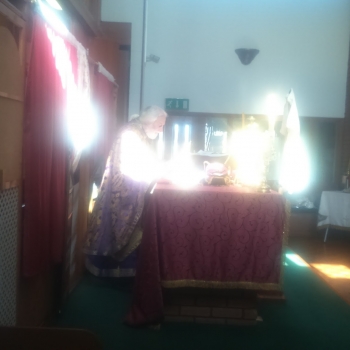
Every liturgy Fr. Symeon served was a real and literal initiation into the sacrament. It was solemn, neither drawn out nor hurried, without highlights, but not monotonous. At first, he didn’t have chanters. Anybody who could would do their bit. Even I chanted on occasion. These first impromptu chanters usually sang poorly and this created the impression that Fr. Symeon actually wanted this: low profile, no special effects. This would encourage contrition. A friend of mine told me off once when I departed from this ‘rule’.  But soon proper chanters began to appear and the cultivation of music became part of the whole training the people acquired by being close to the blessed Elder.

*

At church … twice as healed

At church, man is freed from the demonic influence

and the traps the devil sets.

At church, man is healed.

These are not just words. It’s the truth.

The sacrament of the Anointing of the Sick

is for the healing of our illnesses.

If we are not healed,

we don’t need to be healed,

that’s why we aren’t.

If you take it this way, you are already healed.

You know very well that an illness which lingers

and doesn’t go is precious.

Whatever needs to go, God will take away.

Whatever doesn’t need to stay, God will take away

be it an illness or demonic influence.

And for whatever stays on and hurts us

we pray to God.

We should pray many a time,

time and again should we beg,

not only for deliverance from soul illnesses

and the demonic influence

but also for deliverance from body illnesses, as well.

Let us pray to God for everything time and again.

Not because God needs us to pray to him again and again.

We need to do this again and again,

because, precisely, God wants to see our faith.

Man, especially today,

gets used to something by repeating it,

learns something by reapeating it.

If you pray time and again

–you need to do this–

and God doesn’t relieve you of your illness, know that:

either you have not shown

as much faith as He wants and expects from you,

or that the illness should not go

because it is necessary.

If you take your illness issue according to God,

then, by it remaining,

you feel twice healed.

If He heals you, you are healed once.

If the illness lingers,

you feel healed twice.

Because both when time comes

 will you be healed from your illness

and until the right time comes to be healed

will your soul be healed, too.

Your inner person will be healed,

this person who suffers from illness,

from the leprosis of sin.

The same goes for all mental illness

and whatever else hurts us.

If man sees all his issues

within the providence of God,

he will feel such a relief,

as if all his problems are solved.

Because in God

all is resolved!

Holy Hesychasterion “The Nativity of Theotokos” Publications.

Archimandrite Symeon Kragiopoulos


 (*) This tribute was written by Professor Georgios Ant. Galitis and offered to the faithful in the Holy Trinity Monastery, Panorama, at the end of the 6 months Memorial Service for Fr. Symeon. The poetry/homilies excerpts are from orthodox path.org

(To be continued)


Christians of Comfort


fr-symeon1

Annual Memorial Service of Father Symeon Kragiopoulos

Last month in Greece, I had the blessing to attend Church services at both the women’s Monastery of the Nativity of the Theotokos  and at its twin ‘brother’, the men’s Monastery of the Holy Trinity, at Panorama, the suburbs of my hometown, Thessaloniki.  Elder Symeon Kragiopoulos was their spiritual father and abbot. He  passed away last year, at 6:00 a.m. on September 30, 2015, but even after a year, his presence is still felt everywhere in both monasteries.

He was known throughout as a true elder and teacher. I would like to acknowledge here his zeal, patience, kindness and loving example. He has been in so many ways a spiritual signpost of the faith for my own journey through the desert. What an authentic, uncompromising, and yet gentle, loving, kind, compassionate contemporary Elder, what a  heaven-endowed, grace-filled rock of Faith and consolation, a true voice in the wilderness in our times of apostasy! Oh I have been so blessed to hear him preach in my youth, probe into the Niptic Fathers and the Bible, and have attended for years his church services, especially ‘his’ vigils, and his famous silent assemblies, dedicated to the Jesus Prayer, when I was not studying or working abroad.  I even had the blessing to spend invaluable, private time with him as a spiritual father, helping me prepare for my postgraduate studies, work and life at the U.S.A.

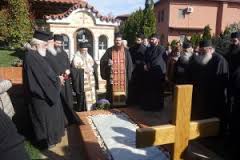
In recent years he largely kept silence due to his failing health but he was known throughout as a God-bearing elder and teacher of the true faith. Throughout his life-long ministry, culminating in the prayerful silence of his final, ‘hermit’ years, Elder Symeon has been a rare gift of God, especially for us Thessalonians. In so many respects, Thessaloniki will never be the same after his humble, God-fearing ministry, and we can never thank enough God for the blessing of walking along the Way with such a venerable Elder by our side. His tomb is already a pilgrimage site, and his spiritual children kneel and pray there for hours for his guidance, fully aware that now he is closer to us in the Holy Spirit. Whenever I read his books, or listen to his recorded homilies, the joy and jubilation of Resurrection warms my heart and tears are streaming from my eyes, for the Venerable Elder who was our staff, for the Man of God whom we knew and loved and in whom we placed, after God, so many of  our hopes. We felt so loved and so safe in his presence!

The elder leaves behind many soul-profiting words, and the faithful invariably testify to a presence in Holy Spirit of the Elder, even while ‘simply’ reading or listening to his homilies:

Like the deep sea…

Spiritual work happens secretly in the heart. Externally, let everything else threaten us, like the sea: the wind blows, waves rise. But deep down it’s all quiet, peaceful, serene.

This is how a man who trusts in God lives. There might be a wild rage out there, but deep down nothing hinders the soul from having mystical communion with God, mystical love for God. Quietly and mystically, in a special way that the heart perceives, the Lord is whispering: “Don’t be afraid. I am here. Keep walking this path. Keep loving Me, keep believing in Me, keep following Me.”

It’s not enough to suffer myriad things in life. When, though, you believe in God and accept all these—whatever it is that happens to you—accept all these gladly, for the love of God, God will make a saint out of you.

Man will find all, but after he has lost all, after he has deprived himself of all. It matters greatly for a man to deprive himself of the most beautiful, the best, the most innocent, the purest things, which the Lord Himself has deprived himself of.

It matters greatly for man to deprive himself of things because he loves God.


We run to the Lord with pain 

However, we know that we have a Saviour, we know that Christ came to earth. Then we start to understand what it means that he came to save us, and we run to the Saviour. We run to the Lord with pain, with prayer, with a cry, with faith, with hope and a firm conviction that the Lord will accept us and will save us. The Lord wants us to approach things exactly like this. This is not our own daring or our own boldness. He wants us to act just like that, to entrust ourselves in this way, and for this reason he gave us promises. So someone does this work, and little by little the decay of his soul, that lies in the subconscious and the unconscious, emerges.

* * *

Self-worship lives and reigns …

For us to have right communion with Christ, it is necessary that our entire soul becomes conscious, that it comes into the light, into the grace of God, and that nothing remains in darkness. However, no matter how much someone believes, no matter how much he, every day, makes a new start in the true life and struggles to give himself and devote himself to God, he must realize this vital point: that within him, the ego, pride, and selfishness, live and rule. This self-love, this self-worship, lives and reigns. Therefore, man must become humble: every day, he must increase in humility. We have many things, many realities from our everyday life that help us with this work.

He who truly loves humility, and desires to become humble, begs God for this. In this way, in the beginning, and imperceptibly –later perhaps more truly—he starts, little by little, to feel this, the emptying of the soul from the ego, from selfishness, from the idol which we have installed within us. And so if one is completely humbled, he surrenders himself to God and is devoted to him—meaning that every day he makes a new beginning, from which the whole object of his soul will finally come into the light of God—in truth, man will arrive at this state which the Lord promises to us.

           But what is this state?

The Lord didn’t come simply to die Himself. Rather, He said that we will also die with Him. And in the same way that He Himself resurrected, we will also be resurrected. Whatever Christ is after the resurrection, this man also becomes when he is united to Christ. He is not simply a good man who thought up some good things. Christian means little Christ. In the end, Christ will make each one of us whatever He is himself. He does not simply advise us from the outside, but enters into us and takes us into Himself. We are united and become like unto Him. Even from this life we become like unto Christ, but this will become complete in the next life.

I pray this for all of us.


Christians of comfort

We are Christians of comfort. That’s why the Lord will let us struggle a lot.

Don’t expect salvation with certainty, unless all comforts are abolished in you.

Our whole Christian mentality functions wrongly.  On the one hand, we want to avoid suffering. On the other, we take great care not to lose or deprive ourselves of anything. And we “walk” in the wrong manner.

In the long run, whether we like it or not, we will have suffering. And indeed, when we have a fake impression that we are enjoying the goods of this world, our life is often like hell.

***

These words, and many more can be found here.


Memory Eternal, dearest pappouli! May we meet you in Heaven!

*  *  *

In the following days, I am going to present a tribute to Father Symeon, together with excerpts from his homilies and a few recordings, for those of you who are hearing about this venerable elder here for the first time. Even if the recordings are in Greek, I trust the spirit of this man of God can be felt through and richly bless us all.


Fountains in the Desert

Book launch by En Plo Publications in Athens

   fathers.jpg

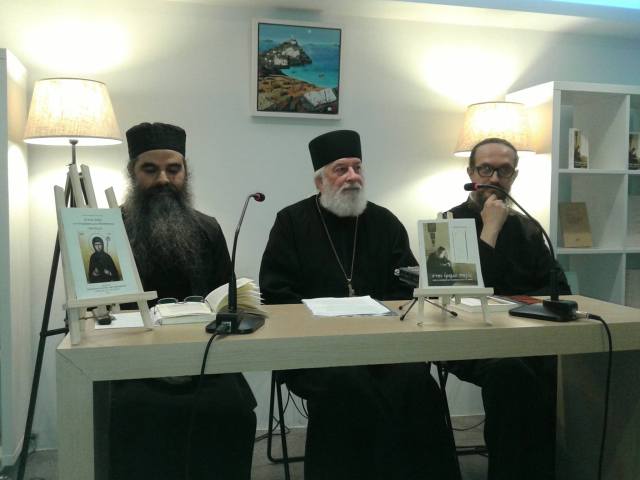
This event has been a most humbling experience! The ethos of the two panel speakers, Hieromonk Chrysostomos of Koutloumousiou Monastery, Mount Athos, and Fr. Bogdan-Konstantin Georgeskou, and that of the author himself, Fr. Jonathan Hemmings, permeated all the events. Such love and humility, especially in the face of various trials and tribulations, the least being an airline strike (!) impacting with its last-minute flight cancellations our speakers’ trips, felt like a rare blessing in “the apostasy of our times”. Fr. Seraphim’s Rose warning “Do not be deceived !” “It is later that you think, hasten therefore to do the work of God” is a favourite motto of  Father Jonathan, his spiritual grandchild.

The book presentation proved to be a Panorthodox Synaxis, truly ecumenical! So many Greek, Romanian and English Orthodox friends turned up. En Plo Bookstore was packed out! The occasion provided everybody with the grace of fellowship.

icon7

Hieromonk Chrysostomos, the first panelistsummed it all aptly in the opening sentence of his presentation: “I have not come here to introduce or recommend the book, which needs no such thing, as this is evident to anyone who begins to read it, but I have come here, all the way from Mount Athos, to meet its author!” 

Because “cradle Orthodox” have so much to learn from “Orthodox converts“! (One of the ‘ironies’ of this event was that in the many conversations which followed with priests, academic theologians and lay people, Father Jonathan, himself a ‘convert‘, had to repeatedly ‘defend’ Orthodoxy from ‘cradle Orthodox‘ faithful, from their disillusionment, doubts, and confusion about ‘their’ faith).

For Hieromonk Chrysostomos presentation, “Monasticism as Unity and Overcoming Divisions” go to http://www.pemptousia.gr/video/ierom-chrisostomos-koutloumousianos-monachismos-ine-i-enotita-ke-i-ipervasi-ton-diereseon/

A vignette of the occasion which was indelibly marked in my heart was the author himself, in front of the audience in the packed room, all quiet during Hieromonk Chrysostomos’ presentation, deeply immersed in prayer, bending in humility his head, radiant, otherworldly, silent, and yet so eloquent, so full of the Holy Spirit amidst all this noise and praise in the crowded building. And I write ‘building’, because both floors were packed, and people were also waiting outside the book store too!

The long queue of the author’s spiritual children at the end of the book launch, their love and gratitude was such a heartwarming experience on its own! “And they shall come from the east, and from the west, and from the north, and from the south, and shall sit down in the kingdom of God.” (Luke 13:29) So many memories, of his life and ministry, of his works and his deeds, of love, which will continue in them and in their families. Father Jonathan was himself visibly moved to be with his spiritual children and dearest supporters of the ‘crucified’ Community of the Holy and Life Giving Cross in Lancaster, England and meet new friends in Christ and make further ‘connections’ in the Holy Spirit with those who are part of Christ’s extended family.


book launch.jpg


The two panel speakers’ presentations were outstanding, and the author impressed the audience with his profound humility, his love for everybody, his wise words, the purity of ‘his’ Orthodoxy, his poetry and his knowledge of the Greek language:

“It is with a profound sense of thanksgiving that in humility I thank you for publishing “Fountains in the Desert.” It is the product of a long lived admiration for those who found the desert to be a treasury of blessings. I have simply woven my own experiences into this mystical landscape. Any worth in it springs from the overflowing love of God for me, a prodigal, and to those whose zeal, patience, kindness and loving example have been spiritual signposts of the faith for my own journey through the desert.

Such salvation is experienced when one is thirsty for the Truth and the saints who Christ sends, provide the living water from which one drinks deeply of the sparkling fresh fountains of our Orthodox Christian faith. I wish to recognise in particular the heaven endowed, grace-filled influences of His Eminence Metropolitan Antony of Sourozh, Archimandrite Barnabas of New Mills, Archimandrite David of Walsingham, Archpriest Michael Harper and Hieroschemamonk Ambrose ( formerly Fr.Alexey Young) the spiritual son of Blessed Seraphim Rose, who chrismated me .

The Apostle Paul writes to the Christians at Ephesus:

Ephesians 5:2

“Walk in the way of love just as Christ loved us and gave Himself up for us as a fragrant offering and sacrifice to God.”

When we drink deeply from these sparkling springs and living waters of Orthodoxy, there is an inevitable outpouring of love to sustain us in our journey and an inexpressible joy to share this life giving water with others who thirst after truth. This is the life of the Church, to share the Gospel.

Luke 13:29


29 And they shall come from the east, and from the west, and from the north, and from the south, and shall sit down in the kingdom of God.

So we have much to do- because for to those who have been given much, much is expected. We rejoice with those returning to the Orthodox Church. We weep with those who find themselves exiled from their lands. We are warmed by the fact that so many of our parishes are microcosms of Pentecost with faithful being welcomed from all over the world regardless of nationality. We thank God that we witness strength of faith and growth in His Church and we ask empowerment for the apostolic mission set before us to bring God’s love to a hungry and thirsty world.

The glory of God is revealed in joy. The mercy of God is experienced in suffering. The grace of God is discovered in fellowship. The power of God is realised in miracles. The love of God is manifested in mission. Our dialogue is with heaven, even in the deserts of our cities where we encounter ourselves, the evil one and God. Christ only speaks one language and that is the language of love for His creation. May His love give voice to our faith.” (excerpts from the author’s presentation)

*

Fr. Jonathan‘s interview following the booklaunch has been videotaped by pemptousia.com and will appear shortly.

*

The Orthodox Christian Parish of the Holy and Life ­Giving Cross at Lancaster (United Kingdom) belongs to the Antiochian Orthodox Christian Archdiocese of the British Isles and Ireland, is a relatively small parish led by Fr. Jonathan, but with faithful from more than half a dozen nationalities, a ‘crucified’ parish, literally ‘on the move’ for over 20 years. After 20 years of using borrowed premises (a quite typical situation for ‘convert’ Orthodox parishes at the UK), they are renting a former Anglican church St Martin’s of Tours Church from Friday to Sunday evening, in order to serve the needs of the Orthodox Christians in the Lancaster area.  To this end, they are making an appeal to raise funds to cover the rent and other needs of the Church on a permanent basis. Apart from your much needed prayers, you can find information on how to contribute to their fund raiser here. The proceedings from this Greek translation of the book or the English original will be likewise used to cover basic needs of the Church. The Holy and Life ­Giving Cross at Lancaster is a lively parish which enjoys Christian fellowship, having meals together and taking part in pilgrimages to Orthodox monasteries, churches, ancient Christian sites and other worship places (photos), produce a newsletter each month with their news and spiritual food for thought, and is engaged in a number of holy tasks.

When Demons Speak

 At St. Gerasimos’ Feast

St. Gerasimos of Cephalonia Feast Litany Miracles 


St. Gerasimos the New Ascetic of Kefallonia (+1579) is known as a renowned healer of the mentally ill and a grace-filled exorcist of the demon possessed. They flock to his holy shrine which contains his incorrupt relics to receive healing. His nickname is “Kapsalis” (“the burning one”), after the desolate place of Kapsala on Mount Athos, where the Saint lived as an ascetic.The demons cry out: “Kapsalis, you have burned us.”


An eye-witness: “When the priest was performing the Holy Unction, a demon-possessed woman was screaming in convulsions: ‘Is it not enough that the old priest that stays here doesn’t leave me in peace day or night, and today you with the oil, the two of you will burn me?’ As soon as she was anointed, the demon was so shaken that the woman fell down unconscious but she was freed by the grace of the Saint.”


Another: I happened to be traveling in Kefallonia during the feast of St. Gerasimos. When I arrived at the monastery, loud screams were coming from the demon possessed in the church, saying: “You are burning me, Gerasimos. You are burning me Kapsali.” Everyone understood in the church that there was a spiritual battle going on around them at that moment that they could hear but not see.


The Saint ‘Gets Up’!


A most solemn moment, as the Saint is ‘allowed’ in the vertical position

only during his Feast and Litany.

And His Litany

“As the sun you emerge from Your church Gerasimos, and with heaven’s angels you ascend the heights”.


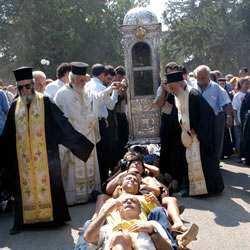
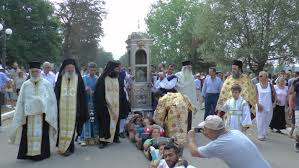
On Aug 16 the Saint’s relics are carried in an upright position in a procession for 500 metres. The procession starts at the church and proceeds down a wide road lined with poplars as far as a spreading plane tree where there is a well which is said to have been dug by the Saint himself.


Tradition has it that Omala valley exclusively receives His Blessing. Many times it was attempted to remove Him from here, without success. A little further down on the road to Troianata, the location is called “podoria” and it is the place from where He could be moved no further. He would become heavy.


Among the procession, the Saint is in the middle, raised high, untouched by time, in His clerical robes which like His body did not perish in the grave.


“A five-branch plane tree and a deep well you left for us Gerasimos as an eternal sign”


He will rest at the Well that He dug, under the shade of the plane tree – The water in the Well will overflow and the leaves of the plane tree will thrush to greet The Master.


Hours before the litany begins, people struggle to secure a position to lay down anywhere along the procession’s way so that the Saint may pass over them. The Litany  is the peak of hope for miraculous healings.


St. Gerasimos of Cephalonia Feast Litany Miracles


The older church containing the relics of St. Gerasimos is built directly over his cave and pilgrims are welcome to descend the ladder and squeeze through the tiny floor-level entrance that leads into the cave.

St. Gerasimos of Cephalonia Feast Litany Miracles


This August the Lord granted me the special blessing to take part in all this. An indelible pilgrimage for both the profound mourning that was searing my heart and the healing ointment of forgiveness that is still working wonders in my life.


Living Waters


desert3


Isaiah 43:19

19 Behold, I will do a new thing,

Now it shall spring forth;

Shall you not know it?

I will even make a road in the wilderness

And rivers in the desert.


John 4:10

10 Jesus answered and said to her, “If you knew the gift of God, and who it is who says to you, ‘Give Me a drink,’ you would have asked Him, and He would have given you living water.”


John 7:38

38 He who believes in Me, as the Scripture has said, out of his heart will flow rivers of living water.”


John 19:34

34 But one of the soldiers with a spear pierced his side, and forthwith came there out blood and water.

*

Listen!


A person’s response to God’s offer of salvation is a matter of engaging the will, faith and action.

Without the will there is no movement,

Without faith there is no direction,

Without action there is no reward.


To discover Living Water requires us knowing:

Whose open Hand provides this blessing and treasure

What is it’s measure

and

Where to find it flowing?


We must start by digging for water in the caverns of the heart.

If the ground is rocky, we must dig in silence with the sharp adze of patience.


Listen carefully!

Do your hear something?


If our ground is hard, we must soften it with mercy and repentance:

For the soil of pride can only be removed through meek dependence

On God.


Listen!

Do you hear the drip of water on stone?


We must not simply remove the weeds which are the fruits of the passions,

we must excavate each day with persistence

since familiar habits possess a stubborn resistance;

whereas the humus of humility is the place to locate compassion.


In this way, we may even lead in order to serve.

Leading the way to build a viaduct for the King of Glory

Order our service to others by constructing a conduit for Christ.


Dig therefore with wisdom,

Dig with discernment,

Dig with love,

Whilst guarding the heart at all times with diligence.


Listen!

Do you hear water flowing?


Because at the time appointed,

At the opportune moment,

We who are disjointed

are healed and

Sealed with the Holy Spirit.


God opens the flood gates of our hearts

With His own master key of humility,

To become a channel of His grace.


Just listen to that sound!


The sound of Living waters;

an ocean wave, a mighty river in flood, a cascading waterfall

a fountain of benediction;

heard by earth’s sons and daughters

To become for all a Life- Giving spring, welling up to Eternity.


Work hard then each day and dig!

Listen, work, dig deep

head bowed with sweat and tears,

extinguishing fears of death, awakening life from sleep,

exchanging salt waters for sweet

to greet Living waters.


Many rich and powerful men would pay dearly to see the Lord or His Most Pure Mother, but God does not appear in riches, but in the humble heart… Every one of the poorest men can be humbled and come to know God. It needs neither money nor reputation to come to know God, but only humility.

(St. Silouan the Athonite, Writings, I.11,21)


By Fr. Jonathan Hemmings


desert9