Every Wednesday morning, I drive to the Galini Nursing Home. I don’t have any people there; in fact, I didn’t know a soul when all this started. I just go there, sit in the common area, and knit.
I’ve been doing this for four years. I’m 71 years old, a retired teacher, and time is the only thing I have in abundance.
At first, the nurses were concerned. “Ma’am, are you looking for someone in particular? A room?”
“No,” I would say. “I’m just here to sit for a while.”
Eventually they stopped asking. They assumed, I guess, that I was a lonely soul with nowhere else to go.
But I had a plan. I watched the residents pass by, some in walkers, some in wheelchairs, almost all with their eyes fixed on the floor. When they saw me knitting, they would stop short. Their eyes followed the rhythm of the needles.
At one point, a woman named Eleni, 84, decided to talk to me. “What’s this going to be?”
“A blanket,” I replied. “For no one in particular.”
“It seems like a lot of work for nothing,” she said with a slight complaint.
“I guess you’re right,” I said with a smile. “Would you like to help me “waste” some time together?”
She looked at me as if I had offered her a miracle. “My hands haven’t touched a thread in thirty years.”
“Great. Then you won’t notice if I slip a stitch.”
She sat down next to me. I gave her the needles, and it was beautiful to watch, her fingers remembering the movements long before her memory recalled them.
By the next month, Mrs. Eleni had brought three friends. Then there were six.
The centre moved us into the sunny, glass-fronted room and officially christened us “The Needle Company.” We didn’t do anything special; we just sat together, our hands busy, chatting about the weather, our grandchildren, and how pain can be eased. The real change was invisible.
These women began to dress in their good blouses again. They stopped skipping breakfast. A resident, Mrs. Maria, 89, who had not spoken a word since her husband left, began to tell vivid stories of how they sewed uniforms during the war.
The blankets and scarves began to pile up. Colorful, slightly crooked, and completely incomplete. “Where are all these supposed to go?” Mrs. Eleni asked one day.
“To the ‘Homeless Hostels’ and the ‘Youth Shelters,’” I said.
So every month, we sent a box full of warmth, made by women the world had largely forgotten.
Last winter, a young man appeared at the reception desk of the Unit. He asked to see the women who made the blankets. The staff hesitated, but eventually led him to the sunny room. He was holding a blue-and-yellow scarf, filled with uneven rows of knitting.
“They gave it to me at the shelter facility in December,” he told us, his voice trembling. “I slept with it every night on the bench. There was a tag hidden in the edges: ‘Hand-knitted by Eleni, 84 years old. You are not alone.’”
Mrs. Eleni shivered, putting her hand to her heart.
“Now I’m back on my feet,” he said. “I found a room and a job that starts on Monday. I just had to come here and tell you… no one had ever made anything just for me. This scarf made me feel like I deserved to be saved.”
We were all in tears.
My husband still shakes his head every time I leave on Wednesdays. She thinks I just drive across town to gossip and knit with strangers.
But Mrs. Helen passed away last Tuesday. Quietly, in her sleep. At the funeral, her son sought me out. “My mother lived for Wednesdays,” she said. “She told me you gave her purpose again. You gave her spark back.”
Our circle still meets every week. Seven women, ranging in age from 78 to 95, create “awful” scarves for people who desperately need to know that someone, somewhere, is thinking of them.
I don’t solve the world’s biggest problems. I just sit in a sunny room and knit with some incredible women. But I’ve learned that sometimes, that’s exactly the way to save a life.
Dear brothers and sisters, I wish you all a blessed Great Lent! This 40-Day Fast is considered in Orthodox tradition, “the tithe of the year”, a spiritual offering of roughly 10% of our time (40 days plus Holy Week) to God, intended for intense spiritual renewal, prayer and fasting. It acts as a reminder that all time, all possessions and all gifts belong to God, encouraging us to reorient our lives away from passions and toward Him.
Especially for this time, I find +Rev. Thomas Hopko’s 55 Maxims are most relevant, those “55 things that a believer, very simply, would do if they were really a believer and were really obedient to God and wanted to live the way God would have us live”. These 55 Maxims may appear too practical and down-to-earth, but are in truth profound and deep. May we put these 55 Maxims into practice for the following 40 Days and ever, Amen!
1 Be always with Christ and trust God in everything.Never forget God.
2 Pray as you can, not as you think you must.Pray as God inspires you to pray, not as you want to, but as God gives. And for a Christian, that would mean in one’s heart, in one’s room, and in one’s Church.
3 Have a keepable rule of prayer done by discipline. You can’t just pray when you feel like it. You have to pray by discipline, the times of day where you would remember God and say your prayers.
4 Say the Lord’s Prayer several times each day.Just as one is getting into one’s car or walking into one’s office or into one’s classroom or before eating a meal, when waking in the morning, when going to sleep at night. Just say the Lord’s Prayer. It’s the prayer that the Lord gave, a short prayer, but it contains everything that a human being needs to pray if Christ is crucified, raised, and glorified.
5 Repeat a short prayer when your mind is not occupied.This short prayer could simply be “Lord have mercy” or “Lord Jesus Christ have mercy.” The person just might say “Jesus.” A person might say “God,” but just some short prayer that fills the mind when the mind is not working in order to have the remembrance of God in one’s life, in one’s heart.
6 Make some prostrations when you pray.Kneel down. Bend over. Bow down. Use your body. As St. Ephraim said, “If your body is not praying when you’re praying, you’re not really praying.” Prayer is not just an activity of the mind and heart. It’s an activity of the whole person.
7 Eat good foods in moderation and fast on fasting days.
8 Practice silence, inner and outer.Just sit for a few minutes every day in total silence. Turn off all the appliances. Open oneself to God. Don’t think about anything. Watch the thoughts that come, and turn them over to God.
9 Sit in silence 20 to 30 minutes each day.
10 Do acts of mercy in secret.
11 Go to liturgical services regularly.
12 Go to Confession and Holy Communion regularly.
13 Do not engage intrusive thoughts and feelings.
14 Reveal all your thoughts and feelings to a trusted person regularly.
15 Read the scriptures regularly.
16 Read good books, a little at a time.
17 Cultivate communion with the saints.
18 Be an ordinary person, one of the human race.
19 Be polite with everyone, first of all family members.
20 Maintain cleanliness and order in your home.
21 Have a healthy, wholesome hobby.
22 Exercise regularly.
23 Live a day, even a part of a day, at a time.
24 Be totally honest, first of all with yourself.
25 Be faithful in little things.
26 Do your work, then forget it.
27 Do the most difficult and painful things first.
28 Face reality.
29 Be grateful.
30 Be cheerful.
31 Be simple, hidden, quiet and small.
32 Never bring attention to yourself.
33 Listen when people talk to you.
34 Be awake and attentive, fully present where you are.
35 Think and talk about things no more than necessary.
36 Speak simply, clearly, firmly, directly.
37 Flee imagination, fantasy, analysis, figuring things out.
38 Flee carnal, sexual things at their first appearance.
39 Don’t complain, grumble, murmur or whine.
40 Don’t seek or expect pity or praise.
41 Don’t compare yourself with anyone.
42 Don’t judge anyone for anything.
43 Don’t try to convince anyone of anything.
44 Don’t defend or justify yourself.
45 Be defined and bound by God, not people.
46 Accept criticism gracefully and test it carefully.
47 Give advice only when asked or when it is your duty.
48 Do nothing for people that they can and should do for themselves.
49 Have a daily schedule of activities, avoiding whim and caprice.
50 Be merciful with yourself and others.
51 Have no expectations except to be fiercely tempted to your last breath.
52 Focus exclusively on God and light, and never on darkness, temptation and sin.
53 Endure the trial of yourself and your faults serenely, under God’s mercy.
54 When you fall, get up immediately and start over.
55. Get help when you need it, without fear or shame.
About vigils, the Feast of the Theotokos’ Sacred Veil (Skepi) and Her Holy Protection, the power of the Psalter and the monastery’s chicken coop!
“By Fasting, Vigil and Prayer Thou didst Obtain Heavenly Gifts” (Fourth Great Lent Sunday- St. John of the Ladder , Troparion, tone 1)
Not for the faint-hearted! A most ascetic monastery, I must admit. I, for one thing, thought that I had no problem with fasting, and yet here, I realise that I am such a dainty eater! I have had enough of their plain bread, watery, fasting soups and fruit!
As to vigils, rising at ungodly [sic!] hours to chant Psalms, after two consecutive vigils, one at St Demetrios’ Feast in Thessaloniki and the other one here, at the monastery, for the Sunday Holy Liturgy, I believe that I have reached my limit. If I had any doubts (which I did not have) now I feel confident that I am not yet ready for this second step in this ladder, for this “violence” on our flesh. Not to mention the third ring, prayer …
“By Fasting, Vigil and Prayer Thou didst Obtain Heavenly Gifts”
“And from the days of John the Baptist until now the kingdom of heaven suffereth violence, and the violent take it by force.” Matthew 11:12
Oh dear! A most ascetic long weekend. I have been so food deprived, so heat deprived, and so sleep deprived—the worst part— that I cannot put it to words. I certainly need time and rest to recover from all this ascetic labour. I do feel blessed and most grateful, I am floating, but this monastery’s specifications are for angels, fleshless, holy beings. The sisters are of course lenient with us poor guests, yet even the “compromise” they bless for us is so hard for my spiritual level!I cannot even begin to imagine how it is to spend Great Lent here, with only meal a day, and what a meal …
One can”feel” their asceticism even in their etherial chanting. Indeed, an ascetic hue to the spectrum of light explored so far on my way of a pilgrim. And so “hidden”! Adding a wholly empirical dimension to the verse “our lives being hidden in Christ!” So very different to my previous two pilgrimages to Dormition monastery in Panorama and St George Karslides monastery in Sipsa. Such a humbling experience! Probably because of all this most demanding typikon, this monastery has the least pilgrims or faithful attending, even when its gates are open. As to the sisters, they humbly believe that they they are useless, lukewarm, “end of times” monastics, not honouring their calling.
Matushka Constantina is so right when she writes at her blog (Lessons from a Monastery): “Encountering monastics reminds the pilgrim that there are better Christians than himself (not that he cannot also learn this in the parish, he most certainly can, but it is an indisputable fact that one is faced with at a monastery). Hence the famous statement: “Angels are a light for monastics, and monastics are a light for the world.”[9] The monastic is simultaneously humbled and enlightened by reading the lives of the saints, just as the layman is when he compares his life with that of a monastic. … the layman makes pilgrimages to monasteries in order to draw the soul away from the distracting world and into an environment of stillness and prayer, where the atmosphere is conducive to taking stock of one’s life alongside that of a dedicated monastic, and to allow the grace of the monastery to help him see his own sinfulness.”
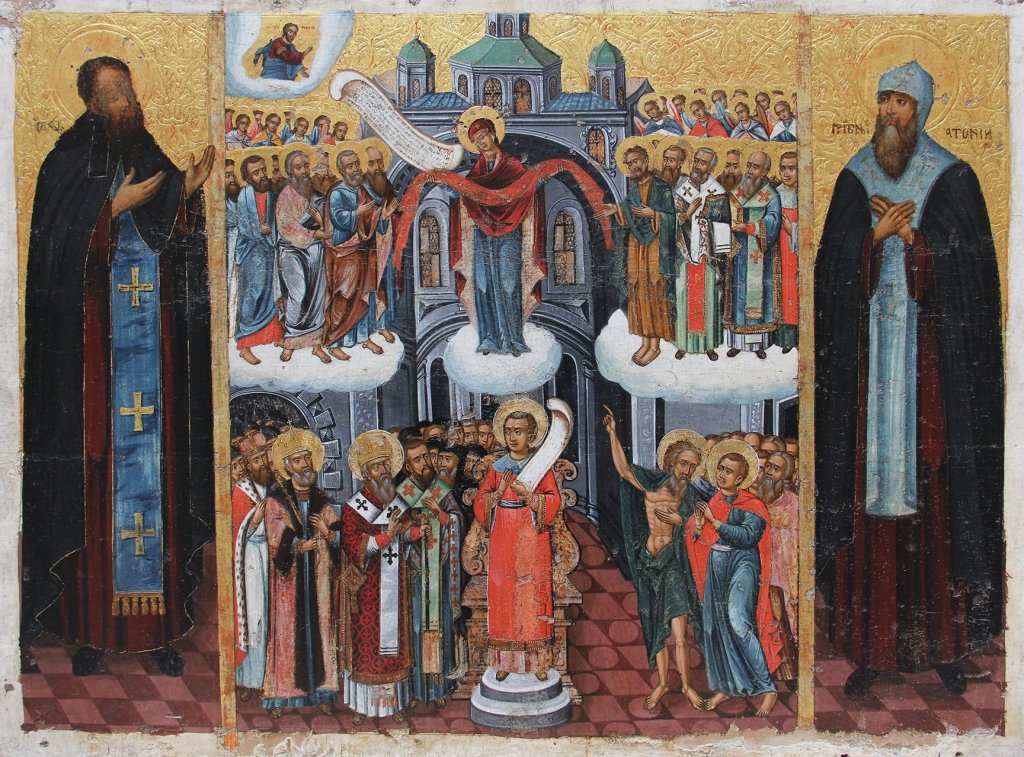
Economia is granted to me and I arrive late at the morning church service. I don’t think I could take one third consecutive vigil in a row. Today, on October 28, the Holy Orthodox Church in Greece commemorates the Holy Protection of our Most Holy Lady, the Theotokos and Ever-virgin Mary, that is, her sacred veil (skepi) kept in the treasury of the sacred temple of Blachernae; and we also remember how the righteous Andrew, the Fool for Christ’s sake, beheld it spread out above and covering all the pious.
The Feast was originally marked on October 1st, yet the Greek Orthodox church, in 1952, transferred its celebration of the Protection to October 28 in conjunction with “Okhi Day” as a testament to the rejection of European aggression and as a day of national remembrance.
Before daybreak on October 28, 1940, the Italian ambassador to Greece, representing Italian dictator Benito Mussolini, went to Greek general Ioannis Metaxas with an ultimatum. Italy wanted full control of Greece to occupy “strategic locations”; otherwise it would brutalise the country.General Metaxas shouted “Okhi!” meaning “No!” Thus, Greece was plunged into the Second World War, as Italy burst through, and then Nazi Germany eventually, wreaking havoc and horrors on the Greek people.
Both dates recognise the Ever-virgin’s constant defence for all the faithful, all over theworld, whenever we prayerfully seek her protection and shelter in distress and strife. It goes without saying that we must ask the Theotokos to extend her protection and intercession every day of our life.
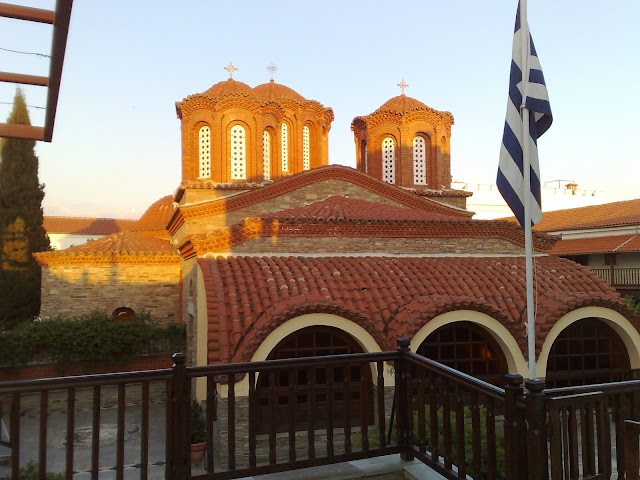
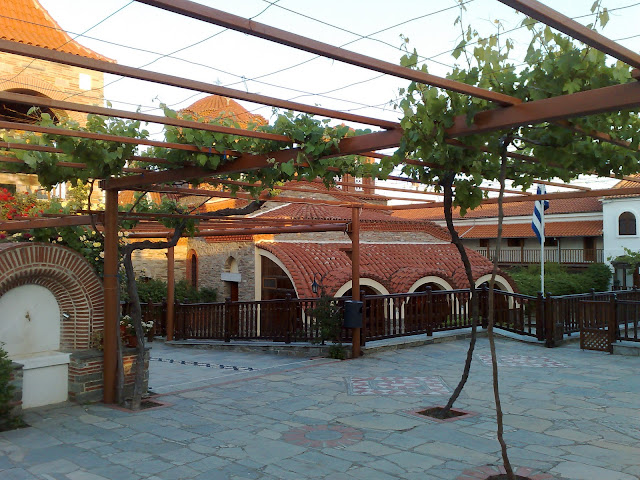
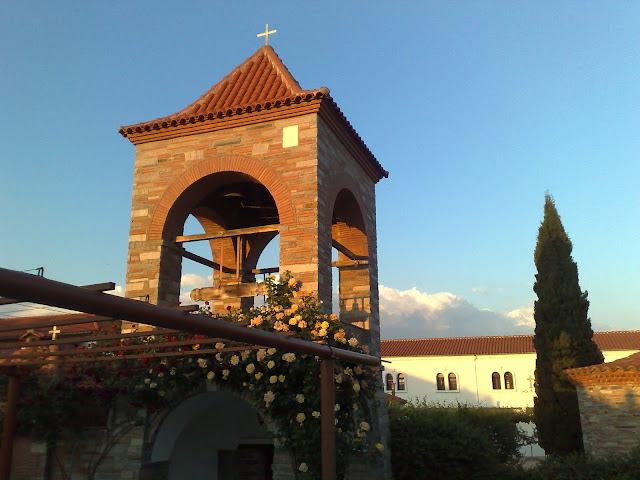
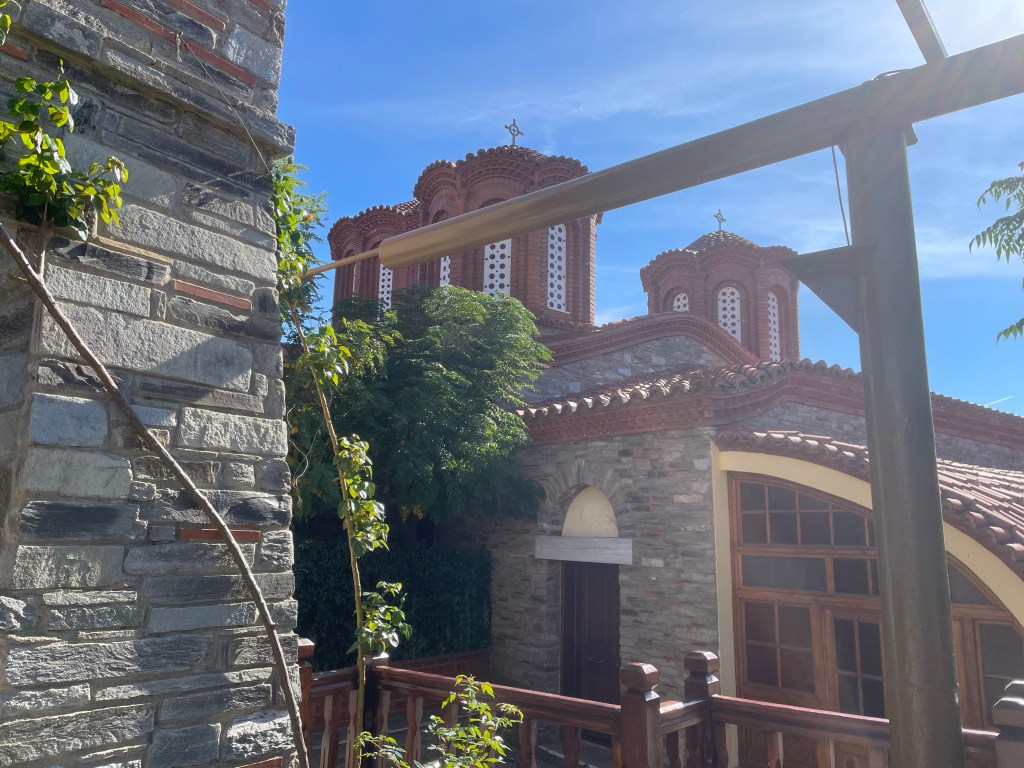
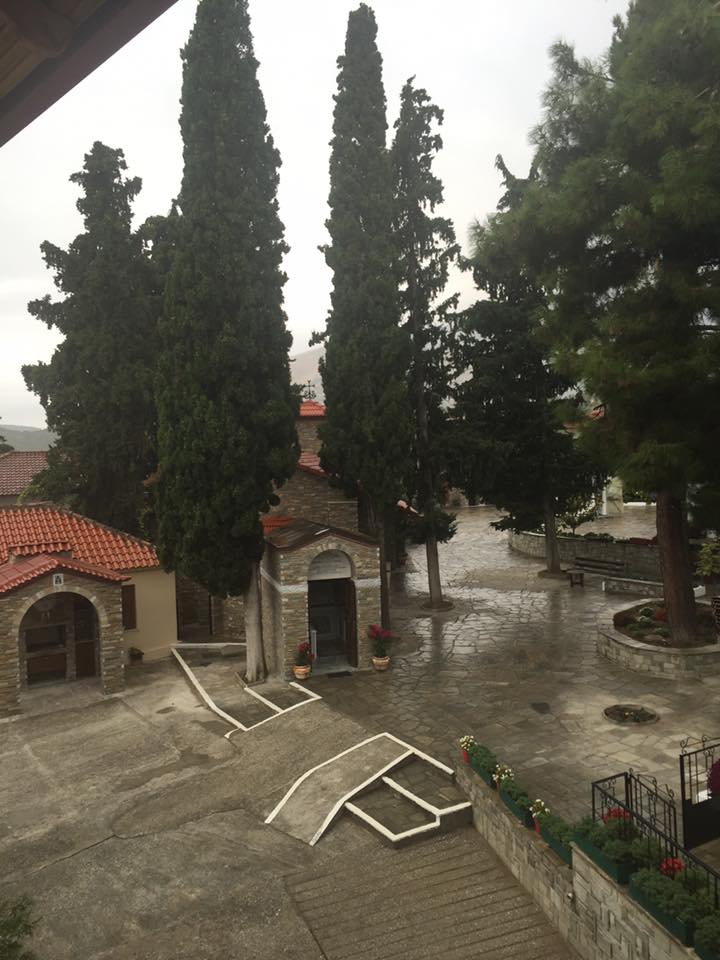
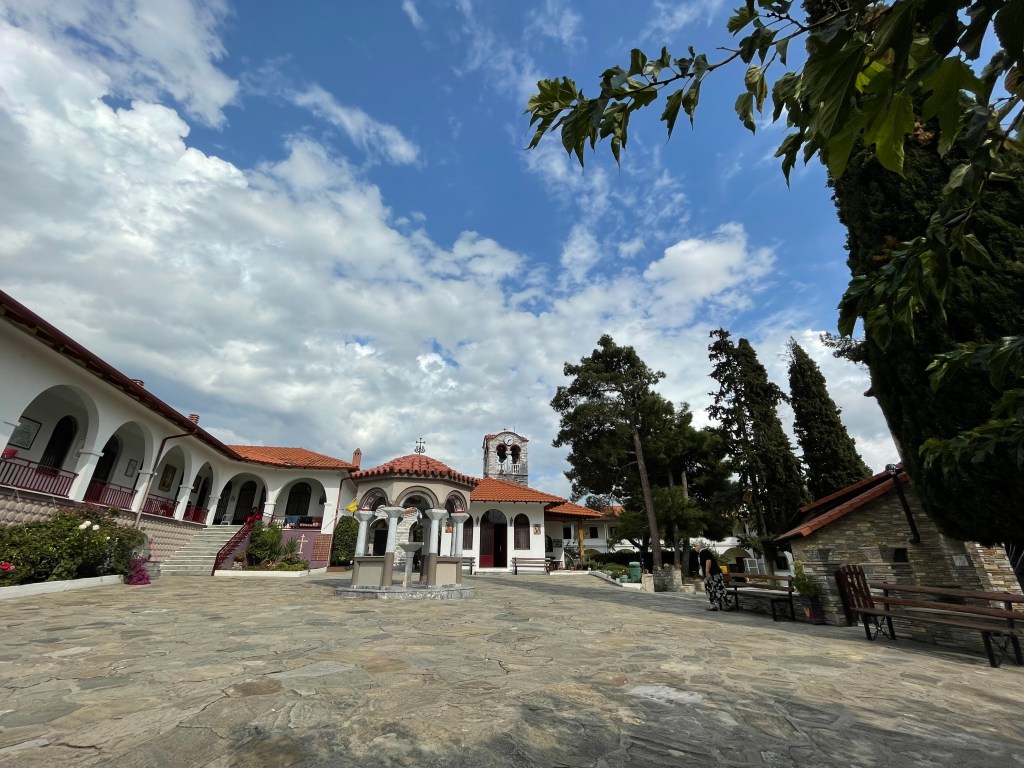
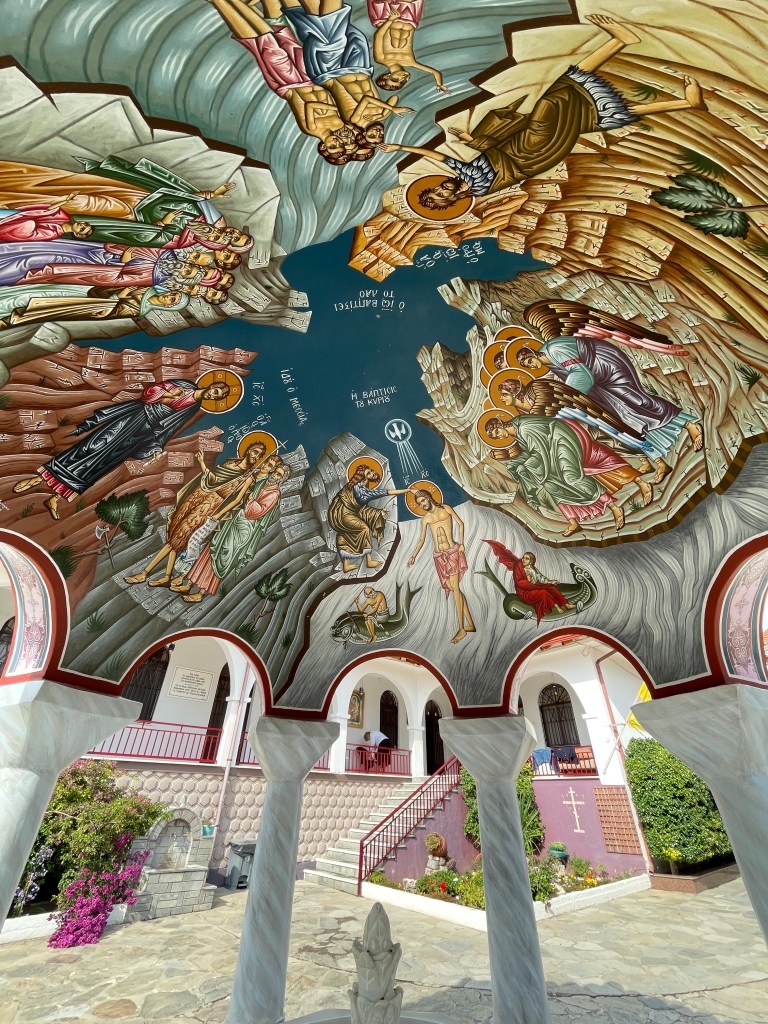
A holy, sacred place, an agios topos
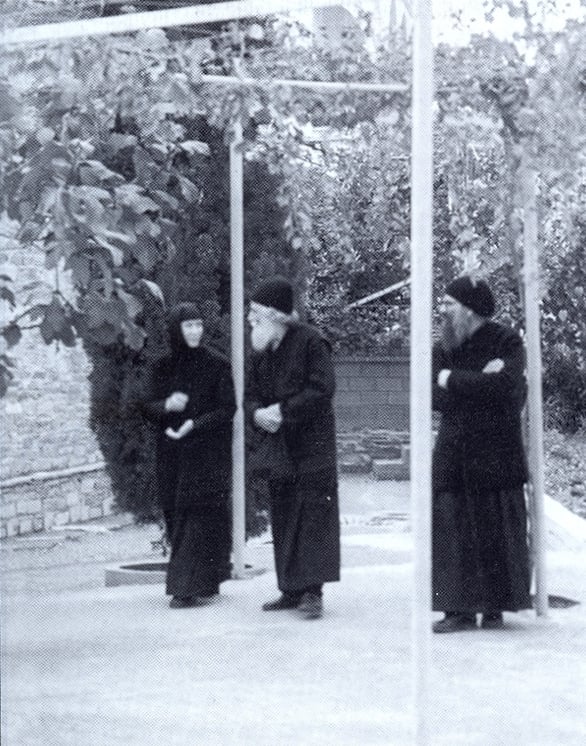
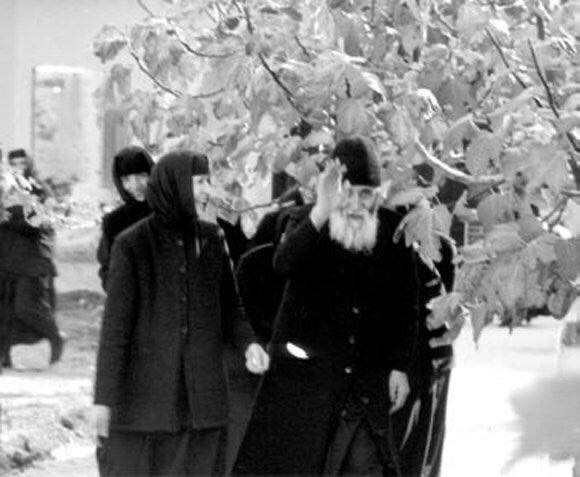
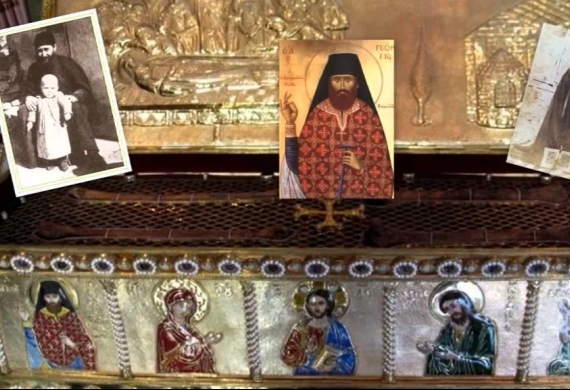
St Paisios, the spiritual founder and father of this monastery, +Gerondas Gregorios, St Paisios spiritual child, founder and spiritual father of the monastery, and +Gerondissa Euphemia
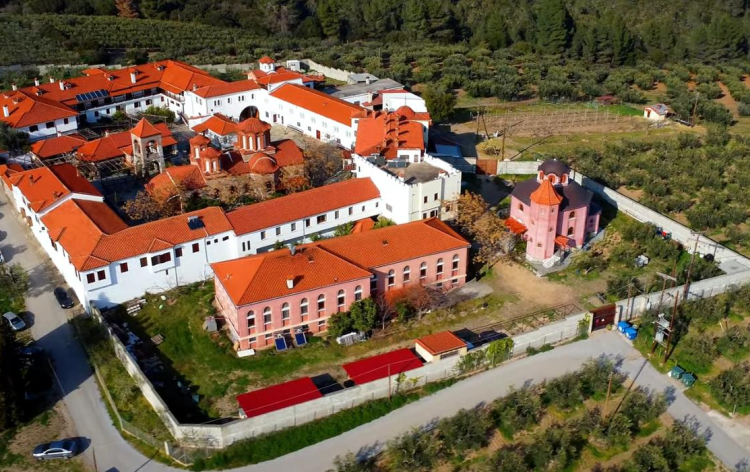
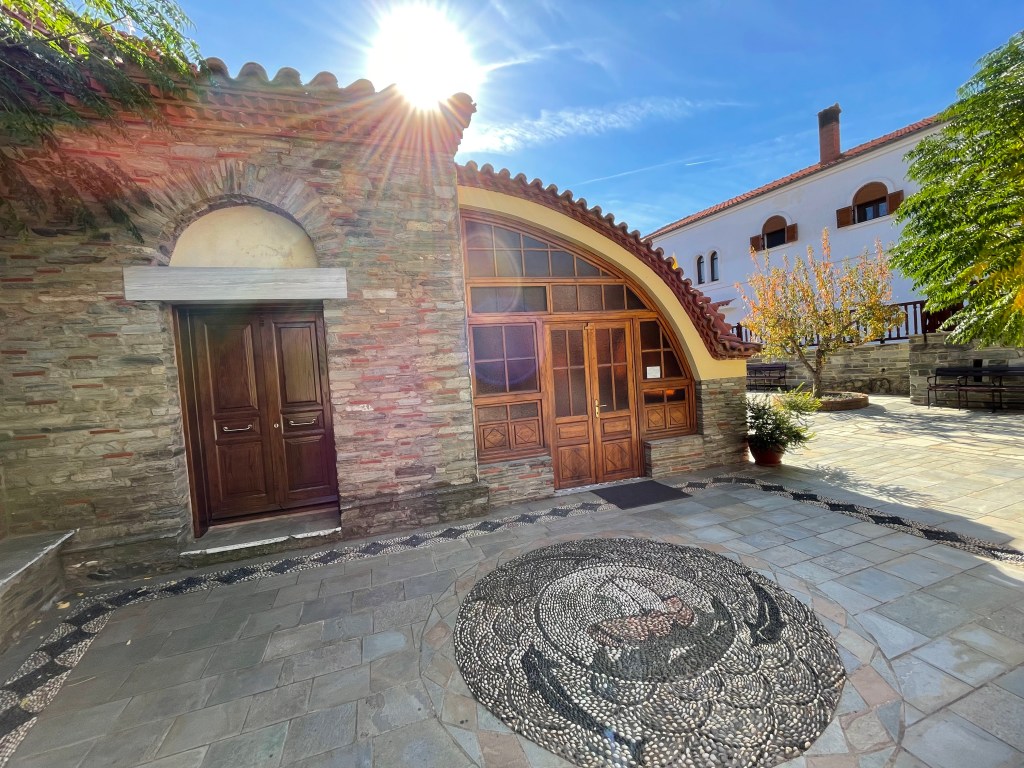
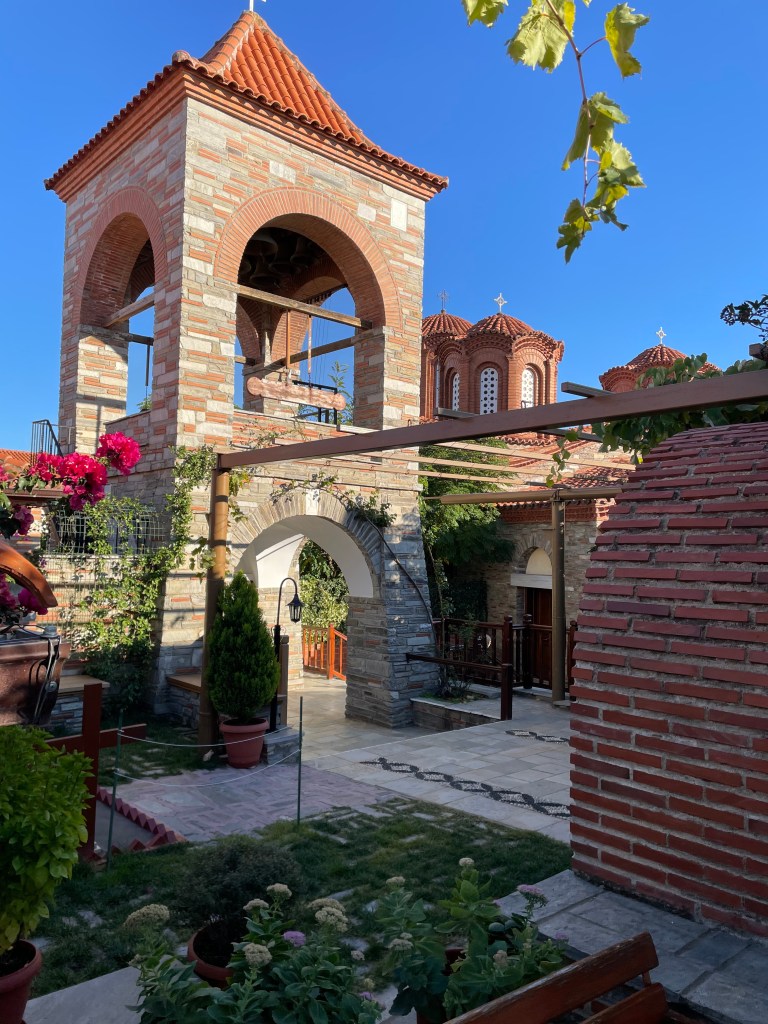
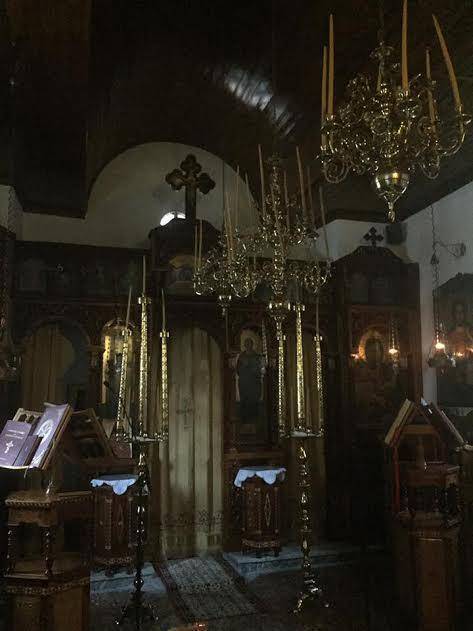
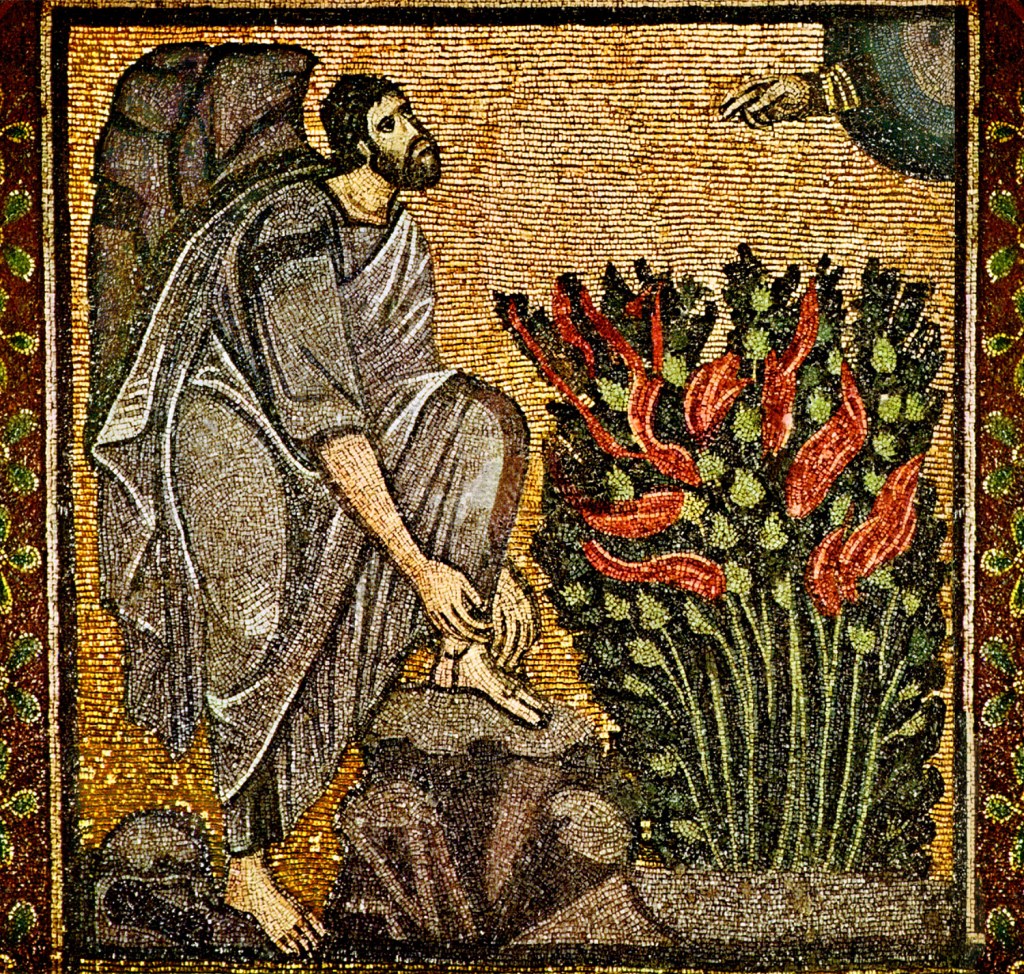
Everything is holy in the grounds of a monastery. It is an agios topos, a holy, sacred place. The prayers of the monastics, the saints that dwell within, the angels that protect it, its chapels and the temple of God in its grounds, all these sanctify the place. “And Moses said, I will go near and see this great sight, why the bush is not consumed. And when the Lord saw that he drew nigh to see, the Lord called him out of the bush, saying, Moses, Moses… loose thy sandals from off thy feet for the place whereon thou standest is holy ground” (Exodus 3: 3-5). All monasteries I have visited so far feel holy, sacred places, yet this monastery seems the most etherial, otherworldly of all.This holiness permeates all its grounds.
St Paisios, + Gerondissa Euphemia and Sister Paisia, looking at the camera behind Gerondissa. I had the privilege to spend quite some time during my stay here with Sister Paisia.
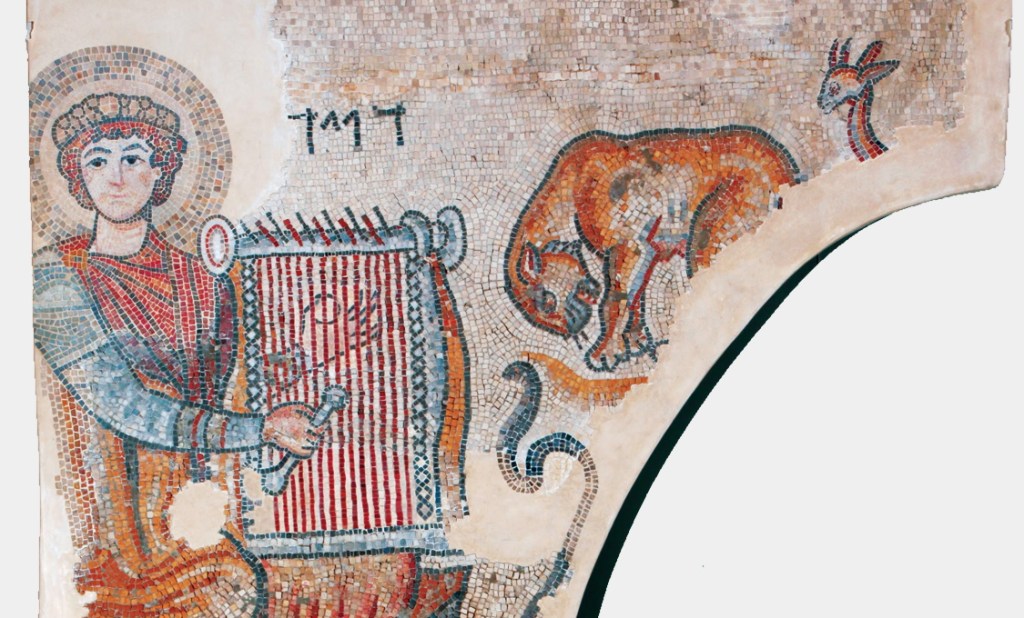
11 For He will give His angels charge over you, to guard you in all your ways. 12 Upon their hands they will lift you up, lest you strike your foot against a stone. 13 You will tread upon the lion and cobra, trample the young lion and serpent. (Psalm 91:11-13)
Let me share with you a story which a sister here told me about the power of the Psalter, transfusing holiness …
… even to their chicken coop!
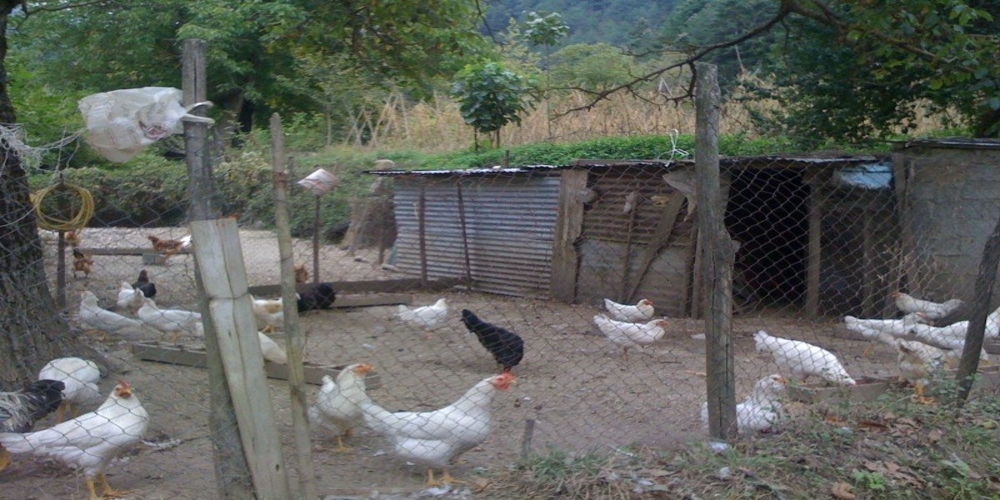
This is what the monastery’s chicken coop looks like. You can tell that it is unprotected from the top and sadly the sisters had many problems with hawks attacking and snatching their chickens. The sisters would take turns, one after another, every hour, to protect their chickens, to no avail really, until Sister T. appeared, a frail, old sister …
This sister hada particular affection for the Psalter. Rather than recite the kathismata in her cell, she got the blessing from Gerondissa to sit on her chair inside the chicken coup grounds and recite the psalter there, together with the chickens. She kept doing this every day, for two years before reposing in the Lord.
These two years, all hawk attacks suddenly ceased! Not only this, but even after her sleep in the Lord, for 16 years counting until now, no hawk has attempted a single attack on the chicken! Amazing! For 16 years going! So, the sisters have stopped guarding the chicken coop and chasing predators away. The sister who told me this story, added that Gerondas Gregorios of blessed memory, after this sister’s sleep in the Lord, wondered how long her psalter protection will last. Well, it lasted 16 years and going! This frail, old sister with the particular affection for the Psalter died a holy death on an Easter night, after receiving Holy Communion at the Pascal holy Liturgy. Glory to God for all things!
Sadly, the time for my departure has arrived, but I am not leaving alone. I have to drive two university students first to the church of St. Demetrios, and then one of them to the airport for Cyprus. Glory to God for all things! What an amazing synodeia! The family of one of these two students I am offering this drive has 10 children (!), her father is a priest and a teacher, and their mother comes from a family of … 13 children! They have all moved from Athens to Metamorfosi and build their house here to live next to the monastery, together with all their nephews, children and grandchildren.
How many stories have I heard on the way!What a joy and a privilege to be together with these young people! How fast time flies! A few decades ago, other pilgrims drove me back to Thessaloniki, to spare me the buses, the walking and the long hours of waiting. Now it is my turn to return the favour. Glory to God for all things!
Somereflections on “hiding” and “hiddeness” in God, on holy obedience, on the force of the preposition ‘in’, and lovely, amplifying words by George Herbert, my favourite metaphysical poet(1593 – 1633), in his poem‘Colossians 3:3’
Eothinon VII
Mode grave
“Ἰδοὺ σκοτία καὶ πρωΐ… Lo, darkness and early dawn. And why, Mary, are you standing by the grave, your mind full of darkness? Why do you seek where Jesus has been laid? But see the disciples running together, see how they have realised the Resurrection from the grave clothes and the napkin, and have remembered the Scripture concerning this. With whom and through whom we too have believed and sing your praise O Christ, the Giver of Life.”
*
“For you have died, and your life has been hidden with Christ in God.” (Col 3:3)
*
It is probably my first ever Sunday Holy Liturgy at about 02:00!! Other than Easter Sunday of course. Only “one worth comes to mind with the chanting,…ethereal! I meant word but indeed it is worth in the true sense of a noun … the level at which someone or something deserves to be valued or rated.”
I feel surrounded by angels, not monastics. These sisters never sleep! They pray all the time and they are hidden from the world.
I kneel to receive the blessing of Gerondissa Mariam before Holy Communion and she tells me that she has read my note and gives me her blessing to come as often as I want, unconditionally… What a gift!Such undeserved mercy and graciousness!
Inside the church, other than the sisters and the priest, it is only the five of us, fellow pilgrims. How strange for a Sunday Holy Liturgy even in a monastery, let alone a parish in the world, to be so “empty” at the Sunday Holy Liturgy!
After the dismissal of the Liturgy, silently we retire to our cells for some rest and hesychia, and then proceed to the morning common meal where we eat while listening to a sister reading Saint Gregorios Palamas’ homily on Nestor. Then Gerondissa Mariam takes the floor and offers a homily on the mystery of holy obedience to our spiritual father: (Just in case, we had missed that key point in all the sisters’ words yesterday: that Holy Obedience is the “one thing needful … that good part which shall not be taken away” ,Luke 10:41–42).
“St Nestor first received the blessing from his spiritual father, St Demetrios in the prison “bath-house” where he was chained, and then contested and defeated Lyaeus. This is so revealing of the power of holy obedience. St Demetrios blessed Nestor and in fact told him that he would be victorious but would then be martyred. Receiving the Saint’s blessing and sealing himself with the sign of the precious Cross, Nestor presented himself in the arena, and prayed, “O God of Demetrios, help me!” –“Ο Θεός του Δημητρίου βοήθει μοι”, uniting his will with that of his spiritual father, and ultimately with God’s Will.
Straightway he engaged Lyaeus in combat, and much to everyone’s surprise, the stripling novice smote Lyaeus with a mortal blow to the heart, leaving the former boaster lifeless upon the earth, and defeating the previously undefeated imperial champion. Nestor thus stroke a blow against idolatry. Many of the spectators believed that “the God of Dimitrios” had, indeed, helped him. This infuriated Galerius, who must have suffered considerable loss of face, and he ordered the decapitation of the young man. See the fruit of holy obedience? This we must all imitate!”
Our morning common meal comes to an end, prayers are said, and all nuns swiftly disappear back to their cells to pray, other than the very few ones whose obedience are the guests. No visitors yet, as the monastery gates are still closed and will open up only much later in the afternoon.
If yesterday it was the silence of the monastery which struck me, that true hesychasm, today it was the mystery of its hiddeness which permeated me.Certain experiences are so difficult to express in words.
The rest of the morning is spent in silent strolls, the Jesus prayerand quiet conversations with a few nuns around us, “pondering the mystery of “hiddeness” in our heart” (Luke 2:19). A different ‘spiritual surgical procedure’ in the “Antechambers of paradise”.
St. Paul says that “our true life is hid with Christ in God” (Col. 3:3). Such a rich verse that apophatically speaks of theosis, true mysticism!The sisters humbly admit that these lines are beyond their understanding.
It is this preposition “in” that makes all the difference. I don’t believe that there is a God, intellectually; I believe in God empirically. I believe you….or should I say …I believe in you. What force this has! “I believe in one God ….”
+ Gerondas Gregorios’ cell outside the monastery
Let us now see how George Herbert, a favourite metaphysical poet of mine, expands these Bible words ‘Our life is hid with Christ in God’, taken from St. Paul’s letter to the Colossians and how these words are themselves hidden within this poem. Pay attention also to how he personalises the words– ‘our’ is changed to ‘my’.
Colossians 3:3′
My words and thoughts do both express this notion, That Life hath with the sun a double motion. The first Is straight, and our diurnal friend, The other Hid, and doth obliquely bend. One life is wrapped In flesh, & and tends to earth: The other winds towards Him, whose happy birth Taught me to live here so, That still one eye Should aim and shoot at that which Is on high: Quitting with daily labour all My pleasure, To gain at harvest an eternal Treasure.
Isn’t this beautiful? As in many of his poems, Herbert uses pattern and shape to explore his theme. The expanded line runs diagonally through the poem, creating a tension which is only resolved in the final line. Double meanings help to create the tension. On the one hand, we live our everyday, earthly lives. On the other hand, we live our eternal, heavenly lives. Our life ‘wrapt in flesh’ pulls us down to earthly things: the upward movement ‘winds towards Him’. Christ himself experienced a double motion. Not only did he come down to earth from heaven in his human birth, but he was raised to heaven in his resurrection.
As in other poems by Herbert, ‘sun’ and ‘Son’ are punned. The movement of the sun is used to shine light on the movement of the Son of God. For the sun has a double motion – we are most familiar with its daily east to west motion, ‘our diurnal friend’. However the sun moves annually from west to east, and this pattern was illustrated by an oblique or diagonal band around the globe. ‘It doth obliquely bend’.
There is a hidden quality to the ways in which people live out their faith in God, for there is a hidden quality in the way God is active in the lives of people. We do not always recognise God’s purposes and ways of working in the world. We do not see the whole until the end, but for Herbert, the treasure to be found during earthly and eternal life is Christ.
The day is coming to a close. At long last, the monastery is full of pilgrims, even if briefly. Vespers follow, coffee, and social time for everybody. Then obediences for us in the kitchen, washing and tidying. The kitchen seems to be always the busiest area in any “home” 🙂
“Be silent, all flesh, before the Lord,” exclaims the prophet Zechariah (Zech 2:13).
Upon entrance, silence envelops me. Abruptly, I am separated from the tumult, noise, busyness and endless distractions of the outside world.
“Peace, be still!” Jesus orders the wind of noise, confusion and tumult to cease in the midst of our own storms and turmoil.
I feel separated from other people, all people, too! Is anybody here?! What a contrast to last night’s feast! There, at the vigil in St. Demetrios church, in Thessaloniki, an amazing Resurrectional experience unfolded in a packed church! So many holy chalices all around the Royal Doors! So many people receiving Holy Communion and then, at the dismissal of the holy liturgy, flooding the streets outside the church. Here, I am all alone — the silence of the heart! And what a deafening, thundering silence that is!
“When the Lamb opened the seventh seal, there was silence in heaven for about half an hour.” (Rev. 8:1)
Yet, how can it be that a monastery of more than 50 sisters plus novices and postulants look and feel so uninhabited, so “desolate”! Am I really all alone here? ...
“Let us love silence till the world is made to die in our hearts.” St. Isaac of Syrian
Sister Elizabeth approaches and welcomes me. She gently inquires about my news. This sister was coordinating my endless faxes to Gerondas when I was at the UK and sending his replies. She knows everything about me! Her question: “Have you got a spiritual father now?”
This question will become a refrain during my brief stay here, asked by all sisters who spend some time with me. In fact, a refrain addressed not only to me, but to all pilgrims and visitors here. It is not that the sisters are not concerned with/about our problems and sorrows, but our obedience to a spiritual father seems of paramount importance and the key to everything. Even if with his guidance and help, our problems are eventually not “solved”.The mystery of holy obedience. “Obedience shows love for Christ. And Christ especially loves the obedient” (St. Porphyrios,Wounded by Love, p. 25).
Saint Simeon the New Theologian wrote the following to one of his spiritual children: “We conceived you through teaching, we underwent labour pains through repentance, we delivered you with much patience and birth pangs and severe pain and daily tears” (Epistle 3, 1-3).
Barsanuph’s soul-stirring prayer makes the immense love of a spiritual father for his spiritual children more palpable: «Behold, here am I and the children that You gave to me; protect them in Your Name, shelter them with Your right hand. Lead us to the harbor of Your Will and inscribe their names in Your book… Lord, either include my children along with me in Your Kingdom, or erase me also from Your Book… » (Nicodemus of the Holy Mountain, “Book of Barsanuph and John”, Response 99).
Reciprocally, in this mystery of Christ, the spiritual child should place everything at his Father’s feet, with humility and filial trust. Saint Basil the Great urges us to “not keep any movement of the soul secret, but to bare whatever is hidden in the heart” (“Oroi Kata Platos” – Conditions breadthwise, 26, ΒΕΠΕΣ 53, 184). Nothing should be concealed from our spiritual father. That is the only way our sins are forgiven by God. We are freed of the burden of guilt. We uproot our passions. And the spiritual father thereafter guides us safely through our spiritual life.There is simply no other way!Our goal is not simply to manage/ solve all our problems here on earth, but “receive the end of your faith—the salvation of your souls”. (1 Peter 1:9)
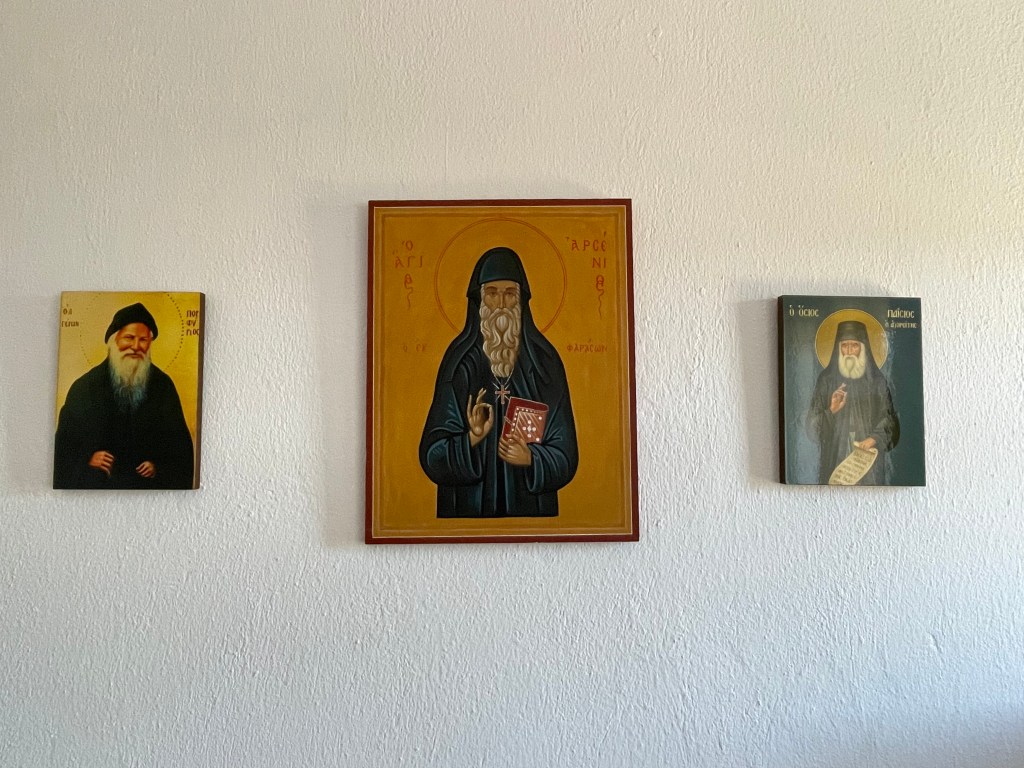
Other sisters soon join us for a minute to welcome me and hear the news about St Demetrios’ vigil in his church –it is after all his feast today– but they quickly disappear. Not a minute of idle or small talk. I am shown to my St Paisios, St Arsenios and St Porfyrios (!) cell, and there is still some free time until our common meal at 15:00 to take a quiet walk inside the monastery or … sit in my cell.
Inside my cell
“A brother came to Scetis to visit Abba Moses and asked him for a word. The old man said to him, ‘Go, sit in your cell, and your cell will teach you everything.’“
God calls each one of us in silence and invites us to go into our inner “room,” shut the door and pray to our Father in secret, assured that He will answer our prayer (Mt 6:6). It is only in this silence and stillness that we can listen to Him, hear His “still small voice” (1 Kings 19:11-13). The quiet water of Siloe flows without noise or sound, “goes softly’ (Is. 8:6).
Gradually, the guests house starts to get filled: two young ladies, university students, in their early twenties, settle in, then another one arrives, this one still in high school, with fond memories of +Elder Gregorios treating her with candies and hugs, and finally a young engineer who attended at the nearby Ormylia monastery a service of monastic tonsure.
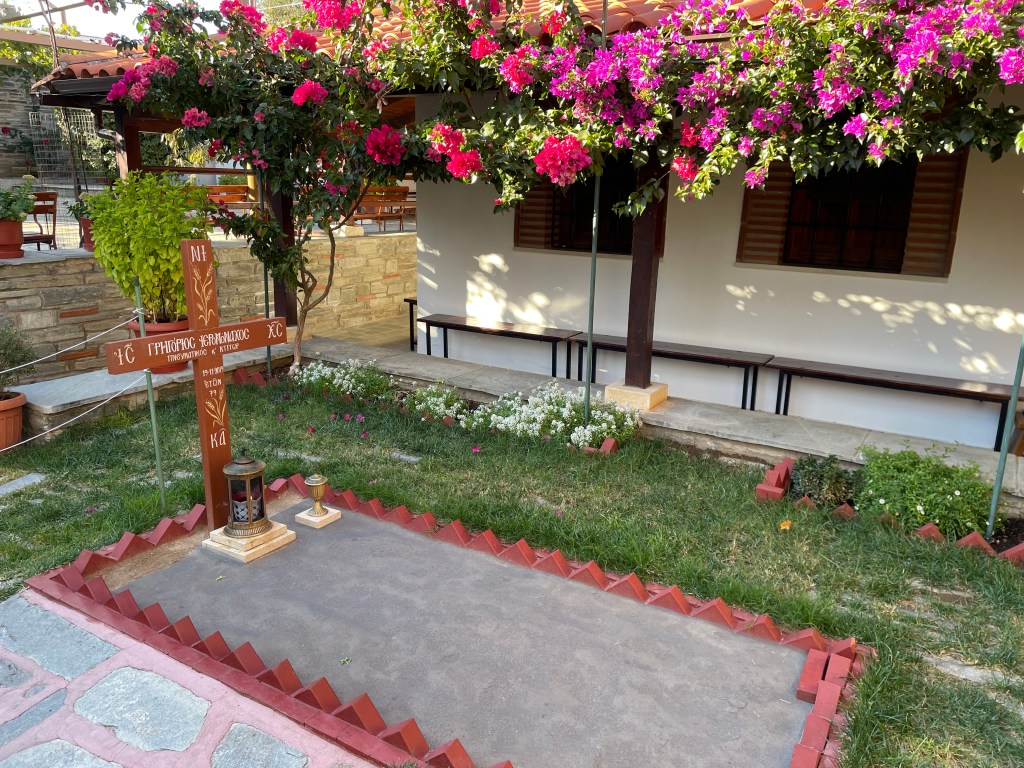
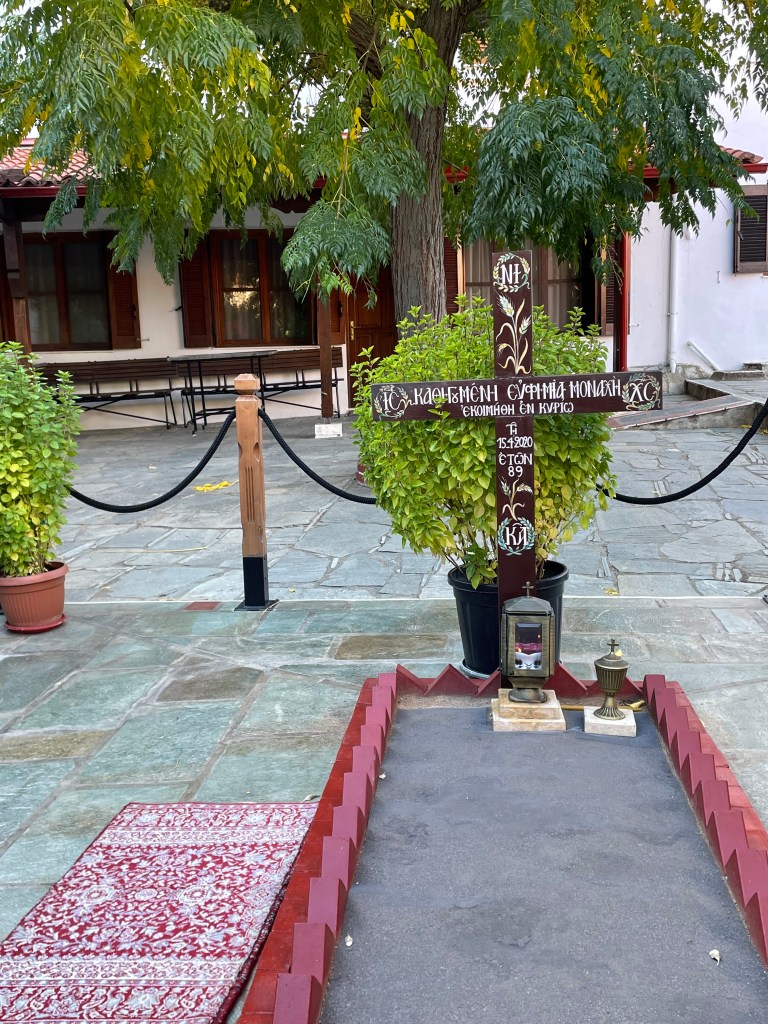
Gerondissa Euphemia’s grave (+15 April 2020, 88 years old). She was the first Abbess of the monastery and fell asleep in the Lord shortly after Gerondas Gregorios’ departure to Heaven (19 Νοεμβρίου 2019).
Bells ring and the common meal with the sisters begins, with a reading of Saint Gregory Palamas’ homily on St Demetrios. Our meal is a very ascetic one, as we are all preparing for Sunday Holy Communion.
We retire very early in our cells. The Sunday service will be a vigil from 23:00 to 03:00!
At the insistence of Sister Elisavet, I prepare a brief note for Abbess Mariam. Briefly, I share my news and ask her blessing. No questions or requests. Only her blessing to allow me to stay here longer and more often. –Which was one of the things +Gerondas Gregorios had always urged me to do, Sister Elisavet points out to me …
I give the note to the sister in charge of the guests’ house, pray and wait. After all, our vigil will begin very soon.
*
“Do not be afraid that there will be no fruit when all dies down; there will be! Not everything will die down. Energy will appear; and what energy!” St. Symeon the New Theologian
“Silence is the sacrament of the world to come” — St Isaacthe Syrian
Nothing had prepared me for what happened today at the monastery. Mother Porfyria had texted me back at night that, God willing, we would meet briefly today, sometime before we leave. In turn, I had texted my spiritual father for his prayers to help me discern what to discuss with her in these precious, few minutes. His reply: “Let Christ decide. He will be there with you”.
And yet, nothing had prepared me for what happened today at the monastery. I remember that this is what I had told you at my first monastery pilgrimage, at Panorama Dormition Monastery, but this time the spiritual experience was far more powerful, overwhelming I would say.
Such beautiful chanting in Church! Listen to a recording of sisters chanting Matins, Semantron and Bells:
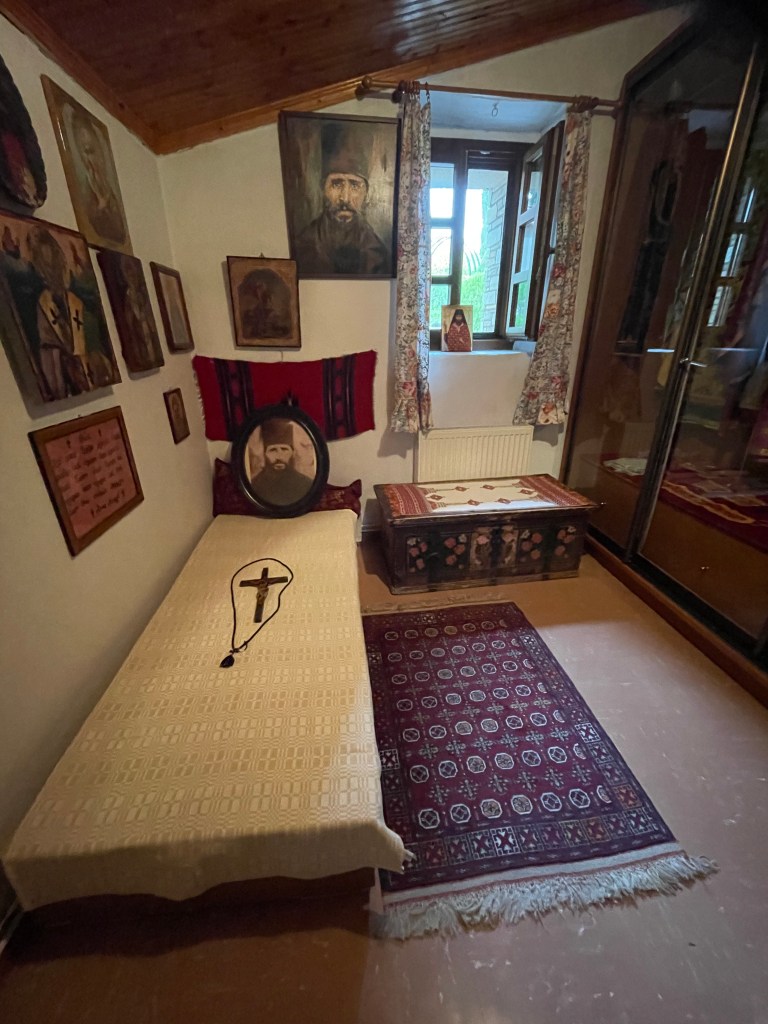
After the Holy Liturgy, I went straight to St George Karslidis cell and chapel, open to the faithful only on Feast Days and Sundays, thinking that Mother Porfyria would rest a bit after these long church services, before venturing out in the public. She is so loved by the sisters and all the faithful that there is always a long queue following her wherever she is going. Here one feels what joyful obedience out of love is.
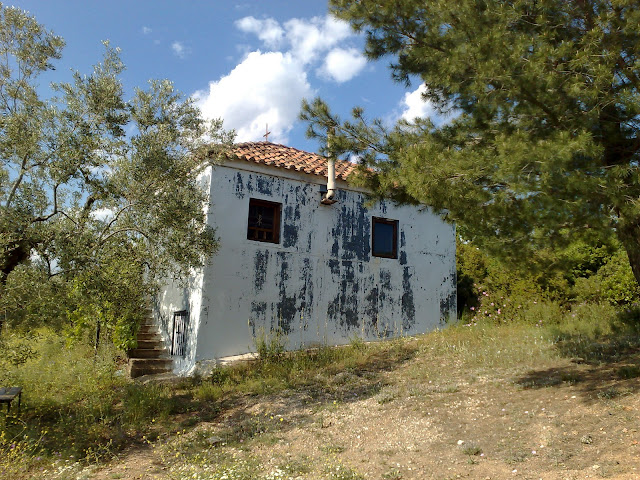
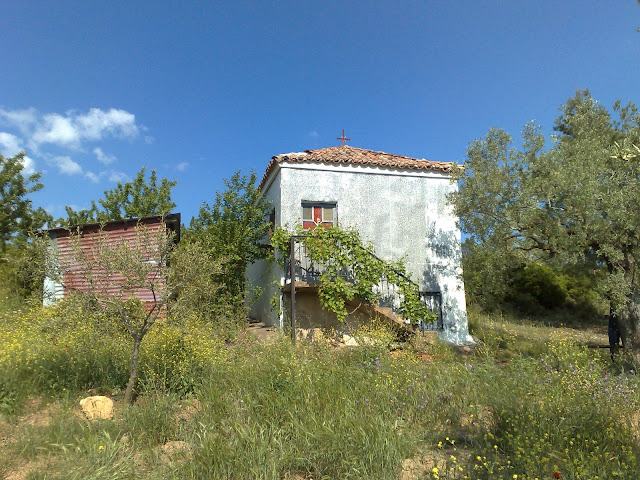
Saint George Karslides cell
And then, it happened! When I emerged out of St George Karslidis cell, I saw her! but what did I see?! I saw Gerondissa climbing up the stairs of the guests’ house in a hurry and ‘frantically’ searching for me everywhere, checking the guests’ living room, and ignoring everybody else! I rushed towards her and asked her to forgive my disappearance, but I thought she might rest a bit. Are you kidding me? Mother Porphyria rest a bit? How little do I still know her! No sleep, no rest, no ease, no break-fast, no coffee, nothing for her sake, only burning herself as a candle, always full of love and humility, always ready to sacrifice everything for her ‘neighbour!
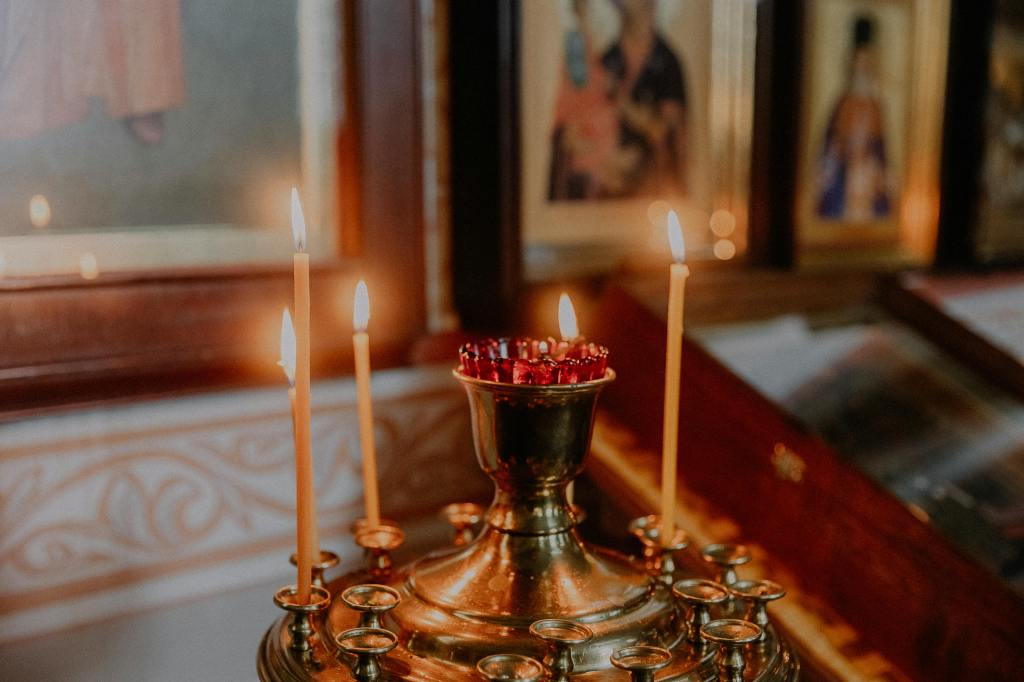
If we burn ourselves up as a candle, we become lights in the world.
It was so embarrassing for me! I must have scandalised all the pilgrims and the sisters in the monastery! First this frantic search, and then this grabbing me and ‘pushing’ me further and further behind the inner gates, since pilgrims and sisters never stopped approaching her, literally disappearing and returning after half an hour! Half an hour?! So, the Abbess disappeared for half an hour at the monastery’s busiest visitors’ time, after the Sunday Holy Liturgy, with the monastery literally packed, overflowing with people?!
What’s more, not for 5 min but for half an hour, all alone, listening to her precious spiritual counsel! What a blessing! And what a profound spiritual encounter ours was! Mother Porphyria reflected on our “common” Way of the Cross, dating back to 1988, at our visit to Sipsa monastery, both of us lay persons then, both of us spiritual daughters of + Gerondas Gregorios. Such a beautiful synaxis after so many years! She insisted how our first meeting sealed our future in God’s unfathomable Providence. Back at this time, she was exploring various monasteries with the desire to become a nun, while I was visiting various monasteries for my spiritual growth, before my graduate studies and work at the States. This first meeting dates back to the Pentecost Feast of 1988. Our 36 years anniversary in her words!
Providence brought us to the same monastery, with the blessing of +Gerondas Gregorios, and the following amusing misunderstanding happened then: because I arrived earlier than Mother Porphyria, the sisters at Sipsa monastery thought that I was the one interested to become a novice. So they offered me a single room to have more “space” and privacy to pray. When Mother Porphyria arrived, the sisters understood their mistake but because they did not want to upset me and have me change room, they left me all alone, at peace, and accommodated Mother Porphyria in a double room. Of course, I was clueless about all this, and when I met her, later in the day, at the services and the meals, she did not give anything away. To this day, she finds all this very funny!
Glory to God for all His gifts, especially our fellow travellers in the Way! Mother Porphyria stressed how important is to be always grateful, how God loves those who are grateful. Our faith and life is literally eucharistic. Glory to God for all things were Saint John Chrysostom. last words as he died in exile in the year 407. The word “Eucharist” is derived from the Greek word eucharistia, meaning ‘thanksgiving. This term originated in the 1st or 2nd century A.D. as early Christians commemorated Christ’s Last Supper with thanksgiving. Such thanksgiving inspires and empowers us to act in humble, loving, compassionate ways, with empathy and in service to others.
She also told me that gratitude and total surrender to God will make us fools for Christ and full in His Joy. Galatians 2:20 speaks to the profound change that occurs when we surrender to God: “I have been crucified with Christ and I no longer live, but Christ lives in me. The life I now live in the body, I live by faith in the Son of God, who loved me and gave himself for me.” And then, the greater the trials and tribulations, the greater our Joy will be. Mother Porphyria told me that this was a key teaching of Gerondas Gregorios of blessed memory to his spiritual children.
She then added that when we are ‘crucified’ wherever God’s Providence has placed us, then our martyrdom, and especially our prayers during our martyrdom, transfuses our crucifiers with His love. And this is such a blessing to offer to the world because sadly there are lots of people who rebel against God’s boundless Love and refuse to accept it and then share it. But the key to become such a channel for God’s Love is the will to be crucified and our gratitude for all our crosses. There is simply no other way!
God is indeed doing something wonderful. If we burn ourselves up as a candle, we become lights in the world. These are my spiritual Father’s words.
“Just as the oil and wick burn in the vigil lamp, submissive to our will, so let our souls also burn with the flame of love in all our sufferings, always being submissive to God’s will”, St. Nikolai Velimirovich.
This burning, of course, hurts, but Christ, our Bridegroom, bore the heaviest Cross of all: All our crosses plus only He knows what more …
Then Mother Porfyria moved on to some very private matters for herself and myself, which obviously I cannot share. All I can say is that her words were overpowering. A bit too powerful and profound for my spiritual level … standing in awe before the Burning Bush… We have been meeting all these years, but never before had she administered such a “deadly blow” on me! She has always been supportive and kind, wiping my tears, but this time was “only” “tough love”. Days later, and I find myself still reeling… Very tough love…
When I shared these words with my spiritual father, he told me: “Indeed tough love but which bolsters faith in an uncomfortable way”. And it was not so much her words, but the Holy Spirit through her words. Such a powerful presence! Even now, days later. Palpably so…My eyes have opened a little bit to the price our spiritual fathers and mothers “pay” when we ask for their prayers.
Please forgive me for not being able to share further our private discussion. And also forgive me if I cannot put her holy wisdom into words. Days later, I listened to a homily from Essex Monastery, which emphasises the same point: “The Taste of Death is a Prelude to Resurrection Life” How Elders burn themselves up to offer light and “how their spiritual children can make them prophets [ie. prophetic lights] with their holy obedience”, in Saint Sophrony’s own words. But I repeat, it is one thing to just listen to these holy words, and another thing the holiness of the speaker to be transfused to your heart and nous. “… and a great multitude of people … came to hear Him and be healed of their diseases … for power went out of Him and healed them all” (Luke 6: 17-19).
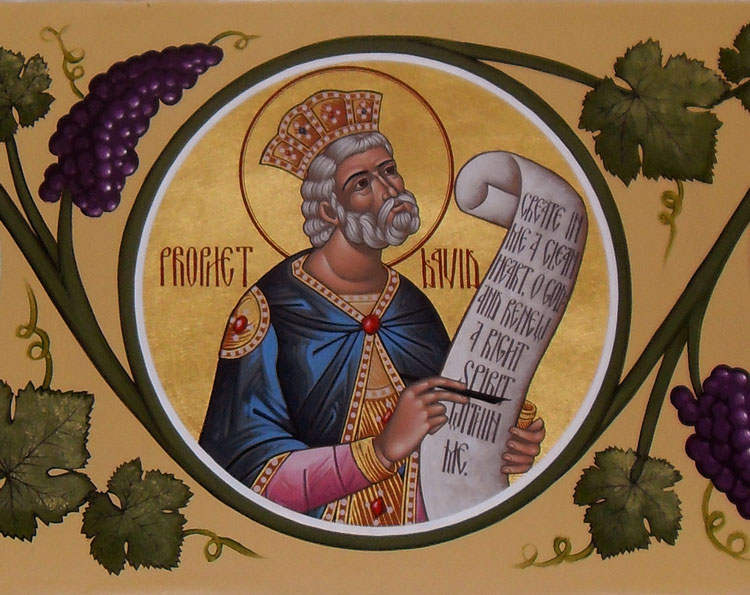
One thing I can certainly share is Mother Porfyria’s insistence on the power of the Psalter in spiritual warfare, which she also stressed at a group discussion with the faithful, at the monastery courtyard, shortly after our private discussion: “The Psalms of the prophet David – the sacred Psalter – are an age old weapon, an effective cure against fear, terror, and demonic forces.”
Mother Porfyria’s insistence on the power of the Psalter, reminded me of another homily, by Metropolitan Neophytos of Morfu this time, about a holy ascetic of our times, Elder Theodoros the cave-dweller from Agiofarango, Crete (†2016), about the power of the Psalter:
“If you were to ask me to tell you what I learned after so many years in the desert, I would simply answer this: the power of the Psalter. If I were to start my life over, I would struggle to do one thing: memorize the Psalter. This is the womb of noetic prayer. This is the fertile soil where the seed of prayer thrives. It scourges the demons. When I was reading the Psalter during my vigils, a demon came, roaring like a wild boar in my ear, especially when I said the verse, “Let God arise and let his enemies be scattered, and let those who hate him flee before him…” (Ps 68:1 (67 LXX)) and the verse that says, “…for You are my Lord and my God”. He was in a rage, grabbing me by the throat and choking me. He tried to mess up my words so that I wouldn’t say it.”
Saint Paisios of Mount Athos reveals a similar experience of his about the power of the Psalter:
“How much consolation I find with the Psalter! That hour and a half when I read the Psalter, I see it as the most positive help to the world… The Psalter is divinely inspired, it was written with divine illumination, this is why it is so potent, so deep in meaning… With the Psalter I feel like rejoicing…I was pounding the devil with a cannon. During the day I pounded him with the Psalter, at night with prayer.”https://www.orthodoxwitness.org/the-power-of-the-psalter
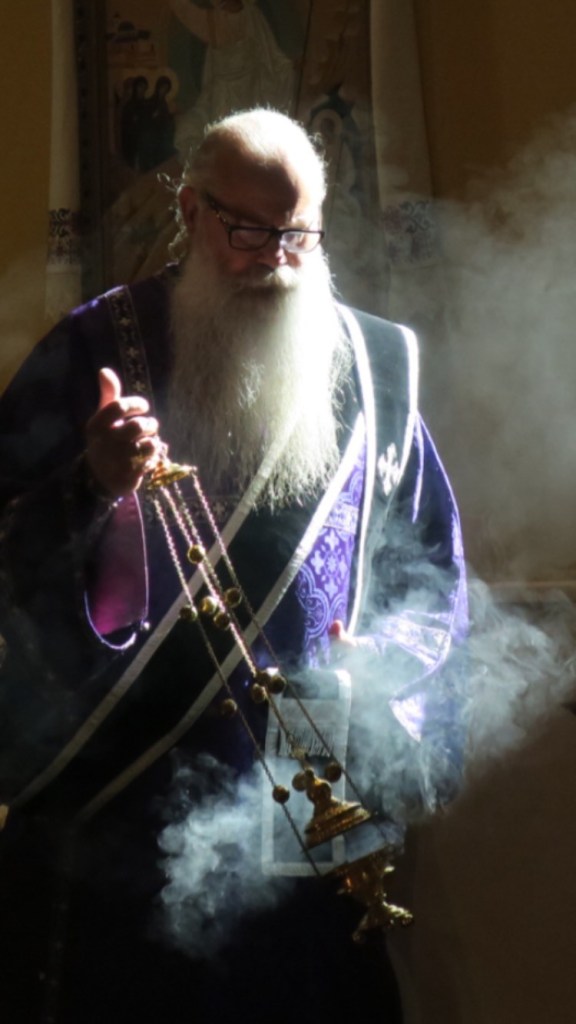
Mother Porphyria also urged the faithful that flocked around her to cense, ie. offer incense to, not only our icons, immediate environment and people near us, but also God’s creation!, those afar, our families at school, our colleagues at work, our families and friends away, all over the world … She told us that is what Fathers have told her and insisted on this. So, we must sense and cense … since before we offer incense we must sense them.
If we burn ourselves up as a candle, we become lights in the world.
What I find most moving, though, are not her words to me or to all the faithful huddling up near her, but the prayer and the Holy Spirit she transfused us through her words.
Like the other sister with a charisma from God at Panorama Dormition monastery, who offered me 5 minutes of her time before I left the monastery. When she told me, for example, to focus on the Holy Liturgy “which is Everything” in Saint Sophrony’s of Essex words, or the Jesus prayer, she transfused the energy of the Jesus prayer to me, and for some hours and days after this, the Jesus prayer would not stop echoing in my heart. Likewise, when Mother Porphyria spoke to us about the power of the Psalter, she transfused this energy, and from there on, for some days, all I could do was to recite the Psalter…
St. Justin Popovich
“To be Orthodox means to have the God-man Christ constantly in your soul, to live in Him, think in Him, feel in Him, act in Him. In other words, to be Orthodox means to be a Christ-bearer and a Spirit-bearer.”
His holy presence is immediately felt upon entering the monastery gates! This Saint is St. Georgios’ Karslidis, the New Confessor of Drama, the founder and first spiritual father of the Ascension Monastery. A bit exhausted after the long drive, off we rush to kneel before his relics and venerate them. … Rush! Waste no more time! “The doors are not yet shut; the bridegroom hears you”. St. Basil the Great
“Take off your shoes”
Hundreds and thousands of the faithful, all these years, especially since his canonisation in 2008, have knelt before him, to seek comfort in life’s trials and tribulations. So many miracles are happening and are being recorded every day!
“Take off your shoes”
Next, we kneel at Gerondissa Akylina‘s grave. Saint Paisios characterized her as “Gerondissa of Gerondisses; ie. Abbess of Abbesses” and Saint Porphyrios of Kausokalyvite called her “Cherub with golden wings”. Her canonisation is expected to take place soon and her relics are now displayed inside the Ascension Church, next to those of St.George Karslides, for veneration too.
So many contemporary Saints and spiritual Fathers and Mothers have blessed her diaconate: Saint Paisios, +Gerondas Iosif Vatopedi, +Gerondas Gavriil Dionysiatis, +Gerondas Gerasimos Mikragiannanitis, +Gerondas Theofilos (Lydia), Elder Efraim of Arizona, establishing her prayer rule, +Elder Georgios Kapsanis Gregoriou, +Elder Aimilianos, Saint Porfyrios, Mother Nikodemi-Ormylia monastery, +Mother Fevronia-Dormition Panorama monastery, to name just a few.
(Mother Porfyria’s obedience for a decade was the exclusive care of the elderly and frail Gerondissa Akylina).
“Take off your shoes.”
The nuns welcome us, show us to our rooms, offer us a meal, in the separate guests’ house, and leave us to rest before Vespers. Yet, what seems most urgent is the need to repent. Now, on the interpretation of the Greek Fathers of the Burning Bush, St. Gregory of Nyssa for example, shoes, made from the skins of dead animals, signify the deadness of repetition, boredom, inattentiveness.
“And the angel of the LORD appeared unto him in a flame of fire out of the midst of a bush: and he looked, and, behold, the bush burned with fire, and the bush was not consumed. … And he [God] said, Draw not nigh hither: put off thy shoes from off thy feet, for the place whereon thou standest is holy ground.” (Exodus 3:2-5 KJV )
“Take off your shoes.”
Start afresh, free yourself from what is lifeless, from enslavement to the trivial, the mechanical, the repetitive. Shake off the deadness of boredom. Wake up. Come to yourself. Open your spiritual eyes. Cleanse the doors of your perception. Look and see! Listen!
“Take off your shoes.”
The monastic triptych of “prayer, study and work” (Abba Isaiah of Scetis ascetic discourses) is observed here too, but with a greater austerity than in other monasteries, probably because of the +Gerondas’ and +Gerondissa’s relics’ omnipresence and the specific typikon they follow, at the inspiration of +St. Efraim of Arizona. A variation of this salvific triptych is “prayer, attention and work”. This triptych offers balance, healing, consolation. There are 38 sisters in this monastery, and lots of young novices and postulants, pre-novices. Nuns come and go busy bees, novices and postulants race all round, pilgrims flock, beautiful gardens and fields surround us, yet everything fades before my eyes. My heart has been struck, smitten (Psalm 102:4)
“Take off your shoes.”
In the evening, I text to Gerondissa Porfyria to plead for a meeting, even for 5 minutes, anytime, before we leave the next day. The day is coming to a close. We retire to our cells. I pray and wait …
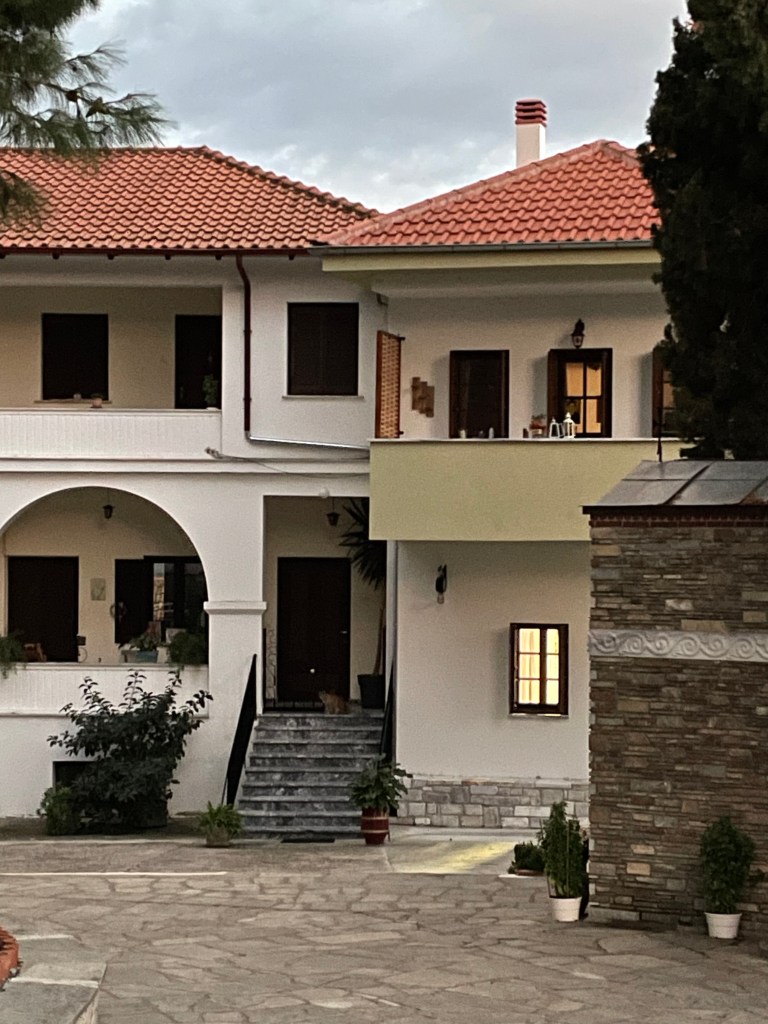
Gerondissa Porfyria’s balcony is the one with the lanterns
St. Gregory of Nyssa
“Sandaled feet cannot ascend that height where the light of truth is seen, but the dead and earthly covering of skins, which was placed around our nature at the beginning … must be removed from the feet of the soul.”
St. George Karslides
“God cares for everyone. Despair is in effect a lack of faith.”
The ‘hidden’ Fr Antonio’s Gikizas and his close relationship with St Porfyrios –he even knew St Nektarios! — wasanother mystery revealed to us during our recent pilgrimage to Athens and Aegina, another link in the chain of holiness to His Kingdom, another stepping-stone on the Way! Glory to God for all things! What a Joy on Heaven and earth when a new Saint reveals himself to the Church, when new “living stones of His Temple” are revealed. “Ye also, as lively stones, are built up a spiritual house, an holy priesthood, to offer up spiritual sacrifices, acceptable to God by Jesus Christ.” (1 Peter 2:5)
*
Who would have imagined that on one of Athens’ busiest avenues, at 59 Alexandras Avenue, in the semi-basement of an apartment building, lived an elder like those we read in the Desert Fathers, with profound humility, compassion and great discernment! It was to this humble, ‘hidden’ priest, Saint Porfyrios would regularly go for Confession, a fact not widely known. One would lay hands on the other and they would confess. One wonders what it was that tied these two elders together.
*
This venerable cleric, Father Antonio’s Gikizas, was born in Kranidi, Argolis, on January 7, 1910, and died in Athens, at the age of 89, on September 30, 1999. His academic knowledge was admirable not only for his time but also for ours with his four bachelor degrees and six foreign languages and many more. This academic excellence should normally separate him from the illiterate St Porphyrios, but Father Antonios, despite his great qualifications, always tried to avoid the high offices that were offered to him throughout his life. His humility was profound. When he was still a small child, he met Saint Nektarios, for whom he had a special reverence. And later in his life, he met St Porfyrios. His acquaintance with the elder – and later Saint of the Church – Porphyrios took place when he served for a short time as a preacher in Kymi of Evia.
*
So, what was it that tied these two elders together? Fathers believe that it was their profound humility and their focus on repentance and the Sacrament of Confession throughout their lives. Father Antonios of blessed memory insisted that what we all need, more than anything else, is “repentance, this gift from God. … Repentance is the key for our entry into the heavenly world, in His Uncreated Church…”. Clearly this was the focus of Saint Porphyrios’ life too, as revealed in his Testament to his Spiritual children, six months before he fell asleep in the Lord: “From a small child I was in sins——But the world thought I was good and everyone shouts that I am a saint. As for me, I feel that I am the most sinful person in the world.——whatever I remembered, of course I have confessed —-But now I have a feeling that my spiritual sins are too many and I ask those of you who have known me to pray for me because I too humbly prayed for you while I lived!” I truly wonders why would such holy men feel that sinful and regularly go to Confession until old age… To confess what? And if they felt and acted thus, what about us?
*
How inter-connected Holiness, Saints are in God’s Providence! Glory to God for all things! “That they all may be one; as thou, Father, art in me, and I in thee, that they also may be one in us” (John 17:21)
Taking things for granted is a trap most of us fall into. It is easy to get used to things and to stop noticing. We stop noticing God’s little gifts, little gestures of love of those around us, our comforts and advantages. The last four weeks, since Father J. has been taken gravely ill, have been a time of deep sadness but also of reflection and hopefully of growth.
Familiarity is a dangerous element in our spiritual life. I have spent so much time with Father J. over the last 18 years, I have relied so much on his advice, prayers, lifts to church, on his love, tolerance and good will that I think I have come to take it all for granted. In any crisis, I assume that he will be there to guide me and especially pray for me. In this crisis, for the first time, I had to pray for him and couldn’t ask for his guidance. I felt lost, but I also felt more than ever the power of prayer, the strengthening bonds of fellowship and I experienced once again the manifold grace of brothers and sisters in Christ praying together. For years now, I have felt that father joyfully carried me and every single person in his church on his back like a cross. His care and prayers make up for our negligence and lack of zeal, for all our lack of love towards God, the church and others.
As a community, especially the cradle Orthodox, we always take for granted that we shall have a church where the Holy Liturgy will be served every Sunday (take it or leave it as it suits us), that there will be a Father to come bless our house, cars, food and visit us when we are ill, that there will be a Father to sign the papers of church attendance for our children to get a place at a desired school and give us a reference of good character, that this Father will pray for us whenever we ask him, that he will be there to hear our confession whenever we feel burdened, that he will settle our little squabbles, that he will baptise our children and read us the prayers on our death bed and serve at our funeral. In the case of our parish, we take for granted even more than that, that our Father will make sure everyone has transport to get to church, that he will answer the phone to hear our little troubles at any hour of the day or night, that he will arrive first in church and leave last and generally make sure that everything is well with the church and in our life. The last weeks have forcefully reminded me that all these are not our due or by any means guaranteed to be there and that we are blessed to have had all these for so many years through God’s grace and Father J.’s love, faith and energy.
Umberto Eco said: “Absence is to love as wind is to fire: it extinguishes the little flame, it fans the big.” I cannot exactly quantify my affection for Father J., but I have thought of him more over the last month than ever before. In his absence, so many touching memories and images came flooding in bringing along both sadness and joy. One of my favourite mental snapshots is of Father looking up to see somebody come through the church door. Every time his eyes light up with joy when his gaze rests on you as you come in through the door and I noticed that Father’s joy is even greater when someone comes who has not been to the church in months or years. This joyful, loving gaze makes you feel so welcome and loved and somehow special. It makes you feel that you are coming home. And this image lead on to another memory of Father crying when he reads the Gospel of the Return of the prodigal son. I cannot remember him ever reading it without tears in his eyes. His love for all these many prodigal children that we are is so great that he stands by us in prayer before God no matter what we are or have done. I know for sure he has stood by me with gentleness and patience even when I disobeyed his spiritual guidance or I argued back or wanted to leave the church.
St John of the Ladder teaches that it is more fearful to anger your Spiritual Father than to disobey and anger God himself. If we anger God, our spiritual father has the grace to pray for us, to intercede and obtain forgiveness for us, but if our spiritual father turns away from us, we have no defence or advocate before God. This is how I have felt about my Spiritual Father, about Father J. He has been my advocate before God, my safety rope for the rock climbing. This rope has kept me connected to the rock when I fell, it stopped me from walking away and giving up when the going got too hard.
Fr Seraphim of Mull Monastery tells the story of the advice he received from his spiritual father just before he was ordained. He told him that the value of his priesthood will be measured in the madness of his love for every single human being who will stand before him irrespective of what they look like, who they are, where they come from, what they have done.
This is exactly how I see Father’s ministry. In his love of all people and in his joyful daily sacrifices for us, I see the reflection of God’s love for all his children. By knowing Father, I feel I have come a step closer to understanding God’s love for every single one of us.
The church or monastery is like a beehive. The spirit of the queen permeates the whole hive and sets the tone for all the bees. If the queen bee is aggressive the whole hive will be an aggressive one, just so when a community has a very loving father, like us, the whole community is loving and gentle. And if at times this isn’t the case, Father dissipates all tension by his prayers and mild spirit.
As Father is recovering from his illness and there is a general sigh of relief in the community and a sense of joy and expectation, I have made a vow not to take my spiritual father for granted ever again or any of God’s gifts to our community, but rejoice in each of them and see them for what they are – signs of God’s love: the beautiful church filled with the gifts from Old parishioners, the people who have prepared the prosphoro, brought the wine, oil and candles and cleaned the church, the people who have come to give and receive and most of all the presence of a father through whose hand a gentle and humble God reaches out to his people. None of my or anyone’s giving of time, money or energy can match the wonder of these gifts.
A dear sister in Christ, a nun in a Greek monastery, recommended Mother Gavrilia’s book to me a month ago, to study again, and draw inspiration and courage and faith in my poor, little missionary endeavours, by that Missionary and Unmercenary Giant. I am so grateful for this Holy Mother and her book. I have had it for many years and read it many times. Each time it goes deeper, deeper. I am reading this again after many years of traveling and the book was packed away. She always, through the message of the Holy Spirit-alive in her, has a word or two about my/your struggles. Especially now. I feel her so close to my side. Mother Gavrilia is such a role model in her fearlessness, her humility and obedience to God’s Will, her dedication to the service of all mankind, her Faith! May we have her blessing!
A poem in the book touched my heart so deeply:
THOU HAST made me known to friends
whom I knew not.
Thou hast given me seats in homes not my own.
Thou hast brought the distant near
and made a brother of the stranger.
I am uneasy at heart
when I have to leave my accustomed shelter;
I forget that there abides the old in the new,
and that there also thou abidest.
Through birth and death,
in this world or in others,
wherever thou leadest me, it is thou the same,
the one companion of my endless life,
who ever linkest my heart
with bonds of joy to the unfamiliar.
When one knows thee,
then alien there is none,
then no door is shut.
Oh, grant me my prayer
that I may never lose the bliss
of the touch of the one
in the play of the many.
[R. Tagore, Gitanjali, LXIII]
This poem, dated March 24, 1964, exactly ten years after she was “reborn”, was found among her papers. On the top of that page, she made the sign of the Cross
Arvo Pärt – And then came the evening and the morning (1990)
“God is Love” … and Mother Gavrilia‘s entire life, which was a hymn to the Lord, became thanks to Him, a burnt offering, a holocaust to His Love.
“Only one thing do I know that I have always, and it is not pride, nor fantasy, but that which I have day and night, wherever I find myself–three things: first, Faith; second, Faith; third, Faith. That’s all! Nothing else can I say to you. It has directed all my life.”
















 ORTHODOX CHRISTIAN FAITH AND LIFE