My husband thinks I’m wasting my time!
Every Wednesday morning, I drive to the Galini Nursing Home. I don’t have any people there; in fact, I didn’t know a soul when all this started. I just go there, sit in the common area, and knit.
I’ve been doing this for four years. I’m 71 years old, a retired teacher, and time is the only thing I have in abundance.
At first, the nurses were concerned. “Ma’am, are you looking for someone in particular? A room?”
“No,” I would say. “I’m just here to sit for a while.”
Eventually they stopped asking. They assumed, I guess, that I was a lonely soul with nowhere else to go.
But I had a plan. I watched the residents pass by, some in walkers, some in wheelchairs, almost all with their eyes fixed on the floor. When they saw me knitting, they would stop short. Their eyes followed the rhythm of the needles.
At one point, a woman named Eleni, 84, decided to talk to me. “What’s this going to be?”
“A blanket,” I replied. “For no one in particular.”
“It seems like a lot of work for nothing,” she said with a slight complaint.
“I guess you’re right,” I said with a smile. “Would you like to help me “waste” some time together?”
She looked at me as if I had offered her a miracle. “My hands haven’t touched a thread in thirty years.”
“Great. Then you won’t notice if I slip a stitch.”
She sat down next to me. I gave her the needles, and it was beautiful to watch, her fingers remembering the movements long before her memory recalled them.
By the next month, Mrs. Eleni had brought three friends. Then there were six.
The centre moved us into the sunny, glass-fronted room and officially christened us “The Needle Company.” We didn’t do anything special; we just sat together, our hands busy, chatting about the weather, our grandchildren, and how pain can be eased. The real change was invisible.
These women began to dress in their good blouses again. They stopped skipping breakfast. A resident, Mrs. Maria, 89, who had not spoken a word since her husband left, began to tell vivid stories of how they sewed uniforms during the war.
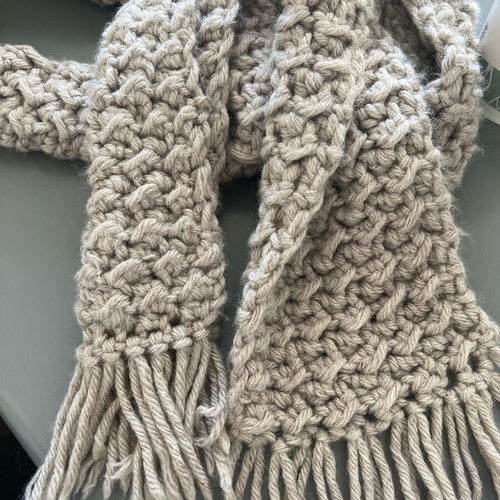
The blankets and scarves began to pile up. Colorful, slightly crooked, and completely incomplete. “Where are all these supposed to go?” Mrs. Eleni asked one day.
“To the ‘Homeless Hostels’ and the ‘Youth Shelters,’” I said.
So every month, we sent a box full of warmth, made by women the world had largely forgotten.
Last winter, a young man appeared at the reception desk of the Unit. He asked to see the women who made the blankets. The staff hesitated, but eventually led him to the sunny room. He was holding a blue-and-yellow scarf, filled with uneven rows of knitting.
“They gave it to me at the shelter facility in December,” he told us, his voice trembling. “I slept with it every night on the bench. There was a tag hidden in the edges: ‘Hand-knitted by Eleni, 84 years old. You are not alone.’”
Mrs. Eleni shivered, putting her hand to her heart.
“Now I’m back on my feet,” he said. “I found a room and a job that starts on Monday. I just had to come here and tell you… no one had ever made anything just for me. This scarf made me feel like I deserved to be saved.”
We were all in tears.
My husband still shakes his head every time I leave on Wednesdays. She thinks I just drive across town to gossip and knit with strangers.
But Mrs. Helen passed away last Tuesday. Quietly, in her sleep. At the funeral, her son sought me out. “My mother lived for Wednesdays,” she said. “She told me you gave her purpose again. You gave her spark back.”
Our circle still meets every week. Seven women, ranging in age from 78 to 95, create “awful” scarves for people who desperately need to know that someone, somewhere, is thinking of them.
I don’t solve the world’s biggest problems. I just sit in a sunny room and knit with some incredible women. But I’ve learned that sometimes, that’s exactly the way to save a life.




 ORTHODOX CHRISTIAN FAITH AND LIFE