Arabic Christmas Carol

The Hymn of the Nativity in Arabic by St. Romanos the Melodist

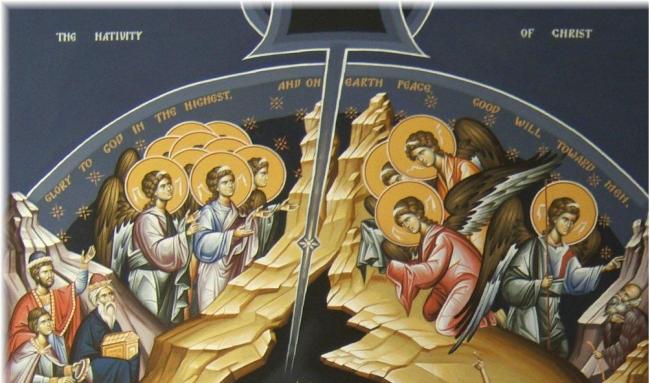
The original YouTube link calls this a “Christmas Carol” and “Byzantine Hymn”. But this is not a carol, and it is not just another “Byzantine Hymn”: it is the Christmas Troparion written by the incomparable St. Romanos the Melodist, shortly after a vision of the Mother of God in which she unlocked his talent.

Church Legend

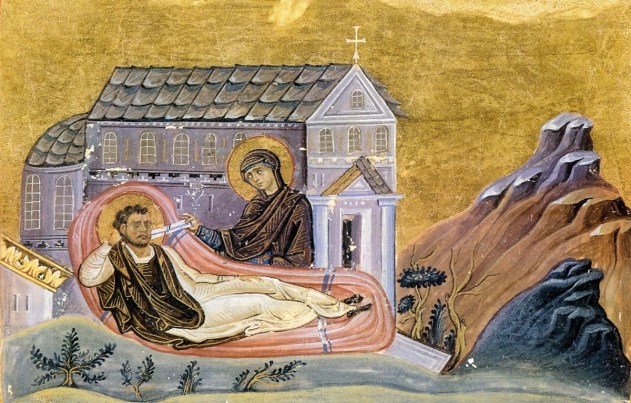
St Romanus was not a talented reader or singer. Church legend has it that during this time, Romanos’ voice was quite harsh and rasping and he was also tone deaf. It is said that the congregation cringed at hearing his voice.  Once, on the eve of the Nativity of Christ, he read the kathisma verses. He read so poorly that another reader had to take his place. The clergy ridiculed Romanus, which devastated him.

st romanos

It was in the Church of the Most Holy Theotokos in the Blachernae quarter of Constantinople, that he received the gift of sacred poetry. After a religious retreat there, in his sleep on Christmas eve, the Mother of God appeared to the grief-stricken youth in a vision while he was praying before her Kyriotissa icon. The Most Holy Theotokos told him not to despair. Blessing him with her right hand, she held forth a scroll with her left hand, saying, “Take the scroll and eat it.” The saint, in his dream, opened his mouth and swallowed the parchment. Thus was he given the gift of understanding, composition, and hymnography. It was Christmas Day, and immediately he awakened and marveled and glorified God. According to an account by Poulos, the service commenced as usual and when it came time for the voice of Romanos to be heard, the participants braced themselves for the accustomed cacophony that would ensue. Then, mounting the pulpit in the church, Romanos began the strains of his kontakion: Today the Virgin gives birth to the one who is above all living things. But when the tone rolled across the church like the sound of a heavenly angel, the stunned listeners stood transfixed. When he had finished, the confused priest signaled him to continue and once again the resonant voice reverberated in the house of God. Then it dawned on one and all that a miracle had occurred. He was now hailed as the “Melodist” (Melodos), “Sweet Singer” (Glykophonos),  and “Righteous Chanter” (Psaltis Dhikeosinis). (taken from: http://ocafs.oca.org/FeastSaintsViewer.asp?SID=4&ID=1&FSID=102826)


The Ass and the Ox

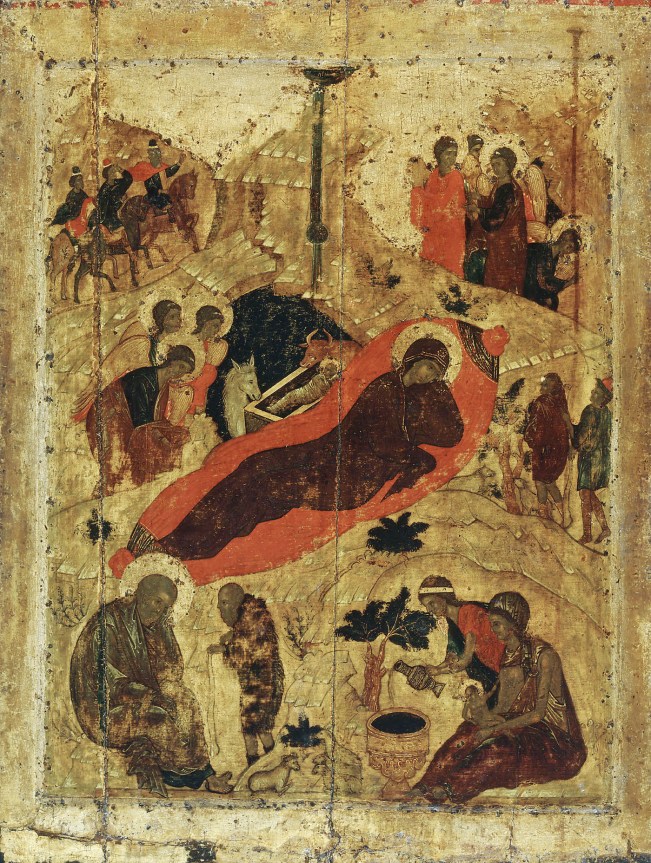
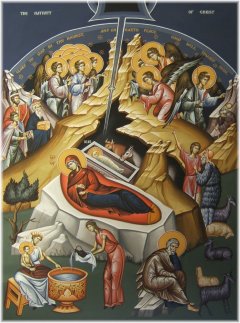
nativity1

Nativity of the Lord” Andrei Rublev 1405, Cathedral of the Annunciation, Moscow

As of today, I thought I might begin to concentrate on certain details of the Nativity iconography and explore their symbolism and theological significance in order to prepare my cave (a hermit as I am 😊) to receive the Word in the flesh.  My starting point will be a symbolic (and typological) analysis of the ox and the ass figures in the nativity iconography.

Generally speaking, the presence of any animals in the Nativity icon is in addition to any symbolic meaning a theological statement of restoration. It reminds us, I think, that all creation worships God ( the stars and the sun and even the dumb animals). That which was brought about by Adam’s transgression meant that the dominion he was given in Genesis over the birds of the air, the fish of the sea and the animals on the land was corrupted, made incomplete and he started eating that which was originally meant for companionship. When the Word who becomes flesh  is born, He who made Heaven and Earth and all that is in it,  it is only fitting that representatives of His creation are there to worship and adore the mystery of the Incarnation.

 
Revelation 5:13                
And I heard every creature in heaven and on earth and under the earth and in the sea, and all that is in them, saying, “To him who sits on the throne and to the Lamb be blessing and honor and glory and might forever and ever!” 
nativity5

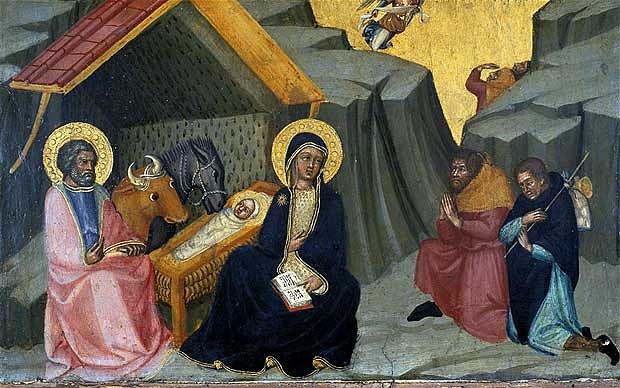
Specifically now to the ox and the ass. “These two manger animals are ubiquitous in Nativity images.  They peer over the new-born Christ child in wonderment, usually with their muzzles close to the child, as if to warm him with their breath.  Their significance should be plain: The ass carries Jesus into Egypt, away from the murderous Herod who, like Pharoah, orders the slaughter of infants.  (The flight into Egypt in Matthew’s gospel is the first of many Jesus/Moses parallels.)  Later, the ass will carry him into the holy city of Jerusalem to the acclaim of the crowd: “Hossana!  Blessed is he who comes in the name of the Lord.” The ass who greets the Lord at his birth is the same ass who bears him into Egypt and carries him to his death at Jerusalem where he is hailed as “king of Israel” but crucified as a common criminal.  The red ox stands as a stark and basic  symbol of Hebrew cultic sacrifice.” (1)

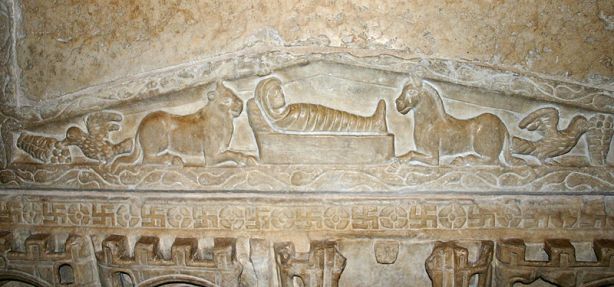
There is no ass or ox in the Biblical narratives of the birth of Christ.  Yet, besides the Christ Child himself, the ass and the ox are the most ancient and stable elements in the iconography of the nativity.  In fact the earliest example of a nativity known to us contains only the swaddled Christ in the manger flanked by the ox at his head and the ass at his feet.  David Clayton, on the New Liturgical Movement blog, has written a detailed piece on the subject, and I will go through the basics while adding a few more aspects he does not mention.

nativity6

Nativity scene on a 4th century sarcophagus from Italy

When reading comments on the nativity (for example in Ouspensky’s “The Meaning of Icons”) one finds that the inclusion of this detail is a reference to the prophecy of Isaiah:

The ox knows his owner, and the ass his master’s crib: but Israel has not known me, and my people have not understood.

nativity4

Some apocryphal texts have the ass and the ox worshiping the Christ child, such as the gospel of pseudo-Matthew:

Therefore, the animals, the ox and the ass, with him in their midst incessantly adored him. Then was fulfilled that which was said by Habakkuk the prophet, saying, “Between two animals you are made manifest.”

nativity7

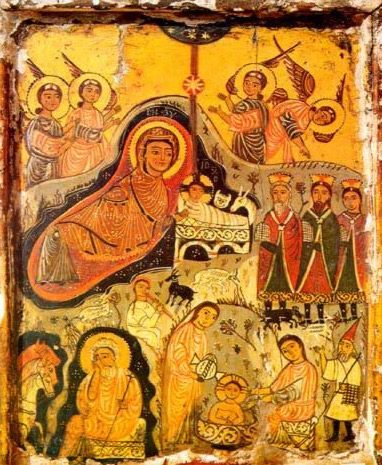
The Nativity – Icon in the Monastery of St. Catherine
[Many thanks to Bill M. for the link and drawing attention to the look on the ox’s face 😊 The icons of St Catherine’s, being isolated and in dry desert conditions meant that their icons have survived remarkably well, making it is a treasure of pre-Iconoclast iconography] (2)

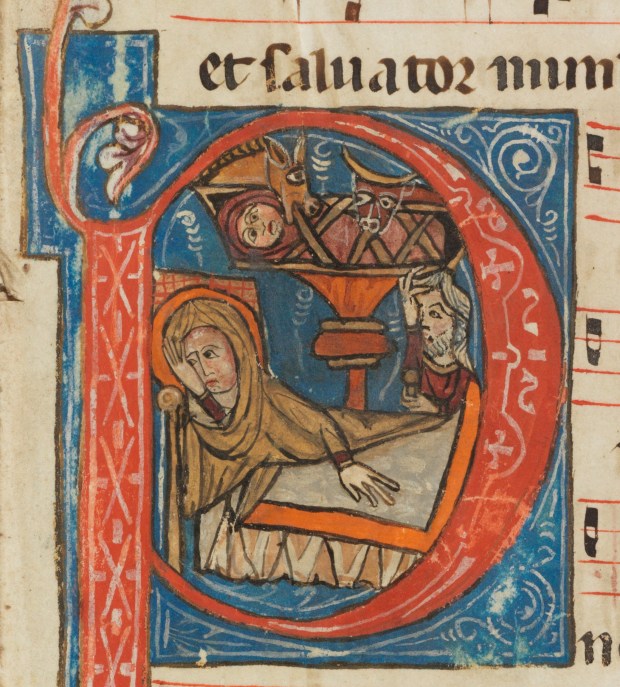
nativity9.jpgFreiburg, Couvent des Cordeliers / Franziskanerkloster, MS 9, fol. 11r. 

What though is the relationship between the ox and the ass, why are these animals paired together so?  We will often read that traditionally, the ox is seen as Israel, and the ass is seen as the Gentiles.  This comes from a very important distinction about the two animals.  The ox is a “clean” animal, and the ass is an “unclean” animal according to dietary proscription in the Old Testament.

Mixing the clean and the unclean is related very tightly to the mixing of Jews and Gentiles.  The clearest example of this is in St-Peter’s vision of the clean and unclean meats placed together, which signify the entry of Gentiles into the body of the Church.  Indeed there is a Mosaic law which I have never seen quoted in relation to the Nativity Icon, but which seems to hold one of the keys to the ass and the ox:

Thou shall not plow with an ox and an ass yoked together.

What is proscribed, the yoking of the clean and unclean, the bringing together of the “inside” and “outside” can only be accomplished without sin by the Christ, the incarnation of the Logos.  In fact, even St-Paul following this tradition, uses the same imagery to warn Christians not to be “yoked” with unbelievers.

nativity6

This brings out another meaning, which is related to the incarnation and its relation to universality of the Church.  The ass is a beast of burden, a “mindless” strength which was created to “carry” .  In this respect, the ass is a symbol of corporality itself.  One should not be surprised that the symbol of the unclean and “outer” is analogical to fallen corporal existence and sensuality. This can be seen so strongly in the hesychastic tradition in its relationship between the heart and the senses.  The “outer” part, corporality, the senses, the Gentile, are related to the garments of skin, which we have discussed before, and this periphery can be seen as protecting but also carrying what is precious, like the shell of the ark…

nativity3.jpg

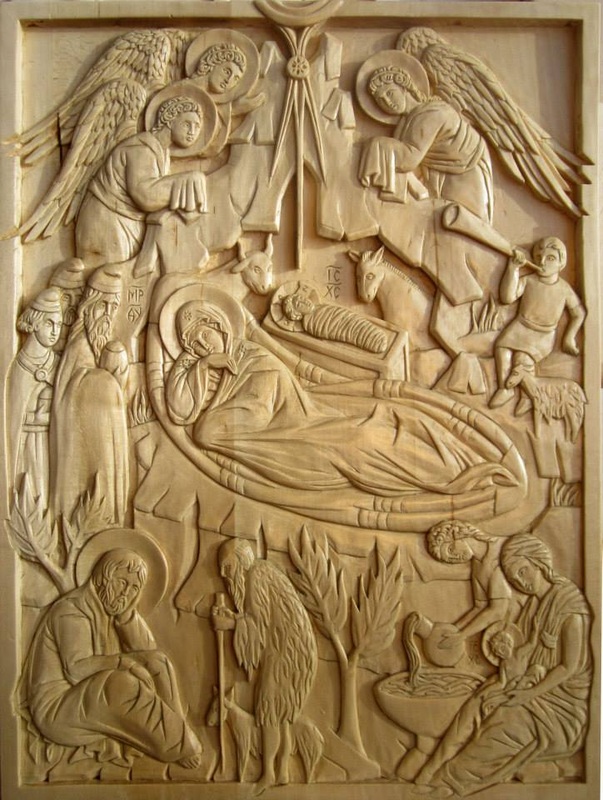
Icon of the Nativity carved in linden by Jonathan Pageau

It therefore follows naturally that stories such as the talking ass of Balaam are seen as prefigurations of the incarnation in sources as early as St-Irenaeus, or that it is so important for Christ be found riding an ass (even in later Rabbinical Judaism, the ass and colt of Zecharia’s prophesy are seen as representing the Gentiles) .  These Old Testament images, like the joining of the ass and the ox in the icon of the Nativity, are symbolic of the joining of extremes, the union of the spiritual and corporal, the clean and unclean, the inside and outside and ultimately the uncreated and created in the person of our Lord Jesus Christ. (3)


Prayer By Night

night.jpg

Pray by night. Pray alone. Pray using no book, no image, no thought. Just stay awake for ten minutes after you wake up to have a glass of water, after your child or a nightmare wakes you. Stand there in the dark, and make no move or sound. Make time stand still, capture that moment and bring it before Christ as your humble offering: this is me; this is who I am; THIS is who You must save.

night2

In fact, it may be useful to even forget that you need to pray. Most of us have such terribly deformed ideas about what prayer is, that it is better to simply forget you are meant to pray. Just stand there and look into the darkness outside your window. Other times, make a prostration and even close your eyes while you are on the floor; and stay there; wait there. Keep your body in a state of tension, but your mind empty. Say nothing. Think nothing. Imagine nothing. Do not pray. Do not move. Just wait for His presence. Wait for Him to notice your silence, your stillness, your death. Wait for Christ, and He will come, because Love forces Him.

20131001-IMG_9385

This is the advantage of praying at this time; night is a shield against thoughts, against images and feelings. Try to be present in that moment, try to be aware of the silence that surrounds you, let the void of that darkness embrace you, let it enter you and fill you with peace and silence. There is something almost sacramental in this hidden silence and stillness before Christ. This darkness, this solitude, this instinctive awareness of one’s mortality, they all force one to open up in ways which would be impossible by daytime.

Be aware that you are awake before Christ while the world lies asleep, defenseless and vulnerable. You are awake before Christ, fighting for the world; you have become an intercessor for this fallen, sleeping world which is one with you, and for which Christ has died.

night3

Ten minutes alone with Christ, night after night, will change your life. When you wake up and you face the worries of the new day, there is something in you that rejoices – you and Christ share a secret, you and Christ share a fight. Your soul knows that it has been fed, and it also knows that, whatever happens during the day, the night will always return with its silence and its stillness. You will live through the day waiting for the night, because when the night falls, you will again bring yourself as an offering before your Creator, and your Creator will feed you once more.

Source: Father Seraphim http://www.mullmonastery.com/monastery-blog/prayer-by-night/

On Earth As It Is In Heaven ❧

To forget this Beauty is to lose sight of the Heavenly Kingdom. Above all we must learn to desire Beauty. It was not for theology or propriety that the Byzantines so adorned their temples. It was for Beauty. In Beauty lies Truth, and by it we show our Love for God.

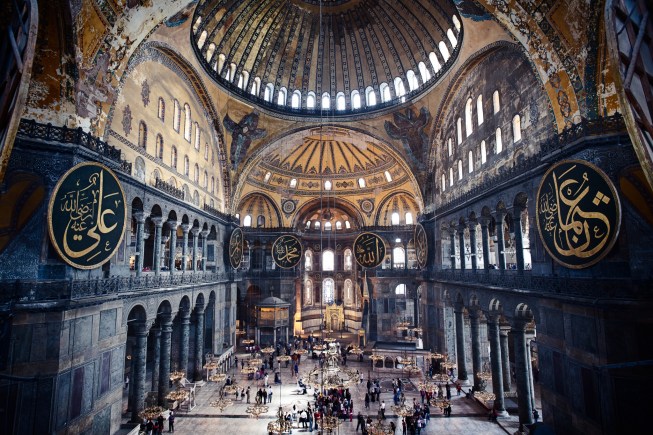
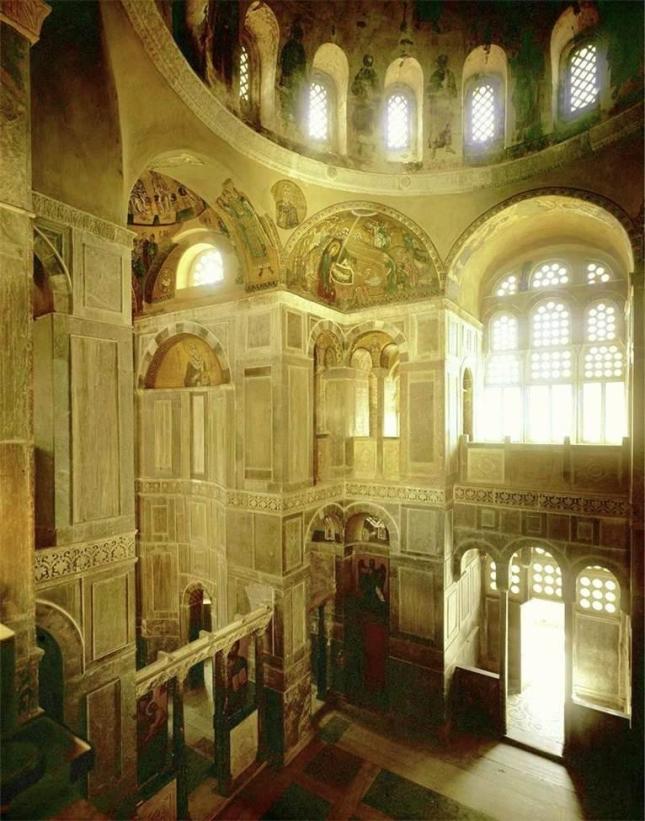
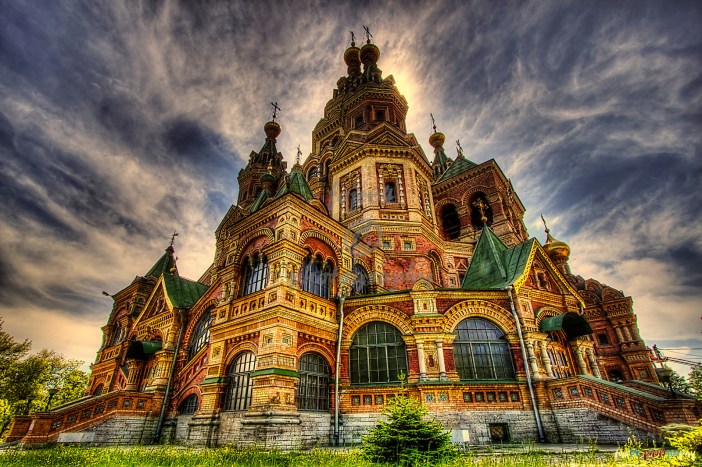
Hagia Sophia Interior (Ayasofya) - Istanbul

‘GOD DWELLS THERE AMONG MEN’

In 988, emissaries of Prince Vladimir of Kiev visited Hagia Sophia. They famously remarked, “only this we know, that god dwells there among men.” This statement highlights the attitude towards holy temples that was universal among ancient religions – that a god actually lived in the temple. Christianity has moved away from this belief, but Orthodoxy retains it as a liturgical concept. In an Orthodox church, Christ and the saints are present among the faithful. Prayers are directed towards their icons, not towards the sky. …


church1

… This is a great difference from Western architecture. A Gothic church is a monument offered up to God. It is an attempt by man to order and beautify all that exists in creation. It points upward to God the Father who is outside of it, and prayers are directed likewise. in contrast, an Orthodox church is introverted. The interior represents Heaven, and to enter it is to step into the New Jerusalem. God dwells there among men, and they have no need of the sun, neither of the moon, for the Glory of God illumines it (cf. Revelation 21 : 23).

church19


Light pours into a Gothic church through great decorated windows. Broken into dazzling colors, it overwhelms the materiality of the walls. The stonework itself magnifies the effect, as it is thin and delicate, and carven with most delicate tracery. The weight of the stone is denied. The worshipper is at once conscious of the awesome radiance and power of the light without and the tenuous structure of the material within. The light beautifies the structure by dematerializing it, even until the stone itself looks like rays of light.

church3


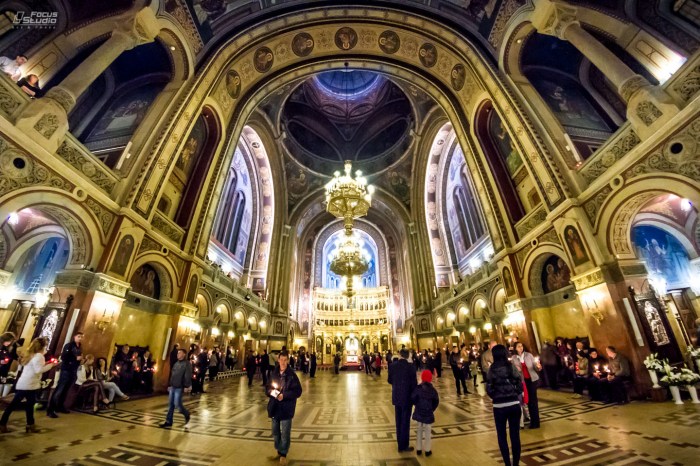
The walls of an Orthodox church are immensely thick and strong. The windows are small and up high, set deeply into the openings. The light is seen reflected off the thickness of the wall, rather than directly from the windows. In some Byzantine churches the window is translucent alabaster or marble, so that the light seems to glow from within the wall itself. Gold mosaics or bright frescoes play the light from many surfaces. Polished lamps and inlaid furniture reflect highlights from every direction. Deep aisles or side chapels behind arches appear as mysterious shadows in the distance, which make the church look brighter by the rich contrast. This is mass transfigured by light. It is the same light as in the icons, holy and all- pervading, the Uncreated Light which emanates from god to his creation. The stone and plaster glow from within. They do not seem transitory, but more real. Walls and piers seem as silent and as still as ancient mountains. They are bathed with the Light of Christ, and are sustained and strengthened by it as we are.

… A church building is the structure and organization of all the icons within it. As a unified edifice, these make up a single integrated icon which encompasses all the history and theology of the Church. The organization of the icons broadly follows three architectural axes.

The first axis is west to east. This is the liturgical axis. The narthex repre- sents the fallen world, and is used for preparation and exorcisms, for judg- ment is at the gates of heaven. The nave represents the redeemed world, or the Church, where the faithful gather among the saints for the worship of god. The sanctuary represents highest heaven; the altar is the throne of god and his tomb. (1)

church7

The second axis is vertical and can be understood as hierarchical. The Pantocrator is at the top of the dome with hands outspread, embracing the universe he created. Below are angels in their appropriate ranks, followed

 by the evangelists, representing the beginning of the church, and then the saints in their tiers below. To the medieval mind, hierarchy meant freedom; it was the mark of identity and security. This axis and hierarchy exist also in the iconostasis as a miniature version of the same concept. The vertical axis has another interpretation which is the approach of god and man. The dome, most brightly lit and filled with angels, is heaven. It touches the nave at the pendentives, where the evangelists are painted, because they record the meeting of god and man. alternately, some churches have four great feasts which are theophanies at the pendentives, for the same reason. The Theotokos of the sign in the apse represents the Church reaching back up to god. Christ appears in the sign before her, emphasizing that by the Incarnation He is already with Her.

church10

The third axis is circular and horizontal, the interplay of icons cycling around the nave and relating to one another across it. This axis often por- trays the flow of time, although it can express many other relationships as well. The great feasts may be ordered chronologically around the nave, or specific feasts may be combined or face one another to highlight theological connections. In a large church there may be hundreds of biblical and historical scenes, and their placement with respect to one another and to the principal feasts can suggest almost limitless depths of interpretation.

Historically, church builders have struggled with the interplay of these three axes. …

church12

THE TEMPLE AS COSMOLOGY

… Of all forms, the cube and the dome are the most sacred and universal in architecture. The cube or square represents the earth, while the dome symbolizes the sky. It was ever the desire of the Romans to combine these forms and represent the universe. They achieved this at Hagia Sophia. The square nave has the most water-like pavement in the world. Sheets of wavy blue-gray marble flow from the altar like the river of the water of life from the Throne of God. Rows of columns rise from the banks like trees. Amazingly, the builders abandoned the thousand-year-old tradition of the Classical orders, and crafted a new type of capital which looks like the fronds of palms blowing in the wind. The arches above the capitals are decorated similarly. The whole nave is like a walled garden of unimaginable scale, the very image of Paradise.


church15


ISLAM VS. CHRISTIANITY — MOSQUE VS. ORTHODOX TEMPLE


church21


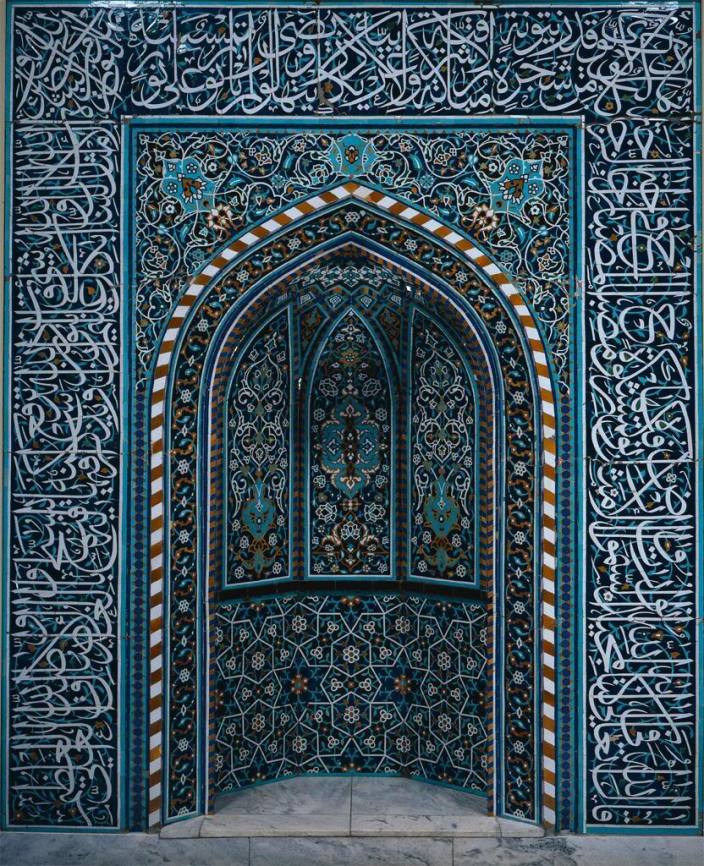
In Islam they build mosques that have the quality of jewel boxes. They are ornamented with a tremendous richness and regal splendor, but are completely devoid of anything iconographic, anything representational. They seem like abstract spaces, as does the Muslim worship within these spaces — the bowing down toward a mihrab, which is, in and of itself, nothing, but only an abstract architectural gesture that indicates the direction of Mecca. And of course, the Islamic faith emphasizes that man is very low and that God is very high, and that, really, the two do not meet; they surely do not meet in the sense that they meet in Christianity. So regardless of how beautiful a mosque may be, mosque architecture has never sought to convey an impression that God is within the mosque. It only conveys the impression that man has attempted to dignify himself by beautifying the mosque to an extent that man might be found worthy to kneel before God (because, of course, one only kneels in a mosque). So, if it is true that the emissaries of St. Vladimir attended services in an Orthodox Church, a Catholic Church, and in a mosque, I think it’s very appropriate that they would have observed that only in the Orthodox Church does it seem that God dwells with men. The very specific and deliberate attempt of Orthodox liturgical art is to convey that impression, and this is, of course, the fundamental gospel of Christianity.

church20

… A good modern building flooded with white light can be beautiful and people will often call such a building uplifting or inspiring. But we need to remember that the purpose of liturgical architecture, of an Orthodox church, is not to uplift and inspire but to make us mindful of the presence of God and the saints. Traditional architecture does this iconographically by revealing the beauty of the uncreated light shining through the saints, through the icons, and by suggesting the veil of mystery and the cloud of witnesses around the altar. For this iconographic technology to be effective requires a certain dim and mysterious light so that the reflections of light off of the gilded icons can be seen as brilliant and even supernatural in the setting of a dark church. A church that is flooded with natural light robs the icons of their ability to shine more brightly than the sun.

church11

*

(1) For the full article “ON EARTH AS IT IS IN HEAVEN ❧ Form and Meaning in Orthodox Architecture by ANDREW GOULD, go to http://nwbstudios.com/articles/On-Earth-As-Heaven.pdf

(2) For excerpts of the article “Mass Transfigured by Light”: The Iconic Vision of an Orthodox Church and ANDREW GOULD’s interview, featured in the current issue of Road to Emmaus Journal, go to http://www.orthodoxartsjournal.org/andrew-gould-featured-in-road-to-emmaus-journal/

Love Bade Me Welcome


herbert1

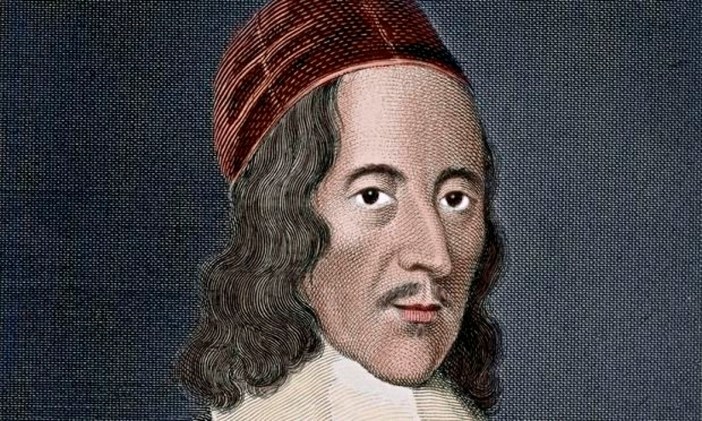
“Love Bade Me Welcome” is an exceptionally poignant poem by George Herbert – seventeenth century English parson and poet – about the Lord’s Supper at which we sit as guests, served by the Lord himself,  given a musical setting, along with four others, in Ralph Vaughan Williams’ 1911 masterpiece “Five Mystical Songs of George Herbert.”


During the final lines, a choir emerges out of the orchestral accompaniment and sings without words the Gregorian Chant melody of the Latin eucharistic hymn, “O Sacrum Convivium”: “O sacred banquet, wherein Christ is received…”

LOVE bade me welcome; yet my soul drew back,

Guilty of dust and sin.

But quick-eyed Love, observing me grow slack

From my first entrance in,

Drew nearer to me, sweetly questioning

If I lack’d anything.

‘A guest,’ I answer’d, ‘worthy to be here:’

Love said, ‘You shall be he.’

‘I, the unkind, ungrateful? Ah, my dear,

I cannot look on Thee.’

Love took my hand and smiling did reply,

‘Who made the eyes but I?’

‘Truth, Lord; but I have marr’d them: let my shame

Go where it doth deserve.’

‘And know you not,’ says Love, ‘Who bore the blame?’

‘My dear, then I will serve.’

‘You must sit down,’ says Love, ‘and taste my meat.’

So I did sit and eat.

—“Love” George Herbert (1593–1632)

rublev1

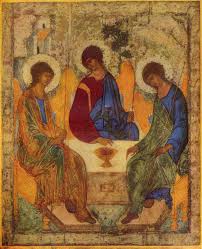
George Herbert’s “Love Bade Me Welcome” and the Lord’s Supper always remind me of Rublev’s Holy Trinity, inviting the faithful in the Divine Circle of Love.

The Five Mystical Songs are a musical composition by English composer Ralph Vaughan Williams (1872–1958), written between 1906 and 1911.[1] The work sets four poems (“Easter” divided into two parts) by seventeenth-century Welsh-born English poet and Anglican priest George Herbert (1593–1633), from his 1633 collection The Temple: Sacred Poems. While Herbert was a priest, Vaughan Williams himself was an atheist at the time (he later settled into a “cheerful agnosticism”), though this did not prevent his setting of verse of an overtly religious inspiration.

“Easter”
“I got me flowers”

1. Easter – from Herbert’s Easter

Rise heart; thy Lord is risen.
Sing his praise without delayes,
Who takes thee by the hand,
that thou likewise with him may’st rise;
That, as his death calcined thee to dust,
His life may make thee gold, and much more, just.

Awake, my lute, and struggle for thy part with all thy art.
The crosse taught all wood to resound his name, who bore the same.
His stretched sinews taught all strings, what key
Is the best to celebrate this most high day.

Consort both heart and lute, and twist a song pleasant and long;
Or since all musick is but three parts vied and multiplied.
O let thy blessed Spirit bear a part,
And make up our defects with his sweet art.

2. I Got Me Flowers – from the second half of Easter

I got me flowers to strew thy way;
I got me boughs off many a tree:
But thou wast up by break of day,
And brought’st thy sweets along with thee.

The Sunne arising in the East.
Though he give light, and th’East perfume;
If they should offer to contest
With thy arising, they presume.

Can there be any day but this,
Though many sunnes to shine endeavour?
We count three hundred, but we misse:
There is but one, and that one ever.

Vaughan Williams “Five Mystical Songs” (part 2):
“Love bade me welcome”
“The Call”
“Antiphon”

3. Love Bade Me Welcome – from Love (III)

Love bade me welcome: yet my soul drew back.
Guiltie of dust and sinne.
But quick-ey’d Love, observing me grow slack
From my first entrance in,
Drew nearer to me, sweetly questioning
If I lack’d anything.

A guest, I answer’d, worthy to be here:
Love said, You shall be he.
I the unkinde, ungrateful? Ah, my deare,
I cannot look on thee.
Love took my hand, and smiling did reply,
Who made the eyes but I?

Truth Lord, but I have marr’d them: let my shame
Go where it doth deserve.
And know you not, sayes Love, who bore the blame?
My deare, then I will serve.
You must sit down, sayes Love, and taste my meat:
So I did sit and eat.

4. The Call – from The Call

Come, my Way, my Truth, my Life:
Such a Way, as gives us breath:
Such a Truth, as ends all strife:
Such a Life, as killeth death.

Come, my Light, my Feast, my Strength:
Such a Light, as shows a feast:
Such a Feast, as mends in length:
Such a Strength, as makes his guest.

Come, my Joy, my Love, my Heart:
Such a Joy, as none can move:
Such a Love, as none can part:
Such a Heart, as joyes in love.

5. Antiphon – from Antiphon (I)

Let all the world in ev’ry corner sing:
My God and King.
The heavens are not too high,
His praise may thither flie;
The earth is not too low,
His praises there may grow.

Let all the world in ev’ry corner sing:
My God and King.
The Church with psalms must shout,
No doore can keep them out;
But above all, the heart
Must bear the longest part.

Let all the world in ev’ry corner sing:
My God and King.


The Art of Spiritual Reading

An Introduction to the Art of Reading God’s Word accompanied by some of the most beautiful medieval manuscripts

Top 10 Most Beautiful Medieval Manuscripts

Black Hours (M. 493 › Morgan Library & Museum)

The Black Hours is a product of unequalled luxury. All 121 vellum folios are stained in black. To make the writing stand out against the dark background, only white lead and opaque paints were used for the miniatures, and gold and silver ink for the script. Only three of these black parchment manuscripts survive to this day.
*


WE BELIEVE THAT THE SCRIPTURES constitute a coherent whole. They are at once divinely inspired and humanly expressed. They bear authoritative witness to God’s revelation of Himself – in creation, in the Incarnation of the Word, and the whole history of salvation. And as such they express the word of God in human language. We know, receive, and interpret Scripture through the Church and in the Church. Our approach to the Bible is one of obedience.

We may distinguish four key qualities that mark an Orthodox reading of Scripture, namely

Top 10 Most Beautiful Medieval Manuscripts

Prayerbook of Claude de France (MS M. 1166 › Morgan Library & Museum)

In the words of Roger Wieck, curator of manuscripts at the Morgan Library: “An artistic triumph…” The personalized prayer book of the French queen Claude de France enchants us especially by its delicate paintings in a charmingly small format of 69 x 49 mm, and even more so by the unusual wealth of illustration it contains.

*

Reading the Bible with Obedience

FIRST OF ALL, when reading Scripture, we are to listen in a spirit of obedience. The Orthodox Church believes in divine inspiration of the Bible. Scripture is a “letter” from God, where Christ Himself is speaking. The Scriptures are God’s authoritative witness of Himself. They express the Word of God in our human language. Since God Himself is speaking to us in the Bible, our response is rightly one of obedience, of receptivity, and listening. As we read, we wait on the Spirit.

But, while divinely inspired, the Bible is also humanly expressed. It is a whole library of different books written at varying times by distinct persons. Each book of the Bible reflects the outlook of the age in which it was written and the particular viewpoint of the author. For God does nothing in isolation, divine grace cooperates with human freedom. God does not abolish our individuality but enhances it. And so it is in the writing of inspired Scripture. The authors were not just a passive instrument, a dictation machine recording a message. Each writer of Scripture contributes his particular personal gifts. Alongside the divine aspect, there is also a human element in Scripture. We are to value both.

Each of the four Gospels, for example, has its own particular approach. Matthew presents more particularly a Jewish understanding of Christ, with an emphasis on the kingdom of heaven. Mark contains specific, picturesque details of Christ’s ministry not given elsewhere. Luke expresses the universality of Christ’s love, His all-embracing compassion that extends equally to Jew and to Gentile. In John there is a more inward and more mystical approach to Christ, with an emphasis on divine light and divine indwelling. We are to enjoy and explore to the full this life-giving variety within the Bible.

most beautiful medieval manuscripts lindisfarne gospels

Lindisfarne Gospels (Cotton MS Nero D IV › British Library)

The Lindisfarne Gospels doesn’t need many words of introduction: it’s one of the finest works in the unique style of Hiberno-Saxon or Insular art, combining Mediterranean, Anglo-Saxon and Celtic elements.

*

Because Scripture is in this way the word of God expressed in human language, there is room for honest and exacting inquiry when studying the Bible. Exploring the human aspect of the Bible, we are to use to the full our God-given human reason. The Orthodox Church does not exclude scholarly research into the origin, dates, and authorship of books of the Bible.

Alongside this human element, however, we see always the divine element. These are not simply books written by individual human writers. We hear in Scripture not just human words, marked by a greater or lesser skill and perceptiveness, but the eternal, uncreated Word of God Himself, the divine Word of salvation. When we come to the Bible, then, we come not simply out of curiosity, to gain information. We come to the Bible with a specific question, a personal question about ourselves: “How can I be saved?”

As God’s divine word of salvation in human language, Scripture should evoke in us a sense of wonder. Do you ever feel, as you read or listen, that it has all become too familiar? Has the Bible grown rather boring? Continually we need to cleanse the doors of our perception and to look in amazement with new eyes at what the Lord sets before us.

We are to feel toward the Bible with a sense of wonder, and sense of expectation and surprise. There are so many rooms in Scripture that we have yet to enter. There is so much depth and majesty for us to discover. If obedience means wonder, it also means listening.

Hours of Jeanne d’Evreux (Acc., No. 54.1.2 › Metropolitan Museum of Art) 

All miniatures are in demi-grisaille, a painting technique using mainly shades of grey and coloring for the figures’ face and hands. The surprising amount of details that can be fit in such small space is outstanding.

*

We are better at talking than listening. We hear the sound of our own voice, but often we don’t pause to hear the voice of the other person who is speaking to us. So the first requirement, as we read Scripture, is to stop talking and to listen – to listen with obedience.

When we enter an Orthodox Church, decorated in the traditional manner, and look up toward the sanctuary at the east end, we see there, in the apse, an icon of the Virgin Mary with her hands raised to heaven – the ancient Scriptural manner of praying that many still use today. This icon symbolizes the attitude we are to assume as we read Scripture – an attitude of receptivity, of hands invisibly raised to heaven. Reading the Bible, we are to model ourselves on the Blessed Virgin Mary, for she is supremely the one who listens. At the Annunciation she listens with obedience and responds to the angel, “Be it unto me according to thy word” (Luke 1:38). She could not have borne the Word of God in her body if she had not first, listened to the Word of God in her heart. After the shepherds have adored the newborn Christ, it is said of her: “Mary kept all these things and pondered them in her heart” (Luke 2:19). Again, when Mary finds Jesus in the temple, we are told: “His mother kept all these things in her heart” (Luke 2:5l). The same need for listening is emphasized in the last words attributed to the Mother of God in Scripture, at the wedding feast in Cana of Galilee: “Whatsoever He saith unto you, do it” (John 2:5), she says to the servants – and to all of us.

In all this the Blessed Virgin Mary serves as a mirror, as a living icon of the Biblical Christian. We are to be like her as we hear the Word of God: pondering, keeping all these things in our hearts, doing whatever He tells us. We are to listen in obedience as God speaks.

Westminster Abbey Bestiary

Westminster Abbey Bestiary (Ms. 22 › Westminster Abbey Library)

Out of all the Bestiaries, the Westminster is considered to be one of the most beautiful and richly decorated bestiaries in the world, and is full of all kinds of incredible descriptions, legends and myths.

*

Understanding the Bible Through the Church

IN THE SECOND PLACE, we should receive and interpret Scripture through the Church and in the Church. Our approach to the Bible is not only obedient but ecclesial.

It is the Church that tells us what is Scripture. A book is not part of Scripture because of any particular theory about its dating and authorship. Even if it could be proved, for example, that the Fourth Gospel was not actually written by John the beloved disciple of Christ, this would not alter the fact that we Orthodox accept the Fourth Gospel as Holy Scripture. Why? Because the Gospel of John is accepted by the Church and in the Church.

It is the Church that tells us what is Scripture, and it is also the Church that tells us how Scripture is to be understood. Coming upon the Ethiopian as he read the Old Testament in his chariot, Philip the Apostle asked him, “Understandest thou what thou readest?” And the Ethiopian answered, “How can I, unless some man should guide me?” (Acts 8:30-31). We are all in the position of the Ethiopian. The words of Scripture are not always self-explanatory. God speaks directly to the heart of each one of us as we read our Bible. Scripture reading is a personal dialogue between each one of us and Christ – but we also need guidance. And our guide is the Church. We make full use of our own personal understanding, assisted by the Spirit, we make full use of the findings of modern Biblical research, but always we submit private opinion – whether our own or that of the scholars – to the total experience of the Church throughout the ages.

The Orthodox standpoint here is summed up in the question asked of a convert at the reception service used by the Russian Church: “Do you acknowledge that the Holy Scripture must be accepted and interpreted in accordance with the belief which has been handed down by the Holy Fathers, and which the Holy Orthodox Church, our Mother, has always held and still does hold?”

We read the Bible personally, but not as isolated individuals. We read as the members of a family, the family of the Orthodox Catholic Church. When reading Scripture, we say not “I” but “We.” We read in communion with all the other members of the Body of Christ, in all parts of the world and in all generations of time. The decisive test and criterion for our understanding of what the Scripture means is the mind of the Church. The Bible is the book of the Church.

godescalc-evangeliary

Godescalc Evangelistary (Ms. Nouv. acq. lat. 1203 › Bibliothèque Nationale de France)

Why is this manuscript so important? In the words of Godescalc himself:

Golden words are painted [here] on purple pages,
The Thunderer’s shining kingdoms of the starry heavens,
Revealed in rose-red blood, disclose the joys of heaven,
And the eloquence of God glittering with fitting brilliance
Promises the splendid rewards of martyrdom to be gained. 

*

To discover this “mind of the Church,” where do we begin? Our first step is to see how Scripture is used in worship. How, in particular, are Biblical lessons chosen for reading at the different feasts? We should also consult the writings of the Church Fathers, and consider how they interpret the Bible. Our Orthodox manner of reading Scripture is in this way both liturgical and patristic. And this, as we all realize, is far from easy to do in practice, because we have at our disposal so few Orthodox commentaries on Scripture available in English, and most of the Western commentaries do not employ this liturgical and Patristic approach.

As an example of what it means to interpret Scripture in a liturgical way, guided by the use made of it at Church feasts, let us look at the Old Testament lessons appointed for Vespers on the Feast of the Annunciation. They are three in number: Genesis 28:10-17; Jacob’s dream of a ladder set up from earth to heaven; Ezekiel 43:27-44:4; the prophet’s vision of the Jerusalem sanctuary, with the closed gate through which none but the Prince may pass; Proverbs 9:1-11: one of the great Sophianic passages in the Old Testament, beginning “Wisdom has built her house.”

These texts in the Old Testament, then, as their selection for the feast of the Virgin Mary indicates, are all to be understood as prophecies concerning the Incarnation from the Virgin. Mary is Jacob’s ladder, supplying the flesh that God incarnate takes upon entering our human world. Mary is the closed gate who alone among women bore a child while still remaining inviolate. Mary provides the house which Christ the Wisdom of God (1 Cor. 1:24) takes as his dwelling. Exploring in this manner the choice of lessons for the various feasts, we discover layers of Biblical interpretation that are by no means obvious on a first reading.

The Grimani Breviary

Grimani Breviary (Ms. Lat. I, 99=2138 › Biblioteca Nazionale Marciana) 

A monumental witness to the splendor of Flemish art produced during the Renaissance. Perhaps an outstanding features of this manuscript is the choice of motifs, which alternate between religious and lay themes.

*

Take as another example Vespers on Holy Saturday, the first part of the ancient Paschal Vigil. Here we have no less than fifteen Old Testament lessons. This sequence of lessons sets before us the whole scheme of sacred history, while at the same time underlining the deeper meaning of Christ’s Resurrection. First among the lessons is Genesis 1:1-13, the account of Creation: Christ’s Resurrection is a new Creation. The fourth lesson is the book of Jonah in its entirety, with the prophet’s three days in the belly of the whale foreshadowing Christ’s Resurrection after three days in the tomb (cf. Matthew 12:40). The sixth lesson recounts the crossing of the Red Sea by the Israelites (Exodus 13:20-15:19), which anticipates the new Passover of Pascha whereby Christ passes over from death to life (cf. 1 Corinthians 5:7; 10:1-4). The final lesson is the story of the three Holy Children in the fiery furnace (Daniel 3), once more a “type” or prophecy of Christ’s rising from the tomb.

Such is the effect of reading Scripture ecclesially, in the Church and with the Church. Studying the Old Testament in this liturgical way and using the Fathers to help us, everywhere we uncover signposts pointing forward to the mystery of Christ and of His Mother. Reading the Old Testament in the light of the New, and the New in the light of the, Old – as the Church’s calendar encourages us to do – we discover the unity of Holy Scripture. One of the best ways of identifying correspondences between the Old and New Testaments is to use a good Biblical concordance. This can often tell us more about the meaning of Scripture than any commentary.

In Bible study groups within our parishes, it is helpful to give one person the special task of noting whenever a particular passage in the Old or New Testament is used for a festival or a saint’s day. We can then discuss together the reasons why each specific passage has been so chosen. Others in the group can be assigned to do homework among the Fathers, using for example the Biblical homilies of Saint John Chrysostom (which have been translated into English). Christians need to acquire a patristic mind.

Morgan-Crusaders-Bible

Morgan Crusader Bible (Ms M.638 › Morgan Library & Museum; Ms Nouv. Acq. Lat. 2294 › Bibliothèque Nationale de France; Ms Ludwig 16 83. M.A. 55 › Getty Museum)

In this manuscript history is depicted in great detail, without any text and recalls the Creation of the world, the Righteous Wars and the deeds of the most important characters of the Old Testament. The Crusader’s Bible fascinates through its rich and refined gold embellishment which comes to enhance the luminosity of the colors.

*

Christ, the Heart of the Bible

THE THIRD ELEMENT in our reading of Scripture is that it should be Christ-centered. The Scriptures constitute a coherent whole because they all are Christ-centered. Salvation through the Messiah is their central and unifying topic. He is as a “thread” that runs through all of Holy Scripture, from the first sentence to the last. We have already mentioned the way in which Christ may be seen foreshadowed on the pages of the Old Testament.

Much modern critical study of Scripture in the West has adopted an analytical approach, breaking up each book into different sources. The connecting links are unraveled, and the Bible is reduced to a series of bare primary units. There is certainly value in this. But we need to see the unity as well as the diversity of Scripture, the all-embracing end as well as the scattered beginnings. Orthodoxy prefers on the whole a synthetic rather than an analytical approach, seeing Scripture as an integrated whole, with Christ everywhere as the bond of union.

Always we seek for the point of convergence between the Old Testament and the New, and this we find in Jesus Christ. Orthodoxy assigns particular significance to the “typological” method of interpretation, whereby “types” of Christ, signs and symbols of His work, are discerned throughout the Old Testament. A notable example of this is Melchizedek, the priest-king of Salem, who offered bread and wine to Abraham (Genesis 14:18), and who is seen as a type of Christ not only by the Fathers but even in the New Testament itself (Hebrews 5:6; 7:l). Another instance is the way in which, as we have seen, the Old Passover foreshadows the New; Israel’s deliverance from Pharaoh at the Red Sea anticipates our deliverance from sin through the death and Resurrection of the Savior. This is the method of interpretation that we are to apply throughout the Bible. Why, for instance, in the second half of Lent are the Old Testament readings from Genesis dominated by the figure of Joseph? Why in Holy Week do we read from the book of Job? Because Joseph and Job are innocent sufferers, and as such they are types or foreshadowings of Jesus Christ, whose innocent suffering upon the Cross the Church is at the point of celebrating. It all ties up.

A Biblical Christian is the one who, wherever he looks, on every page of Scripture, finds everywhere Christ.

Wiener-Genesis

Vienna Genesis (Codex Theol. Gr. 31 › Österreichische Nationalbibliothek)

It is the most ancient purple manuscript surviving today. The fragment of the Genesis (from the Greek Septuagint translation) is compiled in golden and silver ink, on a beautifully purple-dyed calfskin vellum. Each page contains a lavish miniature depicting the text, for a total of 48 well-preserved images.

*

The Bible as Personal

IN THE WORDS of an early ascetic writer in the Christian East, Saint Mark the Monk: “He who is humble in his thoughts and engaged in spiritual work, when he reads the Holy Scriptures, will apply everything to himself and not to his neighbor.” As Orthodox Christians we are to look everywhere in Scripture for a personal application. We are to ask not just “What does it mean?” but “What does it mean to me?” Scripture is a personal dialogue between the Savior and myself – Christ speaking to me, and me answering. That is the fourth criterion in our Bible reading.

I am to see all the stories in Scripture as part of my own personal story. Who is Adam? The name Adam means “man,” “human,” and so the Genesis account of Adam’s fall is also a story about me. I am Adam. It is to me that God speaks when He says to Adam, “Where art thou?” (Genesis 3:9). “Where is God?” we often ask. But the real question is what God asks the Adam in each of us: “Where art thou?”

When, in the story of Cain and Abel, we read God’s words to Cain, “Where is Abel thy brother?” (Genesis 4:9), these words, too, are addressed to each of us. Who is Cain? It is myself. And God asks the Cain in each of us, “Where is thy brother?” The way to God lies through love of other people, and there is no other way. Disowning my brother, I replace the image of God with the mark of Cain, and deny my own vital humanity.

In reading Scripture, we may take three steps. First, what we have in Scripture is sacred history: the history of the world from the Creation, the history of the chosen people, the history of God Incarnate in Palestine, and the “mighty works” after Pentecost. The Christianity that we find in the Bible is not an ideology, not a philosophical theory, but a historical faith.

Then we are to take a second step. The history presented in the Bible is a personal history. We see God intervening at specific times and in specific places, as He enters into dialogue with individual persons. He addresses each one by name. We see set before us the specific calls issued by God to Abraham, Moses and David, to Rebekah and Ruth, to Isaiah and the prophets, and then to Mary and the Apostles. We see the selectivity of the divine action in history, not as a scandal but as a blessing. God’s love is universal in scope, but He chooses to become Incarnate in a particular comer of the earth, at a particular time and from a particular Mother. We are in this manner to savor all the uniqueness of God’s action as recorded in Scripture. The person who loves the Bible loves details of dating and geography. Orthodoxy has an intense devotion to the Holy Land, to the exact places where Christ lived and taught, died and rose again. An excellent way to enter more deeply into our Scripture reading is to undertake a pilgrimage to Jerusalem and Galilee. Walk where Christ walked. Go down to the Dead Sea, sit alone on the rocks, feel how Christ felt during the forty days of His temptation in the wilderness. Drink from the well where He spoke with the Samaritan woman. Go at night to the Garden of Gethsemane, sit in the dark under the ancient olives and look across the valley to the lights of the city. Experience to the full the reality of the historical setting, and take that experience back with you to your daily Scripture reading.

Then we are to take a third step. Reliving Biblical history in all its particularity, we are to apply it directly to ourselves. We are to say to ourselves, “All these places and events are not just far away and long ago, but are also part of my own personal encounter with Christ. The stories include me.”

Betrayal, for example, is part of the personal story of everyone. Have we not all betrayed others at some time in our life, and have we not all known what it is to be betrayed, and does not the memory of these moments leave continuing scars on our psyche? Reading, then, the account of Saint Peter’s betrayal of Christ and of his restoration after the Resurrection, we can see ourselves as actors in the story. Imagining what both Peter and Jesus must have experienced at the moment immediately after the betrayal, we enter into their feelings and make them our own. I am Peter; in this situation can I also be Christ? Reflecting likewise on the process of reconciliation – seeing how the Risen Christ with a love utterly devoid of sentimentality restored the fallen Peter to fellowship, seeing how Peter on his side had the courage to accept this restoration – we ask ourselves: How Christ-like am I to those who have betrayed me? And, after my own acts of betrayal, am I able to accept the forgiveness of others – am I able to forgive myself? Or am I timid, mean, holding myself back, never ready to give myself fully to anything, either good or bad? As the Desert Fathers say, “Better someone who has sinned, if he knows he has sinned and repents, than a person who has not sinned and thinks of himself as righteous.”

Have I gained the boldness of Saint Mary Magdalene, her constancy and loyalty, when she went out to anoint the body of Christ in the tomb (John 20:l)? Do I hear the Risen Savior call me by name, as He called her, and do I respond Rabboni (Teacher) with her simplicity and completeness (John 20:16)?

Reading Scripture in this way – in obedience, as a member of the Church, finding Christ everywhere, seeing everything as a part of my own personal story – we shall sense something of the variety and depth to be found in the Bible. Yet always we shall feel that in our Biblical exploration we are only at the very beginning. We are like someone launching out in a tiny boat across a limitless ocean.

“Thy word is a lamp unto my feet, and a light unto my path” (Psalm 118 [119]:105).

*

Lectio Divina  is a four-part way of reading Scripture:
Lectio. Read. God is speaking, so I listen intently to what he says.
Meditatio. Engage. God is speaking to me, so I listen personally.
Oratio. Pray. God is speaking to me, so I listen personally and reply personally in prayer.
Contemplatio. Live. God is speaking to me, so I listen personally and reply in prayerful living.

*

By Bishop Kallistos Ware: “How to Read the Bible” at http://orthodoxeurope.org/page/11/1/4.aspx#obedience


Source: MEDIEVALISTS.NET, “Top 10 Most Beautiful Medieval Manuscripts” http://www.medievalists.net/2015/10/03/top-10-most-beautiful-medieval-manuscripts/

Sing Ye Carols!

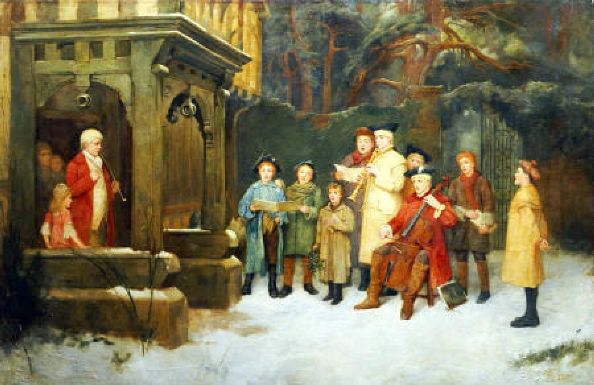
 Carol Singers William Gunning Kind


Sing Ye Carols: An Interview with Hierodeacon Herman by  • November 24, 2015 

Hierodeacon Herman (Majkrzak), Chapel Music Director and Lecturer in Liturgical Music at Saint Vladimir’s Seminary, has started a small ministry during this Nativity fast – a series of Facebook posts highlighting lesser-known hymns and carols from the Western tradition. You can enjoy his posts here: Fr. Herman’s Choral Advent Calendar. We thought this a good opportunity to ask him to share some thoughts on Western hymns and carols, and what role they can play in Orthodoxy.

A painting depicting traditional Christmas carolers in Greece

A. Gould: Father Herman, to begin please tell us about your Facebook page, “Fr Herman’s Choral Advent Calendar.”

Hdn Herman: Andrew, thanks for hosting me at Orthodox Arts Journal. I think many of your readers would be interested in checking out what I’m calling my “choral Advent calendar.” I’ve based the name for the page on the delightful old German Advent calendars where each day leading up to Christmas you open a little door that reveals a holy image or a scripture verse or the like. My page is the same idea, but each day it’s a link to a piece of choral music.  And with each day’s post, I include a description or commentary, and the text of the piece. My hope is that people will take this fast as an opportunity to listen to music attentively ­– i.e., will learn something about a piece before listening, and will listen to it with their undivided attention, while not doing anything else, and while reading along with the text.
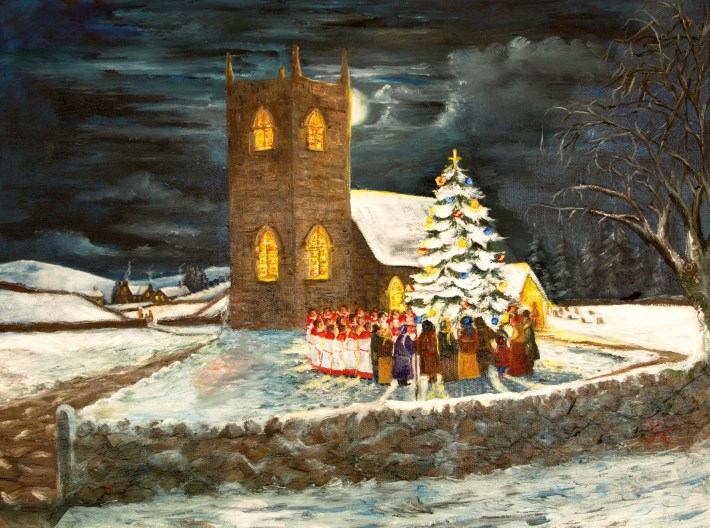
carols2

Most of the pieces I’m posting are from the repertoire of Western choral music, especially carols and hymns, the subject of this interview. I do occasionally post Orthodox liturgical music as well, and in any case the posts are following the Orthodox liturgical calendar throughout the fast. For those on the Old Calendar, I’ll be refreshing each post thirteen days later, so you can follow and be sync liturgically with your parish.

You don’t need to have a Facebook account to access the posts, but for those who aren’t on Facebook, I also have an email list – write the OAJ editor if you’d like to be added, and tell him whether you want the new calendar or the old calendar posts.
OLYMPUS DIGITAL CAMERA

A Gould: A lot of people, including Christians, tend to be fed up with Christmas music. It’s everywhere, in stores, in offices, and on the radio, and so much of it is cheap and just helps in the commercialization and secularization of this important Christian holy day. It can be easy to become cynical or jaded. You must have some thoughts on this, given how much you think about carols.

Hdn. Herman: Absolutely, Andrew. I think we should really make an effort not to be cynical about Christmas. The world has tried to spoil Christmas in so many ways, but we shouldn’t let that effort triumph in our own lives, in our own hearts.

I prefer to look at the presence of carols in stores and malls as one of the last vestiges of Christianity in the public space here in America, and I think we should value this and build on it. Yes, the carols are sometimes cheap and often annoying, but it’s not all “Jingle Bell Rock”! I’m always delighted when I go into a department store in 2015 and hear songs about Christ’s virgin birth! Even if, as is usually the case, I don’t like the musical arrangements, I’m still so happy to hear them. Some Christians complain when they start hearing carols and seeing Christmas decorations long before Christmas. Okay, maybe this is not ideal, but, you know, really I’d prefer to go into a store on November 1st and hear a song about Our Savior – or even Rudolph! – than a song about licentiousness, which is what we’re treated to the rest of the year.

Young adults today will probably be the last generation to have grown up somewhat familiar with a basic repertoire of a dozen or so famous carols: “The first Nowell,” “Hark, the herald-angels sing,” “Silent night,” “O come, all ye faithful,” “O come, O come, Emmanuel,” and the like. For many people, memories of early childhood Christmases are some of the purest and happiest of their lives, even if mixed with avarice or bitterness surrounding gifts, and those memories are bound up with carols like these. This means that for the next fifty years or so, these carols will have the potential to connect to a very special part of people’s lives. Our task as Orthodox Christians in a society increasingly post-Christian, but still having these vestiges of Christian memory, is to elevate these carols, to help them be a window through which people can experience something beautiful, something peaceful, and have even just a glimmer of joy and gratitude. This is especially our job if we are musicians. We should organize concerts with carols, and go caroling in our neighborhoods or at local hospitals and nursing homes. Let’s not let the devil have Christmas. It doesn’t belong to him.

christmas-caroling

A. Gould: You grew up as an Episcopalian, and you were an organist and singer in the Anglo-Catholic tradition before your conversion to Orthodoxy. How has your experience with Western liturgical music influenced your vocation as an Orthodox choir director?

Hdn Herman: Well, Andrew, when I think back to the time in my life, to early adolescence (not long before you and I first met), when I was moved to make a resolute commitment of my life to our Savior, Christ Jesus, it seems to me that it was liturgical music that the Lord used to open that door in my heart. Discovering the traditional canon of Western, and particularly English, church music inspired me to learn about and immerse myself in the more traditional forms of Western liturgy that that music was meant to accompany. So, for example, I will never forget the summer Sunday in 1991 or ’92 when for the first time I attended a solemn mass in the full Anglo-Catholic tradition. It’s a cliché, but it really was a life-changing experience to discover a much older, more full stream of liturgical tradition, largely unscathed by the banal impoverishments that the liturgical reform of the 60s had brought about in Western Christianity. I was twelve or thirteen, and I had discovered the joy of my life: traditional liturgical worship. It was traditional music that led me to take traditional liturgy seriously, and liturgy in turn inspired me to dip into theology in my early high school years. I read C.S. Lewis, Peter Kreeft, and other contemporary apologists, but then went further with Thomas Aquinas and collections of Patristic homilies. I even read a ten volume set of Anglican dogmatic theology by F.J. Hall. This all may seem far afield of your question, Andrew, but it’s not, really, because without this theological self-education I would probably never have become Orthodox. In my early college years I realized that I needed to have complete integrity and unanimity between these three great loves of my life: music, liturgy, and theology. I could not have one without the other two, and it is only in the Orthodox Church where they constitute an integral whole. I take my work as an Orthodox choir director seriously because I see what an irrevocable effect good church music had on me in middle school, and I think Orthodox church music has even greater potential to direct the lives of our young people today on the path of righteousness and salvation.

c


A. Gould: It is often the experience of one who converts, that at first he feels it is a complete rupture – that nothing from his old ways are compatible with Orthodoxy. But over time, we mature, and come to understand that much of what we had known in the Western Church is highly sympathetic to Orthodoxy. And we start to see that the Western and Eastern traditions are not necessarily isolated alternatives, but rather are two related sisters in the Church’s history. Each has historically depended upon the other for inspiration, and they need to do so still, if liturgical art is to remain fresh and creative. This has been my experience since my conversion, and I wonder if yours has also followed this pattern?

Hdn Herman: I think you’ve put this very well, Andrew. This is a common path for converts, and I would even say it is a necessary path, first intentionally to distinguish yourself, to set yourself apart from what the service of reception of converts calls your “former delusion,” but then, perhaps years later, to go back and reacquaint yourself with these roots, viewing them with new, Orthodox eyes.

Yes, people who convert to Orthodoxy, especially from other Christian communities, should wholeheartedly immerse themselves in and be formed by the Orthodox tradition, not just in its dogmatic and moral teachings, but in its Eastern liturgical piety, its traditions of chant, iconography, and architecture, its ascetic disciplines, its monastic ethos. (And as an aside, to really do this well, I think you need to develop some measure of affection for and familiarity with one of the cultures from which Orthodoxy came to this country and to your parish. In my case that meant the culture and faith of Russia.) This is so important, because this is the path to making Orthodoxy your own: you are completely uprooted from your previous confession, and then you’re deeply planted in the soil of the Church. And I’d say that the new convert should not be too concerned with distinguishing between what is essential and what is incidental in Eastern Orthodox practice. (And to be clear, by incidental, I don’t mean insignificant.) Such distinctions are important, and will come with time and education, but new converts are not capable of making such distinctions, really, and if they try, they may become confused and perhaps be led astray.

But later, having undergone that clear separation and having internalized the ways of one’s new home, having laid a firm foundation for one’s new identity as an Orthodox Christian, one is then able to look at traditional Western Christianity with clearer vision and with more sympathetic eyes, and one sees that there is so much there that is beautiful and true and worthy of our close attention and admiration. You’re still aware of the problems, certainly, but you no longer fixate on them. And, yes, as you say, the more you learn about Church history, the more you see that, despite the Schism, despite the dogmatic divergences, East and West have never been two isolated, watertight compartments within Christianity. It is one common culture, with its roots in the Roman Empire. There are different emphases, of course, but the family resemblances are often quite charming.

Christmas carolers, Ukraine

A. Gould: Regarding Western hymns and carols, how would you characterize their strengths and weaknesses as a liturgical art? What do they do really well, and what do they offer us that may be lacking in the Eastern choral traditions?

Hdn Herman: That’s a huge question, Andrew. I’ll come at it from a few different angles.

Let me begin by clarifying that Western carols are not, technically, liturgical. Though often sung in Church, their origin is not found in prescribed liturgical texts or chant books, but rather they arise out of the spontaneous devotion of Christian people. And such extra-liturgical or, perhaps, paraliturgical singing exists within Orthodox cultures as well: one thinks especially of the famous Russian and Ukrainian Christmas carols, transplanted and sung to this day with such great fervor by Yup’ik Orthodox in Alaska, of the Arabic carol for Lazarus Saturday, “Rejoice, O Bethany,” or of the many carols from Greece or Serbia, including 20th-century compositions by St Nektarios of Aegina or St Nikolai of Zhicha. So I’d want to rephrase your question and make it less about East and West and more about liturgical and non-liturgical.

Put in that light, I think it’s really important for us to nurture extra-liturgical expressions of our Faith, and singing together about Christ and his Incarnation is one of the best ways of doing this I can think of. People who sing together about joyful things become joyful themselves. You and I did this for hours on end when we were teenagers, and I think this should be a regular part of the lives of all Orthodox children, youths, and grown-ups. Singing hymns and carols together is much better than making playlists of rock music on Spotify or playing video games! The one draws us into the embrace of a centuries-old Christian culture, the other conforms us to the world.

Koledari Christmas Carolers, Bulgaria

So, what extra-liturgical music should Orthodox be singing? For English-speaking Orthodox, the answer is obvious: we have a tradition ready to go, we just have to make it our own! And I think it’s wonderful when we as Orthodox say, “Everything, anywhere, that is good and true and beautiful belongs to Christ and belongs to His Church, and so we will preserve it and pass it on because it is, in fact, ours.” We are the custodians of all that is good in Western Christian culture, because we are Orthodox Christians who speak a Western language and who live in the West. That’s a serious responsibility, when you think about it, and unfortunately Western Christians, with some notable exceptions, are not taking their patrimony seriously! Isn’t it ironic that we as Orthodox might pick up and treasure the Western carol tradition just as so many Western Christian denominations are turning away from their own traditional music and embracing contemporary musical forms that are shallow by comparison?

Christmas carolers, Romania

To return to your question, I probably wouldn’t say that there’s anything lacking in the Eastern choral traditions for the context in which they originate. The liturgical hymnography and chanting of, say, Slavic or Romanian or Arabic lands is complemented by a culture of pious folk singing that brings the Faith into the home. These Eastern carols are often much simpler melodies than the liturgical chants of the Church, they are composed in meters and verses that are easy to learn and remember, and so have immediate popular appeal – and yet they are also suitable for more elaborate arrangements and for performance at a very high and nuanced artistic level.


All the same things can be said of Western carols. And for English-speaking Orthodox, English carols and hymns, whether for Christmas or other seasons of the Church year, give us the unique opportunity of hearing our faith sung in poems originally written in English, hearing our faith expressed in poetic and musical forms native to our culture and our language. This is something immensely valuable. This is something that really helps us make the Faith our own as English-speakers, and it’s something that helps us elevate our Anglo-American culture so that it partakes of the Spirit of the Church and the life of Christ. The same can certainly be said about, say, French- or German-speaking Orthodox and those respective carol traditions, but I’m speaking from my own experience and vantage point as an English-speaker.

A troupe of self-described 'Hipster Carolers' in New York City.

A. Gould: Can you give an example of a carol that expresses good theology in a uniquely Western way – a carol that is wholly sympathetic to Orthodoxy, but that could never have been written in the East?

Hdn Herman: Well, I’d hesitate to say what “could never have been written in the East.” Eastern hymnography encompasses a huge variety of themes and expressions, and of course the hymnography contained in the received texts of our service books is only a fraction of the hymnography composed in the Eastern Church.

But one can readily find Western hymns and carols that express perfectly Orthodox theology, and that do so in poetic forms more familiar to the Western ear. An example that comes to mind is the majestic hymn, Of the Father’s Heart Begottena translation of the fourth century Latin hymn, Corde Natus Ex Parentis, by Aurelius Prudentius Clemens. With this and so many other early Latin hymns, not only is its content Orthodox, but so is its author, since Prudentius lived centuries before the Schism. The text has a simple, regular meter and rhyme scheme; the melody is solemn, yet lyrical and joyful – though a liturgical hymn, it demonstrates many carol-like qualities.

The text expounds the mystery of the Incarnation, beginning with the eternal begetting of the Son by the Father, moving on to the Creation of the world, and the foretelling by “seer and sybil” of Christ’s advent to bring salvation from the curse of sin and death, and arriving at the Incarnation itself, the birth of the eternal Son from his Virgin Mother. It moves forward into the future (in a verse unfortunately omitted in the linked recording), to sing of Christ’s Second Coming as Judge of creation, and concludes in an explosion of glorious praises by angels and men and all creation, singing with joy around God’s throne.

Of course, these are all themes we can find in Eastern hymnography, but perhaps what makes this hymn distinctly Western is its sweeping survey of the entire economy of salvation within one, long hymn. The focus is the Incarnation – this is a Christmas hymn – but it places that mystery in the context of the whole history of creation and beyond; indeed in its first verse it sings of Christ as the beginning and the end:

He is Alpha: from that Fountain,
All that is and hath been flows;
He is Omega, of all things
Yet to come the mystic Close,

thus, in just four pithy lines, drawing together the vast expanse of time and eternity. It does so with an allusion to the Book of Revelation (the Alpha and the Omega), which itself is uncommon in Eastern hymnography, since that book is not part of the lectionary of the Eastern Rite.

Christmas carolers, Ukraine

A. Gould: The English-language translations of Orthodox hymnography currently available are disappointing with regard to poetic language, and the tones to which they are usually sung are disappointing with regard to melody. Most of our hymnography, as sung in American churches, compares negatively to the elegance of great English hymns. Do you think that, over time, with better translation and better musical settings, it will be possible to sing Orthodox hymnography with this kind of poetic refinement and fitting melody?

Hdn Herman: Good questions. You’re asking both about the chant melodies used for our stichera, troparia, and other hymns, and also about the English translation of these texts. There’s not much I have to say about the melodies themselves. When sung beautifully, and in their most authentic forms, they are beautiful, and I don’t think inventing a new body of chant melodies ex nihilo would ever gain much traction. Whether working with Byzantine chant or one of the Slavic chant families, our job as choir directors and singers is to sing stichera sensitively and reverently. The temptation in Russian chant, certainly, is to make a caricature out of these sacred melodies, in each musical phrase racing through the recitation, and then dragging out the ending as if somehow to compensate for how fast one had just been singing. Often the hymn is not pointed well to begin with, with phrases that are too long to be sung meaningfully, or divided at the wrong part of the sentence, or with emphases put on unimportant words, where they could with slight adjustment be used to bring out more substantive words. If there is an area of Western church music that could inspire us to sing Russian chant more sensitively, it would be Anglican Chant, with its flexible, recitation-based melodies used by English cathedral choirs for the singing of Psalms. But one cannot simply imitate the style of Anglican Chant when singing Kievan Chant – the result could be quite comical. This is a difficult subject to articulate.

Malankara Orthodox Christmas Carolers in Abu Dhabi, U.A.E.

Regarding English translations, this is a can of worms, but impossible to avoid. The English language culturally is not in good shape at the beginning of the third millennium, alas. I’m reminded of a letter written by poet W.H. Auden to his parish priest (Auden was an Episcopalian) probably in the early 70s:

Our Church [i.e., the Anglican Church] has had the singular good-fortune of having its Prayer-Book composed and its Bible translated at exactly the right time, i.e., late enough for the language to be intelligible to any English-speaking person in this century (any child of six can be told what ‘the quick and the dead’ means) and early enough, i.e., when people still had an instinctive feeling for the formal and the ceremonious which is essential in liturgical language.

This feeling has been, alas, as we all know, almost totally lost. (To identify the ceremonious with ‘the undemocratic’ is sheer contemporary cant.) The poor Roman Catholics, obliged to start from scratch, have produced an English Mass which is a cacophonous monstrosity (the German version is quite good, but German has a certain natural sonority): But why should we imitate them?

Well, lucky for us Orthodox, many of our translators did not feel they needed to “start from scratch,” but produced solid English translations that built on the wording and the spirit of Jacobean liturgical English. The difficulty is that neither the Prayer Book nor the Bible gives us models of how to render the florid rhetoric of Byzantine hymnography in English. I think that Metropolitan Kallistos’s translations (though some may disagree with certain word choices here and there, naturally), do the best job of any translation of bringing together the style of traditional liturgical English (admitting of some careful and limited modernization) and the text of Byzantine hymns. I wish he had gone on to complete Mother Mary’s draft of the Octoechos and Pentecostarion!

When we look to the tradition of the English translation of Latin carols and hymns, we see that they are almost always translated metrically, i.e., according to the original Latin meter, so that they can be sung to the same melody, which is composed to fit the text like hand in glove. This is also how the liturgical books prepared by Holy Transfiguration Monastery in Brookline translate Byzantine hymnography, because they intend them to be sung to Byzantine melodies composed for the Greek texts. But a metrical translation is always a paraphrase, and sometimes this can be problematic. In any case, when translating for Russian chant, fidelity to the Greek meter is not required, since Russian chant melodies are by nature expandable and contractible, so as to allow for more or fewer syllables per phrase, as needed.

In general, I would love to see a greater poetic sensitivity in our liturgical translations, but one that is rooted in the tradition of English scriptural and liturgical translation that stretches back to the sixteenth century—this too is part of our patrimony as English-speaking Orthodox! However, there are many who strongly disagree with me, thinking that we should create our own style of liturgical texts using 21st century literary English style as the starting point. I take Auden’s approach here: ours is not the right era for this, because we have lost that “instinctive feeling for the formal and the ceremonious which is essential in liturgical language.” By the way, this principle Auden articulates is nothing new, but was present even in the earliest liturgical translations from Greek to Latin. This has been demonstrated by the linguistic historian Christine Morhmann.

Carolers in Bucharest, Romania, 1929

A. Gould: Is there a way for Orthodox churches to incorporate Western hymnography into their worship? There has always been some paraliturgical music in Orthodox services – hymns that are commonly used in local traditions, but which do not appear in the service books. Why should English-speaking churches not use old English hymns as paraliturgical anthems? Can you give us your thoughts on this question, and maybe some practical suggestions?

Hdn Herman: I’d be very cautious about this, actually. There is not really any open slot in our services for paraliturgical hymns, with the possible exception of the time during the Communion of the clergy at Divine Liturgy. There are those who argue that only the prescribed Communion Psalm should be sung at this time, but given that so many of our people rarely attend Vespers and Matins, I often will sing stichera during Communion, rather than repeating Psalm 148 every Sunday. If paraliturgical hymns are sung during Communion, I believe they should only be hymns by Orthodox hymnographers, either ancient (including pre-Schism Western hymns), or modern.  After the dismissal of a service, as during the veneration of the Cross after Liturgy, I would be comfortable with later Western carols or hymns. I once saw a video of Christmas Liturgy from Christ the Savior Cathedral in Moscow in which they sang Russian translations of Western Christmas carols during the veneration of the Cross. (I specifically recall hearing “Angels we have heard on high…”) I think this is good.


Christmas Vespers at the Cathedral of Christ Our Savior, Moscow, 2013

A parish can also sing carols during coffee hour or parish meals, at Holy Supper on Christmas Eve, or following a class or lecture. And parishioners should organize carol sings in their homes too, as well as in neighborhoods, downtown shopping areas, and nursing homes, hospitals, and prisons. All these possibilities embody the goal of letting our devotion to God flow out of Church and into our daily lives. Families could sing a different carol together each night after dinner during the Nativity fast and up through the end of the festal season.

A project I’ve been thinking about for some time is to compile several dozen of the best Christmas carols (both familiar and less-well-known) for use by Orthodox communities, carefully choosing which versions of each carol to use, to bring out the richest content. So many Protestant hymnals, unfortunately, have meager selections, missing verses, or poor harmonizations, or have altered the words for political reasons… but at present, as a convenient resource, I recommend finding a used copy of the Hymnal 1940 from the Episcopal Church. It’s quite solid, and unlike most Protestant hymnals it includes many hymns from the pre-Schism West – the old Gregorian office hymns, many of which are quite ancient.

A. Gould: Father Herman, you’ve given our readers much to think about. Do you have any closing comments?

Hdn Herman: I do indeed, Andrew! You’ve got me on a roll. Just a few final words about music more generally, as it relates to the life of the spirit and the life of the Church.

Our culture is drowning in music; many people are to some extent addicted to having music playing in the background throughout their day, and much of that music does not edify but draws us away from Christ in subtle or sometimes blatant ways, to say nothing of the resulting absence of silence. With the choral advent calendar, I’m trying to give people an opportunity to be more intentional about their music, and to help folks find music which can warm their hearts and help them draw near to God.

Christmas carolers, Poland

Now, taking the next step, and not just listening to good, Christ-centered music, but singing it: this is really important for Orthodox Christians in America. Our young people especially should be singing much more than they are, both in Church and at home (and hopefully at school too). Parents with any musical ability should make this a regular part of their family time, and children with any musical ability should have the formal study of music, especially piano and singing, as a central part of their education – required, not optional.

Why do I insist on this? Not only because Orthodox Churches across North America are in desperately dire need of proficient singers and choirmasters, but also because this can be such an important element in basic human developing and flourishing. And it’s on this subject that I’ll close, leaving you with a few words by Fr. Seraphim (Rose) of Platina:

The education of youth today, especially in America, is notoriously deficient in developing responsiveness to the best expressions of human art, literature, and music, as a result of which young people are formed haphazardly under the influence of television, rock music, and other manifestations of today’s culture (or rather, anti-culture); and, both as a cause and as a result of this – but most of all because of the absence on the part of parents and teachers of any conscious idea of what Christian Life is and how a young person should be brought up in it – the soul of a person who has survived the years of youth is often an emotional wasteland, and at best reveals deficiencies in the basic attitudes towards life that were once considered normal and indispensable …

Sometimes a spiritual father will deny his child the reading of some spiritual book and give him instead a novel of Dostoevsky or Dickens, or will encourage him to become familiar with certain kinds of classical music, not with any “aesthetic” purpose in mind – for one can be an “expert” in such matters and even be “emotionally well-developed” without the least interest in spiritual struggle, and that is also an unbalanced state – but solely to refine and form his soul and make it better disposed to understand genuine spiritual texts.

The entire article is well worth reading, but can best be summed up by the grace-filled words of St. Paul: “Finally, brethren, whatever is true, whatever is honorable, whatever is just, whatever is pure, whatever is lovely, whatever is commendable, if there is any excellence, if there is anything worthy of praise, think about these things.” (Phil. 4:8)

So, thanks, again, Andrew, and may you and all your readers have a very blessed Nativity fast!

A. Gould: Thank you, Father Herman.

Source: Orthodox Arts Journal at http://www.orthodoxartsjournal.org/sing-ye-carols-an-interview-with-hierodeacon-herman/

Fr. Herman’s Choral Advent Calendar Curated daily posts of (mostly Western) choral music and carols for the Nativity Fast, Christmas, and Theophany, each with brief introduction and text. http://www.svots.edu/


An Icon Making An Icon!

Christ Pulls St-Peter from the Waters. Jonathan Pageau

Christ Pulls St-Peter from the Waters. Linden and gilding. 4′ x 5′. Carved by Jonathan Pageau.

Since I began icon carving full time 4 years ago now, I had a secret list of the things I wanted to make, certain objects and images that were dear to me.  To my own joy and surprise, I have been progressively checking off items from that list with ongoing commissions, making even those objects and icons I did not think could find patrons such as complex reliquarieswedding crownsopus sectile icons or the image of the Holy prophet Jonah.

One of the images I had secret hope of making is Christ pulling St-Peter out of the water. For those who have read some of my writings one can quickly see how it encompasses so much of my vision of the incarnation, of death, resurrection and the pastoral reminder on where to focus our eyes when advancing into the chaotic world.  So last year, when a patron commissioned this icon at a size of 4’ x 5’ for St. Peter Orthodox Church in Bonita Springs, Florida, I was ecstatic.   This is the biggest icon I have carved to date.

In working out the drawing for the icon carving, I based the composition on my favorite version of this event, a 12th century mosaic from Sicily.

peter-drowning2

Many details are different, but the basic composition is the same. I reduced the size of the boat to make it less overwhelming and to fully have St-Peter under the boat.  I also wanted to make sure we could see at least the eyes of all the Apostles.  I changed Christ’s left hand so that instead of holding a scroll, it was placed in a position suggesting the upcoming motion, the rising of St-Peter.  I also added a few details, such as a dragon head on the boat and I changed the shape of the mast and sail to suggest a Chi-Ro.

Drawing process of St-Peter on water

One of the things that kept changing as I worked on the drawings was just how deep Peter was in the water.  The priest of the parish, fr. Hans Jacobse, commented that he really wanted the water to be high up on his body to give that sense of sinking, but this created some challenges for me because I still wanted us to see St-Peter.  Wood is generally opaque to say the least. In the mosaic version, there is wonderful use of transparency and so I began pondering just how it could be possible to at least suggest transparency in wood.

Final scaled drawing. The level of water on St-Peter will still change in the final carving.

Icon in process, attempting to find ways to show the transparency of water.

I wanted the composition of the water to say something about the event and so beyond suggestions of transparency to show that St-Peter is actually in the water, I also designed it so to have a wave wrapping around his right foot in an image of the Psalms:

The cords of death entangled me; the torrents of destruction overwhelmed me. The cords of the grave coiled around me; the snares of death confronted me. (Psalm 116:3)

The water under Christ’s feet in contrast seems to shoot out from under them, organized by their contact with them. I gilded some of the water to add to this sense of the organizing and transfiguring effect Christ has on creation.

IMG_1319

IMG_1320

Visually, I was looking forward to taking further the experimentation in carving water I had begun in my icon of Jonah. I wanted to create a sense of almost overwhelming movement which would contrast with the vigorous yet safe relationship established between Christ and St-Peter. Christ holds St-Peter by a firm grip, reminding us of the grip Christ has on Adam in the icon of the resurrection. Their gazes are fixed on each other, Peter with a hint of surprise and Christ with calm compassion.

IMG_1317

IMG_1321

IMG_1318

When Christ appears to the Apostles floating at sea, the waters are rising in a tempest. Christ approaches them above the flood, mastering the chaos, the chaos of the primordial waters, the chaos of the passions, of doubt, of all that is in the world of death. St-Peter is the only one to dare walk out with Christ, but because of this boldness, when peering into the storm he panics and sinks. Which one of us has not experienced this? We can imagine St-Peter crying out:

Save me, O God, for the waters have come up to my neck. I sink in the miry depths, where there is no foothold. (Psalm 69: 1,2)

But the face of Christ appears to him through the waves and his hand reaches to catch him. We can hear St-Peter confess:

He lifted me out of the slimy pit, out of the mud and mire; he set my feet on a rock and gave me a firm place to stand. (Psalm 40:2)

This is St-Peter, the son of Jonah, both the stable “rock” and the one who sinks, the bold fisherman who finds the gold coin in the fish’s mouth, but also that one in constant danger of being swallowed by the sea.

This is his story repeated over and over in the Gospels, the story of the one who recognized Jesus as Christ then immediately called out by Christ to “get behind me Satan”, the one who tells Christ he will never deny him then deny him three times as the three days of Jonah in the fish, the three days of Christ in the grave. To meditate on this cycle in the story of St-Peter is to pierce so many mysteries of the Church, so many signs of the times and so many cycles in our own lives.

What is the end of this, what is the end of this story? When Christ appears to the disciples on the Sea of Galilee after his resurrection (John 21), it is the same sea in which St-Peter sank when attempting to walk on water. St-Peter recognizes his Lord on the land, and this time he does not walk on the water. This time his boldness leads him to dive into the deep, to put on his garment and voluntarily plunge, then to be asked three times by Christ: “Peter, son of Jonah, do you love me?” It is not when we walk on the water that we are closest to Christ, but it is when our boldness serves humility. It is when our boldness leads us to die that we are closest to the image of Christ. What impossible thoughts to consider, what scandal it is to fathom such things?

Coming back to our icon, we can say without hesitating that the image of St-Peter being pulled out of the waters is an image of our salvation in so many ways, and I find great joy in having made it.  I hope it will be a blessing for the parish to which it is headed.

IMG_1328

IMG_1327

IMG_1325

IMG_1324


Process of Icon Carving


11216208_1034801319877257_8246492179151514650_o (1)

885642_1035012216522834_2520325151194419110_o

10835272_1037492579608131_5789311249143712612_o

10915106_1045760318781357_6860956537237390303_o

1512254_1048973031793419_3333873536351898288_o

1401985_1066397040051018_9109354896291323811_o

11010944_1069297396427649_4612781722797446725_o

10854886_1124019347622120_4514934908847813528_o

CommentsAndrew Gould A masterpiece of the highest order. Astonishing! My favorite detail is the Viking-like prow on the ship – a pagan monster fleeing the sanctification of the waters. And a bit of an iconographic curiosity – a wood carving depicting a wood carving.” John Tkachuk  An icon making an icon!

Source: Icon Carving of Christ Pulling St-Peter from the Water by  Orthodox Arts Journal http://www.orthodoxartsjournal.org

Pillars To Heaven: Stylites in the Levant

stylitis14

CIS:E.445-1965

stylitis20stylitis18

St. Symeon Stylites

By Lord Alfred Tennyson


Altho’ I be the basest of mankind,

From scalp to sole one slough and crust of sin,

Unfit for earth, unfit for heaven, scarce meet

For troops of devils, mad with blasphemy,

I will not cease to grasp the hope I hold

Of saintdom, and to clamour, morn and sob,

Battering the gates of heaven with storms of prayer,

Have mercy, Lord, and take away my sin.

Let this avail, just, dreadful, mighty God,

This not be all in vain that thrice ten years,

Thrice multiplied by superhuman pangs,

In hungers and in thirsts, fevers and cold,

In coughs, aches, stitches, ulcerous throes and cramps,

A sign betwixt the meadow and the cloud,

Patient on this tall pillar I have borne

Rain, wind, frost, heat, hail, damp, and sleet, and snow…(1)

stylites34

Interview About Stylites (2)

stylitis11

Qala’at Si’man. Ruins of the Basilica of St. Simeon the Elder, Deir Sim’an, Syria (3)


RTE: Lukas, will you describe your archeological work, and how you became interested in the stylites?

LUKAS: … My interest in monasticism in general has led me to a very particular interest in stylitism (stylos, in Greek, meaning “column”), the ascetics who stood on pillars. Although we often think of stylitism as a very unique and lonely calling, in its developed form it cannot be separated from monasticism. The stylite withdrew from the world, but in doing so in such a spectacular way, he attracted the world. And as soon as people began coming for advice or counsel, he needed dedicated friends or disciples to organize his life – to make sure he was protected, that he would be given the hours of silence he needed, and that the people coming to see him were taken care of.

stylitis4

The stylite himself is generally seen as a Syrian-Mesopotamian phenomenon, a very severe attempt to follow Christ not only through self-mortification and fasting, but through standing on a tiny platform at the top of an exposed column or pillar – never coming down, and only rarely sitting or lying down. By exposing themselves to the harshest conditions any human can, they strove to be spiritually cleansed and to elevate their souls.

stylites30

stylitis9

What we know about the stylites comes from Greek and Syriac texts, some written when the stylites were still alive, and many of which relate the history of the most famous pillar saint, St. Simeon the Stylite (the Elder), who died in 459. Within twenty years after his death, the famous pilgrim- age sanctuary and later medieval fortress of Qal’at Si’man was built. As Christians, we would call it “The Martyrium of St. Simeon the Stylite.”

stylites31

St. Simeon the Elder is the prototype, he was the one who was imitated. Of his life we have very specific evidence in both Greek and Syriac sources, although it is the Syriac which give the best descriptions. They tell us that he was a very ascetic man, and that at a certain point in his life he joined a monastic community. At a very early stage, however, it became clear that he was much more rigorous than the other brothers and finally had to leave to pursue his calling.

stylitis7

St. Simeon moved north of the mountain of Gebel Sheikh Barakat, to a village called Telanissos (now Deir Sim’an), at the foot of the mountain where his sanctuary was later built. (Gebel is “mountain” in Arabic, and it is now known as Gebel Sim’an.) The Syriac sources say that he lived a very basic life. We read of him taking a camel laden with goods up and down the road, and that wherever he went people were impressed by this humble, modest man. At a certain point he decided to go up the mountain to expose himself to the harshness of the wilderness.

stylitis10

Don’t forget, we are in northern Syria where winters may be very, very cold and summers extremely hot with strong winds. Simeon was very aware that this place was exposed to harsh weather conditions year round. However, it is also a very beautiful place, with a 270o view in several direc- tions, and not far from the village and the Roman road. If you take the old north-south Roman road from Cyrrhus, forty or fifty kilometers north, down towards Telanissos (now Deir Sim’an) to the junction that links you to Antioch in the west, you’ve passed between Telanissos and Gebel Sim’an.

stylitis2

So, we know that he was here not far from the main road, that he stood on the column without a break, summer and winter, for almost fifty years; that he was famous for his asceticism, for his suffering endurance, but also for the very social role he played in giving advice and counsel to the local population, to those who passed on the roads, to distant nomadic Arab tribes that came for his judgement and help, and even to the Byzantine emperor. We know he was constantly asked for personal, moral, and even legal advice (and this is important because legal matters in those days were very linked to religion, as in modern Islam.) So, St. Simeon was a man for everyone and everything.

DCF 1.0

But he soon found himself in the dilemma of having withdrawn from the world, but now being too close to the world. Pilgrims, as we know from the sources, came from far and wide. They came from all over the Mediterranean: by boat to Antioch, then crossing the rough country to Simeon’s column. They came from Seleukia, from Asia Minor, from the Arabian peninsula, from Europe. As time went on, he decided to add anoth- er ten cubits to his column, and then another, until finally according to the Syriac text, he was standing at a height of forty cubits. (40 cubits = 60 feet or 18 meters)

stylites37

RTE: I remember from his Life that he didn’t begin with a pillar – perhaps he had gone up the mountain simply because it was isolated and he knew that other people couldn’t conveniently live there. But the moment they understood that he was a holy man they came anyway, as people do, until the crowds were trying to touch him, to grab pieces of his clothing. I’ve wondered if perhaps he had even taken a vow to remain there and the pillar was simply a necessary measure to get out of their reach.

stylites36

LUKAS: Yes. I think it was the universal dilemma of an isolated holy man. Once you are holy you often become known and can’t avoid people seeking bless- ings. The holy man is like a magnet. But permanent exposure to the world puts your monastic ideals at risk because you don’t have the time of reclusion, of absolute silence, of being alone with God. So, adding to the column’s height was perhaps an attempt to maintain his original ideal of a life of prayer.

stylites38

RTE: Also, the noise of a constant crowd – in St. Simeon’s case it was not a handful, but hundreds of people a day from different countries with horses, pack animals, campfires. Some stayed for weeks. It must have been overwhelming.

stylites40

(1) For the full poem go to http://www.online-literature.com/tennyson/728/

(2) For the full two-day traveling interview through the Syrian desert, where Lukas’ command of archeological detail and his fascinating insights (both Christian and academic) into the daily lives of these great ascetics make the era come alive, its saints immediate, and their presence inescapable, go to http://www.roadtoemmaus.net/back_issue_articles/RTE_22/PILLARS_OF_HEAVEN.pdf

(3) The church of Saint Simeon Stylites dates back to the 5th century. The United Nations Educational, Scientific and Cultural Organization (UNESCO) designated it a World Heritage Site in 2011.

stylites39

* Austrian archeologist Lukas Schrachner’s extensive fieldwork centers on early Christian monasteries and stylite sites in Turkey, Syria, Lebanon, Jordan, and Egypt. The Levant in the present context is the region occupied by Palestine, Trans-Jordan, Lebanon, Syria and south-eastern Turkey.


Voronet Sistine Chapel

voronet1voronet2voronet4


Tucked in the small village of Voroneț, Romania, you can find the great Romanian Orthodox Voroneț Monastery, one of a string of “painted monasteries” in Romania, Moldova, and Ukraine, built mostly in the 15th and 16th centuries. Voroneț Monastery specifically was built in 1488 over a period of 3 months and 3 weeks (!), and is dedicated to St. George. The monastery was abandoned around 1775 due to political instability, and a monastic community didn’t return until more than two hundred years later in 1991. The building is famous for its beautiful frescoes and icons, both inside and out, which is how it got its nickname as the “Sistine Chapel of the East.”

Voronet-blue1voronet-blue4voronet-blue12voronet-blue9voronet-blue6voronet-blue5voronet-blue7

The frescoes at Voroneț feature an intense shade of blue known in Romania as “Voroneț blue”. “The exterior walls — including a representation of the Last Judgment on the west wall — were painted in 1547 with a background of vivid cerulean blue. This blue is so vibrant that art historians refer to Voroneț blue the same way they do Titian red. Monastery of Voronet has been declared World Heritage by UNESCO.  Below are some great photos of the beautiful sacred building. Enjoy!

voronet-blue2Remus Pereni, Flickrglobetrotter_rodrigo, Flickrglobetrotter_rodrigo, FlickrJoergsam, Wikipediaglobetrotter_rodrigo, Flickrglobetrotter_rodrigo, FlickrAdam Jones Adam63, WikipediaIone.pomana, WikipediaGroundhopping Merseburg, FlickrSîmbotin, WikipediaGroundhopping Merseburg, Flickr

Watch “Monastery Voroneţ” documentary at https://www.youtube.com/watch?v=l1buejr72eY

voronet-blue10Groundhopping Merseburg, FlickrGroundhopping Merseburg, Flickr

Source: “The Sistine Chapel of the East”: Romania’s Beautiful Voroneț Monastery http://www.churchpop.com/2015/10/06/the-sistine-chapel-of-the-east-romanias-monastery/