Love all; Pray for all; Weep for all; Repent for all
Starets Zosima, St Silouan the Athonite and St Isaac the Syrian on Salvation of all the World
For St Silouan there is a single and undivided mystery of salvation, at once personal, pan-human and cosmic: everything, like the ocean, flows and enters into contact with everything else. There can be no disagreement between our personal salvation and the salvation of the world. The two form a unity. Our own salvation is necessarily linked to the salvation of every other human being, for ‘our brother is our life’. At the same time, the transfiguration of us humans inaugurates the transfiguration of the cosmos. Not without reason, on the last page of Fr Sophrony’s book on the Starets, do we find a prayer that is all-embracing in its scope:
O Lord, give unto us this love throughout Thine whole universe (504)
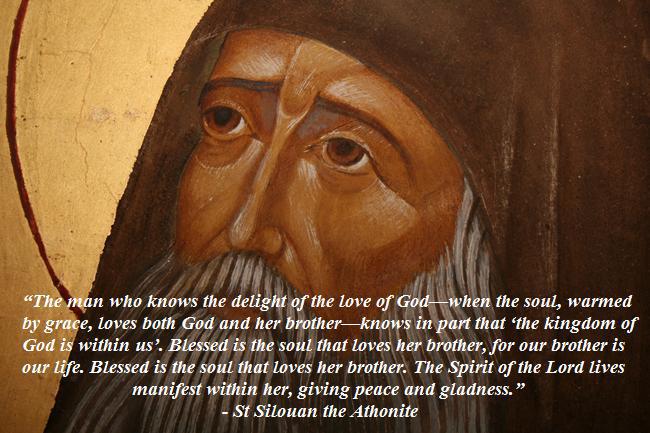
We Must Pray for All: The Salvation of the World According to St Silouan
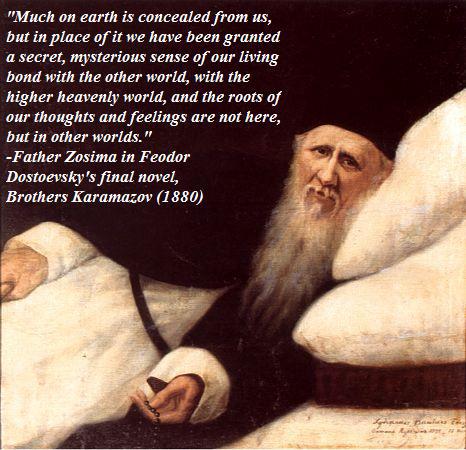
‘Love all creation’, says Starets Zosima in Fyodor Dostoevsky’s novel The Brothers Karamazov:
Love all creation, the whole of it and every grain of sand within it. Love every leaf, every ray of God’s light. Love the animals, love the plants, love everything. If you love everything, you will perceive the divine mystery in things.
This ‘divine mystery’ of which Starets Zosima speaks is precisely the interdependence, the reciprocal coinherence, of all created things in God.
Everything, like the ocean, flows and enters into contact with everything else: touch one place, and you set up a movement at the other end of the world.
Such is Dostoevsky’s vision of cosmic unity. The created world constitutes an individual whole, and so the salvation of each individual person is inextricably bound up with the salvation of all humankind and, yet more widely, with the salvation of the entire universe. ‘We are members of one another’ (Ephesians 4:25) needs to be given the broadest possible application. It is not only we humans who depend on each other as the limbs of a single body; but we have bonds of kinship with the animals as well, and also with trees and plants, rocks and earth, air and water. We live in them, and they in us.
Precisely the same sense of cosmic unity is expressed by St Silouan the Athonite:
He who has the Holy Spirit in him, to however slight a degree, sorrows day and night for all mankind. His heart is filled with pity for all God’s creatures, more especially for those who do not know God, or who resist Him and therefore are bound for torment. For them, more than for himself, he prays day and night, that all may repent and know the Lord (352).
The Lord bestows such rich grace on His chosen that they embrace the whole earth, the whole world, with that love (367).
Archimandrite Sophrony, in his book on Starets Silouan, sums up the teaching of the Starets on cosmic coinherence in these words:
The life of the spiritual world, the Staretz recognized as one life and because of this unity every spiritual phenomenon inevitably reacts on the state of the whole spiritual world (101).
We shall not be distorting the meaning of the Starets – or that of Fr Sophrony – if we give to these words an all-inclusive scope: instead of saying ‘the spiritual world’ and ‘every spiritual phenomenon’, we can correctly say ‘the createdworld’ and ‘every phenomenon’. As Fr Sophrony states elsewhere, St Silouan believed that each person who truly prays to God ‘integrates everyone into his own eternal life whatever the geographical distance or the historical time between them’ (233). Indeed, he integrates not only every person but every thing. Nothing is alien to him. In Dostoevsky’s words, ‘Everything, like the ocean, flows and enters into contact with everything else.’
Despite the striking parallels between the Russian novelist and the Athonite monk, it is highly unlikely that St Silouan had ever read Dostoevsky. More probably, the similarities arise because both are shaped by the same living tradition, and both are drawing on the same sources. St Silouan (almost certainly) and Dostoevsky (possibly) have been influenced by a Mesopotamian hermit of the seventh century, St Isaac the Syrian, who writes in a famous passage of his Ascetical Homilies:
What is a merciful heart? It is a heart on fire for the whole of creation, for humanity, for the birds, for the animals, for demons, and for every created thing. At the recollection and at the sight of them such a person’s eyes overflow with tears owing to the vehemence of the compassion which grips his heart; as a result of his deep mercy his heart shrinks and cannot bear to hear or look on any injury or the slightest suffering of anything in creation. This is why he constantly offers up prayer full of tears, even for the irrational animals and for enemies of truth, even for those who harm him, so that they may be protected and find mercy.
What exactly does Starets Silouan mean when, faithful to the teaching of St Isaac, he affirms that the saints ‘embrace the whole earth, the whole world, with their love’? Let us note the all-embracing love and prayer that constitute our true vocation as human persons. There is first his firm conviction that God calls every human being to salvation. Secondly, there is his conception of the ‘total Adam’ and, linked with this, his insistence that my neighbour is myself. Thirdly, there is his firm assurance that in God’s total plan it is not only human beings but the entire cosmos that is to be redeemed and transfigured.
‘Divine love desires salvation for all’
‘It was particularly characteristic of Staretz Silouan to pray for the dead suffering in the hell of separation from God’, writes Fr Sophrony, and he goes on to recall an exchange that he overheard between the Starets and a somewhat dour hermit:
I remember a conversation between him and a certain hermit, who declared with evident satisfaction, ‘God will punish all atheists. They will burn in everlasting fire.’
Obviously upset, The Staretz said:
‘Tell me, supposing you went to paradise and there looked down and saw somebody burning in hell-fire – would you feel happy?’
‘It can’t be helped. It would be their own fault,’ said the hermit.
The Staretz answered him with a sorrowful countenance:
‘Love could not bear that,’ he said. ‘We must pray for all’ (48).
This universal intercession commended by St Silouan, so far from being sentimental or Utopian, has on the contrary a clear Scriptural foundation: ‘God desires everyone to be saved and to come to the knowledge of the truth’ (1 Timothy 2:4). This is the key text that the seventeenth-century Arminians invoked when opposing the strict Calvinist doctrine of double predestination; this is the text that inspired the dynamic missionary preaching of John Wesley in the eighteenth century; and this is equally a saying that the twentieth-century Athonite keeps steadfastly in view:
My soul longs for the whole world to be saved (291)…. Divine love desires the salvation of all (328)…. The Lord’s is such that He would have all men to be saved (368)…. Our one thought must be that all should be saved (379)…. The merciful Lord sometimes gives the soul peace in God but sometimes makes the heart ache for the whole universe, that all men might repent and enter paradise (426).
According to St Silouan, this burning desire for the salvation of all humankind is to be found to a supreme degree in the Mother of God, the Blessed Virgin Mary:
She, like her beloved Son, desired with her whole heart the salvation of all (406)…. She loved mankind and prayed ardently… for the whole world that all might be saved (365).
The fact that God desires the salvation of all does not of course mean that our salvation is automatic and inevitable. As the Letter to Diognetus states, ‘God persuades, He does not compel, for violence is foreign to Him.’God’s call to salvation comes in the form of an invitation, which we on the human side are free to accept or to reject. But, although the response varies, the call is universal.
St Silouan’s belief that God does indeed desire the universal salvation of the human race can be summed up in four short injunctions: love all; pray for all; weep for all; repent for all.
(1) Love all. When as a young monk, attending a service in the Church of the Holy Prophet Elijah, St Silouan received a vision of Christ (26), the effect of this vision was to flood his soul with ‘a rare feeling of love for God and for man, for every man’ (34). This all-embracing love remained with him throughout his life: ‘Love cannot suffer a single soul to perish’, he wrote many years later (272). Comprehensive love of this kind he saw as par excellence the characteristic of the saints (not that he would have made any claim to be himself numbered among them):
The holy saints have attained the Kingdom of Heaven, and there they look upon the glory of our Lord Jesus Christ; but by the Holy Spirit they see, too, the sufferings of men on earth. The Lord gave them such great grace that they embrace the whole world with their love (396).
This ardent love, as the Starets envisages it, extends beyond the living to the dead and to those not yet born. In Fr Sophrony’s words:
In seeking salvation for all men love feels impelled to embrace not only the world of the living but also the world of the dead, the underworld and the world of the as yet unborn – that is, the whole race of Adam (108).
For St Silouan, as we have seen from his conversation with the dour hermit, this love for our fellow-humans includes even hell within its scope. Expounding the teaching of the Starets, Fr Sophrony writes:
Dwelling in heaven, the Saints behold hell and embrace it too in their love (116).
This is possible for them, because the love that is at work in their hearts is nothing else than the love of God Himself; and God’s love is present everywhere – even in hell:
God is present in hell, too, as love (115)…. Even in hell Divine love will embrace all men, but, while this love is joy and life for them that love God, it is torment for those who hate Him (148).
In the words of Vladimir Lossky, ‘The love of God will be an intolerable torment for those who have not acquired it within themselves’
In thus teaching that the power of love extends even to hell, the Starets is once more following St Isaac the Syrian:
Even those who are punished in Gehenna are tormented with the scourging of love. The scourges that result from love – that is, the scourges of those who realize that they have sinned against love – are harder and more bitter than the torments which result from fear…. The power of love works in two ways: it torments those who have sinned, just as happens here on earth; but those who have observed its duties, love gives delight. So it is in Gehenna: the contrition that comes from love is the harsh torment; but in the case of the sons of heaven, delight in this love inebriates their souls.
‘The power of love works in two ways’: what the saints in heaven feel as joy, those under condemnation in hell experience as intense pain. But it is the same divine love that is present in them both.
If those in hell are not deprived of God’s love, if they are embraced also by the love of the saints, may it not still be possible for them to respond to this love that surrounds them on every side? Is there not still a hope that they may ultimately be saved? St Isaac certainly seems to have believed in universal salvation:as a member of the Church of the East, dwelling safely beyond the confines of the Byzantine Empire, he had no reason to fear the anti-Origenist anathemas of the Fifth Ecumenical Council (553).
What of St Silouan? Fr Sophrony maintains that the Starets was no Origenist (109), and I agree with him. St Silouan insists that our loving intercession should extend even to those in hell, we are to sorrow ‘over those who are not saved’ (377) and to weep for those ‘who do not know God’ (386). Further than this, however, he does not go. With characteristic reticence, he avoids all speculation about a final apocatastasis. He does not attempt to specify who can be saved and who cannot; that is a mystery known at present only to God. For his part he answers only with the words, ‘ I do not know’:
Father Cassian used to say that all heretics would perish. I do not know about this – my trust is only in the Orthodox Church (483).
When reflecting on the possibility that in the Age to Come there may be some who remain for ever unreconciled, burning in hell-fire, the Starets says simply, ‘Love could not bear that.’ Further than this he does not go.
What of the demons? Might they also be saved, and in that case should we not pray also for them? St Isaac the Syrian, as already noted, affirms that the merciful heart is ‘on fire’ with compassion for the demons, but he does not actually say that we should pray for them. St Silouan speaks in similar terms. We are to ‘pity’ the demons, but nothing is stated about intercession on their behalf:
The Spirit of God teaches love towards all, and the soul feels compassion for every being, loves her enemies and pities even devils because they have fallen away from God (469).
The Starets was emphatically a man of the Church; and so, if asked whether we may legitimately pray for the demons – Fr Sophrony does not in fact record any occasion when he was so asked – surely his answer would have been that the Church has no such practice; and in all such matters we must follow the Church’s rule of prayer. But at the same time it is not for us to set limits to the divine mercy.
(2) Pray for all. Love and prayer go together; if, then, we are to love all human persons, this signifies that we are also to pray for them. So the Starets writes:
I pray Thee, O Merciful Lord, let all mankind, from Adam to the end of time, come to know Thee (319)…. I will pray for the whole human race, that all people may turn to the Lord and find rest in Him (328)…. I beseech Thee, O Lord, let all peoples come to know Thee (332).
The Starets quotes with approval the words of an ascetic monk with whom he once talked:
Were it possible I would pray everyone out of hell, and only then would my soul be easy and rejoice (468).
‘Were it possible’: the Starets does not say that it actually is possible. The Starets sees this all-inclusive intercession as the proper and characteristic vocation of the monk.
The constant prayer for others constitutes the monk’s way of serving society as a whole:
Thanks to monks, prayer continues unceasing on earth, for through prayer the world continues to exist…. When there are no men of prayer on the earth, the world will come to an end…. The world is supported by the prayers of the saints (407-8).
In this connection Fr Sophrony refers appropriately to the sixth-century elder St Barsanuphius of Gaza, who asserts that in his day there were three men who through their prayers were preserving the whole human race from catastrophe (223). Barsanuphius mentions the names of the first two, who significantly are otherwise unknown to the annals of history. He does not say who the third was, presumably because God had revealed to him that it was Barsanuphius himself.
By thus praying for the world, the monk not only helps the Church and human society at large, but he also helps himself. Here the Starets describes his own experience as a monastery steward. Most monks consider that this particular ‘obedience’ renders it impossible to preserve continual prayer and inner peace, for it involves contact with large numbers of people throughout the day. Starets Silouan disagrees. If the steward will only intercede constantly for those under his charge, saying ‘The Lord loves His creation’, all will be well: he will find that he is freed from distractions and can maintain an uninterrupted remembrance of God (418).
In the monk’s relationship with the world, St Silouan distinguishes a double movement. First, through prayer the monk withdraws into himself, shutting out the world, gradually liberating himself from visual imagery and discursive thinking, and so entering into the image-free stillness of the heart. But then, within the depths of his own heart, he rediscovers his solidarity with all humankind and with the whole creation. So the monk’s flight from the world turns out to be not world-denying but world-affirming. In the words of Fr Sophrony:
In his longing for God he ‘hates’ the world and retires totally into the depths of his own heart. And when he does so totally, in order there to do battle against Satan, in order to cleanse his heart from every single passion, in the depths of this heart of his he meets with God, and in God begins to see himself indissolubly linked with the whole of cosmic existence; and then there is nothing alien, nothing that is extraneous to them.
As St Silouan observes, ‘True, Arsenius the Great was bidden to “shun” people but in the desert, too, the Spirit of God teaches us to pray for people and for all the world (296).
(3) Weep for all. True prayer cannot but be costly; loving intercession involves an inner martyrdom, a willingness on our part to accept suffering. As St Silouan says, ‘Praying for people means shedding blood (236); ‘The greater the love, the greater the suffering’ (338). It is not enough simply to read lists of names; we are required to intercede with tears of sorrow. ‘Pray for all’ means ‘Weep for all’:
My heart aches for the whole world, and I pray and shed tears fro the whole world, that all may repent (341)…. My soul weeps for the whole world (371)…. O Lord, grant me tears to shed for myself, and for the whole universe’ (385).
(4) Repent for all. St Silouan would have us go yet further on the path of mutual coinherence. Not only are we required to weep for all, but we should also repent for all. In his view this is part of what St Paul meant when he said, ‘Bear one another’s burdens, and in this way fulfil the law of Christ’ (Galatians 6:2). As Fr Sophrony points out, if viewed in purely juridical terms the notion of vicarious repentance – of laying one person’s guilt upon another – makes no sense; it is simply ‘not fair’. But the love of Christ is not limited to juridical norms:
The spirit of Christian love speaks otherwise, seeing nothing strange but something rather natural in sharing the guilt of those we love – even in assuming full responsibility for their wrong-doing. Indeed, it is only in this bearing of another’s guilt that the authenticity of love is made manifest and develops into full awareness of self (120).
Adam’s fall consisted precisely in his refusal to accept that he too was involved in the guilt of Eve’s sin. ‘Adam denied responsibility, laying all the blame on Eve and on God who had given him this wife’, and so he shattered the unity of the human race. If only, instead of justifying himself, he ‘had taken upon his shoulders the responsibility for their joint sin, the destinies of the world might have been different’ (121). We in our turn, when we refuse to repent for others, are repeating Adam’s sin, thus making his fall our own.
Strange though this concept of vicarious repentance may seem to most modern readers, it has in fact an excellent Patristic pedigree. One author who expresses this idea in strong terms is St Mark the Monk (?early fifth century):
The saints are required to offer repentance not only on their own behalf but also on behalf of their neighbour, for without active love they cannot be made perfect…. In this way the whole universe is held together in unity, and through God’s providence we are each of us assisted by one another.
‘Adam, our father’
St Silouan’s consuming desire for the salvation of all stands out in yet sharper relief when we take into account his teaching about what may be termed the ‘total Adam’. This is not, I think, a phrase that he himself employs, but it accurately sums up his point of view.
For St Silouan, Adam is ‘our father’ (451), the ‘father of all mankind’ (448). Following St Paul (1 Corinthians 15:22, 45), the Starets sees Adam the first-formed man as the collective head of the human race, containing and recapitulating within himself the whole of humankind. There are obvious parallels here between St Silouan and St Irenaeus of Lyon, even though the Starets was probably unfamiliar with the Irenaean writings. This solidarity and recapitulation in Adam renders all human persons ‘consubstantial’ and ‘ontologically one’, as Fr Sophrony puts it (123, 51, 217). This ontological unity is not merely abstract and theoretical but specific and actual, ‘for the whole Adam is not an abstraction but the most concrete fullness of the human being’, to quote Fr Sophrony once more (222). It was the denial of this ‘consubstantiality’ that constituted, as we saw earlier, the essence of Adam’s fall.
This unity in the ‘total Adam’ is movingly expressed in the best-known of all St Silouan’s writings, ‘Adam’s Lament’ (448-56). Here the Starets takes up and develops in his own way the liturgical texts for the Sunday before Lent, the ‘Sunday of Forgiveness’, on which the Orthodox Church commemorates the expulsion of Adam from paradise. In particular he has used the ikos appointed for that day:
Banished from the joys of paradise, Adam sat outside and wept, and beating his hands upon his face, he said: ‘I am fallen, in Thy compassion have mercy on me.’…
O paradise, share in the sorrow of thy master who is brought to poverty, and with the sound of thy leaves pray to the Creator that he may not keep thy gate closed for ever. I am fallen, in Thy compassion have mercy on me.
As we read St Silouan’s prose-poem ‘Adam’s Lament’, it becomes clear that this is the lament not just of Adam but of Silouan himself, and not of him alone but of the whole human race. Adam’s sorrowful repentance is our repentance also:
The soul that has lost grace yearns after the Lord, and weeps as Adam wept when he was driven from paradise (326)…. O Lord, grant unto us the repentance of Adam (271).
Nor is this all. It is the lament not of humankind alone but of the entire creation, for all created things are involved in Adam’s fall:
Thus did Adam lament,
And the tears streamed down his face onto his beard,
onto the ground beneath his feet,
And the whole desert heard the sound of his mourning.
The beasts and the birds were hushed in grief (449).
Lo, the whole earth is in travail (452).
The sin of Adam is cosmic in its effects, destroying as it does the primal harmony that prevailed between humans and the rest of creation. So Adam exclaims in his ‘Lament’:
In paradise was I joyful and glad:
the Spirit of God rejoiced me,
and suffering was a stranger to me.
But when I was driven forth from paradise
cold and hunger began to torment me.
The beasts and the birds that were gentle
and had loved me turned into wild things,
and were afraid and ran from me (455).
Because of our solidarity in the ‘total Adam’, writes Fr Sophrony, all of us share in Adam’s guilt (120). This does not mean that either he or St Silouan would endorse an Augustinian doctrine of original sin, in a fully developed form. But it does mean that, united as we are as members of a single human family, we are each of us ‘responsible for everyone and everything’, to use the phrase of Starets Zosima in The Brothers Karamazov. Yet, if we are subject to a solidarity in guilt, we enjoy egually a solidarity in salvation: in the words of Khomiakov, ‘No one is saved alone.’My personal salvation is bound up with the salvation of the entire human race, and indeed of the whole creation. Fr Sophrony neatly illustrates this interdependence in both sinfulness and salvation by recounting a conversation that he once heard between two Athonite monks:
The first said,
‘I cannot understand why the Lord does not grant peace to the world even if only a single person implored him to do so.’
To which the other replied,
‘And how could there be complete peace in the world if but a single malicious man remained?’ (200)
This understanding of the ‘total Adam’ means that, on each occasion when we say the Lord’s Prayer, we offer it not only on our own behalf but on behalf of everyone. As Fr Sophrony says, ‘When we pray “Our Father” we think of all mankind, and solicit the fullness of grace for all as for ourselves’. St Gregory of Nyssa emphasizes this same point when he states that, since we ‘share in Adam’s nature and therefore share also in his fall’, in consequence the petition in the Lord’s Prayer, ‘Forgive us our trespasses’, is something that we offer for Adam’s sake as well as for our own.This fits exactly with St Silouan’s line of thought.
On the basis of this theology of the ‘total Adam’, the Starets is able to give a particularly powerful interpretation to Christ’s command, ‘You shall love your neighbour as yourself’ (Matthew 19:19). I am able to love my neighbour as myself, because by virtue of the unity of all humankind in ‘Adam our father’, my neighbour is myself. I am likewise to pray for others as I pray for myself: ‘All my desire’, says St Silouan, ‘is to learn humility and the love of Christ, that I may offend no man but pray for all as I pray for myself (350: italics in the original). In the same way the suffering of the other is my suffering, and my neighbour’s healing is healing for me as well; ‘my brother’s glory will be my glory also.’ ‘If one member suffers, all suffer together with it; if one member is honoured, all rejoice together with it’ (l Corinthians 12:26).
This leads St Silouan to affirm in a strong and literal sense that my neighbour’s life is my own: ‘Blessed is the souls that loves her brother, for our brother is our life’ (371: italics in the original). For the one who prays, says Fr Sophrony,
The existence of mankind is not alien and extraneous to him but is inextricably bound up with his own being…. Through Christ’s love all men become an inseparable part of our own individual, eternal existence (47).
Christ has taken up the ‘total Adam’ into Himself and has suffered for him; we therefore should take up into ourselves ‘the life of all mankind’, looking upon every other person as our ‘eternal brother’:
Each of us must, therefore, take heed not only for himself but for this single whole (47-48).
So it is that, according to the Starets, ‘in his deep heart the Christian after a certain fashion lives the whole history of the world as his own history’; for ‘no man is alien to him’ (234).
Exactly because my neighbour is myself, because my brother’s life is my own, I am required to love my enemies.
Only in the light of St Silouan’s teaching on the ‘total Adam’ can we truly appreciate the crucial importance that he attached to love for enemies. I am to love my enemy, because my enemy is myself; I am the other whom I regard as my enemy. His life is mine, and mine is his. Love for enemies is a direct corollary of our mutual coinherence in ‘Adam, our father’.
‘Weep with me, forest and desert’
Sin and salvation, however, are not merely human in scope, but they also involve the entire created order. When Adam fell, the whole creation fell with him; and by the same token our human salvation will inaugurate the salvation of the total cosmos. As Fr Sophrony puts it, ‘Every saint is a phenomenon of cosmic character’ (223). We are not saved from but with the world.
This cosmic understanding of sin and salvation has a firm basis in Scripture. St John the Baptist, for example, greets Jesus with the words, ‘Behold the Lamb of God, who takes away the sin of the world’ (John 1:29). The Forerunner does not say ‘the sins’, but he says ‘the sin’ (in the singular) ‘of the world’. Beyond the personal sins of individual humans, there is a deeper sinfulness that involves the world as a whole. St Paul in his turn states that the entire created universe is at present ‘in bondage to decay’ and ‘groans as if in pangs of childbirth’, waiting ‘with eager expectation for the revealing of the children of God’. When we humans enter into our ‘glorious liberty’ in Christ, then the whole creation will also be set free (Romans 8:19-22). Our fall, that is to say, entails the fall of all creation, and our redemption will likewise bring liberation to creation as a whole. The New Testament concludes with a comprehensive vision not only of a ‘new heaven’ but of a ‘new earth’ as well (Revelation 23:1).
The same understanding of the cosmic dimensions of Christ’s saving work finds expression in the service books of the Church. Let us take as an example a text with which St Silouan was certainly familiar: the ‘Praises’ or ‘Encomia’ recited at Matins on Great Saturday in front of the Epitaphion depicting the dead Christ laid out for burial.[17] In the first place the ‘Praises’ emphasize that Christ’s death and resurrection bring forgiveness and new life to all the human race:
Uplifted on the Cross, Thou hast uplifted with Thyself all living people; and then, descending beneath the earth, Thou raisest all that lie buried there.
Stretched out upon the Wood, Thou hast drawn us mortals to unity; pierced in Thy life-giving side, O Jesus, Thou art become a fountain of forgiveness unto all.
We notice how the atonement is not selective but universal in its scope. But the ‘Praises’ go further than this, proclaiming that Christ’s death upon the Cross has transformed the entire created order:
The whole creation was altered by thy Passion: for all things suffered with Thee, knowing, O Word, that Thou holdest all in unity.
This is a remarkable statement, but it does not stand alone. The ‘Praises’ return frequently to the theme of this all-inclusive co-suffering:
Though Thou wast shut within the narrowest of sepulchres, O Jesus, all creation knew Thee as true King of heaven and earth.
The whole earth quaked with fear, O Word, and the daystar hid its rays, when thy great Light was hidden in the earth.
Of old the lamb was sacrificed in secret; but Thou, longsuffering Saviour, wast sacrificed beneath the open sky and hast cleansed the whole creation.
O hills and valleys, the multitude of humankind, and all creation, weep and lament with me.
The sun and moon grew dark together, O Saviour, like faithful servants, clothed in black robes of mourning.
Come, and with the whole creation let us offer a funeral hymn to the Creator.
The whole earth mourns with us humans for the dead Christ laid in the tomb; and to an equal degree the whole earth is raised to new life, along with us humans, through the Saviour’s resurrection from the dead. Paschal salvation extends beyond the human realm to the world of nature, involving animals, trees, hills and valleys, sun and moon, and the totality of the material creation.
Faithful to this all-inclusive understanding of Christ’s redemptive work, the Starets believes that our personal salvation is integrally connected with the salvation of the whole world. The precept ‘Love all’ means that we are to love the entire creation: humans first, but also animals, plants, and each and every part of nature. Ours is to be a ‘love without limits’, to borrow the title of one of Fr Lev Gillet’s books. We are to feel ‘compassion for the whole universe and every living creature… a love for every one of God’s creatures’, says St Silouan. ‘Weep for all’ means that ‘you will shed abundant tears for your fellow-man and for every thing that hath breath, and all creation’ (427). ‘When the soul learns love of the Lord, she is filled with compassion for the whole universe (443); and when she mourns for the withdrawal of God’s grace she calls on all creation to lament with her:
Weep with me, forest and desert. Weep with me, every creature created by God, and comfort me in my grief and sorrow (365).
In St Silouan’s teaching concerning the bonds that unite us humans to the rest of creation, there are three points that I find particularly interesting:
(1) The Starets underlines the spiritual value of the human body. While he adopts a negative attitude towards the passions, he is fundamentally positive in his estimate of our human physicality. We are to hate, not our bodies as such, but the sinfulness that corrupts them. In its present fallen state the body may appear to us as our adversary, but in its true and natural condition, as originally created by God, it is our helper and our friend. God calls us to a total sanctification:
The Light of the Lord will be in the souls and minds and bodies of the Saints (290)…. The Holy Spirit pervades the entire man – soul, mind and body (353) (italics in the original).
Advancing on the spiritual way, a person becomes ‘sensible’, consciously aware, of the grace of the Holy Spirit in body as well as soul (283); the ninth of the ten ‘rewards’ that the monk receives from God ‘even here on earth’ is that ‘he feels the grace of God in his body, too’ (501)/ ‘The man with grace in soul and body knows perfect love’ (368).
‘Perfect love’, then, leads to the transfiguration of the body:
The fourth and perfect kind of love for God exists when a man possesses the grace of the Holy Spirit in both soul and body. His body is then hallowed, and after death his earthly remains become relics (343).
The Starets mentions from his own experience an instance of bodily glorification:
At Vespers during one Lent at the Monastery of Old Russikon-on-the-Hill the Lord allowed a certain monk to see Father Abraham, a priest-monk of the strict rule, in the image of Christ. The old confessor, wearing his priestly stole, was standing hearing confessions. When the monk entered the confessional he saw that the greyhaired confessor’s face looked young like the face of a boy, and his entire being shone radiant and was in the likeness of Christ (403-4).
In this way St Silouan’s theology of the human person is firmly holistic. Divine grace embraces the total person, soul and body together; the body is deified along with the soul. This has an immediate relevance for his attitude to the material creation. It is through our bodies that we relate to our physical environment, which passes within us and becomes part of us through the exercise of the five senses. If, then, sanctification involves not only our soul but our physical nature, it follows that through our body we can experience the material world as holy, and through our body we can in turn transmit holiness to the material world around us. Our body is the essential intermediary between our inward being and the world of nature; and, because our body can be filled with grace, it is clear that our own sanctification forms a single mystery with the redemption of the material creation.
As a monk of the strict Athonite tradition, St Silouan had been formed by an austere physical discipline. But never did he interpret this ascetic self-denial in a dualistic sense. The monk’s aim, in the words of St John Climacus, is precisely ‘a body made holy’. He seeks the sanctification of the body, not its destruction.
(2) St Silouan gave careful thought to our relationship as humans with the animals. This is only to be expected. He had grown up in an agricultural community. The Holy Mountain which then became his monastic home abounds in living creatures, in birds, butterflies, snakes and jackals, and also (at any rate in the days of the Starets) in wolves and wild boar, not to mention the domestic animals, the horses and mules, that the monasteries used to keep in great numbers before the advent of the tractor and the jeep. Animals were his constant companions.
His attitude towards them is marked by two characteristics: by loving compassion and by realism. He displays both gentleness and detachment. Loving compassion inspires him to write:
Once I needlessly killed a fly. the poor thing crawled on the ground, hurt and mangled, and for three whole days I wept over my cruelty to a living creature, and to this day the incident remains in my memory….
One day, going from the Monastery to Old Russikon-on-the- Hill, I saw a dead snake on my path which had been chopped in pieces, and each piece writhed convulsively, and I was filled with pity for every living creature, every suffering thing in creation, and I wept bitterly before God (469).
At the same time the Starets urges us not to grow unduly attached to animals, and not to bestow on them the love that we ought rather to give to God and to our fellow-humans:
Feed animals and cattle, and do not beat them – in this consists man’s duty of kindness towards them; but to become attached, to love, caress and talk to them – that is folly for the soul (470).
‘I left that passage out from the first English edition,’ Fr Sophrony once said to me. ‘I knew the English would never be able to understand that.’
Incidentally, St Silouan nowhere suggests that there is anything intrinsically sinful in eating animal flesh. As an Athonite monk he would not have eaten meat, but there are many days in the year when the monastic rule permits fish. There was even a time, so he tells us, when he had to struggle against an almost obsessive desire to consume fish (470-1). If the monk abstains from meat, this is for ascetic and disciplinary reasons, not because meat-eating is in itself wrong. Indeed, the Orthodox Church had never advocated vegetarianism as a general principle.
St Silouan’s compassion for the suffering of animals did not make him lose sight of the truth that God has given this world to us humans for our use. Man, as he puts it, is the ‘supreme creation’ (376). In Fr Sophrony’s words, ‘The world itself was created for man.’ Of course this does not in any way justify a cruel and selfish exploitation of our natural environment. On the contrary, in our enjoyment of the world, we are to show the utmost humbleness and sensitivity. God has indeed given us ‘dominion’ over the animals (Genesis 1:28), but dominion does not signify tyranny.
(3) The compassionate love of St Silouan extends beyond animals to plants: ‘Hurt not the earth, neither the sea, nor the trees’ (Revelation 7:3). On one occasion when the two of them were walking together, Fr Sophrony struck out with his stick at a clump of tall wild grass. The Starets said nothing, but he shook his head doubtfully; and at once Fr Sophrony was ashamed (94). In his own writings St Silouan says:
That green leaf on the tree which you needlessly plucked – it was not wrong, only rather a pity for the little leaf. The heart that has learned to love feels sorry for every created thing (376).
The Spirit of God teaches the soul to love every living thing so that she would have no harm come to even a green leaf on a tree, or trample underfoot a flower of the field. Thus the Spirit of God teaches love towards all, and the soul feels compassion for every being (469).
Thus cosmic compassion, this sense of our human responsibility towards the whole of creation, makes the Starets very much a saint of our own time, living as we do in an era of global pollution. His words, written over half a century ago, are marked by prophetic insight. With good reason the Ecumenical Patriarchate of Constantinople, in the timely statement on Orthodoxy and the Ecological Crisis published in 1990, includes St Silouan the Athonite among the witnesses that it cites, along with the Prophet Isaiah, St Isaac the Syrian and Dostoevsky.
Yet there is a tension, even a paradox, in St Silouan’s attitude towards the created order. He urges us to ‘love every created thing; and emphasizes the beauty of nature:
From my childhood days I loved the world and its beauty. I loved the woods and green gardens, I loved the fields and all the beauty of God’s creation. I liked to watch the shining clouds scurrying across the blue sky (286).
If we lose our sense of wonder before the beauty of nature, so he believed, this suggests that we have at the same time lost our sense of God’s grace (96).
On the other hand, the Starets maintains that the true monk ‘forgets the world’ (501). So he writes:
After I came to know my Lord, and He made my soul His prisoner, everything changed, and now I no longer want to contemplate the world (286)…. My soul… has no wish to look upon this world, though I do love it (381)…. My soul is filled with love of Thee and knows no desire to look upon this world, beautiful though it be (284).
Such is St Silouan’s order of priorities. However much we value the beauty of the creation, we should feel an incomparably greater love for God the Creator.
* * * *
For St Silouan, then, there is a single and undivided mystery of salvation, at once personal, pan-human and cosmic: everything, like the ocean, flows and enters into contact with everything else. There can be no disagreement between our personal salvation and the salvation of the world. The two form a unity. Our own salvation is necessarily linked to the salvation of every other human being, for ‘our brother is our life’. At the same time, the transfiguration of us humans inaugurates the transfiguration of the cosmos. Not without reason, on the last page of Fr Sophrony’s book on the Starets, do we find a prayer that is all-embracing in its scope:
O Lord, give unto us this love throughout Thine whole universe (504)


 Detail from Descent into Hades














 ORTHODOX CHRISTIAN FAITH AND LIFE