Solomon, I have outdone thee!

An excellent documentary and a unique website featuring the grandest Byzantine church of them all, “Hagia Sophia”, Church of the Holy Wisdom in Istanbul, Turkey  


agia1

Iconographer and Russian historian launches unique website featuring “Hagia Sophia,” Church of the Holy Wisdom

agia2

agia5

 agia4

agia6     agia9

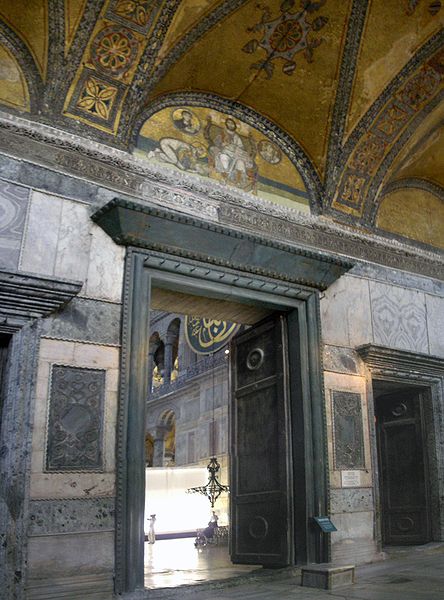
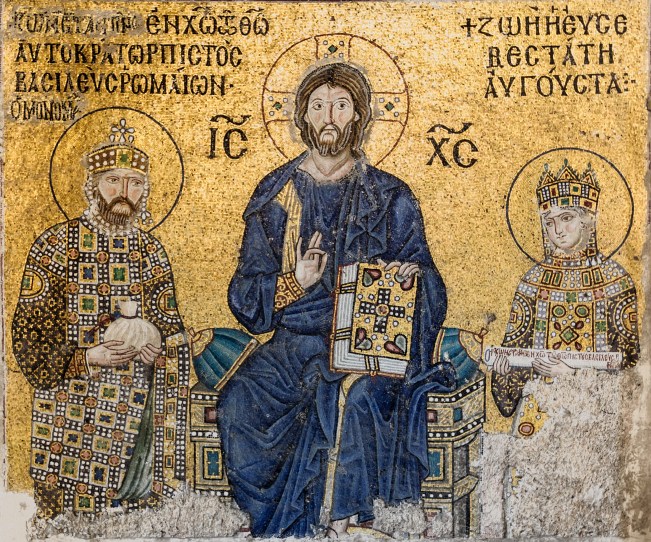
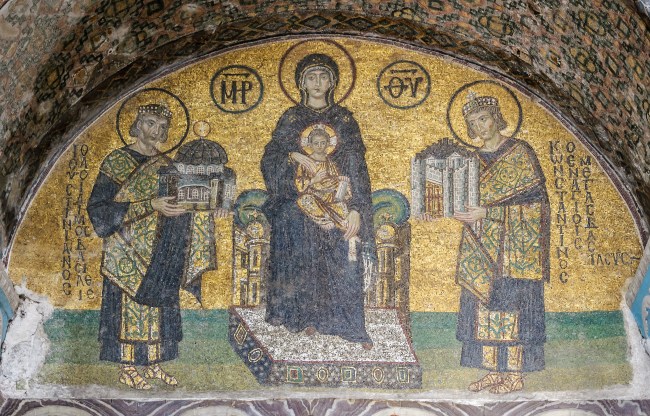
Mosaïque de l'impératrice Zoé, Sainte-Sophie (Istanbul, Turquie)    Mosaïques de l'entrée sud-ouest de Sainte-Sophie (Istanbul, Turquie)

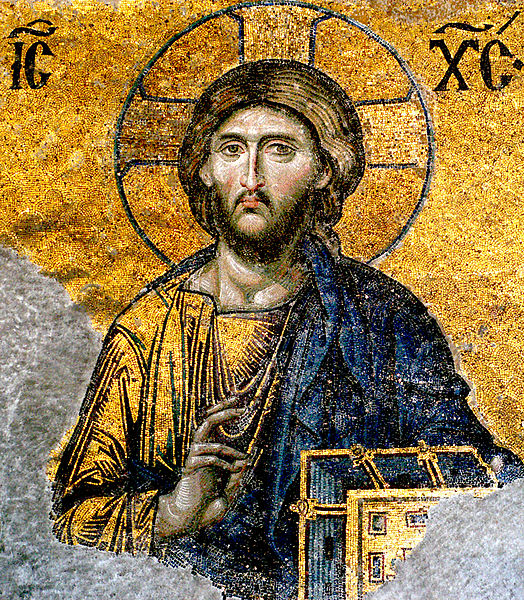
Deisis

An interesting new site illustrating the history of Constantinople’s Church of the Holy Wisdom  popularly known as “Hagia Sophia”  recently appeared on the internet.

A “must visit” for Orthodox Christians, especially those interested in Church history, iconography, mosaics, and ecclesiastical architecture, the site gives special attention to the magnificent “Deesis” mosaic in the church’s south gallery.  Depicting Christ flanked by the Theotokos and Saint John the Forerunner, the exquisite mosaic was uncovered in the 1930s.  It is one of the world’s most beloved images of Our Lord.

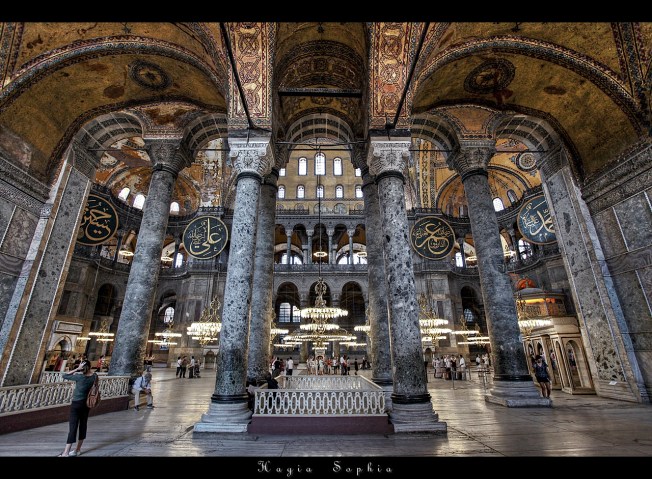
Built by the Byzantine Emperor Justinian in the early sixth century, Hagia Sophia replaced two earlier churches, the first built in 380 AD.

* In the time of Justinian, it had a thousand clergy and in Neara, Herakleion, there is a catalogue listing in the 7th century 600 people, consisting of “80 priests, 150 deacons, 40 deaconesses, 70 sub-deacons, 160 lectors, 25 cantors, and 75 door-keepers”.

http://pemptousia.com/2016/01/haghia-sophia-such-ecstasy-can-never-be-forgotten/

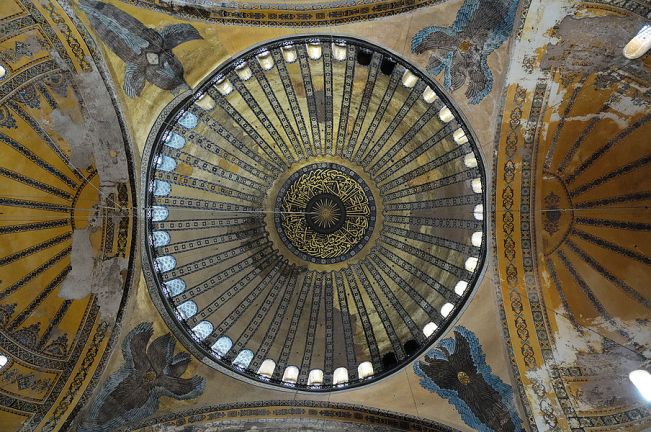
It is an engineering marvel, inasmuch as its massive freestanding central dome  the world’s largest of its kind  has withstood everything from earthquakes to invasions for 1500 years.  After the fall of Constantinople in 1453 AD, it became a mosque.  Its current status  that of a state museum  dates back to the early 1900s.

The site is the work of Bob Atchison, an iconographer and Russian historian from Seattle, WA who now lives in Austin, TX.  His interest in Hagia Sophia, and especially it’s Deesis mosaic, dates back to his childhood.

The site, which includes invaluable historical information, illustrations, maps and plans, and original photographs not readily found elsewhere, is of special interest to Orthodox Christians in general, and specifically to those desiring deeper insights into Orthodox Church history, iconography, liturgy, and ecclesiastical architecture.

*
When Justinian had finished the construction he supposedly proclaimed, “Solomon, I have outdone thee!”

*
The site may be accessed here : http://www.pallasweb.com/deesis


Source: http://oca.org/news/oca-news/iconographer-and-russian-historian-launches-unique-website-featuring-hagia

Archangel Ethiopian Manuscript

A selection of folios from an illuminated manuscript of 17th century Ethiopia, produced during the cultural boom, especially in painting, brought about by the establishment of a permanent court at Gondar by the Solomonic emperor Fasilädäs (who reigned 1632-67). The nearly 50 full-page illuminations of this particular manuscript tell the story of the Archangel Michael who, under the patronage of Emperor Zär’a Ya’eqob, had became the most venerated of all archangels in Ethiopia. He is depicted undertaking a vast host of miracles and heroic feats including saving the faithful from the burning flames of hell, healing the sick and treading on Satan. The illustrations can also teach us about the Ethiopia of the time. According to The Walters Art Museum, “the minutely rendered textiles in these pictures suggest a connection with the fashions of the Gondarine court and indicate that the painters depicted their scriptural subjects using a visual language rooted in contemporary culture.”

Left – Above: How Astaraniqos slept on his bed using the picture of St. Michael as a pillow; Below: How a blacksmith toiled in making a panel for the picture of St. Michael. Right – Above: How Satan flew away like a raven/crow when Euphemia showed him the picture of St. Michael; Below: How Satan came (again) looking like four women and St. Michael trod on him.
Left – St. Michael rescues the faithful from the flames of Hell. Right – The Faithful Rescued by Saint Michael in Paradise.
The Archangel helping Hezekiah of Judah defeat Sennacherib of Assyria.
The Archangel paying tribute to Adam.
The Archangel casting an evil spirit from his church.
The Archangel healing a sick woman.
The Archangel helping seafarers.
The Archangel healing a Jew.
The Archangel helping Susanna preserve her purity.
The Archangel rescuing the Three Holy Children.
The story of Qison continues.
The Archangel rescuing the child from drowning.

Source: The Public Domain Review

Nikola Saric’s ‘Windows’

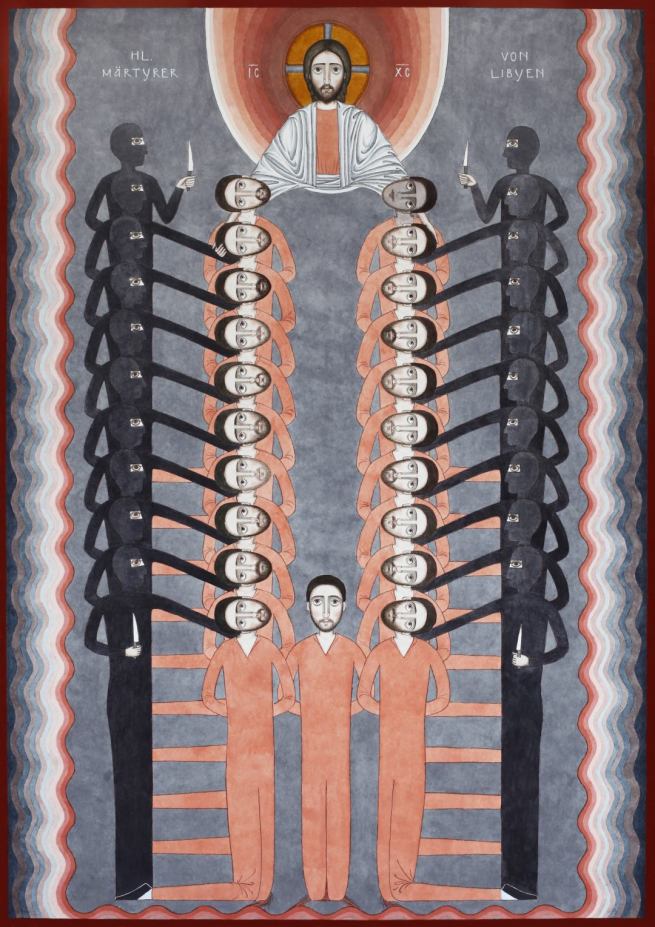
21 martyrs

Holy Martyrs of Libya (21 christians killed by IS terrorists)

*

saric3

Behold the man! The vision and the glory of God.
(Adam from the cycle “Testimonies”, detail)

*

christ

“I am the Alpha and the Omega, the First and the Last, the Beginning and the End.”
Revelation 22:13

*

saric5

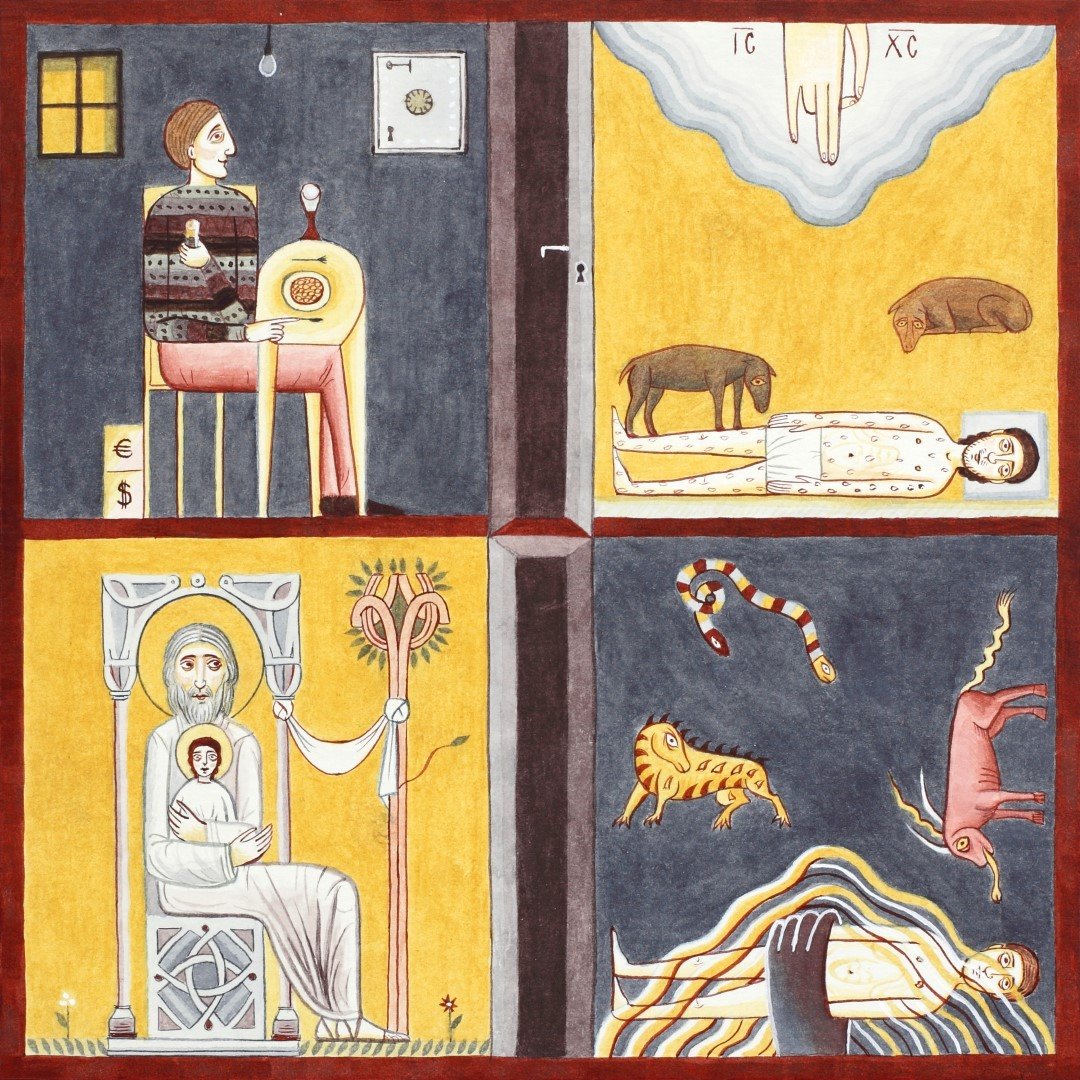
Parable of the Rich Man and Lazarus (Lk 16:19-31), from the cycle “Earthly stories with a heavenly meaning: Parables of Christ”, 2014

*

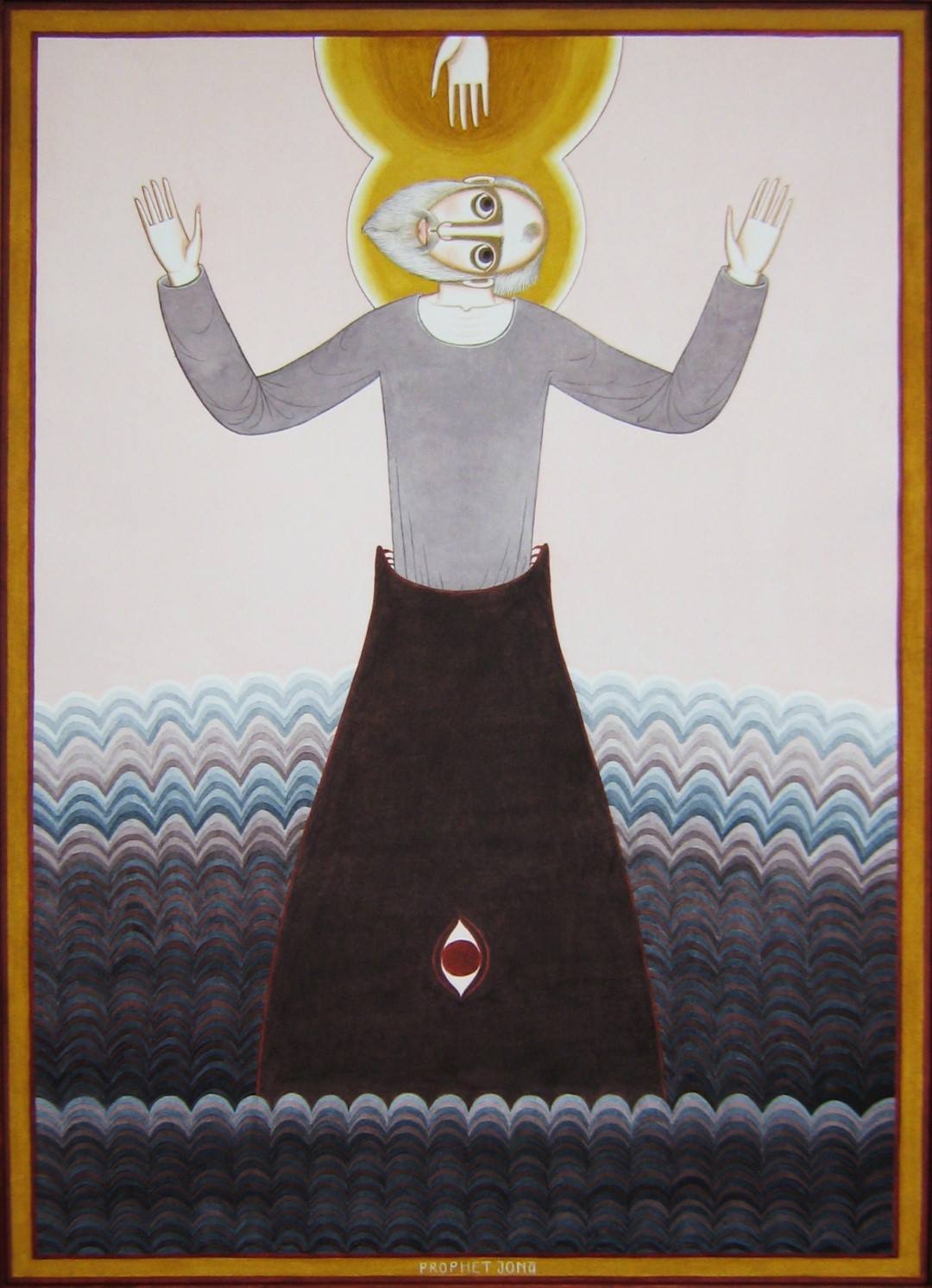
Jonah

“A wicked and adulterous generation asks for a sign! But none will be given it except the sign of the prophet Jonah. For as Jonah was three days and three nights in the belly of a huge fish, so the Son of Man will be three days and three nights in the heart of the earth. (Mt 12:39-40)”

*

myrrh

Jn 12:1-11; Lk 7:36-50

*

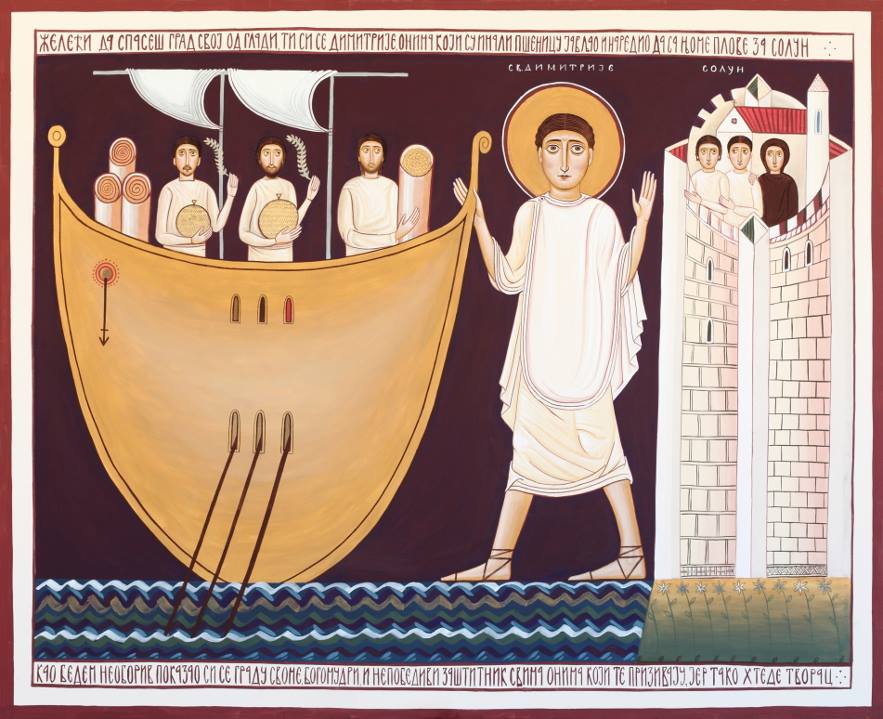
St Demetrios

Akathist to St. Démétrios de Thessalonique, Kontakion10 / Oikos 10

*

saric10

Akathist to St. Démétrios de Thessalonique– Kontakion 6/ Ikos 6, Nikola Saric, 130×160 cm, acrylic on canvas, 2009

*

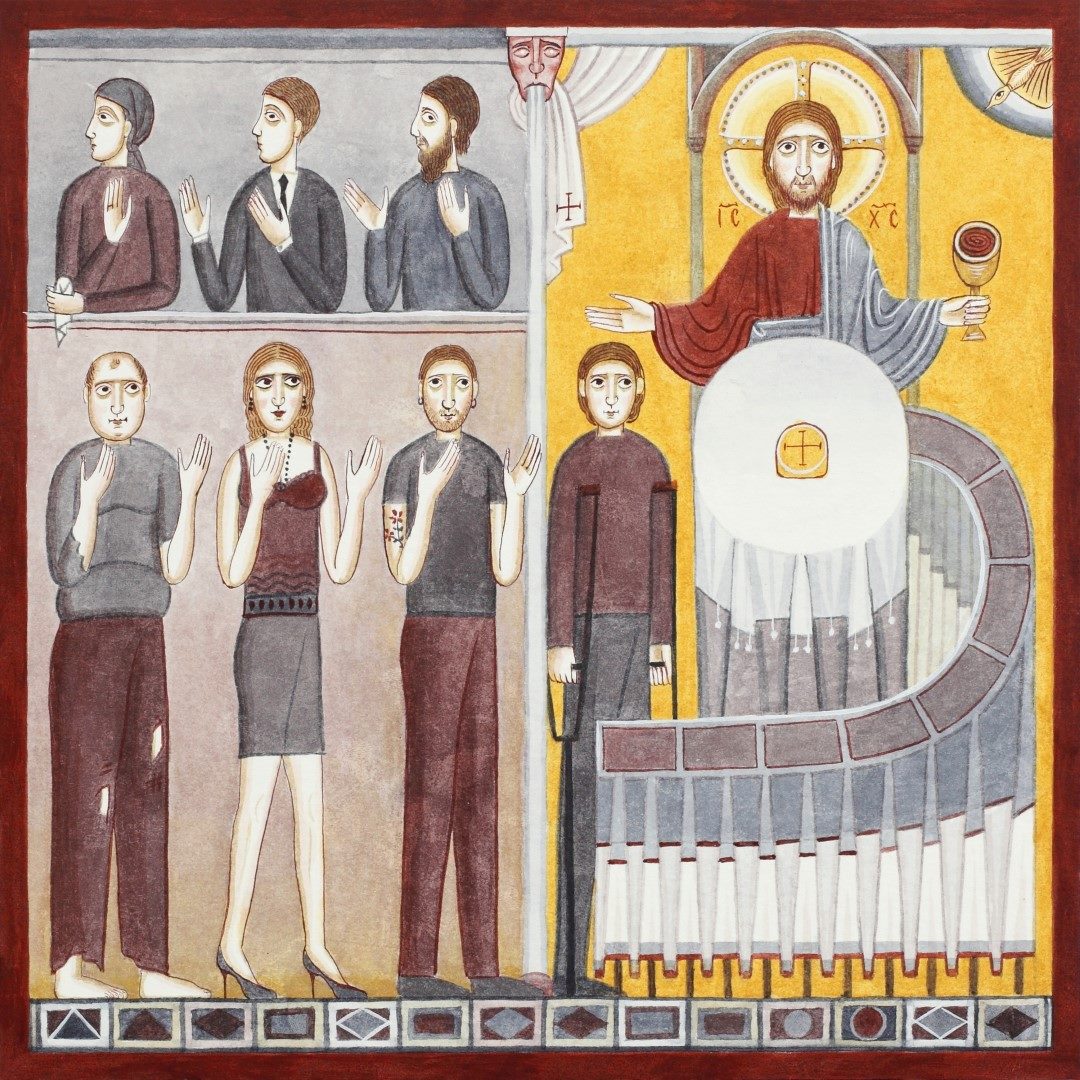
banquet

The Parable of the Great Banquet (Lk 14:15-24), from the cycle “Earthly stories with a heavenly meaning: Parables of Christ”, 2014

*

lost sheep

Parable of the Lost Sheep (Lk 15:3-7), from the cycle “Earthly stories with a heavenly meaning: Parables of Christ”, 2014

*

 saric2

Joy and happiness arose in the house of Jacob. Joseph is alive!

[Nikola Saric’s Paintings and own Captions]

*

 saric1
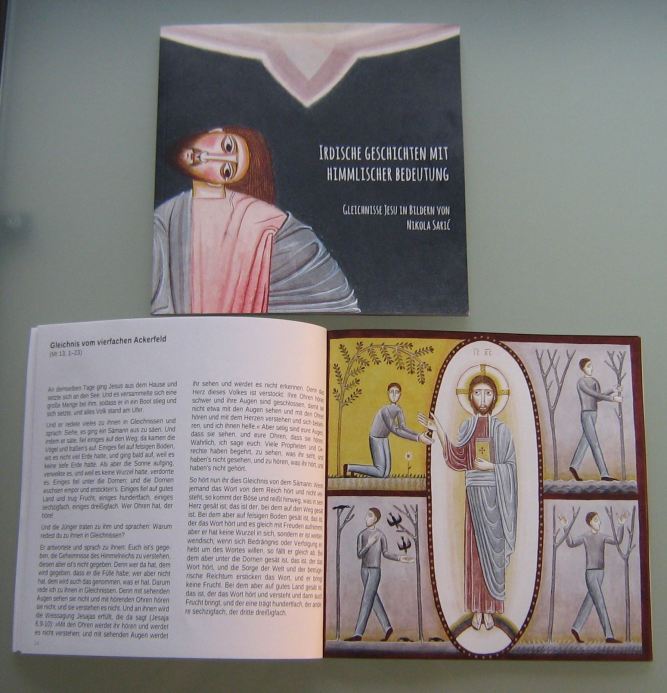
  • Saric’s recent publication “Earthy stories with a heavenly meaning: Parables of Christ”

Windows Into Heaven

Nikola Sarić (born 1985) studied at the TehnoArt School, the Faculty of Applied Arts (art restoration and conservation) and the Academy of Serbian Orthodox Church (fresco painting), all in Belgrade. He focuses on painting, bespoke wall design projects and producing a range of hand-made products under the label Wallsuit.

Saric, a versatile and prolific artist, specialises in sculpting, mosaic, painting, design and calligraphy. Beside working as an independent artist, he holds mosaic courses in Hannover.

Nikola_Sarić,_Installation_GAZELLE,_art-f-air_2012_in_der_Kulturetage_im_SofaLoft,_Jordanstraße_26,_30167_Hannover

Nurtured in the practice of church art, his artistic expression is deriving from sacred Greco-Roman and oriental art. In his works, through the immediacy and simplicity of visual elements, he is trying to convey the intuition of a “transfigured world” and its everlasting glow, harmony and beauty. His interpretations reflect the personal spiritual experience as well as the tradition that breathes and evolves within the concepts of contemporaries. 

For his decorative arts projects and bespoke wall design projects, go to http://www.wallsuit.de

To watch Saric at work, ‘suiting a wall’, go to https://www.youtube.com/watch?v=6FvzZBmF5nQ&feature=youtu.be

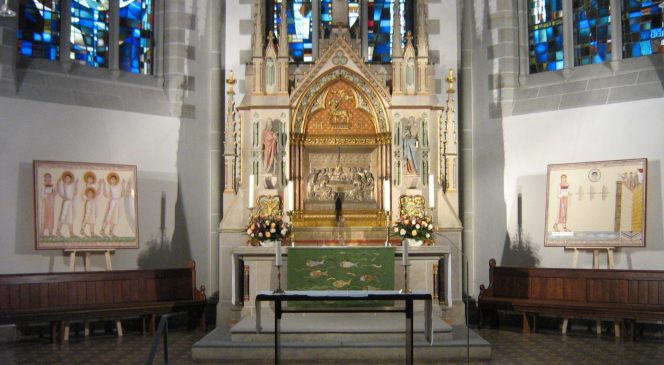
Photos from a recent church exhibition:

saric7 saric8

saric9

For more information please visit his website nikolasaric.de

Romanian Matrix

4_Elena Murariu, +ÿtefan cel Mare SONY DSC


Toma Chituc and Mihai Coman, two iconographers in the Romanian icon renewal.

I. Iconography, a recovered artistic language 

It would have been impossible to imagine a public conversation on icons and their veneration a quarter of a century ago in communist Romania. (…) However, in the last 25 years that have elapsed since the anti-communist revolutions in Eastern Europe, changes have been impressive. (…) In the aftermath of the atheist regime, religious life has revived in all its dimensions: art, liturgy, parish life and monastic communities. There are new parish churches, new monasteries, new canonized saints as well as new Christian martyrs of the communist persecution receiving a large popular veneration and waiting to be canonized. In this context, the icon has become a common presence in homes and offices.

Ioan Popa working on his icon of the

The most remarkable aspect of this revival is that the abundant iconographic demand and the high number of skilled iconographers gave rise to a competitive ambiance that led to an obvious advance in the quality of iconography and, subsequently, to a new iconographic movement.

598567_4005944750189_366075064_n

Our interest focuses on these latter artists who have reached an advanced aptitude of mastering the painting of icons and frescos. Socially, they are also the most visible category, knowing how to promote their creation, how to set up events and integrate their art in the larger cultural and artistic phenomenon. Their personalities are complex: in addition to working in the studio or on the scaffold, they organize symposia, open exhibitions and workshops, invite colleagues from the country and abroad, some of them teach religious art and, generally, they bring iconography to the public attention. One may observe that, over the past five to ten years, the phenomenon has become more alive and has configured a group of iconographers and church painters who are not only talented artists but also curators, theorists and project managers. Furthermore, one of the most significant aspects is that a few artistic values have been gradually assumed by the most valuable iconographers:

1. A thorough education in classical art. ( …)

2. A personal spiritual life. All of them assume, with the Orthodox tradition, that a spiritual dimension is a necessary ingredient to painting an icon. Painting an icon is not a mere artistic activity but a facet of the larger spiritual growth, both personal and part of the community in which the iconographer lives. Painting an icon, therefore, becomes a way of expressing their creativity, a spiritual search in a direct continuity with their ancestral Orthodox legacy and a way of life to which they dedicate themselves entirely. Thus, they strive to understand the icon in a theological manner, as a sacred image, and to address it from a spiritual angle. There are a few cases in which the artists even chose the monastic life; and icon painting became their main obedience in the monastery.

3. They do not imitate but innovate within the canons of tradition. (…)

II. Some iconographers and their work

Gregore Popescu. He is the oldest among the Romanian church painters and has the largest artistic oeuvre.

1_Grigore Popescu_ansamblu altar

SONY DSC

SONY DSC

Elena Murariu represents the middle generation. She worked as a fresco specialist who restored different mural assemblies of the fourteenth to eighteenth centuries and subsequently commenced painting her own icons.

4_Elena Murariu, +ÿtefan cel Mare

Elena Murariu, Holy Brancovan (Brâncoveanu) Martyrs

Gabriel Toma Chituc. Also primarily educated as a classical painter, Chituc is an original and gifted iconographer with a special artistic expressivity. In the last decade, he has become a prolific iconographer striving to find the mystery of the authentic icon inspired by the Holy Spirit.

6_Gabriel Chituc_Nasterea

7_Gabriel Chituc_Bunavestire

OLYMPUS DIGITAL CAMERA

OLYMPUS DIGITAL CAMERA

Ioan Popa. Although he is only 38, Popa has already painted in the fresco technique two churches in Bucharest and Alba Iulia, the church of a monastery in the Apuseni Mountains as well as baptisteries and small chapels in Southern Italy, Cyprus and Mount Athos.

10_Ioan Popa, capela Spital G. Alexandrescu

11_SS Redentore Church, Manfredonia, Italiy,

12_Ioan Popa, ST. GEORGE

SONY DSC

14_Perete sudic, Alba Iulia

15_Bis. Alba Iulia, detaliu

Mihai Coman. He teaches church painting techniques at the Faculty of Theology in Bucharest and studied restoration in Romania. However, in what regards his skills of painting icons and frescos, Coman affirms that he “learned the technique on Mount Athos and understood the icon with the professor and painter Georgios Kordis,” whose doctoral student he is in Greece.

16_Mihai Coman_Cina cea de taina

17_Mihai Coman_Gabriel Chituc_Schitul Brazi

18_Mihai Coman_Acoperamantul

Deacon Nicolae Bălan. After his studies in iconography at the Faculty of Theology in the Department of monumental art, he attended the Faculty of Fine Arts in order to improve his drawing and composition techniques. Bălan is a gifted draftsman and he painted the metropolitan chapel from Limours (France) and St. Trinity Church in Alba Iulia.

19_Balan Nicolae, biserica memorial¦ Alba Iulia

21_Balan Nicolae, cruce altar

20_Balan Nicolae, detaliu bolt¦ Alba Iulia

To these iconographers should be added many others, all of special talent and abundant production. We will mention here a few of them for a few particular reasons. First, some have composed new iconographic themes, like Răzvan Gâscă with his St. Maximus the Confessor with scenes from his life, painted to mark the presence of the relics of St. Maximus the Confessor to Iaşi in 2010.

22_Razvan Gasca_Sf Maxim M

Likewise, Marius Ghinescu for his St. Pachomius at St. Dimitry of Rostov, which represents a moment in the life of Venerable Pachomius of Gledin (1674-1724), a Romanian hermit and bishop who spent his last years at the Pecerska Lavra in Kiev.

23_Marius Ghinescu_Sf Pahomie +Öi Sf Dimitrie al Rostovului

Others should be mentioned for the original manner in which they reconceived certain classical themes, for example Daniela Toma Musat, St. M. George.

24_DANIELA Musat Toma_Sf. Gheorghe

Finally, we should mention some who are talented artist monks able to innovate within the canon, such as Mother Olga, St. Joachim and Anna, Monk Haralambie, The Venerable Founders of Monastery Vatopedi, and Monk Iacob, Mandylion.

25_Monahia Olga_Ioachim si Ana

26_Pr Haralambie_Sf Vatopedini

26_pr Iacov_mandylion

28_BOGDAN VERDES

29_Gabriel Chituc_MD Slava Mc Brancoveni

30_Ioan Popa_Iisus Vita de vie

31_Daniel Codrescu_Deisis cu Sf. Brancoveni

32_Elena Murariu_Sfintii Brancoveni

The last example belongs to Sorin Dumitrescu, a talented metaphysical painter of the old generation converted into an inspired and charismatic theoretician of the icon as well as an original iconographer in spite of the smaller number of icons he has realised. While in his early career as an iconographer he filtered Palaeologan tradition in a personal manner, he searches his present sources of inspiration in the times which preceded iconoclastic controversy.

33_Sorin-Dumitrescu_Modelul-iconic-al-muceniciei--Brancovenilor

With this we close our short excursion into contemporary Romanian iconography. The diversity of artists, styles, techniques, media and sources of inspiration unveils a fascinating artistic and spiritual phenomenon. It will be worth seeing in which direction Romanian iconography will evolve in the future.

*

By 

Source: http://www.orthodoxartsjournal.org/the-new-romanian-masters-innovative-iconography-in-the-matrix-of-tradition/
Sculpting in Time

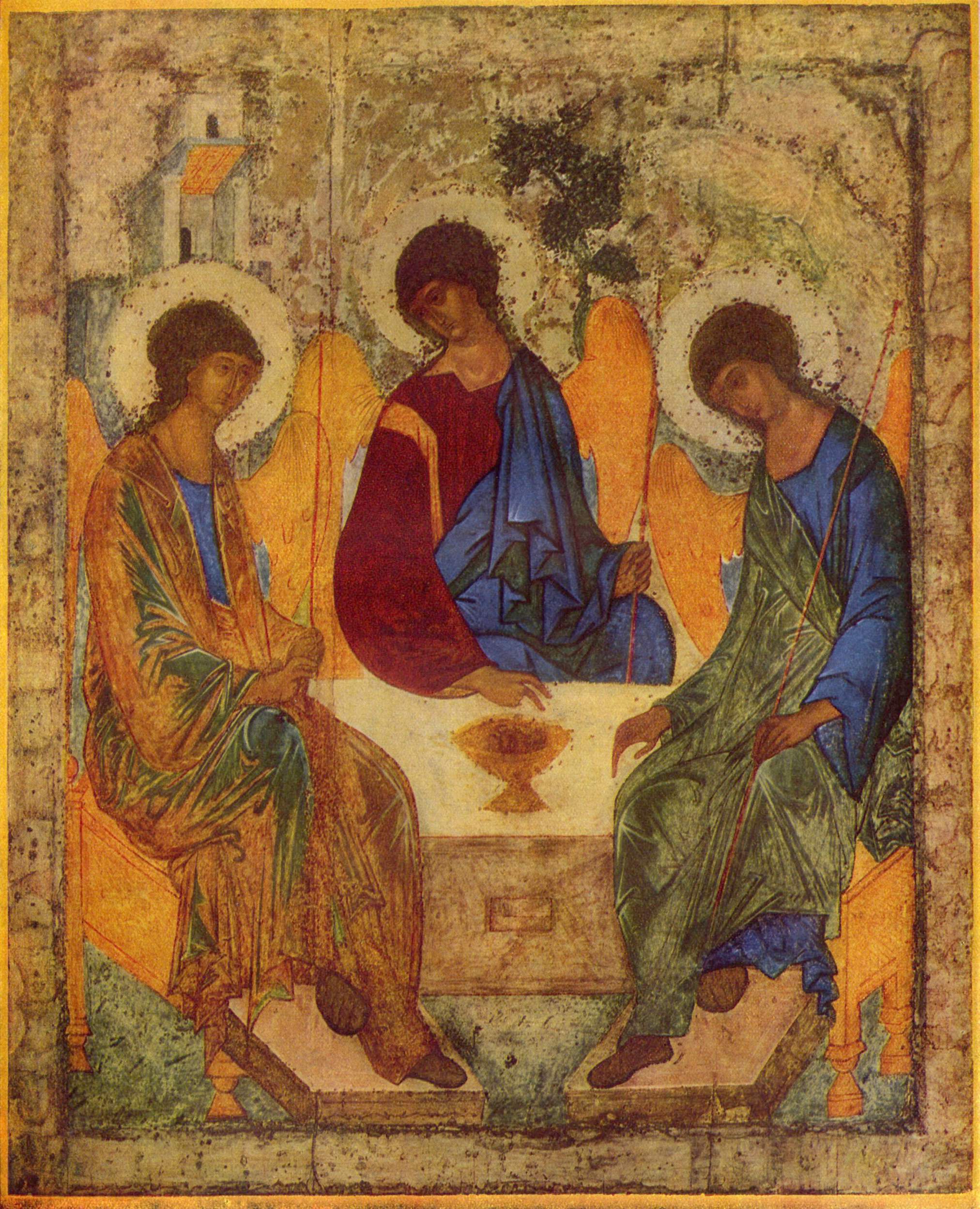
Andrej_Rublëv_001


This is Iconographer Andrei Rublev’s ( Андре́й Рублёв) famous work on the Trinity – Angels at Mamre ( Holy Trinity). For those of you familiar with his art, the colour explication that follows is superfluous. What I would really like to share with you is my (re)discovery of these colours yesterday through Tarkovsky‘s lens. These colours become so alive at the ending of his movie Andrei Rublev (1966) after three hours of black and white! Pay particular attention to https://www.youtube.com/watch?v=FsEbrhv2jGY, esp. 4:50′ to  8:00′.

For those of you who are not familiar with this icon, Rublev gives each person of the Trinity different clothing. On the right, the Holy Spirit has a garment of the clear blue of the sky, wrapped over with a robe of a fragile green. So the Spirit of creation moves in sky and water, breathes in heaven and earth. All living things owe their freshness to his touch. The green mantle of the Spirit, scintillating with light, is clearly a Rublev achievement. Green belongs to the Spirit because the Spirit is the source of life.

The Son has the deepest colors; a thick heavy garment of the reddish-brown of earth and a cloak of the blue of heaven. In his person he unites heaven and earth, the two natures are present in him, i.e., human and divine, (and this is why on the table are placed two of his fingers) and over his right shoulder (the Government shall be upon his shoulder) there is a band of gold shot through the earthly garment, as his divinity suffuses and transfigures his earthly being. The red signifies his earthly passion, and the gold band, his royal status as Christ the King.

The Father seems to wear all the colors in a kind of fabric that changes with the light, that seems transparent, that cannot be described or confined in words. The Father’s ghostly outer garment hints at his inconceivable divine nature. And this is how it should be. No one has seen the Father, but the vision of him fills the universe. His robe is iridescent, shifting from glowing golden-red to azure blue, a triumph of the painter’s art. “You robe yourself in light as in a garment” (Ps 104:2).

The wings of the angels or persons are gold. Their seats are gold. The chalice in the center is gold, and the roof of the house. Whether they sit, whether they fly, all is perfect, precious, and worthy. In stasis, when there is no activity apparent on the part of God, his way is golden. When he flies, blazes with power and unstoppable strength, his way is golden. And in the Sacrifice at the center of all things, his way is golden.

The light that shines around their heads is white, pure light. Gold is not enough to express the glory of God. Only light will do, and that same white becomes the holy table, the place of offering. God is revealed and disclosed here, at the heart, in the whiteness of untouchable light, the Uncreated Light.

For more information, go to:

https://www.youtube.com/watch?v=6g-DkKDQ_5g

https://www.youtube.com/watch?v=vOYFHbmmWZ0