A Holy Man’s Christmas Card

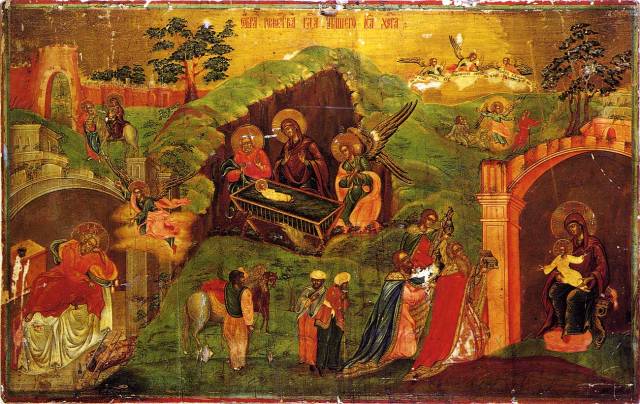
nativity-icon-5Paraskevi, who out of sheer humility does not wish to reveal her full name, was among the first spiritual children of Elder Sophrony, during the time of her studies in England. She sent us a copy of two handwritten scripts by the blessed Elder.

christmas-card

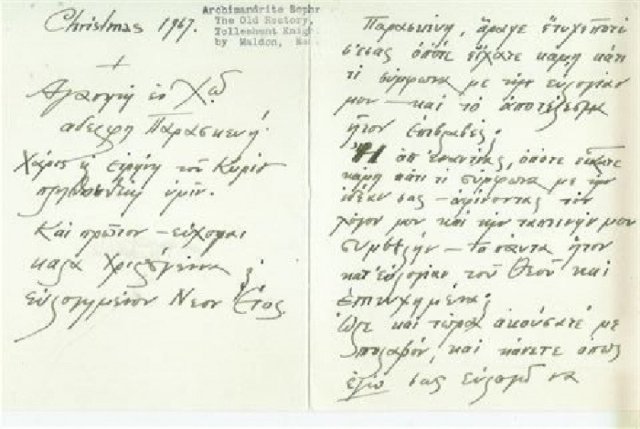
A good wish card which the blessed Elder sent during Christmas 1967, when Paraskevi was going through some difficult times because of the illness of a close relative.

christmas-card2

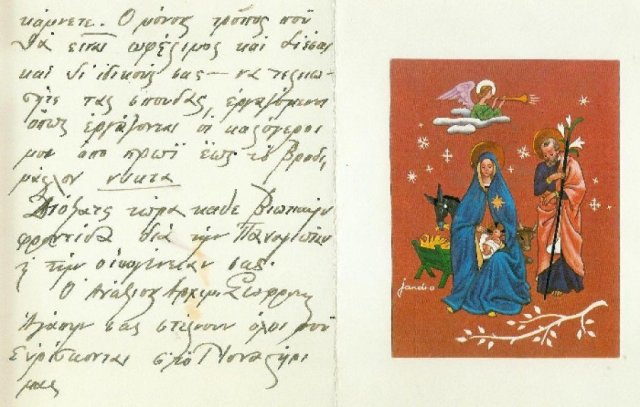
 The outside of the card

The Christmas wish card (handwritten):

Archimandrite Sophrony

The Old Rectroy,Tolleshent Knight

by Maldon, Essex

Christmass 1967,

+

Dear beloved in Christ, Sister Paraskevi.

May the Lord’s grace and peace be abundant in you. Let me first wish you Merry Christmas and a blessed New Year!

Paraskevi, has it ever happened to do something according to my blessing and it turned out harmful? Or has it happened that you did something according to your mind and not according to my humble advice that it was successful and in accordance with God’s providence? Therefore, now you must listen to me, the old fool, and do as I give you the blessing to do. The only beneficial way for you and your relatives is to finish your studies and work at the same time, as my monks do from morning till the evening. Get rid of any worry for X and your family.

The unworthy Arch. Sophrony.

You have the love of all who are at out monastery.

***

christmas-card3

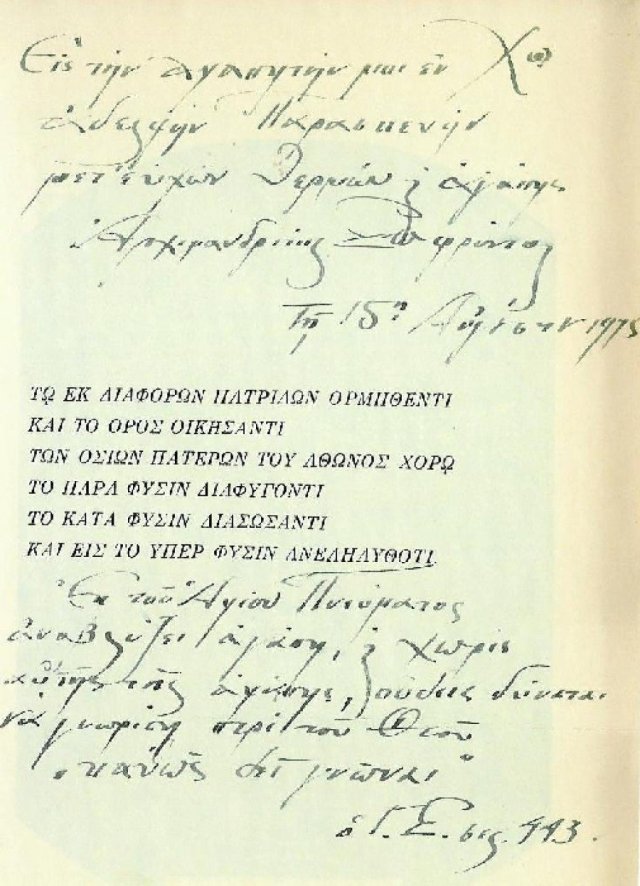
Handwritten inscription by the Elder on the 15th August 1975, when he sent her his book, St Silouan the Athonite

On the book St Silouan the Athonite (handwritten):

To my beloved in Christ sister Paraskevi with warm wishes and love

Arch. Sophrony

15th August 1975

Printed in Caps:

Hailing from various countries

And retreating to the Mountain,

Among the holy fathers of Mount Athos,

Escaping the unnatural

And safeguarding the natural

Rising to that which is beyond nature

Again, by hand of Elder Sophrony:

From the Holy Spirit gashes out love, and without it no one is able to know God ‘as He must be known’.

E.S. p. 443

(Note: E.S. refer to Elder Silouan, not yet recognized as a Saint at the time)

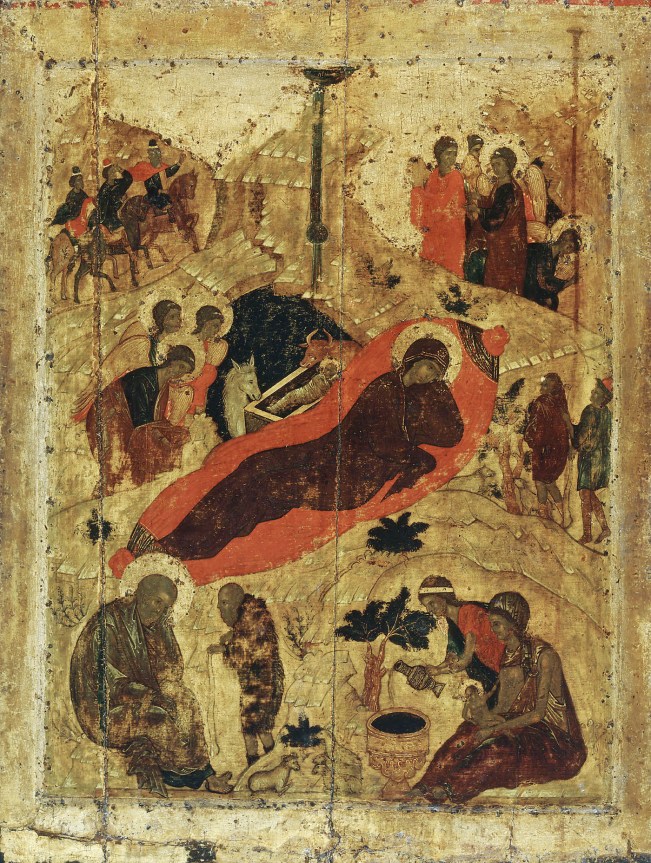
Nativity Paintings from Around the World

Christ is Born! Indeed He is Born!

 Χριστός Ετέχθη! Αληθώς Ετέχθη!

nativity1

Christ is Born! Glorify Him!

“Behold, I bring you good tidings of great joy, which shall be to all people. For unto you is born this day in the city of David a Saviour, which is Christ the Lord.” (Luke 2:10-11)

Jesus Christ was born for all people of all times. To illustrate this truth, Christians around the world often depict him as coming into their own culture, in the present time. The Italians, whose visual language was predominant during the Middle Ages and Renaissance, did it. In fact, when you think “Nativity,” you probably think of the church art from that age and country—not because it offers the most legitimate representations (they are no more “accurate” than the ones below), but because the Church held particular sway at that time, in that place.

Well, the center of Christianity has shifted; it is no longer in the West. And thus if we were to survey the Christian art being produced today, we would see that Jesus, Mary, and Joseph, and the settings they inhabit, have a much different look. We’d see Mary dressed in a sari or a hanbok; we’d see Jesus wrapped in buffalo skin, or silk. We’d see lizards and kangaroos instead of oxes and asses.

Historical accuracy is not the point; the point is to see Jesus as the Savior of your own people, as incarnated very close to you, and relevant to life today.

Here are 19 contextualizations of the Nativity painted within the last century. Each work brings Jesus into a different place, in order to emphasize the universality of his birth.

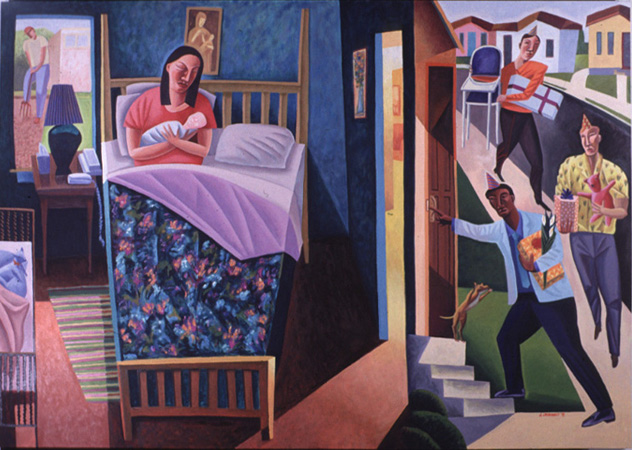
USA:

nativity1

“Nativity” by James B. Janknegt
James B. Janknegt, Nativity, 1995. Oil on canvas, 57 x 82 cm.

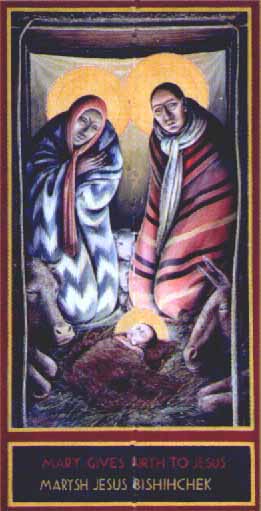
Crow Nation (Montana-based tribe):

nativity2

Native American Nativity
John Guiliani, Mary Gives Birth to Jesus, 1999. From The Crow Series.

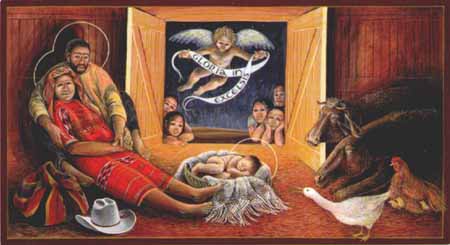
Guatemala:

nativity3

Guatemalan Nativity
John Giuliani, Guatemalan Nativity, 1990s.

Nicaragua:

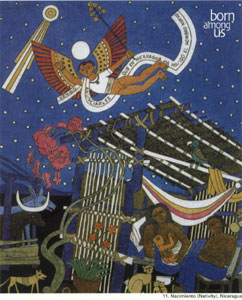
nativity4

Nicaraguan Nativity
Leoncio Saenz, Nacimiento (Nativity), 1983. The banner reads: “I come to tell them that in Nicaragua the new man has been born.”

England:

nativity5

Nativity by Dinah Roe Kendall
Dinah Roe Kendall, The Shepherds Went to See the Baby, 1998.

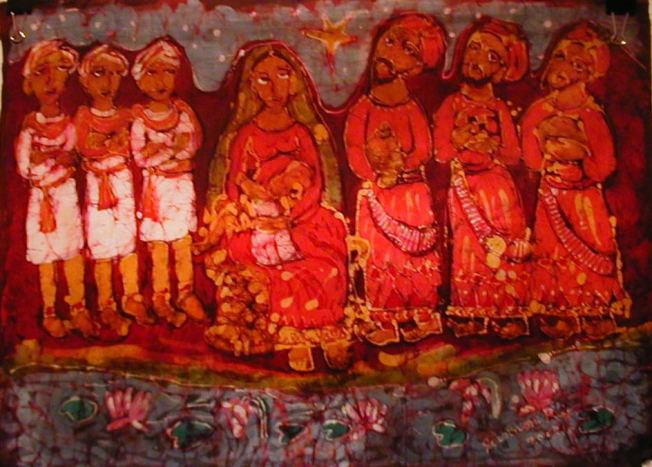
India:

OLYMPUS DIGITAL CAMERA

China:

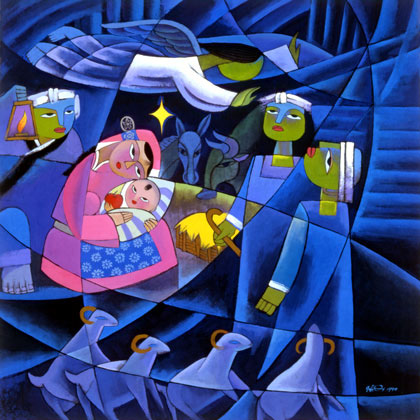
nativity7

Chinese nativity
He Qi, Nativity, 1998. Ink and gouache on rice paper.

Tibet:

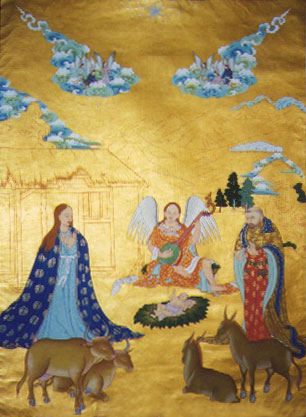
nativity8

Tibetan nativity
A thangka (sacred wall hanging) given by H.H. the Dalai Lama to Fr. Laurence Freeman and the World Community for Christian Meditation in 1998.

Korea:

nativity9

Korean nativity
Woonbo Kim Ki-chang, The Birth of Jesus Christ, 1952-53. Ink and color on silk, 76 x 63 cm.

Japan:

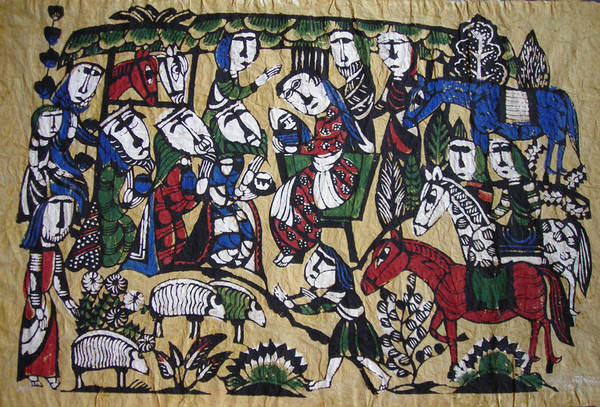
nativity10

Japanese nativity
Sadao Watanabe, Nativity, 1960s? Stencil print on momigami paper, 58 x 78 cm.

Thailand:

nativity11

Thai nativity
Sawai Chinnawong, Nativity, 2004. Acrylic on canvas, 32 x 37 in.

Malaysia:

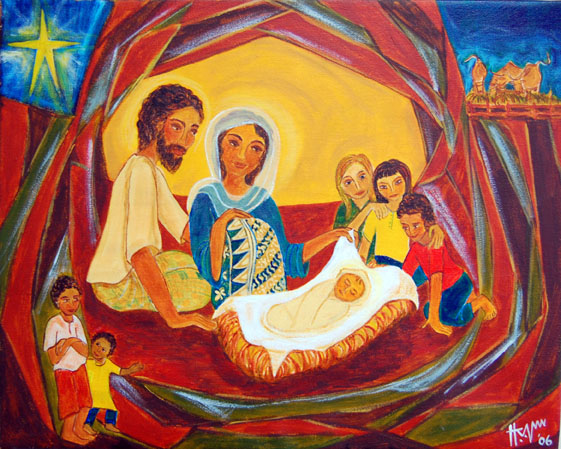
nativity12

Malaysian nativity
Hanna Varghese, God Is With Us, 2006. Acrylic on canvas, 16 x 20 in.

Indonesia:

nativity44

Indonesian nativity
Erland Sibuea, Nativity, 2008. Acrylic on canvas, 31 x 23.6 cm.

Philippines:

nativity33.jpg

Filippino nativity:
Kristoffer Ardena, The Meaning of Christmas, 1995. Oil on canvas, 62 x 46 cm.

Uganda:

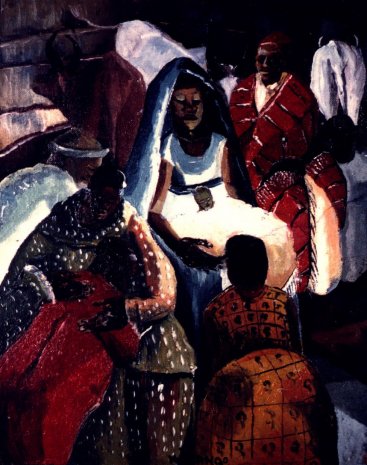
nativity15

African nativity
Francis Musango, Christ in the Manger, n.d. Oil painting.

Cameroon:

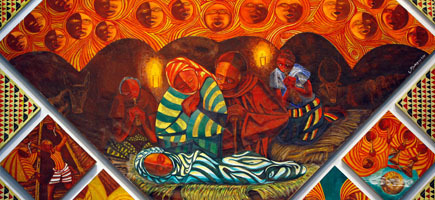
nativity16

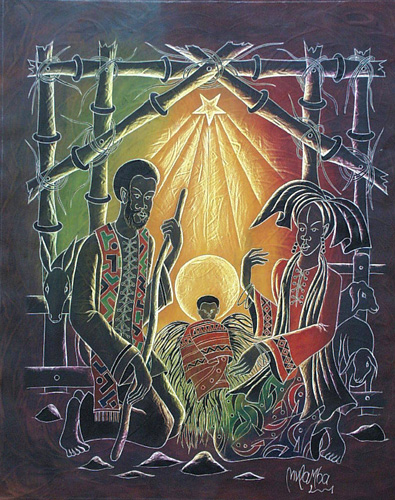
African nativity
Fr. Engelbert Mveng, Nativity, early 1990s. Central scene from church mural. Holy Angels Church, Aurora, Illinois.

Democratic Republic of the Congo:

nativity17

African nativity
Joseph Mulamba-Mandangi, Nativity, 2001. Peinture grattée, 70 x 50 cm.

Australia (Aboriginal):

nativity18

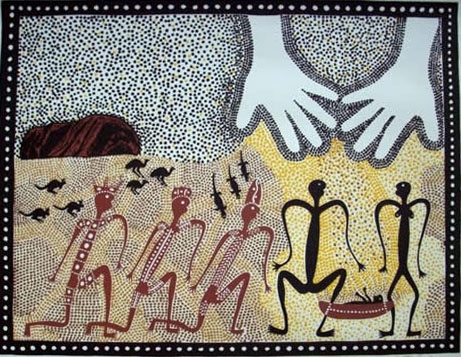
Australian nativity
Greg Weatherby, Dreamtime Birth, 1990s? 51 x 64 cm.

Tahiti:

nativity19

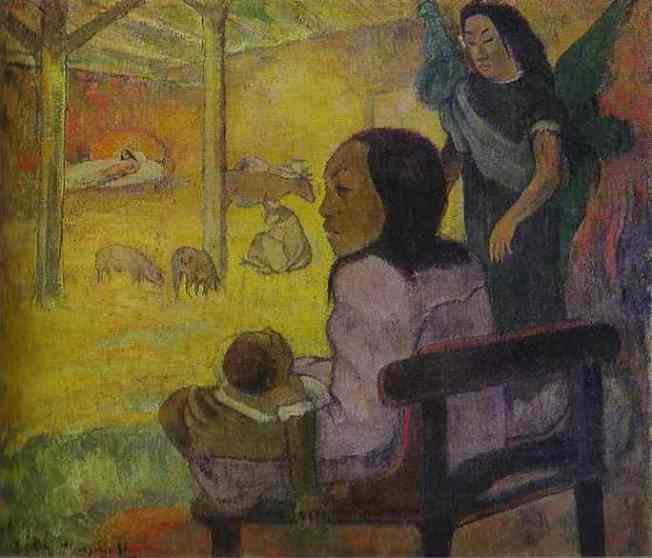
Nativity by Paul Gauguin
Paul Gauguin, Baby (The Nativity), 1896. Oil on canvas. The Hermitage, St. Petersburg, Russia.

Posted on December 25, 2011 by Victoria Emily Jones

Victoria Emily Jones's avatarThe Jesus Question

Four years ago on Christmas Day I posted a selection of nativity paintings originating mainly in non-Western cultures. Each year since then that post has ranked as one of the five most-read posts on this site, with over twelve thousand views to date. So I’ve decided to do a part 2.

My friend Scott Rayl shared a quote with me this week by S. D. Gordon: “Jesus was God spelling Himself out in language humanity could understand.” What a succinct summary of the Incarnation!

Today we celebrate the transcendent God made immanent, accessible. We celebrate his new name: Emmanuel, God-with-us. The artists here can aid us in that celebration.


Australia (Aboriginal):

First Nations of Canada:

Guatemala:

Nicaragua: 

India:

Thailand: 

China:

Japan:

Korea:

Vietnam: 

Philippines: 

Indonesia:

Nigeria:

Ethiopia:

Kenya:

Tanzania:

South Africa:

(Many of the Asian artworks in this post were found through the Asian Christian Art Association website. It’s a really rich resource…

View original post 3 more words

We Are All One

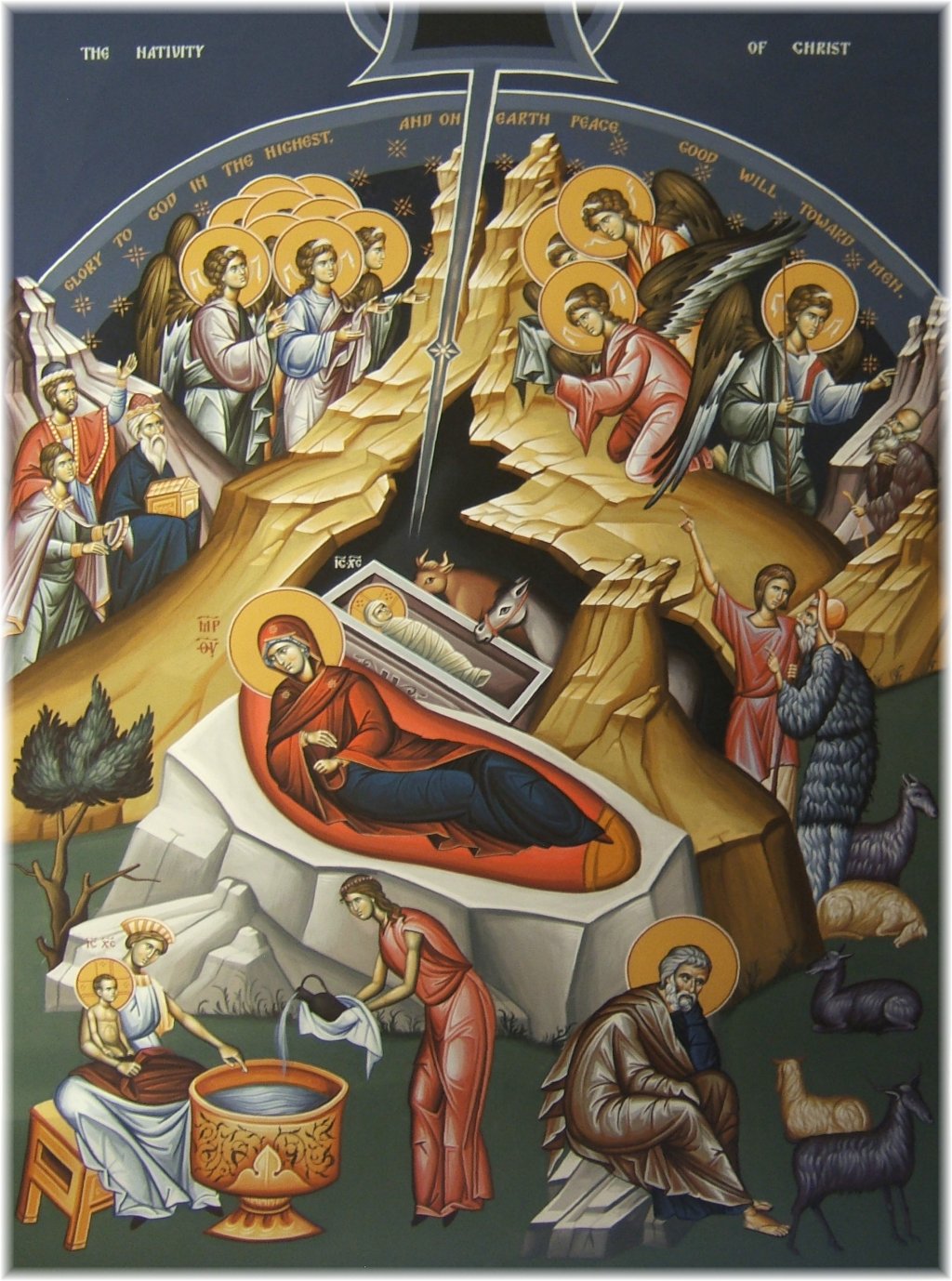
nativity icon.jpg

In a few hours, I’m flying to Thessaloniki, from where I’ll get the bus to Ouranopolis, the port to Mount Athos. I’ll be away until January 4th, so have a blessed Feast of the Nativity and a happy New Year.

This has been a tough year, in ways that I cannot even begin to express, and I’m only now starting to feel the effects. Tiredness, hopelessness and fear, sadness to the point of despair – all of these have haunted me relentlessly during the last twelve months. To say that 2016 has not been my favourite year would be too kind, even for my standards. To say that 2016 has been even remotely a good year would be beyond insincerity and would approach hypocrisy.

We have achieved many things for the Monastery, and for that I must thank you. I have tried to let you know, to the best of my ability, how much I appreciate your support. All my hard work, all my best intentions, all my sacrifice would amount to nothing without you and your hard work, your best intentions, your sacrifice. Together, we have done incredible things this year, and I trust that, by the grace of God, we shall do even more in 2017. For all of this, I thank you. You are in my prayer always, where ever life takes me.

That being said, the Monastery exists in this world and cannot ignore the world. Monasteries are doors between this fallen world and the Kingdom, calling our fallen nature to its true prototype, encouraging us on the way, guiding us step by step, as we fight to let go of our fallenness and we learn to see ourselves through the eyes of God. This is why monasteries exist, this is their purpose.

And this is where I’ve fallen mostly in 2016. Although I’ve kept far from the political fights that consumed the world, I have allowed their noise to disturb me, I have allowed them to distract me from the things that truly matter. I have kept silence over the outpouring of hatred that drowned the world over the Council, Brexit or the US elections, but I have not succeeded to hold on to the silence in my heart.

As a monastic, I have no responsibility to get involved in these fights. Monastics are dead to the world, and to get involved is a failure towards one’s calling. When people accused the Abbas of the Desert for refusing to get involved and judge various people or causes, they sent their accusers to the cemetery and told them to ask the dead buried there to judge them. As a monastic, my responsibility is to stand among you, silent and dressed in my black vestment, as a reminder that our true Calling, our true Identity and our true Home are somewhere else.

As the world rages consumed with passion for one cause or the other, a monk’s calling is to silently remind those who have the eyes to see that we are all mortal and that the real fight, the real cause, the real passion should be for something entirely different: the salvation of our souls. All else is dust.

It is my responsibility, therefore, to tell you all that no one won in 2016. There are no winners. We have all lost. We have all allowed hatred and doubt and fear to enter our hearts. We have all judged, we have all looked at Christ’s image, our brother, and saw in him the enemy. We have all built walls: some have built walls against those who are different from them, others have built walls against those who build walls. There is no difference between walls: regardless of what motivates them, they are all expressions of a void in our hearts. That empty void where Love should have been.

I’m going to Mount Athos for two weeks with this in mind. I’m not looking for rest, physical or emotional. I’m going to regain my perspective of the world and myself. I need to taste silence to be reminded of the things that matter. I need to touch holiness so I may redirect my steps toward it. I need to see sparkles of the Kingdom, so I may turn my back to this empty noise and start walking towards Life again.

I leave behind 2016 with a void in my heart. I pray, I pray with all my strength that Love Incarnate will return once more and fill it. I pray for me, I pray for you – the same prayer, for we are all One. We are ALL One.

Source: Mull Monastery blog

* Kindly excuse any technical issues; we are migrating the blog back to WordPress

See also The Womb and The Tomb in The Nativity Icon

Nativity Paintings from Around the World

Carpe Diem and Christmas

The Ass and the Ox in the Nativity Icon 

Christ’s Nativity: Living a Kairos Life in a Chronos World

Arabic Christmas Carol

Sing Ye Carols!


When Demons Speak

 At St. Gerasimos’ Feast

St. Gerasimos of Cephalonia Feast Litany Miracles 


St. Gerasimos the New Ascetic of Kefallonia (+1579) is known as a renowned healer of the mentally ill and a grace-filled exorcist of the demon possessed. They flock to his holy shrine which contains his incorrupt relics to receive healing. His nickname is “Kapsalis” (“the burning one”), after the desolate place of Kapsala on Mount Athos, where the Saint lived as an ascetic.The demons cry out: “Kapsalis, you have burned us.”


An eye-witness: “When the priest was performing the Holy Unction, a demon-possessed woman was screaming in convulsions: ‘Is it not enough that the old priest that stays here doesn’t leave me in peace day or night, and today you with the oil, the two of you will burn me?’ As soon as she was anointed, the demon was so shaken that the woman fell down unconscious but she was freed by the grace of the Saint.”


Another: I happened to be traveling in Kefallonia during the feast of St. Gerasimos. When I arrived at the monastery, loud screams were coming from the demon possessed in the church, saying: “You are burning me, Gerasimos. You are burning me Kapsali.” Everyone understood in the church that there was a spiritual battle going on around them at that moment that they could hear but not see.


The Saint ‘Gets Up’!


A most solemn moment, as the Saint is ‘allowed’ in the vertical position

only during his Feast and Litany.

And His Litany

“As the sun you emerge from Your church Gerasimos, and with heaven’s angels you ascend the heights”.


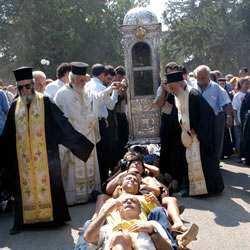
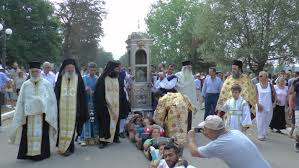
On Aug 16 the Saint’s relics are carried in an upright position in a procession for 500 metres. The procession starts at the church and proceeds down a wide road lined with poplars as far as a spreading plane tree where there is a well which is said to have been dug by the Saint himself.


Tradition has it that Omala valley exclusively receives His Blessing. Many times it was attempted to remove Him from here, without success. A little further down on the road to Troianata, the location is called “podoria” and it is the place from where He could be moved no further. He would become heavy.


Among the procession, the Saint is in the middle, raised high, untouched by time, in His clerical robes which like His body did not perish in the grave.


“A five-branch plane tree and a deep well you left for us Gerasimos as an eternal sign”


He will rest at the Well that He dug, under the shade of the plane tree – The water in the Well will overflow and the leaves of the plane tree will thrush to greet The Master.


Hours before the litany begins, people struggle to secure a position to lay down anywhere along the procession’s way so that the Saint may pass over them. The Litany  is the peak of hope for miraculous healings.


St. Gerasimos of Cephalonia Feast Litany Miracles


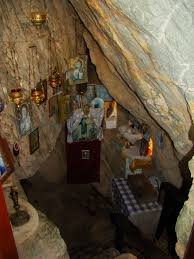
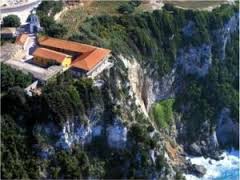
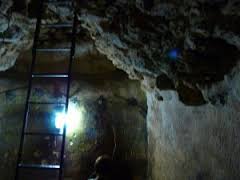
The older church containing the relics of St. Gerasimos is built directly over his cave and pilgrims are welcome to descend the ladder and squeeze through the tiny floor-level entrance that leads into the cave.

St. Gerasimos of Cephalonia Feast Litany Miracles


This August the Lord granted me the special blessing to take part in all this. An indelible pilgrimage for both the profound mourning that was searing my heart and the healing ointment of forgiveness that is still working wonders in my life.


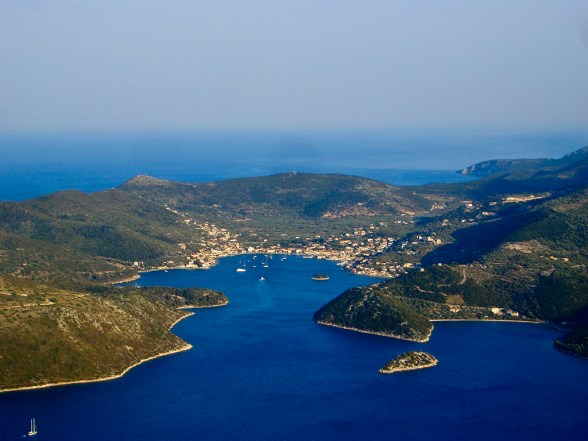
Cephalonia-Ithaka Pilgrimage

On my way  to this summer’s last pilgrimage: Cephalonia-Ithaca for the Dormition Feast

orthodox-city-hermit-and-cephalonia-ithaka-dormition-fast4

orthodox-city-hermit-and-cephalonia-ithaka-dormition-fast1orthodox-city-hermit-and-cephalonia-ithaka-dormition-fast2orthodox-city-hermit-and-cephalonia-ithaka-dormition-fast3


Apologies for being offline through August 31st.

May our Lady bless us and may the Lord keep us in the palm of His Hand until we meet again!

*

“Sister Begona Miguel of the Huelgas Monastery says:

“San Juan de La Cruz teaches us that silence has its own music; it is silence that enables us to see ourselves and the things around us.

‘I would like to add that there are words that can only be said in silence, odd as that may seem. To compose their symphonies, the great geniuses needed silence – and they managed to transform this silence into divine sounds. Philosophers and scientists need silence.

‘In the monastery, at night, we practice what we call The Great Silence.

‘In the absence of speech we can understand what lies beyond.” (Paulo Coehlo blog, In the Huelgas Monastery)

*

Therefore, it is time for the little city hermit to embark on yet another quest for stillness and silence. This blog takes a vacation, returning by the end of August, where I will start making preparations for my return trip to the UK.

You are always welcome to browse the ARCHIVES on the right.

Enjoy the rest of your summer.

With lots of love and poor prayers

The little city hermit

Work Pray Be Saved

transfiguration orthodox church Work Prayer Salvation


Work Pray Be Saved! Back to Mikrokastro monastery, my spiritual basis in Greece! For the Transfiguration Feast. “Lord, it is good for us to be here. If you wish, I will put up three shelters—one for you, one for Moses and one for Elijah!” I feel so safe, protected and loved here! It is always like this: the Mother of God always comforts me; the peace, stillness and hesychia of the monastery invades me; the fellowship of the nuns warms me; the motherly affection of its Abbess, Mother Theologia’s love nurtures me; the nuns’ combination of discipline, structure, work and prayer ‘stabilises’ me; their wise ‘equation’: Work and Prayer= Salvation!‘ centers’ me, ‘grounds’ me on peace and the Holy Spirit.

orthodox monastic Work Prayer Salvation


Just today, I felt so happy harvesting, curing and storing potatoes after the Matins service and Holy Liturgy in the monastery chapel! It felt so exhilaratingly Van Goghean!

Work Pray Be Saved

van gogh Work Pray Be Saved


Certainly one eats his meal afterwards, roast potatoes😃, with gratitude and thanksgiving.

orthodox monks Work Pray Be Saved

van gogh Work Pray Be Saved

*

Fr Jonathan Hemmings has written a whole chapter on this ‘equation’: Work and Prayer= Salvation! in his book, Fountains in the Desert, which I have found most useful and often turn to for life balance ‘tips’.


When the holy Abba Antony lived in the desert he was beset by accidie (ἀκηδία) and attacked by many sinful thoughts. He said to God, “Lord, I want to be saved but these thoughts do not leave me alone; what shall I do in my affliction? How can I be saved?” A short while afterwards, when he got up to go out, Anthony saw a man like himself sitting at his work, getting up from his work to pray, then sitting down again and plaiting a rope, then getting up again to pray. It was an angel of the Lord sent to correct and reassure him. He heard the angel saying to him, “Do this and you will be saved.” At these words, Antony was filled with joy and courage. He did this, and he was saved.


Our human condition requires dependency upon God and interdependency on others. Correct spiritual examination requires the help and direction of a spiritual father who helps us grow into the image of Christ. Self examination alone without such an external reference point can put us in jeopardy such that we choose the wrong direction, make false judgements, become disappointed, lack faith, and fall into the trap of hopelessness and despair. Here we find ourselves in that spiritual malaise of accidie whereby because of our sense of sinfulness before a Holy God, we become inactive, paralysed and reach a state of torpor.

We ponder on the contradiction “How can we be Christians and have such sinful thoughts?” St Antony addresses this dilemma in the desert where he meets the devil, himself and God

“Lord, I want to be saved but these thoughts do not leave me alone;”

We notice that St Antony wants to be saved, he is aware of his own condition. Like the Prodigal son and Zacchaeus we must first come to our right mind and possess a desire (a zeal) for change. St Antony’s request is simple and succinct:

“What shall I do in my affliction. How can I be saved?”

orthodox monastic Work Prayer Salvation

We must be direct in our prayer to God; vagueness in repentance or in our requests is a form of obfuscation.

These two questions of St Antony remind us of that question the Lawyer posed to Christ before the Parable of the Good Samaritan. Luke 10:25 “What must I do to inherit eternal life?”

Inactivity is not an option for Christians; Christians are verbs not nouns!

Antony sees a man sitting at his work then getting up to pray, returning to his work and again rising to pray. The angel was sent by God to correct and reassure St Antony. Consumed by ourselves we lose focus and the source of our strength-we lose the will to work or pray! Work and Prayer= Salvation! This is an equation for all and not just for monks. Full of self loathing we need not only correction but reassurance. When called upon, the compassion and conviction of the All Holy Spirit assists us by His comfort and strength.

orthodox monastic Work Prayer Salvation

Just as our Lord was ministered to by angels in the wilderness after the Temptations Matthew 4:11

“Then the devil left Him, and behold, angels came and ministered to Him.”

So with St Antony an angel ministers to him instructing him and restoring courage and joy. “ Do this and you will be saved.”

The Fathers teach us that we should not trust too readily in our own thoughts and opinions but take heed to God’s Word Who provides us with the pattern of salvation.

orthodox monastic Work Prayer Salvation

In our modern western culture, Life balance is a much discussed topic today. When mums have to juggle careers with caring and the ever increasing demand for dads to prioritize we need to drink from the fountains of the desert. Without work we become indolent and listless; too much work makes us tired and stressed. Without prayer we become detached from our source of strength and the deeper reality Who created us. Likewise prayer without action is fruitless, as St James says in his epistle:

James 2:17

“Thus also faith by itself, if it does not have works, is dead.”

Prayer will warm and revive us in the love of God; work will warm and energise us in the love for others thus fulfilling the Divine equation for salvation:

Luke 10:

27 So he answered and said, “ ‘You shall love the LORD your God with all your heart, with all your soul, with all your strength, and with all your mind,’ and ‘your neighbour as yourself.’”

 28 And He said to him, “You have answered rightly; do this and you will live.”

orthodox monastic Work Prayer Salvation

Fountains in the Desert

Why Fast For Dormition?

Dormition Feast Fast orthodox city hermit

May the Dormition fasting prepare us to receive what God wants to give us. 


It would be a gross understatement to say that much has been written about the Feast of the Dormition of the Theotokos. Yet very little has been written about the fast that precedes it.

We fast, not to get what we want, but to prepare ourselves to receive what God wants to give us.

Every Orthodox Christian is aware and generally knows the reason behind the fasts for Pascha and Christmas. But while they may know of the Dormition Fast, few follow it, and more than a few question why it is there, neither knowing its purpose. First, given the pervasive misunderstanding of the purpose of fasting itself, a refresher on its purpose is always a good idea. There is a perception that we should fast when we want something, as though the act of fasting somehow appeases God, and seeing us “suffer” gets Him to grant our request. Nothing can be further from the truth. It is not our fasting that pleases God, it is the fruits of our fast (provided we fast in the proper mind set, and do not merely diet) that please Him. We fast, not to get what we want, but to prepare ourselves to receive what God wants to give us.


The purpose of fasting is to bring us more in line with another Mary, the sister of Lazarus, and away from their sister Martha, who in the famous passage was “anxious and troubled about many things.” Fasting is intended to bring us to the realization of “the one thing needful.” It is to help us put God first and our own desires second, if not last. As such it serves to prepare us to be instruments of God’s will, as with Moses in his flight from Egypt and on Mt. Sinai, as well as our Lord’s fast in the wilderness. Fasting turns us away from ourselves and toward God. In essence it helps us become like the Theotokos, an obedient servant of God, who heard His word and kept it better than anyone else has or could.


So why do we fast before Dormition? In a close-knit family, word that its matriarch is on her deathbed brings normal life to a halt. Otherwise important things (parties, TV, luxuries, personal desires) become unimportant; life comes to revolve around the dying matriarch. It is the same with the Orthodox family; word that our matriarch is on her deathbed, could not (or at least should not) have any different effect than the one just mentioned. The Church, through the Paraklesis Service, gives us the opportunity to come to that deathbed and eulogize and entreat the woman who bore God, the vessel of our salvation and our chief advocate at His divine throne. And as, in the earthly family, daily routines and the indulgence in personal wants should come to a halt. Fasting, in its full sense (abstaining from food and desires) accomplishes this.


Less time in leisure or other pursuits leaves more time for prayer and reflection on she who gave us Christ, and became the first and greatest Christian. In reflecting on her and her incomparable life, we see a model Christian life, embodying Christ’s retort to the woman who stated that Mary was blessed because she bore Him: blessed rather are those who hear His word and keep it. Mary did this better than anyone. As Fr. Thomas Hopko has stated, she heard the word of God and kept it so well, that she of all women in history was chosen not only to hear His Word but give birth to it (Him).


So while we fast in contemplation of her life, we are simultaneously preparing ourselves to live a life in imitation of her. That is the purpose of the Dormition Fast.

When the assumption of thine undefiled body was being prepared, the Apostles gazed on thy bed, viewing thee with trembling. Some contemplated thy body and were dazzled, but Peter cried out to thee in tears, saying, I see thee clearly, O Virgin, stretched out, O life of all, and I am astonished. O thou undefiled one, in whom the bliss of future life dwelt, beseech thy Son and God to preserve thy people unimpaired.

(Sticheron after the Gospel, Orthros)

Daniel Manzuk is a reader at the Church of the Virgin Mary in Alsip, IL.

Source: Why a Fast for Dormition?  The Word, June 2008


St. Paisios the Athonite

Icons, Photographs and Video on his feast day

a1a2

I may be on a pilgrimage in Romanian monasteries, but St Paisios’ the Athonite, my patron Saint‘s, presence is strongly felt all over Romania. Plenty of icons of his and books with his services and spiritual counsels in all monasteries and churches I have been so far! I truly regret having to leave this week of all weeks Greece, but thanks be to God, while this was going on inside Souroti monastery church on July 12, and this outside the church, near his tomb

a3

Much longer queues than in 2013 … every year longer! The Lord is glorified in His saints!


the faithful all over in Romania were holding Vigils and praying Akathists and Supplication canons, asking for his prayers.

Wherever I go, the moment Romanians realise that I am Greek and my home town is near Souroti, they start asking for my telephone number and email, so that I can make arrangements and help them go and venerate his tomb.


Just in case you missed it, this is a beautiful documentary (in Russian with English subtitles) about the life of St. Paisios the Athonite and his years spent on Mount Sinai in Egypt.

And another one:

And yet another one by the Patriarchate of Moscow (a film documentary of six episodes with total duration of 5 hours on the holy life and work of Saint Paisius of Mount Athos):

The Pentecost icon


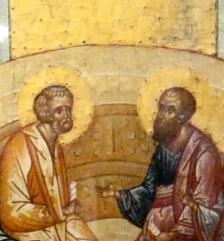
Every year I discover new ‘details’ in the Feasts’ icons. This Pentecost what caught my attention was the old king at the bottom of the Pentecost icon, mysteriously in a small semi-circle.  The more I studied the icon though, the more questions came to my mind. What is St. Paul doing here, since we know he became an Apostle after the feast?! …

pentecost icon.jpg


The Icon for the feast of Pentecost is also called the Descent of the Holy Spirit, as it is a depiction of the event described in the Book of Acts (Acts 2:1-4) when the Holy Spirit descended as tongues of fire upon the Apostles gathered together and enabled them to preach in different languages. However, the Feast of Pentecost is not only the commemoration of an historical event, but a celebration of a present reality: the presence of the Holy Spirit in the Church. Likewise, the Icon for Pentecost is much more than the depiction of a past event.

pentecost St Peter and St Paul Uncreated Church

The presence of the Apostle Paul in the icon, even though at that time he had not yet converted on the road to Damascus, hints that this icon is more than a purely historical picture. Sometimes, the evangelists Luke and Mark are also shown, despite also not having been present in the upper chamber at Pentecost. The gathering, then, is a representation of the Church. The Apostles are seated in a semi-circle, representing a unity and harmony similar to that found in Icons of the Holy Trinity. As in icons of the Holy Trinity, a semi-circle, rather than a full circle, is used so that we as observers are drawn into the unity.

pentecost Descent of the holy spirit orthodox pilgrim uncreated Church

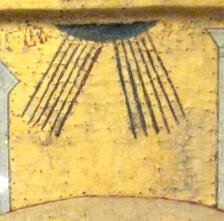
The source of their unity is in another semi-circle at the top of the icon, showing the descent of the Holy Spirit. From the blue semi-circle (c.a. mandorlas) a single ray of light for each of those gathered shines down to illumine them. Sometimes the “tongues of fire” described in Acts are shown at the tips of the rays, ready to descend upon the Apostles. Other times, the tongues of fire are shown already within the halos of each of the seated Saints. Some icons of Pentecost show a dove, either within the mandorla at the top of the icon, or even descending upon those gathered in the upper chamber. Given the appearance of the Holy Spirit as a dove during Christ’s Baptism, it is understandable that this physical image of the Spirit is also used in Pentecost icons. However, the Holy Spirit appeared as tongues of flame at Pentecost, and a dove at Christ’s Baptism, being – in reality – neither of these things. Therefore it is inappropriate to depict the Holy Spirit as a dove at Pentecost, or indeed in any icon except those for the Theophany feast.


pentecost orthodox pilgrim the world and the Uncreated Church


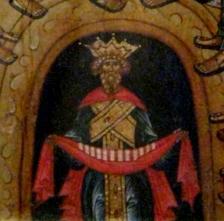
At the bottom of the Icon is another semi-circle, showing an old king against a dark background. He is often named as Kosmos and represents the world. He is crowned as a symbol of earthly authority – i.e. he represents all the peoples of the world, rather than the whole of creation. He is sat “in darkness and the shadow of death” (Luke 1:79), and is aged to show the corruptibility of the world. Yet he also holds a blanket containing scrolls representing Apostolic teaching (compare with the scrolls held by the Apostles in the Icon itself and “the meaning of objects held by saints in icons“). Though in darkness, the descent of the Holy Spirit has not only reached the Apostles, but also all corners of the world into which the Apostles will preach the Gospel. The Empty Seat A striking aspect of the Pentecost Icon is the empty space at the centre, between the Apostles Peter and Paul. This central seat is a place of honour, the “Teacher’s Seat” around which the Apostles are gathered. Why is it empty? Because it is the seat Christ should be sitting in, Who has ascended physically into Heaven. Yet Jesus promised many times that though He would leave them physically, He would instead give to them the Holy Spirit as a comforter, advocate, and guide. This promise was first realized at Pentecost, and is still true today. Therefore, the Icon, which is also an Icon of the Church, shows the Apostles gathered in unity, sustained by the power of the Holy Spirit, surrounding Christ Who is invisibly present. The world, Cosmos, is at their feet, ready and waiting to be harvested through the passing on of Christ’s teaching.


Some icons of Pentecost show Mary the Mother of God in the centre, occupying the “Teacher’s Seat”. Surviving icons of this sort are usually western (the above comes from the border between Finland and Russia). Mary was present at Pentecost, though as already mentioned, the icon is not primarily a historical snapshot of the event. The Theotokos’ presence in the centre is not problematic though, as she is the ultimate exemplar of a Christian. With Jesus Christ ascended into Heaven, the Holy Spirit acts within people, and through the Saints Christ is manifested in the world. Mary is therefore shown in the “teacher’s seat” as the best example we have, and the person on earth who most resembled Jesus Christ (both physically, as His mother, and spiritually as His disciple). Nevertheless, the “empty” seat is a more widespread and, I believe, more impressive image of both Pentecost and the Church. The Apostles are seated as equals, with no individual among them taking the central seat of authority. They don’t need to. Their unity as the Body of Christ is sustained through the real “Vicar of Christ”: the Holy Spirit.


Blessed are You, O Christ our God, who made fisherman all-wise, by sending down upon them the Holy Spirit, and through them, drawing all the world into Your net. O Loving One, glory be to You. (Apolytikion for Pentecost) More About the Feast of Pentecost>>


Source: Pentecost Icon as an Icon of the Church

The Comforter

Fascinating homily in its breadth and depth! Like all by Metropolitan Anthony of Sourozh. In it you may meditate on Nature, God’s Creation, God’s Energia in His CreationThe Little Prince by Saint-Exupery, three-fold etymology of ‘Paraklitos’, Conversion, Betrayal and Apostasy narratives, Faith and Loss of Faith, C. S. Lewis, the difference between Art and Mankind, a beautiful statues and human ‘wreckage’, Father Sergei Bulgakov’s theology, a bold, ‘heretical’, ‘syncretistic’ worship during a World Council of Churches meeting, and so much more. Enjoy!

‘The Comforter’: Our Support and Strength for Mission

I feel more than slightly apprehensive, giving this talk in the background of a very theological theme. And so, you will forgive me, if my theological statements are untheological and if the rest is very different from what you may expect.

First of all, may I make a totally non-theological statement about the Holy Spirit? When we speak of the Trinity, for people as primitive as I am, we can imagine that the old image, given centuries ago, still holds, and we can develop it on one point. Speaking of the Trinity, trying to understand the relation there is between the Father, the Son and the Holy Spirit, some writers have said that we can compare God to the sun in the sky. In its mystery, the sun is unknowable as such. No one of us will ever be able to participate in the nature of the sun, but it becomes accessible to us in its light and warmth. The light is something which we perceive with our senses, by sight, and which reveals to us everything that surrounds us. We do not see the light as such, but it is in the light that things are revealed to us. The warmth of the sun is the way in which He pervades us, and in which we can become participants — to whatever degree is accessible to us — in the life of God.

Christ the Word is an objective revelation of God. The Spirit reaches us only within our experience, in the way in which the warmth of the sun pervades us and we become aware of it, and through it of something which is of God. This is a non-theological introduction to the subject.

As an illustration of this, I would like to give you an example of a contemporary of mine, who had discovered his faith in God through an encounter with Christ. But he puzzled and puzzled about the Holy Spirit. He did not understand. One day, he found himself on a bus. It was in Paris, around the theatre of the Odeon, and he was saying to himself or to God: ‘But what does the Holy Spirit do to us? How can I know that I have had some sort of contact with the Spirit of God?’ And of a sudden he felt he was, unexpectedly to himself, filled with a love of the creation and of the human beings that were surrounding him, in a way in which he had never known he could. And he realised that, at that moment, the Holy Spirit had come to him and made him partake, to the extent to which he could, in his immaturity perhaps, in Love Divine. At that moment, he knew something about the Holy Spirit: that the Holy Spirit was communicating Himself to him by communicating to him something which could not be invented or forced, even out of his human experience.

The Holy Spirit comes to us quietly; at times unexpectedly, at times as the result of a long longing. Some of you may have read a book called The Little Prince by Saint-Exupery. There is a passage in which the Little Prince meets a little fox. Both the Little Prince and the little fox are attracted to one another, but both are desperately shy. The little fox comes and sits down at a certain distance, but whenever the boy makes a movement towards it, it runs away. Then one day the little fox says to him something like: You know, we both long to come to one another, but we are shy and afraid. So when I come, don’t make the slightest move. Look askance, so that I may imagine that you have not noticed my presence. And, not being afraid of being watched, I will come a little nearer than the day before, but don’t turn to me, because I will be afraid and run away. And then, another thing,’ he said, ‘I long to come close to you. And so, let us fix a time when you will come, because then — oh, a good hour before the time — I will know that you will be coming. I’ll come myself and wait. And I shall be filled with this expectation of the moment when you will appear. And then you will sit down and, as I said, pay no attention to me, and allow me to come nearer, and nearer, and nearer.’ This image of the little fox is something that, to me, resembles very much the way in which we relate to the Holy Spirit. Christ comes to us, proclaiming the truth. He is the Truth; He is the One who Is. He is a revelation, an unveiling. The Holy Spirit, in this sense, is not a revelation. He is the one who makes the revelation possible, by making us commune with what is the essence of this revelation: the closeness and the knowledge of God.

If we turn to what we hear in the Gospel about the Holy Spirit, I would like to attract your attention to one passage — to a word rather than a passage — that we repeat time and time again in our prayer: the Comforter. ‘Comforter” is the English translation of the word. When we look at the various languages into which it has been translated from the original, I think we can see a variety of facets in the event. First of all, the Holy Spirit, whom the Lord Jesus Christ sends us, is the one who consoles us for our loss of Christ. I am speaking of the loss of Christ, because each of us believes in Christ, each of us has had an experience of His closeness, His presence. Each of us has had, through His teaching, an experience which He conveys to us in word and in person. But, with the Crucifixion, the death of Christ and the Resurrection and Ascension, He is not present as He was present to His disciples, and He is not present in the way in which He will be present to us when all things will be fulfilled. You remember, probably, the words of Saint Paul, when he says: As long as I am in the flesh, I am separated from Christ. And yet — Christ is my life. And we are all, to a lesser degree than Paul was, of course, in the same kind of situation. On the one hand, Christ is our life; on the other hand, we are still separated from Him. We all long to be with Him, but we cannot go beyond a certain point of closeness. And Saint Paul points it out, when he says that, as long as he lives in the flesh, he is separated from Christ, and he longs for death to come. Not as an end of his earthly life, but as the moment when a veil will be torn apart and, as he puts it, he will know as he is known. He will see face to face what he can see yet only as shadows and images mirrored.

823-600x459

The Holy Spirit reveals Himself to us as our Consoler. In the sense that Christ has promised to send Him to us, He comes to us. He gives us an incipient participation in a closeness of communion with Christ, and through Christ, in Christ, with the Father. So that this is our first experience. His closeness to us consoles us for the fact that we long to meet Christ face to face, to commune with the Father in a way unutterable to us.

But the word goes beyond this. He is not only the one who comforts us; He is the one who gives us strength; strength to live in this orphaned situation in which, on the one hand, we belong to God wholeheartedly, sincerely, heroically at times, and on the other hand live in a world that has fallen away from God and in which we have a function to fulfil. He is the one who gives us strength to live in the world which at times denies everything we long for, which stands between us and our fulfilment by temptation, by beguilement.

At the same time, there is a third meaning in the word. He is not only the Consoler. He is not only the one who gives us strength to face life, in the faith and yet in the partial absence of Christ. He gives us the exulting joy of being with Christ already in this world, because, although our communion with Christ is imperfect, although it is not all-embracing, although we do not know Him as He knows us, we do know Him. And this is a miracle that we could not appreciate if we were born, as it were, in a believing family and if we had been given our faith together with our birth. But those of us who were unbelievers, the millions who believed not and have discovered, know the exulting joy of this discovery of God in Christ and through Him, of the fatherhood of God’s own Father. So that, in the Holy Spirit, we have consolation because we are orphans. We are sent into the world to conquer it for God. And in the process, at moments, we are given a sense of incredible closeness, and we can be astounded and rejoice in the way in which the young man whom I mentioned in the beginning rejoiced, having been filled, in an unutterable manner, with a love he did not know could exist; not only for humanity, not only for every concrete human person, but for the whole of creation.

We are told by Christ that He will send the Spirit to us, who will lead us into all truth. ‘All truth’ is not an intellectual situation. It is not the knowledge of the mind; it is an experiential knowledge. The truth (in Russian istina) is what is: I am He who is. And the knowledge of the truth can only be possessed in communion with Him who is. In a strange way, we have lost through the centuries this certainty that this is what the truth is. It is God Himself; it is the absolute Reality. Pavel Florensky, speaking of the truth, says: ‘Istina — eto Estina’ — the Truth is what is!’ ‘I AM’. And strangely enough, because we have moved knowledge of the truth from this existential experience onto an intellectual level, we feel that we must fight for the truth and defend it, forgetting that the Truth cannot be destroyed by any created power. The Greek word aletheia means ‘what cannot be washed away’, annihilated, even by the waters of the River of Oblivion. Nothing can do it!

If we continue to dwell on words, we could remember that the words verity, veritas, Wahrheit, derive from a Latin word meaning ‘to defend’, not ‘to be defended’. The Truth can defend us against everything, and it does not need us to defend it. This is a very important point with regard to our mission in the world, because it means that we are sent to proclaim it and reveal it, but not to defend it in argument. We cannot defend the Truth by argument. We can present another facet of things, which people can accept or not, but we cannot always defend it in the way it should be defended. I remember when I was young and began to do youth work, my father saying to me: ‘Proclaim the truth and be to people a vision of it, however dim, but do not try to convert anyone by argument, because, if you prove to be more intelligent, more well-read than another person, you will be able to defeat the other person, but you will not have changed his life. And I remember an occasion, a case in the comparatively recent history of the Russian Church in Stalin’s time. A young man called Evgraff Doulouman, who was a student at university, was looking for digs. He found a room in the house of the local parish priest. The priest was mature, ageing, with a deep and tragic experience of life: of the beginning of the Revolution and of the persecution that followed. The young man was full of his atheistic convictions, and he decided to convert the priest to what he believed to be the truth, and they engaged in conversation and discussion. The priest was an old and wise man. He did not argue point by point, but unfolded before the young man the truth as he knew it. The young man was not mature enough to go through the experience that was offered him, and he made it into an intellectual world-outlook that defeated, completely annihilated, his atheistic vision. Having been dialectically defeated, he embraced the Christian faith, asked for baptism, went to study theology in Zagorsk, was brilliant as a student, was ordained deacon and priest and was sent to Samara, I think, to a parish. It was expected that he would be a brilliant missionary, taking into account the way he had moved from refined, deep atheism into a powerful sense of Christianity. When he was in the parish, this young man discovered — in the celebration of the Liturgy, in the sacraments, in his pastoral work — that he could present the Christian truth in words, but he did not believe it all in his inner self. After a while, he renounced the Church and became an active agent of atheist propaganda. I give you this example to underline the fact that it is not in the refinement of argument in debate that one conveys one’s faith.

In the course of the whole history of Christianity, you meet people who are filled with the Holy Spirit, and whose life, whose person, whose words, in their simplicity reached others, hit them at the very core of their being and brought to life a knowledge of the divine that had been dormant. It has been for many as though the knowledge of God was like Lazarus: dead, lying in his grave, who suddenly heard a voice saying: ‘Lazarus, come out!’ And the knowledge of God, an experience that was conveyed by having heard God speak to him, made all the difference. And so, when we speak of the Holy Spirit as being the Spirit of truth, it is not the spirit of formal theological discourse or of any formal thing divorced from the inner experience. Unless it is sustained by this inner experience, it may be a convincing argument but it will not be a power that can transfigure the life of another person.

We are sent into the world to proclaim Christ, but we are not sent into the world to argue about Him. In 1943, C. S. Lewis gave a series of addresses on the English wireless, and in one of them he asks: “What is the difference between the believer that has become alive in God and any other human?’ And he says: The difference can be compared to that which there is between a statue and a living person. A statue may be of supreme beauty, but it is nothing but stone or wood. It can be looked at and admired. It can send us a message of beauty, but not of communion. This beauty will be communion with something earthly, created, but not beyond. Something must happen that will make it of the ‘beyond’. A human being may be infinitely less beautiful than a statue, but it is alive.’ And C. S. Lewis says: “When someone meets one of those statues that have become a living person, he should stop and say: “Look, this statue has come to life!” ‘ This is a challenge to each of us, because we may be satisfactory statues, but are we the kind of people whom others meet, look at and discover that there is life there and not only a shape?

It is very important for us to realise that our message to the world is not a world-outlook. It is a revelation of the presence of the Holy Spirit and of Christ. The Church is a mysterious Body, because the Church is the presence, in the midst of the fallen world, of the fullness of the divine Presence. The first member of the Church is He whom Saint Paul calls the Man Jesus Christ. He is one of us, as well as being, if I may put it that way, one of Them. He is not only One of the Trinity; He is one of humanity. Looking at Him, we can see what it means to be both totally man, human, and totally and perfectly divine. Since the Ascension and the Feast of Pentecost, the Holy Spirit has indwelt the Church totally, filled it with His presence. In the Spirit and in Christ, the whole Trinity is present in the Church. Are we Christians, Orthodox Christians, aware of this? Or is the Church a human body that looks Godward, that believes in God, that has evolved a very elaborate theology, but whose members are not limbs of Christ — as Father Sergei Bulgakov puts it: ‘an extension of the Incarnation’? Are we ‘an extension of the Incarnation’? Does anyone, meeting us, stop a minute and say: ‘In this person, there is something I have never met before. Here is a human shape, but there is something beyond it.’

I think I have mentioned a personal example which I will dare mention again. I came once to the church that became my parish for years in Paris. I aimed at being present at the Vigil, but for one reason or another I was late. The service was over. It had taken place in an underground garage, that led to ground level up a wooden staircase. I entered, and saw that everything was over. Only, there was a man coming up the stairs. It was a monk, in monastic garb, and when I looked at him I felt that I had never in my life met such total inwardness, such serenity, such peace and depth. I did not know who he was. I came up to him and said: ‘I do not know who you are, but would you become my spiritual father?’ This is a sort of central experience I had of a person in whom I saw something I had never seen to that extent: this total inwardness in the abiding presence of God, the Spirit at work, and the Incarnation in him. Years later, I received a little note from him, saying: ‘I have experienced the mystery of contemplative silence. I can now die.’ And three days later, he died. This, to me, was an example of what a Christian can be. He was not ‘impressive’ in any respect. He was not a man of superior education or of an outward holiness, but in him I could see the Incarnation and the presence of the Spirit.

When we look around, do you realise the kind of world in which we live? Bishop Basil must have talked to you about the presence of the Holy Spirit in the created world. At the moment of creation, the Holy Spirit was hovering over the newly-created world. This newly-created world, in translation, is called ‘chaos’. When we think of chaos nowadays, we think of destruction, the chaos that followed the bombing of Dresden. But chaos is something much more essential and deeper. Chaos is the sum-total of all the existing possibilities that have not yet found a shape and blossomed out. The Holy Spirit was breathing over the chaos, over all the possibilities of a world that had been called into being and had no shape yet. By breathing over this chaos, the Holy Spirit was bringing to life all its possibilities, and everything that was hidden as the possible began to emerge as reality, as you can see in the beginning of Genesis. But God did not force the shapes. He initiated the possibility for the creation to become itself more and more; to expand in depth, and in width, and in every respect

Things changed with the Fall. But what had been given first was never taken away; the created world is still that world which God created. If it is distorted, it is not because it has turned away from God, but because its guide, man, has turned away from God, has lost his way and has proved incapable of helping this chaos to become the perfect cosmos: beauty in form, in line and life, so that the world in which we live is the world which, in itself, is pure of stain except for the distortion that we have created in it. When we look at the surrounding world, we must be aware that everything that is monstrous, frightening, ugly and distorted in it is our doing. To apply to the generality a phrase that was spoken in a particular situation, one of the Fathers says: “We must remember that what we call the sins of the flesh are the sins that the spirit inflicts on the flesh. The flesh is pure.’ We make it a victim of sin. Our body says: ‘I am hungry.’ Our imagination says: ‘I want to delight in such-and-such foods.’ The natural situation of the created world is that of a victim of the human fall, of our being separated from God, of our being unable to restore, even in a small patch of land, the purity, the wholeness and the harmony that belong to it by right. This we must remember. With what veneration must we look at the cosmos and everything that is the material world around us, and what broken-heartedness we must feel when we see it distorted, broken, ugly and monstrous at times.

Again, when we turn to God, to God’s revelation and the creation of man — the Lord God breathed His own breath into man: that is the original human, the anthropos, the chelovek, and man, the total man, has remained filled with the Spirit of God. We must remember this: it is not our Christian, our Orthodox, privilege to be such. All human beings are such. Sinful, yes, but basically such. And so, when we look round at all human beings, we have no right to see good in some and evil in others. We must see victims of the human fall in one and the victory of Christ in the Spirit in the other. The saints are examples of this victory. To them, to the extent to which it is possible in a world which has not yet come to the parousia, to its end in Christ’s victory, we find, incipiently or still-surviving, true humanity. And this we must remember when we deal with whomever we deal with. Some people are ‘evil’, yes. But why are they? Have we given them newness of life by being a revelation of Christ and a gift of the Holy Spirit? It is easy, perhaps, at times to be compassionate to a person in error, but how easily do we condemn the error from the height of what we imagine to be the truth as we know it!

I have paid some attention, in the course of the last seventy years or so, to the beliefs of men, to the religions of the world. What strikes me more and more is that, however different they are from the faith of Christianity, they are all a distortion of the truth; not a straight lie against it, except for some who have chosen to be servants of Satan and not servants of Christ.

I would like to keep you a little longer than I intended: my forty-five minutes are just over. If you will allow me ten more minutes, I will let you free.

437

Many years ago, I had a conversation with Vladimir Lossky about oriental religions. He was absolutely in denial of any knowledge, any true knowledge of God, in them. I did not dare argue with a theologian of such magnitude, but what courage could not achieve, I thought cunning might. As we lived across the street from one another, I went home and copied eight passages from the Upanishads, the most ancient Indian writings, went back to Lossky and said: “Vladimir Nikolayevich, I have been reading the Fathers, and I always take down the passages that strike me particularly. I always put down the name of the author, but alas, with these eight quotations I cannot find the author’s name. Could you identify them for me?’ He looked and said: ‘Oh, yes!’, and within a minute and a half he had put eight names of the greatest Fathers of the Church under the quotations from the Upanishads. And then cunning revealed itself in false humility, and I said to him: ‘I’m afraid I have deceived you. These are from the Upanishads.’ He looked at me and said: ‘Really? Then I must read them.’ And that was the beginning of a change of mind in him with regard to the statements of other religions.

Many years ago, in 1961, I was part of the first Russian delegation to the World Council of Churches in Delhi. Among a number of us, there was a man called Father Ioann Wendland, who later became a bishop in America and in Germany. He had been a secret priest in Siberia while doing geological research during the Stalin period. We decided to go to a pagan place of worship, to see and to try to understand. We arrived there. At the door, we had to take our shoes off, which we obligingly did, and we were about to leave them there when the warden came up to us and said: ‘Oh no, sir, you do not leave your shoes here. They are new and good, and would be stolen. I’ll put them in my office.’ So our shoes went into the office and we went into the place of worship. It was a round place of worship, divided into ten or twelve sections, and in each of them there was what we would call a pagan denomination, worshipping in its own way. We sat one after the other in the ten or twelve compartments, at the back, using our rosaries and praying the Jesus Prayer, trying to commune with God and seeing if we could commune with the people there. We both came out of it with the certainty that, whatever they called their god — whether it was the god-elephant or the god-monkey or another — they were praying to the only one God there is. And we had communed in prayer with them all, in spite of the fact that, on the surface, they had been praying pagan prayers to idols. That also made me think.

I will end your torment with one more thing. What I have said should make us much more understanding and attentive in our attitude to unbelievers. Not those who are empty of belief but those who are actively godless. I will give you one example, which some of you must have heard from me, because I always repeat myself. The example is this: I was coming down the steps of the Hotel Ukrainia a number of years ago. I was wearing my cassock, as I always do. A young man came up to me and said: ‘I am an officer in the Soviet Army. You are, I presume, a believer, dressed as you are.’ I said: Yes.’ Well, I am an unbeliever. Bezbozhnik (I am godless).’ I said: That’s your loss.’ He said: ‘And why should I turn to God? What have I got in common with Him?’ I said: ‘Do you believe in anything at all?’ Yes,’ he said, ‘I believe in man and in humanity.’ I said: ‘In that, you and God share the same faith. Start at that point.’ And, I think, more often than we do, we should be aware that there is no-one who lives without a faith, without believing in something. And more often than not, we may discover that God believes in the same. Only better, deeper, more perfectly, but that this person who fears that there is nothing between God and him has something in common with Him. At this point, we may remember the passage of the Gospel in which Christ says to Nicodemus: The Spirit blows where It chooses, and no-one knows where It comes from and where It goes.
We must be infinitely reverent when we look at the world that surrounds us, which we have distorted and which suffers like a martyr under the result of human sin, and remains pure, so pure that God could become man and put on flesh; a flesh He inherited not only from the personal saintliness of the Mother of God but from the fact that she was the heir of all the saintliness of thousands of years of human life in history. We must remember that all humans are possessed of this breath of life which is God’s breath and God’s life, however distorted it may be. We must remember, as I have said, that the Spirit blows where It chooses. Without this precondition of the way in which the world, mankind, relates to God, no-one — no one of us and no-one in the world — could discover God. It is the Spirit that reaches us and that kindles in us life eternal. So, when we speak of being sent into the world, we must remember that we are unworthy messengers of a message that may be received by the created world around us, and by the humankind around us, better than we are capable of proclaiming it.

How often it happens that words of truth are said that do not reach the congregation that is there, but reach someone who by accident, or by an act of divine Providence, has entered the church. We must remember this. And go into the world, not to proclaim a theoretical theology of the mind but to grow into the life of Christ, to open ourselves to the action of the Holy Spirit, to believe that the Holy Spirit is active in the created world which is dear to God. Dear to God, because the Body of Christ belongs to this created world through the Incarnation, and to mankind — to everyone.