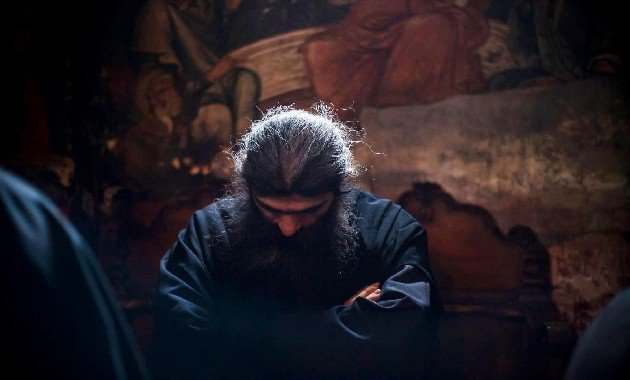
“Leave this problem that you have to me, son. I’ll deal with it. You pray, stay calm, have peace within you and be careful how you live. Everything will turn out in accordance with Christ’s will.”
Archimandrite Symeon Krayiopoulos
“Leave this problem that you have to me, son. I’ll deal with it. You pray, stay calm, have peace within you and be careful how you live. Everything will turn out in accordance with Christ’s will.”
Archimandrite Symeon Krayiopoulos


Impossibility of Aloneness
I’m an Orthodox Christian living in Homer, Alaska and experienced Jesus Christ in the Himalayas, in India.
I listen to the heartbeat of rain outside…
Cold, Alaskan fog blowing in off the bay, emerald hills now that autumn is here and summer chased away into the mountains. But a milky white fog spreads over the bay like a silken ghost. I used to visit Trappist monasteries, back when I was Catholic, at the beginning of high school, and searching for a relationship of love. I read plenty of philosophy then to know that knowing isn’t enough, that having a realization in the mind is entirely different from experiencing a revelation of the heart.
I spent two birthdays in the Himalayas…
Traveling along gravel roads that drop deep into icy gulches where the Ganges river rages below not yet packed with the filth and mud and newspapers of villages, not yet carrying remainders of Indians in her current, I found Christ found me. It’s a difficult and strangely compelling atmosphere to confront oneself, – – India, – – sandwiched with black corpses, white snow, pagan fires and virulent animals.
I took a bus north from Delhi. It was crowded, tight and cramped, flies buzzed between my face and the windows smeared with brown slime. It’s so polluted in Delhi, so much coffee-colored smoke, so much steam that you really can’t see the sun. You saw it, a rising orange-reddish ball burning over the horizon fifteen minutes in the morning, but then fifteen minutes slouching back down again, an exhausted head over the mountains.
I grew up Catholic but turned to Buddhism when introduced to a self-hypnosis class at my Catholic high school, experimenting with meditation and ‘mindfulness.’ I experienced serious symptoms of manic depression then, partially because I’d consciously turned away from the Judeo-Christian God, and also because life at home was very, very difficult for me. I grew anxious and got into extremely self-destructive habits, and so Buddhism seemed a perfect door to address – or not address – my turning from God and family, and focusing my energy toward dissolving into a Void, a dissolving bubble on an endless and personless river, Tathāgatagarbha. The element that got me is to dissolve my desire, and abandon my selfhood, in order to avoid suffering. But desire doesn’t seem so bad, especially when it is for love, which requires more than one person, and thereby voids any notion of abandoning self, – – and to love, to truly love, is to give, which may require sacrifice, and suffering – –
So Tibetan Buddhism kept coming up, because the meditation helped calm my anxieties and depression, and because the culture proved highly engaging, what with all her colorful flags, her skulls, and metaphysical explanations of things, – – but what is left, when ‘I’ disappear, and there is no one else for whom a relationship of the heart can exist? Not to mention, what did the experiences of the Gospels, the Cloud of Witnesses, the Holy Church, amount to? I knew nothing of Orthodoxy when I reached into the closet of Buddhism, but in light of it, now, what does it all add up to?

Mindfulness worked as far as cleansing the window, the mind, is concerned, which is important, but then many of its doctrines, – and I explored countless doctrines, – really stop here. Clear sky. But what it did not do, and could not, really, is orient me toward the sun, and the warmth of the sun, and the sunlight – – all religions seem to contain some seed of truth, but fail in witnessing to the Triadic God…and all my destructive habits, and relationships, and every mantra, and yoga, all of which I’ve had my fill…this is how Christ brought me to Him.
Back to the story, I’m in Delhi, on a bus. And after an hour or two of sitting in that cramped, stuffy and urine-soured air you hear the front breaks release, the bus finally stretching her arthritic joints and creak slowly forward. She rolls, head first, toward the busy main road. For fifteen minutes we cough and pop down the road, away from my filthy, but greatly lovable refuge of Manju Ka Tilla, a sort of Tibetan refugee camp criss-crossed with telephone wire, wet and narrow alleyways packed with dogs and diapered babies, and polio. Cobblestone streets and bakeries, copper trinkets and arms, this is the first place on earth I met leprosy, and her sister polio. The beginning of my spiritual warfare.
I usually saw them together, these two, – polio and leprosy – crowding in around a barrel of fiery rags, in the crayon-black darkness hands like chewed-up bread, teeth pencil yellow and cracked. I see a boy attacked by a skinny, vicious-looking dog with long, wet fur and crazy eyes – it looks like a red and yellow fox, – – a tangle of fur and blood and whimper. The taxi cab drivers, waiting on their afternoon customers near the stinking, feathered dumpsters launch after the monster in a terrible raid of madness and darkness. They chase the thing down with bricks loosened from neighboring grocery store steps leaving the boy warm and wet with his own blood, a hound’s tooth broken off inside his leg.
Here is suffering, and personhood, and sacrifice…
He looks young but his face shows no signs of innocence. His dark eyes follow me as I run a few feet away to pick up a bottle of water, then return. We look at each other. His long, dangling arms and fingers started rubbing the area of skin that have broken open and gush a strange, purple fluid.
Wet, mossy feet and the bitter odor of trash hang in the air. Cows streaked with vomit pick through spoiled food and milk cartons nearby at the dumpsters. He waits for a doctor but one never arrives. I don’t know what else to do. The boy looks through me, limping into an alley and disappearing in the terrible darkness.
I will live here a total of five and a half months. I will have arrived here practicing Buddhism and Hinduism for eleven years, and leave Christian…
I thought maybe I’d join a Buddhist monastery, or be discovered by wise sage in the mountains, spend the rest of my life in the Himalayas experiencing exotic mystery and enlightenment. I read dozens of sutras by various Buddhas, had an underlined and well-worn copy of the Bhagavad-Gita and Upanishads, and was reading all the California guys, Bhagavan Das, Ram Das, Krishna Das, and even met most of them, all the 60s ‘hippy’ idols who dropped acid and flew to India to go ‘find the guru.’ I read Be Here Now and did the whole drug scene, but despite all the colorful statues and marijuana and tantra, no matter how ‘empty’ I became, there wasn’t enough and I sensed…how can I say this…something was wrong.
I worked as a wilderness guide for at-risk youth in the sage deserts of Idaho. Teaching primitive skills, meditation and mantra, and working with psychologists to develop methods of emotional and behavioral therapy – – I was chased by a wolf, I killed a rattlesnake. And while out there, – this is in the middle of my life before Christ, – – toward the end of it, actually, – – I began experiencing strange things – not only while traveling through India, but before that, and not only me, but my girlfriend. We saw, and everyone involved with this recipe of mantra, meditation, yoga, – and a lot of it sober, – – we saw shadows and demons, experienced trembling and ungodly anxiety and fear. So I knew something was strange, something was going on. It is not all opinion, all belief, for if I have freewill, and exist outside the body, – and I had plenty experiences where I knew I was more than my body, – – and this is one of the things that helped me dismiss and eventually leave the bag of eastern religions, – in addition to God’s grace, – – that if I am more than my body, and I have free will, and can choose to either accept or reject love, then others can too, and this brought up the issue of good versus evil, of right and wrong.
Was what I was doing, right? Who was I following? Are these things, these deities, just archetypes, and if not, if they are ‘real,’ are they ‘good?’ It like jumping into an ocean and realizing there are many different things floating around in there, harmless creatures, some of them beautiful, and some, in fact, that will attack you, that are poisonous, and the astral life, the spiritual life, is like that. Very quickly, once I got to India, I understood this. And was scared.
The boy with the watermelon disease, his head swollen on a piece of cloth outside my guest room door, a cloud of black flies wriggling over an empty ribcage and hollow eyes, a human Jack-O-lantern, his mother’s long brown arm rung with silver jewelry begging for rupees.
So why did I leave a supportive and beautiful girlfriend behind in Oregon to experience this? I was beginning to mend my relationship with my parents, gain more confidence, and had read Way of the Pilgrim a number of months before, but it was with all my California stuff, and I never saw any relation to that and Orthodoxy, never once asked, where is a church that deepens one’s relationship with the living, loving, Truth? Where truth is a Person, as I’d later read from Father Seraphim Rose?
I’d head up to the mouth of the Ganges River, to Gangotri, – – into a mountain. On my 28th birthday, I listened to the heartbeat of the wind on the cliffs, on the water, and experience not a realization of the mind, though that did happen, sure enough, but only once the heart was struck by a sort of cherubim’s sword in my heart, experiencing a revelation occurring in meeting the living God, Jesus Christ, and myself peeling away from itself.
What can I say?

Everything I’d learned, practiced, experienced for all of eleven years poured out from my head, in one ear and out the other, replaced by their approximate Christian terms, fulfilled, actually, and I knew reincarnation is impossible through the resurrection, because I am a self, a soul, and I knew karma is impossible because it operates independently of ‘God’ and there is Divine Intervention, I’ve witnessed it, and experienced it. In the cave, a joyous ache in my heart, and in the cave, no more aloneness, no more aloofness. In the Himalayas, and I mean immediately, like I was zapped, I really met Christ, and was dumb for a moment, and in Eternity I saw in my heart the Person of God as Christ, and I could never, ever be alone. Maybe I’d FEEL alone, sure, (doubtful) but I ought to remember, the impossibility of aloneness. Maybe that should be the title of this letter.
So what happened after? I picked up a Bible and read the thing in a guest house back in Dharamsala, over 12 hours away, and then I’d return to America, after the shaking bus trips and gargantuan ceremonies of burning bodies and yellow and black gods and goddesses, and and I’d fall into the lap of the Orthodox Church, in Eugene, and, I’m only skimming over it now, due to time constraints, and I’d visit St Anthony’s Monastery, in Arizona, and all the monasteries and churches in between, long enough to fill a book, and pray to St Herman who could, by his intercessions, bring me straight to Spruce Island, and to where, kneeling before his relics, find home. In Homer. There is more, but I’ll write later. So much has happened to my heart. Forgive me for rambling, and going on. May the Father of Lights enlighten us, and have mercy on us. Amen.
“It is one thing to believe in God, and another to know Him.” + St Silouan
By Magnus
Printed in Issue 24
Editors Note: Joseph Magnus now lives in Port Townsend, Washington. He is a writer of children’s books and helps the Father Lazarus Moore Foundation. To visit his blog and read more of his poetry, short stories, and other writings, visit here: Servant of Prayer


Unless we look at a person and see the beauty there is in this person, we can contribute nothing to him.
One does not help a person by discerning what is wrong, what is ugly, what is distorted.
Christ looked at everyone he met, at the prostitute, at the thief, and saw the beauty hidden there.
Perhaps it was distorted, perhaps damaged, but it was beauty none the less, and what he did was to call out this beauty.
Based on Metropolitan Anthony of Sourozh

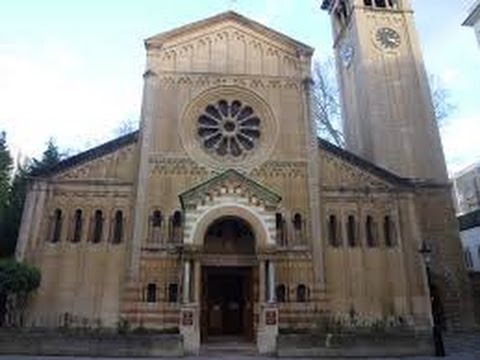
Being immersed in the Beauty of Slavonic Church services, especially the awesome beauty of the Eucharist- the Divine Liturgy has everything we need. Overpoweringly beautiful and haunting. Such Beauty seems to sum up Christianity. We Christians should be first and foremost Eucharistic creatures.
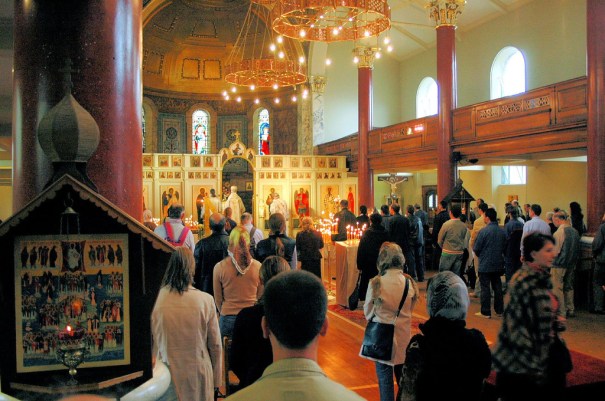
The Russian Orthodox Cathedral of the Dormition of the Mother of God and All Saints (Ennismore Gardens, London)

Coming here has been a dream from my youth. Metropolitan Anthony’s of Sourozh books, especially Living Prayer, School for Prayer, God and man, and Courage to Pray, have sealed my conversion to Christ:
“I met Christ as a Person at a moment when I needed him in order to live, and at a moment when I was not in search of him. I was found; I did not find him.
I was a teenager then. Life had been difficult in the early years and now it had of a sudden become easier. All the years when life had been hard I had found it natural, if not easy, to fight; but when life became easy and happy I was faced quite unexpectedly with a problem: I could not accept aimless happiness. Hardships and suffering had to be overcome, there was something beyond them. Happiness seemed to be stale if it had no further meaning.
As it often happens when you are young and when you act with passion, bent to possess either everything or nothing, I decided that I would give myself a year to see whether life had a meaning, and if I discovered it had none I would not live beyond the year…”(continue)
Metropolitan Anthony’s presence is so alive here! You can feel him still serving, from Heaven, at the Altar, especially during the Divine Liturgy.
So many Russian Saints relics here! St Seraphim Sarov, St Silouan the Athonite, Grand Duchess Elizabeth Feodorovna, Ignatius Bryanchaninov, John of Shanghai and San Francisco, Xenia of Saint Petersburg, just to name a few ...
Praise the name of the Lord Byzantine Chant
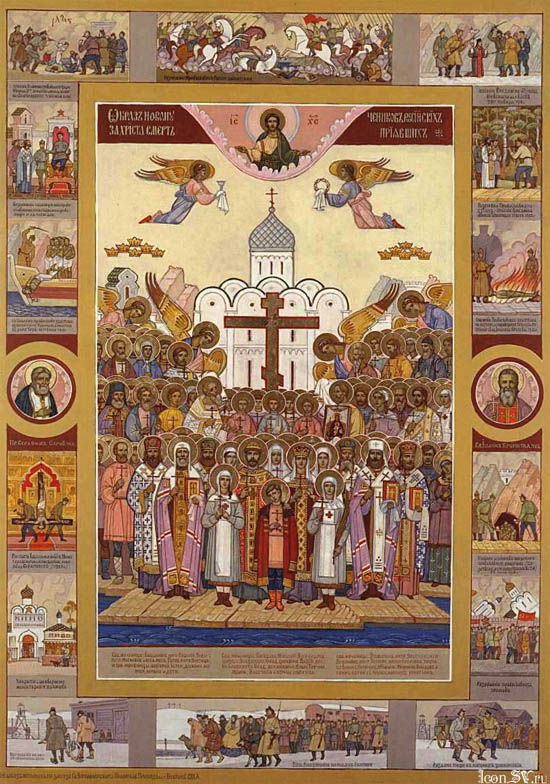
At the homily, the priest spoke about the Feast of the day: the Synaxis of the Holy New Martyrs and Confessors of the Russian Church
More than 1700 names are commemorated in the Synaxis. Here is just one of them:
Commemoration date December, 17 (December, 4 old calendar)

Born into a merchant family in St. Petersburg. In 1920, she survived a tragedy. First, her husband, an officer of the Tsar’s Army and warden of the Smolny cathedral, died of cholera, then all five of their children. Seeking the Lord’s succour, Catherine joined the brotherhood of St. Alexander Nevsky, founded at the cathedral of the Fedorovskaya Icon in Petrograd, and became the spiritual child of Hieromartyr Leo (Egorov).
Catherine was arrested in 1932 with the other members of the brotherhood (ninety in total). She was sentenced to three years of labour camp “as a member of a counter-revolutionary organisation.” Upon release, she settled in Borovichi, like Martyr Keira Obolensky. In 1937, she was arrested and charged with the clergy of Borovichi. She refused to plead guilty of “counter-revolutionary activity” even under torture. Was executed by firing squad on the same day as Keira Obolensky.
At the time of execution, she was sixty-two.
For other martyrs and confessors commemorated today, go to Pravmir

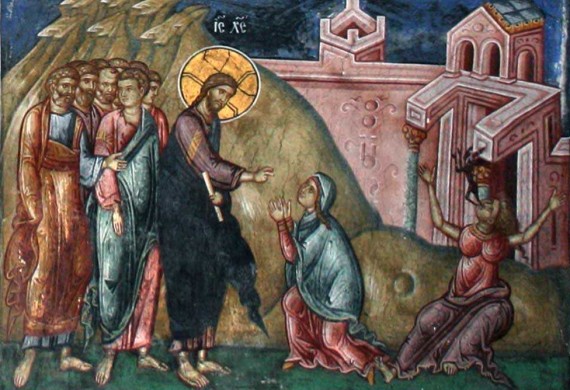
“Lord, you are implacable.”
St. Silhouan the Athonite
In today’s gospel reading, we find a woman in great need: her daughter is horribly demon-possessed. In such situations, when you experience pain, you do things that you wouldn’t do under other circumstances. Just so, this Canaanite woman runs with determination to receive that which she seeks. First, her great faith and second, the depth of her humility, give her complete conviction that she will receive that which she desires. And her entire conversation with Christ develops gradually, in a remarkable way.
And what about us? I wonder, will we go down, one step at a time, just as the Canaanite woman did? Will we accept whatever the Lord permits so that we stay faithful until we receive our desired end, our salvation?
Holy Hesychasterion “The Nativity of Theotokos” Publications.
Archimandrite Symeon Kragiopoulos

![Jesus Prayer].jpg](https://orthodoxcityhermit.com/wp-content/uploads/2016/11/jesus-prayer.jpg?w=648&h=391)
Metropolitan of Nafpaktos and Agios Vlasios, Hierotheos, speaks on Mount Athos’ secret cry: the Prayer of the Heart
As biological life is transmitted, so spiritual tradition is a whole life.
*
A guide speaks theoretically, but the Fathers beget spiritually.
*
The Holy Mountain is a living organism.
*
May the Lord find us worthy to hear its secret cry!
*
Already in his youth, Metropolitan Hierotheos was particularly interested in the Fathers of the Church, working for a time in the monastery libraries of Mount Athos, on the recording of the codices. He was especially interested in the teaching of St. Gregory Palamas.
The influence of Fr. John Romanidis, the study of the patristic texts and particularly those of the hesychast Fathers of the Philokalia, many years of studying St. Gregory Palamas, association with the monks of the Holy Mountain (Mount Athos), and many years of pastoral experience, all brought him to the realisation that Orthodox theology is a science of the healing of man and that the neptic fathers can help the modern restless man who is disturbed by many internal and existential problems.
Within this framework he has written a multitude of books, the fruit of his pastoral work, among which is Orthodox Psychotherapy. Some of these books have been translated into various languages, such as English, French, Spanish, Russian, and Arabic. With these books he conveys the Orthodox spirit of the Philokalia to the restless and disturbed man of our time.
Books

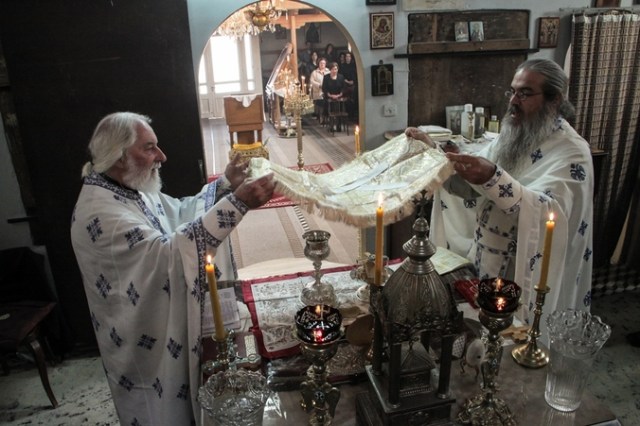
Fr. Jonathan Hemmings (Orthodox Christian Parish of the Holy and Life-Giving Cross at Lancaster) talks about his conversion to Orthodoxy, his meeting Metropolitan Anthony of Sourouzh, the Most Reverend Metropolitan Kallistos Ware, and other Living Signposts God of the Faith, and his last book, Fountains in the Desert.
For a more detailed testimony of Fr. Jonathan’s Conversion go to Finding the Faith of Joseph of Arimathea

The Monastery of the Archangel Michael on the Greek island of Thassos is a podvoriye of Philotheou Monastery on Mt. Athos. Gerontissa[1]Theophano, the mother of Elder Ephraim of Philotheou and Arizona, spent the final years of her life there and departed to the Lord on February 27, 1986. She became a novice to her own son! The gerontissa of the monastery, Abbess Ephraima, blessed us to record stories of Gerontissa Theophano, as well as recollections about her from sisters of the monastery.
In the Monastery of Archangel Michael and generally in Elder Ephraim’s spiritual family everyone calls Gerontissa Theophano “Grandma.” “Grandpa” is Elder Joseph the Hesychast, the spiritual father of Archimandrite Ephraim, and “Grandma”—Gerontissa Theophano. About how this common woman, spending the large part of her life in the world and having raised three sons, one of whom became an Athonite abbot and great elder, ascended to such spiritual heights, we will try to speak in this article.
We hope that the example of this Orthodox Christian, having combined within herself the virtues of motherhood and monasticism, would inspire our God-loving readers, both laity and nuns, to try to imitate her measure of strength in podvigs and prayerful labor. We also hope that readers of this article will come to love Mother Theophano, and begin to turn to her for prayerful help and beseech her intercession and teaching, undoubtingly believing that she has found boldness before the Lord God, Whom she so loved and Whom she sincerely served with her whole heart until her final breath.

Gerontissas Theophano (left), and Macrina
Person of prayer
Gerontissa Theophano (in the world Victoria Moraitis) had true maternal love for people. Her character was strict, but with love. She was severe first with herself and only then with others, with those whose souls were given to her to care for by the Lord, for her children and the young novices. Gerontissa was a person of prayer, and moreover was quite merciful and gracious, despite her severity.
She was always a faithful woman, regularly going to church, but in early childhood she lived without any special podvigs and had no elder who could direct her in the spiritual life. She loved to visit new places and go on various trips. But after a fire in her house, and after a miracle associated with this fire, she turned to Christ with her whole heart. Soon afterwards the Lord sent her a spiritual father.
“All together we’re not worth one Victoria”
As is known from Elder Ephraim’s book My Elder Joseph the Hesychast, Fr. Ephraim (Karaiannis), a disciple of Elder Joseph who had left the Holy Mountain and settled in the city of Volos, became her family’s spiritual father. He became the spiritual father of the community of which Victoria and her friends were members. Some of them got married and others chose the monastic path in life. Victoria stood out among them; she was so modest and God-loving, and had such a gift of prayer, vigil, and philanthropic works that her spiritual father Elder Ephraim said of her: “All together we’re not worth one Victoria.”
Podvig in the world
Victoria’s husband, Dmitry Moraitis, was also a believer. He went to church but didn’t have the same zeal for God that his wife had. However, he never put up any obstacles in her spiritual life and podvigs. For example, Victoria constantly labored in fasting, both during and outside the Church fasts. Preparing to receive the Holy Mysteries of Christ, she, according to pious Greek tradition, kept the so-called “triimeron”—a complete three-day fast, eating absolutely nothing for three days. At the same time she had to do all of the necessary housework, and raise her children. After three full days of abstention she communed of the Holy Mysteries of Christ and would eat a little food that day, to begin again the next day preparing for Communion, and, accordingly, to begin a new three-day fast.
At night she often awoke and arose to pray, locking herself in the kitchen. She prayed on bended knee, with tears and many prostrations. Her son John, the future Elder Ephraim, would say to her: “Mama, when you finish praying, wake me up and we’ll pray a little together.” Thus, from childhood, thanks to his mother, he loved nighttime prayer. When he was small it was hard for him to pray for a long time, but he tried to arise and pray at least a little bit, as much as he was able.
As I already said, Gerontissa Theophano’s husband allowed her everything connected with fasting and the spiritual life, but himself did not seek to emulate her in her podvigs. He was a so-called “moderate Christian.” He had his own work—a small carpenter’s workshop, where he worked with his sons, from an early age teaching them his craft and dreaming of leaving them his workshop as an inheritance. In the end this work was inherited by Elder Ephraim’s older brother Nicholas. He works there to this day, now together with his sons and grandsons.
In wartime

Elder Ephraim’s family
Dmitry and Victoria had four children. First they had a daughter, Elena, born in 1924. Victoria was an orphan, and before marriage she had to clean the neighbors’ houses to feed herself. So from eleven years old she was out in society. One of the women she worked for was especially kind to her, took care of her, and even helped her get married. When Victoria had a daughter, she named her after this woman, Elena. Elenitsa, as they called her at home, died in early childhood. Then three sons were born to Victoria: Nicholas (1926), John (the future Elder Ephraim, 1928) and Christos (1930).During the Second World War Greece was occupied. A famine began in Volos and other cities. They had to collect and gather grass to survive. Additionally, the peaceful inhabitants were constantly in danger from the occupiers, but Victoria’s prayer saved her family and children in these difficult years. More than once the future elder and his brothers avoided death literally by a miracle.
In these years, to help his parents somehow feed the family, John and his brothers would haggle for every little thing at the city market: bagels, quinine, buttons, matches… One of these days, when John and Nicholas had just gone off to trade, the market was surrounded by Germans who seized everyone there, saying that everyone would be immediately shot. Just a few minutes before, Nicholas had briefly left the market for some necessity, and therefore he wasn’t captured, but John was among those whom the Germans took to be shot.
At that last moment the residents convinced the Germans to release at least the women and children. John was about fifteen years old, but he was short and thin from hunger and of weak health, looking younger than his age. In Greece in those years the young boys wore short pants, like shorts, in winter or summer. The elder was a head shorter than the boys his age and at fifteen still wore these short pants. In those years clothes were generally worn for a long time, literally to tatters. It saved him: thanks to his children’s clothes, small stature and thinness he passed for a child, and at the last moment they released him together with the women and other children, and the Germans shot all the boys and men that day.
Another time at the same market the soldiers captured and beat the elder’s older brother Nicholas half to death, for no reason.
They often saw people hanged in those days. In those years they lived in an atmosphere of constant fear and terror. Only faith and prayer supported Victoria and her family. When the bombing began, all their neighbors fled to the bomb shelter or hid in basements, but Victoria stood on her knees before her icons and prayed. So strong was her faith.
Notice from the Lord
From the very beginning Victoria knew that one of her children would become a monk. She received two notices from the Lord about it. Here’s the story about how I learned about these notifications. When I spoke with Gerontissa Ephraimia and the sisters of the Monastery of the Archangel Michael they couldn’t exactly remember what kind of notice it was.
Then Gerontissa Ephraimia concluded: “There is only one way to find out how it was: we have to talk with someone that Gerontissa Theophano personally told about this event, with some person who knew her well in her lifetime.” Then I mentally asked Gerontissa Theophano and Elder Ephraim to send me such a person, because I didn’t want to write something not corresponding to truth.
On the last day of my stay in Greece, when I was at one of the elder’s monasteries, the Monastery of the Ascension of the Lord in the village of Proti in the district of Serros, a group of pilgrims from the city of Volos came there—the birthplace of the elder and Mother Theophano. Among the pilgrims was Elena Ksenia; learning that I came from Arizona, she spoke with me and said she had been a spiritual child of Elder Ephraim since she was twelve (she is now sixty-five). Immediately after that she began to tell me, of her own initiative, the story of this vision, for which my own narration would not be good enough. I recorded the story in her words:
“Gerontissa Theophano, whom I met in Portaria, once told my mother about how the Lord had sent her two signs about Elder Ephraim. They were like visions between dreams and reality. The first time she saw three crowns flying to heaven. Two of them were laurel crowns, and one was golden and this crown flew in the direction of the Holy Mountain. She was pregnant then and didn’t know then how many children she would still have.
When her third child was born, the future Elder Ephraim, in the first forty days after birth, one day, also between sleep and waking, she heard a voice: ‘Victoria, come forth, look at your son, an elder, who came from the Holy Mountain.’ She thought in amazement: ‘How can it be? I just bore this child! When did he manage to become a monk?’ But still she went outside and saw the elder: her newborn child a few days from birth, but in the form and image of a hieromonk, in full abbatial vestments, decorated with flowers and gold.”
“Not halfway, but completely and exactly as demanded”

Elder Ephraim in youth
Knowing that John should become a monk, Victoria was especially exacting towards him. But she was a loving, albeit strict mother. The elder’s brother Nicholas notes that she always demanded that the children precisely carry out her instructions: “Not halfway, but completely and exactly as demanded.”In 1947, Elder Ephraim left for Athos. His father didn’t want to let him leave the house and didn’t bless him to become a monk: he needed a helper at the carpentry workshop, where there was always a lot of work. Then John’s mother helped him secretly leave. She went against her husband’s will in this case, because she knew that the will of God was that her son become a monk.
When John turned nineteen and the family’s confessor, Fr. Ephraim, blessed him to go to Athos, his mother helped her son prepare in secret everything he needed for the trip. His father, knowing his son’s strong desire to leave for Athos, strictly controlled him and required him to be report in on where he was and when he would return. At that time there were catechism courses at their parish, something like a school for youth, which John regularly visited. His father didn’t allow him to go to these lessons, which his spiritual father, Fr. Ephraim, held. On the day he left for Athos his mother advised him to write a note to his father that he had gone to the catechism class and would return later. In his talks the elder would say that even this corresponded to reality: for how many catechetical lessons did he have to endure on Athos in the beginning?
John left a note, grabbed the things he had prepared and headed on foot for the port, to the pier to get on the boat to Athos. His father, returning from work, asked Victoria where their son was. She showed him the note and, having read it, he calmed down. However, later, when the hour had passed when John usually returned from the lessons, his father got worked up and began to interrogate his wife. In the end she was obliged to reveal the whole truth. Then his father, angrily shot back: “This will not be,” grabbed a bike and dashed for the pier, hoping to catch up with his son and bring him back home. Along the way he fell off the bike and hurt himself pretty badly, such that he was in no condition to continue his pursuit. He had to return home with nothing. In his conversations the elder concluded that, obviously, it was the will of God that he got on the boat that day and sailed for Mt. Athos.
Accepting the monastic tonsure
He wrote his mother just one letter from Athos, in which he wrote: “Here, mama, we don’t wash ourselves with water. We wash ourselves with tears.” Then there was no news from him for many years. As we know, the first time the elder left Mt. Athos, according to the last will of Elder Joseph, after his death, was to visit his hometown of Volos, and take upon himself the spiritual direction of the sisterhood which at that time lived in one house in the village of Stagiares in the Pelion region. It was then that he met his mother again, and, as we know, she didn’t even recognize him—so much had the elder changed over the years, spent in ascetic labors.
In 1962, with the blessing of Elder Ephraim, the sisterhood from Volos bought a small plot in the village of Portaria on the mountain in Upper Volos to build a monastery there. There was no monastery there before that. The miraculous icon of the Mother of God which had been in the house in Stagiares before that was immediately transferred here.
After transferring the icon to the new place they began to work on building repairs, and the beautification of the territory, and in 1963 the sisterhood relocated to Portaria. Soon Elder Ephraim celebrated the first tonsure in the newly-constructed monastery—over his own mother Victoria, who was named in tonsure Theophano, and her friend who was named Matrona. Elder Ephraim named his mother in honor of the blessed queen Theophano († 893/894), the wife of Leo the Wise. The elder greatly reveres her and therefore named his mother in her honor, and after her many of the elder’s abbesses and nuns also received this name.
The first and best novice
After her tonsure, Gerontissa Theophano did not stay in Portaria, but returned home for some time. By this time her husband, Elder Ephraim’s father, had already died, but her youngest son, Christos, was not yet married. Gerontissa lived at home with her youngest son until he got married, and then finally relocated to Portaria, to the monastery.
Soon after the tonsure of his mother, Elder Ephraim tonsured Maria who he named Macrina—she became the abbess of the monastery in Portaria. Gerontissa Theophano was her sponsor in the tonsure, and therefore Matushka Macrina considered her her gerontissa and spiritual mother. For many years in Portaria they shared one cell and continued in joint prayerful podvigs, as they had done in the world, in Victoria’s home, locking themselves at night in the kitchen, to spend hours kneeling in collective prayer. They were great women of prayer. The locals bear witness: they saw how two pillars of fire would rise from the monastery at night to Heaven—the prayers of Gerontissas Theophano and Macrina.
Thus Gerontissa Theophano became the first and best novice of her own son. As the nuns say, she had true obedience and unceasing prayer, and therefore she had a lot of temptations.
Gerontissa was always the first to church
Gerontissa Theophano lived in Portaria until 1983. By that time her health had worsened, and the climate in Portaria did not suit her. Then, because of her sickness, Elder Ephraim decided to transfer her to the newly-opened Monastery of the Archangel Michael on the island of Thassos.

The Monastery of the Archangel Michael
During the final period of Gerontissa Theophano’s life in the monastery on Thassos, the sisters said that she was always the first to church. She always stood during the services, never sitting anywhere. In Greek churches, in addition to stasidi along the wall, usually there are rows of chairs, usually in the back but sometimes in the front of the church, and the faithful periodically sit down to rest, because services in monasteries are very long.
Gerontissa Theophano always prayed standing with her prayer rope, never letting go of her prayer rope. Because of her unceasing prayer she endured much from demons who heard and saw firsthand. She told the sisters that only had she just entered her cell to rest before the night services, and lied down upon her bed, when demons came to her, not allowing her to sleep. They called her: “Hey, old woman! old woman!” and pulled her from every side, tossing her blanket, and she saw them. Once they pestered her so much that she absolutely could not fall asleep in the evening. They finally left her not long before the beginning of the service, and matushka dozed off. Then came the pounding on the semantron[2], gathering the sisters for the service. Seeing that she hadn’t come to the church, Sister Isidora went to her cell to wake her. She began to knock on the door of her cell, and Matushka Theophano thought it was the demons again harassing her, and answered from behind the door: “Go away, stop hitting me!” Later she said the devil beat her all night, not letting her sleep.
The final test
When gerontissa turned 92 (Decemebr 20, 1983) she had a stroke and became paralyzed. Until the very last day before her illness she independently took care of herself and helped in the kitchen, making food for the sisters and teaching them how to make prosphora and various other household things. She was a great homemaker, and whatever she undertook turned out well. Moreover, she was very hard-working, never stopping for rest, all the time either praying or working.
The first Lent after her stroke everyone thought she would die. Elder Ephraim came to Thassos from the Holy Mountain and spent forty days—the whole of Great Lent—with his mother. He saw a great number of demons all around her, who gave her soul no rest. He began to fervently pray and beseech the Lord to deliver his mama from the demonic powers. By his prayers, Gerontissa received relief from her illness, came to and remained lucid until her blessed repose which occurred two years later. In one of his recorded talks, Elder Ephraim talks about his mother’s blessed repose.
Elder Ephraim’s story about the blessed repose of Gerontissa Theophano

Elder Ephraim at the grave of his mother
“The climate on the island of Thassos suited her better than in Portaria, so I moved her there. She gradually drew near to the end of her life. Two years before her death, at the age of 92, she was paralyzed. From that time she didn’t completely raise herself from her bed. But, glory to God, as the Gospel says: And every one that hath forsaken houses, or brethren, or sisters, or father, or mother, or wife, or children, or lands, for my name’s sake, shall receive an hundredfold, and shall inherit everlasting life (Mt. 19:29).
This is what happened with my mother: during her illness she was surrounded by caring daughters—the sisters of the monastery who took care of her with great zeal. And where in the world will you find such love now?! Her nurse, one of the sisters of the monastery, so loved my mother that there are no words! She was so nice, so kind, and even slept together with her, head to head…
When a crisis came during my mama’ illness, something happened which happens very rarely, but when it happens it’s only with spiritual people for the sake of testing them and for gaining experience. It happened one night. Mama was as if dead already several days—she didn’t eat, didn’t drink, and didn’t open her eyes. She didn’t drink a single drop of water. She was dehydrated, with closed eyes—how dying people usually look…
When she was in such a state I was there with her, together with the nun-nurses and Gerontissa. It was dark, lampadas were burning. The night before, at about the same time, her eyes opened at some point. She opened her eyes and looked around, as if she was expecting something to happen or that already happened, with some kind of uneasiness, as if listening to something, or seeing something or someone. This was the first time after being unconscious for so many days that she showed some attention to the world around her. Lying, because she was unable to move, with open eyes, she looked all around, to the right, left, up, and down. And as the moments flowed by, her face more strongly revealed a state of terrible agony and terrible fear—a whole river of fear. I saw such fear reflected on her face as when some killer is drawing near with a knife, ready to cut you.
I began to cover her with the sign of the Cross, repeating aloud the Jesus Prayer to calm her. I understood that what was happening was a demonic temptation. After a while the danger passed, and the invisible powers departed. Mama calmed down, and she was still conscious. Then I asked her: ‘Mama, what happened? What’s with you’—‘Oh… so many, they are so many!’ And from that moment mama began to pray: ‘O Mother of God, save me! O Mother of God, save me!’ Day and night! From that point her mouth never stopped. Day and night she besought salvation from the Mother of God.
It is striking that she had no thoughts, only prayer—sick people usually easily succumb to thoughts. By her way of life—constant podvigs and labors—mama acquired exceptional patience, and this patience helped her maintain prayer this whole time. I asked her: ‘What happened?’—‘The Mother of God helps me!’ And again the prayer continued: ‘O Mother of God, save me! O Mother of God, save me!’
After some time, when the torment was over, she completely calmed down and shut her eyes. The next day at the exact same time her eyes again opened. The same fear and agony was again displayed on her face. The exact same scenario happened again. It was all quite excruciating.
Then I wondered: why does the devil have authority over this holy soul? I, of course, understood that this temptation was allowed so she could obtain a crown, that through this ordeal she could acquire boldness before God. And at some point, when she was in such a state, I said to myself: ‘It’s not fitting that this should continue. It’s time to end this.’ I went to my cell, got on my knees and began to pray: ‘O Lord, I beg Thee, do one of two things. Either take her right now, that she could have peace already, because she is worthy of peace, or banish the devil away from this holy soul. She has already labored for Thee so much, and now her time for rest has arrived.’ This is how I prayed.
When her eyes opened again the next day at the same time, she was calm. ‘Mama, how are you?’—‘They left…’ The trial was over. From that very moment began the blessed final period of her blessed life. Days passed in this blessed state. Her appearance gradually changed, she became more and more beautiful. Of course, this beauty was not physical, but spiritual. I wanted to photograph her. The grace in her was clearly apparent. Thus she gradually drew nearer to death.”
“I saw how her soul ascended unhindered to Heaven”
“The following year, after Nativity, in Christmastide, I went to the monastery to see her again,” continues Elder Ephraim’s narration. “She spoke and understood what was happening, and unceasingly repeated the prayer. In the final moments of her life her face was transfigured, blessedness shining upon it. She turned to the right, revealing her widely shining eyes and glanced off to the side as if she saw something there. In that moment I felt such Paschal joy in my soul, such resurrection, as if I had suddenly gathered the grace of ten Paschal nights.
It was the first time I felt this in my life. Of course, when my elder Joseph departed to the Lord there was something special then too, but here it happened with my own relative. I felt such happiness at that moment, and also felt and saw … I don’t know, in what manner it happened, but I saw how her soul ascended unhindered to Heaven.
When the doctor arrived he couldn’t believe that she had already died—she looked so alive. Her body was warm and soft, like the body of someone living. ‘Lord, have mercy! I can’t believe it!’ the doctor exclaimed. It was incorruption. I told the doctor that Christ said: death is but a dream, and every person will awaken on the day of the Second Coming at the sound of the archangel’s trump.
When the doctor left, we sewed her up in a monastic habit, with three crosses sewed on top. Meanwhile I continued to feel such strong Paschal joy, that I wanted to go out on the street and sing ‘Christ is Risen!’ She was so beautiful after death. She was 95, but she looked like she was 15. It was the result of her whole life, all her labors; it was a reward for all her labors.”
Her relics were found to be “very beautiful”

Gerontissa Theophano’s grave at the cemetery. There is no cross on it because her relics have already been removed.
The sisters of the monastery told me that when Gerontissa Theophano’s coffin was carried to the monastery cemetery, sheep came and doves flew over. The sheep managed to get themselves out of their pen, ran to the grave, all bleating at the same time, and turned around and ran back to their pen. Then from somewhere above their appeared a flock of doves which flew over the grave and disappeared into the heights.
Her relics were found to be “very beautiful.” In Greece the tradition still exists of taking bones around the third year after death and placing them in an ossuary—not only on Athos but in other monasteries and even among the laity in regular cemeteries. By the color and smell of the relics you can hypothesize about the postmortem state of the soul of the departed. For example, there are cases when the body does not dissolve, or the relics emit a foul odor—then it is considered that things are bad for the soul of the departed and it stands in need of prayerful help. Family members begin to order forty-day prayers for the dead and distribute alms for the repose of the soul. There are particular signs by which you can know that the soul of the departed found grace from the Lord: an amber color to the relics and a sweet fragrance emanating from them. It even happens that the relics of some Orthodox acquire incorruptibility.

So, when they opened Gerontissa Theophano’s grave, her relics were fragrant and had the most amber color, by which it could be determined that her soul found salvation. A reliquary was made for her head which is now kept in the Monastery of the Archangel Michael on the island of Thassos.
Through the prayer of holy fathers, O Lord Jesus Christ, our God, have mercy on us!
[1] Gerondissa, the feminine form of geronda, is the Greek word used to denote respect for an abbess or female spiritual instructor.
[2] A piece of wood which monastics rhythmically beat to call the others to the services.
Source: Pravoslavie.ru

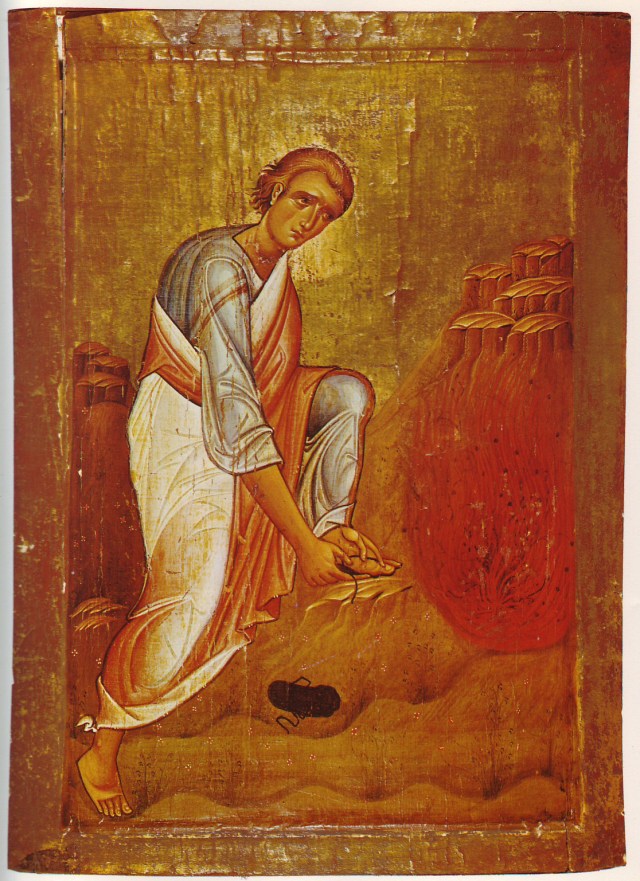
Fatherhood consists in a person—and he or she may not even be a priest—giving another person birth to spiritual life. Looking at his spiritual father, that person saw, as the old saying goes, the radiance of eternal life in his eyes, and therefore was able to approach him and ask him to be his instructor and guide.
The second thing that distinguishes a father is that a father is as if of the same blood and spirit as his disciple; and he can guide his disciple because there is not only a spiritual but also a psychological resonance between them. Probably you remember how the Egyptian desert was once filled with ascetics and instructors, but people did not choose their instructors according to signs of his glory. They did not go to the one about whom they had heard the best reports, but rather sought out instructors who they understood, and who understood them.
This is very important, because obedience does not mean blindly doing what someone who has either material-physical or emotional-spiritual authority over us says. Obedience is when a novice has chosen an instructor whom he trusts unconditionally, in whom he finds what he has sought for. He hearkens not only to his every word, but even his to tone of voice, and tries through all of what manifests the elder’s personality and his spiritual experience to re-cultivate himself, to partake of that experience and become a human being who has grown beyond the limits of what he could have done by himself.
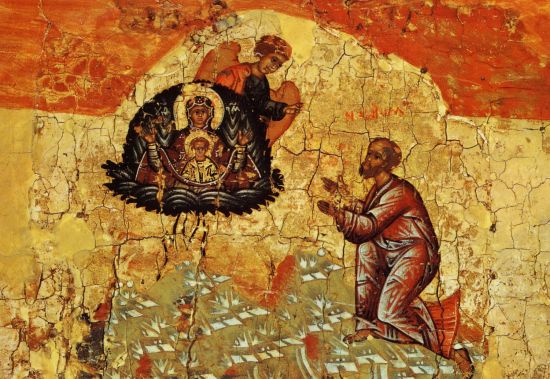
Obedience is first and foremost a gift of hearing—not only with the mind, or with the ear, but with one’s whole being, with an open heart; a reverent contemplation of the spiritual mystery of another human being.
On the part of the spiritual father, who has perhaps given you birth or received you already born but became a father to you, there should be a deep reverence for what the Holy Spirit is working within you.
A spiritual father, just as the simple and ordinary, commonplace priest, should be in a condition to see the beauty of God’s image in a person that cannot be taken away. (This condition often takes effort, thoughtfulness, and reverence for the person who comes to him.) Even if a person is marred by sin, the priest should see an icon in him that has been harmed either by conditions in life, from human neglect, or blasphemy. He should see an icon in him and have reverence for what has remained of this icon; and only for the sake of this, for the sake of the divine beauty within that person, he should labor to remove everything that deforms that image of God.
When Fr. Evgraf Kovalevsky was still a layman, he once said to me that when God looks at a human being, He does not see the virtues that he may lack, or the successes he has not attained—He sees the unshakeable, radiant beauty of His own Image.
Thus, if a spiritual father is incapable of seeing this eternal beauty in a person, to see the beginning of the process of fulfilling his call to become a God-man in the image of Christ, then he is not capable of leading him, for people are not built or made. They are only aided in their growth according to the measure of their own calling.
At this juncture, the word “obedience” calls for a bit of an explanation. Usually we talk about obedience as submission, being under authority, and often as a kind of enslavement to a spiritual father or a priest whom we call our spiritual father or elder—not to own our detriment only, but also to his.
Obedience consists in, as I have said, hearing with all the powers of our soul. However, this obligates both the spiritual father and the “listener” equally, because a spiritual father should also be listening with all his experience, all his existence, and all his prayer. I will even go further to say that that he should listen with all the power of the Holy Spirit working in him to what the Holy Spirit is bringing to pass in the person entrusted to his care. He should know how to search out the paths of the Holy Spirit in him, to be in awe before what God is doing, and not bring him up according to his own image or how he thinks he should develop, making him a victim of his spiritual guidance.
… One of the tasks of a spiritual father consists in educating a person in spiritual freedom, in the royal freedom of God’s children. He must not keep him in an infantile state all his life, running to his spiritual father over every trifle, but growing into maturity and learning how to hear what the Holy Spirit is wordlessly speaking to him in his heart.
Humility in Russian means a state of being at peace, when a person has made peace with God’s will; that is, he has given himself over to it boundlessly, fully, and joyfully, and says, “Lord, do with me as Thou wilt!” As a result he has also made peace with all the circumstances of his own life—everything for him is a gift of God, be it good or terrible. God has called us to be His emissaries on earth, and He sends us into places of darkness in order to be a light; into places of hopelessness in order to bring hope; into places where joy has died in order to be a joy; and so on. Our place is not necessarily where it is peaceful—in church, at the Liturgy, where we are shielded by the mutual presence of the faithful—but in those places where we stand alone, as the presence of Christ in the darkness of a disfigured world.
On the other hand, if we think about the Latin roots of the word humility, we see that it comes from the word humus, which indicates fruitful earth. St. Theophan writes about this. Just think about what earth is. It lies there in silence, open, defenseless, vulnerable before the face of the sky. From the sky it receives scorching heat, the sun’s rays, rain, and dew. It also receives what we call fertilizer, that is, manure—everything that we throw into it. And what happens? It brings forth fruit. And the more it bears what we emotionally call humiliation and insult, the more fruit it yields.
Thus, humility means opening up to God perfectly, without any defenses against Him, the action of the Holy Spirit, or the positive image of Christ and His teachings. It means being vulnerable to grace, just as in our sinfulness we are sometimes vulnerable to harm from human hands, from a sharp word, a cruel deed, or mockery. It means giving ourselves over, that it be our own desire that God do with us as He wills. It means accepting everything, opening up; and then giving the Holy Spirit room to win us over.
It seems to me that if a spiritual father would learn humility in this sense—seeing the eternal beauty in a person; if he would know his place, which is nothing other (and this is a place that is so holy, so wondrous) than the place of a friend of the bridegroom, who is appointed to safeguard the meeting of the bride—not his own bride—with the Bridegroom. Then the spiritual father can truly be a travelling companion to his spiritual child, walk with him step by step, protect him, support him, and never intrude upon the realm of the Holy Spirit.
Then the role of the spiritual father becomes a part of that spirituality and that maturing into the sanctity to which each of us is called, and which each spiritual father should help his spiritual children attain.
*
For more food for thought on this matter, go to:
WHAT IS SPIRITUAL DIRECTION? WHAT IS SPIRITUAL DECEPTION? by Fr Alexey Young (now Hieroschemamonk Ambrose), a spiritual child of Fr. Seraphim Rose, who offers some insightful words on the role of a spiritual father in our lives and how to relate to him, seeking to avoid deception and leading us to a true knowledge of God. Fr. Alexey also offers some recollections of his own spiritual father, Fr. Seraphim Rose.
And to:


His discourse was also theological. He never ignored dogma, never indulged in moralizing, empty verbiage or flights of fancy. He spoke well, was comprehensible, and used theology, not as a system of knowledge, but as the essence of life, which imbues the whole of human existence. The centre of his theology was the Bible, which he knew in depth. His sermons were, at bottom, Biblical and he recommended that his ‘children’ read the Scriptures, and, indeed, he set a chapter of the New Testament to be read every day, by all of them. He immersed himself in the Scriptures, engaging with the text and enjoying the interpretational footnotes, both Patristic and modern.
We would often speak at length on the telephone about one passage or a single word.
His theological discourse wasn’t superficial. He knew theology in depth, he was up-to-date with theological bibliography and followed developments in academic theology. He was usually present at conferences of the Greek Society for Biblical Studies and took part in the discussions, reminding people, through what he said, that theology isn’t merely knowledge, but also an experience, without which knowledge ‘is puffed up’. And all the days of the conferences, when Fr. Symeon circulated as an ordinary member, he emanated the fragrance of Christ with his words, his smile and his presence. At one such conference in Cyprus, during a break, a professor from Thessaloniki approached a group of a few young people who were talking to Fr. Symeon and said: ‘Do you know what a blessing this moment is for you. In Thessaloniki we get to enjoy Fr. Symeon’s presence in drips and drabs. You’ve got him here when and for as long as you want’.
His theological discourse was also niptic. He enjoyed the niptic fathers and imitated them in word and deed. The saying attributed to Saint Neilos: ‘If you’re a theologian, you’ll pray properly; and if you pray properly, you’re a theologian’ (On Prayer 61) was a rule of life. The silent assemblies, of which we spoke above, are a small example of his desire to teach the method of the prayer of the heart. And even if these silent assemblies have not been generally adopted as his vigils have, they were of great benefit, because the idea spread of using a prayer-rope and saying the Jesus prayer. Until then, it had been unknown to the wider public, neglected or held to be something that was appropriate only for monastics.
I realized just how much Fr. Symeon was imbued with the spirit of the prayer of the heart, how much he was himself niptic, from a long discussion we had as we were returning from a conference of the Greek Society for Biblical Studies on Patmos, the first of a series, at the end of September, 1975.
As we were sitting in the stern of the ship, in the moonlight, returning from the island of the Revelation, he showed himself to be a great niptic father, a holy teacher of the prayer of the heart. He was taken up, speaking from another world, and I tried to follow him, drinking in his words. We parted past midnight, with the feeling that we weren’t done with the subject. How could we be when ‘perfection is never-ending’?
Fr. Symeon never advertised his work. He never challenged anyone in his homilies. You learned about him from other people. I recommended his talks to someone and he said to me afterwards: ‘You mean there’s somebody like him in Thessaloniki and you didn’t tell me earlier?’
*

 The event of salvation is conscious. We should know this and not fear it at all. Further, we should beg God to reveal our true selves to us. Then God will see that we accept this not with words, but in practice. Therefore, when at some point, either we make a mistake or something else happens, and God allows all of our wickedness, and our whole diseased and bleak inner state to be revealed, we need to accept it. We need even to be thankful, saying: “My God, such a thing I had awithin me and I didn’t recognize it! I thank you, my Lord, that you allowed me to see what I am”.
You must see this and embrace it. Not in the sense that you will hang onto it, but in the sense that you will acknowledge that you are the one that has this within you. You ought to acknowledge it without wanting to blame and pass the responsibility to someone else and without averting your eyes as though not wanting to see it. Some men and women who work at lowly jobs, whatever happens, they stoop and patiently do the work completely. On the contrary, a person may be fragile or delicate, and supposedly ashamed, supposedly disgusted and supposedly isn’t able to do such work. If he does this work though, it will be incomplete. Here, though, in our own case, it’s necessary that we see our sin. We must see this thing that we hold onto as if we want it, and within which our soul has been sunk for an entire life. We must see it, must feel it. We must see how difficult it is, nearly impossible, to escape from this state. Therefore, someone is completely convinced, and thinks: “It’s over. I’m going to perish”. This is Hades. Namely, someone sees that he is in Hades.
However, we know that we have a Saviour, we know that Christ came to earth. Then we start to understand what it means that he came to save us, and we run to the Saviour. We run to the Lord with pain, with prayer, with a cry, with faith, with hope and a firm conviction that the Lord will accept us and will save us. The Lord wants us to approach things exactly like this. This is not our own daring or our own boldness. He wants us act just like that, to entrust ourselves in this way, and for this reason he gave us promises. So someone does this work, and little by little the decay of his soul, that lies in the subconscious and the unconscious, emerges.
How long will this last for? A lifetime. Until the end of our life, this is the work we have to do. But grace is involved. It also happens every so often that when you enter within yourself or when you give yourself to God, the decay you have within emerges on its own, and you see it whether you want to or not.
It is a bleak state, a filthy state, but grace is involved since in exactly this way you are redeemed, once and for all, and are saved. And it is through this that you are delivered from this state.
*

“And when Jesus went out He saw a great multitude; and He was moved with compassion for them, and healed their sick.”
Then – as the Gospel passage tells us – since the multitude had followed him into the desert for many hours and were hungry, the Lord with five loaves and two fish, having blessed and multiplied them, fed five thousand men with twelve additional baskets taken up.
The compassion of Christ is not simply some sentimentality, but is a manifestation of His love toward His creation. God always loves the world, He loves every individual person, but for Him to be moved to compassion and to show it, it is also necessary for a person to be appropriately receptive to it.
It’s not enough to simply do some good works (to pray, to go to church, to study). Whatever we do we are sinners and unworthy of God. Consequently, we are unacceptable. All the same, we need to do these things precisely to show our good disposition, to show that we want to be saved, that we choose God, we seek Him, we love Him. But is not enough for these things to be done only because of habit.
That’s why it is good, wherever we find ourselves, to ask ourselves night and day whether our disposition is such that the Lord is able to be moved to compassion for us. It is not necessary for you to journey along many and distant roads, climbing and descending, in order to achieve this. God is the one who covers the distance that exists between us and Him.
All a person needs to do is one little thing, but a little thing which is great and which is everything: to humble himself, to repent, to have the fear of God within him, to not be puffed up, self-inflated, and conceited.
And then – O, the wonder! – God will be found wherever we are. Then irrespectively of how things arise in our lives, we will feel the compassion of God and see how God will provide all that our souls and bodies need. It is not difficult for God – not difficult even for God to heal you from sickness or to put in order other problems and situations in your life. He can take care of everything. But we need to adopt that disposition that will elicit His compassion toward us. (August 3rd, 2014)
Transcribed talks by Archimandrite Symeon Kragiopoulos
From: Holy Hesychasterion “The Nativity of Theotokos” Publications.
Translated by fr. Matthew Penney
(To be continued …)
For Fr. Symeon Kragiopoulos: The Portrait of a Spiritual Father – I, The Theologian and the ‘Liturgical’ Being (his famous church services and vigils), go here
For Fr. Symeon Kragiopoulos: The Portrait of a Spiritual Father – II, The ‘Silent’ Assemblies of Father Symeon Kragiopoulos, (his famous silent sessions of the Jesus prayer), go here
For Fr Symeon Krayiopoulos: The Portrait of a Spiritual Father – III, A Servant of the Holy Mystery of Confession, go here …


