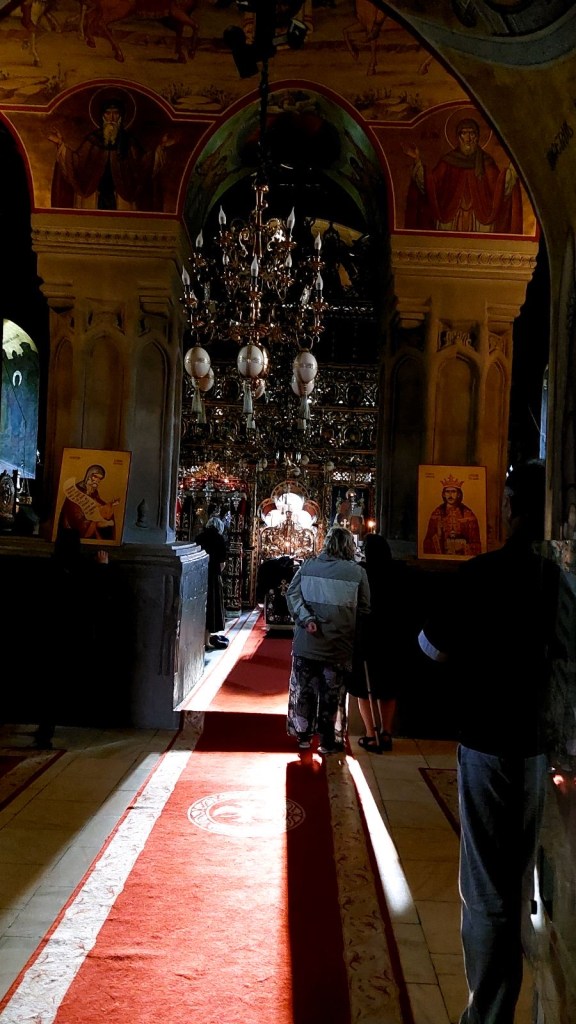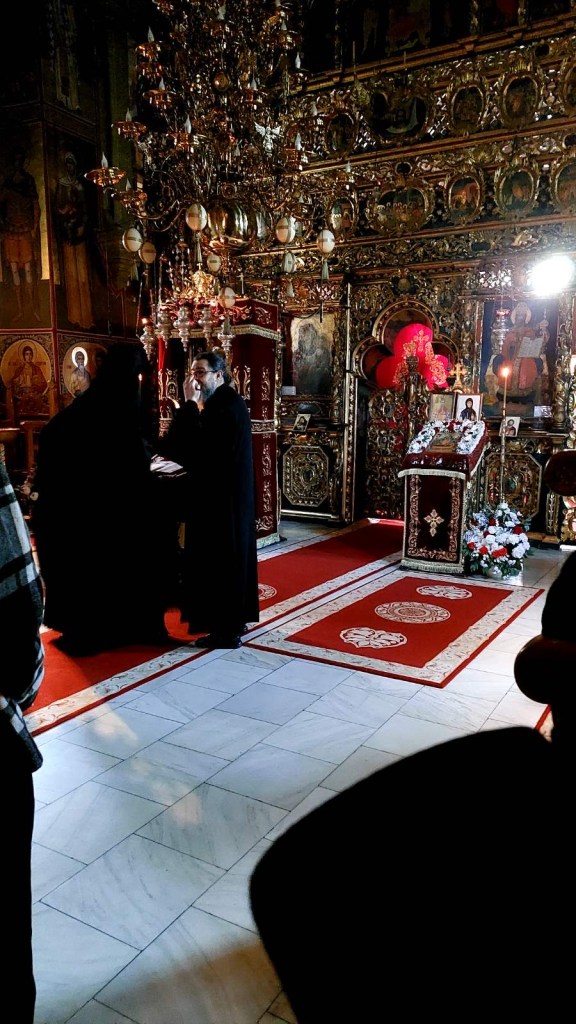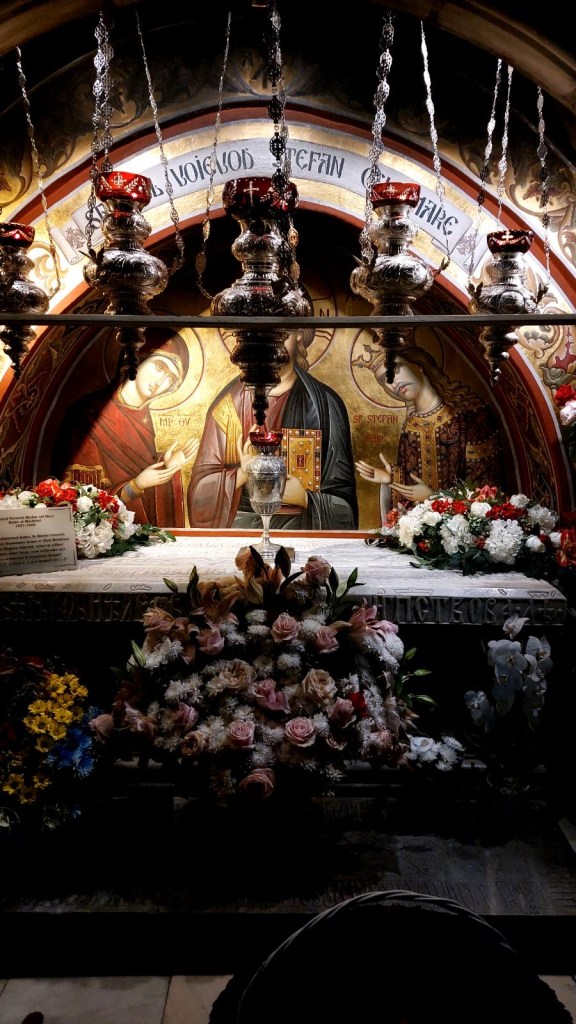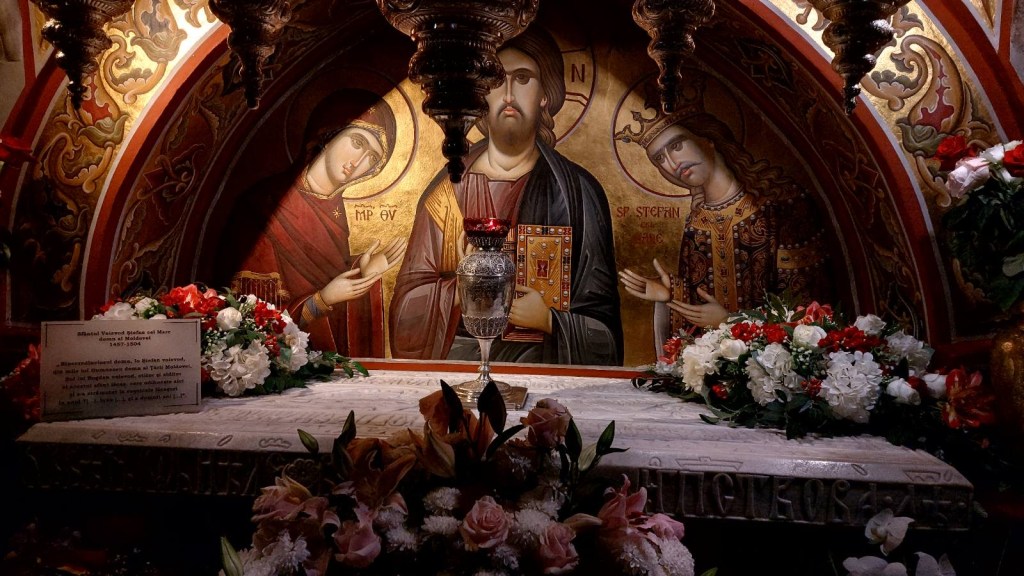
The sun is racing to hide behind the aged Theodosian walls and reign in full purple over the vast Thracian plain. The guided tour program has ended and pilgrims have scattered in groups at the market for shopping and dinner.
Our company – seven souls – is walking through old Constantinople, searching for some relics of the Byzantine Queen of Cities in the modern city of 15 millions. Tonight, the last night of the pilgrimage, we would try to discover some Byzantine churches, more than a thousand years old, that still stand forgotten by Time, but unfortunately, also by Greek visitors to the City.
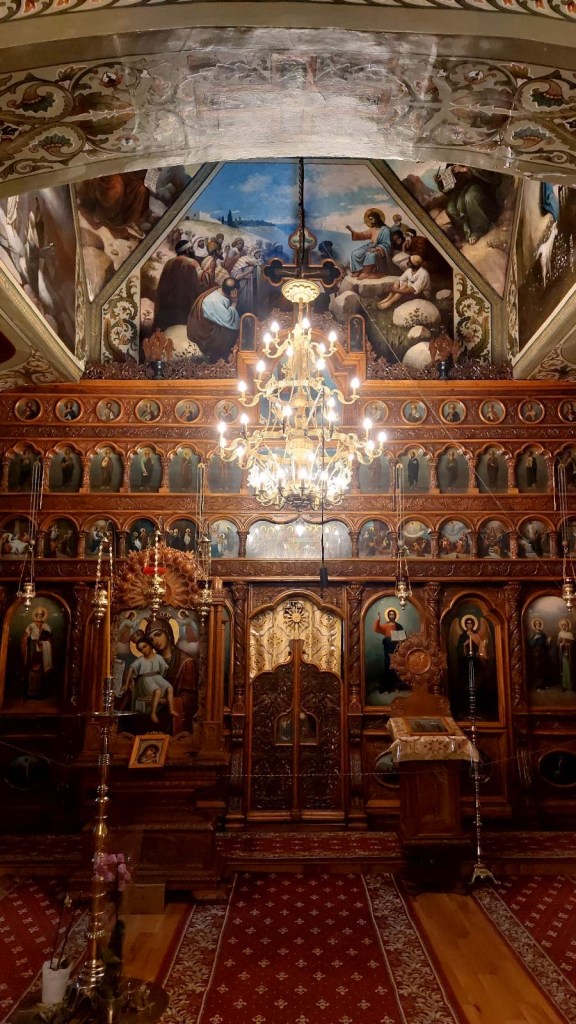
We cross a main street and turn left onto a smaller one. In front of us stands a large mosque, which externally bears the characteristics of a monastery chapel except for the Cross, which has been absent from its dome for some centuries.
We proceed and ask the hodja for permission to enter. Eager and friendly, he welcomes us and allows us entry. At the same time, he explains to us that this is where the famous monastery of Akataliptos (1) was located in Byzantine times. However, the time of prayer is approaching for the faithful Muslims; the hodja leaves us and, dressed in his official uniform, enters the interior and begins namaz (2). About a dozen men gather around him, repeating some prayers and kneeling when he gives the order.
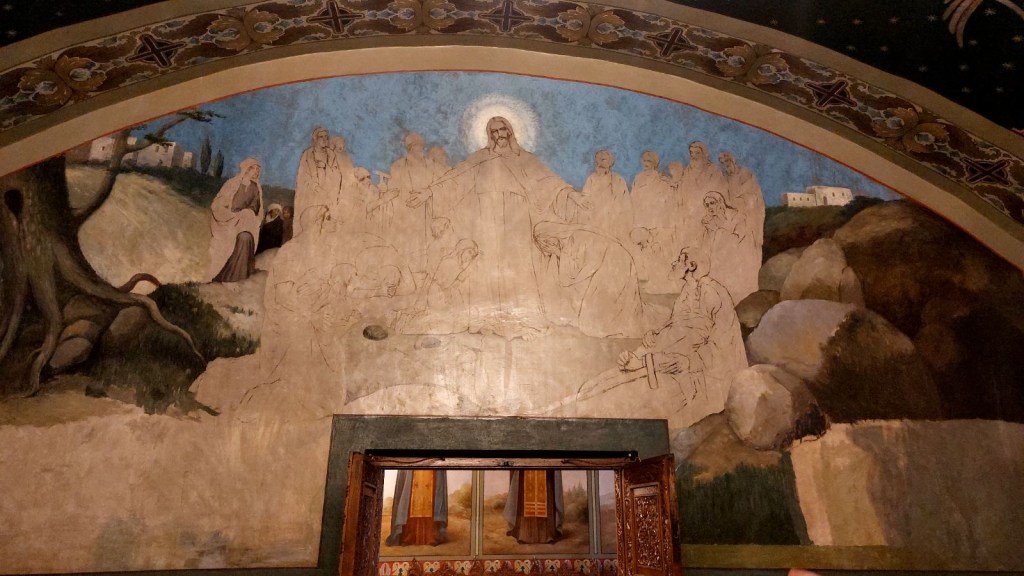
Barefoot and silent, we explore the interior of the mosque, persistently searching its walls and arches for some fragments of frescoes or mosaics. However, we cannot see anything, since the plaster has been scraped off along with the iconographies that were depicted on it (aniconic Islam strictly forbids the depiction of the physical form of God and His prophets). Only in the arch of the central entrance from the apse to the main temple do we see traces of fresco. The figures are unrecognisable.
We leave the mosque, without having satisfied our desire to discover something unique from the years of Byzantine glory. As we stand in the courtyard of the mosque, we observe symmetrically towards the central building, constructions that could be the chapels of the catholicon (3).
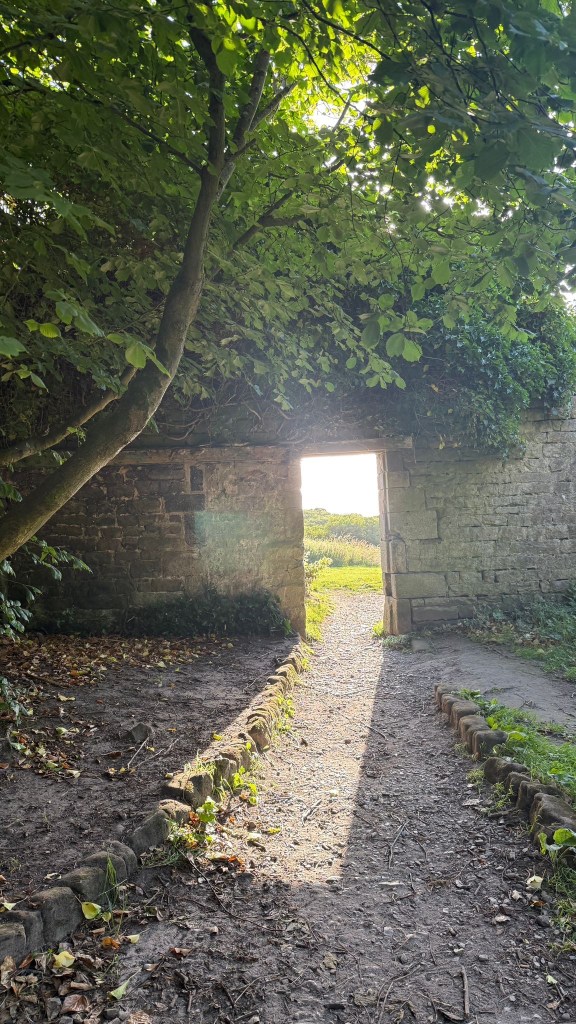
As it has already become dark for good, we move to the left and enter a garden with trees, where there are many ruins haphazardly thrown away, who knows since when. Carved marbles, capitals, broken columns, stones and a wall on the north side of the garden, elsewhere collapsed, elsewhere standing still. It was as if we had entered another era. A few steps behind us was the City of the 21st century, and yet in that space we felt that time had stopped counting.
With considerable hesitation and some fear lest someone might stop us, we enter the ruins and proceed to the depths where an iron door is visible. Could it be a chapel? After crossing the garden of ruins, we reach the locked door. Its window has no glass and in the dim light we can make out the interior. It does indeed appear to be one of the chapels of the catholicon. However, there are no murals or mosaics in it, as we had imagined, but only cleaning supplies, trash cans, brooms, dust pans, street cleaners’ uniforms…
We return somewhat disappointed, but something does not let us abandon that place yet. We search through the ruins. We stop at a large marble slab, leaning against a terrace. Is it perhaps the breastplate of the old iconostasis? Does it have relief crosses and other Christian symbols somewhere? In a little while we will grasp that this marble is a Holy Altar. The casket of the inauguration is clearly visible, from which the cap and of course its contents are missing. There we bow as we feel that we are in front of a plundered holy Altar, one of the many that were desecrated and destroyed after the Fall. In shock, we embrace its edge.
We leave the garden and return to the mosque. We want to beg the kind-hearted hodja to open the right chapel for us, the entrance to which we have already located among the grass and the bushes on the other side of the mosque. He takes the keys and we follow him with awe and hope. We cross another garden with fewer ruins and reach the iron door. At this point, the light of a spotlight falls on the outside, but the interior of the chapel remains dark. It has many small spaces, niches, arches; an ideal place for a vigil!
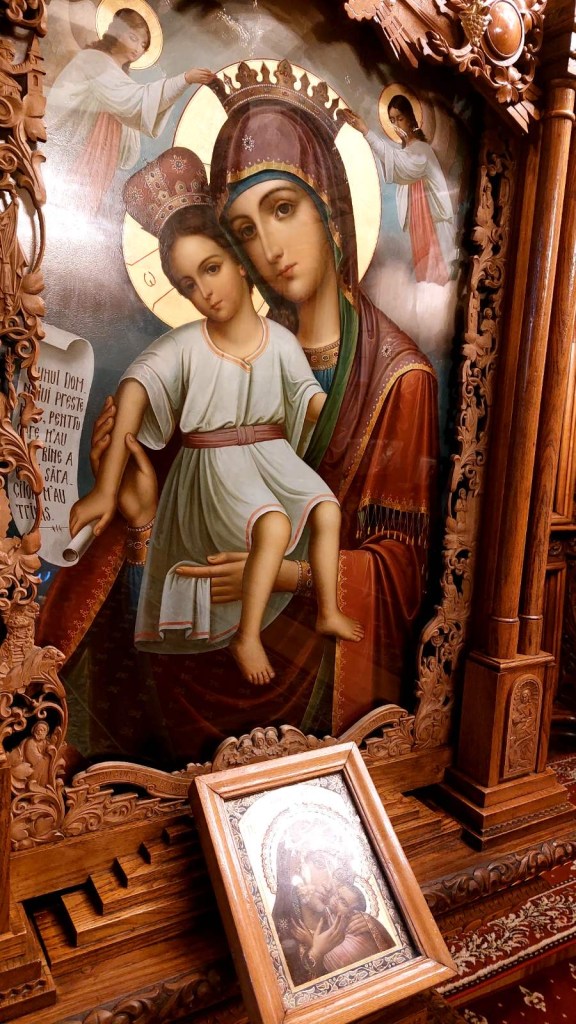
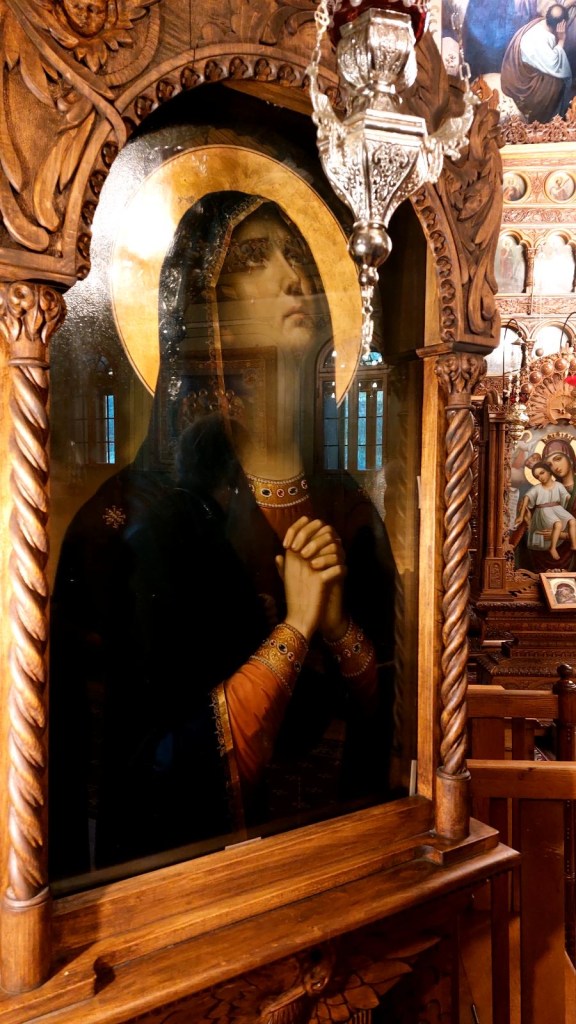
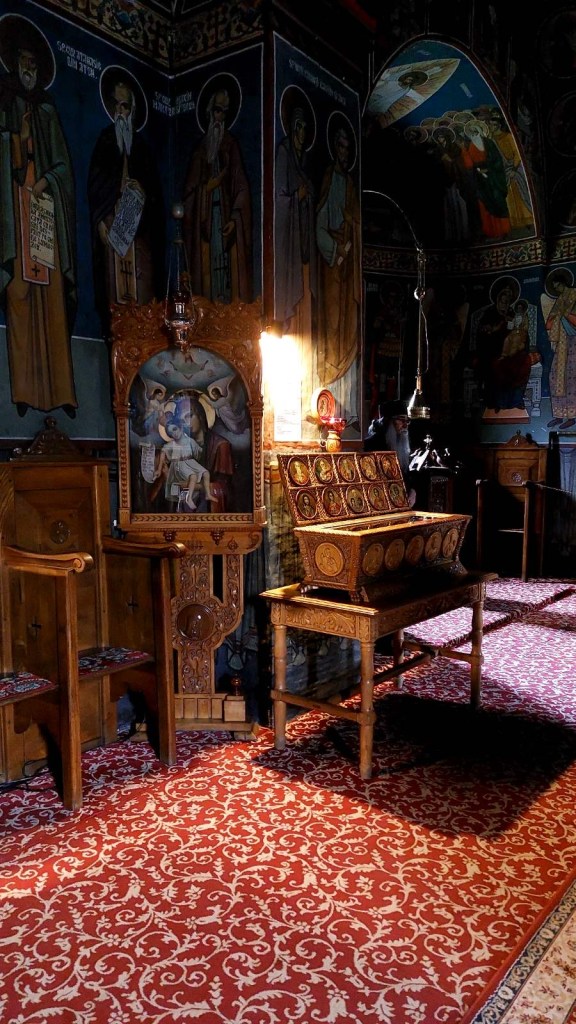
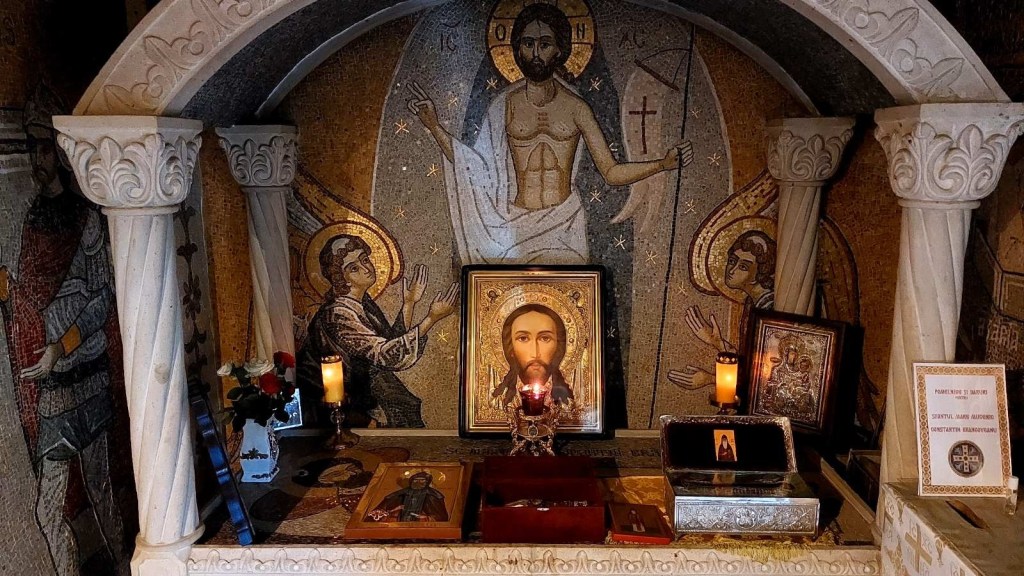
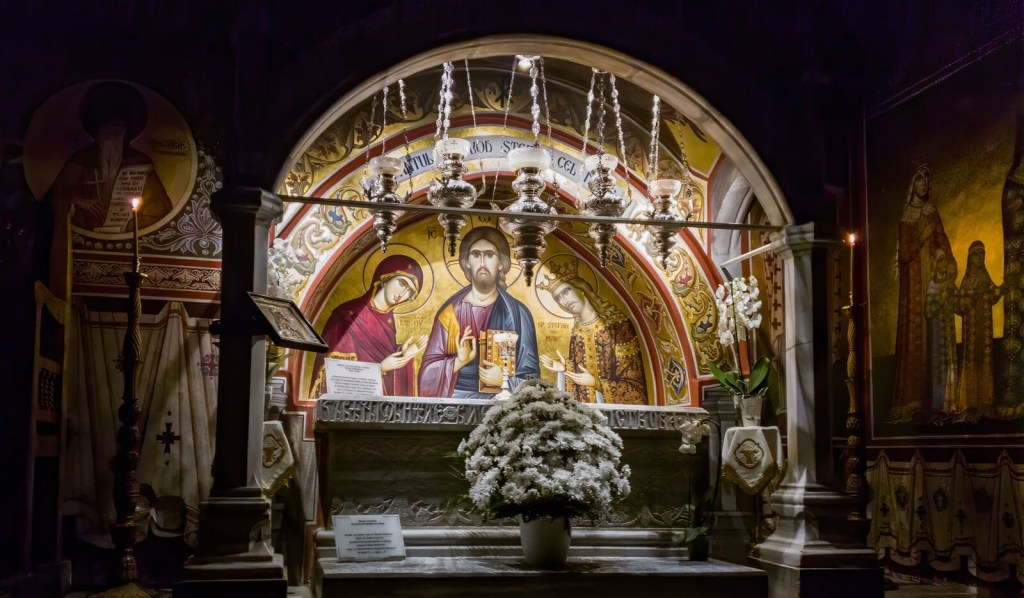
The guide shows us a tomb, but his limited English does not allow him to explain more to us. However, he allows us to take photographs, as he draws our attention to the places where there are fragments of a mural-fresco, as he calls it. In the flash of the camera we can indeed see a few icons preserved in much better condition than those of the Catholicon. In a niche is the representation of the Theotokos – in the type of Platytera, (ie. More Spacious than the Heavens) – and on either side of it is the inscription Panagia the Kyriotissa (4).
We worship the mural of the Theotokos, humming Axion estí (ie. It is Meet and Right). In a moment we leave the solemn chapel and the priest locks the rusty lock again. He tells us that tomorrow all of us pilgrims could come to see this monument. We thank him and leave but we still do not feel like returning to the hotel. Today is our last night in the City and we would like to experience more of its secrets.
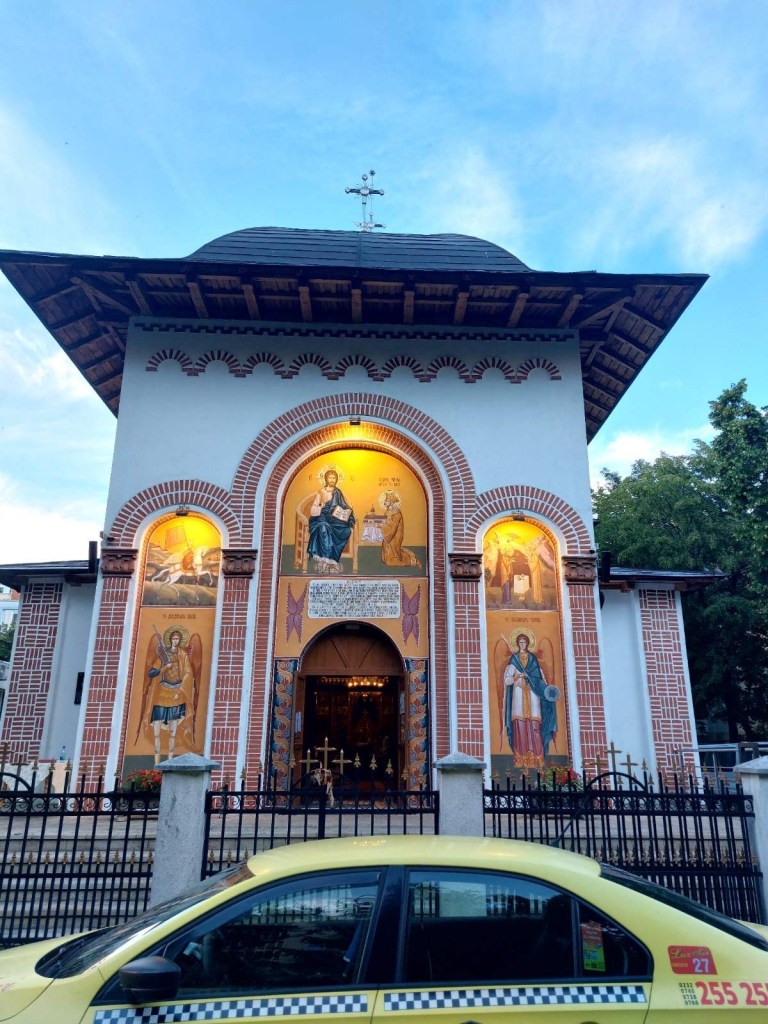
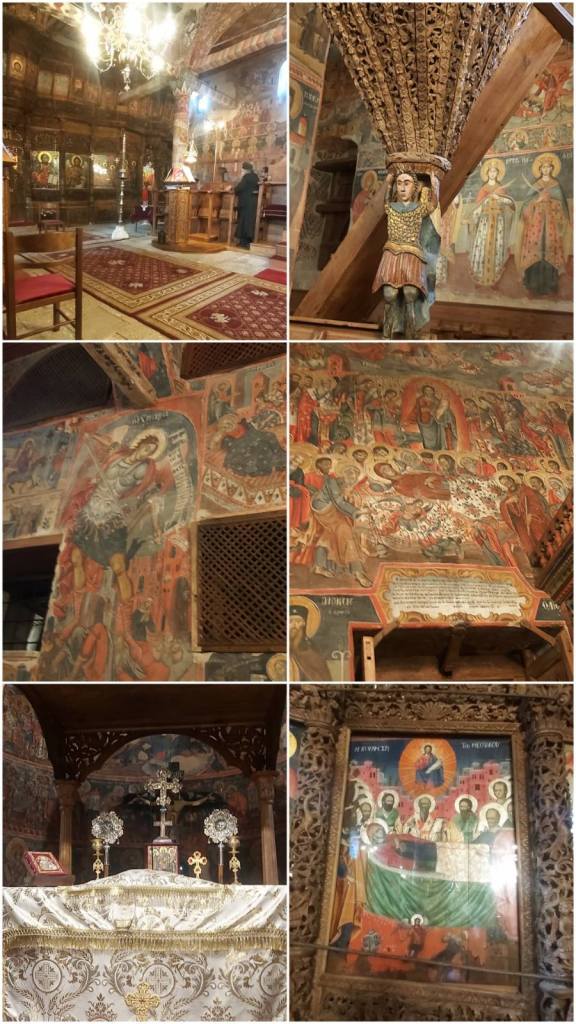
We now head north, continuing our journey through the old neighbourhoods. Somewhere we pass under an arch from the Byzantine period, a ruin that still stands. Next to it is a huge plane tree. Now the lights are fading and the area looks like a remote neighbourhood. In an opening in the semi-darkness, some children are playing ball. At the end of the small road that we cross, we turn into an alley and find ourselves in front of a small but beautiful and perfectly preserved, at least externally, Byzantine church. An elegant work of art with its central dome, three smaller domes in the narthex and two chapels integrated into the entire building. However, inside this little church is a Muslim mosque.To our surprise, we see Christian symbols welcoming us, carved into the marble slabs on either side of the central entrance.
The hour is past and the door is closed. However, someone seems to be inside and we gather the courage and knock to let us in. It is the hodja of the mosque, not as cheerful as the previous one, and he hurries to show us the fresco in the right dome of the narthex. In the dim light we see Christ Pantocrator at the centre of the dome and around Him a choir of Saints. The middle dome and the left are plastered on the inside. In the main church there is nothing to remind of the Byzantine past of this building, except for a few Corinthian capitals. The chapel on the right serves as a storeroom; it is closed. On the left, the other chapel is open and illuminated. It has been converted into… a restroom, three toilets in a row, in the space that once was the Sanctuary… Somewhere there is a small door, and a narrow, almost hidden staircase, leading up to a small room.
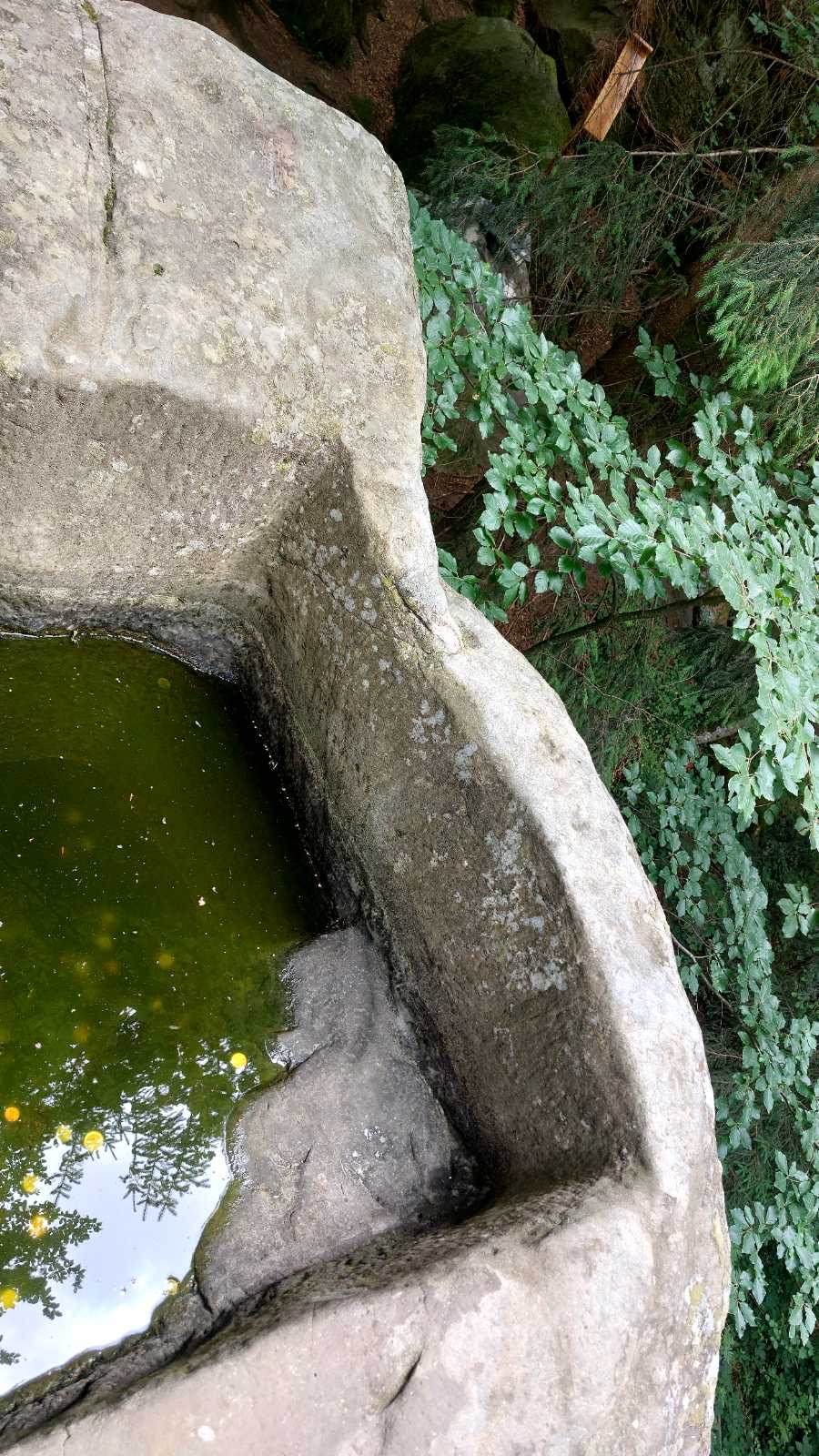
“The priest used to live there”, the hodja explains to us and adds in his broken English: “Byzantine holy water”, showing us a stone jar in the narthex filled with water. What could this be? A bottle of holy water from the Byzantine years, which has changed its use and is now used for washing Allah’s faithful before their prayer?
We thank the hodja, apologise for the evening disturbance and make our way to leave. At the exit of the mosque, a basket has been placed and we are asked to put whatever tip we want into the basket…We leave and take the road back. It is already late but we are in no hurry to return. In our inner world, emotions are mixed, especially of those who were coming to old Constantinople for the first time. Everyone reflects on what they saw tonight…
More than five hundred years have passed since the Queen of Cities fell, but some thousand-year-and more-old buildings remain standing, provoking with their presence Time, the Catalyst. They remain standing and wait. What are they waiting for? Are they waiting for sensitive international organisations to protect them and stop the work of desecration? Are they waiting for tourists to photograph them? Are they waiting for the Greek visitors, who have completely forgotten about them? Are they waiting for incense to be fragrant, for candles and multi-branched chandeliers to light their kube5 (Turk. ie dome)? Are they waiting for the sound of ‘Christ is Risen’ to be heard under their thousand-year-old arches?
And yet, they are waiting…
HieromonkSynesios, Monastery of St.A, V, Ch.
Notes
The Monastery of Christ Akataleptos (the Incomprehensible Christ) is first mentioned in a document from the year 1094 and existed until the end of the Byzantine empire. For a long time, it was believed that the Kalenderhane mosque was the church of this monastery. However, this church is now securely identified as that of the monastery of the Mother of God Kyriotissa. The former Byzantine church known as Eski Imaret Camii, which was usually taken for that of Christ Pantepoptes (the All-Overlooking Christ), has only recently been identified with the church of the monastery of Christ Akataleptos. Cf. https://www.byzantium1200.com/akataleptos.html
Namaz: Turkish word for prayer with genuflection.
Catholicon: In the Orthodox Church, a catholicon is the main church of a monastery, often located at the center of a monastic complex and serves as the primary location for main liturgical services.
The Church of Theotokos Kyriotissa (probably now Kalenderhane Mosque) is located near the east end of the Aqueduct of Valens in Constantinople. While it is a large Middle Byzantine church with a cross-in-square plan covered by a dome, it has a complex structural history, with several stages of building on the site, including a bath complex. Cf.https://www.thebyzantinelegacy.com/kyriotissa
+ Father Gregorios, 19 November, 2019 — 6th year Memorial service
Memory Eternal, dearest Father!
“Love in Christ is a sacrificial Love, a self-sacrificing, self-denying Love, Agape. You sacrifice everything for the person you love, “your neighbour”. By “our neighbour”, we mean every person as God’s Image, even our enemy. By “love” we do not mean that we should do whatever the other person wants us to do, but to love him with Christ’s burning and flaming Heart, for his salvation” (+ Elder Gregorios Papasotiriou)
*
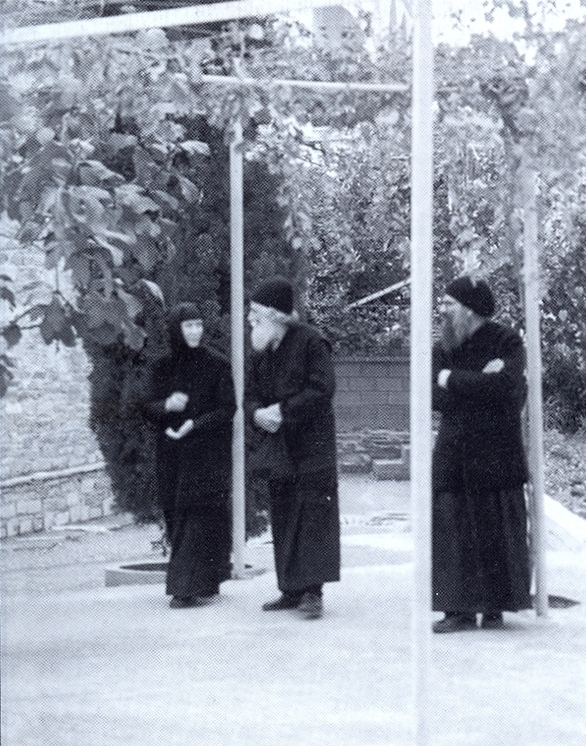
This is how we have always felt his love! For years, Gerondas Gregorios of blessed memory offeredhis prayers with tears and his never-to-be-forgotten spiritual guidance. My rebirth in Christ ((John 3:4), my new life literally started with his guidance about 40 years ago.I feel so unworthy of such a blessing!
*
“Father Gregorios, born Dimitrios Papasotiriou, was born on February 16, 1940 in Paleokomi, Serres, to pious parents, Alexios and Efthymia.
From his childhood, he was characterized by an inclination for life in Christ and very early he felt the divine call for the priesthood and complete dedication to the Lord through the monastic calling. Thus, after completing his studies at the Theological School of Aristotle University of Thessaloniki, he came to the Holy Metropolis of Kassandria, where he was ordained a deacon and priest by the blessed Metropolitan Synesios Visvinis. During his stay in Polygyros, the Elder, together with other fathers under the guidance of Fr. Spyridon Trantelis (later Metropolitan of Lagadas), formed a group that served the people of God, as well as the children of the Polygyros boarding school for boys, with much love and self-sacrifice.
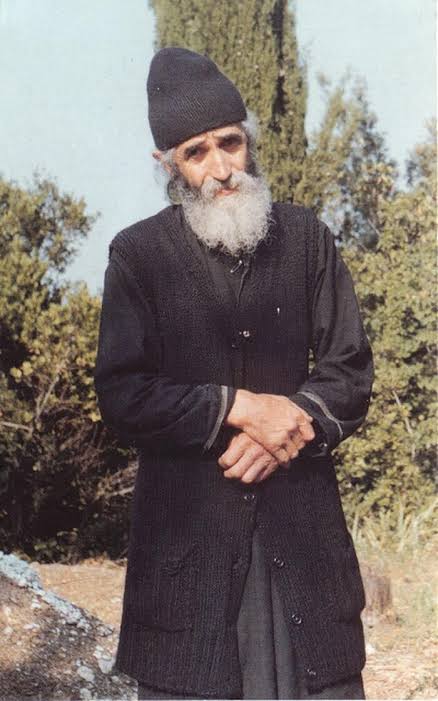
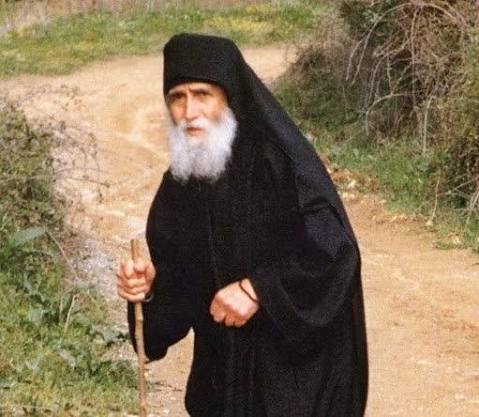
From his student years, the Elder particularly loved Mount Athos. He visited it very often and was particularly associated with the Holy Monastery of Saint Dionysios and the blessed Hegumen Fr. Gabriel, who became his spiritual father for a number of years. However, the main turning point in the Elder’s spiritual journey was his acquaintance with Saint Paisios the Athonite. He became connected to him with an unbreakable spiritual bond, becoming his disciple and striving throughout his life to imitate his holy life. In fact, Saint Paisios also became his godfather during the monastic tonsure of Elder Gregory in the cell of the Holy Cross in the year 1977.
In the year 1970, the flame of hesychia led Father Gregory to the then dilapidated Metochion of the Holy Monastery of Saint Dionysios in Metamorphosis, Chalkidiki, where, with the blessing of the local Bishop, he settled in a monastic cell-barn next to the Church of the Holy Forerunner.
This place from then on became the arena of his great ascetic struggles and the base for his priestly-pastoral ministry here in Chalkidiki. Only God knows his ascetic labors and efforts in order to serve the people of God with the pilgrimages, the preaching, the confession, the holy services, the vigils, the divine Liturgies. Saint Porphyrios, who attended a divine Liturgy in 1974, commented: “When Father Gregory serves the Holy Liturgy, all of God is within him and all of Father Gregory is within God.”
With the encouragement or rather the command of Saint Paisios, the life of the Monastery begins in 1975. The Holy Monastery of Dionysios grants the necessary area for the construction of the Holy Hesychasterion. The blessed Abbots Fr. Gabriel and Fr. Charalambos supported Elder Gregory with great love, foreseeing that the now deserted place of the old Metochion would be transformed into a spiritual oasis. Then the first group of spiritual children of the Elder was established, which formed the nucleus of the later sisterhood. The first Abbess was Eleni Paschaloglou from Rodolivos, Serres – herself a spiritual child of Elder Gregory -, later Elder Ephemia, who passed away to the Lord almost five months after the Elder’s “fallen asleep” after 45 years of sacrificial ministry in the Monastery.
The life of Father Gregory is henceforth spent in material and spiritual labours for the construction of the Hesychastirion, for the guidance of the Monastics, but also in his great offering as a priest, preacher and above all a spiritual father to the people of God. The Elder who abhorred worldly prominence and loved humility and obscurity, is now becoming well known as Father Gregory the Spiritual Father. Hundreds of souls found the path to salvation with him, thousands rested under his rock, countless were helped by his spiritual guidance.
The blessed Elder suffered from many illnesses throughout his life, which he bore with great patience and a doxological disposition as if someone else were suffering. Especially the last few years were a cross of painful trials and a life of patience, because the pain and illnesses reached their peak.
The good God, wanting to rest the good shepherd and His faithful steward, called him to Himself after a sudden stroke on November 19, 2019. The funeral service and burial were held on November 21, the day of the Feast of the Entrance into the Temple of Our Most Holy Lady the Theotokos and Ever-Virgin Mary, the birthday of the Monastery, when 45 years ago Saint Paisios gave the blessing and the command to Father Gregory to begin the great work for which he sacrificed his life.” (Ραδιοχρηστότητα, by his spiritual son and priest Father Nikolaos at St. Palnteleimon, Mesimeri )
May we have his prayers! “Kai sta dika mas.” “And to our own!” May we be reunited with you dearest Father in Heaven in God’s Kairos!
This profoundly moving and thought provoking homily is by Father Anastasios, the spiritual father of dear friends, a Father who is hearing Confessions all the time, from morning to night, and from night to morning. Indeed, our thoughts, the logismoi that surround us, especially concerning certain acts, even after they have been forgiven, are symptoms of our fallen state and marred image. Indeed we should, as we say in the liturgy,” live out our life in peace and repentance.” I wish you all a blessed Christmas Lent!
*
“It is a topic that is discussed a lot.
Since you have confessed this sin, why do you have to confess it again? You have said these things!!!
Is this opinion correct?
It is, if Spiritual Life is not a continuous path from Darkness to Light.
It is correct, if Spiritual Life is not a continuous Purification, Illumination and Theosis process!
However, since Christ, the Theotokos, the Holy Apostles and our Saints prove to us with their Life and teaching that the Spiritual Life is a path of Repentance, Forgiveness of Sins and Eternal Life, then our Sin is also constantly revealed!
A path of continuous Illumination, which reveals our Sin to us first as an ACT. We confess it.
With Confession we receive Absolution of Sin, as an act, and we have peace.
However, the Light of the Holy Spirit, which entered inside us with the Absolution of Sin, reveals to us, as we continue in Kairos our Repentance, that before the act, we entertained many sinful Thoughts (ie. Logismoi) .
The same Sin is revealed to us, not only as an Act, but also as a Logismos.
Next to it, we begin to see other acts, which preceded and followed the Sin that we confessed.
We go to the Confessor and reveal the new revelations of our Sin, but also the new Sins, which we saw in the prayer for our Sin.
We receive more Light from the new Confession and with our continuous Repentance, Christ reveals to us the same Sin as our heart’s desire, connected to many other heart desires.
The Light of the Mysteries of Repentance, Confession and Holy Communion constantly reveals to us new facts that surround the Sin that we first confessed; they reveal to us other Sins, but also Sin itself more deeply, things that we did not see before.
The Light of the Mysteries, with Careful Repentance as the protagonist, constantly reveals to us deeper and deeper the same Sin, from action, to thought that preceded and desire from which the Sin began.
It constantly and daily reveals to us, along with Sin, our Mind and how it functions, our Heart and how it functions.
It reveals to us, constantly and daily, that WE HAVE NOT ONLY HARMED OURSELVES, BUT ALSO THOSE AROUND US, OUR SPIRITUAL FATHER, OUR BRETHREN, OUR WIFE, OUR HUSBAND, OUR CHILDREN, THE ENVIRONMENT, OUR NATURE AND NATURE.
It reveals to us that the one SIN THAT WE HAVE CONFESSED IS A LIFE IMPRINT; IT IS NOT AN ISOLATED ATTITUDE OF LIFE, BUT OUR WHOLE LIFE!
There are two Commandments, Love for God with all your soul, which cleanses, purifies love for ourselves as the Image of God and for our neighbour!
Of all our Sins, one is the WORST, ONE IS OUR WORST PASSION, to which we must direct all our Vigilance and prayer.
It is OUR SELF-LOVE with all its CHILDREN, first, and OUR CARNALITY, SENSUALITY with all its children.
Didn’t David see these things and say “MY SIN IS FOREVER BEFORE ME”?
Didn’t Fr. Anatoly, in the Russian film “THE ISLAND”, see this?
Isn’t this the Vision of the Hesychasts, either in the Desert of Nature, or in the Desert of Big Cities?
Our spiritual awakening, the Revelation of one passion, reveals ever-increasingly all our hidden passions, like the laboratory tests of a Cancer Patient, which bring to light new data, so that the proper pharmaceutical treatment can be carried out.
THE LIGHT OF THE HOLY SPIRIT OF THE MYSTERIES OF THE CHURCH GRADUALLY LEADS US TO PURIFICATION, ILLUMINATION AND THEOSIS.
Just as the Archaeological excavations slowly, with daily labour, uncover the findings of ancient civilizations, so the Divine Light progressively reveals to the person who is Penitent until Death, the hidden Sinful Life.
Repentance, Confession and Holy Communion, with the cooperation of the Penitent with the Holy Spirit, constantly reveal our Sin, our sinful Life.
It is like the investigation of a crime, where the more the authorities search for it, the more the causes, the culprits, their intentions, their participation in the criminal action are revealed.
This work, while it begins with pain, because we identify the damage we have caused with our sin, always ends with Heavenly Joy, ripens within us the Fruits of the Holy Spirit: Love, Peace, Joy!
As we progress unto Purification from the vision of our Sinful Life, which we see constantly coming out of our Heart, as Christ tells us, we begin to see our Nature, our heredity and ourselves as a Member of the Body of Christ and the Church!
This is the Hesychastic Life of the Orthodox Church, where constant Repentance brings the Holy Spirit, who is the Protagonist of our Life, as Christ said to the Samaritan woman:
“God is Spirit, and those who worship Him must worship in spirit and truth.” (John 4,24).
To those who see sin as an act, a thought or a desire, they think that a confession is enough to be forgiven. This opinion is natural, if this is knowledge.
However, to those who see Sin as a symptom and imprint of a constantly revealed SINFUL LIFE, a whole Life is not enough for them to confess and cleanse themselves.
This is how our Saints lived, with the culmination of Abba Sisois, who pleaded to Christ, when He came to take his soul :
– WILL YOU NOT ALLOW ME, LORD, JUST A LITTLE MORE TO LIVE, SO THAT I CAN REPENT?
Hearing this, his Disciples said, “Elder, you HAVE BEEN REPENTING YOUR WHOLE LIFE!”
And the Great Sisois said:
– BELIEVE ME, BROTHERS, I DO NOT THINK I HAVE EVEN MADE A BEGINNING YET.
Those who see, know that the vision of running water, while it appears to be the same, is not the same.
Those who see, in the Holy Spirit, constantly know their Sin, that it is not itself, that is why they cry out with a sigh,“Lord Jesus Christ, have mercy on me!”
And the Forgiveness of Sins comes and pain becomes Joy, slavery becomes Freedom and darkness, Eternal Light!
Spiritual Life is not only an interrogation and attribution of responsibilities; it is mainly a lifelong treatment, which is done with great care and diligence, daily and constantly until death.”
“Someone recently described Thessaloniki as like a dry cake. I’m not sure about this simile. I would prefer to describe it in terms of warm slices of bread. Exchanging a cold, windy, wet Manchester of 13C for a calm, warm late evening 25C, Thessaloniki was indeed a taster of what was to come. Having navigated the vicissitudes of the roaming signal with a friendly local, a familiar “taxi” driver arrived to pick me up from the terminal.
I have often thought that the word terminal speaks of rather sad endings rather than the springboard and opening to new adventures.
Having been delivered to my assigned apartment I enjoyed the sleep of the just traveller.
The five days in Thessaloniki spent with my spiritual children had both an eternal and a brief dimension. Time expands and contracts according to God’s ordinance.
House blessings, Confessions, Social Gatherings, Prayers, Church and Monastery Visits and the not so mundane coffee stops roll into a well risen loaf with the yeast of kindness and the warmth of hospitality.
In just one day we visited:
The Holy Church of St Nicholas Orphanos
The Church of Pammegistoi Taxiarches where there was a Byzantine Crypt and huge Basil bushes outside.
Vlatadon Monastery.
Latomos Monastery and later the cave Church of St David the Dendrite.
St Demetrios Church.
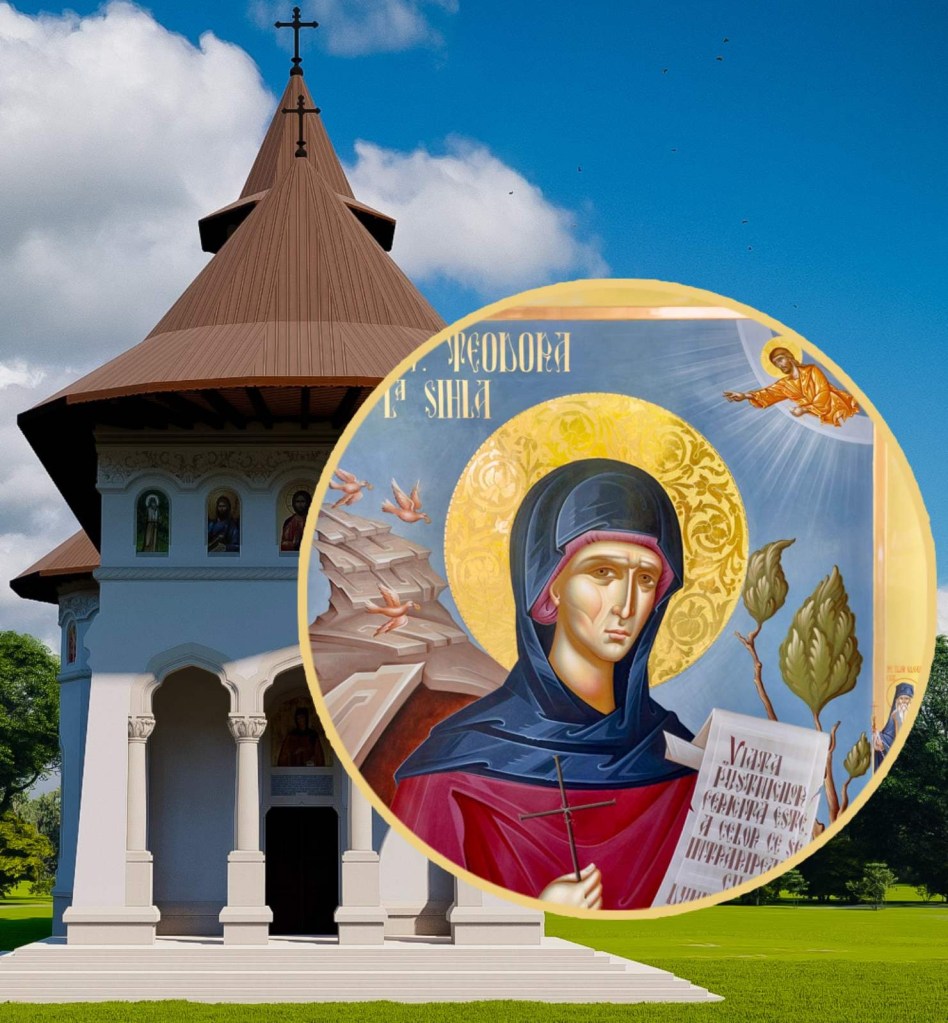
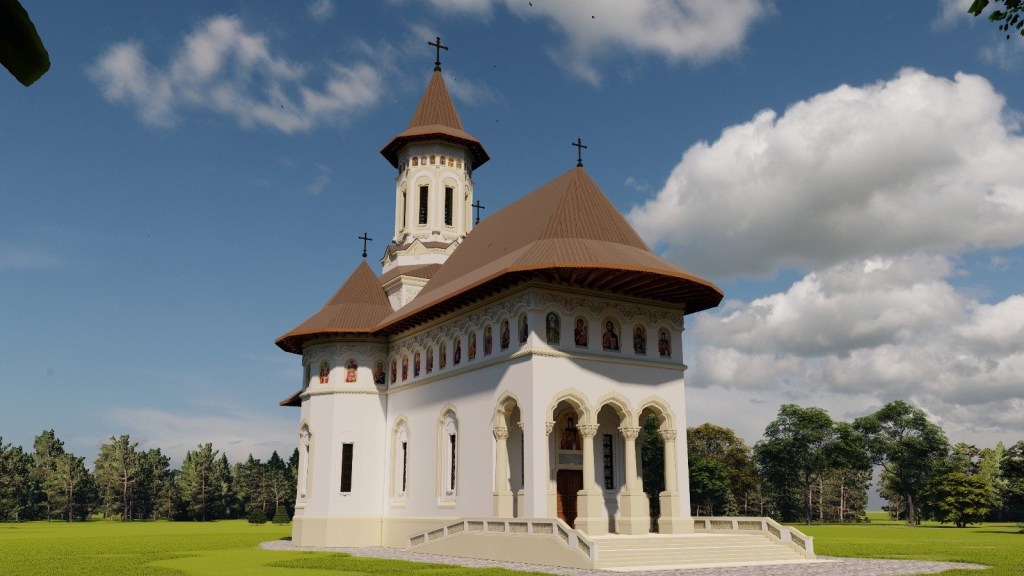
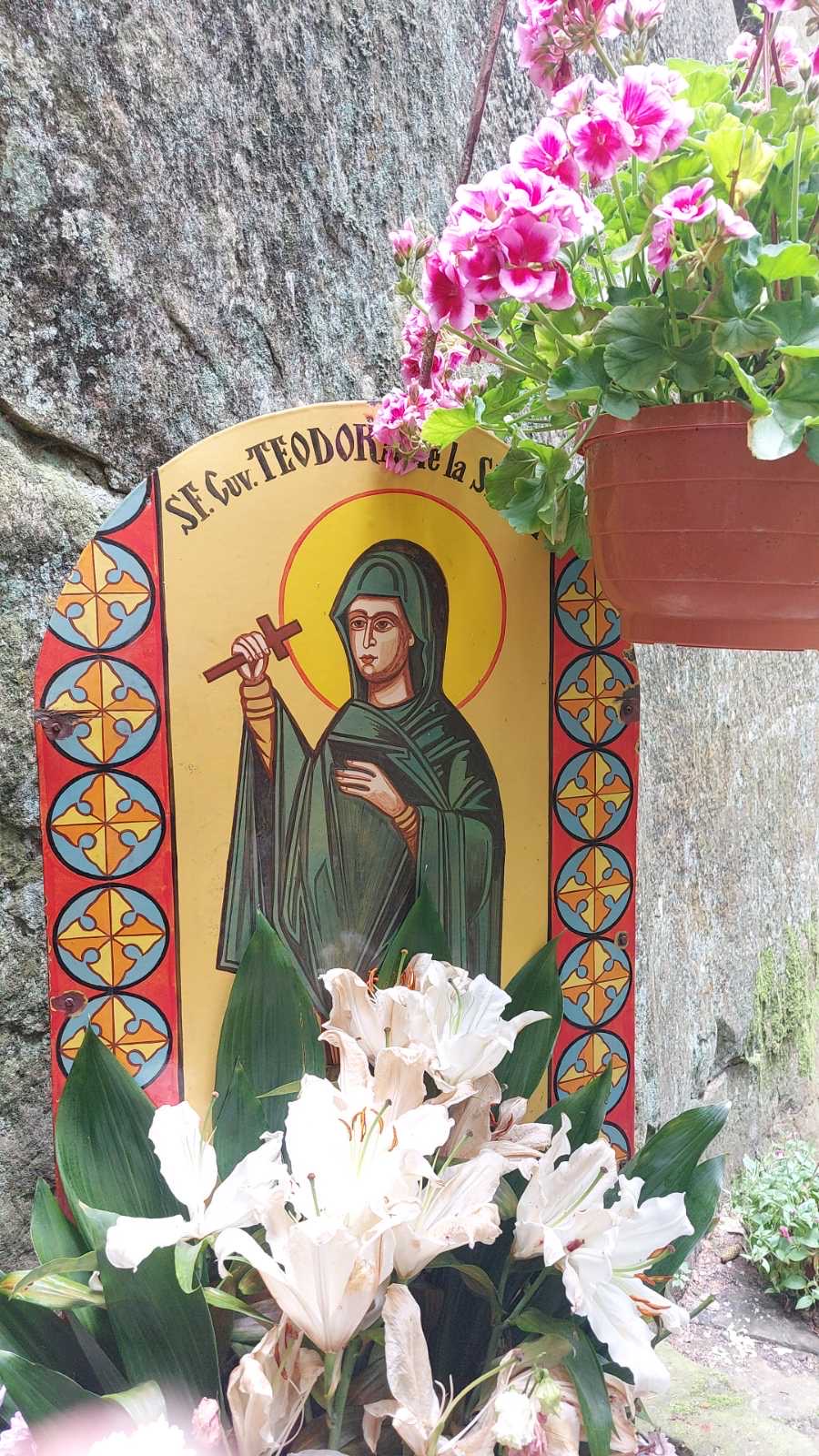
St Theodora Monastery and Church where we venerated the holy relics of St Theodora and St David.
Church of St Theodora
Stopping for late lunch the first thing to arrive on our table was warm sliced bread — a gift and a symbol of the spiritual slices of holiness we had tasted earlier.
St Demetrios church St Anysia relicsChurch of Pammegistoi Taxiarches with byzantine cryptSt Nicholas OrphanosBasil bushOsios David the Dendrite Latomos monasteryView from Vlatadon Monastery
We took the bread, blessed it, gave thanks, broke it and shared the humble gift with the meal — a eucharistic pattern that is woven into every fabric of the Christian Life.
So many precious memories in a short space of time — but God’s time (kairos not chronos). For these treasured moments I give thanks to God”.
Last week, Archangel Michael, became central in my life. First, my spiritual father arrived and rescued me after a summer of fires, all kinds of fires, and carried me in his arms like the Good Shepherd. He also brought me this icon of the Archangel Michael to protect me from the attacks of the evil one “through the valley of the shadow of death.
Then, a dear spiritual sister of mine is leaving tomorrow on a pilgrimage to Archangel Michael of Panormitis (Gr. O Πανορμίτης) on the island of Symi, and promised to give our names for commemoration and bring a copy of that miraculous icon of the Archangel Michael, one of the most famous miraculous icons of the Archangel in Greece.
Archangel Michael of Panormitis, Taxiarches monastery, Symi island
The other famous and truly fierce, if I may use such an expression for an icon, is the miraculous icon of Archangel Michael is that of Mantamados on the island of Lesvos, where a dear spiritual brother lives and prays for all mankind. This is an icon that once you encounter and venerate, you never forget all your life. I had this blessing a few years ago.
Archangel Michael of Mantamados, Lesvos
Last but not least, today, Monday 22 September, is the day of of the autumnal equinox, September 22, which is closely related to Archangel Michael in a way that may surprise you.
Forgive my long parenthesis. Now to the autumnal equinox and Archangel Michael. There is an ancient legend: when Archangel Michael defeated the devil, his sword carved a fiery line on the ground. And the amazing thing is this: on the map of Europe and the East, seven holy shrines dedicated to the Archangel are aligned – all on the same line!
📍 1. Skellig Michael (Ireland) – a rocky island in the ocean, where ascetics lived in strict conditions, believing in the protection of the Archangel. 📍 2. St. Michael’s Mount (England) – a place where the Archangel appeared to fishermen in the 5th century. 📍 3. Mont-Saint-Michel (France) – a famous monastery on an island, which seems to be floating above the sea. 📍 4. Sacra di San Michele (Italy, Piedmont) – a monastery on a mountaintop, with a view that touches eternity. 📍 5. Monte Sant’Angelo (Italy, Gargano) – a cave, into which, according to tradition, Michael descended and consecrated it. 📍 6. Monastery of St. Michael (Symei Island, Greece) – an ancient pilgrimage site in the Aegean Sea, where believers flock for healing. 📍 7. Monastery of St. Michael on Mount Carmel (Israel) – the last point of the line, a symbol of union with Heaven.
✨ All seven of these sanctuaries are located on a straight line. And if we pay attention – this straight line coincides with the sunset on the day of of the autumnal equinox, September 22.
“I remember dear little Mother Akylina . Her bent figure eagerly recommending books in the bookstore, hardly seeing her over the counter but an eagerness to impart a clear voiced wisdom learned from ascetic struggle. May her memory be eternal and may she pray for us in the nearer presence of Christ”(Little Abouna)
“We pray again for the repose of the soul of your servant Dionysios the Monk… † October 19, 1993
The famous and great singer Dionysios Theodosis who became a monk at Mikra Agia Anna on Mount Athos, shortly before cancer led him to Christ at the age of 35…
No one knew his secret throughout his battle with the incurable disease, until at his funeral procession at the Church of St Thomas the Apostle in Goudi, his spiritual director, Fr. Spyridon Mikragiannanitis, mentioned: “We pray again for the repose of the soul of your servant Dionysios the Monk!” Everyone was speechless.
Dionysios Theodosis (June 16, 1958 – October 19, 1993) was a Greek singer. During his career, he collaborated with well-known Greek composers including Yiannis Spanos, Giorgos Hatzinasios and Marios Tokas and with singers such as Giorgos Dalaras, Dimitra Galani and Haris Alexiou.
He was experiencing great existential impasses, until he met Saint Paisios, who discerned his pain and said: “You, my child, are bringing me a lot of pain, you need to confess, and to a good spiritual father. Go to the Mikra Agia Anna and talk to Father Dionysios, he is good and will help you”.
Dionysis followed the advice and set off by boat for Mikra Agia Anna. A monk next to him struck up a conversation and introduced himself: “Father Dionysios Mikragiannanitis”. After the initial surprise, they struck up a conversation for a while, but Dionysis thought he was a “jester” since this was not the image he had had until then of a spiritual person: that is, a serious, perhaps even grim old man. His illness, however, came to radically change the landscape. He began chemotherapy in London. His visits to Mikra Agia Anna intensified and he announced to the Fathers that he wanted to become a monk! At least once a month when he finished at dawn his work he would take his motorcycle and travel to Mount Athos.
With his mother, also a singer, in a shop somewhere in Istanbul…
During that time, the song “As Long as a Coffee Lasts” was also written, which he performed himself and which few know that he dedicated to his Elder!
He wished to get well and dedicate his life to hesychasm. His elder, Dionysios, before leaving for treatment abroad, shaves his head and allows him to visit the hospital in England without his cassock.
On Mount Athos, together with Elder Efraim Katounakia
No one knows his secret, not even his mother Despo, who stands by his side in his last moments and reads a book he gave her about the garden of the Virgin Mary.
She is impressed by what he tells her about Mount Athos.
She prays to God in her heart: “May my son get well and with my blessing come to serve you.”
Dionysios says his prayers in the bed of the hospital and she does not know that those prayers are his monastic rule! One day, the English nurse tells Dionysis’ mother in a lacklustre voice, lacking any real emotion: «he died».
The funeral took place in Greece. Among other relatives, friends, well-known singers, actors and musicians, his elder, Dionysios, also attended.
Fr. Spyridon revealed the secret at the ceremony when he said the name of the deceased: “the servant of God, monk Dionysios”(!) The congregation was amazed.
Immediately after the ceremony the Fathers took his body, wrapped it in a sheet and monk Dionysios was buried in Mikra Agia Anna, in the place where he wanted to become a monk.
His stepfather and godson Benjamin Koul, a person who converted to Orthodoxy by Dionysis often visited his grave, knowing the people of Mikra Agia Anna. (Benjamin was a Turk and was baptized in Greece. His son, Dionysis Theodosis, was his godfather in the Sacrament…)
At the baptism of his step-father and godson
His wish was to be buried next to his child when he departed this life.
His wish was fulfilled. He fell ill a few years later and also departed this life, adding another painful loss to the lady-Despo who, when the three years of his burial had passed, took the bones and brought them to Ouranoupoli.
There the monks received them and buried them next to those of his spiritual father, godfather and child, monk Dionysis.
From the page, “Dionysis Theodosis / DionisisTheodosis” and Amfoterodexios
Please watch monk Dionysis sing the song he dedicated to his spiritual father. At first sight, it looks erotic but it is about Agape!
As long as a coffee lasts
Dedicated to his spiritual father
Don’t leave me alone this night, I am roaming in a minefield When I drink you up and dry up this night Either I’ll be saved or I’ll be lost
Stay a little longer Until I escape And if you want, hold me As long as a coffee lasts Stay a little longer Until I escape And then say bye And that you will come again
Don’t leave me alone this night My mind turns to evil Comfort my pain this night Lead me on with your love, like a baby
Stay a little longer Until I escape And if you want, hold me As long as a coffee lasts Stay a little longer Until I escape And then say bye And that you will come again (2)
On the board outside in large red letters on the white background SILENCE — EXAMINATION IN PROGRESS. Complete silence is hardly possible.
The history of silence, ironically it seems, starts, as physicists say with the “big bang” — I say ironically because there was no one there to hear it unless you believe in God and since the big bang may have happened in a vacuum, there was no sound.
Our lives more than ever are filled with sound; it seems as though we cannot do without distractions; from the mp3s to the music that invades our lives. We need to have space, peace and quiet.
John Cage
4′33″ (pronounced Four minutes, thirty-three seconds or, as the composer himself referred to it, Four, thirty-three) is a three-movement composition by American avant-garde composer John Cage (1912–1992). It was composed in 1952 for any instrument (or combination of instruments), and the score instructs the performer not to play the instrument during the entire duration of the piece throughout the three movements (the first being thirty seconds, the second being two minutes and twenty-three seconds, and the third being one minute and forty seconds). Although commonly perceived as “four minutes thirty-three seconds of silence” — the piece actually consists of the sounds of the environment that the listeners hear while it is performed. Over the years, 4′33″ became Cage’s most famous and most controversial composition. The writer composer is trying to show that there is no such thing as silence — that there is a movement and dynamic — he invites us to listen.
Silence sometimes has a bad press in the Bible — often when it is used, it refers to God silencing His people to stop their mouths:
He silences the lips of trusted advisers and takes away the discernment of elders. (Job 12:20)
But the king will rejoice in God; all who swear by God’s name will praise him, while the mouths of liars will be silenced. (Psalm 63:11)
“Therefore, her young men will fall in the streets; all her soldiers will be silenced in that day,” declares the LORD. (Jeremiah 50:30)
Hearing that Jesus had silenced the Sadducees, the Pharisees got together…. (Matthew 22:34)
In a positive way however, silence is the space in which God speaks. A relationship between two people involves dialogue — speaking and listening. If we cannot listen we cannot have a relationship. My silence allows others to speak and your silence allows you to hear me. At the very heart of God’s universe is a dialogue between heaven and earth — from creation onwards it has always been so. It is in fact what happens in an iconic way with the Holy Liturgy. When Christ came to earth there were those who heard him and those that did not. If you want to acquire a quality of reception on your radio, you have to turn it on and tune in until your radio receiver allows you to hear. Our hearts, minds and souls are like radio receivers — if you want to acquire a quality of prayer, you must tune your heart towards God in a qualitative receptive silence.
Silence between notes makes music, silence between words makes language — otherwise we have cacophony and noise. Any teacher can vouch for that truth and every pupil knows it.
We need space and silence. When the desert father went into the silence of the desert in the fourth century they found the devil and themselves before they found God. When Jesus went into the desert he was tempted too by the voice of the devil. St Seraphim went into the desert of the Northern Thebaid in Russia as a hermit but not before he had learned obedience and humility within a community. Without obedience to a rule one would go mad. Silence can be torture and is a torture with white noise. Yet in solitude we can listen to other things — the birds of the air, the wind, the sea — we never have complete silence for the whole of Creation is either singing or groaning. We can be part of a communal silence in the monastic tradition — the silence of a community is a dynamic silence — it is not the silence of the one — the monolith — but of corporate sharing— full and replete — like the dynamic of the Holy Trinity.
The definition that Metropolitan Kallistos gives of prayer is, I think, so valuable — “I just sit and look at God and He just sits and looks at me.” Sometimes words are unnecessary — when one is in love with another person words sometimes becomes an interruption to that shared mutual appreciation.
Prayer is a relationship with God and an encounter with the real world not limited by time and space — it is not two dimensional but brings us into the very reality of our being. It brings us into contact with those invisible dimensions which interpenetrate our life. For life lived without prayer, without God is only two dimensional — it is a flat world and it is lived in relationship only to self. But in fact Visible and Invisible coexist as fire is present in red hot iron as hydrogen and oxygen co-exist to bring us thirst quenching water. They are not mutually exclusive.
Prayer as Metropolitan Antony Bloom said in “Courage to Pray” is an end to isolation — it is living our life with someone. Prayer makes us aware of God’s presence which we would not be if we did not pray — like switching the radio on and tuning in we have to make the effort to hear God speaking. Indeed he who does not pray is in isolation — the more we pray the more we realise our need upon God — the reality of our vulnerable state of mortality comes to the for, but at the same time we begin to appreciate more grace and divine support. Prayer does not change God — prayer changes us, because it is God the Holy Spirit praying in us. C. S. Lewis, that great friend of Orthodoxy, expresses it like this in his poem on Prayer:
Master they say that when I seem
To be in speech with you,
Since you make no replies, it’s all a
dream – One talker aping two.
They are half right, but not as they
imagine; rather, I
Seek in myself the things I meant to
say, And lo! The wells are dry.
Then, seeing me empty, you forsake
The listener’s role, and through
My dead lips breathe and into utterance wake
The thoughts I never knew.
And thus you neither need reply
Nor can; thus while we seem
Two talking, thou art One forever, and I
No dreamer, but thy dream.
– C.S. Lewis
So we need to distinguish between negative silence, which is isolation from God, and positive quietude — calm, hesychia — which is union with God. The experienced use of mental prayer (or prayer of the heart), requiring solitude and quiet, is called “Hesychasm” (from the Greek “hesychia”, meaning calm, silence), and those practicing it were called “hesychasts.” “A sign of spiritual life is the immersion of a person within himself and the hidden workings within his heart.”
“Acquire a peaceful spirit, and around you thousands will be saved.” (St Seraphim of Sarov.)
In our busy life bombarded by sound — we value things by what we do, what is achieved, the end product, the target fulfilled, the box ticked, but perhaps rather than the measure of doing perhaps we need to recalibrate our lives into being — after all we are not human doings but human beings. We should try to set aside at least half an hour each day for quiet reflection and application: SILENCE — EXAMINATION IN PROGRESS – — since we shall experience it sooner or later:
[The Seventh Seal and the Golden Censer] When he opened the seventh seal, there was silence in heaven for about half an hour. (Revelation 8:1)
An interim to all these prophesies I have recently posted. Kindly have a look at this conclusion of a chapter I am in the process of translating for Gregoriou monastery of Mount Athos.
“Here is a beautiful summary of spiritual work left to us by Abba John the Dwarf, one of the most discerning and holy ascetics. With this we end this brief presentation.
Every morning, make a beginning with every virtue and commandment of God.
And strive
With much patience,
With fear and long-suffering,
With love of God,
With all the readiness of soul and body,
With much humility,
With patience bearing the sorrow of the heart and carefully guarding it,
With much prayer,
With prayer for others with sighs,
With purity of tongue,
With watchfulness over the eyes.
Do not be angry,
even if you are insulted,
but have peace within yourself;
Do not return evil for evil;
Do not pay attention to the mistakes of others;
Do not give value to yourself, who is below all creation;
Oppose and renounce the material world
and everything that has to do with the flesh.
Live:
With a willingness to take up your cross,
With a fighting spirit,
With poverty of spirit,
With askesis and spiritual determination,
With repentance and tears,
With a warlike struggle,
With discernment,
With purity of soul, With food as much as it should be,
Working quietly at your handiwork,
With night vigils,
Enduring hunger and thirst, cold and nakedness,
By toiling.
And above all and with all these together:
To seal yourself your coffin lid as if you have died,
Bearing in mind that death is near you every minute … ( Abba John the Dwarf, 34).
“Will modern man want to hear these messages sent to us by the ancient ascetics of Thebaid and their other peers? Will he want to?” (+ Elder Eusevios Vittis of blessed memory)
St Nikolai Velimirovich, his Prayers by the Lake, St Paisios, and WWW3 and end-of -world prophecies and a lot more… Your prayers
Dear brothers and sisters, Christ is in our midst. Global events especially at the last two weeks have shocked and deeply saddened me, and my only consolation and light in that darkness was only the church services and the lives of the saints. And … St. Nikolai Velimirovich life and poetry, his Prayers by the Lake. So many of his poems I felt were as if written for us, right now!
Those global events have sparked interest all over the world in WWW3 and end-of -world prophecies and in particular those of recent Orthodox Saints, like St. Paisios who lived and died in the 20th century. I spend quite some time the last two weeks studying these prophesies because lots of people all over the world asked me for a blogpost selecting, presenting, and translating some of these prophesies. I soon realised how very careful one has to be not to distort the Saints’ words. This is precisely why St Paisios left that handwritten note about the electronic ID, which I have translated in the previous blogpost.
It all started on 13 June 2025, when the Iraq nuclear power plant was struck by Israeli airstrikes during the opening stages of the Iran–Israel war (Operation Rising Lion), and further implemented on 22 June 2025, when the facility was bombed by the United States military. The blessed Elder Theodore Agiofarangitis of Crete (28-4-2016) had said to Metropolitan Fr. Neophytos of Morphou: “My children, you will be drinking your coffee in the morning and you will hear that the Jews have hit the Persian nuclear program! Then the great events will begin!” Lots of people, especially in Greece and Cyprus, felt that this prophesy had become news headlines! It had begun…
Elder Theodore the Cave-Dweller (2016), the last ascetic of Agiofarago in Crete
This blogspot is work in progress, a tentative draft, as I am still studying St. Paisios books and I would be most grateful if any of my readers could help me in tracing these, or other for that matter, prophesies. Any help would be most appreciated! Let us all please be very careful and please forgive me for any mistake in what follows. Although lots of ‘prophesies’ circulating recently have been attributed to St. Paisios, not all of them are reliable. To give you just one example:
Lots of websites and blogs reproduce nowadays that Saint Paisios said: “The Middle East will become a battlefield”. Some write a variation: “The battlefield will be Palestine, the grave the Dead Sea.” And they continue: “This will be the first half, but there will also be a second half”. Also: “the Saint is reported to have said: “War will come from above and from below. From above they will descend and from below they will ascend. And Greece will be in between.” Some interpret these words in the following manner: Saint Paisios wants to tell us with these prophetic words that World War III will begin in the parts of Syria and Palestine and then spread to Asia Minor and Constantinople). This phrase, although enigmatic, has been interpreted by spiritual people and theologians as a reference to future conflicts in the north and south of Greece, which will bring the country into a difficult geopolitical position but also into a position of increased importance.
The “above” war: Ukraine – Russia: The war in Ukraine, which broke out in 2022, renewed fears of a wider European or global conflict. The involvement of major powers, such as the US and Russia, combined with the military presence of NATO in the Balkans, is creating an explosive situation in the north of Greece. The Ukrainian crisis is recognized by many as the fulfillment of the “upper” part of the prophecy. It is a war that is descending, both literally and symbolically, towards the European south.
The “lower” war: Israel – Palestine and the Middle East: On the other hand, developments in the Middle East are also worrying. The resurgence of military conflicts between Israel and Hamas, attacks by Hezbollah, Iran’s stance and the ongoing instability in Syria and Lebanon, compose an explosive landscape. Israel’s geographical location and the theological-spiritual significance of this region lead many to interpret these conflicts as the “lower” war of prophecy. A war that is “rising,” and threatens to spread to the Mediterranean and Europe.
Greece in the Middle – Geopolitical Hub and Spiritual Responsibility: The phrase “and Greece will be in the middle” is key to understanding the prophecy. Greece is, literally and figuratively, between the two war axes. It is a member of the West, but it also has deep cultural, religious, and geostrategic roots in the East. Greece’s geopolitical importance is constantly increasing, both because of its strategic location, natural resources, energy, and its role as a stabilising factor in the wider region.
The problem with these prophesies is they cannot be traced in any reliable book of St. Paisios. Part of them is written in one book which I remember very clearly Gerondas Gregorios of blessed memory warning us against reading it, because he told us the first volume in the series was ‘quite’ accurate and close to St Paisios’ life and words, but the second one included lots of ‘claims’ and opinions which were the author ‘s, not St. Paisios’! So we have to be very careful!
*
The only prophesies I traced in reliable recordings and publications of St. Paisios’ life and words the last two weeks are the following, presented in an article by Athanasios Zoitakis. If in a hurry, go straight to the Constantinople prophesies towards the end. i have also skipped lots of already fulfilled prophesies, such as the dissolution of the USSR in 1991, the Turkish invasion to Cyprus in July 1974.
*
In the first epistle to the Corinthians, Apostle Paul names the gifts of the Holy Spirit to Christ’s Church: But the manifestation of the Spirit is given to every man to profit withal. For to one is given by the Spirit the word of wisdom; to another the word of knowledge by the same Spirit; to another faith by the same Spirit; to another the gifts of healing by the same Spirit; to another the working of miracles; to another prophecy; to another discerning of spirits; to another divers kinds of tongues; to another the interpretation of tongues (1 Cor. 7–10). The Lord generously rewarded His disciples and apostles with these gifts—unlearned fishermen became theologians, prophets, and teachers. They preached the Gospel truth throughout the world, worked amazing miracles, and at the end of their lives were vouchsafed to receive a martyr’s crown.
It is no accident that the Holy Church calls St. Cosmas of Aitolia “equal to the apostles”. A fiery and sincere preacher, even during his lifetime he worked a multitude of miracles and healings, and was vouchsafed a martyric death.
The saint was not only an outstanding Orthodox enlightener; he is truly considered a great prophet of latter times. St. Cosmas of Aitolia left a great number of stunningly exact prophecies about the future of mankind (about scientific inventions, wars, and ecological catastrophes). Many of his predictions have already come to pass, while others are still awaiting their fulfillment.
These are not dreamed-up predictions in the spirit of the false prophecies of the much-hailed Nostrodamus, which had as their goal to lead man away from Christ, but true testimonies of the Holy Spirit, called to help us not fall into diabolical snares and to preserve the purity of the Orthodox faith.
St. Cosmas of Aitolia preaching to the people. Photo: Mystagogy.
Every town, every village that St. Cosmas visited preserves his prophetic words. Many of the saint’s prophecies have come down to us not only in written form, but also as oral history. People have been brought up from childhood on the saint’s precepts, and therefore even today there is no one in Greece who isn’t familiar with the prophecies of St. Cosmas of Aitolia.
Many of his prophecies are bound up with specific spheres of life, and cannot be understood without knowing the local realities and historical contexts. Some, to the contrary, are bound up with the destiny of universal Orthodoxy and the modern world. The majority of St. Cosmas’s prophecies have been preserved to our times. Some of these prophecies are known through the books, manuscripts, and codices of the eighteenth to nineteenth centuries. During the Second World War, a teacher in a school in Northern Epirus found a collection of seventy-two prophecies written in a Koran in the Albanian language. The saint’s prophecies were so essential to life, so popular, and important to the people that some did not want to part with his words even during the period of cruel persecutions, and they “hid” the prophecies of the great Orthodox saint in the sacred books of Islam.
If the main task of the prophets of the Old Testament period was to foretell the coming of the Messiah, then the main work of New Testament Prophets has been to foretell the end of the world and the Second Coming of Christ. All New Testament holy men, endowed with prophetic gifts (including St. Cosmas), foretold not some new events or states, but rather prepared their flock for the Terrible Judgment and the Second Coming of our Lord and Savior. They prepare us not only for overcoming the hardships and temptations of the last times, but also for the main goal of our earthly existence—“a good defense at the dread Judgment Seat of Christ”.[1]
“The prophets were great martyrs! They were greater martyrs than the martyrs, despite the fact that they did not all die a martyr’s death. This is because the martyrs did not suffer long, while the prophets saw how evil was being committed and so suffered continually. They shouted and shouted, while everyone else just blew their own horns.”[2] These words belong to our contemporary Athonite Elder Paisios of the Hagiorite. Elder Paisios (like any other Greek) was from early childhood immersed in the traditions connected with the name of Equal-to-the-Apostles Cosmas. Later in conversations with people who came to him he would often cite from the sermons and prophecies of this saint. The elder spent a long time restoring the monastery in Konitsa—a place that was uninterruptedly connected with the name of St. Cosmas of Aitolia (now there is a magnificent church built in his honor there). But the most important thing is that Elder Paisios explained to us certain of the saint’s “Constantinople” prophecies, which had previously evoked heated arguments amongst researchers.
The two saints were bound together by their common pain for their native land and the Orthodox Church. Both were outstanding missionaries, who brought a multitude of their contemporaries to Christ. There lives are examples of sacrificial service to God and neighbor.
Sts. Cosmas and Paisios showed with their entire lives that love for God is unthinkable without for your people. At the same time, in their relationship to their motherland these two ascetics were alien to superficial ardor, which flares brightly but quickly dies out. They showed that love for one’s motherland is a daily, exhausting and dangerous labor, bereft of anything showy and especially not carried on with any earthly reward in mind.
For this sacrificial labor first of all is needed deep humility, and dedication to God’s will. Elder Paisios’s life was penetrated with this. We can find such readiness for this self-denial in the words of Holy Hieromartyr Cosmas, which are a program for his entire work on earth:
“You may say, ‘But you are a monk, so what are you doing in the world?’ And I, my brothers, am not doing rightly. But because our people have become unlearned, I said, ‘Let Christ lose only me, but receive all the rest. Perhaps by God’s mercy and by your prayers I will be saved’.” Here Equal-to-the-Apostles Cosmas stands on equal ground with Apostle Paul, who said, For I could wish that myself were accursed from Christ for my brethren, my kinsmen according to the flesh (Rom. 9:3).
Wars, hunger, cold, unthinkable catastrophes and tragedies—all this was prophesied by St. Cosmas. But he names these events not in order to frighten the fainthearted and impressionable. The saint gives practical advice on how to overcome the adversities and withstand them while preserving our faith. He suffered through every word he spoke and they therefore had importance and significance not only for his contemporaries, but also for subsequent generations.
The prophecies of St. Cosmas of Aitolia have become essential instructions for several generations of people living on the Balkan Peninsula. Let us also listen to his words, follow his instructions, and preserve our hope and faith that with God’s help, all trials will in the end be turned to our benefit.
The prophecy of “the desired”
With his prophecies, St. Cosmas of Aitolia was able to return his compatriots, who had been languishing for over 300 years under a foreign yoke, to hope in their national rebirth. St. Cosmas’s contribution to the future liberation from Turkish rule was enormous. Here are the words of a song that became the anthem for the Greeks fighting against foreign rule:
Help, St. George Help, St. Cosmas, To take back Constantinople again And the Church of Hagia Sophia.
St. George, as we know, was the protector of armies. And St. Cosmas became for the participants in the national-liberation movement a symbol of the struggle for the rebirth of Orthodoxy and the Greek motherland. They were inspired by his prophecies, which awakened faith and hope in them.
The saint, of course, could not speak openly with his flock about national liberation. He used the words, “the desired”, “the longed-for”. “When shall ‘the longed-for’ come?” the saint was often asked.
Here is how he answered that question:
“This place will one day become Romean[3] again. Happy is he who will live in this country.”
The saint often pronounced this prophecy when visiting the enslaved Balkan lands to preach. They were all soon liberated from the Turks.
“The desired will come to you in the third generation; your grandsons will see it.”
These words were again pronounced in Epirus. This Greek province was liberated during the Balkan war of 1912–1913, when the grandchildren of those to whom St. Cosmas spoke this prophecy were still alive.
“There is yet much suffering ahead. Do no forget my words: pray, act, and be calm. Until this gash on the sycamore tree closes over, your settlement will be enslaved and unhappy.”
The saint said this in the Epirus village of Tsaraplana. The gash on that tree cicatrized in 1912.
From the time the local inhabitants heard that prophecy they would go everyday to the sycamore and see if the wound on the tree had cicatrized. Over 130 years passed, and then the joyful news spread around the region: “It’s happened! The saint’s prophecy has been fulfilled!” And people were not deceived in their expectations—just a few months later they received their long-awaited freedom.
“The desired will come when two Pachalias will fall on the same day.”
The Annunciation and Pascha fell on the same day in 1912. Just a few months later, the regions to whose inhabitants the saint had addressed his prophetic words were liberated from Turkish rule (this is how Elder Paisios interpreted St. Cosmas’s prophecy).
“May these mountains be blessed: They will save many souls.”
The saint said these words in Vonitsa. In May 1821, the inhabitants of this area, following the prophetic advice of St. Cosmas, found refuge in the Lefkada Mountains.
“Thank your fate that you will find yourselves in the high mountains—they will save you from many calamities. You will hear danger, but you won’t see it. You will suffer for three days and three hours.”
Metsovo. Photo: Wikipedia.
The saint pronounced this prophecy in the town of Metsovo. On May 27, 1854, there was in fact a cruel three-day battle. Many local people were able to escape death by hiding high in the mountains.
“O blessed mountain! How many women and children you will save when difficult years come.”
On November 4, 1912, the saint’s words were fulfilled. In the mountains of Siatista, 45,000 women and children were saved.
“First will come the red caps, then in fifty-four years they will be replaced by the English, and then there will be a Greek state.”
The saint pronounced this prophecy about the liberation of the Ionian Islands on the island of Cephalonia. These words were fulfilled with amazing accuracy: After the Venetians the islands were taken over by the French (a folk name for them was the “red caps”), and on the fifty-fourth year (!) the English replaced them, and only after that did the Ionian Islands, as St. Cosmas foretold, receive their long-awaited liberation.
“Catastrophe will reach the cross, but it won’t be able to go any lower. Do not be afraid. Do not leave your houses.”
With these words the saint addressed the inhabitants of Polineri. At the place where he preached, the saint as was his custom raised a large cross with which this prophecy is connected.
In November 1940, the armies of fascist Italy invaded Greece. Meeting practically no resistance they captured more and more territories. Finally they reached the cross about which the saint had prophesied. Alarmed at the threat of the Italian forces’ further advancement, the Greek authorities issued an order to evacuate the inhabitants of several areas, including Polineri. A one hundred-year-old inhabitant of the village of Tegos Nasioulas had not forgotten the saint’s prophetic words: He addressed his fellow villagers, convincing them not to leave their houses. The authorities considered them saboteurs who were trying to hold up the evacuation and make it easier for the Italian forces to advance. They asked the old man to be silent, even beat him cruelly, but he was he did not back down.
The Italians did in fact reach the cross, but they could not go any further—the Greek forces stopped their attack.
Prophecies about Constantinople
Regaining Constantinople has always been the dream of the Greeks and other Orthodox nations in the Balkans. Its fall was the most devastating and tragic date in Greek history. The rebirth of a national state did not reach its logical conclusion: the restoration of an Orthodox Empire with its capital in Constantinople. Having foretold the liberation from the Turkish yoke, St. Cosmas also foretold the future liberation of Constantinople. The “Constantinople” prophecies still await their fulfillment.
Many of St. Cosmas’s prophecies have long remained a puzzle to us and were the subject of the most contradictory explanations. Moreover, in the people’s consciousness they were mixed up with the many false prophecies that exist about the liberation of the City. Elder Paisios not only explained the saint’s words, which are still hard to understand, but he also helped separate the “wheat from the chaff”—the true testimony of the Holy Spirit from the predictions of false prophets who have led us into confusion and error.
The two saints are not only bound together by common prophesies about the fate of the City, but also by the their love of Byzantium and dedication to the idea of an Orthodox, multi-national empire—a sentiment natural to the majority of Greek ascetics.
For them Byzantium is not just a political program but also a way of thinking and perception of the world: “Byzantium placed the beginning of the Holy Mountain [Athos]. Today the Holy Mountain could renew Byzantium, if only we would preserve that strength in ourselves, not ‘be lazy’, not ‘lose our color’. Look, people are now disappointed in everything and are looking for something that is not of merely transitory value. This is very easy. If only we ourselves would not fade.”[4] Byzantium is an image of a sovereign state that is inseparably connected with Orthodoxy, founded upon Orthodoxy. It is a “Christian kingdom”, as St. Cosmas of Aitolia accurately defines it.
“The red vests will drive the Turks from the City”
We do not yet know the meaning of this prophecy. Some express the supposition that the color red will be present in the uniforms of the liberating soldiers.
“There will be so much blood spilled in the City that a three-year-old calf could swim in it.”
This prophecy was supplemented by Elder Paisiios: “In Constantinople there will be a fierce battle between the Russians and the Europeans. Very much blood will be spilled.”[5]
“Armies will pass through the valley of Mouzini headed for Constantinople. Let the women and children go to the mountains. They will ask you, ‘Is the City far away?’ Answer: ‘It is near’. By answering that way, you will avoid much disaster.”
The Mouzini Valley is located in Northern Epirus. Although this Greek province is now in the territory of Albania, it has a significantly non-Albanian (mainly Greek) population, whom St. Cosmas addressed in his prophecy.
“When you hear that a fleet is sailing in the Mediterranean Sea, know that the Constantinople question will soon be resolved.”
It is clear from the prophecies that in the struggle for Constantinople, the opposing sides will make broad use of their navies.
“The armies will not even get halfway to the City when they will hear news that “the desired” has come.”
Certain of St. Cosmas’s “Constantinople” prophecies were deciphered in the late twentieth century and supplemented by Elder Paisios the Hagiorite.
“Here is what the elder said when he was asked one day about the events in Serbia:
“ ‘Today, for the sake of the Turks the Europeans are creating an independent state with a Muslim population (Bosnia, Herzegovina). However, I see that in the future they will carefully divide Turkey itself as well: the Kurds and Armenians will rebel, and the Europeans will demand recognition of these peoples’ independence and rights to self-government. Then they will say to Turkey: “We once did you a favor, and now in the same way, the Kurds and Armenians should receive independence.” Thus will they ‘nobly’ divide Turkey into parts.
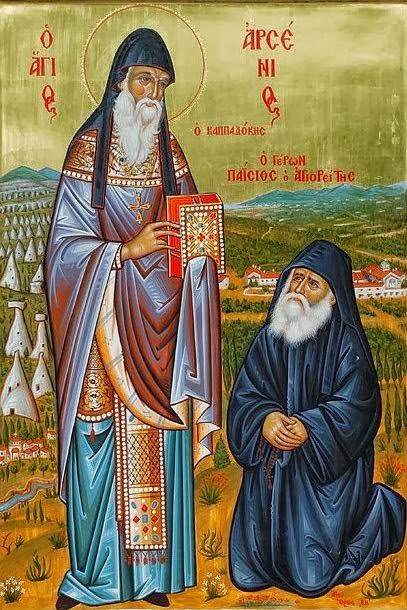
“St. Arsenius of Cappadocia told the faithful in Faras that they will lose their fatherland, but soon they will gain it back again.”[6]
“There will be yet another foreign army. It will not know Greek, but it will believe in Christ. They will also ask: ‘Where is the City?’”
The fate of Constantinople will be decided in a military and diplomatic contest of the largest world sovereignties, for whom for some (as yet unknown) reason the break up of Turkey will be profitable.
St. Paisios the Hagiorite.Elder Paisios emphasized that this will happen without Greece’s direct participation: “We will take Constantinople back, but not we ourselves. Because the majority of our young people have become degraded, we are not capable of such a thing. Nevertheless, God will arrange it that others will take the City and give it to us.”[7]
Many Greek researchers are convinced that Russia, of the same religion as them, will take an active part in deciding the Constantinople question. Truly, the Russian people fit to the greatest degree St. Cosmas’s description: “They will not know Greek, but they will believe in Christ.”
“One day a group of children, students of the Athonaida, decided to go to the elder and ask him whether the Greeks will take Constantinople and will they, the children, live to those times. They came to Fr. Paisios’s kaliva, took their treats, but were afraid to ask the question. One made a sign to another, and he to a third. But in the end, no one could bring himself to ask the elder. Then the elder said to them himself: ‘Well, young fellows? What did you want to ask? About Constantinople? We’ll take it, we will, and you will live to see it’.”[8]
“The antichrists (that is, the Turks.—A.Z.) will leave, but they will return, and then you will chase them to the Red Apple Tree.”
In Greek folk tradition the Red Apple Tree is the name for Kokkini Milia—a place somewhere in Mesopotamia, where the Turks will be driven after the liberation of Constantinople.
Of course, now it seems to us that the liberation of Constantinople, just like the break up of Turkey along with the strengthening of Russia are almost impossible. But let’s not forget that all is possible to God, and the situation in world politics can make a 180-degree turnaround at any moment.
“One day, Mr. D. K. visited Elder Paisios. At that time the USSR was a strong and seemingly invincible world power, and no one could even suppose that it could be destroyed (this was in the Brezhnev era).
But Elder Paisios said to him, by the by:
“You will see that the USSR will break apart.”
Mr. D. objected:
“But Geronda, who could break apart that enormous might? No one would even dare to touch its toenails.”
“You’ll see!”
The elder foretold that the breakup of the USSR will be obvious even to Mr. D., despite his advanced age.
The Elder went on:
“Know, that Turkey will also fall apart. There will be a war that will last two periods. We will be the victors, because we are Orthodox.
“Geronda, will we suffer losses in the war?”
“Eh, at the most they’ll occupy one or two islands, but they will give Constantinople to us. You’ll see, you’ll see!”
“The Turks will leave, but they will return again and reach Hexamilia.[9] One third of them will perish, one third will come to believe in Christ, and another third will go to Kokkini Milia.”
“No one can explain this, and all make mistaken suppositions. They say that Hexamilia is in Langadas, Kilnis,[10] in Thrace,[11] in Corinth; but no one knows that what the saint was talking about is the six miles of territorial waters[12].[13]
“Once, I met Elder Paisios, who was somewhat disturbed and upset. He gave me some treats and then began the conversation himself:
“ ‘Certain people came to me and said that a war will start, the Turks will enter Greece, and they will chase us six miles to Corinth (that is how they explained the prophecy of St. Cosmas of Aitolia, with their corrupt thinking). <…> Although I don’t like to talk on the theme of prophecies, they forced me to explain to them the meaning of the six miles about which St. Cosmas spoke. This is none other than six miles of the sea shelf. It is what we and Turkey have been gnawing at each other about in recent years and about which we will finally “lock horns”. But they will not enter Greece, they will only advance to these six miles, but then they will meet with great calamities from the north, as it is written, and all their plans will collapse.”[14]
“Today, reading prophecies is the same as reading the newspaper—they are so clearly written. My thoughts tell me that many events will take place there: The Russians will occupy Turkey, Turkey will disappear from the map, because one third of the Turks will convert to Christianity, a third with perish, and a third will head for Mesopotamia.”[15]
The prophecies of Sts. Cosmas and Paisios talk about how a third of the Turks will become Christians. It is notable that even now there are many crypto-Christians amongst the Turks. Many pilgrims who have been to Turkey tell about how during their travels people would come up to them, ask them for icons, prayer books, and look for opportunities to confess and receive Communion.
“Then it will come, when there will come two summers and two Paschalias together.”
For a long time the meaning of this prophecy was hidden from us, and only at the end of the twentieth century did Elder Paisios shed light on St. Cosmas’s words.
“They started telling me what St. Cosmas had said: ‘Then it will come, when there will come two summers and two Paschalias together’. They say that now (when Pascha coincided with the Annunciation and the last winter was like summer) it means that the Turks will attack Greece.
“We’ve all become prophets, father, and explain things with our minds however we want… Here I was forced to tell them that when St. Cosmas said, ‘Then it will come…’ he didn’t mean the Turks at all. He meant that liberation will come for the people of North Epirus. And truly, after this year, after so many years the borders were opened, and now they can more or less be connected with their fatherland.
“My father, I understood that these people bring very great harm by explaining the prophecies with their poor minds. And more than that, they pass on their false thinking to others.”[16]
The author, Athanasios Zoitakis, is a doctoral candidate in history and teaches Church history in the History Department of Moscow State University. He is also currently the editor-in-chief of thePravoslavie.ru Greek edition.
[12] The zone of six miles, including several islands in the Aegean Sea. The Turks are now actively making claims to this territory. The continually violate Greek air space, and in 1996, due to these territories a military conflict nearly broke out between Greece and Turkey. (These conflicts are still coming up at the time of this translation.—Trans.)