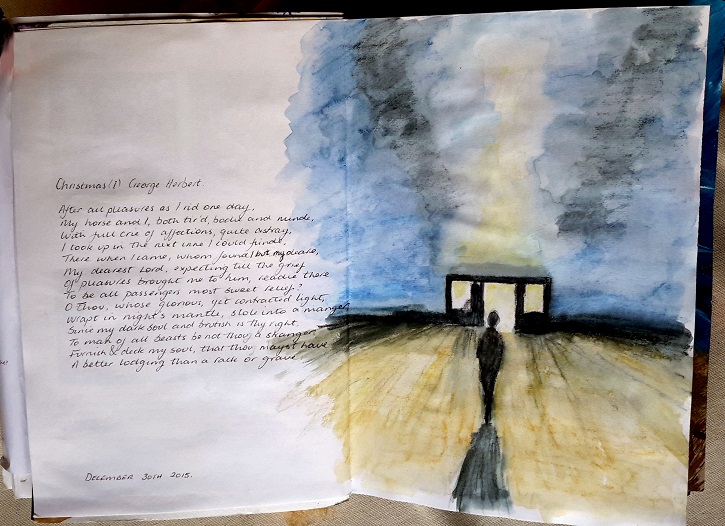
Dear brothers and sisters in Christ, Christ is born. Glorify Him. May we too mystically return to our ‘country’, our ‘normal’ lives, after these Twelve Days, by “another way” (cf. Matthew 2:12), like the Magi, radically changed in our hearts! Because there is another way for each one of us. Not the way of the world, not the way of death, not the way of mundane life, of anger and confusion and busyness, of sorrow, sin, loneliness and suffering. But another way, for each one of us, obtainable because of our mystical meeting with Jesus Christ at the Manger, “at the next inn”.
*
Christmas I
By George Herbert
After all pleasures as I rid one day,
My horse and I, both tired, body and mind,
With full cry of affections, quite astray;
I took up the next inn I could find.
There when I came, whom found I but my dear,
My dearest Lord, expecting till the grief
Of pleasures brought me to Him, ready there
To be all passengers’ most sweet relief?
Oh Thou, whose glorious, yet contracted light,
Wrapt in night’s mantle, stole into a manger;
Since my dark soul and brutish is Thy right,
To man of all beasts be not Thou a stranger:
Furnish and deck my soul, that Thou mayst have
A better lodging, than a rack, or grave.
*
George Herbert is probably my favourite poet. Even in this ‘simple’ sonnet, the Nativity story is told from an innovative angle, and realigns one of Herbert’s favourite tropes for denoting the relationship of God and the soul, that of a kindly host and needy guest.
Shoppers and partygoers, busy staff and busy-er families alike might sympathise with the exhausted rider (“quite astray”) evoked at the beginning of Christmas (I). The unexpected opening modifier, “After all pleasures,” contains an important ambiguity. The preposition “after” suggests both a following in time, and an actual pursuit. Herbert’s speaker, seemingly, is exhausted both by the pleasures experienced and by the process of chasing them, as if unsatisfied pursuit, unsatisfied consumption and busyness were as crazily embroiled in the 17th century as the 21st.
The older meaning of “affection” is “disposition”, and the plural, “affections”, in line three, suggests a throng of bodily and emotional needs, rushing about like hunting dogs that are “in full crie” and yet have lost the scent of their prey. There’s no lecture on the emptiness of pleasure-seeking – simply a vividly realised picture of heated chase and confused disappointment – “the grief/ Of pleasures …” What an amazing line and how theologically true echoing the Prodigal Son parable! How patiently is the Lord awaiting each one of us until “the grief of pleasures” brings us to Him and then He offers relief!
That the inn where the rider pauses is partly an ordinary country inn, a natural place of recovery for huntsman and horse, is suggested by the wonderfully casual demotic of “I took up in the next inne I could finde”. But this inn is also the one in Bethlehem, whose stables are Christ’s birthplace. Touching on his favourite, lovely “hospitality” metaphor, Herbert reveals that Christ is already there, awaiting the traveller “and all passengers” like the kindliest of welcoming hosts.
A little metaphysical punning follows. God has “contracted” his light to be born in human time; he has made his light very much smaller to suit his incarnation, and he has made mankind a binding promise. There’s an almost maternal tenderness in this image of God “wrapt in night’s mantle”.
The mood is picked up in the emotional repetition of the epithet, “My dear,/ My dearest Lord …” From then on, the sonnet turns from first-person narrative to direct apostrophe, from anecdote to prayer.
The symbolism of Christ’s rebirth in the human soul is hardly original. But Herbert’s metaphysics are always strongly rooted in the actual, and his speaker’s prayer is sharp and fresh when he pleads, “To Man of all beasts be not thou a stranger …” The supposed overlord of the animal kingdom, Man, is singled out but also “contracted” at a stroke, to become just another beast in the stable. An almost timid recognition of how distant such a being is from God underlines the plea, “Be not thou a stranger”.
And then Herbert lightens the mood with a new metaphor, one of immediate interest to any of his parishioners planning to “deck the hall” – or the hovel. But the reference is only briefly playful, and Herbert’s speaker is looking ahead to the crucifixion when he asks that his “dark soul and brutish” be furnished and decked so as to be a fit lodging for Christ, “better … than a rack or grave”. (Cf. Carol Rumens’ Poem of the Week, 2014, The Guardian).
The conclusion of this poem where the weary traveller after a day (a life?) of travel, finds solace in the presence of God comes in such start contrast to the closing lines of Robert Frost’s dark, winter poem, “Stopping by Woods on a Snowy Evening”:
“The woods are lovely, dark and deep,
But I have promises to keep,
And miles to go before I sleep,
And miles to go before I sleep.”
How blessed are we that in the darkness of our world, the light of His presence breaks through piercing our personal struggle with the company of angels. Christ is born. Glorify Him.
May we too return to our ‘country’, our ‘normal’ lives, by “another way” (cf. Matthew 2:12), like the Magi, radically changed in our hearts!

 ORTHODOX CHRISTIAN FAITH AND LIFE