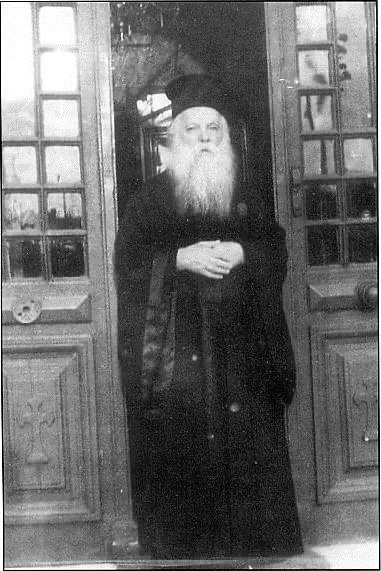
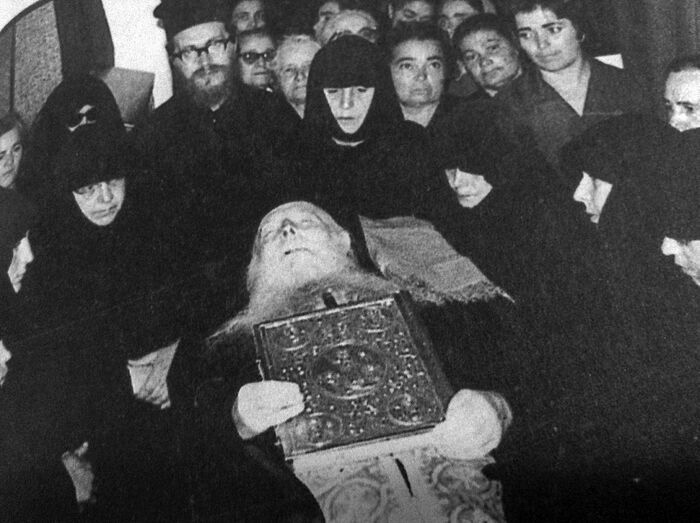
Yet another link in the chain of holiness to His Kingdom, revealed to us, during our recent pilgrimage to Athens and Aegina, another stepping-stone on the Way! The humble Saint of Marousi, To St Athanasios Hamakiotis! Glory to God for all things! This blogpost will present his life and three of the most memorable miracles during his life and after his repose in the Lord.
1.The incident with the Holy Communion took place at the end of St Athanasios Hamakiotis life. His end was blessed, reminiscent of the end of the great saints that we read in the old Synaxaria: “While he was in the hospital, the priest from the Petraki Monastery would come every day to give him Communion. In the last few days the fever had skyrocketed. The thermometer read 42 degrees. At midnight on the 15th to 16th of August he turned and told the nun. -‘Child, be ready tonight’. -‘Why Elder?’ -‘Tonight I will have a big visit and we must be ready to take communion. It’s an opportunity; don’t miss this opportunity’. – ‘Yes, Elder, tomorrow the priest will come’, answered the nun, without understanding what the elder meant. ‘No, tonight, we will have communion’, he insisted. ‘The angels will come! Now read the Holy Communion Canon’. The nun read it and as soon as she finished, he said to her: – ‘Repeat it’. She read it a second time and then, the Elder told her: – ‘Since we won’t be in time, read to me the final prayers’. The nun read: ‘I believe Lord and I confess…’ and the rest.
The Elder continued. -‘Sing now ‘On the divine prison the uncle Abbakum…’ He even provided the tone. The nun chanted: ‘Above the divine prison, the great Abbacum, stand with us and show us, a bright Angel, clearly saying: Today is salvation for the world, because Christ has risen as almighty.’ Indeed, what a nice and how appropriate for the moment choice. – ‘Repeat it’. The nun repeated it. ‘And another time.’ We leave the continuation of the narrative to the nun who experienced this shocking moment: ‘While I was chanting the troparion and I came to the word ‘Abbakum’, I experienced an urgent impulse to fall down on my knees. I quickly knelt down, he threw the sheet over me and half covered me. The Elder, with all the strength he possessed, stood up a little, raised his hands and in awe said the words before the Holy Communion, as the priests say them. I was afraid that he would fall and tried to see what he was doing by pulling the sheet aside a little. He made the same movements that he made when he took communion at the Holy Altar, saying: ‘Here I come to Christ the immortal king and our God. They are transmitted to me by Athanasios, the unworthy Hieromonk, the holy and all-holy…’ He opened his mouth and received Holy Communion from a beautiful angel! I was amazed to see him in the night with the little light taking communion and drinking the blood of the Lord and saying: ‘in the name of the Father… and of the Son… and of the Holy Spirit’. He said ‘Amen’ and calmly bowed, filled with unspeakable joy and profound emotion at God’s unexpected gift. Then he turned and said to me: – ‘Now read the Thanksgiving prayers’. I read them, although I felt overwhelmed by that experience. Then a sweet sleep took him.
It dawned. And because Fr. S. from the Petraki Monastery would come every morning to offer Holy Communion, I say to him: – ‘Elder, let’s read the Holy Communion; Fr. S. will arrive soon to offer Holy Communion to you’. The Elder reacted. – ‘No, my daughter. I have already received Holy Communion, once! Did you see anything?’ I didn’t know how to behave. -‘Uh…no…Elder.’.. What could I say? After some time, Fr. S. came with Holy Communion. As soon as he saw him, he said again: – ‘I have already received Holy Communion, once!’ P. S. left shocked and speechless.
Monastic Calling
Who was this St. Athanasios? He was born George Hamakiotis in 1891 in a mountain village in Kalavyrta. He became a monastic novice at the age of 15, and after finishing seminary 7 years later, he became a monk with the name Athanasios. He was ordained a deacon at the age of 25, and a priest at the age of 30 in 1921. In 1931, he went to serve various churches in Athens. In 1936, he was appointed rector of the Panagia Neratziotissa Church in Maroussi, which became known throughout all of Attica thanks to Fr. Athanasios’ prolific work.
Father Athanasios was distinguished from his childhood for his fiery love for God. His village church and the surrounding chapels were his favorite retreat. He used to run there since he was a small child to pray. In Agia Lavra he stood out from all the monks for his spiritual struggles. Father Anthimos, another elder in Agios Lavra recalls: “In his face I met a real monk. Father Athanasios observed the monastic rule to a much greater degree than the other monks.”
Indeed he lived with more askesis and spiritual ‘violence’ than all the rest. Not only would he never be absent from the monastery services, but while the service started at 4 in the morning, he would get up two hours earlier. So for two hours, in the peace of the night, he prayed, or studied the Holy Bible and the Fathers of the Church. “The monk’s weapons are study and prayer” according to the Holy Fathers. Indeed, to defeat sleep, he would read while walking around his cell, holding a candle in one hand and the book in the other.
But there was a period when the monastery had an abundance of monks and a lack of cells. Thus the monks were forced to live in the same cell three, four, five together. Again Fr. Athanasios found a way not to give up his beloved spiritual study. He would place the oil lamp behind his headboard and, in order not to disturb the other monks, he would place a rough piece of cardboard that limited the light only to him. Thus, with this primitive ‘table lamp’, he could immerse himself undisturbed in the texts of the Bible and the Holy Fathers and slowly enter their spirit.
Not only then but throughout his life the Elder read, and not just read, but studied diligently. He underlined on the books, commented, took notes, or copied into notebooks, whatever he liked and impressed him. This can be seen in his books, but also in his manuscript collections, which are preserved either in the monastery or at his spiritual children. He also kept clippings from magazines and even newspapers, anything that would be useful for his spiritual training and pastoral ministry.
Priest in Neratziotissa
A loner, he loved the monastic life, which is why he sought out the isolated church of Nerantziotissa, which had been a men’s monastery since ancient times. Many pilgrims from almost all parts of Attica, but also from elsewhere, came to receive the blessing of that excellent priest. His fame had now gone beyond the then narrow limits of our city.
2. Once upon a time, a sick child came to Nerantziotissa with his parents and relatives, since science had proven powerless to restore the child’s health. Father Athanasios, after sending the relatives and other followers away, and recommending absolute silence, took the child and his mother and entered the church to pray. Throughout his prayer in the church in front of the icon of the Virgin Mary, on his knees, Father Athanasios had raised his two hands to the sky and tears were running down his cheeks. The child was on the slabs below and the mother was kneeling next to him. When Father Athanasios finished his prayer and made the sign of the Cross on the child, he got up, walked and left the church alone. Panagia Neranziotissa had performed her miracle. And that wasn’t the only thing. Father Athanasios had the privilege of having his soul full of divine grace, which he channeled through his constant prayer to those who came to him with a spirit of humility and repentance. The road to salvation was opening before them and Neranziotissa was becoming a site of holy pilgrimage. Athanasios Hamakiotis: The Saint of Marousi
Father Athanasios continued his hesychastic programme even when he was in Neratziotissa. He never forgot that he was a monk. His whole life was a litany around and in the Temple. He loved holy services and he lived ‘in’ them. The centre of his life was the Divine Liturgy. As Metropolitan Iakovos of Argolida writes: “The Divine Liturgy was his thought, the desire of his soul, his being, it was everything for him, so much did the grace of the mystery affect him, that he was literally transmuted when he officiated”. In his ceremonial movements he was austere, measured, serene, his gait quiet and humble. There are not a few who saw him at the time of the Divine Liturgy, or during the Great Entrance, but also at other times even outside the church, his eyes transfixed to Heavens, his face shining, his feet not touching the ground, conversing with God in hesychia. Often some adults who saw this exquisite sight were stunned. They barely contained their surprise and hushed their voices, so as not to create disorder. But the little children could not be held back. They interrupted the Liturgy with their voices and shouted: “Mom, the priest doesn’t step on the ground! The priest is flying!” As the Divine Liturgy progressed, the Elder ascended. His countenance changed, his hands trembled, his eyes streamed with tears. When it was time to take communion, he would not leave anyone in the sanctuary. At that unique moment he wanted to be alone and said: “And now, Lord, You and I.”
According to the testimony of Father A.L.: “There was no end to the tears that he would shed at the time of the Divine Liturgy. Especially, at the time of Holy Communion, he would shed even more tears, pleading God: “Do not burn me, Lord. Burn away my sins.” And his tears would flow. I have never seen an Elder cry like this before. It surprised me so much! Once, I had the boldness to ask him: -Why are you crying, Elder? – I am crying for my sins, he answered. Because they are so many that I shouldn’t be at the altar. I should have been somewhere else!”
Prayer was always on his lips. Especially at night until late in the morning he prayed outside his little house. Many saw him in the dark with his hands raised praying. The Elder felt a special love for the Most Holy Theotokos and the saints. An attitude of childlike, pure devotion. He addressed Panagia as “Our Lady Theotokos”, or “My lady”; “Save us, my Mother”. He would rest his head on her image and repeat the same words, or other simple requests. He even said: “May the candle of Panagia always be lit in the cell.” He addressed Saint Anna similarly. When he approached her icon and looked at her, he would say: “Mother of my mother, help us.” Among the other saints, it seems that he especially loved and honoured Saint John the Baptist. He would say his prayers and when he would conclude, he would turn to him and say: “My lord, we shall meet again.”
The area St. Athanasios Hamakiotis truly excelled was Confession. Thousands of people found in him a true spiritual father and bowed their heads under his epitrachelion. He heard Confessions until very late into the night despite his fragile health. The subject of repentance was his favorite sermon. He was constantly calling for repentance.
His charity and almsgiving were unparalleled. He didn’t even want to touch the money. When they gave him money he looked for ways to get rid of it. He ran to the poor and sick, to the paralyzed. He helped them not only financially, but also took care of them himself. In a short time, Neratziotissa had become a charity center. He even said in one of his sermons: “Child, do you realise what is accomplished with charity? The world offers rags and buys Paradise.”
3. Of the many recorded incidents, we will offer one that shows his immense sacrificial love. It was the nightmarish winter of 1942. People were dying in the streets from hunger and disease. A spiritual daughter of his, one of the most beloved children of Elder Athanasios, sick and exhausted, was dying. She understood that her end was near and told her relatives to prepare her shroud. Her only consolation was a small gospel with a thick dark cover. She would read for a while, then get dizzy and leave it next to her pillow. In her daze, she turned and saw it. It looked like bread to her. And she sighed: – Oh, my Christ! I wish I had some white bread! Those in the room smiled. At that time, there was no bread, let alone white bread! Just twelve grams of lupin beans were given with the ration card and, even for this humble food, they had to wait for more than ten days to distribute it! The sick woman was thinking: – “Temptation, this is what it is! “Man does not live by bread alone” (Matthew 4:4).
Everything outside was covered in snow. The people of Marousi never remember so much snow before. It was over half a meter. And the cold was bitter. Everything had died. Father Athanasios was on the other side of the city, somewhere in Pefki, where he was blessing a house. The people of the house, instead of money, offered him two pieces of white bread. It was the best gift they could offer him. But the Elder did not keep it for himself, nor did he put a morsel in his mouth. He reflected on his spiritual children. He remembered the two who were most in need. One was the sick woman we mentioned. He started for her home. The road was long and, with so much snow, extremely difficult. But, “love does not seek its own things” (1 Cor. 13:5). It counts for nothing! Who knows how long, or, rather, how many hours, St. Athanasios walked in the snow! He arrived at the house of the bedridden woman who craved some white bread and went straight to her room. – “How are you doing, my child?” – “I’m not well, my father.” Then, the man of the Holy God, Elder Fr. Athanasios Hamakiotis, took a piece of white bread from his neck. – “Child, I went and did a house blessing, and they gave me some bread; here it is! I brought it to you!” The sick woman was dumbfounded. She began to cry and, through her sobs, told him about the “temptation” she had experienced a while ago. The Elder smiled in satisfaction. – “Do you see, my child, how much God loves us?” The blessed Elder sat down, spoke words of consolation to her, supported her shattered morale and blessed her. The dying woman slowly recovered, survived and recounts this incident with tears to this day.
Father Athanasios, however, did not finish his daily mission here. He continued his course in the snow. You see, he even had one more piece of bread to offer. Another poor young lady, sick with adenopathy, was starving and suffering. The Elder also arrived at this house. He offered the second piece of white bread, comforted the sick woman there, and left. Exhausted, frozen, hungry, alone, he arrived back at “Neratziotissa”. The long road of sacrificial love of the Spiritual Father, at least for that day, had ended…
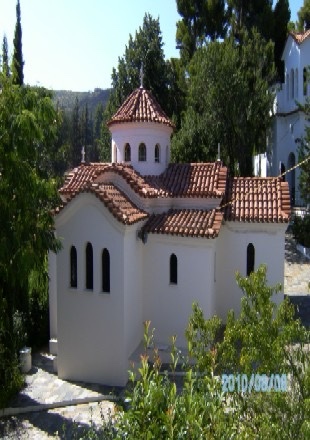
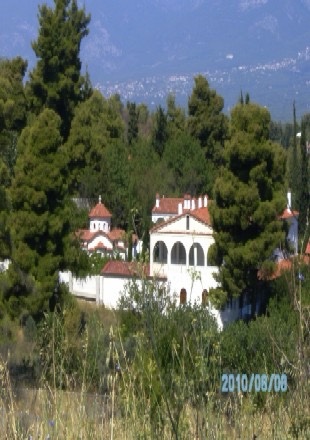
For the last four years of his life, Father Athanasios lived in the small Panagia Faneromeni Monastery, which he had built himself in Attica. His life of prayer, service, and sacrifice, continued there too. To all this was added the spiritual guidance of the nuns there. In every way he tried to help them grow in Christ. And he was preparing for the great journey, praying with tears and waiting… Then, in May 1967, his health began to deteriorate and he was transferred to Evangelismos hospital. According to the testimonies of his spiritual children, who served him, lots of miracles took place there. Every day, he would pray, receive the Holy Mysteries and offer his last words to his spiritual children.
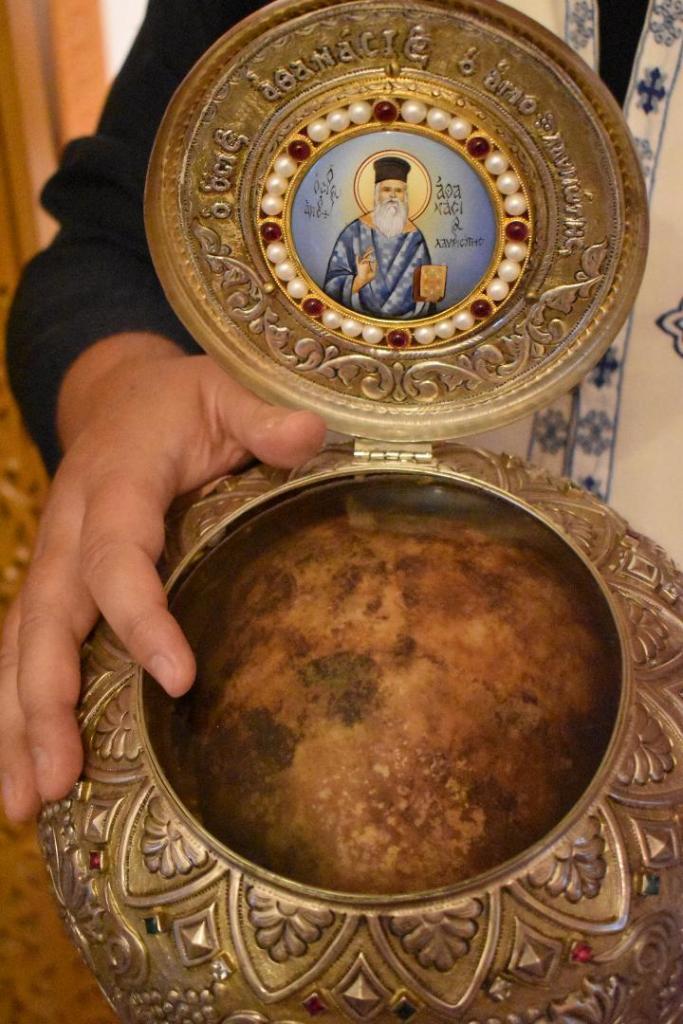
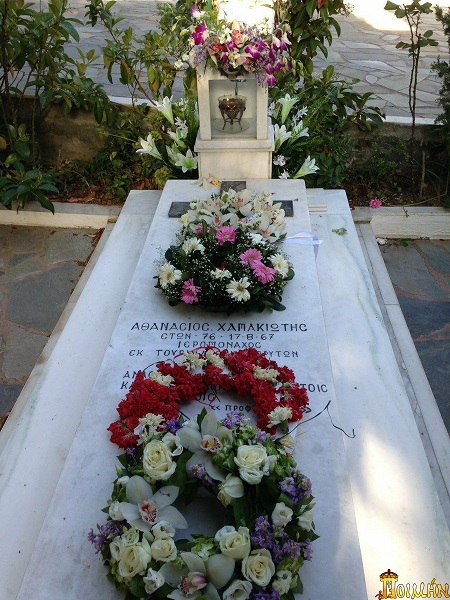
On August 17, 1967, the Monk Athanasios Hamakiotis, the Elder of Neratziotissa, surrendered his holy soul to the Lord. His “warm and flexible” skin was buried in the Holy Sanctuary of Faneromeni, next to the Katholikon of the Hesychasterion. 47 years have passed since his final sleep. And the day of great joy came. On October 23, 2014, the day of commemoration of the holy Apostle James of Adelfotheos, the Most Reverend Metropolitan Mr. Kyrillos of Kifissia, Marousi and Oropos celebrated the Divine Liturgy in the Catholic Church of the Hesychastiri of Faneromeni, assisted by two other high priests and several clergy. After the Divine Liturgy, the remains of the holy father were collected. Everything was done simply and humbly, as the old man would have wanted. Those who were informed of it flooded the area of the Hermitage. With great emotion, the Most Reverend Metropolitan Mr. Kyrillos took in his hands the skull of the holy father and blessed those present. The holy relics were prepared by the Fathers and then taken to the Katholikon, where everyone worshiped with reverence. Then they were escorted and placed in the old man’s cell. A few hours passed and the old man made his presence felt. A sweet fragrance flooded his cell and the whole area of the monastery. “God is truly wonderful among his saints”. Excerpts from Metropolitan Mr. Nektarios’ book, “Hieromonk Athanasios Hamakiotis – In the Steps of Holiness”. My translation. Source: Vima Orthodoxias
This sweet fragrance continues to appear from time to time to this day, as many clergy and laity have attested. The elder is remembered for the beautiful way he served Liturgy and the sacrificing charity and love he offered to all people. The fragrance and the many miracles which continue to this day attested to his holiness and his official canonization was a matter of time. Elder Athanasios was initially proposed for canonization by the Holy Synod of the Church of Greece in August 2017.
Announcing the canonization of St. Athanasios on 16th of November 2023, the Metropolis of Kifisia writes: “Our Sacred Metropolis delights and rejoices in hearing the above Decision of the Holy and Sacred Synod of the Ecumenical Patriarchate. The celebration of his memory was set for the 17th of August of each year, the day of his venerable repose, and on the 23rd of October, the day of the translation of his sacred relics.”
St Athanasios’ cell, his personal belongings, and his relics remain there to our day. Orthochristian,
*Why Elder Athanasios Hamakiotis Didn’t Allow His Altar Servers in the Sanctuary During Communion
Elder Athanasios Hamakiotis and the Threatening Fire of 1990
Two Saints from Marousi: St Athanasios Hamakiotis and St Gavriilia

 ORTHODOX CHRISTIAN FAITH AND LIFE