This year, Holy Week was especially difficult due to an enforced isolation. A little city hermit delights in quietness and solitude, but not an enforced one, and not together with somebody else who is ‘difficult’, where one has to practice cutting your own will every minute. Nonetheless, His Will may be done, and so this painful week passed and that and most demanding obedience was concluded for the time being…
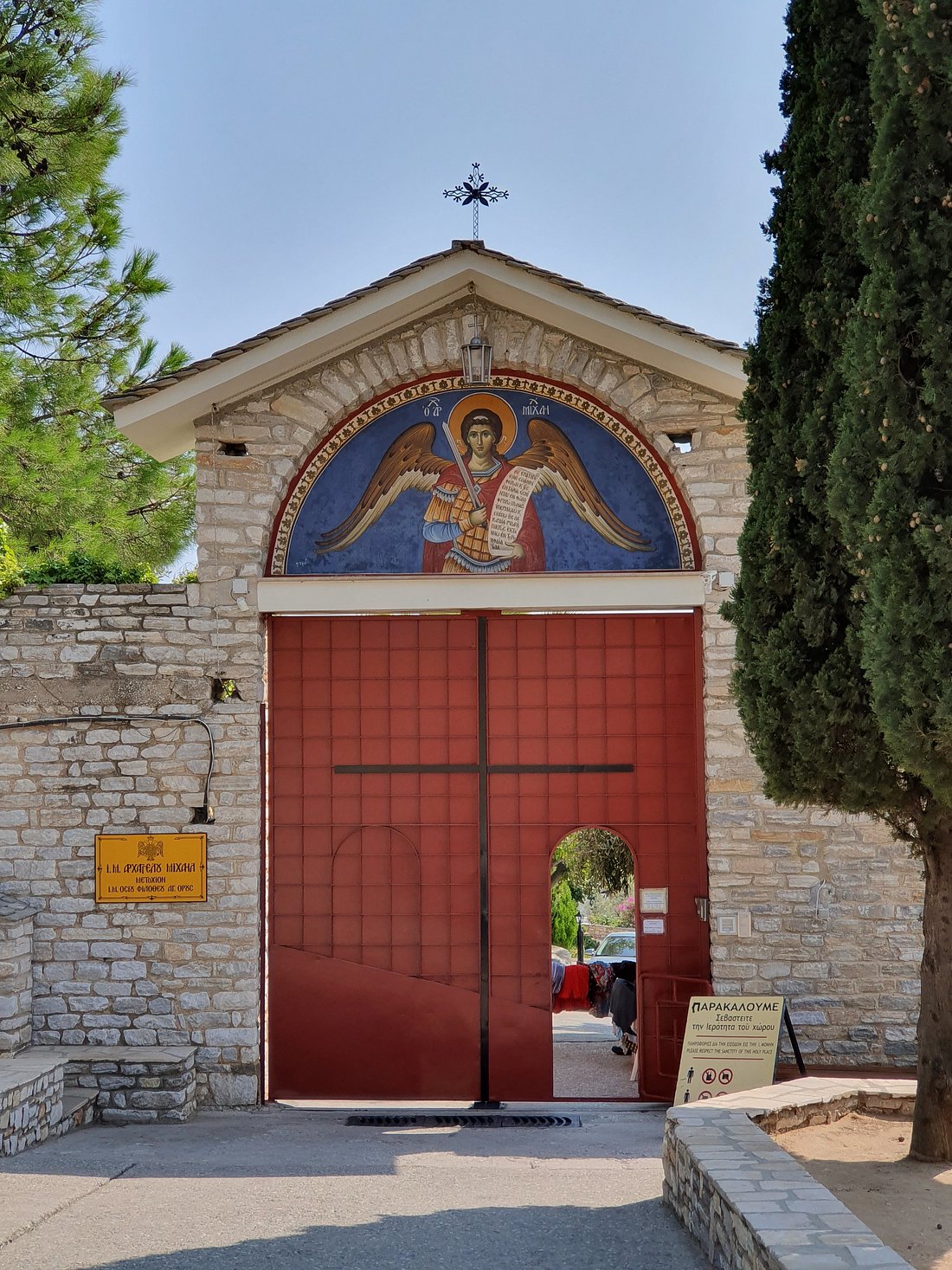
Thank God, the Bright Week which followed was “bright-er”. Its highlight was a pilgrimage by St. Arsenios Monastery, and especially our visit to the Monastery of Archangel Michael in Thassos on Bright Wednesday, the following day of its litany:
The Monastery of Archangel Michael is located on the way to Alyki, about 25 km, south of Limenas. It is built on the edge of a cliff, thus it gives a spectacular view of the Aegean Sea.
The view…
The Archangel Monastery is the biggest and by far the most popular monastery of Thassos, to pilgrims and tourists alike.


The monastery is a share of the Holy Monastery of Philotheos (at the monastic state of Mount Athos). Its historical origin is set in the Byzantine times. In 1090 AD the hermit Luke built a small chapel at the place obeying the command of Archangel Michael, who hit with his hand and a holy spring gushed out there. The holy water, which has been a source of many miracles, flowed in the chapel until the occupation of Thassos by the Turks. Then some irreverent Turks tried to pollute the spring mocking our faith and the result was that the spring dried out. Later the holy water gushed out again and keeps flowing until today in a different position, in a cave under some rocks near the sea. It is called the “on the knees” holy water because you enter the spring on your knees. It is still the source of miracles to the pilgrims who pray and ask for the Archangel’s help.


In the convent is also found a piece of the Holy Nail, put in the right hand of the crucified Christ and it is kept in an artistically crafted hexapterygo (ie. silver six-winged plate) for the pilgrims to worship and for the protection of the convent and the island. This was dedicated to the Monastery of Philotheos by the emperor Nikiforos III Botaneiates and it was miraculously moved to this chapel as the Archangel wished. As part of religious celebration, every year, on the first Tuesday after Easter, the Monastery conducts a procession that starts at a small village of Theologos. During the procession, they carry the Holy Nail back to the convent.


This Monastery share remained abandoned until 1974, when the blessed Ephraim, Abbot of the Monastery of Philotheos, brought the first sisterhood in this place, where the facilities were rudimentary. The nuns have worked very hard to reconstruct the place and bring the convent to its present amazing condition.
The grace of the Holy Nail and the Archangel, as well as the plethora of miracles attract many pilgrims from all over the world, praying for help and protection from the trials and tribulations of life.

The Agiasma – Holy Water
Nuns are most cautious when eager pilgrims want to visit the cave of the holy water. They insist that you should know that:
- Because the journey has many difficulties, you must have the appropriate physical health and condition and ability and undertake personal responsibility for the effort.
- Most of the route consists of climbing the rocks. Essential supplies for the route are sports shoes and water.
- The duration is determined by the capabilities of each pilgrim. It lasts an average of 2-5 hours.

From all 40 of us, only Father Nikodemus and two pilgrims attempted the descent and made it to the cave. The descent and the ascent took them a total of 6 hours, and then they disappeared for about another 6 hours to restore themselves until the night prayers. Have a look at the video below of the descent with the two company of two goats to see how difficult this descent is.

For more information about the miraculous spring of the Archangel and the Discovery of the Honorable Nail of the Saviour, go here.

 ORTHODOX CHRISTIAN FAITH AND LIFE