Sir Stanley Spencer’s Burning Bushes

spencer17

Sir Stanley Spencer (1891-1959)

He was a visionary, a genius. Some said, a lunatic.

spencer12

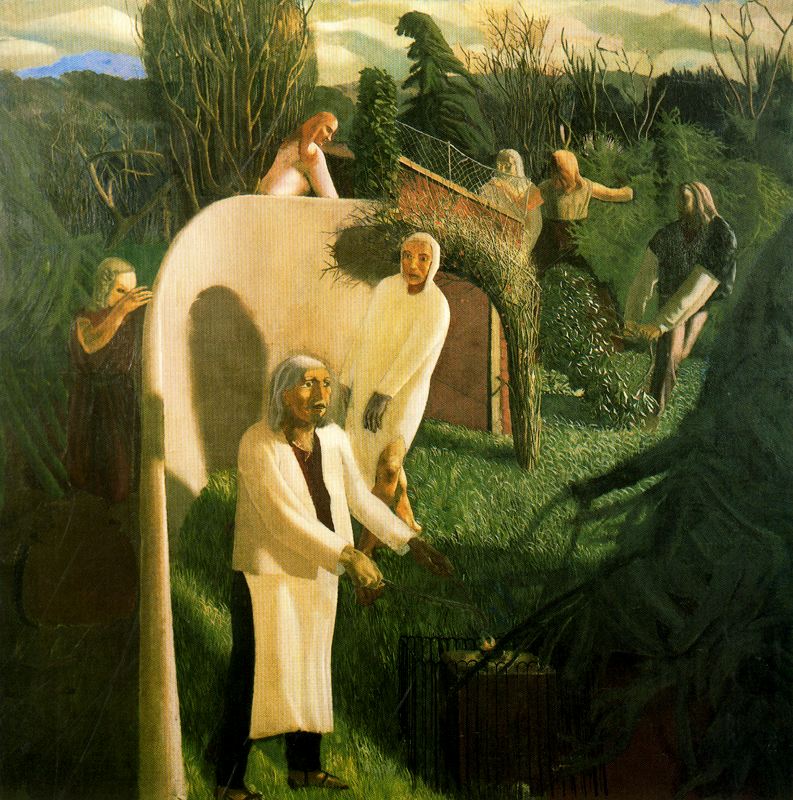
Have a look at his ‘Biblical’ contemporary Zacharias and Elizabeth praying to conceive St. John the Forerunner:
spencer40

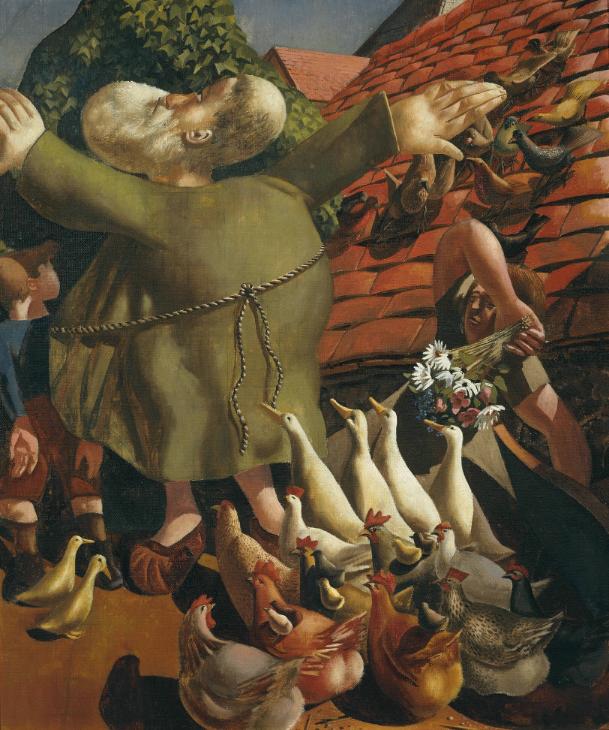
Or at his St Francis and the Birds:

St Francis and the Birds 1935 Sir Stanley Spencer 1891-1959 Presented by the Trustees of the Chantrey Bequest 1967 http://www.tate.org.uk/art/work/T00961

“St Francis of Assisi, the founder of the Franciscans, is popularly remembered for being able to talk to birds, and pray with them. Here he is shown as an old man, dressed in a Franciscan robe, talking to birds on a farm.” [Tate] Stanley Spencer intended to display this painting in his ideal gallery, which he called ‘Church House’, though it was never built. Admittedly, there is a certain “strangeness” in the painting, particularly in the way the saint separates the boy and girl. This painting was in fact rejected by the Royal Academy in 1935, interpreted as an offensive caricature. Spencer was eventually reconciled with the Royal Academy and was elected a full member in 1950; he was knighted in 1959.

spencer37

‘Understand. Spencer is not a fool. He is a damned good man’ one of his officers said. Spencer had just bandaged him and called for stretcher bearers because the officer was grievously wounded. Stanley Spencer had no idea that many people thought of him as an idiot.

spencer36

Spencer was other worldly. He was not run-of –the –mill. His genius as a painter imbued him with love for all of creation. He saw the redemptive force of love in everything, in everyday life, in hospitals ,on the battlefield, in the human body. His innocence and love of beauty could sometimes make him a victim. He thought he loved Patricia Preece, an artist of voluptuous proportions, whom he painted and who tricked him with many wiles into divorcing his wife and marrying her. Yet his childlike soul made him beloved of many. His daughters loved him and remembered his beautiful character and his redeeming love for all of nature.

spencer10

“Everything I do for anyone is as ointment poured forth and it is an exercise creating joy, which is eternal; and it is the army has caused me to learn that by being happy in the present state I am satisfied. But what is wonderful is that by praying for the power to love purely or absolutely you get that power. I feel ashamed of what I would do when I first came out here, compared with what I would do now. The army ought to make any man an artist, because it ought to give any man these feelings.”

Stanley Spencer wrote these words in a letter to friends when he was a soldier on the Salonika front during the First World War. He had been a hospital orderly but was then in active service fighting against the Bulgarians and the Germans. He was finally sent home in 1918 as a result of his frequent and debilitating bouts of malaria.

spencer101

Resurrection

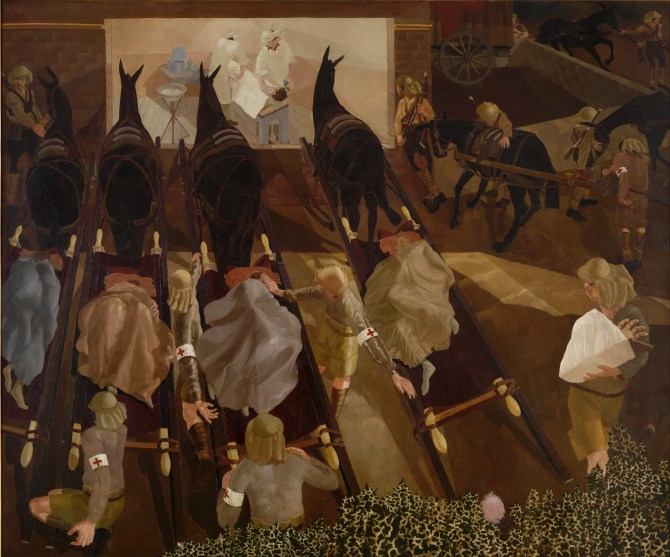
His extraordinarily moving painting of Smol in Macedonia, Travoys Arriving with Wounded at a Dressing Station at Smol, Macedonia, showing an illuminated operating theatre with the wounded on stretchers outside drawn by mules, resonates with biblical undertones: the dressing station was an old Greek church which Spencer drew such that, with the animal and human onlookers surrounding it, it would recall depictions of the birth of Christ. Rather than showing the horror of war, the painting gives hope of continuing life.
spencer19

In the 1920s Spencer was asked by the Behrends family to do the murals for a memorial chapel for their brother Harry, who had died of malaria on the Salonika front. Spencer had always wanted to express his memories of the war and he spent six years on what are regarded by many to be his finest paintings, at the Sandham Memorial Chapel at Burghclere in England. Paul Mitchell says: “Perhaps one would expect scenes of death and destruction. But there is not a gun… and only one officer in sight. Entering the chapel you see ahead vivid white crosses tumbling from the sky and piling up around the altar. Soldiers are emerging from their graves in a Resurrection scene.

spencer9

spencer20

spencer21

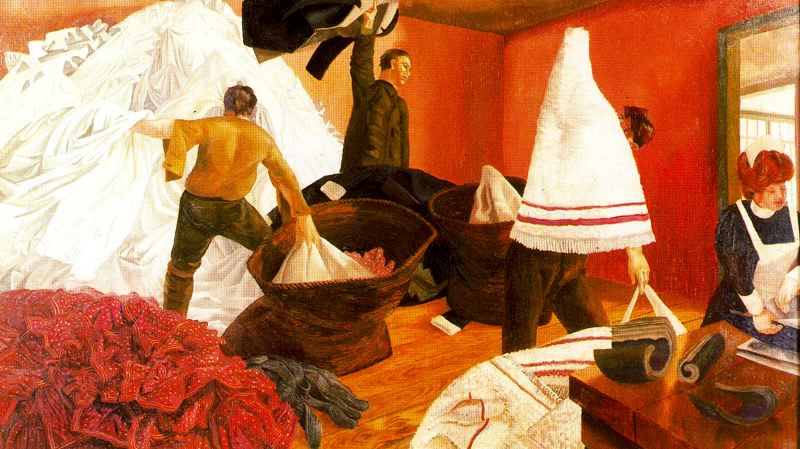
The other walls depict the everyday life that Spencer himself experienced. Even with titles such as Sorting and Moving the Kit-Bags Spencer imbues the paintings with such beauty and meaning that as he himself says, “they don’t look like war pictures, they rather look like heaven”.The everyday activities of the soldiers are transformed from banality. Saint Augustine, whom the artist had read, believed that even menial work could be a way of glorifying God. He continues, “the picture is supposed to be a reflection of the general attitude and behaviour of men during the war”, when a soldier would fondly remember the “caress of a sweetheart” or “sitting in his doorway chatting to his neighbours”. For Spencer himself the five years it took to complete the works was a means to “recover my lost self”.
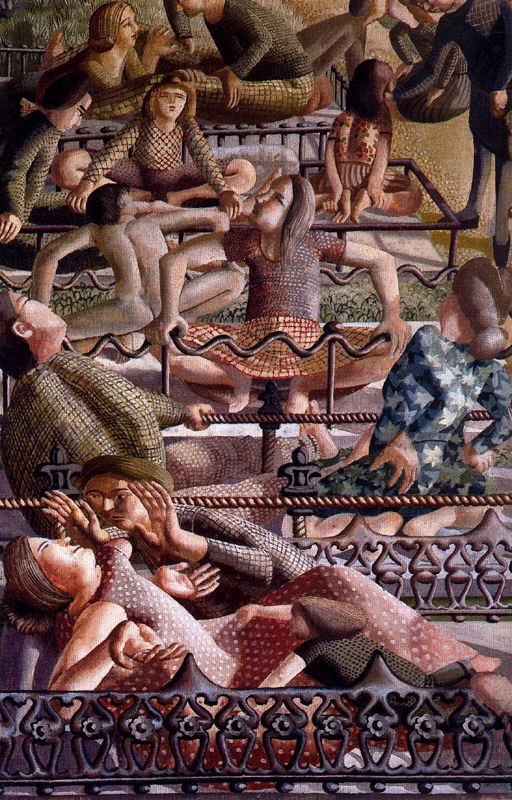
spencer102

Resurrection–Reunion

spencer103

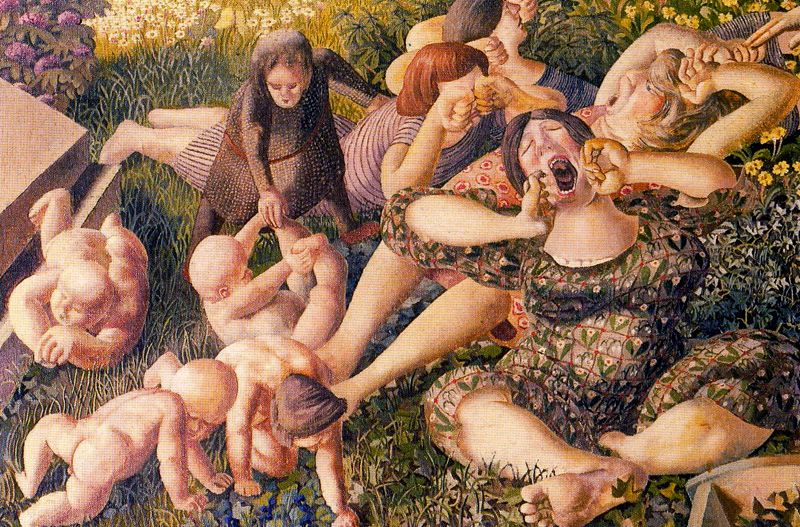
Resurrection–Waking Up

They are highly personal paintings that go beyond the mundane, treating the great themes of death and redemption in an extraordinary vision of grandeur. Spencer went on to paint an amazing Resurrection painting with his home village of Cookham, and the local churchyard as its background.

spencer100

The Resurrection, Cookham 1924–7

“Spencer believed that the divine rested in all creation. He saw his home town of Cookham as a paradise in which everything is invested with mystical significance. The local churchyard here becomes the setting for the resurrection of the dead. Christ is enthroned in the church porch, cradling three babies, with God the Father standing behind. Spencer himself appears near the centre, naked, leaning against a grave stone; his fiancée Hilda lies sleeping in a bed of ivy. At the top left, risen souls are transported to Heaven in the pleasure steamers that then ploughed the Thames.” [Tate]
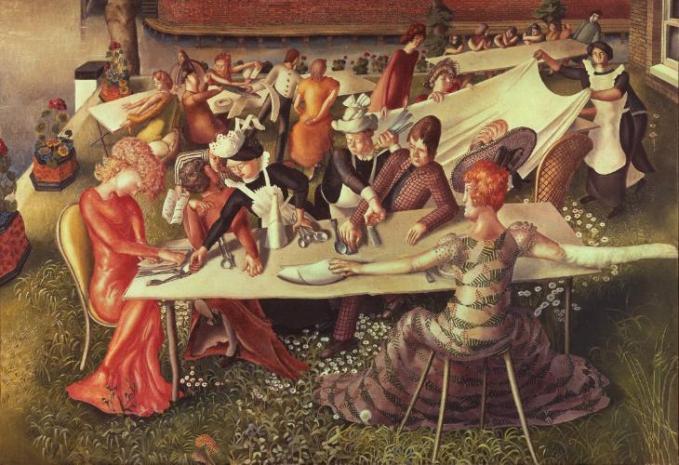
Dinner on the Hotel Lawn 1956-7 Sir Stanley Spencer 1891-1959 Presented by the Trustees of the Chantrey Bequest 1957 http://www.tate.org.uk/art/work/T00141

Not that Stanley Spencer saw himself as a prophet. On the contrary, he believed that the divine was present everywhere, in everything in the world, that the transforming power of love could express the suffering of people and their desire for a better world. Tiny details of life and the human condition were the driving force behind his work. … Spencer’s works often express his fervent if unconventional Christian faith. This is especially evident in the scenes that he based in Cookham which show the compassion that he felt for his fellow residents.

spencer27

Christ Preaching at the Cookham Regatta

*

«When I lived in Cookham I was disturbed by a feeling of everything being meaningless. Quite suddenly I became aware that everything was full of special meaning, and this made everything holy. The instinct of Moses to take his shoes off when he saw the burning bush was very similar to my feelings. I saw many burning bushes in Cookham. I observed the sacred quality in the most unexpected quarters.»
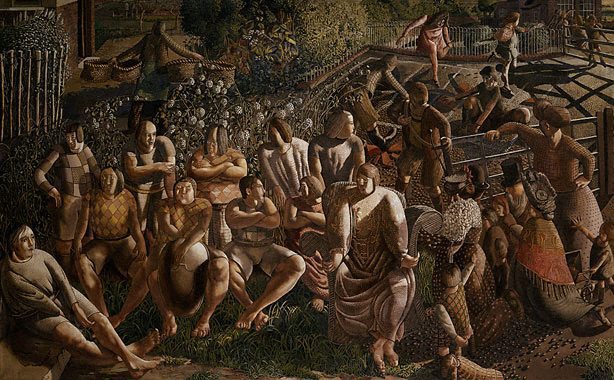
Artist : Sir Stanley Spencer (England, b.1891, d.1959) Title : Date : 1951-1952 Medium Description: oil on canvas Dimensions : Credit Line : Watson Bequest Fund 1952 Image Credit Line : Accession Number : 8702

Christ in Cookham (1951-1952)

spencer105

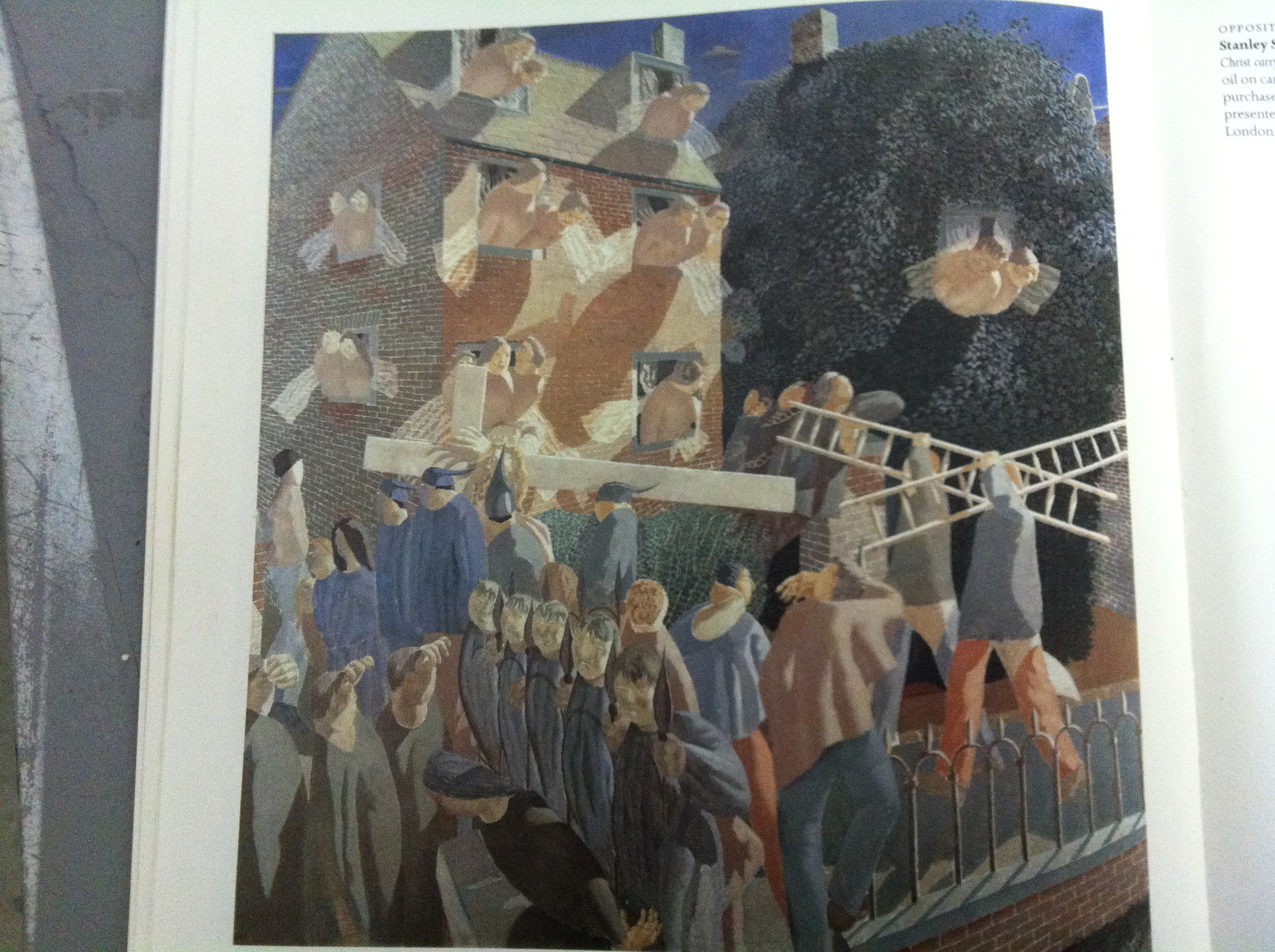
Christ Carrying the Cross 1920

Carpenters walking down Cookham High Street form a link with Christ’s carrying the cross through Jerusalem. The Tate Gallery originally mistitled this picture “Christ Bearing his Cross” which intensely irritated Stanley Spencer.  As he said, the false title implied:

A sense of suffering which was not my intention.  I particularly wished to convey the relationship between the carpenters behind him carrying the ladders and Christ in front carrying the cross.  Each doing their job of work and doing it just like workmen  . . . Christ was not doing a job or his job, but the job.
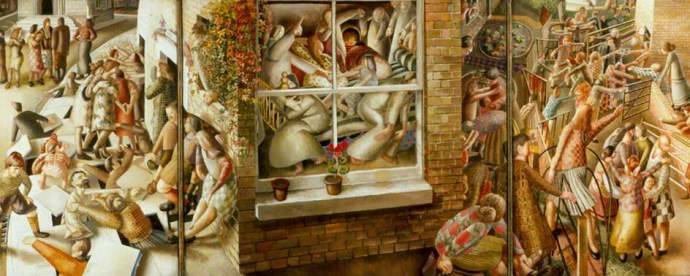
DACS; (c) DACS; Supplied by The Public Catalogue Foundation

The Resurrection with the Raising of Jarius’s Daughter

*

Again, when Stanley Spencer’s dealer thought of cataloguing the painting as “Christ Carrying His Cross” Stanley was furious. The cross was for him universal. We all have to carry the cross.
spencer35

spencer16

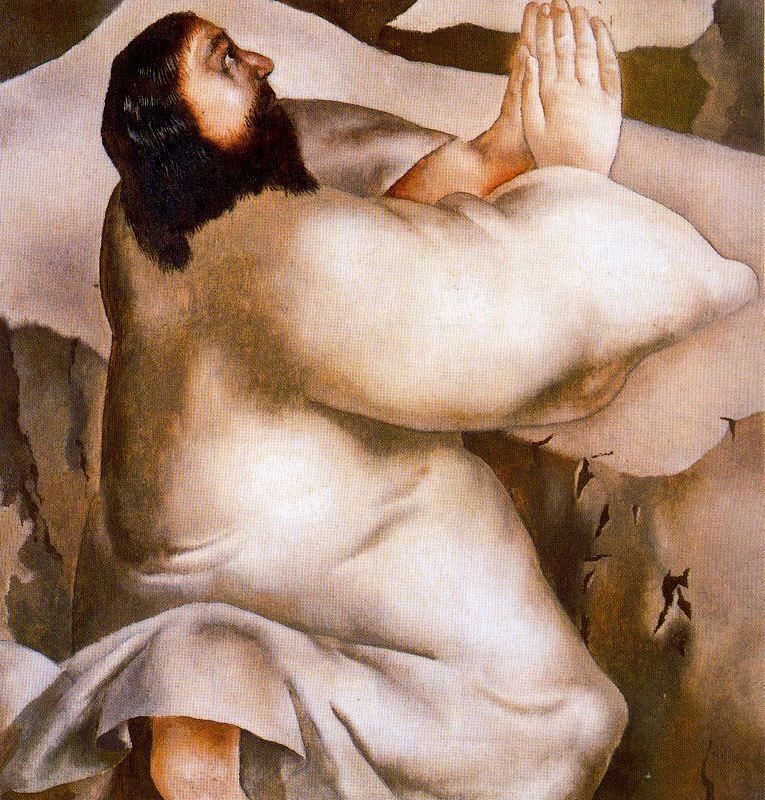
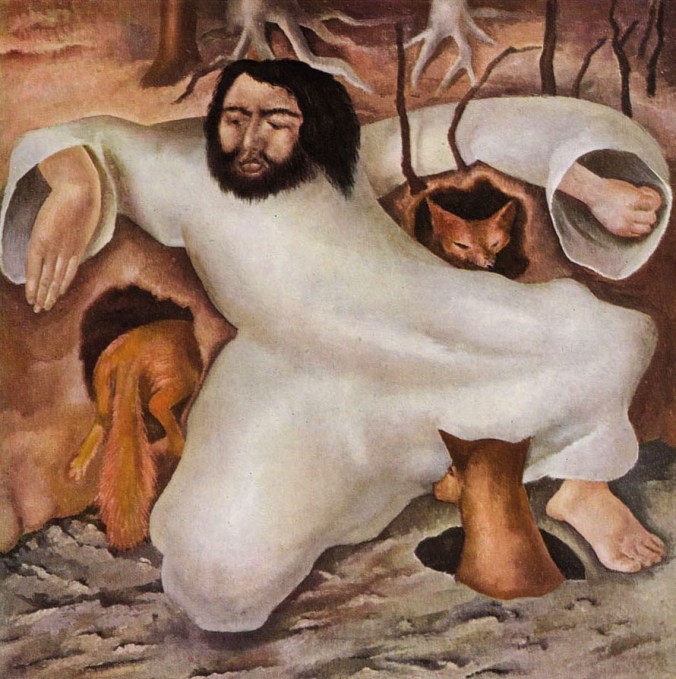
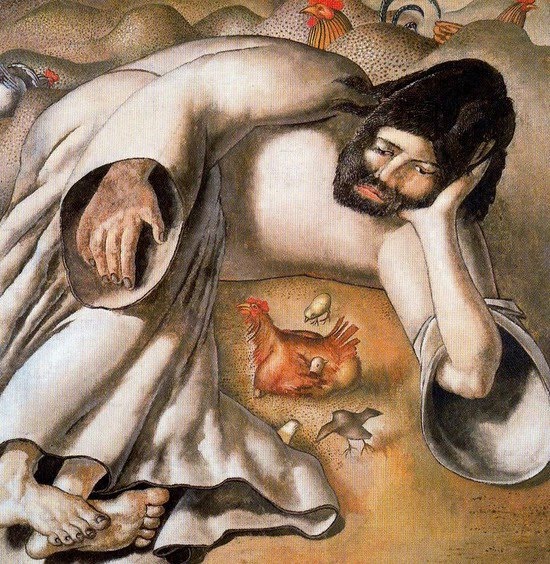
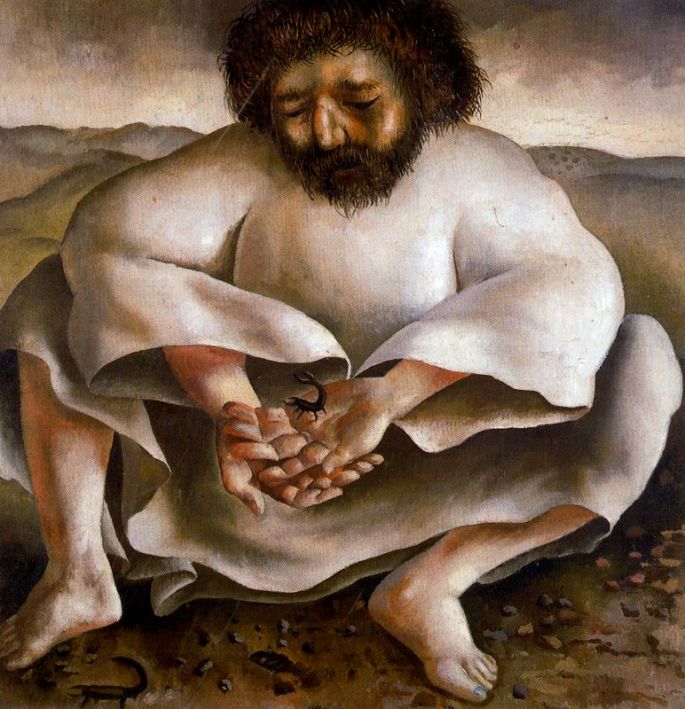
The moving series of paintings Christ in the Wilderness, were a product of a very difficult time for Spencer. He had been betrayed by Patricia Preece and left pretty much destitute. His wife Hilda and children were not with him. He worked in a bare studio in London. The depiction of Christ protecting the hen is incredibly moving.
spencer31

spencer32

Spencer’s genius was his vision. For him all that was material was divine, imbued with “the grandeur of God.” Like Saint Paisios he could love the whole world. Saint Nectarios of Aegina said: “Our heart should be so filled with love that it should overflow to our neighbor.” “The impulse for his creativity came out of his own idealistic efforts to articulate suffering humanity’s craving for a better world.” Paul Mitchell said.
spencer30

spencer34

Spencer said: “Love is the essential power in the creation of art and love is not a talent.  Love reveals and more accurately describes the nature and meaning of things than any mere lecture on technique can do. And it establishes once and for all time the final and perfect identity of every created thing.”

*

“I love to dwell on the thought that the artist is next in divinity to the saint. He, like the saint, performs miracles.”

*

Spencer’s art is fascinating, bizarre, unworldly and yet too wordly. His life was more eccentric and not always so praiseworthy. In fact, he lived a pretty messy and imperfect life, and did not always live out his convictions very well. But this does not necessarily mean that he is to be judged and condemned together with his ‘art’. Isn’t he in a sense a fellow struggler rather than a role model, and doesn’t his honesty about his own personal battles make him that much more accessible to us today? Spencer felt compelled to record the truth of Christianity as he saw and felt it, and such art as his can reach places in the human heart that reasoned argument can never penetrate. “Where William Blake was aware of heavenly voices in the next room, Stanley Spencer was susceptible to visions of holiness along the Cookham lanes, … turning its streets into visions of holiness.” May he teach us to discover burning bushes all over the world.

*

For more, please watch a brilliant lecture by Richard Harries, The Rt Revd Lord Harries of Pentregarth, Gresham Professor of Divinity, “Distinctive Individual Visions”, part of  Christian Faith and Modern Art Series http://www.gresham.ac.uk/lectures-and-events/distinctive-individual-visions  “As at the end of the 18th century William Blake developed a highly individual style that did not fit easily into the categories of the age, so in our time artists like Marc Chagall, Stanley Spencer and Cecil Collins, in their very different ways, have sought to express an intense, highly personal religious vision of the world. …”

16nov11richardharries_distinctiveindividualvisions

16nov11richardharries_distinctiveindividualvisions

The ‘Trash Can’ Rescue

trash can

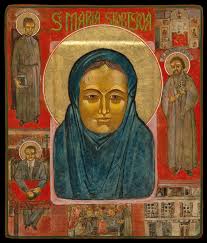
The Trash Can Rescue was the code name for an undercover operation aimed at smuggling out Jewish children headed for the death camps in Paris. “The story occurs after Mother Maria had established the house with the blessing and help of her bishop, Metropolitan Evlogy Georgievsky, on rue de Lourmel.  Word got out that something was happening at the stadium, not far from the house. “. . .There was a mass arrest of Jews — 12,884, of whom 6,900 (two-thirds of them children) were brought to the Velodrome d’Hiver  . . . Held there for five days, the captives in the stadium received water only from a single hydrant, while ten latrines were supposed to serve them all. From there the captives were to be sent via Drancy to Auschwitz.”

Mother Maria of Paris wrote both poetry and religious essays in addition to running a soup kitchen and community center in a ghetto of Paris

Mother Maria of Paris wrote both poetry and religious essays in addition to running a soup kitchen and community center in a ghetto of Paris.

Because Mother Maria was well-known to the police and sanitation crews as she would scour the back alleys of Paris and the central market gathering day old food and recyclables for the poor of her community, she was granted access into the stadium.  She quickly sized up the situation.  The stadium had become a central transfer and processing hub for the thousands of Jews of Paris.

She prayed for assistance.  The idea came to her.  By employing the confidence of the local sanitation workers in charge of hauling the garbage from the stadium, Mother Maria perpetrated a plot that would at least save the children from the gas chambers: stuff them into the garbage bins, haul them out on the trucks from the stadium, and then under the cover of night, sneak the children to the house on rue de Lourmel where she then could orchestrate their continued passage to the south of France, an area outside of Nazi control, and to safety. The chronicle of the Trash Can Rescue has been memorialised in the children’s book Silent as Stone written by Jim Forest and beautifully illustrated by Dasha Pancheshnaya (St Vladimir’s Press: http://www.svspress.com/silent-as-a-stone/ )“It would have been possible for her to leave Paris when the Germans were advancing toward the city, or even to leave the country to go to America. Her decision was not to budge. “If the Germans take Paris, I shall stay here with my old women. Where else could I send them?” http://incommunion.org/2004/10/18/saint-of-the-open-door

mother maria

No one is sure how many children Mother Maria and her garbage crew saved.  But what is certain is that she eventually was found out by the Nazis. (When Nazis interrogated her about whether she had seen any Jews, she would point to an icon of the Mother of God or else point to the body of Christ on her crucifix.)  The priest, Father Dimitri Klepinin who had served alongside her in the “monasticism in the world” and her son Yuri were arrested.  They had been guilty of forging fake baptismal certificates for Jews who came begging for help.  Yuri and Father Dimitri eventually died in Buchenwald camp while Mother Maria was sent to Ravensbruck. … It was Good Friday, March 30th, on the eve of the liberation of Paris, 1945, that Mother Maria was one of those chosen for death. According to other accounts, she took the place of another prisoner who was marked for the gas chamber that day. …

mother maria2

For the rest of the article go to http://greekamericangirl.com/mother-maria-of-paris-says-oxi-to-the-nazi-mass-murder-machine/

For more information about Maria’s activism, inspiration, grace, heroism, and hope-filled commitment, so needed in our world today, go to my earlier posts “Like a Russian Novel” at https://orthodoxcityhermit.com/2015/09/23/mother-maria-of-paris-saint-of-the-open-door/ and “Solitary and Naked Before God” at https://orthodoxcityhermit.com/2015/09/23/taking-up-the-cross/

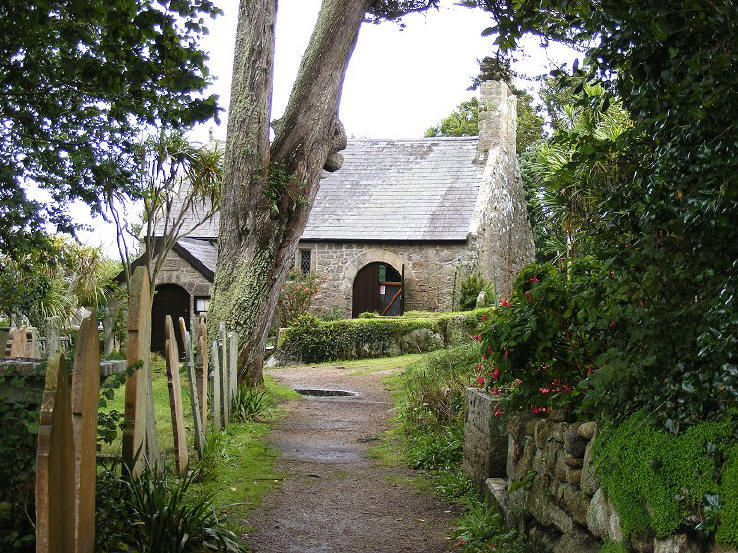
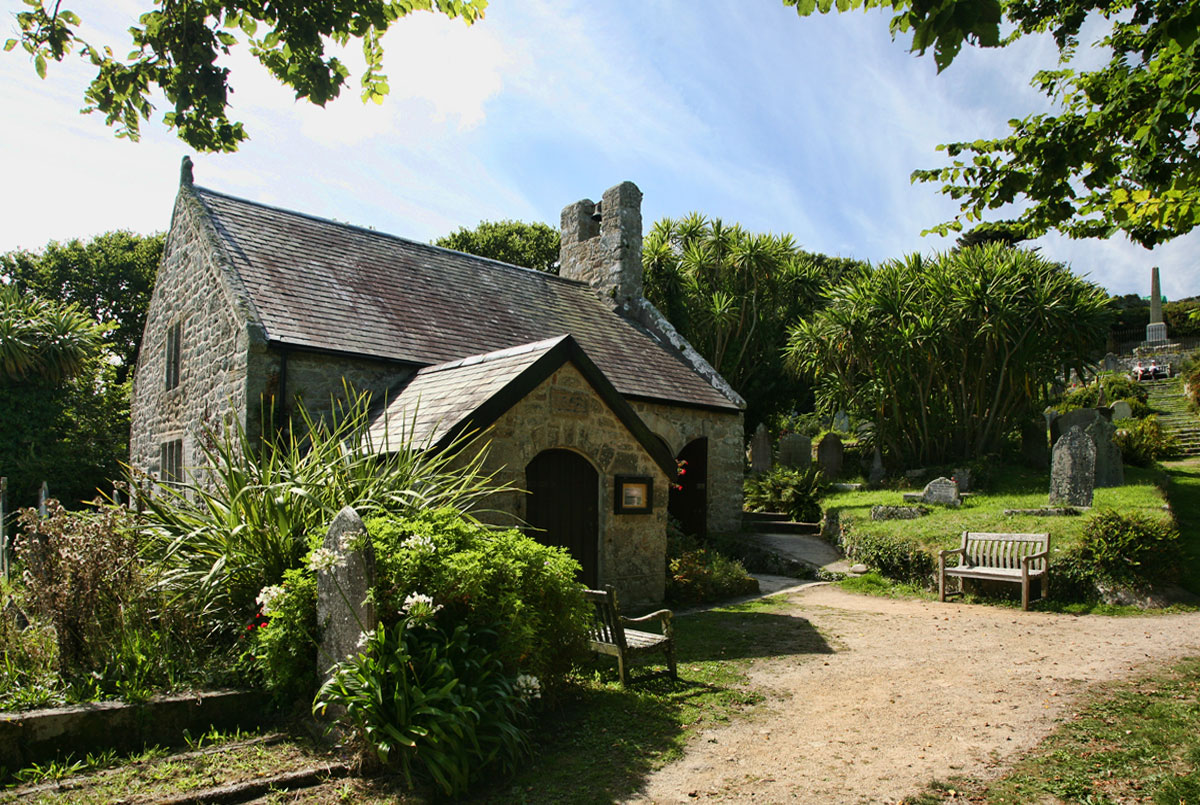
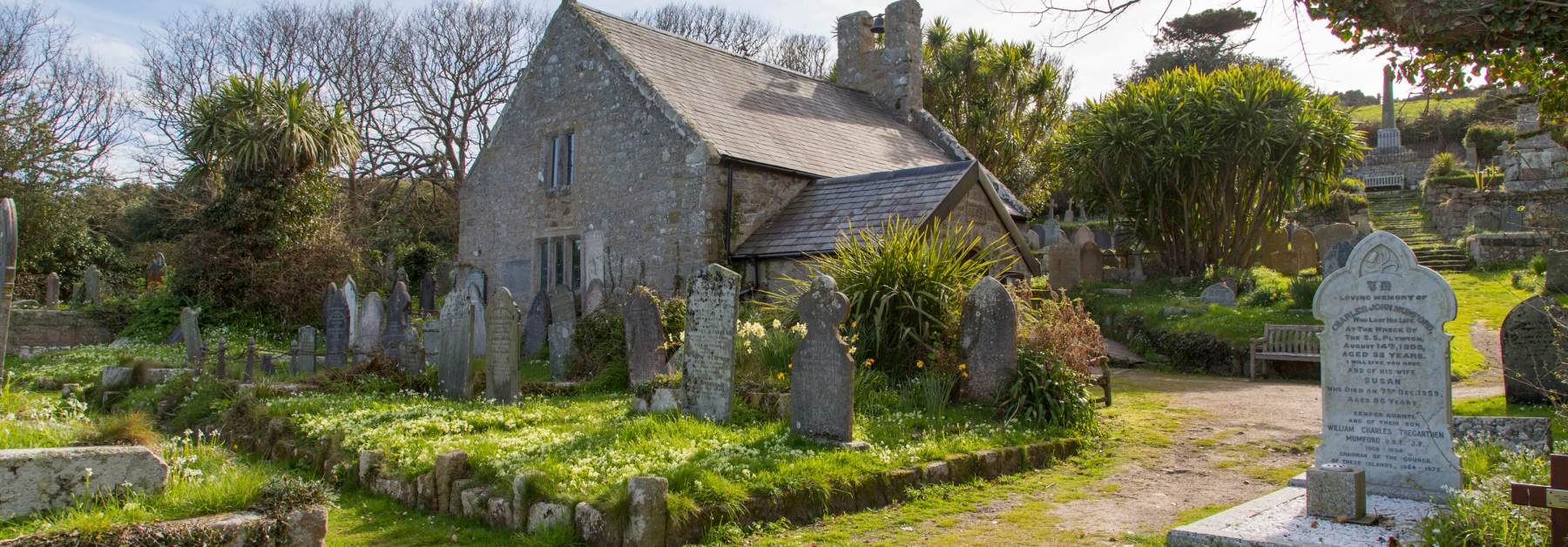
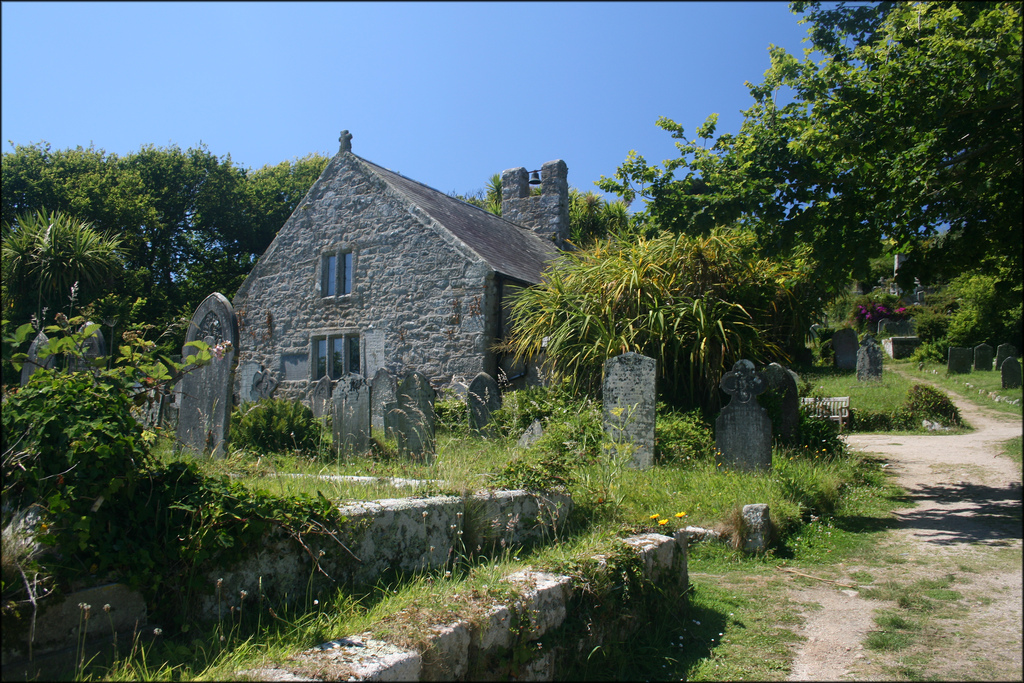
Scilly Celtic Saints

scilly1

scilly4

Isles_of_Scilly_NASA

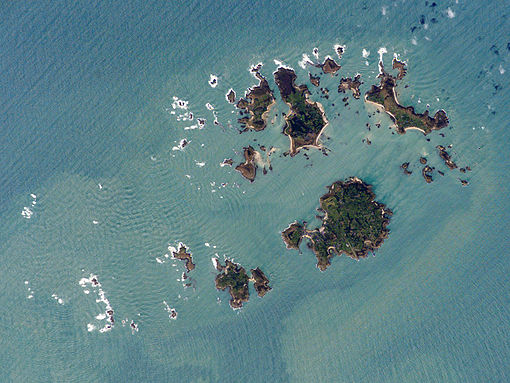
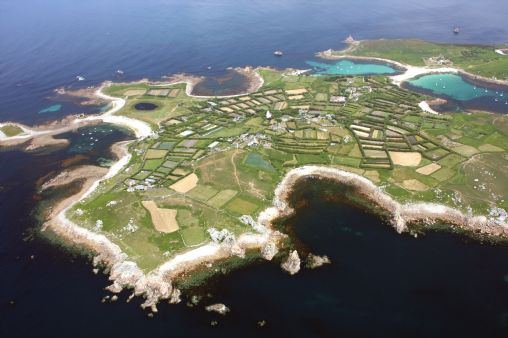
Aerial photo of the Isles of Scilly

*

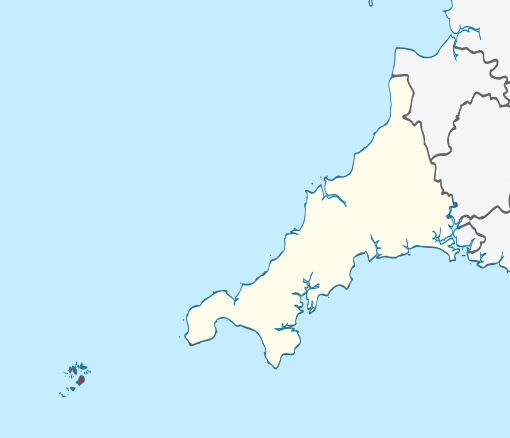
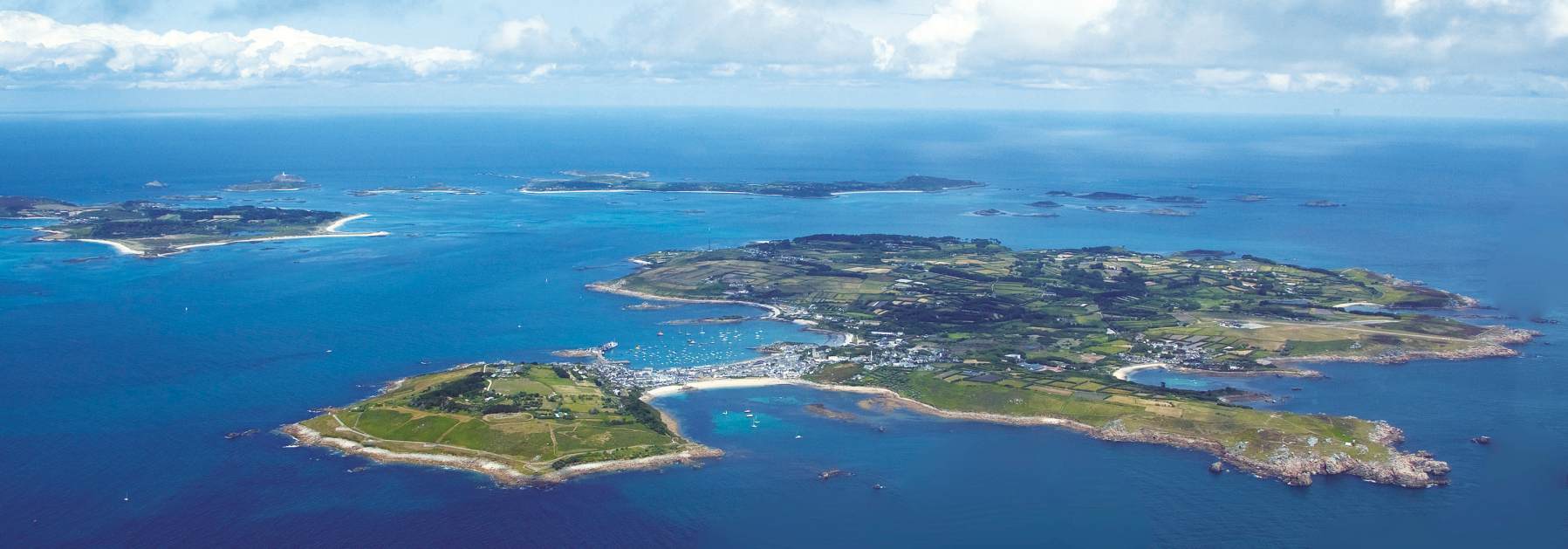
To continue our pilgrimage to the Celtic sacred sites and pilgrim routes of England, our next stop is Scilly –pronounced “silly”–Islands! Yet another look at Christian faith from a Celtic perspective. Have you been there? The Isles of Scilly (/ˈsɪli/CornishSyllan or Enesek Syllan) (Introduction of the “c” may be to prevent references to “silly” men or saints!) are an archipelago off the southwestern tip of the Cornish peninsula of Great Britain, comprising  5 Major, inhabited islands,St Mary’sTrescoSt Martin’sBryherSt Agnes and 140 others. 

Isles_of_Scilly_in_Cornwall

The Isles of Scilly (bottom left corner) are a part of the ceremonial county of Cornwall (white)

scilly3

Scilly Saints

Holiday Reflections on these Holy Isles

By Father Jonathan Hemmings

scilly2

“For since in the wisdom of God the world through its wisdom did not know him, God was pleased through the foolishness of what was preached to save those who believe.” (1 Corinthians 1:21)

*

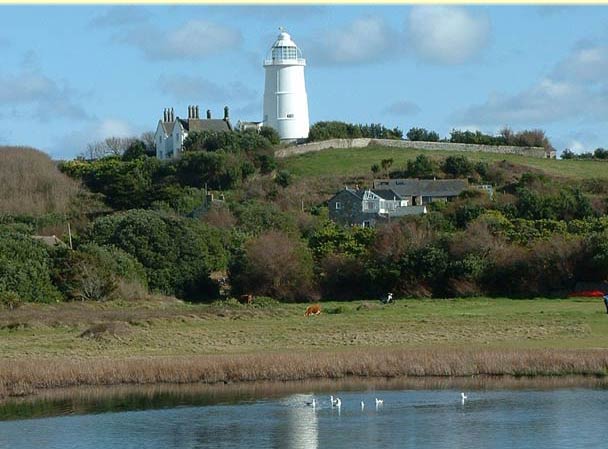
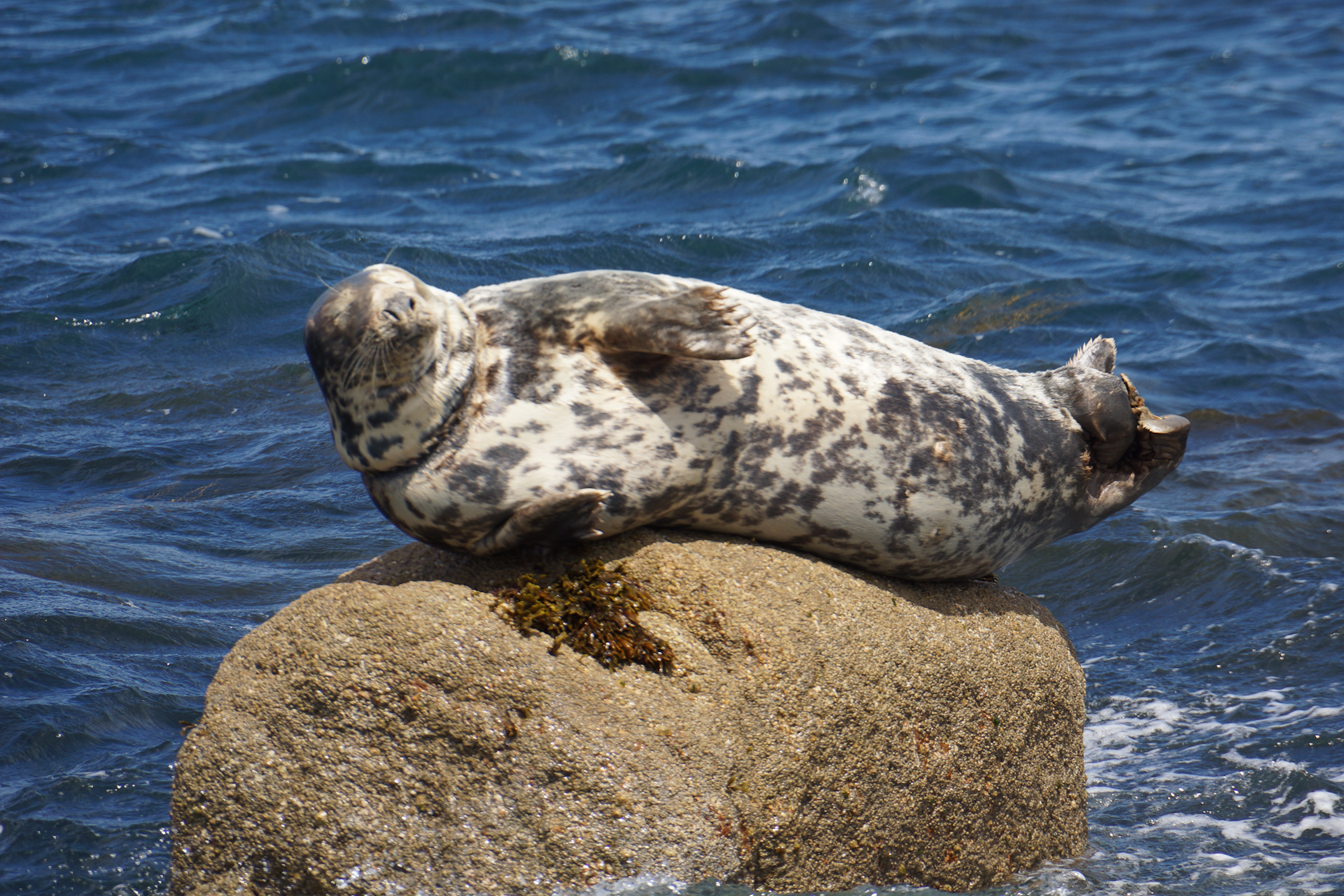
Forty miles south west off the Cornish coast are the beautiful Scilly Islands. Bathed by clear water, graced by an equitable and temperate climate, surrounded by wildlife in sea and air, seals, puffins and dolphins, they have a flora unique to the British Isles. The very names of some of these Islands, St.Mary, St.Agnes, St.Martin, St.Helen, suggest a link between faith and culture. Look a little deeper and one finds an important vein of Celtic Orthodox spirituality etched, sometimes quite literally into the very granite of the rocks that form the base of life in these offshore outposts of faith and spiritual powerhouses of prayer.

 *

St. Mary’s

The largest of the Islands, it was known at first as Ennor, the origin of which is obscure, it seems that the name of the island was taken from the dedication of the Church in the Old Town to Our Lady in mediaeval times. As “Star of the Sea” (Steren an Mor) the intercessions of the Mother of God are still sought for those who sail in these shipwreck strewn islands where the hazards of shallow tides and hazardous rocks still persist and catch the unwary voyager. [ For a list of shipwrecks of the Isles of Scilly go to http://list of shipwrecks of the Isles of ScillyThere is a little valley in the middle of the island known as Holy Vale.

scilly-st mary

scilly-st mary and tesco

scilly-st mary1

scilly-st mary3

scilly-st mary5

scilly-st mary6

scilli-st mary's9

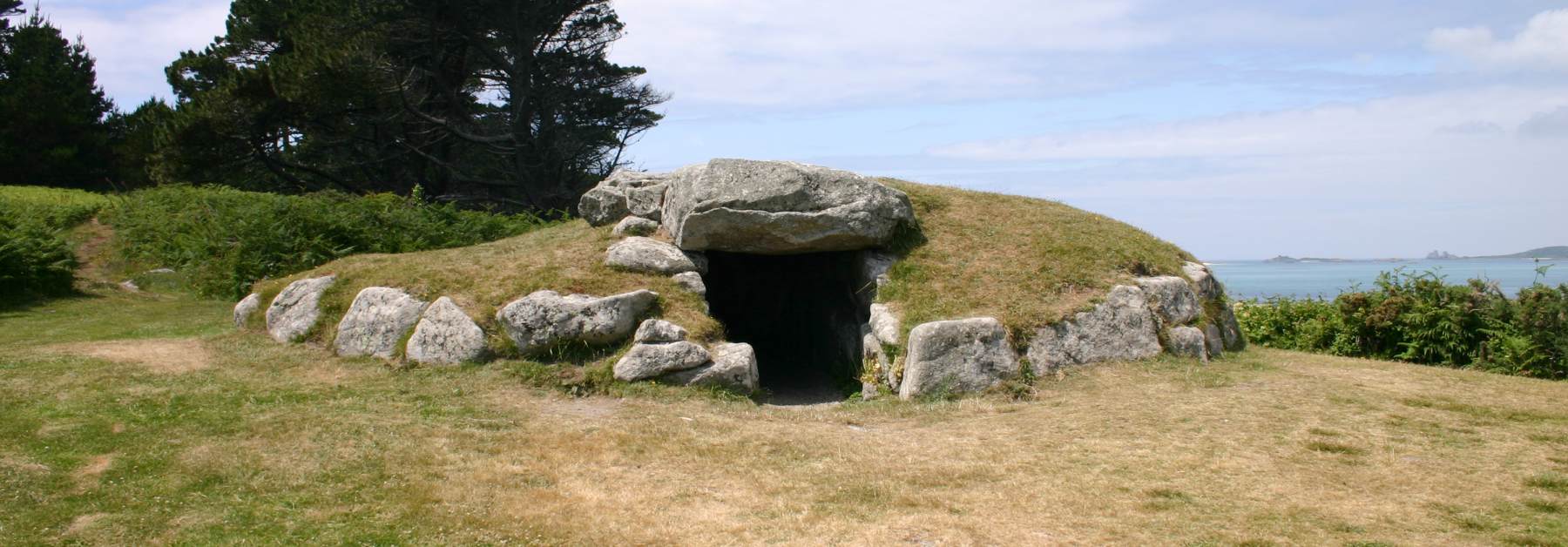
Bants Carn, St Mary’s

 scilly-st mary8

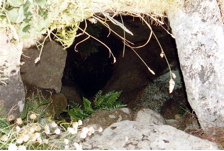
Scilly St Mary’s Bant burial chamber entrance

*

St. Agnes

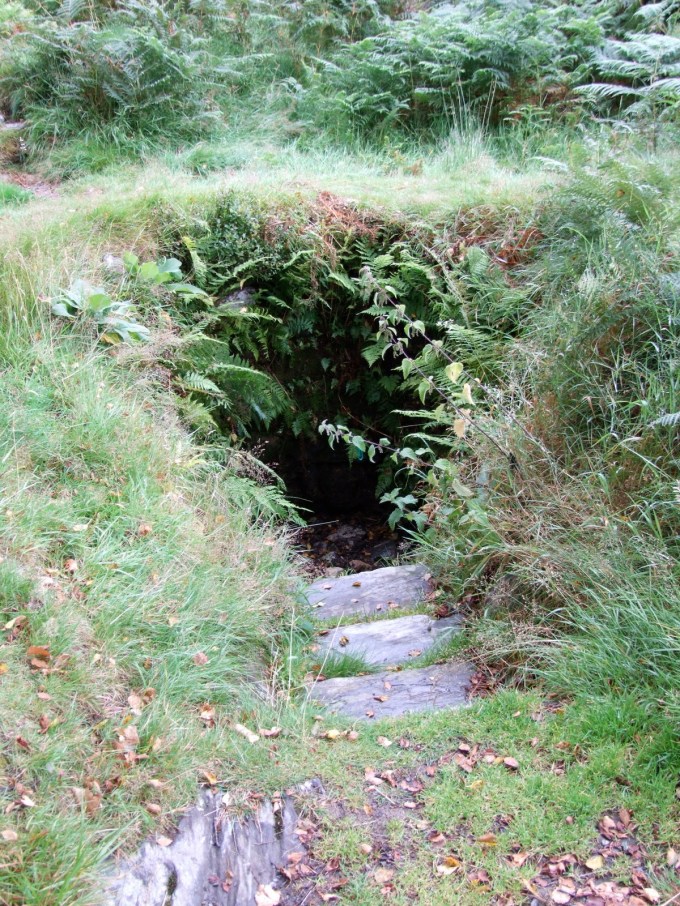
The southernmost Island is that of St. Agnes. Named after the Roman Saint we find during Norman times the replacing of celtic saints with popular western saints. However, to the south east of the Island is the crescent- shaped St. Warna’s Cove which marks the spot where this Irish celtic nun landed and made her dwelling-place after sailing single handed from Ireland. It is remarkable to ponder on the courage and fearless spiritual enterprise of the Celtic Christians who used the Irish Sea much as we today would use the M6 motorway. St. Warna is the patron saint of the Scilly Island of St Agnes and prays for the salvation of those subject to wrecks. It may be noted that it is said that some of the more pagan element wanted shipwrecks in order to plunder the cargo in past times. At St. Warna’s Cove there is a holy well near to the shore where the saint lived in her hermitage and prayed. Nearby there is a large standing granite stone with an impressive and distinctive Cross emblazoned on its face made by the weathering of the wind!

scilly-st agnes2

scilly-st agnes3

scilly-st agnes4

Porth Conger, St Agnes

scilly-st agnes

St Agnes, isles of Scilly and The Bar of sand which connects it to Gugh

scilly-st agnes7

Views taken on or on the way to St Agnes

scilly-st agnes9

Summer Sky – St Agnes, Scilly Isles

scilly-st agnes5

Troy Town Maze, St. Agnes, Isles of Scilly

scilly-st agnes6

Gugh. Gugh, St. Agnes, Isles of Scilly

scilly-st warna5

On the island of St Agnes, St Warna is the patron saint of shipwrecks

 *

St. Martin’s

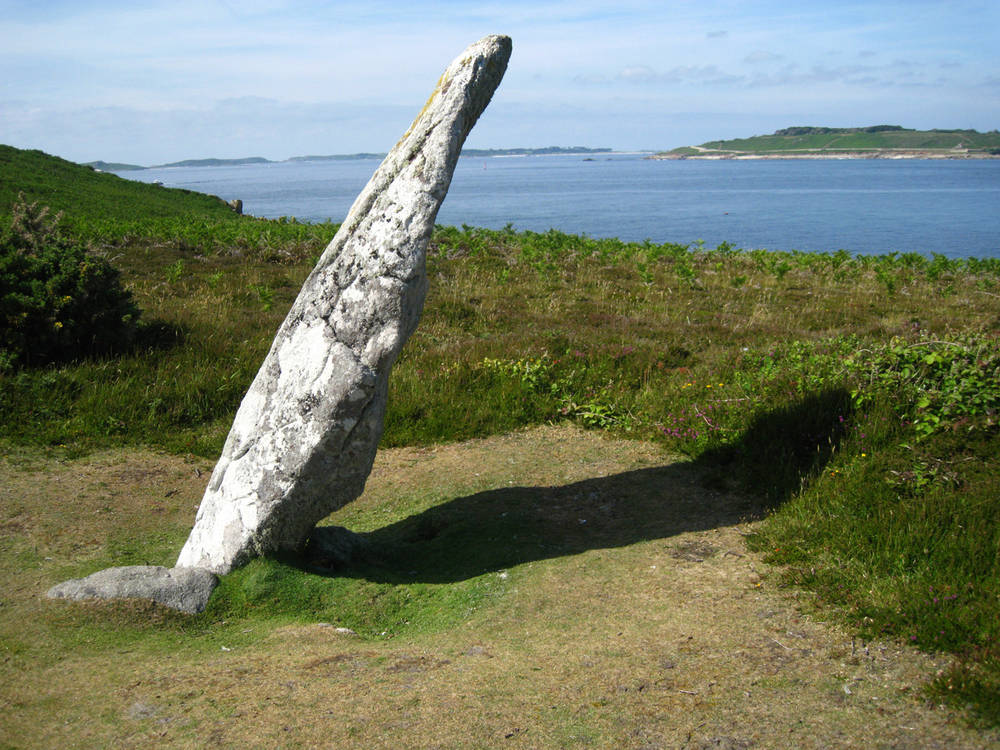
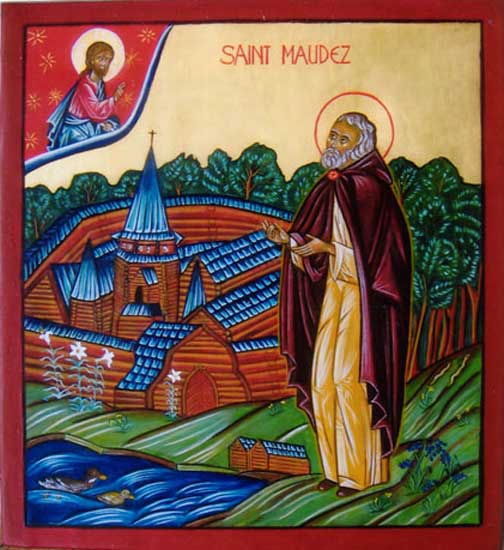
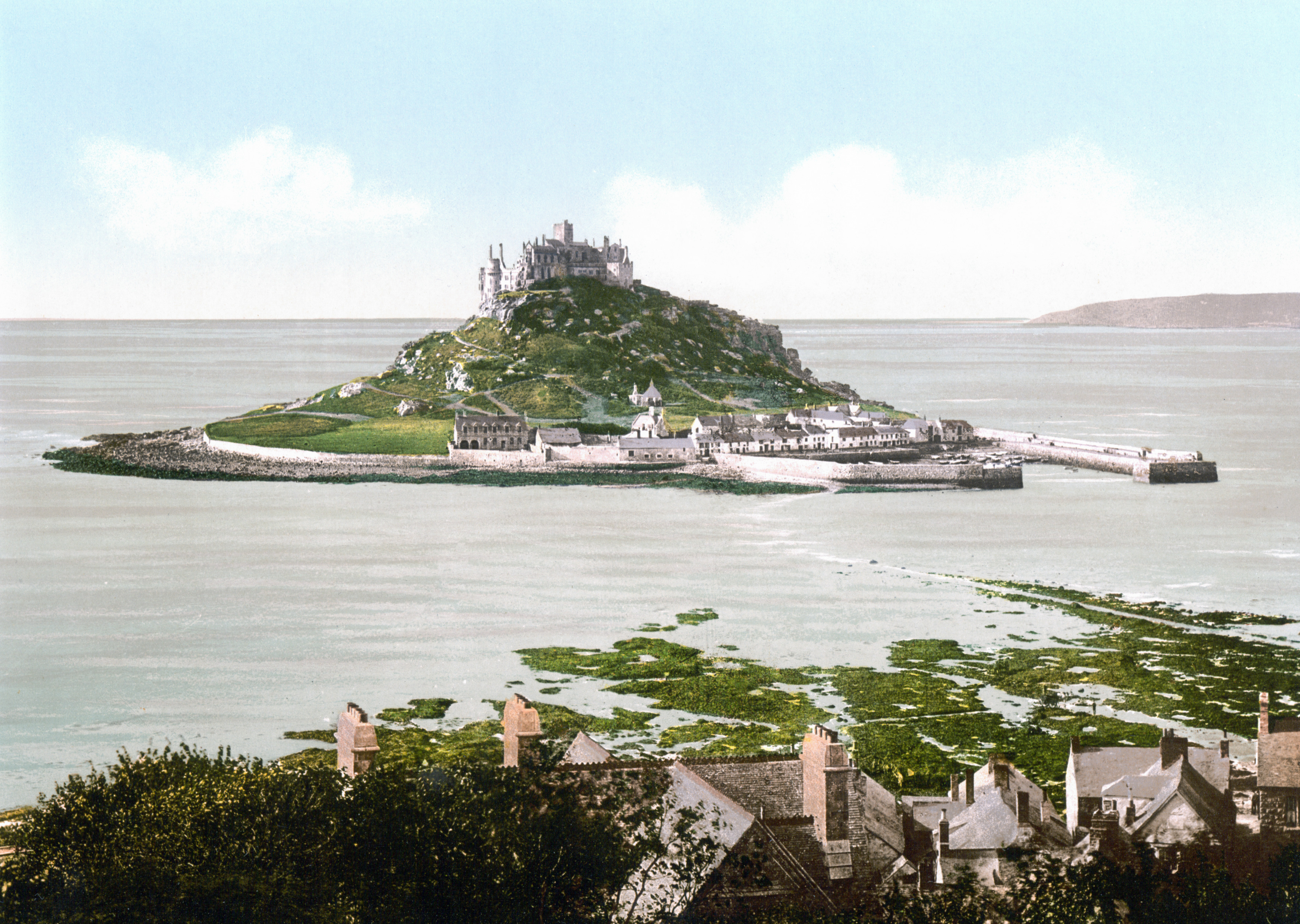
The Island was originally called Mauded which is similar to the Breton name for the Cornish St. Mawes who has a small town named after him near Falmouth where he lived for a time after sailing from south Wales. In the Roman Calendar his feast day is November 18th. According to tradition he was a 6th Century Welsh hermit and Abbot, also called Maudetus or Maudez. He lived as a solitary and then went to an island off the coast of Brittany, France, where he is revered as St.Maudez. He is believed to have founded other monasteries and churches in Cornwall and Brittany. There is a tradition that Saint Mawgan ( a place near Newquay, Cornwall which has a holy well), if he is to be identified as the same, was at one time Bishop of the Scilly Islands. The transition to a completely different saint, St. Martin seems to be a “latinization” of the name, again from the time of Norman occupation.

 scilly-st maws

scilly-st martin's1

scilly-st martins

Offshore and inshore islands, St Martin’s, The Isles of Scilly

*

Bryher Isles

scylli-bryher2

SCILLY-bryher1

scylli-bryher3

Bryher is the smallest inhabited island in the Isles of Scilly. It’s famous for the spectacular Hell Bay with it’s pounding waves crashing over the rocks on.

Tresco

The name of the Island was at one time St. Nicholas the patron saint of sea farers which seems most appropriate. This beautiful island boasts a Benedictine Priory established in 1114, the remains of which can still be seen today within the gardens of Tresco. It was probably established from the Abbey at Tavistock in Devon which was also dedicated to St. Nicholas.

scilly-tresco

scilly-tresco1

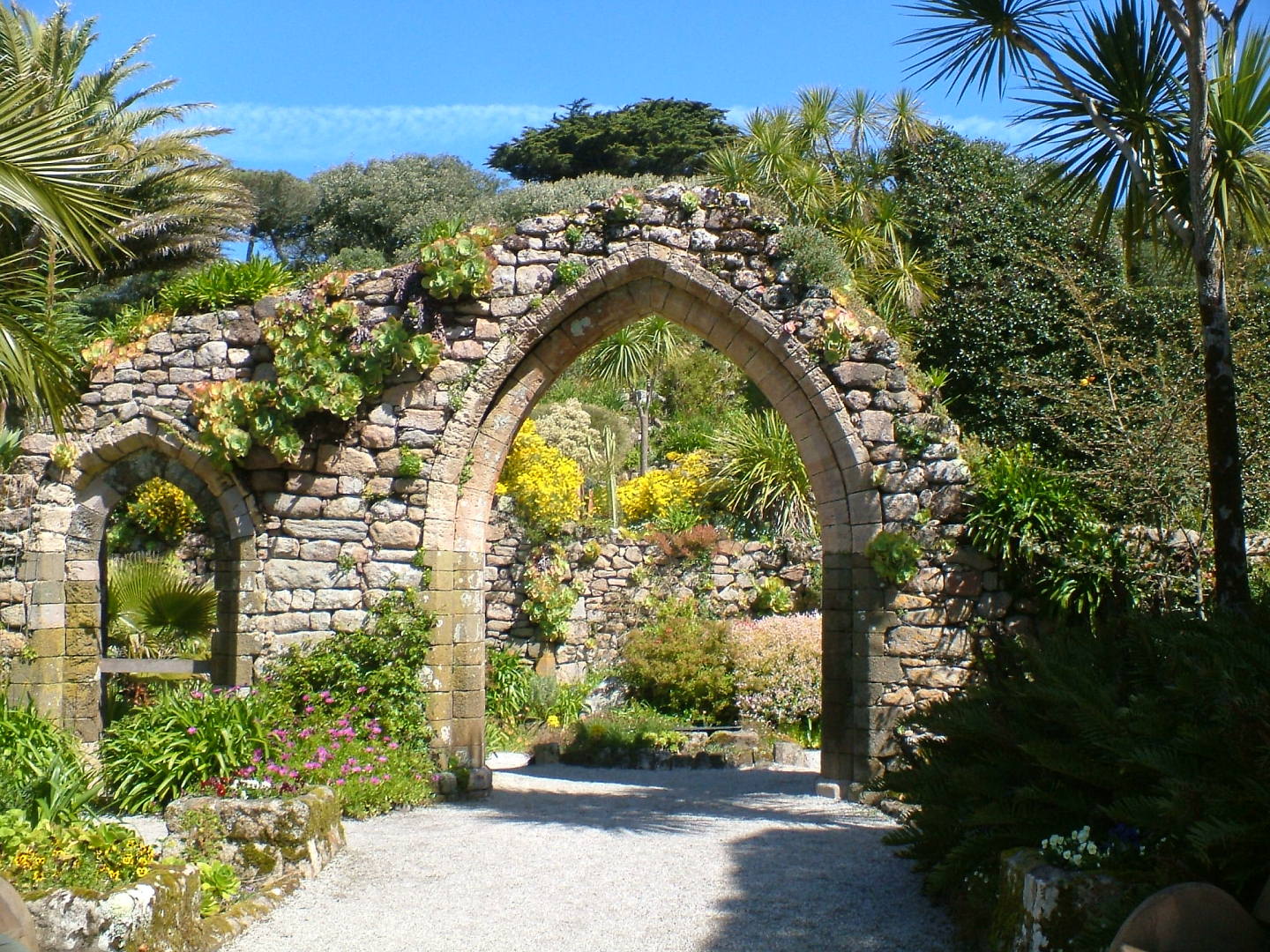
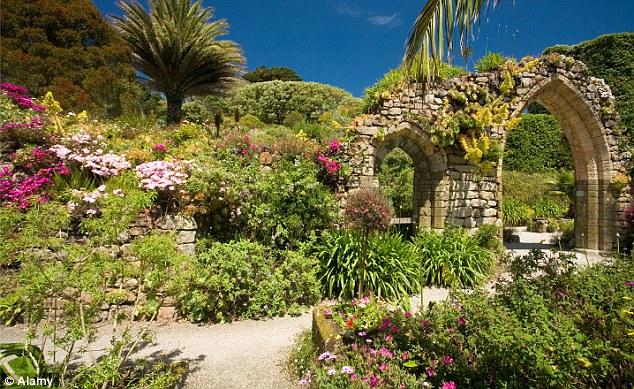
The arch from the wall of the mediaeval monastery in Tresco Abbey Gardens

scilly-tresco5

Abbey Gardens Tresco

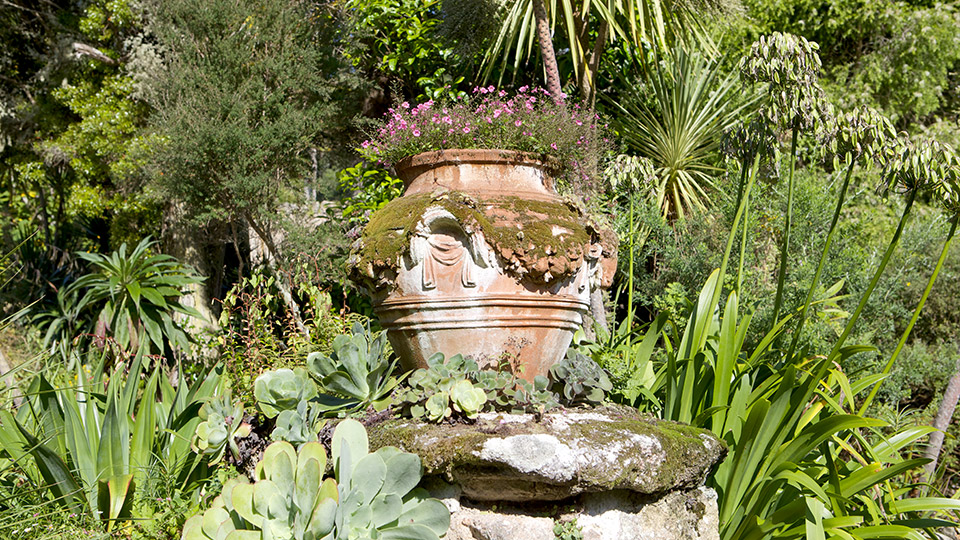
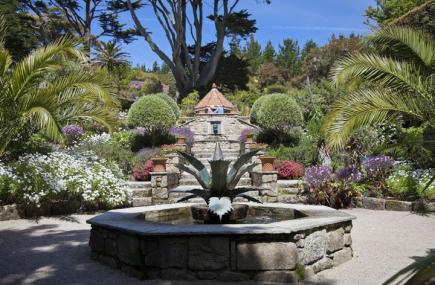
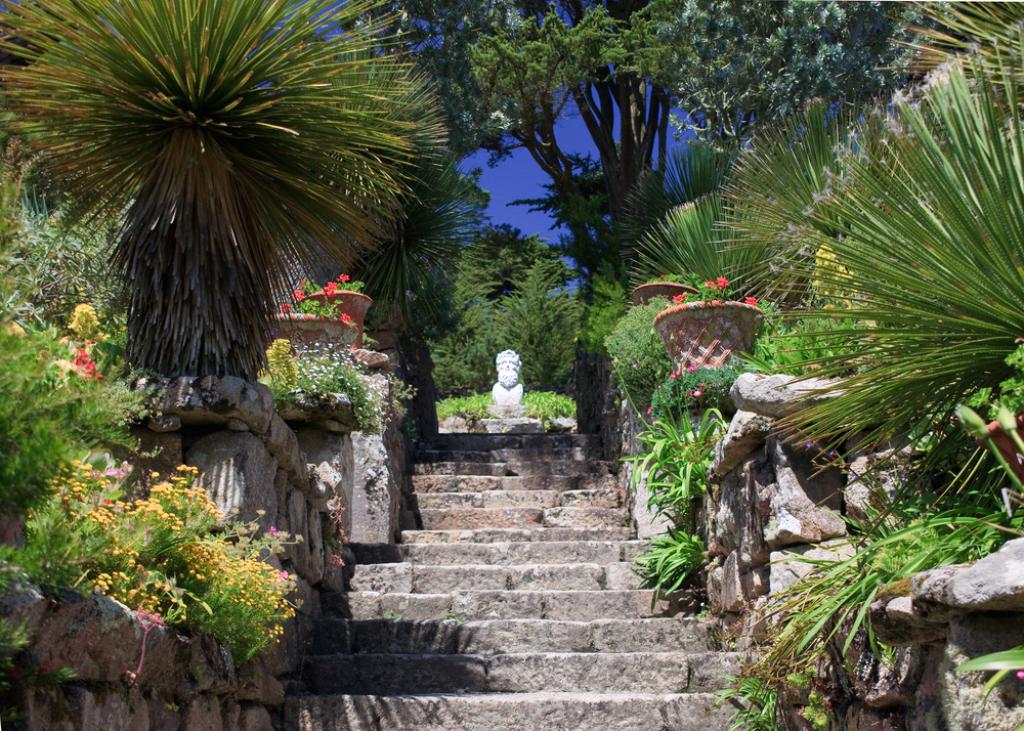
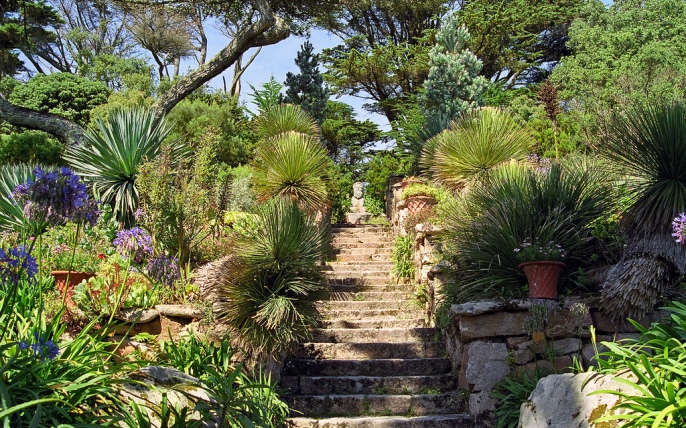
Tresco Abbey Gardens, Scilly Isles, UK Looking at the plants in this garden it is difficult to believe that Tresco Abbey Gardens is situated in the British Isles. Containing sub-tropical plants from Australia, South Africa and South America – including Echiums, Agaves, Aloes, Proteas, Aeoniums, Strelitzias and palm trees, this garden looks as though it should be situated in the Mediterranean! However, it is located in England, on the small island of Tresco in the Scilly Isles (approximately 28 miles from the south west tip of Cornwall in the United Kingdom). The photographs in this set where taken in late August when a lot of the color had already left the gardens. However, the varied planting provides a superb example of the value of a clear garden structure filled with diverse and contrasting foliage – creating a wonderful green tapestry of architectural plants throughout the year. Details: With a stunning background of white sandy beaches and vivid turquoise sea, Tresco Abbey Gardens is an outstanding historic garden set amid the romantic ruins of a 16th century priory. The gardens were started by Augustus Smith, who moved to the island in 1834. The garden has subsequently been developed by four succeeding generations of the family from Augustus Smith. The gardens have many delightful features, often seen at their best in the warmth of the afternoon sun, ranging from the Abbey arch, the Neptune steps, the shell house and a number of tastefully placed sculptures (including one to the earth goddess Gaia), all bordered by fantastic foliage of varying shapes, textures, sizes and hues. Surrounded by sea and in the warmth of the Gulf Stream the climate is exceptionally mild and totally frost free in most years. With south facing terraces, these gardens have often been referred to as ‘Kew gardens without the roof’, because in mainland UK, you would only find these plants in a botanical garden glass house. Location: Tresco Abbey Gardens, Tr

Tresco Abbey Gardens, Scilly Isles, UK
Looking at the plants in this garden it is difficult to believe that Tresco Abbey Gardens is situated in the British Isles. Containing sub-tropical plants from Australia, South Africa and South America – including Echiums, Agaves, Aloes, Proteas, Aeoniums, Strelitzias and palm trees, this garden looks as though it should be situated in the Mediterranean! However, it is located in England, on the small island of Tresco in the Scilly Isles … With a stunning background of white sandy beaches and vivid turquoise sea, Tresco Abbey Gardens is an outstanding historic garden set amid the romantic ruins of a 16th century priory. The gardens were started by Augustus Smith, who moved to the island in 1834. The garden has subsequently been developed by four succeeding generations of the family from Augustus Smith. The gardens have many delightful features, often seen at their best in the warmth of the afternoon sun, ranging from the Abbey arch, the Neptune steps, the shell house and a number of tastefully placed sculptures (including one to the earth goddess Gaia), all bordered by fantastic foliage of varying shapes, textures, sizes and hues. Surrounded by sea and in the warmth of the Gulf Stream the climate is exceptionally mild and totally frost free in most years. With south facing terraces, these gardens have often been referred to as ‘Kew gardens without the roof’, because in mainland UK, you would only find these plants in a botanical garden glass house.

scilly-tresco3

Tresco Abbey Gardens

scilly-tresco6

scilly-tresco4

scilly-tresco7

King Charles’ Castle is a ruined coastal artillery fort near the north extremity of the island that dates back to the sixteenth century

scilly-tresco8

Samson

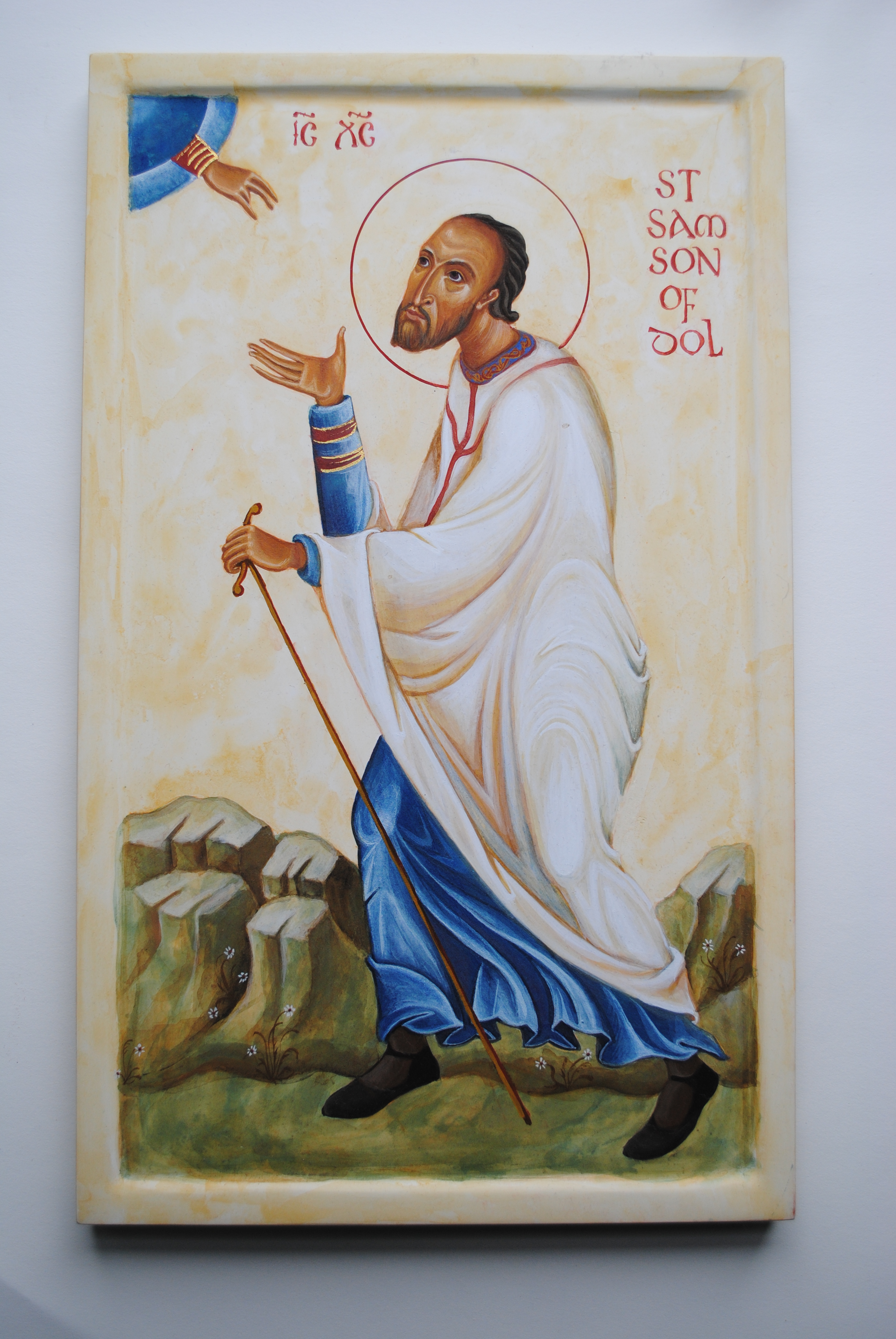
The island is connected with the welsh saint St. Samson of Dol who travelled to Cornwall, Brittany and the Channel Isles. Samson was educated by St. Illtud at the Abbey of Llanilltud Fawr (Llantwit Major) in Glamorganshire; where he was ordained a deacon and then a priest. Samson of Dol found it necessary by the Will of God to remove himself to the monastery on Ynys Byr (Caldey Island). He eventually became Abbot there and considerably established a strong community. Later in his life he chose the life of a hermit near the River Severn but, being made a Bishop, he turned to missionary work in Cernow (Cornwall) and came to the Scillies where one of the islands is named after him. He died on 28th July AD 565 and was buried in Dol Cathedral in Brittany. His ‘Life’ which survives, was written the following century. In the AD 930s, King Aethelstan acquired a number of his relics – including an arm and his crozier – which were proudly displayed in Milton Abbey (Dorset) until the time of the Reformation. The Island of Samson was inhabited until quite recently.

scilly-samson2

Old Cottage on South Hill, Samson

scilly-st samson

Tean

This little northern island was also inhabited until recently. The name Tean derives from the name Theona. There are ruins of her dwelling place still where once as a hermit she prayed and gave glory to the Holy and Life Giving Trinity and also remains of some celtic graves of the 6th century nearby. Recent excavations have unearthed some interesting Romano-British finds. These include an older ‘toothless’ woman whose head lies under the altar of the later built chapel, she may in fact be St.Theona, after whom the island is named.

   Tean,_Isles_of_Scilly._View_from_the_Great_Hill_-_geograph.org.uk_-_260948

Tean, Isles of Scilly. View from the Great Hill – geograph.org

scilly-tean2

Hedge Rock and Tean, Isles of Scilly

scilly-tean

Old Man, Tean, Isles of Scilly

*

St. Helen’s

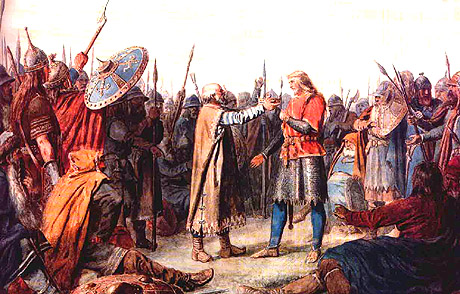
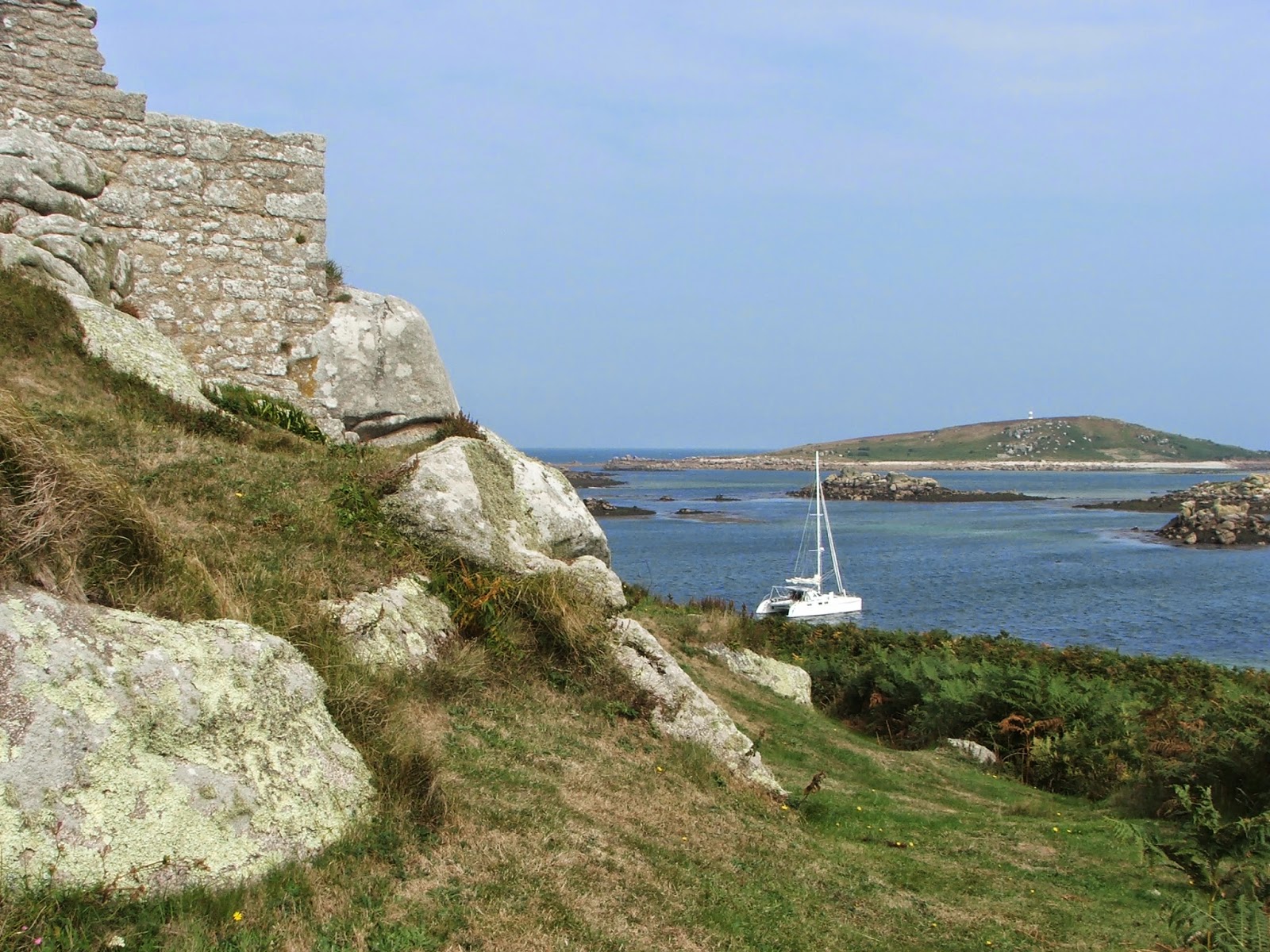
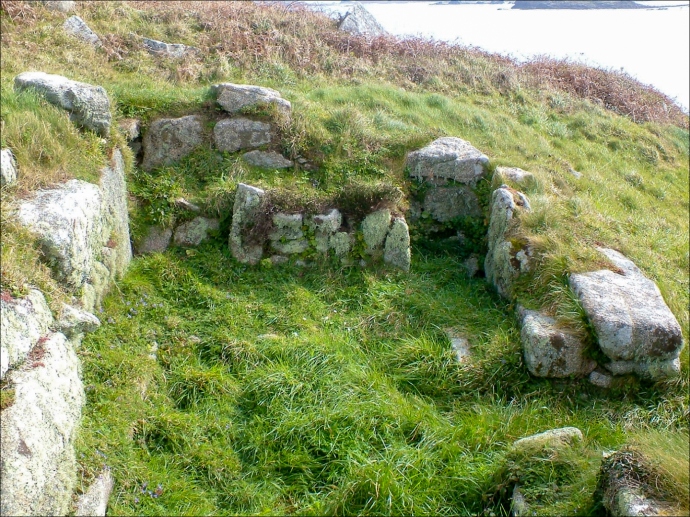
We know that this island was called St. Helen, the Blessed mother of Holy Constantine the Great, from 16th century maps but it is associated with another ancient saint, that of Elidius or St. Lide as he is also known. On the uninhabited island of St. Helen’s are the remains of St. Elidius’ Hermitage which contains an 8th century Christian monastic chapel which was active until the 11th. century. This holy place is still honoured today with local people making a Pilgrimage to the site on 1st August. There is an interesting connection between the Scilly Islands and the Christian mission to Norway. In 980 Olaf Tryggvason came to the Scilly Islands. Snori Sturluson recounts in his “Saga” that this notorious marauding Viking met Saint Elidius and heard of “the God of the Christians.” He was converted to Christianity and agreed to be baptized and all those with him. He took the faith with him returning to Norway and Iceland with “three priests and other learned men.” As King of Norway he began the process of evangelism which was continued by his successor Saint Olaf.

Peter_nicolai_arbo,_olaf_tryggvasson_king

Olaf Tryggvason, who visited the islands in 986. It is said an encounter with a cleric here, at St. Helen’s, led him to Christianise Norway

st helen

St. Helen

scilli-st helen9

St. Helen’s Viewed From The Block House. Tresco

scilli-st helen's1

On the uninhabited island of St. Helen’s are the remains of St. Elidius’ Hermitage which contains an 8th century Christian chapel

scilli-st helen2

St. Helen’s Pool

scilli-st helen's3

Early mediaeval chapel on St Helen’s

scilli-st helen4

Well known for its pest house, in which sailors infected with plague would be quarantined, St Helen’s is a prominent landmark on the Scilly coastline

scilli-st helen6

Church of St Elid on the island of St Helen’s

*

Sailing into history

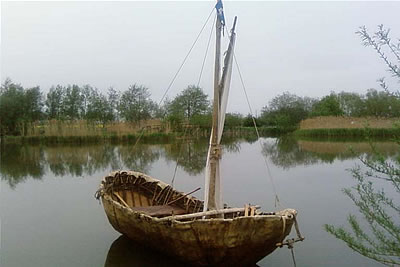
What strikes me about these saints is their adventurous and persistent spirit in Christ-their sheer delight and desire to bring Christ to every part of these Islands however small, blessing this part of God’s vineyard by their work, prayers and holiness of life. Whilst on St.Mary’s I learned from the curator of the Museum, that in August 2000, on June 28th a Breton vessel named Saint Efflam (founder of a monastery in Brittany, France. He was the son of a British prince) from an enterprise called Odysee Celtique (Celtic Odyssey) sailed into St. Mary’s harbour re-enacting ancient celtic monastic voyages-it was a Breton vessel and a reconstruction of a traditional curragh.

curragh

Curragh

The boat was constructed from a frame of hazel poles over which was stretched tar-covered canvas imitating the ox skins which would have been used originally. Whilst at sea the crew slept on the open boat and had few concessions to modern facilities during the voyage. As Amanda Martin says in her article in Scilly 2000 in “The Voyage of the Sant Efflam” such an experience was not for the faint hearted. “The whole feat requires a tremendous physical effort not to be undertaken lightly.”

These living saints give inspiration to us today by their energy and boldness for the gospel’s sake. In Christ we should imitate their humility, simplicity and calling.

*

A prayer

*

My boat is small

The ocean vast

Lord fill my sail

Maintain my mast

Christ my captain

Spirit’s power

Save me Lord

In danger’s hour.

Amen

*

These “fools for Christ” saved many because they preached Christ crucified and many believed and so they put the Christ in Scilly. Perhaps we, in this our time of God’s good grace need to make a similar Scilly Pilgrimage!

Thin Places (IV)

celtic72

*

“The Church in The British Isles will only begin to grow 

when She begins to again venerate Her own Saints

 *

(Saint Arsenios of Paros †1877)

*

Celtic Monasticism, A Model of Sanctity By Hieromonk Ambrose (Father Alexey Young) — Part IV of IV

Central to Celtic Christian culture was the Cross.

For the Celts, simplicity wasn’t so much a question of externals–like furniture, architecture, and so forth. It was something internal, and it was founded upon the phrase, “Thy will be done”. This meant God’s will, not our own. It meant dying to oneself, not having opinions and not judging others.

*

Even in the 7th and 8th centuries there were so-called Christians who were uncomfortable with the Cross of Christ and chose to ignore it, just as there are today. The Celts, however, had a particularly clear-headed understanding of the Cross. To quote Sister Benedicta Ward, a renowned scholar on the subject of the Desert Fathers as well as monasticism in the British Isles in the early Christian centuries: “The Cross was not something that made them feel better, nicer, more comfortable, more victorious, more reconciled to tragedy, better able to cope with life and death; it was rather the center of the fire in which they were to be changed.” (op.cit.)

It reminded them that they must pick up and carry their own crosses in this life and follow Christ, for dying to oneself has always been the great secret of holiness.

celtic73

Thus, these monks and nuns saw themselves as warriors of the spirit, for to die to oneself was considered a greater act of heroism than dying on a battlefield in defense of one’s tribe. “The Celtic Church was a Church of heroes…of strong” and fiercely dedicated men and women. “The old Celtic warrior spirit was alive in them, [but now] put to the service of the Gospel and the following of Christ, the High King. Today [we might] find it hard to identify many [such] warrior Christians…[with] the active virtues of courage, strength, outspokenness, decisiveness, and the ability to stand up for something.” (Joyce, op.cit.)

celtic79

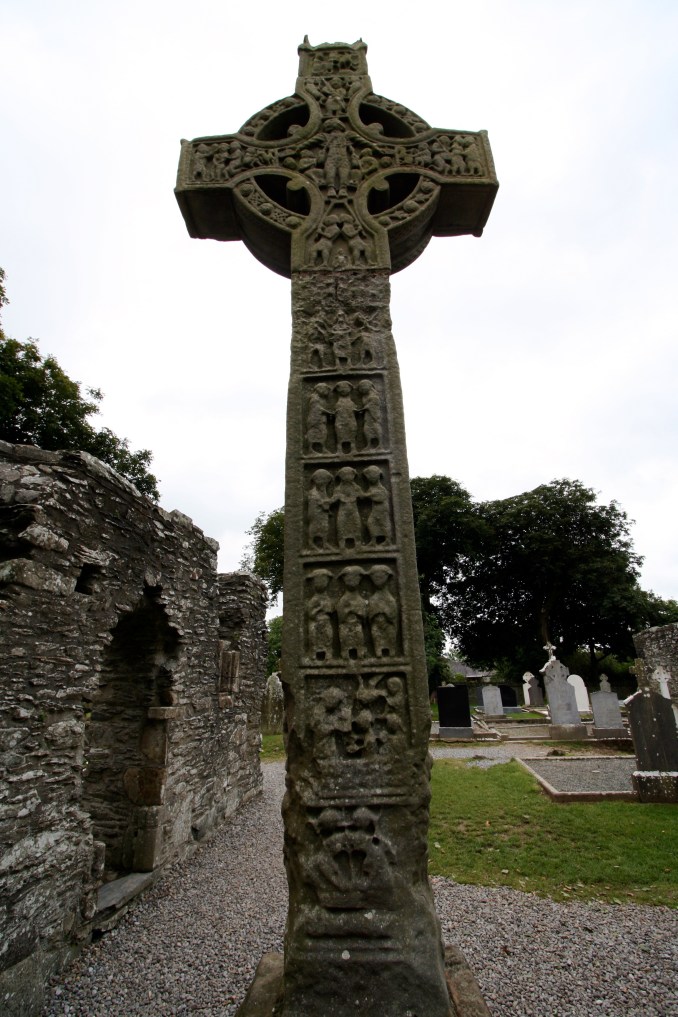
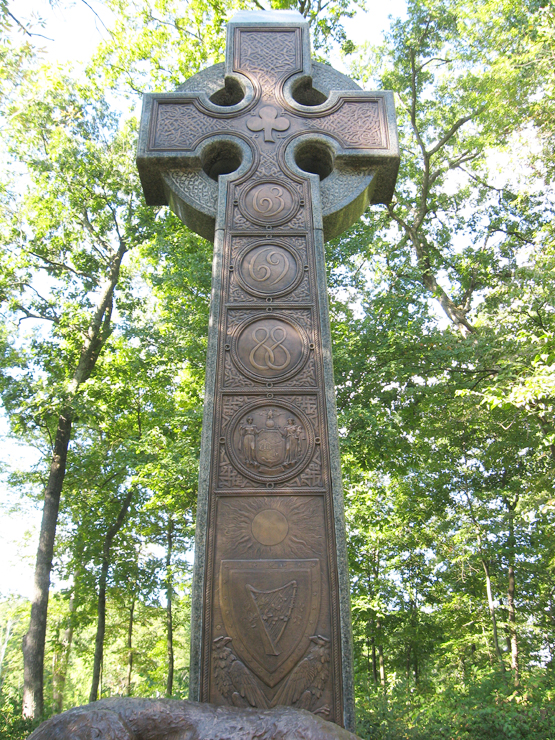
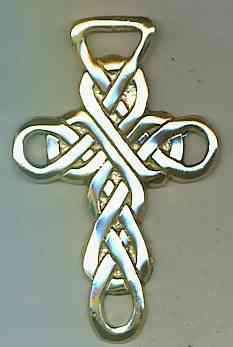
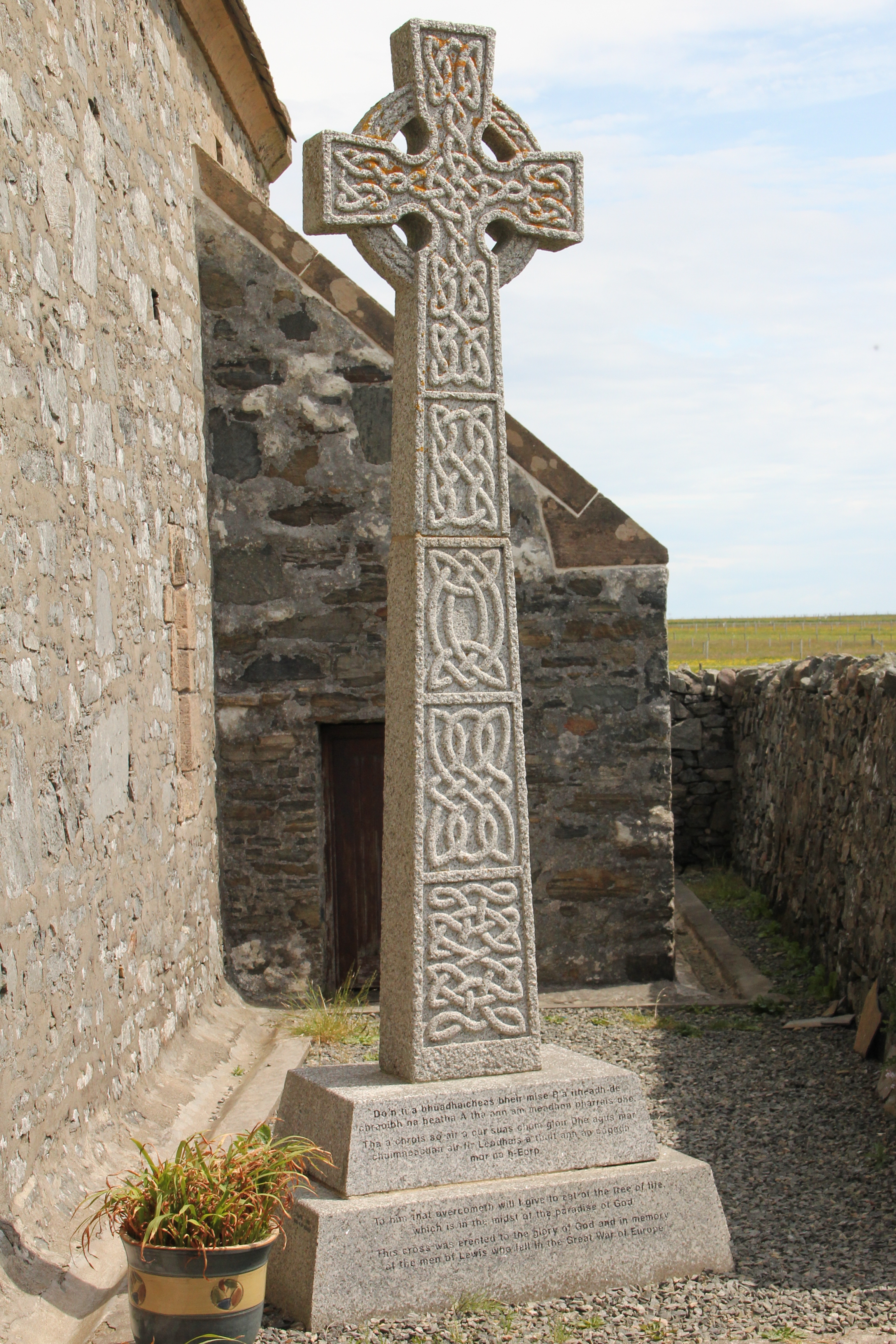
Nowhere was the Cross more loved and cherished than in the monasteries, where highly-carved and richly symbolic great “High Crosses”–some of them 15 feet and taller– were set up–many of them still standing today. These were not the suffering and bloody crucifixions found later in the West, particularly in Spain and Italy. Nor were these the serene and peaceful crosses of the Eastern Church. No, Celtic crosses were a genuine Christian expression all their own. Sometimes Christ is depicted, but often not; however, when He is shown, He is always erect, wide-eyed, and fully vested like a bishop, a great High Priest. In this form He is a symbol of victory over sin and death; He radiates invincibility.

celtic71

“The way of the cross for [Celtic Christians] was the way of heroic loyalty, obedience, and suffering. It involved study and thought, doctrine and orthodoxy, art and imagination. It was a complete, unified way of life, lived intimately with God….[Our] fragmented modern world, both secular and religious, has a lot to learn from it.” (Cavill, op.cit.)

celtic78

Saint Kevin, Hermitage of Glendalough

*

“Thou wast privileged to live in the age of saints, O Father Kevin,

being baptized by one saint, taught by another, and buried by a third.”

*

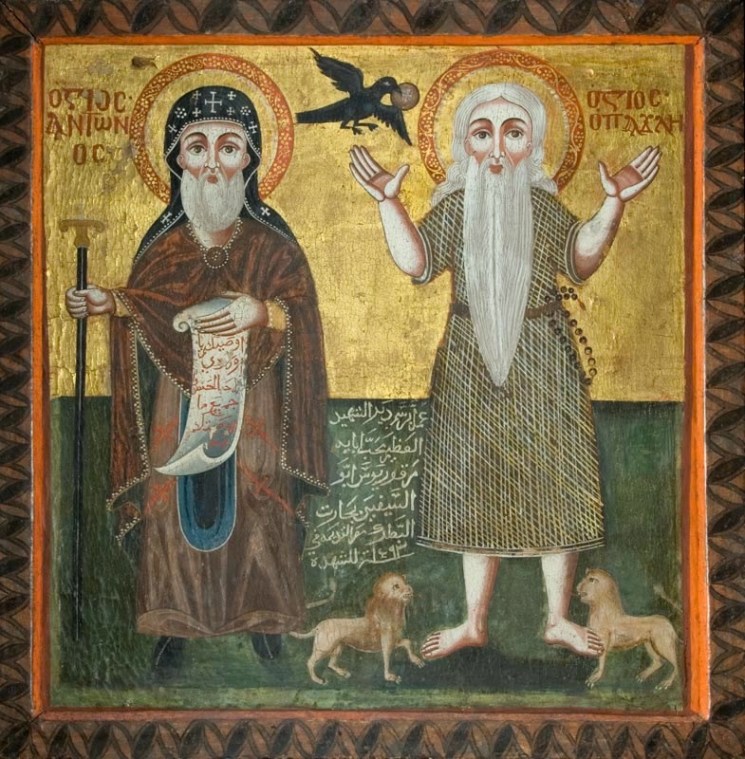
A common ascetic practice, even for the laity, was called crosfhigheall or “cross-vigil”, and it consisted of praying for hours with outstretched arms. St. Coemgen sometimes prayed in this position for days. Once he was so still, for so long, that birds came and began to build a nest in his outstretched hands.

celtic81

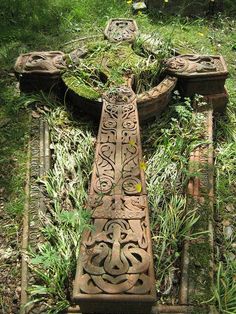
Scholars believe that the Celtic High Cross patterns probably came from Egypt. There are no loose ends in these patterns; this symbolizes the continuity of the Holy Spirit throughout existence–for God has no beginning and no end.

celtic66

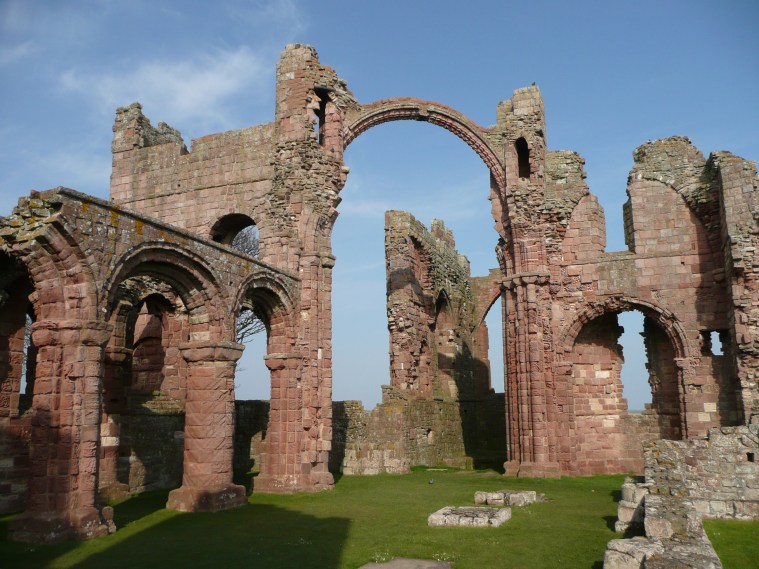
Lindisfarne Priority, Rainbow Arch

celtic77

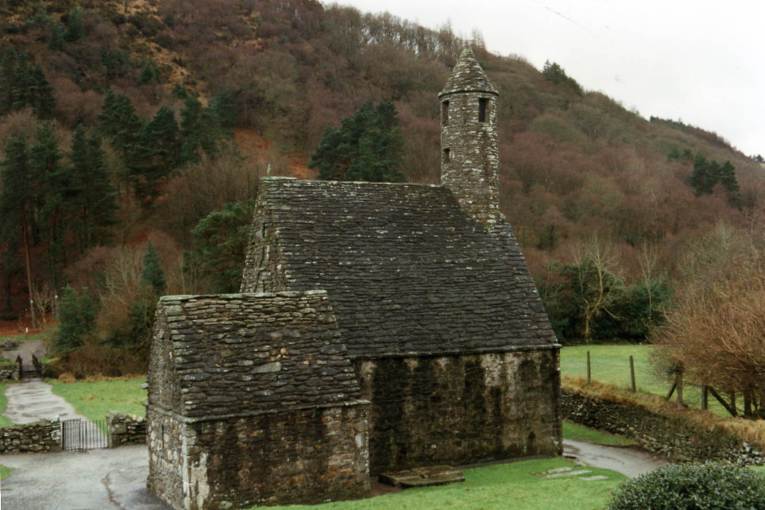
The chapel of Saint Kevin at Glendalough

An example of the love and respect they had for the Cross may be seen in an Anglo-Saxon poem, “The Dream of the Rood” (“rood” being an Old English word for “rod” or “pole”, sometimes it also meant “gallows”). In the “The Dream of the Rood,” Jesus Christ, the Second Person of the Blessed Trinity, is shone as a “serene and confident young hero…[who] prepares for battle. He strips…and climbs up on the gallows [the Tree of the Cross], intent on saving His people. He is in control, self-determining, expressing His lordship….[And] the Cross trembles at the fearful embrace of its Lord.” (Cavill, op.cit.) Listen, now, as the Cross, personified, speaks of how it raised up Christ:

“Unclothed Himself God Almighty when He would mount the Cross, courageous in the sight of all men.
I bore the powerful King, the Lord of heaven; I durst not bend.
Men mocked us both together. I was bedewed with blood. Christ was on the Cross.
Then I leaned down to the hands of men and they took God Almighty.” (Ward, Ibid.)

celtic68

St Helier’s hermitage –Hermitage rock

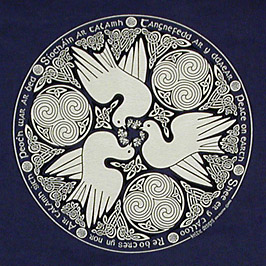
The interlacing, knot-work, plaiting, weaving patterns and spiral designs, with animals and plants and saints, and scenes from Scripture, which decorate almost every surface of a Celtic High Cross, are so distinctive and profound in their symbolism that they are a study all to themselves. Today I can only point out a couple of things.

celtic84

celtic86

Scholars believe that these incredibly complex patterns probably came from Egypt, but also may have some Byzantine influences. It’s important to note that there are no loose ends in these patterns; this symbolizes the continuity of the Holy Spirit throughout existence–for God has no beginning and no end; only Christ is the Alpha and the Omega. The same is true of knot-work patterns, which are endless and cannot be untied. Spiral designs symbolized the Most High God Himself, the “motionless mover,” around whom all things move. Some of these are what are called “Crosses of the Scriptures” because they are decorated with panels illustrating scenes from the Bible. High Crosses possess an almost dream-like quality in their complex geometric patterns, dignified and strong, heroic and towering over men, and yet also reminding those Christians of the Christian doctrine of kenosis, the self-emptying of Christ.

celtic80

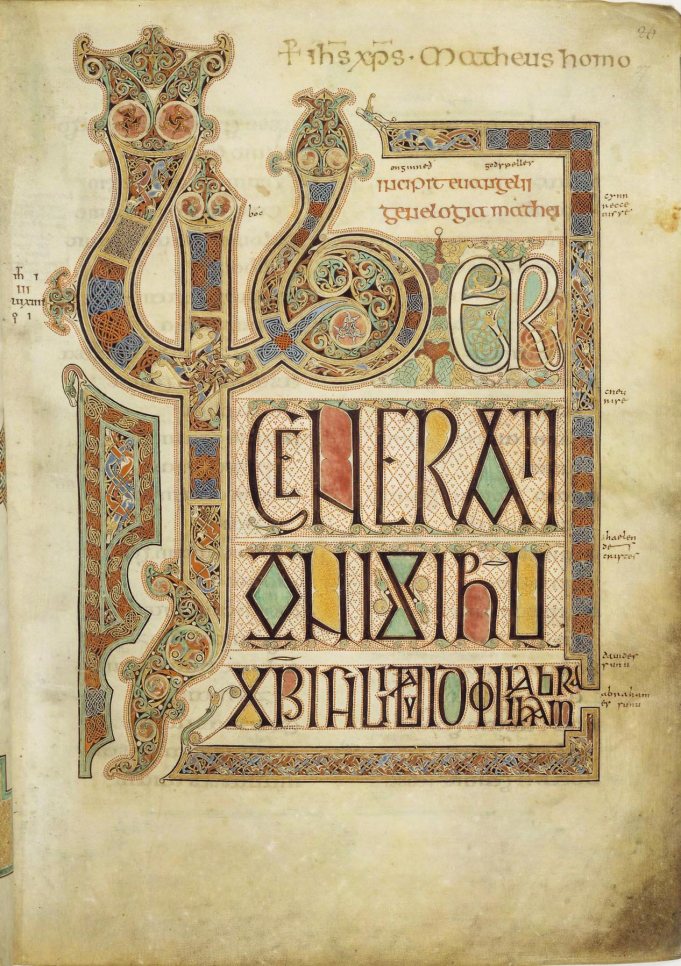
Lindisfarne Gospels 

One of main factors contributing to the eventual decline and dissolution of a Celtic monastery was when the Cross began to no longer be a focus. “If monastic life…did not have at its center the reality of the Cross, it became a source of corruption….[for] ‘Once a religious house or order cease[d] to direct its sons to the abandonment of all that is not God and cease[d] to show them the narrow way…it [sank] to the level of a purely human institution and whatever its works may be they are the works of time and not of eternity.’” (Dom David Knowles, quoted in Ward, Ibid.)

celtic87

An essential dimension was asceticism (askesis) which, for the Celtic monk consisted of a kind of martyrdom. “A homily in archaic Irish, probably dating from the last quarter of the seventh century…speaks of [this]:

‘Now there are three kinds of martyrdom, which are accounted as a cross to a man, to wit: white martyrdom, green and red martyrdom. White martyrdom consists in a man’s abandoning everything he loves for God’s sake, though he suffer fasting or labor therat. Green martyrdom consists in this, this, that by means of fasting and labor [a Christian] frees himself from his evil desires, or suffers toil in penance and repentance. Red martyrdom consists in the endurance of a cross or death for Christ’s sake, as happened to the Apostles…’

For this reason, the Celtic tradition regarded monasticism as the Army of Christ (Militia Christi) and the monk as a soldier of Christ (miles Christi). Young men, in their effort to emulate the heroism of their ancestors, entered monasteries–the “Green Martyrdom.” Instead of fighting in the Fianna (the Celtic army), they joined the Militia Christi to wage war against the evil spirits and sin.” (Fr. Gorazd Vorpatrny, op.cit.) Not surprisingly, one writer calls these Celts “Ascetic Superstars.” (Bitel, op.cit.)

*

“I should like a great lake of ale for the King of Kings;

I should like the angels of heaven to be

drinking it through time eternal!” – St. Brigit of Kildare

*

And yet, with all of this sober asceticism, the Celts never lost their native enthusiasm, exuberance, and just plain cheer, as we see in a prayer written by the wonderful 5th century Abbess, Brigit, when she exclaims: “I should like a great lake of ale for the King of Kings; I should like the angels of heaven to be drinking it through time eternal!” How could anyone fail to be charmed by such a character–a woman who was a great leader of monastics, both men and women, who was baptized by angels, got out of an arranged marriage by plucking out one of her eyeballs, and fell asleep during a sermon given by the incomparable Equal-to-the-Apostles, St. Patrick!

celtic69

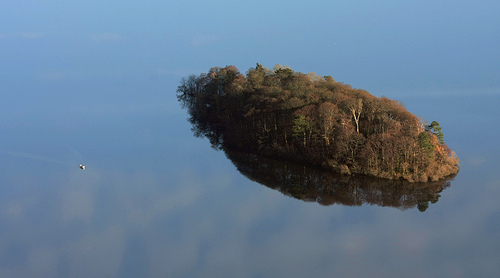
St Herbert’s Island, Derwent Water 

Finally, the Celts were Trinitarian Christians par excellence. This is partly because even before they were Christian they already thought in terms of threes. And for them–unlike most Christians today–the Trinity was very real, very alive, not something vague and theoretical. What one scholar calls a “Trinitarian consciousness” (Joyce, op.cit.) completely shaped everything about them. As another has said: “‘We are here at a central insight of Celtic theology….Christ comes not to show up or illuminate the deformity of a fallen world but rather to release a beautiful and holy world from bondage….an affirmation, difficult but possible, of [that] which is the created image of the eternal Father and the all-holy Trinity.’” (Noel Dermot O’Donoghue, quoted in Joyce, op.cit.) “To follow the spiritual world-view of the Celtic Christians is to embrace a way of life that is a real commitment to the belief that the Trinitarian God is alive in this world.” In the Celtic world, “Jesus Christ is our hero, our sweet friend….The Father is High King of heaven, a gentle and beneficent father, a wise and just ruler. The Spirit is a tangible comforter and protector ….This God is never to be reduced to the ‘man upstairs’ or anyone we can capture and box in. And yet this wonderful, mysterious God is close to us….[This] God is extremely good.” (Ibid.)

celtic85

Brothers and sisters: the sanctity of Celtic monastics is a model for us in that it combines heroism and joy in perfect and beautiful balance. For them, the heroic life was one completely dedicated to living intimately with the God-Man whom they described as “victorious,” “mighty and successful,” “the lord of victories,” a great warrior to whom they pledged undying, fearless, creative and exuberant loyalty. And yet, for all of their heroism, their monastic world-view, could be ‘summed up as the ‘Christian ideal in a sweetness which has never been surpassed.’” (Nora Chadwick, quoted by Joyce in op.cit.) To slip into their world, even for just a few moments, as we’ve done here this afternoon, is, I believe, is not just inspiring; it’s almost breathtaking.

celtic83

Just as I began my talk today with a prayer of St. Columban of Iona, I would like to conclude with another prayer from this great Celtic monastic saint:

Prayer of
St. Columban of Iona

Lord, Thou art my island; in Thy bosom I rest.
Thou art the calm of the sea;
in that peace I stay.
Thou art the deep waves
of the shining ocean.
With their eternal sound I sing.
Thou art the song of the birds; in that tune is my joy.
Thou art the smooth white strand of the shore;
in Thee is no gloom.
Thou art the breaking of the waves on the rock;
Thy praise is echoed in the swell. Thou art the Lord of my life;

*

celtic33

Source: http://www.asna.ca/angloceltic/celtic-monasticism.pdf

Also, listen to Hiermonk Ambrose (Father Alexey Young) about THE UNIQUENESS OF CELTIC MONASTICISM at http://www.asna.ca/angloceltic/

For more information on Celtic Orthodoxy, go to http://www.mullmonastery.com and follow father Seraphim’s pilgrimage and struggles to found the first Orthodox monastery in the Hebrides in over a millennium.

*

To continue our pilgrimage to the Celtic sacred sites and pilgrim routes of England, our next stop will be Scilly –pronounced “silly”–Islands! (/ˈsɪli/Cornish: Syllan or Enesek Syllan) (Introduction of the “c” may be to prevent references to “silly” men or saints!) Yet one more look at Christian faith from a Celtic perspective. The Isles of Scilly  are an archipelago off the southwestern tip of the Cornish peninsula of Great Britain, comprising  5 Major, inhabited islands,St Mary’sTrescoSt Martin’sBryherSt Agnes and 140 others. For more, go to https://orthodoxcityhermit.com/2015/11/05/scilly-pilgrimage/

Thin Places (III)

A Journey into Celtic Christianity


celtic53

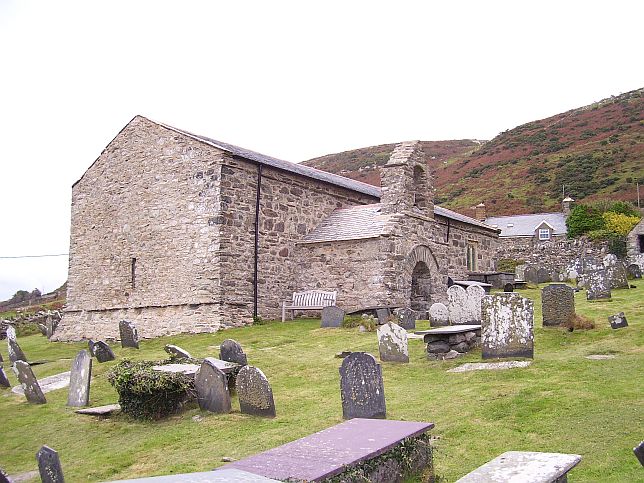
Llwyngwril St Celynin

*

“The Church in The British Isles will only begin to grow 

when She begins to again venerate Her own Saints

 *

(Saint Arsenios of Paros †1877)

*


Celtic Monasticism, A Model of Sanctity By Hieromonk Ambrose (Father Alexey Young) — Part III of IV 

celtic75

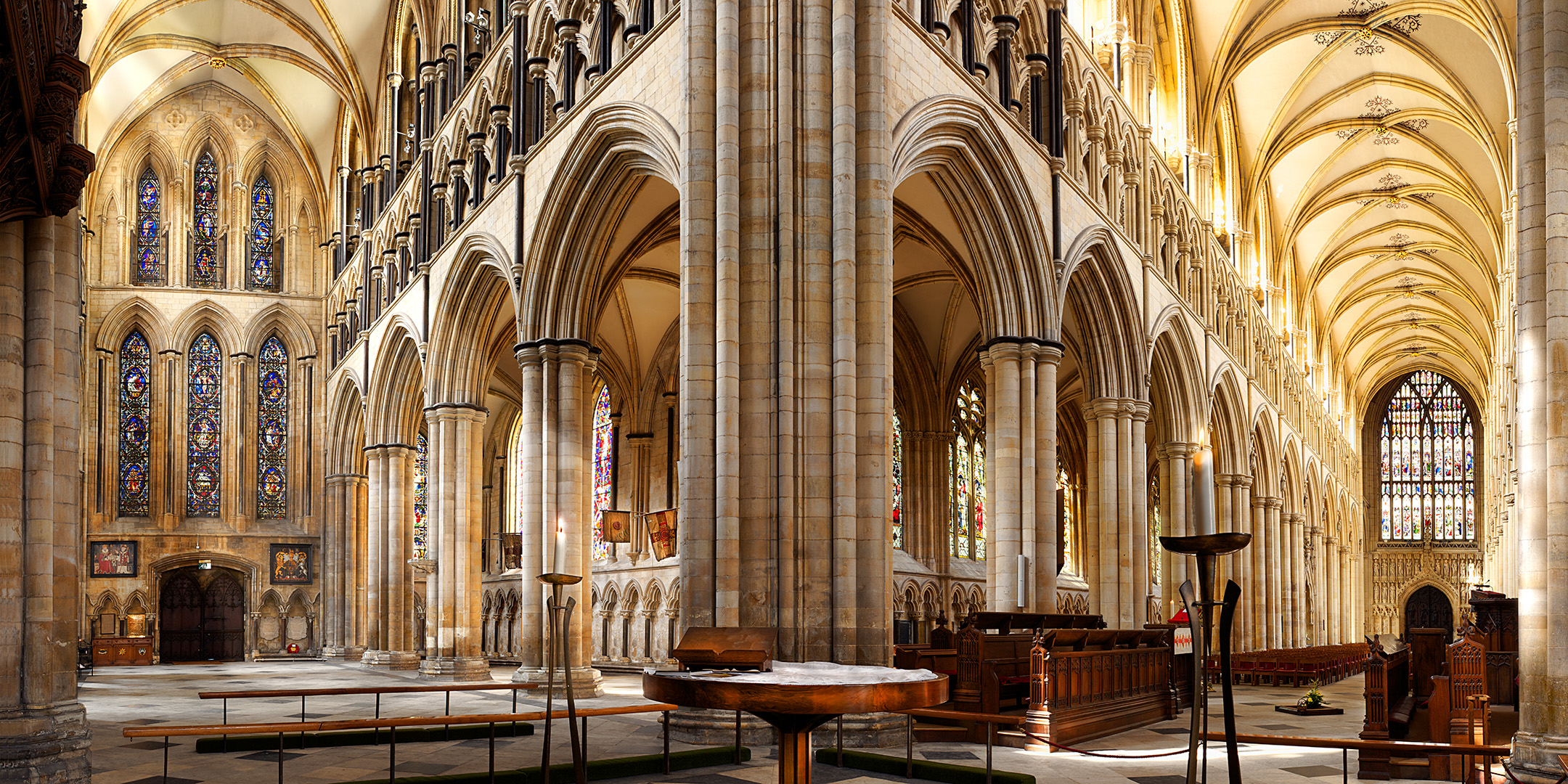
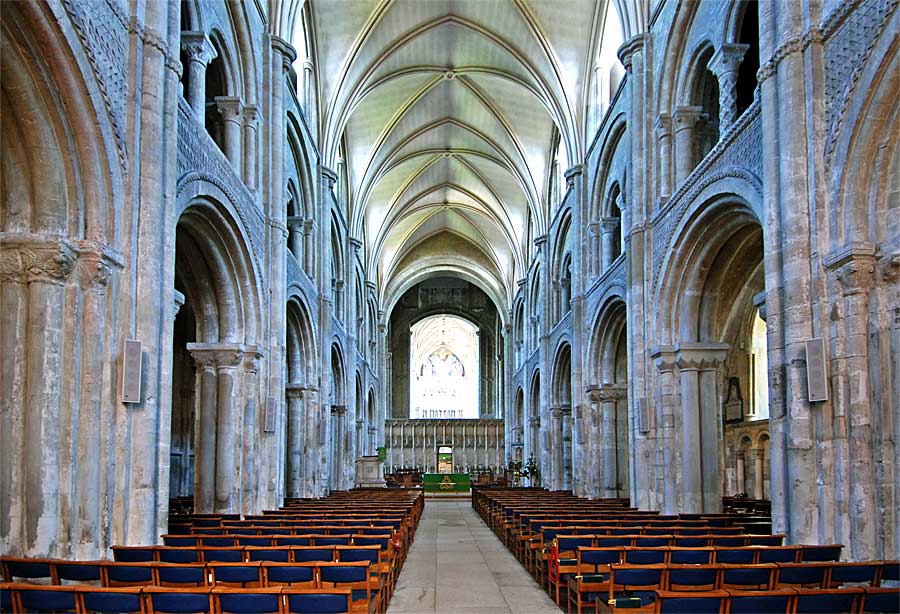
Beverley Minster, East Yorkshire, England 

St. David of Wales lived in the 6th century. He came from a monastery which had been founded by a disciple of St. John Cassian. So great is St. David that he deserves a whole lecture to himself, but today I’ll just mention him in connection with the wisdom of the Egyptian desert: he possessed the gift of tears, spoke alone with angels, subdued his flesh by plunging himself into ice cold water while reciting all of the Psalms by heart, and spent the day making prostrations and praying. “He also fed a multitude of orphans, wards, widows, needy, sick, feeble, and pilgrims.” (Edward C. Sellner, Wisdom of the Celtic Saints). The Roman Catholic scholar, Edward Sellner, adds: “ Thus he began; thus he continued; thus he ended his day. He imitated the monks of Egypt and lived a life like theirs.” (Ibid.) The same writer assures us that “because of its [the Celtic Church’s] love of the desert fathers and mothers, it has a great affinity with the spirituality of the Eastern Orthodox [today].”

celtic43

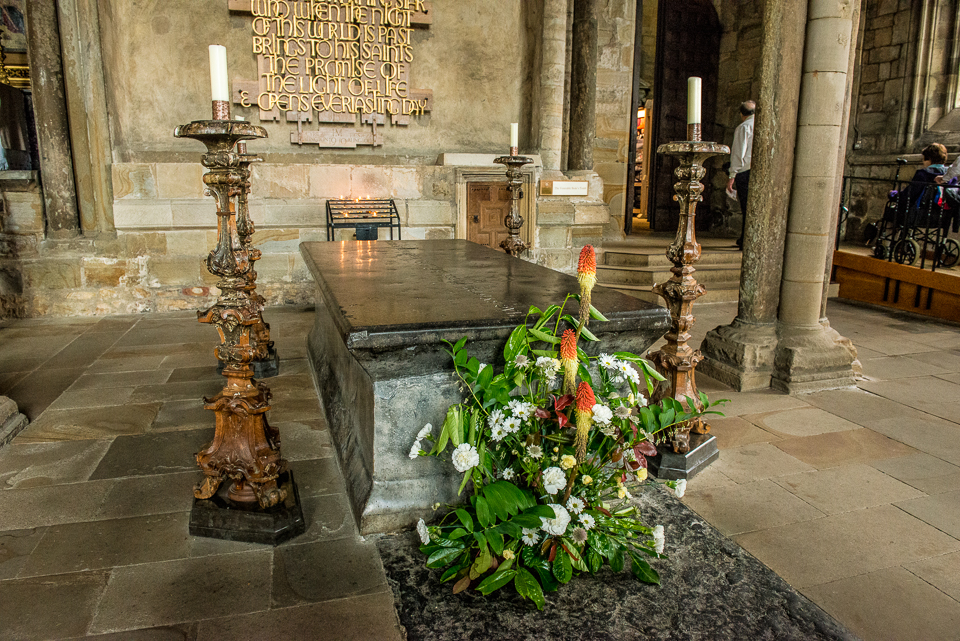
Tomb of Venerable Bede, Durham Cathedral

There are many other evidences of Eastern and Egyptian contact and influence, too numerous to list now. But in his interesting study, The Egyptian Desert in the Irish Bogs, Fr. Gregory Telepneff mentions also the fascinating interlacing knots and complex designs found on the famous standing High Crosses, which show Egyptian or Coptic influence. “Celtic manuscripts show similarities to the Egyptian use of birds, eagles, lions, and calves….In the Celtic Book of Durrow, one can find not only a utilization of the colors green, yellow, and red, similar to Egyptian usage, but also ‘gems with a double cross outline against tightly knotted interlacings,’ which recall the ‘beginnings of Coptic books.’ [Henry, Irish Art]. There is at least one instance of the leather satchel of an Irish missal and the leather satchel of an Ethiopian manuscript of about the same period which “resemble each other so closely that they might be thought to have come from the same workshop’ [Warren, Liturgy].” (Telpneff)

celtic46

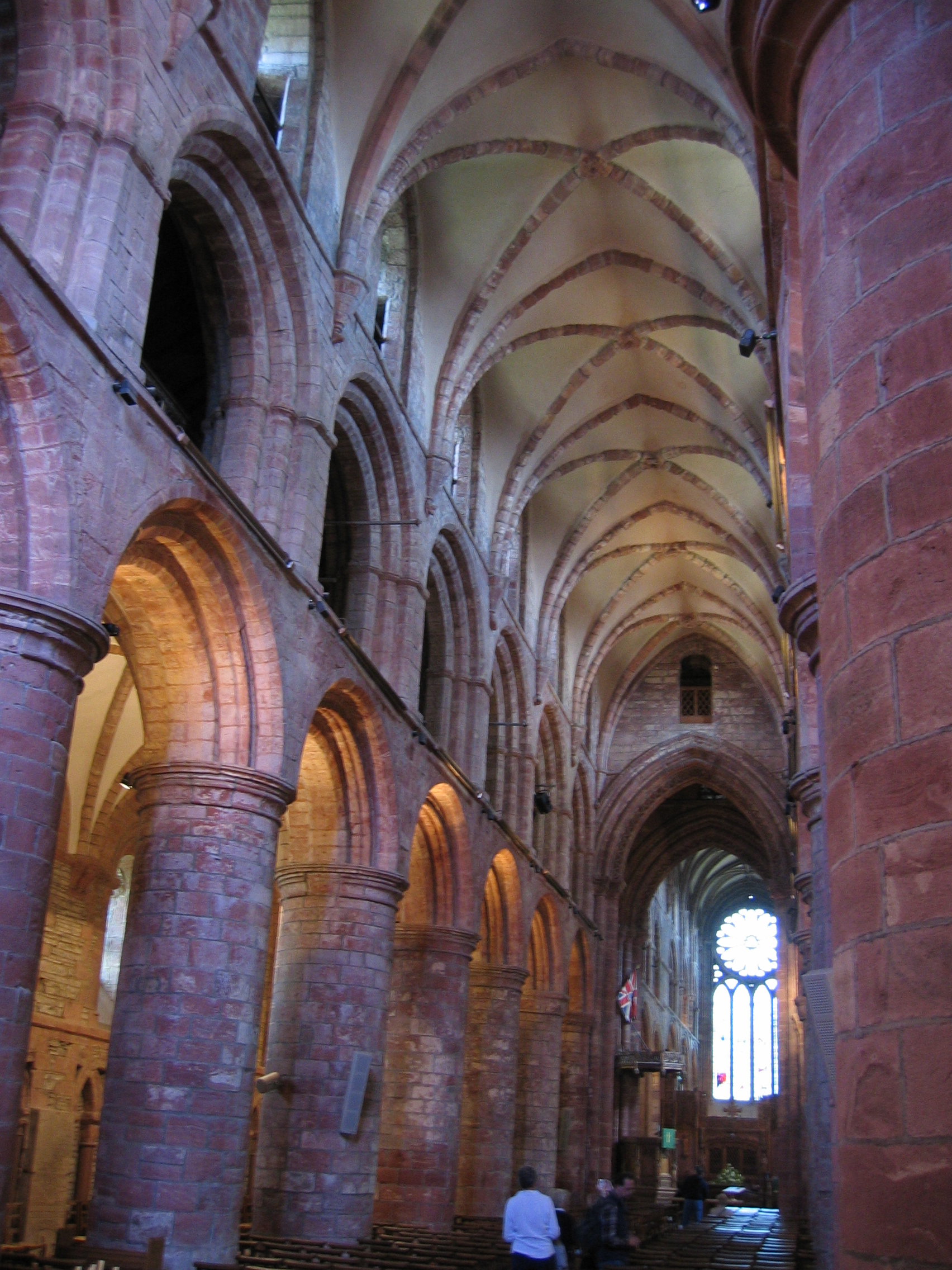
St. Magnus Cathedral Kirkwall

*

Culturally, then, I suggest that Celtic culture was a unique

and intriguing blend of Egyptian and other Middle Eastern influences

with native or indigenous cultural elements.

*

celtic41

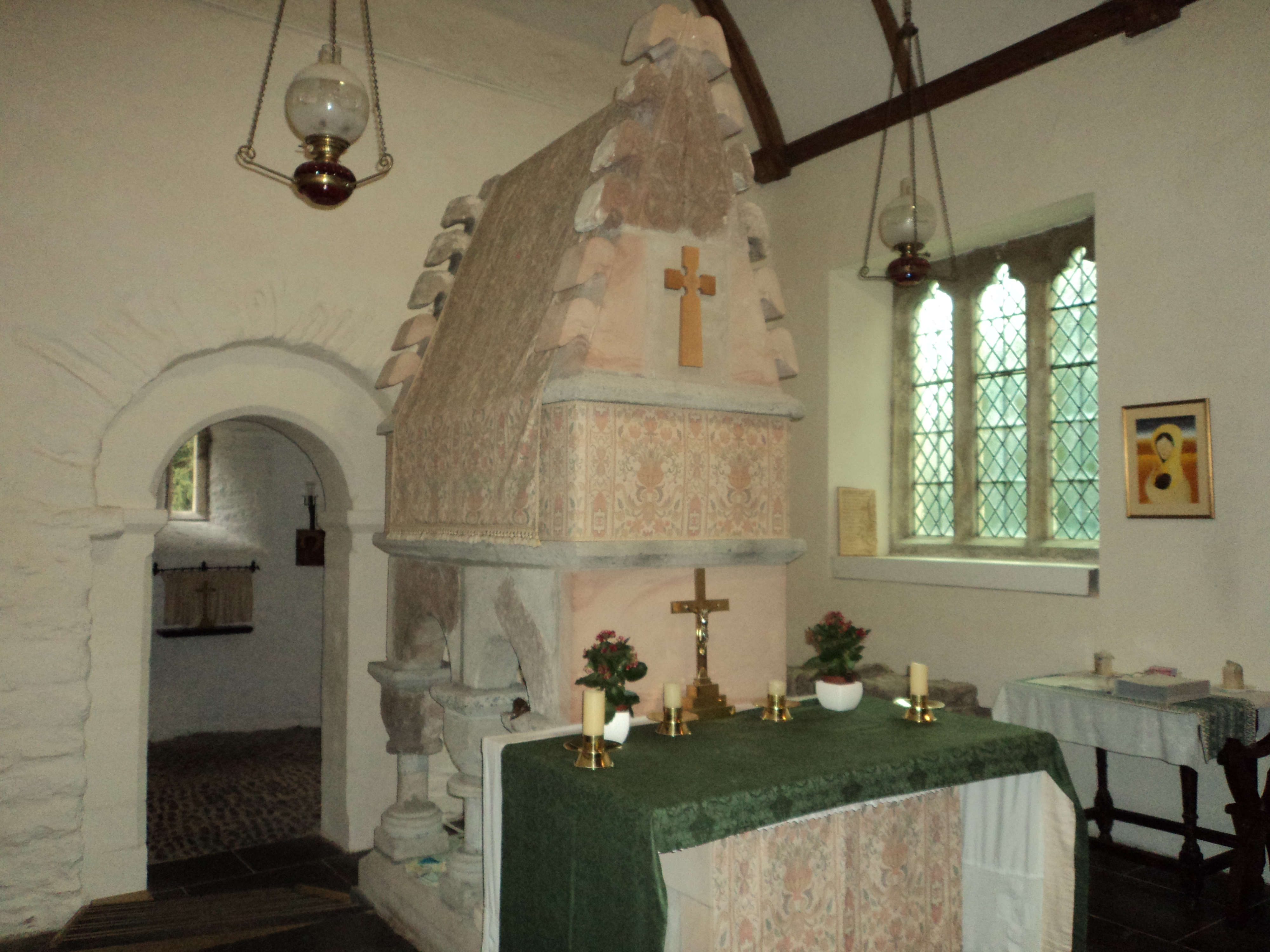
12th century Shrine of Saint Melangell

Before going further I want to say a few words about the term “spirituality.” In our time this has become a wastebasket word into which we put whatever we want the word to mean. Our English word, “spirituality”, comes from the French, and originally described someone who was clever, witty, or perhaps even mad! But our ancient Christian ancestors, whether from Russia, Europe, the Middle East, or the lands of the Celts, did not have such a concept. Certainly they did not see spiritual life as something separate from the rest of life. For them, spirituality was how they lived, how they prayed, how they worshiped God–and it was all bound up together, not separated out. Today, however, we have managed to artificially compartmentalize ourselves and our lives, making “spirituality” something that we do in addition to or separate from regular life. This has made possible a very artificial approach to the Celts.celtic42

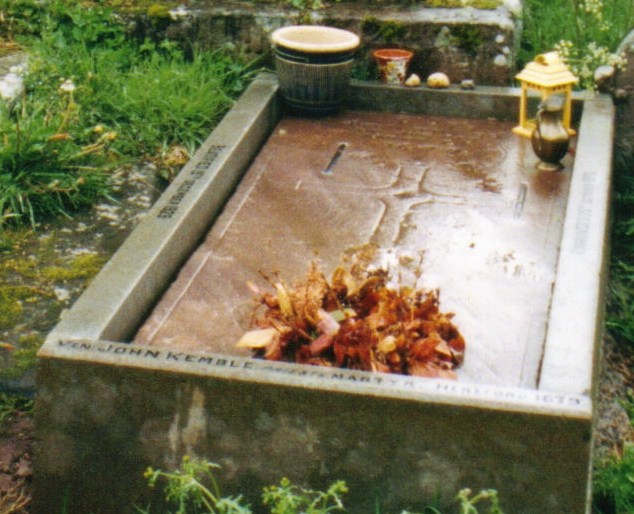
Tomb of St. John Kemble

Thomas O”Loughlin, one of the best of our present-day writers on the subject of Celtic Christianity, make the following sage observation in his book, Journeys on the Edges:

“In the last decade interest in the attitudes and beliefs of the Christians of the Celtic lands in the first millennium has swollen from being a specialist pursuit among medievalists and historians of theology into what is virtually a popular movement. In the process more than a few books have appeared claiming to uncover the soul of this Celtic Christianity in all its beauty….[Many writers] operate by offering their own definitions of ‘Christianity’ past and present, and then setting these against their definition of ‘Celt’ or ‘Celtic’. In this way they can reach the conclusion they want.”

Typical of our modern arrogance and intellectual- spiritual poverty, we project our own feeble ideas back onto a more robust and spiritually rich time, treating the world of Celtic Christianity like a smorgasbord, where we take those things we happen to already “like,” and put them together to form our own very distorted and sometimes even perverted “version” of the Celts.

celtic47

celtic48

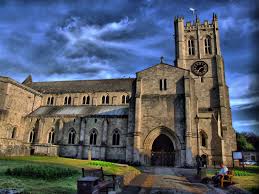
1177: Priory Church of the Holy Trinity, Christchurch, Dorset, England

An example: It is a fact that in the early Christian centuries, Ireland, Scotland and parts of Wales were never subject to Roman rule–neither the old Roman Empire nor the Church of Rome held sway over “Celts.” But some modern writers interpret this to mean that Celtic Christians, since they were “non-Roman,” were therefore anti-Roman or even anti-authority and against the idea of an organized, patriarchal Church. There is absolutely no evidence for such a conclusion, although in fact Celtic Christians did have a quite different way of organizing communities than did Christians on the continent–but this was not out of rebellion, but because their own models were from Egypt and the East, not from Europe! The simple fact is that “the Irish church had always been at the edges of Roman Christianity, [and considered to be a] a barbarian church of limited interest to the Popes.” (Paul Cavill, Anglo-Saxon Christianity: Exploring the Earliest Roots of Christian Spirituality in England) “Although the climate and situation of Britain were very different from the hot deserts of Egypt, there were principles–simplicity, prayer, fasting, spiritual warfare, wisdom, and evangelism–that were easy to translate to the communities of these isles.” (Michael Mitton, The Soul of Celtic Spirituality in the Lives of Its Saints)

celtic45

The Shrine of St. Wite

But this means that entering into the spiritual, mental, emotional, and physical world of a Celtic Christian monk is difficult–not impossible, but difficult.

First we must realize that the Celts–had no concept of privacy or individuality such as we have today. Families did not live in separate rooms, but all together; no one thought about the idea of “compartmentalizing space” and only hermits and anchorites felt a calling to be alone in spiritual solitude with God, although monks had separate cells, just as monastics did in the Egyptian Thebaid.

The idea that people are separate individuals from the group was not only unheard-of, but would have been considered dangerous, even heretical. Self-absorption, “moods,” and being temperamental–all of these things would have been considered abnormal and sinful.

It wasn’t until the 13th and 14th centuries that people in the West started keeping journals or diaries, and there were no memoirs–also signs of individuality and privacy, of singling oneself out from the family, group, or community–nor were there actual real-life portraits of individuals, until the 14th century. (The art of realistic portraiture developed in response to the medieval idea of romance–for an accurate portrait was a substitute for an absent husband or wife.)

celtic50

Beverley Minster, East Yorkshire, England 

*

Celtic Christian understood, just as do

Eastern Christians, that man is saved in community;

if he goes to hell, he goes alone.

*

Furthermore, “‘the dominant institution of Celtic Christianity was neither the parish church nor the cathedral, but the monastery, which sometimes began as a solitary hermit’s cell and often grew to become a combination of commune, retreat house, mission station…school [and, in general] a source not just of spiritual energy but also of hospitality, learning, and cultural enlightenment.” (Ian Bradley, quoted in Mitten, Ibid.) It was only much later that people began to be gathered into separate parishes, and even later before bishops had dioceses that were based on geographical lines rather than just being the shepherd of a given tribe or group, “being bishops of a community, rather than ruling areas of land. The idea of ‘ruling a diocese’ was quite foreign to the Celtic way of thinking.” (Ibid.)

celtic52

Beverley Minster, East Yorkshire, England 

*

If you think about what all of this means in terms of how we today view ourselves, the world in which we live, and the values that we have today, you can see how difficult it’s going to be for us to enter into the world of the Celts. Today we are quite obsessive about such things as privacy and individuality, of “being our own selves” and “getting in touch with the inner man” and other such self- centered nonsense. But the Celtic Christian understood, just as did and do Eastern Christians, that man is saved in community; if he goes to hell, he goes alone.

celtic51

Beverley Minster, East Yorkshire, England 

So the orientation of those Christian Celts to God and the other world was very different than the orientation of our modern world, no matter how devout or pious we may be, and this makes the distance between us and the world of Celtic monasticism far greater than just the span of the centuries. A renowned scholar, Sir Samuel Dill, writing generally about Christians in the West at this same period of time, said: “The dim religious life of the early Middle Ages is severed from the modern mind by so wide a gulf, by such a revolution of beliefs that the most cultivated sympathy can only hope to revive in faint imagination ….[for it was] a world of…fervent belief which no modern man can ever fully enter into….It is intensely interesting, even fascinating…[but] between us and the early Middle Ages there is a gulf which the most supple and agile imagination can hardly hope to pass. He who has pondered most deeply over the popular faith of that time will feel most deeply how impossible it is to pierce its secret.” (Quoted in Vita Patrum, Fr. Seraphim Rose)

celtic61

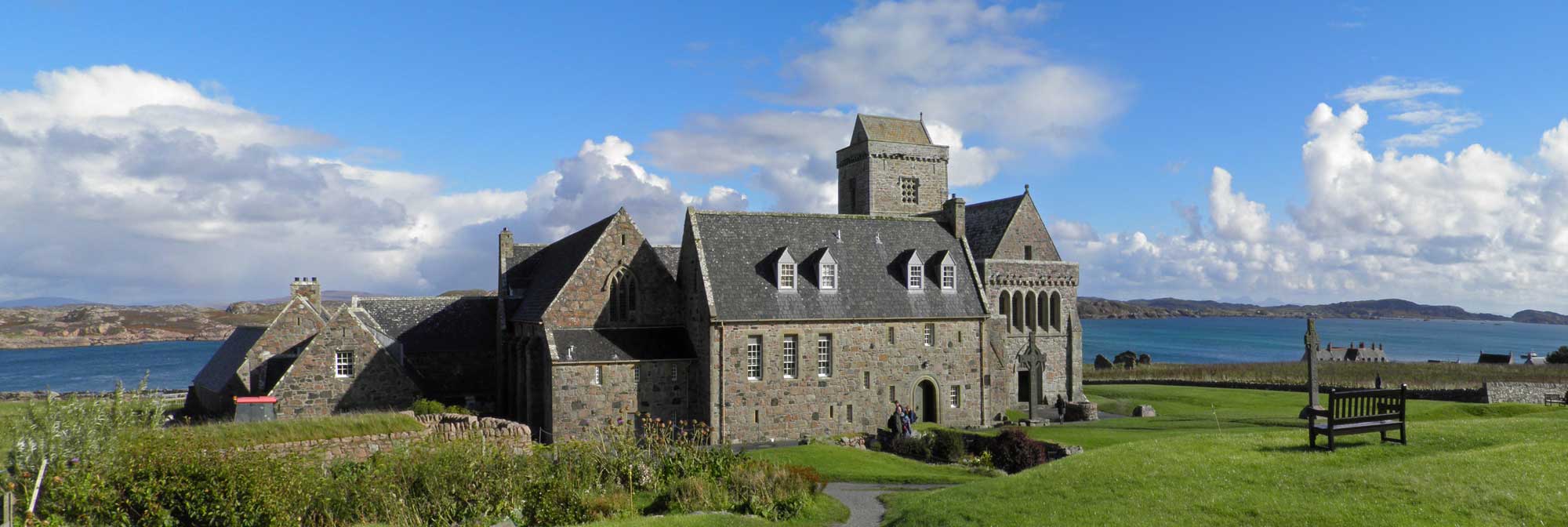
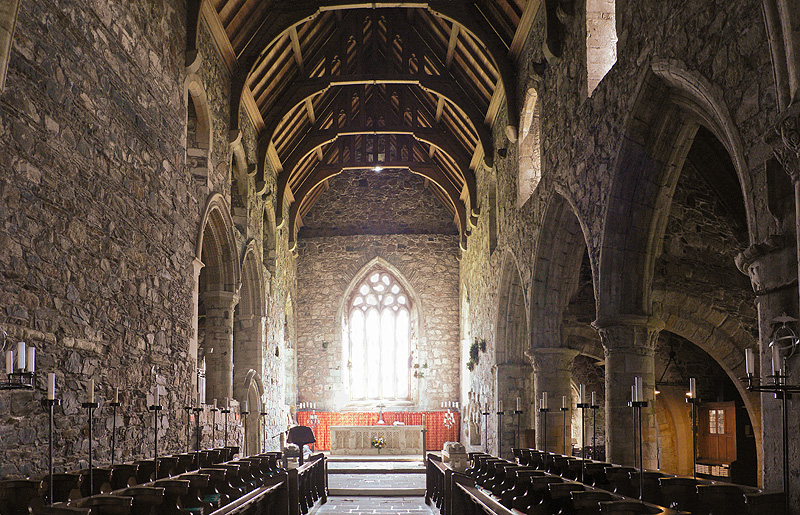
Iona Abbey, Scotland 

But is it really “impossible”? To enter their world–the world of Celtic Christianity, which is the same as Celtic monasticism–we must find a way to see things as they did–not as we do today–; to hear, taste, touch, pray, and think as they did. And this is what I mean by the word “spirituality”–a whole world-view. We must examine them in the full context of their actual world–which was a world of Faith, and not just any Faith, but the Christian Faith of Christians in both the Eastern and Western halves of Christendom in the first thousand years after Christ. Spirituality is living, dogmatic, theology. This is the only way we can begin to understand how Celtic Monasticism can be a model of sanctity for us living today, more than a millennium after their world ceased to be. Remember, I said it would be difficult to enter their world; difficult, but not impossible… When we speak of someone or something being a “model,” what do we mean? In this instance–speaking about Celtic monasticism as a “model”–we mean something that is a standard of excellence to be imitated. But here I’m not speaking of copying external things about Celtic monasteries–such as architecture, style of chant, monastic habit, etc., which are, after all cultural “accidents.” I’m speaking of something inward, of an inner state of being and awareness. It’s only in this sense that Celtic monasticism can be, for those who wish it, a “model of sanctity.”

celtic60

Iona Abbey, Scotland 

But what do I mean by “sanctity”? We must be careful not to slip into some kind of vague, New Age warm “fuzzies” which are more gnostic than Christian and have more to do with being a “nice” person than encountering the Living God in this life. By sanctity I mean what the Church herself means: holiness–which is nothing more or less than imitation of Christ in the virtues, and striving to die to oneself through humility, so as to be more and more alive to Christ, successfully cutting off one’s own will in order to have, only the will of Christ, as St. Paul says in his epistle to the Galatians (2:20): “I am crucified with Christ: nevertheless I live; yet not I, but Christ liveth in me…” So, holiness means dying to oneself and especially to one’s passions, more and more, so as draw closer and closer to the Lord God Himself, through Jesus Christ, and Him crucified and risen. In addition, Celtic Christians had the concept of “hallowing” or “hallowed”–an old fashioned term that today has survived only in the unfortunate pagan holiday called “Halloween” (from “All Hallows Eve”–which began as the vigil for the Western Feast of All Souls Day and later took on vile pagan overtones). To early British Christians, something or someone that was “hallowed” was “set apart” from others and sanctified for service to God. Thus, a priest’s ordination or a monastic’s tonsuring was his “hallowing.”
celtic63

St Moluag, Eoropaidh, Isle of Lewis 

And so, thus it was that those blessed and hallowed monastics of Celtic lands modeled forth certain principles that we can still see, study, understand, and imitate today.

The Celts were masters of Christian simplicity. Nowadays there is a movement in our culture to recover some simple basics, but the model is often that of the Quakers or the Shakers or the Amish. Perhaps that’s because those groups are easier and more attractive to imitate; I don’t know. For the Celts, however, simplicity wasn’t so much a question of externals–like furniture, architecture, and so forth. It was something internal, and it was founded upon the Lord’s Prayer–in particular the phrase, “Thy will be done”, as we find in the later commentaries of the Venerable Bede of Jarrow and Alcuin of the court of Charlemagne. This was crucial to living a simple Christian life: “Thy will be done” meant God’s will, not our own–placing absolute trust in the Providence of God for everything–one’s health, one’s finances, the size of one’s family or the size of a monastic community–everything. It meant dying to oneself, not having opinions and not judging others. This was where simplicity began, and from there it easily expressed itself in outward forms, such as not owning five tunics when just two or even one would be sufficient.

celtic64

St Moluag, Eoropaidh, Isle of Lewis

Simplicity did not necessarily mean “plainness,” as we’ll see shortly when we look at the intricate sacred art of the High Crosses. Celtic Christians were not “Plain People,” like Quakers or the Amish. But they were “Simple People,” in that they were single-minded and intensely focused on the other world and the journey through this life to God.

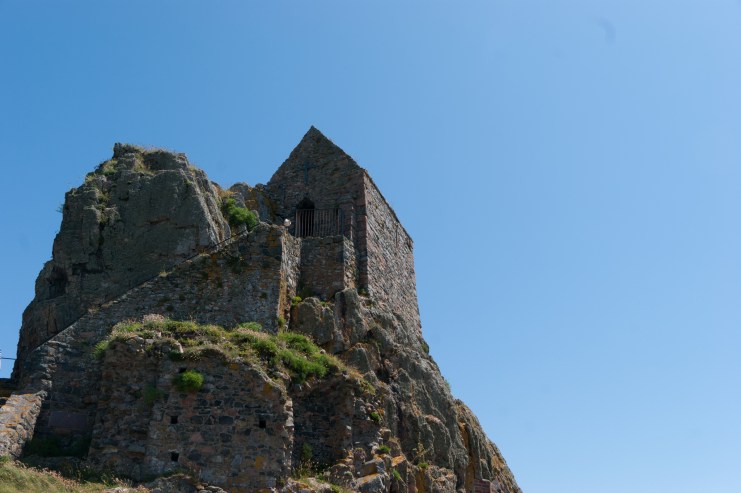
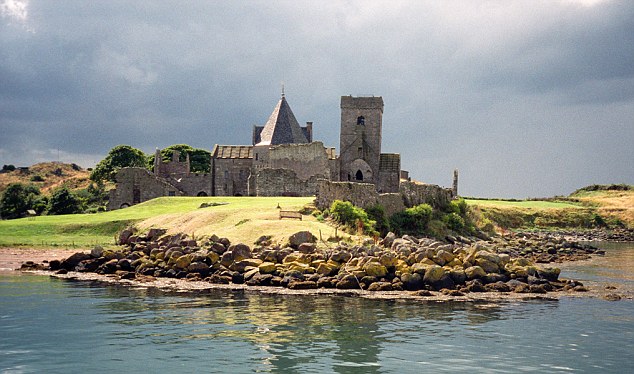
B5A2FH Inchcolm Island and Abbey Firth of Forth, Scotland

Inchcolm Island and Abbey Firth of Forth, Scotland

In common with all Christians at that time, the Celts had no concept of “private prayer” in the sense of spontaneously thinking of words or phrases to say to God. This practice belongs to a much later period in Christian history, when ideas of privacy and individualism had become more important than traditional ways of seeking God through prayer. This didn’t mean that a Celtic Christian didn’t pray outside the divine services, but for them, prayer was primarily liturgical, and this meant the Psalms. Most monks and nuns memorized the complete Psalter. Occasionally a particularly gifted monk would compose a prayer, such as the one I read by St. Columban at the beginning of this lecture. But in moments of need one remembered verses and phrases from the Psalms – such as “In my distress I cried unto the Lord, and He heard me,” from Psalm 120, and “Hide not Thy face from me, O Lord, in the day of my trouble” (Psalm 10, or”In the Lord I put my trust” (Psalm 11).

*

[To Be Continued …]

*

Source: http://www.asna.ca/angloceltic/celtic-monasticism.pdf

Also, listen to Hiermonk Ambrose (Father Alexey Young) about THE UNIQUENESS OF CELTIC MONASTICISM at http://www.asna.ca/angloceltic/

For more information on Celtic Orthodoxy, go to http://www.mullmonastery.com and follow father Seraphim’s struggles to found the first Orthodox monastery in the Hebrides in over a millennium.

For Part IV go to https://orthodoxcityhermit.com/2015/11/01/thin-places-a-journey-into-celtic-christianity-part-iv/

To follow an alternate route at our pilgrimage to the Celtic sacred sites and pilgrim routes of England, you may go to https://orthodoxcityhermit.com/2015/11/05/scilly-pilgrimage/ and visit Scilly –pronounced “silly”–Islands! (/ˈsɪli/Cornish: Syllan or Enesek Syllan) (Introduction of the “c” may be to prevent references to “silly” men or saints!) Yet another look at Christian faith from a Celtic perspective. The Isles of Scilly  are an archipelago off the southwestern tip of the Cornish peninsula of Great Britain, comprising  5 Major, inhabited islands,St Mary’sTrescoSt Martin’sBryherSt Agnes and 140 others.