St. Porphyrios once told a Pediatrician: “Listen to what I have to say to you. Every time you examine a child*** you should offer a fervent prayer with love: Lord Jesus Christ have mercy on your servant.”
As he said this he took a deep breath while he opened his hands. “It is in this way that you should pray for every child. God has sent a precious soul into your hands. As you place your hands on them pray fervently within yourself that the grace of God will be transfused into the soul of the child.
“Do all this things spiritually and in secret. The others who are present won’t understand anything. You will prescribe to them medicines which science dictates but in the final analysis Christ will heal the child.” (source)
* This is exactly how Sister Aggeliki lived and ministered the needs of her younger (and older) patients. She was a true Child of God, taking care of all of us, children of God. She was a paediatrician for “paedia” (children) from newborn to 99+ years old 😊
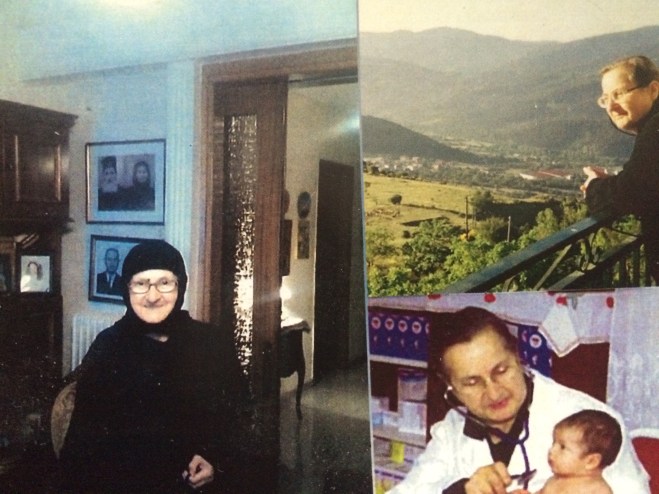
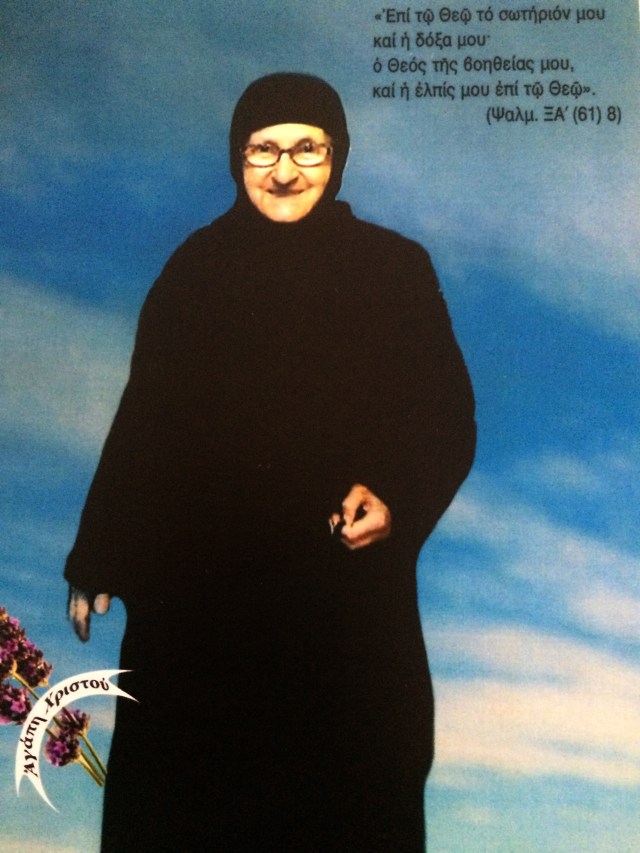
Sister Aggeliki Tsaousi slept in Christ last year amidst the Lights of Theophany, having lived a long life of poverty for Christ, of sacrifice and prayer, dedicated to the ministering of the poor, the sick, the needy, the addicted, the refugees, families in crises, all her brethren in Christ, no matter what their country of origin was and what their religion. She established a charitable organization “Love of Christ”, recruited other like-minded volunteer doctors and founded an ‘international’ humanitarian-aid non-governmental organization (NGO), a model Doctors Without Borders, before that term was even invented. The fact that the doors of her clinic remained open 24/7 and welcomed everybody drew upon her the criticism, even wrath of some of Thessaloniki’s local society, who could not understand why she bothered with gypsies, Muslims, drug addicts, Albanians or atheists. She often got into trouble for being no respecter of persons, but the Lord did not abandon this handmaiden who trusted in Him and lived a life of holiness and humility. She was a woman of integrity, great strength and faith, and pursued the path of the Cross, of sacrifice, with the Holy Unmercenary St. Panteleimon and St. Nektarios of Pentapolis by her side, making their presence most powerfully felt in her daily ministry with great miracles of healing.
After Meeting such a Person, how can you not change?
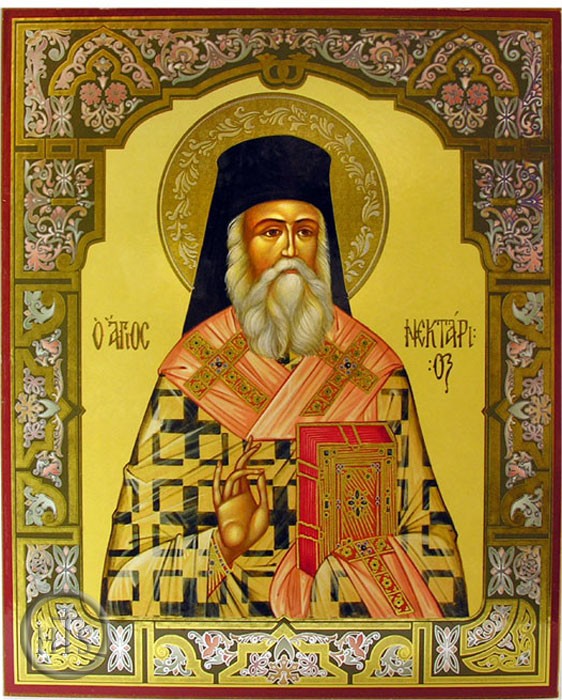
St. Nektarios of Pentapolis (Sister Aggeliki’s Patron Saint)
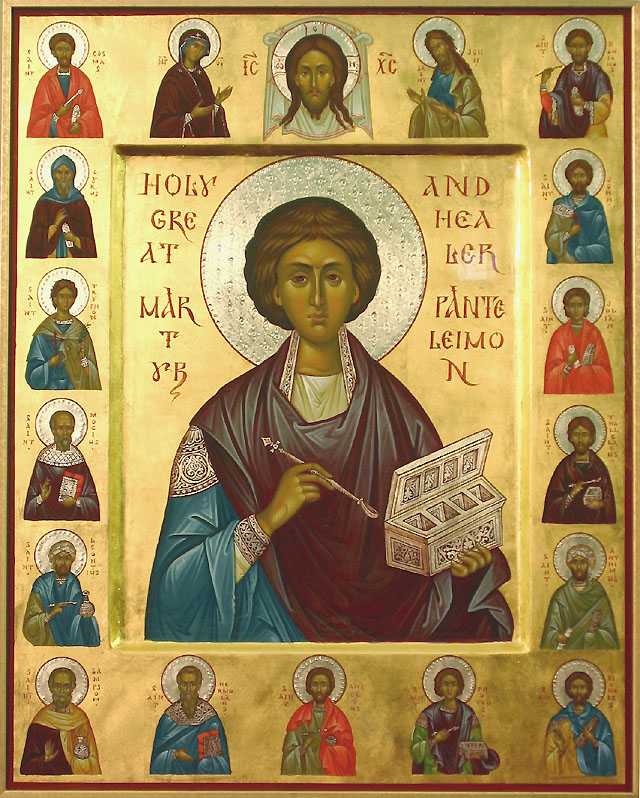
Holy Unmercenary St. Panteleimon (Sister Aggeliki’s ‘Medical Assistant’)
I have never written before in my life an obituary, especially in a language which is not my mother tongue! but I feel deeply moved to make a humble attempt for Sister Aggeliki, since I have been blessed to be on her side for more than 2 decades.
Sister Aggeliki was truly, genuinely ecumenical. She “incarnated” John Donne’s Meditation:
No man is an island,
Entire of itself,
Every man is a piece of the continent,
A part of the main.
If a clod be washed away by the sea,
Europe is the less.
As well as if a promontory were.
As well as if a manor of thy friend’s
Or of thine own were:
Any man’s death diminishes me,
Because I am involved in mankind,
And therefore never send to know for whom the bell tolls;
It tolls for thee.
Sister Aggeliki’s love for God and her ‘neighbour’ was proverbial, unwavering, selfless, unconditional and boundless. She was special and she made everybody feel special and loved! She became a legend all over Greece! A doctor who was never granted her degree, because as a University student she refused to take the oath, which was the custom of Greek universities back in those days, since she felt it contradicted God’s law: “But I say unto you, Swear not at all …” (Matthew 5:34).
A doctor whose career collapsed before its beginning, but not her calling! A doctor who never “earned” any salary for her services, who worked as a volunteer in all major hospitals, clinics, charitable and missionary organisations, in Greece and abroad, a doctor who was eventually hired as a cleaning lady (!) but was never paid, again (!), and even her “pension” as a cleaning lady went straight to the poor, the church and various charitable organisations, as we all found out after her repose. So, how on earth did she make it? This remains still a mystery to everyone but God!
Dear Sister Aggeliki, such zeal, such a pure spirit and love for Christ! She strove so hard to remain invisible, hidden, but God’s Grace “betrayed” her … She would make it a point to frequent ‘anonymous’ chapels to hide herself from people and their praise — indeed I remember her ‘confessing’ this ‘secret’ to me — yet, everybody recognised her everywhere and sought her blessing and her prayers! She was the families’ refuge and strength, a proverbial Rock in times of distress, always present in times of need, always preferring fasts to feasts, when faced with conflicting demands in her hectic schedule.
Serving as the doctor of ‘Love for Christ’, assisting administratively nearby and far monasteries , supporting charitable/missionary organisations, ministering the needs of the poor who flocked around her, had Sister Aggeliki working from dawn to midnight each day. In the midst of her exhausting ministry she devoted careful time to her inner life of prayer, composed Christian poetry and wrote Christian plays, kept a diary in which she set down her thoughts, feelings, and prayers, and systematically recorded Patristic teachings on monasticism together with her broad experience in contemporary monasticism, encoding them in her voluminous work, her magnum opus (in the editing process; under publication) Rule of Love for Christ: A Set of (Spiritual) Articles of ‘Incorporation’ For a Woman’s Monastery.
So, let me eventually dare upon a few vignettes …
Vignette1: It all started very unexpectedly, back to the days when my son was a toddler, and undergoing from one medical complication to another, being sent from one hospital to another, with doctors at their wits’ ends, experimenting on all sorts of medication on him, without being able to diagnose, let alone treat, his health problem, whatever that was. In despair, always in search for a paediatrician who could assist us in our impasse and bring our woes to an end, God took care of us and I was given her telephone number, I cannot recall by whom …
I remember our first telephone call in full detail. I was very upset and frustrated and all she did was calmly ask a couple of questions to understand what the problem was and then she paused! I thought the line was broken, but she was still there on the other side; she told me she had to pray so that she would not pile error upon error on this chain of medical misjudgments to avoid further jeopardising my son’s health. So, I waited and … waited in silence … Finally, she told me in full detail what we had to do, until she would examine our son, which she promptly did, once she was available, and then treated him for just one week, and do I need to add that she was correct 100% in her “diagnosis” and that this was the end to my son’s health problems?
You would not want to let such a paediatrician disappear from your life, would you? The fact that you would not have to pay anything for such treatment, or travel all the way to hospitals or wait long hours in queues outside surgeries, was the least for such a Godsend present. Even the fact that she never erred, even in the most difficult cases, never! , was a “minor” detail to what just a single visit to this amazing woman offered you. Really, could it be that people like her truly existed? Indeed, she was in “possession” of something which none or very few other paediatricians or doctors, or indeed anybody, could offer, and that was nothing less than a glimpse to another world, a beautiful world full of Serenity, Love, Compassion, Light, Peace, Hope and true Healing.
She was such a magnet and we soon got stuck to her, like practically anybody else who got to know her better. One could not help but be drawn into her strong, warm, calm, prayerful, charismatic circle of grace- and be changed! Gradually we even began to fathom the depths of her life and ministry if that could ever be possible ! Because you have to somehow be spiritually similar to such a person to be able to understand or describe her by any means. And we most surely were not. But we were blessed to be next door neighbours (😊), so we would regularly visit her at her home-clinic, and spend hours and days talking, praying, helping, planning … Yes, planning! Because during these intimate visits, we eventually became attracted to her vision and started ourselves volunteering to help other people.
All these long days of ministry, of driving her to homes in need, of visiting terminal patients, orphans, of children summer camps and soup kitchens, of concerts and plays, of sharing the holiness of fellowship in Christ and bringing the Church to the Laity of God, to give you just a few examples, would not only not tire us, but on the contrary would help us forget or deal better with “our” problems, would most deeply refresh us. She had such a fine sense of humour and was always so cheerful! So many memories, dear Sister Aggeliki, a true Angel, Messenger of God, so many words of yours still echoing in my ears, so many pieces of invaluable spiritual advice. May you remember us in your prayers now that you are face to face to God and behold His Glory in the company of His Saints.
After Meeting such a Person [Προς-Ωπο, Prosopon (/ˈprɒsɵpɒn/[1] or /prɵˈsoʊpən/;[2] from Ancient Greek: πρόσωπον, πρός (prós, “towards”) + ὤψ (ṓps, “eye”), most often translated as “person”, and as such is sometimes confused in translation with hypostasis, which is also translated as “person.”, but pros-opon originally meant a Person whose eyes are directed Up-wards, to Heaven — Sister Aggeliki’s eyes were most certainly directed Up-wards!
Vignette2: Preparations for a feast for the children’s summer camp were under way and a volunteer got very tired, lost its temper, started shouting at Sister Aggeliki and insulting her, and eventually slammed the door in her face! As if all this exhaustion had triggered an explosion of deep-rooted rivalry, jealousy, pride and resentment! She wanted so desperately to be in charge and lead! And what did most patient Sister Aggeliki do? Did she lose her temper? She was older, exhausted after all and suffering from cancer too. No, she just took a deep breath and started praying spiritually and in secret. I was stupefied !! What was that woman thinking?! Just the age, frailty and the habit that Sister Aggeliki was wearing should be more than enough to teach her to behave herself and show more respect! I rushed downstairs to try to appease her (to no avail), as she was still shouting at the top of her voice that she was right and that Sister Aggeliki was to blame for all this! So what did Sister Aggeliki decide to do? Magnanimous Sister Aggeliki, generous in forgiving an insult or injury, free from petty resentfulness or vindictiveness. She “punished” herself just like St. Nektarios, who rather than punish two students of his, when they misbehaved, when he served as the headmaster of the Rizarion Ecclesiastical School, he ‘punished’ himself and started fasting (ie. eating nothing!) and praying for their sake. Likewise, Sister Aggeliki repented, fasted, prayed and refrained from Holy Communion that Sunday until she confessed to her spiritual father and asked for forgiveness for a wrong she had not committed! Needless to add, she forgave that woman wholly and unconditionally that very moment and never entertaining any bad thought (logismos). Sister Aggeliki would always, very humbly, like her patron Saint, Saint Nektarios, endure injustice slanders and meekly face temptations.
Vignette 3: She was on her deathbed, facing terminal cancer, and stifling her moans with Hymns and Martyrs’ Apolytikia. To her very last day, she examined sick children and ministered people’s needs. Just to remember her hoarse from pain voice singing a hymn a day before her end reduces me to tears.
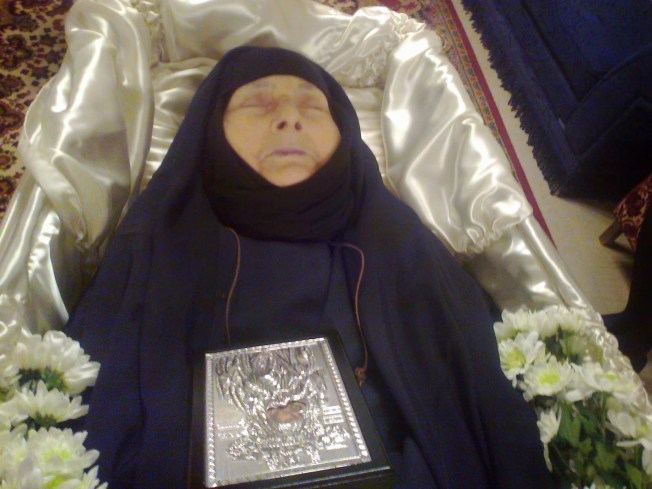
Vignette 4: The minute her pure soul flew to her Maker, Sister Aggeliki’s face glowed; she raised her hand with her prayer rope, and blessed everybody at her side, leaving this world with ineffable Joy!
After Meeting such a Person, how can you not change?
–– Geronda [ie. Saint Paisios], the final diagnosis has been made. Your tumor is cancerous and it’s aggressive.
–– Bring me a handkerchief so that I may dance to the song: “I bid farewell to you, O poor world!” I have never danced in my life, but now I will dance for joy as my death approaches. [Dialogue With Elder Paisios as He Faces Death at http://orthodoxwayoflife.blogspot.gr/2014/10/ dialogue-with-elder-paisios-as-he-faces.html
And so, she danced her way to Heaven! Sister Aggeliki had always wanted to become a nun; she fasted and prayed like a nun; she owned nothing, gave away everything, and wore a habit all her life, but she stayed in the desert of the cities instead, because she sacrificed her “calling” in order to take care of her blind sister, who was suffering from a very serious mental disorder and was dangerous to herself, her environment and Sister Aggeliki of course. Humbly she would confess that this cross was for the expiation of her sins! She did not want to commit het to a mental institution, because this sister was simultaneously a fool for Christ, and wanted to spend endless hours in Church and in prayer. Sister Aggeliki knew that she could not lead such a church life in a mental hospital, where they would ‘sedate’ her with heavy medication, so she ‘waited’ by her side for 50+ years and would walk her to church whenever there was a service. Sister Aggeliki received tonsure only a few months before her death, when her sister had died. And yet, how moving it was today to hear her commemorated in Church as a “Sister”, because if there was any woman who deserved to be thus commemorated as a nun, if not on Earth, then surely in Heaven, this was most certainly her!
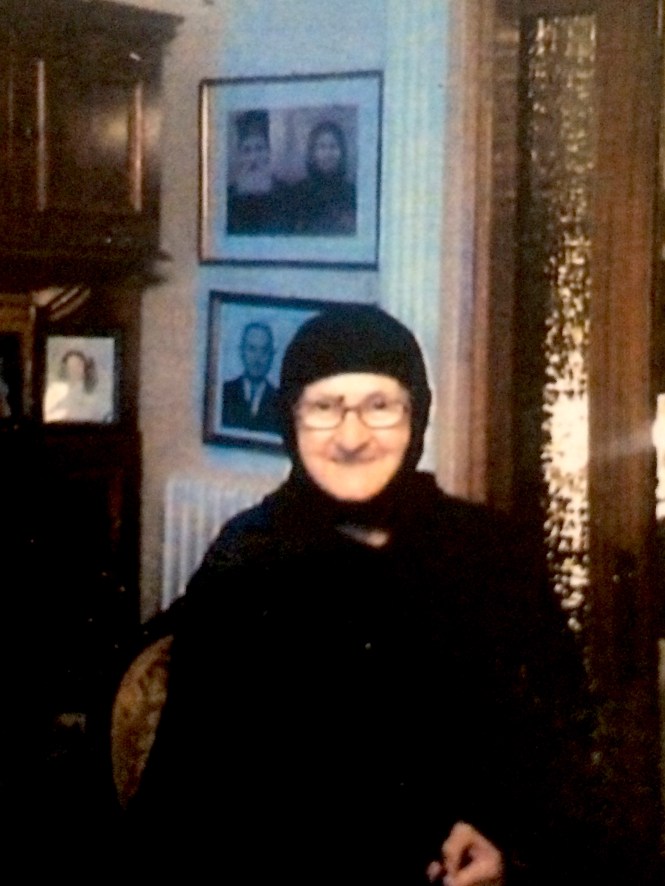
Today, during the Memorial Service, it suddenly occurred to me that rather than praying for her, we ought to pray to her, and ask her blessing from “above”!
https://www.youtube.com/watch?v=4ZRrbixpVV0
Why these bitter words of the dying, o brethren,
which they utter as they go hence?
I am parted from my brethren.
All my friends do I abandon and go hence.
But whither I go, that understand I not,
neither what shall become of me yonder;
only God who hath summoned me knoweth.
But make commemoration of me with the song:
Alleluia! Alleluia! Alleluia!
But whither now go the souls?
How dwell they now together there?
This mystery have i desired to learn; but none can impart aright.
Do they call to mind their own people, as we do them?
Or have they forgotten all those who mourn them and make the song:
Alleluia! Alleluia! Alleluia!
We go forth on the path eternal, and as condemned,
with downcast faces, present ourselves before the only God eternal.
Where then is comeliness? Where then is wealth?
Where then is the glory of this world?
There shall none of these things aid us, but only to say oft the psalm:
Alleluia! Alleluia! Alleluia!
If thou hast shown mercy unto man, o man,
that same mercy shall be shown thee there;
and if on an orphan thou hast shown compassion,
the same shall there deliver thee from want.
If in this life the naked thou hast clothed,
the same shall give thee shelter there, and sing the psalm:
Alleluia! Alleluia! Alleluia!
Youth and the beauty of the body fade at the hour of death,
and the tongue then burneth fiercely, and the parched throat is inflamed.
The beauty of the eyes is quenched then, the comeliness of the face all altered,
the shapeliness of the neck destroyed; and the other parts have become numb,
nor often say: Alleluia! Alleluia! Alleluia!
With ecstasy are we inflamed if we but hear that there is light eternal yonder;
that there is Paradise, wherein every soul of Righteous Ones rejoiceth.
Let us all, also, enter into Christ, that we may cry aloud thus unto God:
Alleluia! Alleluia! Alleluia!

































 ORTHODOX CHRISTIAN FAITH AND LIFE