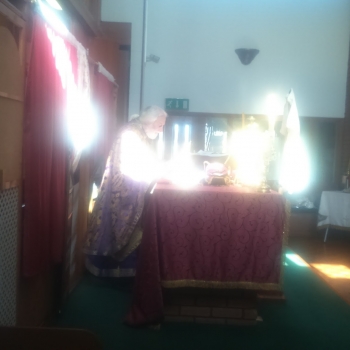
An Interview with Fr. Jonathan Hemmings
The tradition of faith in Great Britain goes back to the Apostolic era!
by Tudor Petcu
A Romanian writer, Tudor is a graduate of the Faculty of Philosophy, University of Bucharest, Romania. He has published a number of articles related to philosophy and theology in different cultural and academic journals. His work focuses on the evolution of Orthodox spirituality in Western societies as well and he is going to publish a book of interviews with Westerners converted to Orthodoxy. In this article, he interviews Fr. Jonathan Hemmings, Orthodox theologian, who is the priest of the Holy Life-Giving Cross Orthodox Church in Lancaster, UK, talks about faith and love in Christ.
1.) Before discussing your conversion to Orthodoxy, I would appreciate it a lot if you could talk about your main spiritual experiences and journies untill you have discovered the Orthodox Church.
First of all, we need to be sure of what we mean when we use the term convert or “conversion.” We all need to be converted – both those who come from different traditions and confessions and those from traditionally Orthodox countries who are referred to as “cradle Orthodox”. Christianity is not a Philosophy, it is a relationship with the All Holy Trinity. We are converted to Christ and we are received into the (Orthodox) Church through Baptism and/or Chrismation. Sometimes this happens in the other order of events. Those who are Baptised Orthodox as babies need to employ the gift of the Holy Spirit given to them; those who are called to the Orthodox Christian faith are prompted by the same All Holy Spirit. As Metropolitan Kallistos said
“We Orthodox know where the Holy Spirit is but we cannot say where He is not.”
As scripture says
“the Holy Spirit moves where He wills.”
One has to experience the Orthodox Church either through her Liturgy or through the “living signposts of the faith” whom God sets before us if we are open to the Truth. By “ living signposts” I mean men and women who possess grace and in whom we see the light of Christ. Christianity in the west tends to be analytical and logical, Eastern Christianity is synthetic and mystical and engages the whole of our being.
You shall love the Lord your God with all your mind with all your strength, with all your heart and with all your soul.
The fact that we do metanoias (reverences or bows) shows that even prayer is a physical as well as a mental process. I have always believed in God, from a little child. I cannot remember a time when I did not believe in God. I had the right Christ, I just needed the right Church. Of course all this was a preparation for me to discover or rather recover the Orthodox faith.
2.) How would you characterise your own spiritual road to Orthodoxy? According to this question, would it be correct to say that Orthodoxy is able to heal the wounded souls?
I am like the Prodigal son in the parable who returns to his father. The Orthodox faith according to tradition was brought to Britain by St Joseph of Arimathea. An early Archbishop of Canterbury was Greek- St Theodore of Tarsus. St Constantine the Great was made Augustus Emperor here in York when he was in charge of the sixth Legion. So I did not choose to find something “foreign”; I returned to the Church which was established here in Britain.
The Orthodox Church is Universal as we proclaim on the Sunday of Orthodoxy. The Church is the hospital for souls. As Blessed Augustine said
“Our hearts are restless until they find their rest in God”
Restlessness of the spirit is a characteristic of this age. So I have not discovered something new, I have recovered something authentic and original.
3.) Considering all what you have experienced over the years from the spiritual point of view, why is Orthodoxy so precious and meaningful to you?
Well, I believe Orthodoxy is not only original, unchanged and authentic but it is the teaching and preaching of Christ’s Apostles (Kerygma and Paradosi). Tradition is not simply historical, it is vital and dynamic. The Orthodox way fulfils the needs of the whole person and makes the broken person whole. It is precious because it is the
“pearl of great price.”
Once you find it, then you must share this treasure with others and not keep it to yourself.
4.) Do you think that Orthodoxy could be considered a burning bush?
4. I have a stone from Mount Sinai which contains the image of the bush which Moses saw burning and yet which was not consumed. If you want to forge metal, you must first heat it and out it into the fire and then you can shape it to the tool you require. When we are put into the fire of God, the same happens. It is so God can shape us into the person that He has called us to be. When we are alive in God then we become all flame. We are standing on holy ground, so when we approach God we must do so with awe before the majestic power of God.
5.) Now, I would like you to tell me what does the Orthodox monasticism mean for you and what impressed you most in your monastic pilgrimage, if I can call it like that?
5. Orthodox Monasteries are “LightHouses” for souls. They are often remote and inaccessible because the quietness for the soul requires asceticism . They are full of angels because the angelic life is lived there. When we say in the Lord’s Prayer
“Thy kingdom come on earth as it is in heaven”
then this is what monks are doing. The very walls of the Churches are filled with prayer and so one can feel tangibly the peace of God. It is this peace which passes all understanding that one experiences. Again I say that Orthodoxy is Life in the sense that we experience it, we live it. I have been to many Orthodox Monasteries in Romania. The most memorable moments are when I met Pr Ioanichie Balan in Sihastria Monastery and when I served the Holy Liturgy with Pr. Teofil Paraian( the blind Staretz) at Sambata de Sus. These were moments when the veil between heaven and earth was very thin.
6.) What would be the difference between you as a heterodox and you as an Orthodox?
I am complete. When Our Lord died on the Cross he said in St John’s Gospel
“It is finished”
but this also means
“It is completed”
that is, the work of salvation. In this sense “conversion” is an extension of what I once was. As C. S. Lewis (much respected by Orthodox) once put it
“Imagine yourself as a living house. God comes in to rebuild that house. At first, perhaps, you can understand what He is doing. He is getting the drains right and stopping the leaks in the roof and so on; you knew that those jobs needed doing and so you are not surprised. But presently He starts knocking the house about in a way that hurts abominably and does not seem to make any sense. What on earth is He up to? The explanation is that He is building quite a different house from the one you thought of – throwing out a new wing here, putting on an extra floor there, running up towers, making courtyards. You thought you were being made into a decent little cottage: but He is building a palace. He intends to come and live in it Himself.”
C.S. Lewis, Mere Christianity
As I have said before, I have always loved God but the depths of Orthodoxy provide me with the resources that nourish my soul.
7.) I remember some words which impressed me much while I was discussing with a Swiss writer converted to Orthodoxy. He was saying that he was born to hate but through Orthodoxy reborn to love. How would you characterise these words as a convert to Orthodoxy?
We were all born to love. Christ summarised the Commandments as Loving God and Loving your neighbour. Orthodox Christianity can be summarised in these words. But love is a verb… we must put into action those things which we believe. I am sure the prisons in Romania are full of criminals who would call themselves Orthodox and who have been baptised as such, but sin found a place in their hearts. Glory to God he is merciful and loves mankind! And so we must live out our life in peace and repentance. Being Romanian does not make you Orthodox anymore than being Greek, Russian, Serb or British. There was no ethnic identity in the Garden of Eden before Adam and Eve’s transgressions. May the love of God embrace us all.
This interview is one of many that will be published in the book “The rediscovery of Orthodox heritage of the West” by Tudor Petcu, containing interviews with different Westerners converted to Orthodoxy. It will be published in two volumes and the first one will appear by the end of this year.
Journey to Orthodoxy


 ORTHODOX CHRISTIAN FAITH AND LIFE