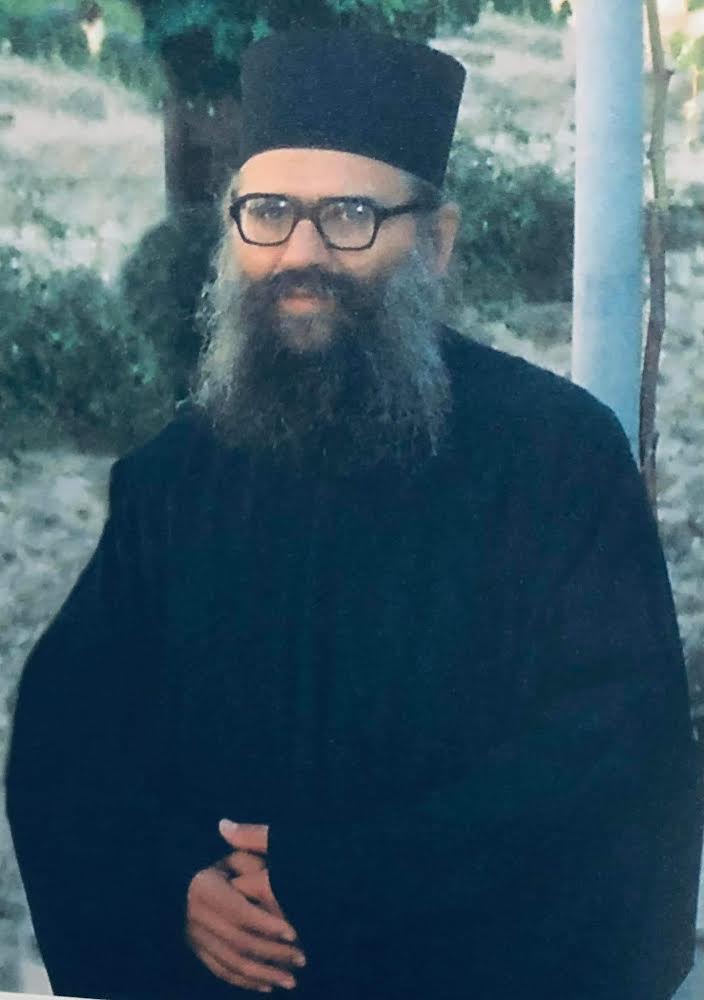
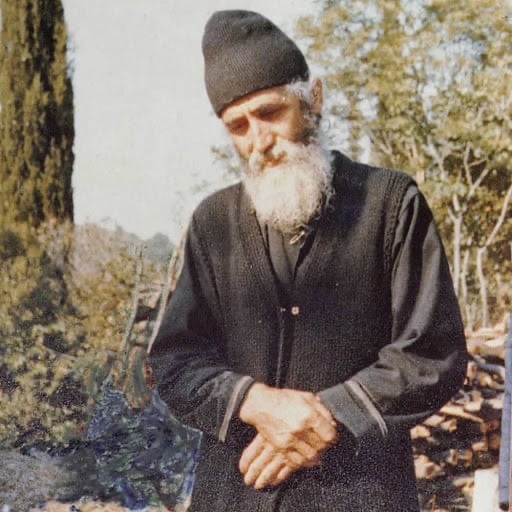
Gerondas Gregorios Papasotiriou, Spiritual Father and Founder of the Saint John the Forerunner Monastery at Metamorfosi, Chalkidiki–This list was compiled by some of his spiritual children in his memory on the day of the memorial.
Orthodoxy equals Orthopraxy— we should always seek virtue by engaging in a spiritual battle against our passions.
Paradise is not earned “from the armchair” [Greek idiom, meaning without any effort], but requires hard work. “The Kingdom of Heaven suffereth violence, and the violent take it by force.” (Matthew 11:12)
We should endure with patience sorrows, trials, injustices, and insults.
We should study the Gospel and the lives of the Saints so that we can see our spiritual poverty and wretchedness.
We should also pray alone “ Lord Jesus Christ have mercy on us”, “ Most Holy Theotokos save us”, “ Holy Saints of God pray/ intercede for us”.
We should chant to dissipate our melancholy and spiritual idleness/acedia.
Whatever we do, we should do it with all our heart. Life without a heart is not really life. We become robots if we have a mind, a sharp brain, and are very clever, yet do not have a heart; then we have nothing.
We should attend Church as often as we can and we should receive Holy Communion after Confession, and if that is not possible, when we have peace in our heart.
We should prepare before Confession so that when we go to the Sacrament, we should confess our own sins, and not those of others, without idle words, with self-knowledge, and real repentance.
We should tolerate and forgive others so that God also forgives us.
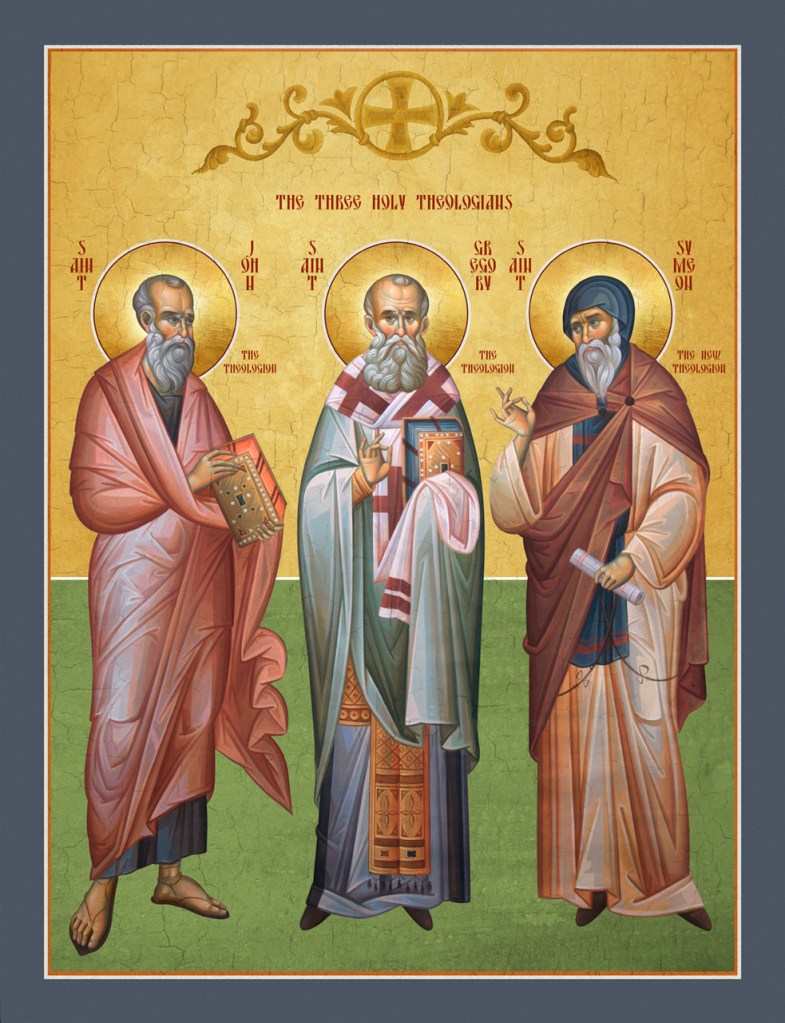
Among the many theologians of the Orthodox Church, three saints are given the appellation Theologian: St. John the Theologian, St. Gregory the Theologian, and St. Symeon the New Theologian. There is a monastery in Panorama, at Thessaloniki suburbs, the Monastery of the Holy Trinity, which is the only one all over the world with a chapel dedicated to these three theologians, celebrating their annual Panegyris, the Feast of the Synaxis of the Three Theologians, on the first Saturday of each November.
Here are some words of Elder Symeon Kragiopoulos of blessed memory, spiritual father and founder of the monastery, about these three theologians, and St. Symeon the New Theologian, his patron Saint, in particular, that shed light into his decision to dedicate the brotherhood to them.
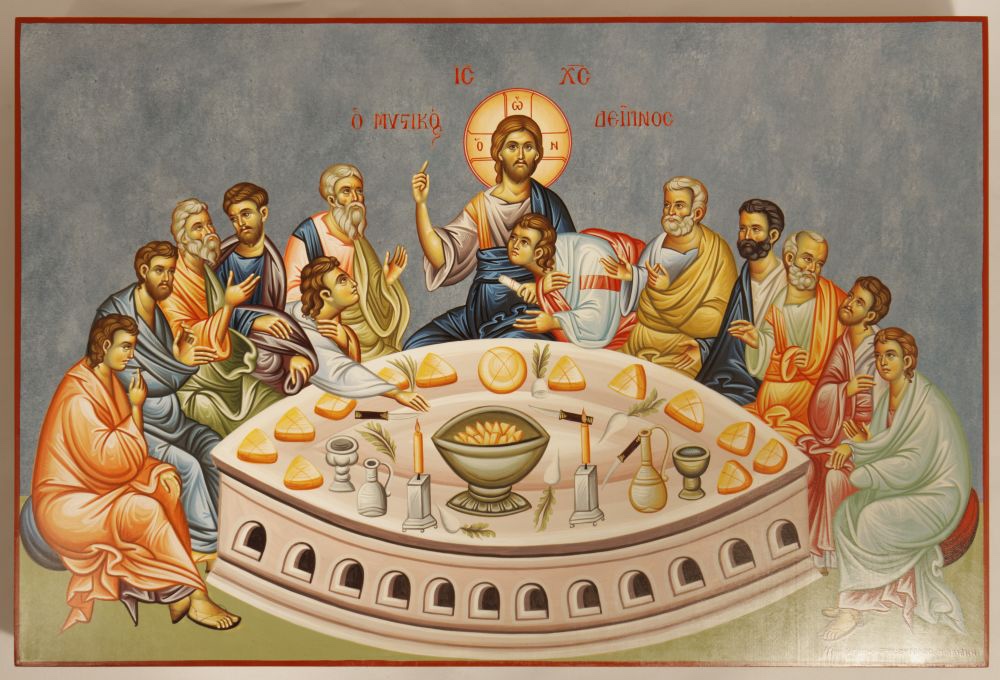
St. John the Theologian: Love
“Throughout his gospel, he writes about himself: John 13:23 “Now there was leaning on Jesus’ bosom one of his disciples, whom Jesus loved” (and 19:26; 21:7 and 20) … Saint John had this understanding that he was the disciple whom Christ loved. …Let us all focus on this. Do I possess God’s Love? Do I feel God’s Love? God is offering His Love, but does it reach my soul?”
*
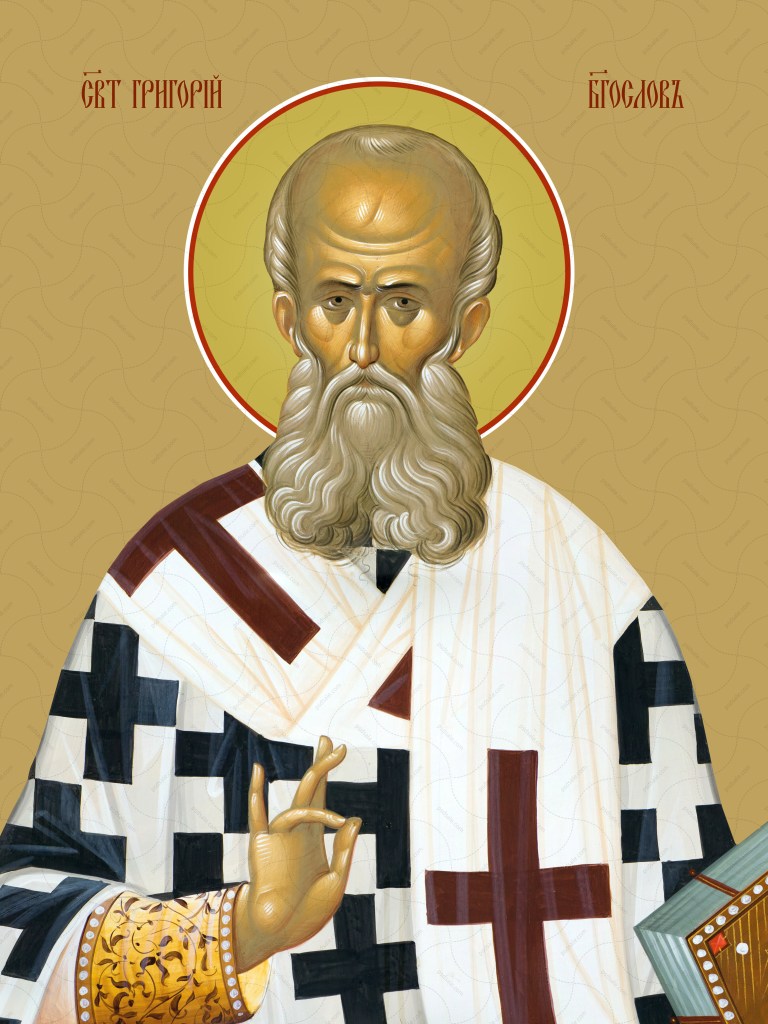
St. Gregory the Theologian: Unceasing Prayer and Hesychia
“Remember God more often than you breathe.”
Μνημονευτέον γὰρ Θεοῦ μᾶλλον ἢ ἀναπνευστέον»
“No sooner do I conceive of the Οne than I am encircled, illumined by the splendour of the Τhree; no sooner do I distinguish them than I am carried back to the Οne.
When I contemplate the three together, I see but one torch, and cannot divide or measure out the undivided light.”
The first of all beautiful things is the continual possession of God.
For God loves to be entreated, He loves to be compelled.
*
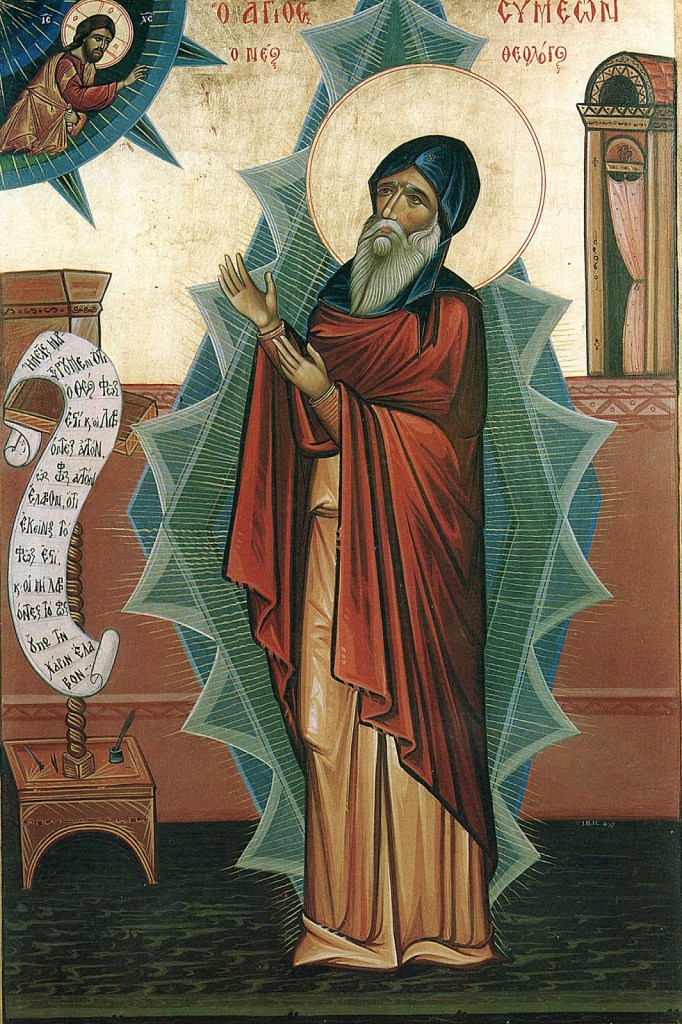
Saint Symeon the New Theologian: Insatiable Thirst for God,Extreme Humility and Sacramental Obedienceto his spiritual father [obedience given to the spiritual father for Christ’s sake which thus becomes obedience to Christ].
All aspects of St. Simeon’s life are most noteworthy, but what is probably the most striking element of all is his sacramental love and obedience to his spiritual father.
Look at the spiritual heights St. Symeon reached:
Light
In the midst of that night, in my darkness
In the midst of that night, in my darkness, I saw the awesome sight of Christ opening the heavens for me. And he bent down to me and showed himself to me with the Father and the Holy Spirit in the thrice holy light — a single light in three, and a threefold light in one, for they are altogether light, and the three are but one light,. And he illumined my soul more radiantly than the sun, and he lit up my mind, which had until then been in darkness. Never before had my mind seen such things. I was blind, you should know it, and I saw nothing. That was why this strange wonder was so astonishing to me, when Christ, as it were, opened the eye of my mind, when he gave me sight, as it were, and it was him that I saw. He is Light within Light, who appears to those who contemplate him, and contemplatives see him in light — see him, that is, in the light of the Spirit… And now, as if from far off, I still see that unseeable beauty, that unapproachable light, that unbearable glory. My mind is completely astounded. I tremble with fear. Is this a small taste from the abyss, which like a drop of water serves to make all water known in all its qualities and aspects?… I found him, the One whom I had seen from afar, the one whom Stephen saw when the heavens opened, and later whose vision blinded Paul. Truly, he was as a fire in the centre of my heart. I was outside myself, broken down, lost to myself, and unable to bear the unendurable brightness of that glory. And so, I turned and fled into the night of the senses.
Pay attention to his starting point:
Obedience
Experiences of a man named “George“.
In Saint Symeon’s “On Faith” found in the “Philokalia“, there is an account of the experiences of a young man named “George” [- Symeon himself of course -][Saint Symeon the New Theologian reposed in the Lord in 1022].
THERE was someone called George, very young in age, nearly twenty years old, living in Constantinople – in our own day.
He was very good-looking, and he went about with such ideas of his own appearance, that many people had a mean opinion of him, especially those who judge things by a man’s outward show, and who, without taking into consideration what is hidden in each person, condemn, and become indiscriminate judges of others.
This young man made the acquaintance of a very holy monk, who lived in a monastery in Constantinople, and opening up to him all that was hidden in his heart, he even told him that he longed for the salvation of his soul, and had a great desire to remove from the world, and become a monk.
Now, the honourable Elder praised him for the goal he had set for himself; he counselled him, as was proper, and gave him that book of Saint Marc the Ascetic to read, in which he writes about the spiritual law.
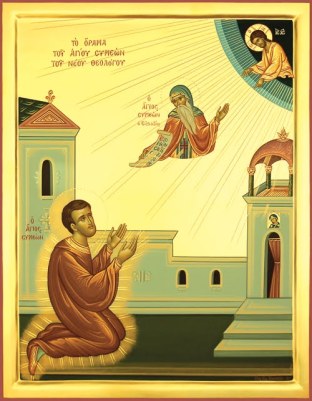
… Every evening, when he went to bed to sleep, he made the prayer and the prostrations which that holy Elder had encouraged him to do, and then fell asleep. … Thus grew from day to day the prayer he made each evening, to which he applied himself until midnight. … So then it was, that one evening at the time when he was praying, and was saying with heart-sight (νοερῶς) in the eye of his heart, the “God be merciful to me a sinner”, suddenly a divine illumination shone out upon him, and that whole place was filled with that light.
And that blessed young man, I mean to say, George, remained in wonderment and forgot whether he was in his house, because he saw light everywhere, as if he were outdoors.
Nor did he comprehend whether his feet were still planted on the earth, or whether he was standing upon air; but at the same time, he had no bodily or worldly concern in his heart-mind (νοῦς) at all, but he completely forgot the whole world, and everything met and became one with the divine light; and it seemed to him, that he too became light, and was wholly filled with tears and an indescribable joy.
And at the last, his heart-mind went up to the heavens, and there he saw another light, brighter still, and beside that light it seemed to him that there stood the holy Elder who had given to him, as we said, the book of St Marc, and the prayer rule which he observed.
Now I myself, as I heard these things from the young man, came to the conclusion that the intercession of the holy Elder contributed a great deal to this, and that God so ordered things to show the young man to what height of virtue the holy Elder had come, which is why he saw him standing beside that light.”
Saint Symeon the New Theologian, “On Faith”.
Most importantly, even, at the height of God’s revelations, St. Symeon saw his holy Elder standing and attributed everything to his prayers.
May these three Saints inspire us and intercede for us, help us ascend the Divine Ladder towards the goal: eternal life in the Kingdom of God.
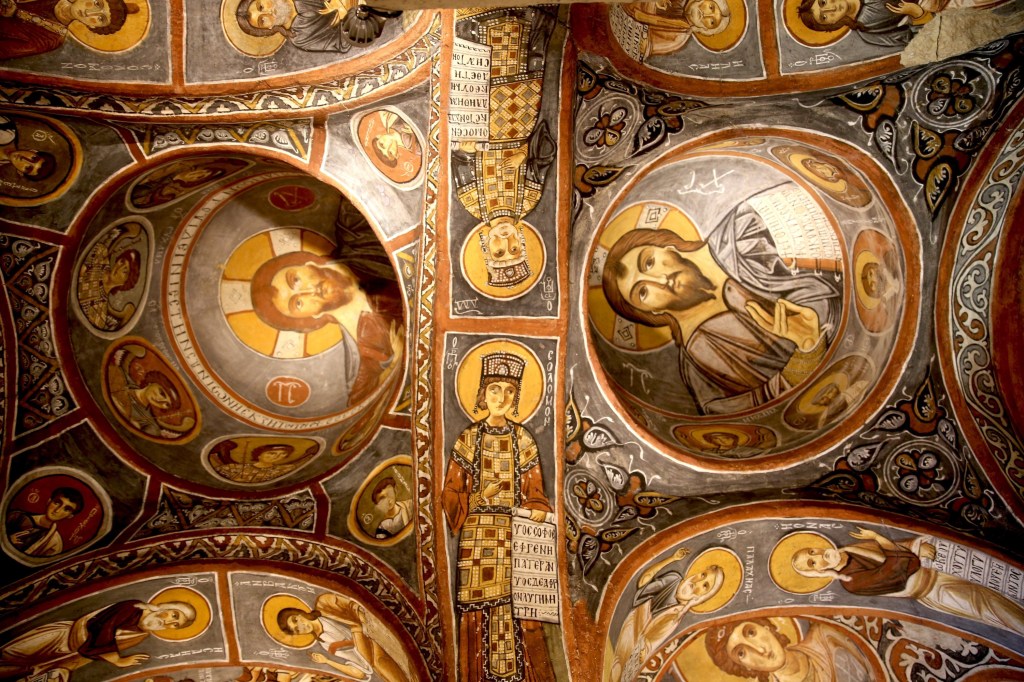
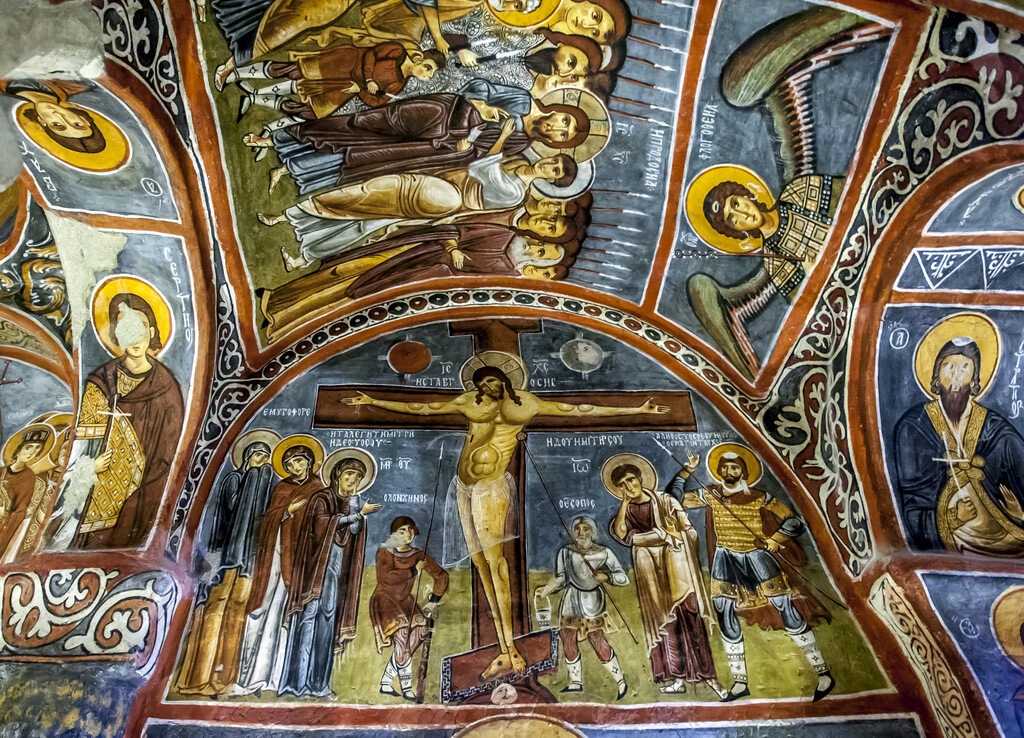
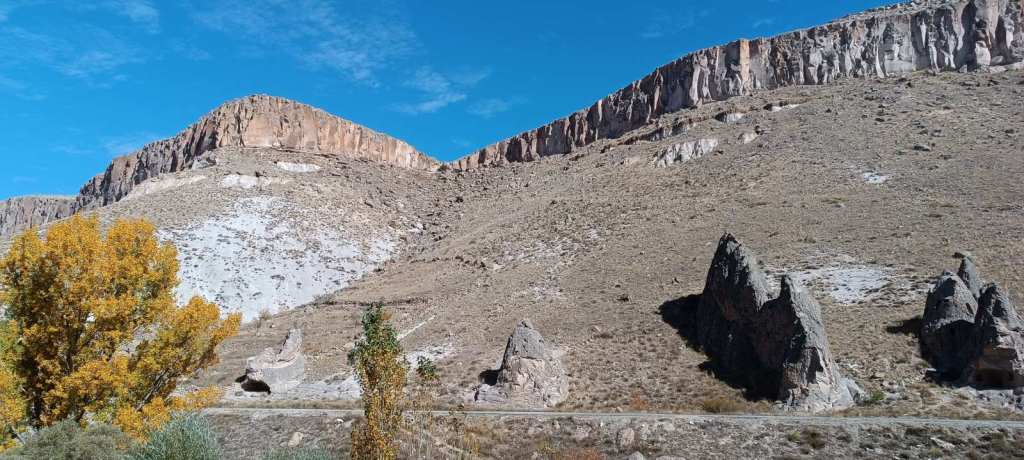
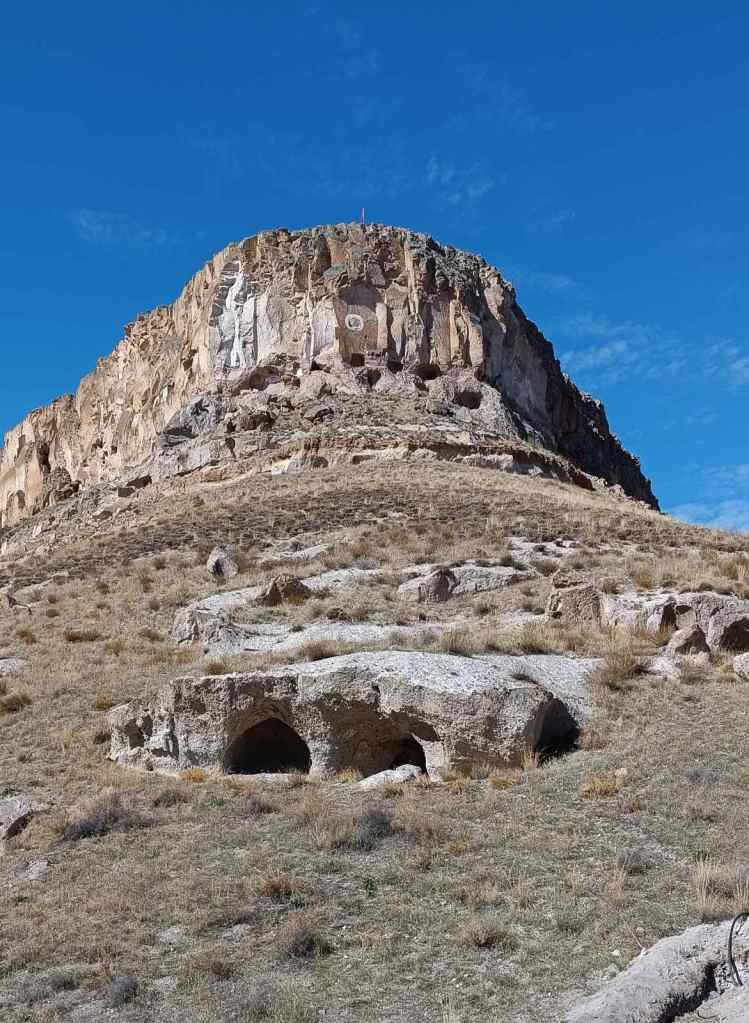
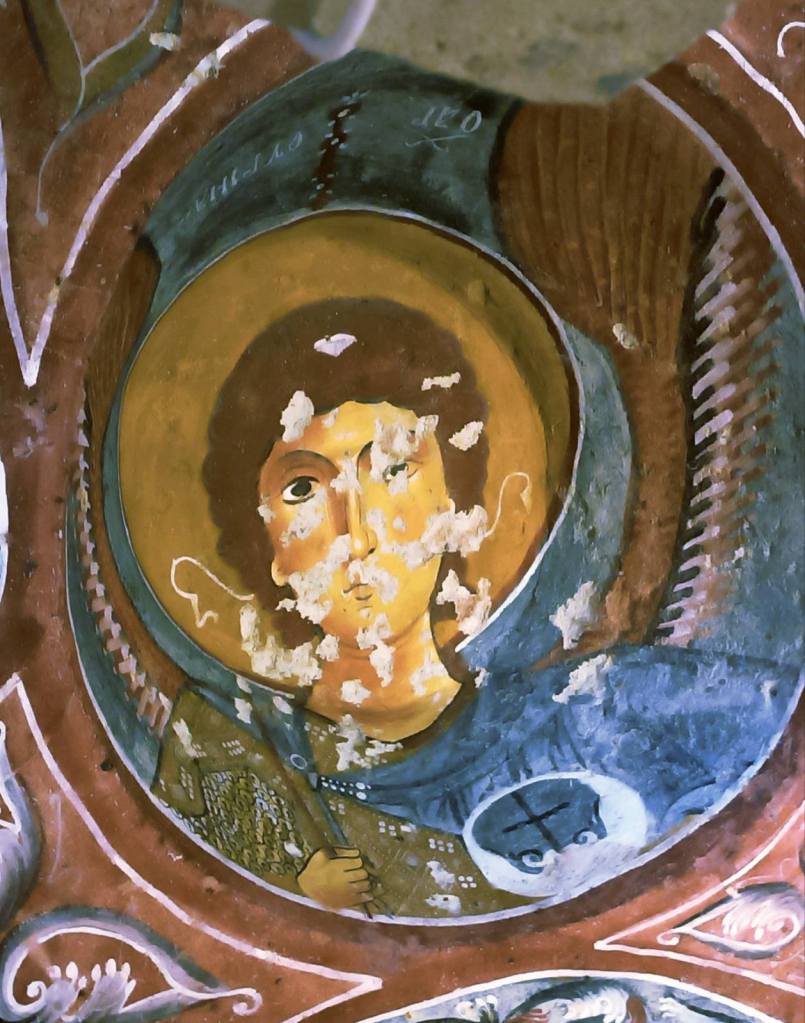
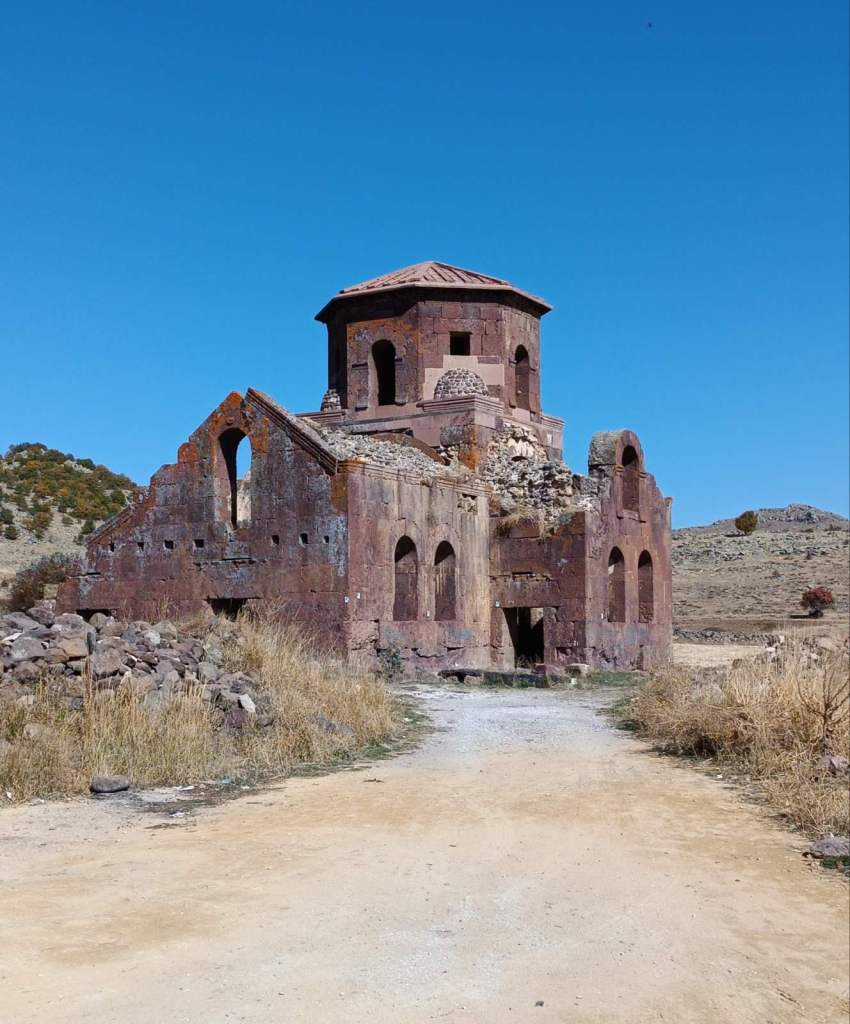
“We are travelling to an unknown city of Cappadocia, walking in the midst of volcanic valleys …
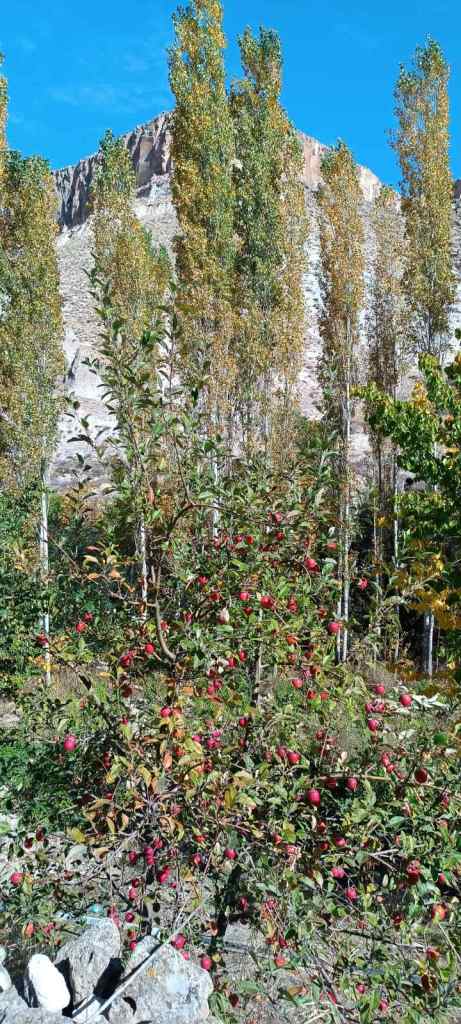
… which Greek people have turned into fertile land …
… climbing high, up to the crenellations where Digenes Akrites (1) raised their swords …
… where the powers of Light fought those of Darkness …
We are going to celebrate Holy Liturgy there, in an orthodox temple (2)
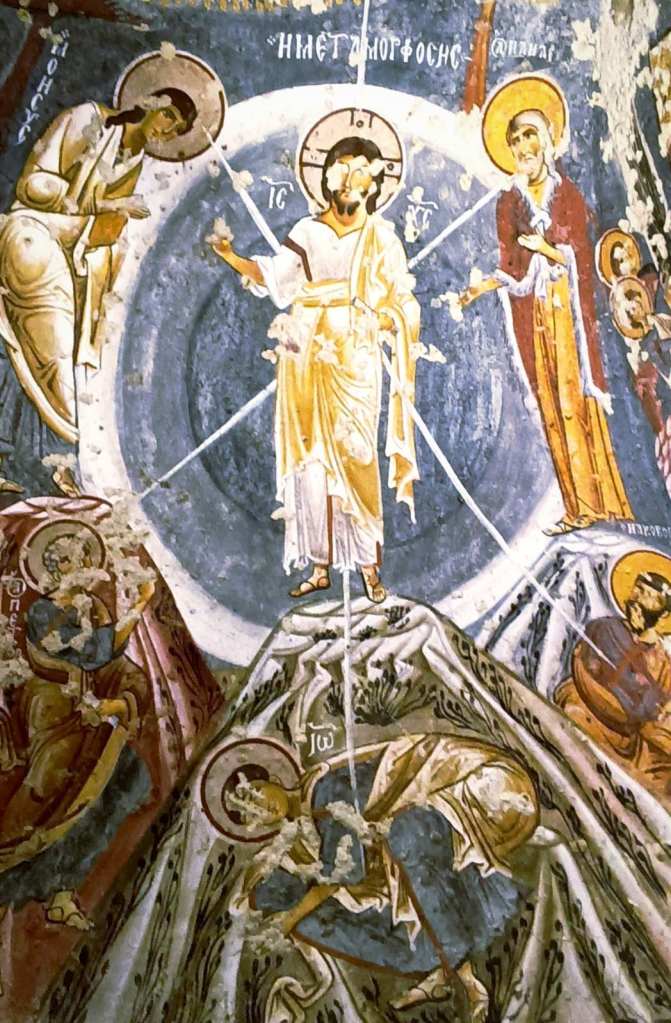
… so that Tabor light will shine in our souls (3)
… and all mankind
(1) Digenes Akritas: “digenes” literally means “born of two races”, i.e. “Roman” (Byzantine/Greek) and “Saracen” and “Akritas” means “frontiersman.”, existing at the borders between Christendom and Islamic lands
Panorama Monastery Dormition of the TheotokosOn our way back from St. Arsenios Monastery
Some years ago I learned that numbers are not important. The number of people attending Church is not an accurate indicator of either faith or success; however one measures success? Geronda Theoklitos of St Arsenios monastery confirmed this independently of my thoughts when he said ” look after your small flock.” ” God looks at the heart not on the outward appearence” as the prophet Samuel said to Jesse, the father of David. I have passed through security and passport control. The flight is delayed. Time to pray. We pray that God will keep us all in his love. “Wherefore, O you who fear the Lord, praise Him in the places where ye now are. Change of place does not effect any drawing nearer unto God, but wherever you may be, God will come to you, if the chambers of your soul be found of such a sort that He can dwell in you and walk in you.” St Gregory of Nyssa 8
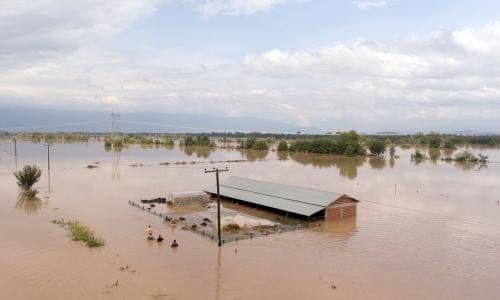
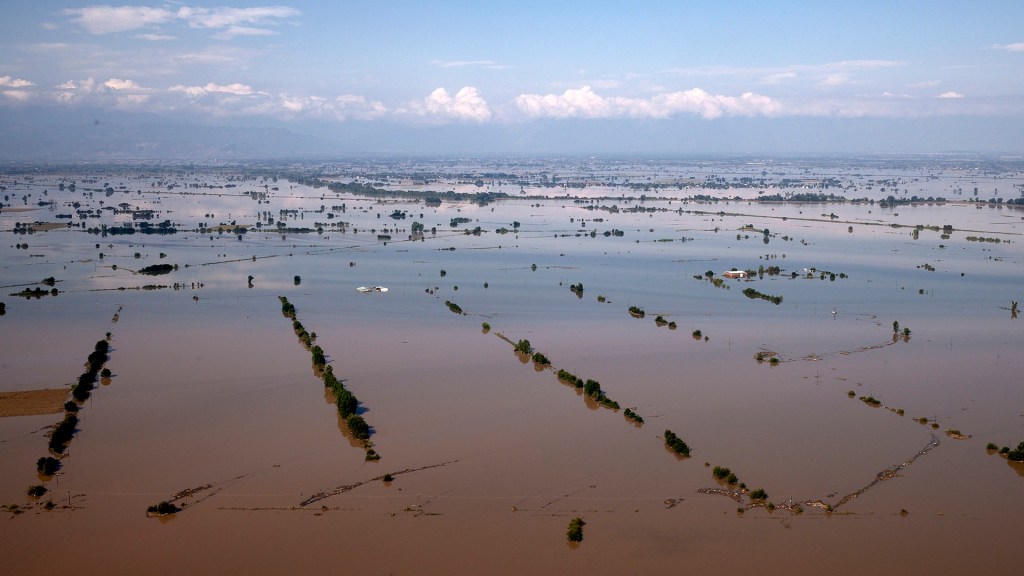
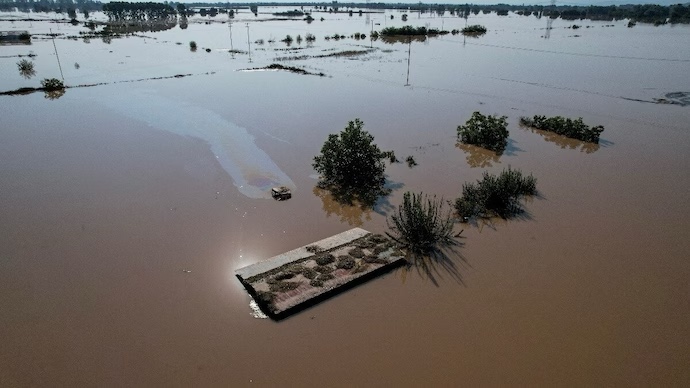
Greece and its next plague of Egypt … This and the following images show the devastating effect of the storm Daniel on its eastern coast.
*
“Then He said, ‘Go out, and stand on the mountain before the Lord.’ And behold, the Lord passed by, and a great and strong wind tore into the mountains and broke the rocks in pieces before the Lord, but the Lord was not in the wind; and after the wind an earthquake, but the Lord was not in the earthquake; and after the earthquake a fire, but the Lord was not in the fire; and after the fire a still small voice. So it was, when Elijah heard it…” 1 Kings 19:11-13
*
The travelling guide’s diary—2
Some Abouna quotes and vignettes that struck my attention during his little pilgrimage … all in a ‘still small voice’ which ended up in silence …
The LORD will fight for you, and you have only to be silent! (Ex. 14:13-14).
*About Joy in Christ and Suffering: “Christ has offered us so much joy in meeting twice at such a short time [I am bound to travel to the UK end of September] barely a month apart, because we are going to suffer when all this ends.”
*About House Blessings: why did Abouna say such fervent prayers at the blessing of a particular house — his eyes were ablaze!— and he completely ‘ignored’ another house we visited? He barely stayed there 5 min and even suggested we all have coffee outside (!) at the neighbouring cafe. Such hurry, such ‘rudeness’! He barely even looked at their icon corner!
*About Monastic Calling and Monasteries: So many lengthy discussions and inquiries all these days, on foot, or inside the car during the long car drives, about which monastery to choose and become a monastic, even at the monasteries we visited, inquiring/ discussing with the monastics themselves about their monastery typikon … yet no conclusive answer … only silence! Just hints about city hermits …
*Gerondas Theoklitos of St. Arsenios of Vatopedi holding Abouna tightly and hugging him so tightly! A scene I will never forget! What a surprise! I always thought Gerondas Theoklitos was very strict and never expressed his emotions!…
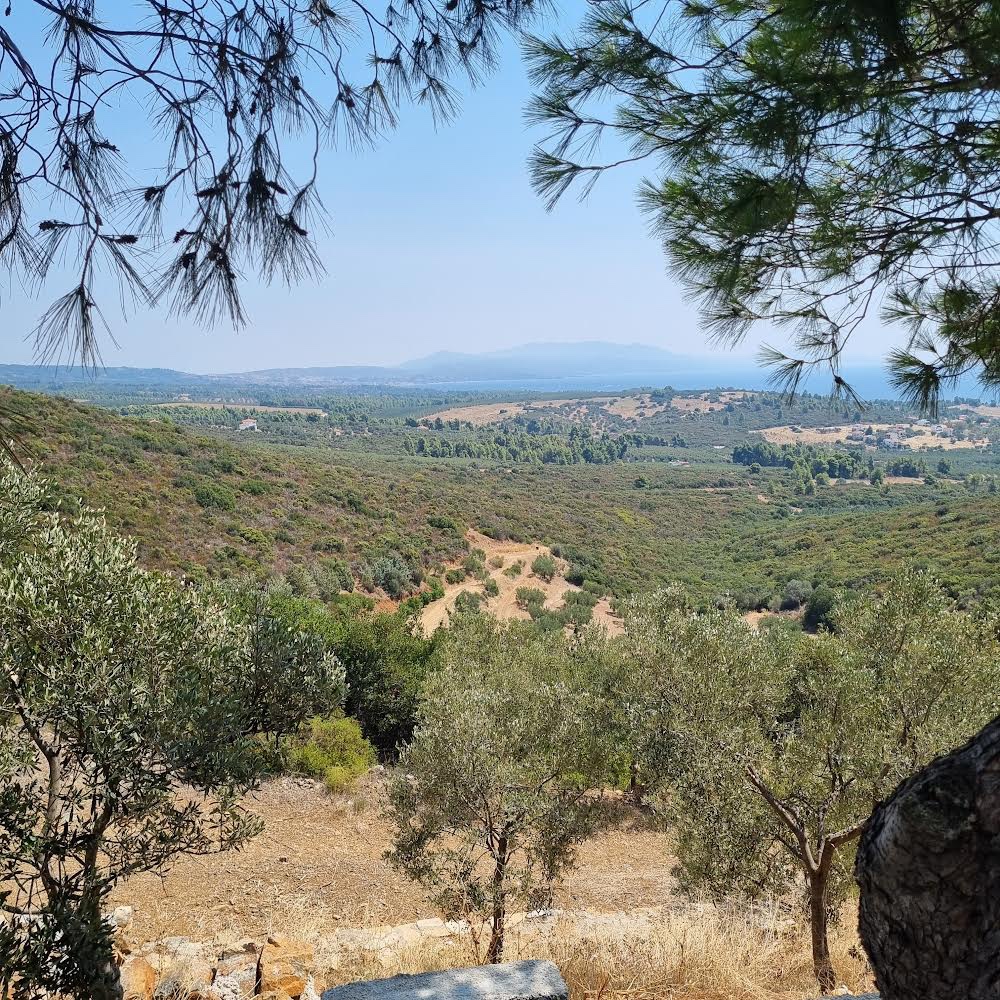
overlooking the sea from the Monastery of St Arsenios in the mountains
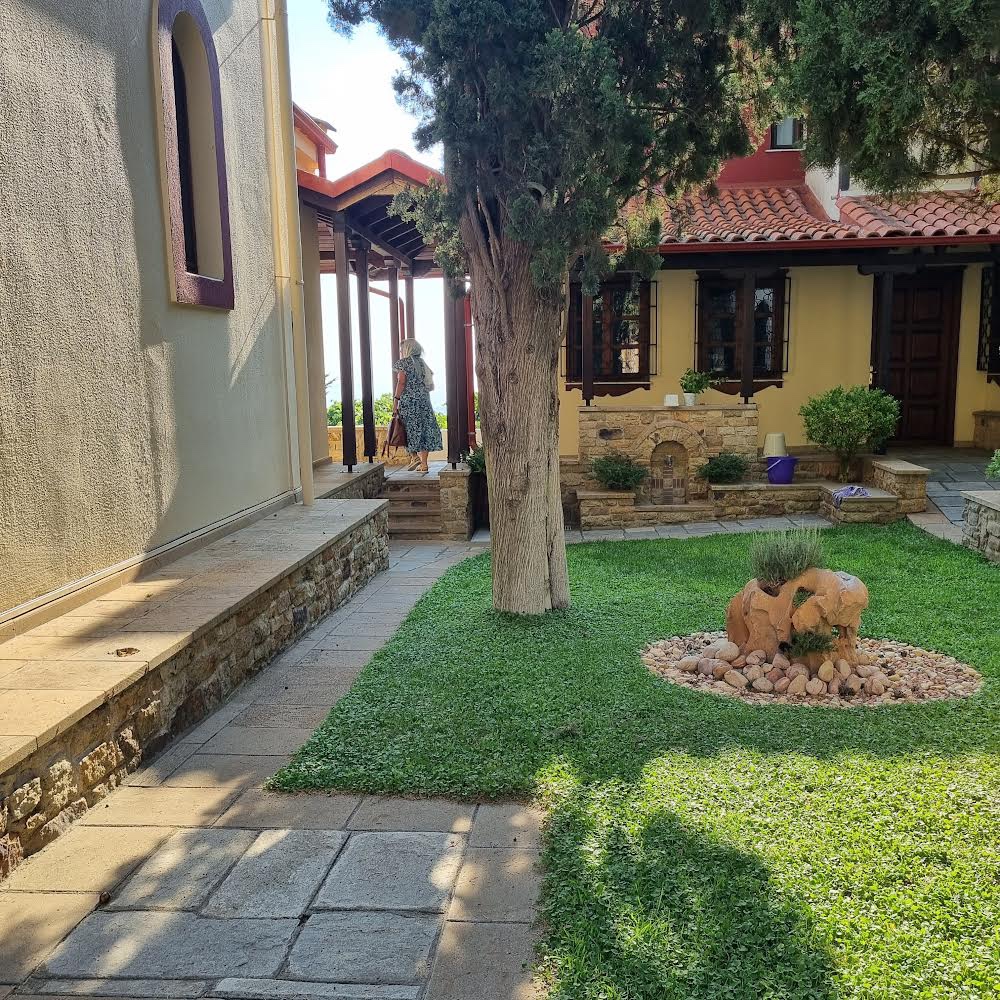
Monasteries are places of healing and light. The Monastery of St Arsenios is one such place.
N.b.This is as close as I came to Agion Oros in the distance!
Another little miracle enabled us to meet Theologos and Vaiga with children again . We were joined by a priest from Germany Fr Victor with his Presbytera and children. The usual courtesies were extended to us, loukoumi, coffee and biscuits along with the necessary water!
Geronda Theoklitos joined us and he afforded us a great deal of his precious time even though he had many confessions to hear.. It was a true blessing to meet him.God it seems bends time in order for those who seek Him to receive His grace . Time is not really measured in monasteries. Of course there are set times for worship and work but one does not sense time passing.
I told Geronda of the mutual ministry we have at our parish and he quoted a greek proverb “Το ‘να χέρι νίβει τ’ άλλο και τα δυο το πρόσωπο” which when translated goes something like : ” The one hand washes the other hand and both wash the face “. I suppose we have similar saying” many hands make light work.”Washing the feet is an act of service and humility, but washing the face brings cleansing and refreshment.He gave another word:St Anthimos of Chios: “ εκείνο το ´γιατί κι εκείνο το ´εγώ´ που έχομεν, αυτά μας απομακρύνουν απο τον Θεό και μας χωρίζουν απο αυτόν» — «this “why” and this “I” which we have, these distance us from God and separate us from Him.”
The proximity of hospitality and holiness is palpable in Orthodox monasteries. Faith ,food and fellowship are inseparable. For some visitors monasteries are places not only of refreshment but of healing where quiet can replenish the soul and regenerate the spirit. It is most important for Orthodox Christians to renew their spiritual batteries. Such peace was abundant at Panorama monastery. Sister S shared the typicon and structures of monasticism and we glimpsed the evening service before heading back to Thessaloniki. I think words alone cannot convey the experience of visiting monasteries. For those who truly seek God then they are places where His energies are to be found…in abundance!
– “The orthodox monastics are like the lighthouse. The lighthouse has to be always on the rocks by the sea. Do you want them to go and live into the city and be added to the other street lights? They can not become a lantern and be placed into the city’s roadside. The orthodox monastic is like a remote lighthouse, that stands high on the rocks, directing the ships of this world with their flashes, and upon the open seas the ships are orientated in order to reach their destination, which is God.” Saint Paisios of Mount Athos from the book: Spiritual Awakening
I had never thought one can really “bend”, transcend Time until I spent last week together with my little Abouna. Together, we drove hundreds of miles, visited a number of Holy monasteries, met Gerondas, received holy words, but most importantly, for me at least, we transcended Time into Kairos, ie. made a Leap unto God’s Saving Time, God’s Providence for our salvation.
How many dimensions exist in reality? And which dimension were we travelling together with Abouna?! Which dimension is Love? Fifth? This ‘travelling’ has probably been one the most liberating, healing experiences ever in my life, especially since I was so stressed, worked out and nearly burnt out in my obediences the last twelve months. Though the truth is that I was really stressed, worked out and burnt out by my own mind.
“Time is relative; its only worth depends upon what we do as it is passing.” as Einstein wisely pointed out to us. And “ there are only two ways to live your life. One is as though nothing is a miracle. The other is as though everything is a miracle”. And: “God does not play dice with the universe.” Or with our lives. How true all these! And all this I experienced first-hand during these four days together with Abouna.
God is indeed the master of time and circumstance: “And He changes the times and the seasons; He removes kings and raises up kings; He gives wisdom to the wise And knowledge to those who have understanding.” Daniel 2:21
“The Lord gave us chronos time, calendar time, that we may turn it into kairos time, salvation time, time filled with opportunities for us to respond to God’s gracious invitation to the Kingdom”. ~Fr. Anthony Coniaris
Little did I understand those quotes and how literally they are to be taken before I became Abouna’s chauffeur, guide, interpreter and secretary for four days and a witness to how God scandalously intervenes in our lives and plans and provides the precise timing, reversals, cancelations and interruptions so that we meet the “right” people in the “right” place! I became a witness to all these miracles, but also to Abouna’s ease at this “normal”, swimming, flying, floating in Kairos.
***God has a way of surprising us and altering our plans.The visit to St Dimitrios shrine was full of such delightful God- intervening surprises.***
Indeed, a plethora of details is to follow, but let it suffice for the time being to say that this 4 days’ intensive course into Abouna’s daily time ‘management’ have drastically changed my experience of Time, and hopefully this ‘meta-noia’ will last. The list of my obediences after his visit is the same, or even longer, but I somehow have “more” Time, and I certainly have more Joy and Gratitude and Thanksgiving.
Time and stress seem to have loosened their grip on me. “Therefore do not worry about tomorrow, for tomorrow will worry about its own things. Sufficient for the day is its own trouble.” (Matthew 6:34) I have also, immediately—in obedience— started taking two half days off for hesychia and have resumed my Byzantine chanting lessons which I had sadly given up before summer because “I had no time …”. And I feel that this is only the beginning in this so post-quantum, and yet so ancient, and so St Porfyrios, and indeed all the saints’ experience of flying in Kairos:
“Poor people… We live, we read books […] and yet we remain in a relaxed state, recklessly living without Christ. Christ is different. When He comes to a person, entering his soul, the soul changes. A soul [that knows Christ] lives everywhere: on the stars, in the spiritual world, in the Universe. Life without Christ is not real life. … Christ is the new life. Christ is everything. He is joy. He is life. He is the light, the true light, allowing a person to rejoice, to fly, to see everything and everyone. … Love Christ and prefer nothing to His love. He is the source of life, He is everything. Everything most beautiful is in Christ.”
Glory to God for all things! Vignettes from our 4 days together to follow soon …
Creation is groaning … Another young wild horse of Petala found dead yesterday, after losing habitat
Abouna’s Feedback on my Reflection
*** God it seems bends time in order for those who seek Him to receive His grace . Time is not really measured in monasteries. Of course there are set times for worship and work but one does not sense time passing.***
***
“May it be blessed
I think this is a most clearly distilled profile of our time with Christ. I don’t think it is in any way an alternative diary but a complementary (with an e) account of our joint experience. I too found this to be so true.
Indeed in my first day’s diary I think I mention so many blessings in such a short time. I find St Porphyrios words so poignant for they dispense our lived experience in Christ in such a lyrical way.
The people that we met were so lovely. The Christian soul is often seen in the eyes. I wrote to Theologos and said when I met his family heart spoke to heart and spirit to spirit.
William Blake in his poem “Eternity” wrote
“He who binds to himself a joy Does the winged life destroy; But he who kisses the joy as it flies Lives in eternity’s sun rise.”












 ORTHODOX CHRISTIAN FAITH AND LIFE