Give Me This Stranger


child7


Give Me This Stranger” Dedicated to my brothers and sisters in Christ all over the world, “to all mankind”. Especially dedicated to the suffering, persecuted Church and to my Orthodox ‘convert’ brothers and sisters in Christ. I was so deeply disturbed, hurt and offended last Sunday when I heard them being characterised as ‘foreigners’ and ‘strangers’  amidst ‘cradle’ Orthodox circles.


“And Jesus said unto him, Foxes have holes, and birds of the air have nests; but the Son of man hath not where to lay his head.” (Luke 9:58)


“As the sun hid its very rays at the Savior’s death, and the curtain of the temple was rent in twain, Joseph of everlasting memory approached Pilate, beseeching him in this manner:”

child8

Give me this stranger

Give me this stranger, who from infancy has been  as a stranger, a sojourner in the world.”

The Diaspora and Mission


I often hear the word “diaspora” “dispersed” to describe those Orthodox Christians worshipping outside their homelands or canonically defined jurisdictions. Originally used in connection with the Jewish people who were forced into exile outside Israel Deuteronomy 28:25, it has come to be used for those Orthodox Christians falling outside their traditional cultural nascent homelands and living in countries where multiple jurisdictions appertain as in the USA, Australia or Western Europe. Assignment of the “disapora” according to the interpretation of Canon 28 of the Fourth Ecumenical Council was granted to New Rome- Constantinople to take pastoral oversight over the “Barbarian” lands.


The reposed Metropolitan Philip of North America of thrice memory said: “I believe that Canon 28, historically, is a contextual canon and not a dogmatic one; it gave the city of Constantinople certain rights as the New Rome for secular, political reasons because it was the seat of the emperor.”

child2


Give me this stranger, whon His own race has hated and delivered unto death as a stranger.”


If we look to the Apostolic age we see in the Acts of the Apostles that it was the Patriarchate of Antioch that established mission to the “Gentiles” through St Paul the Apostle. All three of his missionary journeys were launched from Antioch. It was His Beatitude Patriarch Ignatios IVth who saw that the manner of living the catholicity of the Church is in full freedom in the Holy Spirit and not in blind adherence to the letter of the canons; because, “the canons were made for the Church and not the Church for the canons.” With spiritual courage, he maintained that “nothing prevents the modification of old and obsolete canons. We must search diligently for the realization of the Church in her present and given historical context, otherwise we die and we become nothing more than a museum filled with mummies.”

child4

Give me this stranger, who in a strange manner is a stranger to death.”


I am not part of any “diaspora,” I am an Orthodox Priest born in the United Kingdom and I am an adopted son of Antioch. There are many Orthodox Christians whose parents were from different jurisdictions who were born here and are baptised into the Orthodox Church which may or may not be part of their “national” jurisdiction. Practically all of our Parishes in Britain and Ireland are Pan-Orthodox in their demography. Glory to God!

The Church as we say in the Creed is One, Holy, Catholic and Apostolic.

child1

Give me this stranger, who has received the poor as guests.”

Those who do not see mission as important are not true Orthodox Christians. Complacency and self regard emanate from empty vessels, veiling themselves with the masks of actors and national flags. Whilst less common the “older brother” syndrome sadly still persists in some circles towards so called “converts.” The Parable of the Prodigal son ( who he was guilty of many sins-Luke 15:11-32) is also a Parable about the Older son whose character is painted as pompous, aloof, resentful, self righteous, grudging, sullen, angry, complaining and jealous. One can do all the right things but with the wrong spirit.

child9.jpg

Give me this stranger, whom the jews from envy estranged from the world.”


From the very beginning the Church was One– she expressed herself at a local level but the faith and doctrine she proclaimed as being held in unity. We hold the faith as Holy– as those called to imitate Christ and to separate ourselves from sin, not from one another on the basis of ethnic identity.


The Church is Catholic that is “universal”; a proclamation which we make on the Sunday of Orthodoxy:-

This is the Faith of the Apostles, this is the Faith of the Fathers, this is the Faith of the Orthodox, this is the Faith which has established the Universe.

child10

Give me this stranger, that I may hide him in a tomb, for as a stranger He has no place to lay His head.”


And the Church is Apostolic based on the teaching, preaching and tradition of the Apostles and by nature “sent out” to preach the Saving Gospel to all nations. From the very beginning, the Church was apostolic and evangelistic in her calling and command. Ethnic pride is simply a form of pharisaism and the very anithesis of Our Lord’s last command:

Matthew 28:19-20

Go therefore and make disciples of all the nations, baptizing them in the name of the Father and of the Son and of the Holy Spirit, teaching them to observe all things that I have commanded you; and lo, I am with you always, even to the end of the age. Amen.


Certainly there are those waiting to hear the word of salvation, but there is no such thing as “ the diaspora”- quite the opposite-only those called and gathered( the ekklesia– the total body of believers belonging to the Lord who are called out from the world) into the Kingdom of God.

Luke 13:29


29 And they shall come from the east, and from the west, and from the north, and from the south, and shall sit down in the kingdom of God.


Give me this stranger, whose Mother seeing His dead body cries out:

“O my Son and my God, I am sorely wounded within me and my heart is rent,

seeing Thee as one dead: but in Thy Resurrection

I take courage and magnify Thee”.


So we have much to do- because for to those who have been given much, much is expected. We rejoice with those returning to the Orthodox Church. We weep with those who find themselves exiled from their lands. We are warmed by the fact that so many of our parishes are microcosms of Pentecost with faithful being welcomed from all over the world regardless of nationality. We thank God that we witness strength of faith and growth in His Church and we ask empowerment for the apostolic mission set before us to bring God’s love to a hungry world.


The glory of God is revealed in joy. The mercy of God is experienced in suffering. The grace of God is discovered in fellowship. The power of God is realised in miracles. The love of God is manifested in mission.


The Diaspora and Mission by father Jonathan Hemmings


“Thus entreating Pilate with these words, noble Joseph receives the body of the Savior: and wrapping it with fear in a linen with myrrh, he places in a tomb Him Who bestows upon all eternal life and great mercy.”


* After the procession with the Epitaphion on Holy Friday night,  the choir sings the “Give me this stranger” hymn.


*Unfortunately so much ‘wordplay’ in the original hymn with the key word/ root “ξένος” (ie. a stranger) is lost in the translation! In ancient Greek “ξένος” & “ξενίζω”  ξενίζω and ξενίζομαι < αρχαία ελληνική ξενίζω (φιλοξενώ) < may alternatively mean “a stranger” as a noun: ξένος, or “surprise conventional people by doing something weird, paradoxical, unconventional” as a verb: παραξενεύω, εκπλήσσω, “behave like a stranger”: φαίνομαι ή φέρομαι σαν ξένος or “offer hospitality usually to a stranger”: αρχαία ελληνική ξενίζω (φιλοξενώ)


The Pentecost icon


Every year I discover new ‘details’ in the Feasts’ icons. This Pentecost what caught my attention was the old king at the bottom of the Pentecost icon, mysteriously in a small semi-circle.  The more I studied the icon though, the more questions came to my mind. What is St. Paul doing here, since we know he became an Apostle after the feast?! …

pentecost icon.jpg


The Icon for the feast of Pentecost is also called the Descent of the Holy Spirit, as it is a depiction of the event described in the Book of Acts (Acts 2:1-4) when the Holy Spirit descended as tongues of fire upon the Apostles gathered together and enabled them to preach in different languages. However, the Feast of Pentecost is not only the commemoration of an historical event, but a celebration of a present reality: the presence of the Holy Spirit in the Church. Likewise, the Icon for Pentecost is much more than the depiction of a past event.

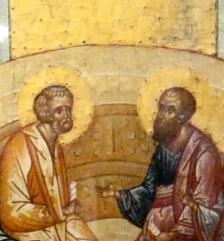
pentecost St Peter and St Paul Uncreated Church

The presence of the Apostle Paul in the icon, even though at that time he had not yet converted on the road to Damascus, hints that this icon is more than a purely historical picture. Sometimes, the evangelists Luke and Mark are also shown, despite also not having been present in the upper chamber at Pentecost. The gathering, then, is a representation of the Church. The Apostles are seated in a semi-circle, representing a unity and harmony similar to that found in Icons of the Holy Trinity. As in icons of the Holy Trinity, a semi-circle, rather than a full circle, is used so that we as observers are drawn into the unity.

pentecost Descent of the holy spirit orthodox pilgrim uncreated Church

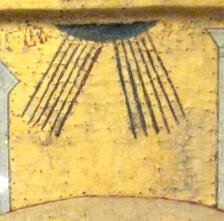
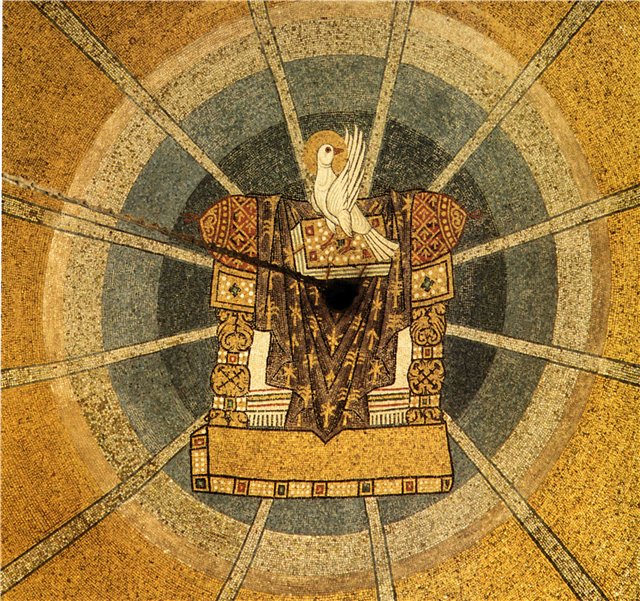
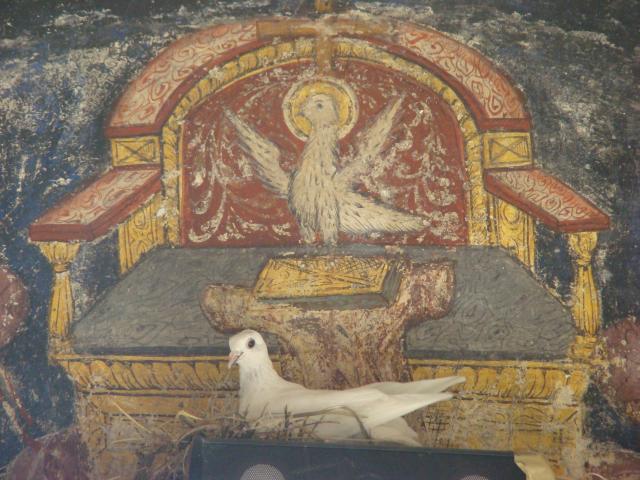
The source of their unity is in another semi-circle at the top of the icon, showing the descent of the Holy Spirit. From the blue semi-circle (c.a. mandorlas) a single ray of light for each of those gathered shines down to illumine them. Sometimes the “tongues of fire” described in Acts are shown at the tips of the rays, ready to descend upon the Apostles. Other times, the tongues of fire are shown already within the halos of each of the seated Saints. Some icons of Pentecost show a dove, either within the mandorla at the top of the icon, or even descending upon those gathered in the upper chamber. Given the appearance of the Holy Spirit as a dove during Christ’s Baptism, it is understandable that this physical image of the Spirit is also used in Pentecost icons. However, the Holy Spirit appeared as tongues of flame at Pentecost, and a dove at Christ’s Baptism, being – in reality – neither of these things. Therefore it is inappropriate to depict the Holy Spirit as a dove at Pentecost, or indeed in any icon except those for the Theophany feast.


pentecost orthodox pilgrim the world and the Uncreated Church


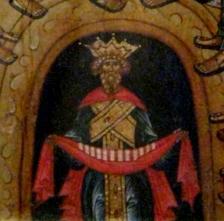
At the bottom of the Icon is another semi-circle, showing an old king against a dark background. He is often named as Kosmos and represents the world. He is crowned as a symbol of earthly authority – i.e. he represents all the peoples of the world, rather than the whole of creation. He is sat “in darkness and the shadow of death” (Luke 1:79), and is aged to show the corruptibility of the world. Yet he also holds a blanket containing scrolls representing Apostolic teaching (compare with the scrolls held by the Apostles in the Icon itself and “the meaning of objects held by saints in icons“). Though in darkness, the descent of the Holy Spirit has not only reached the Apostles, but also all corners of the world into which the Apostles will preach the Gospel. The Empty Seat A striking aspect of the Pentecost Icon is the empty space at the centre, between the Apostles Peter and Paul. This central seat is a place of honour, the “Teacher’s Seat” around which the Apostles are gathered. Why is it empty? Because it is the seat Christ should be sitting in, Who has ascended physically into Heaven. Yet Jesus promised many times that though He would leave them physically, He would instead give to them the Holy Spirit as a comforter, advocate, and guide. This promise was first realized at Pentecost, and is still true today. Therefore, the Icon, which is also an Icon of the Church, shows the Apostles gathered in unity, sustained by the power of the Holy Spirit, surrounding Christ Who is invisibly present. The world, Cosmos, is at their feet, ready and waiting to be harvested through the passing on of Christ’s teaching.


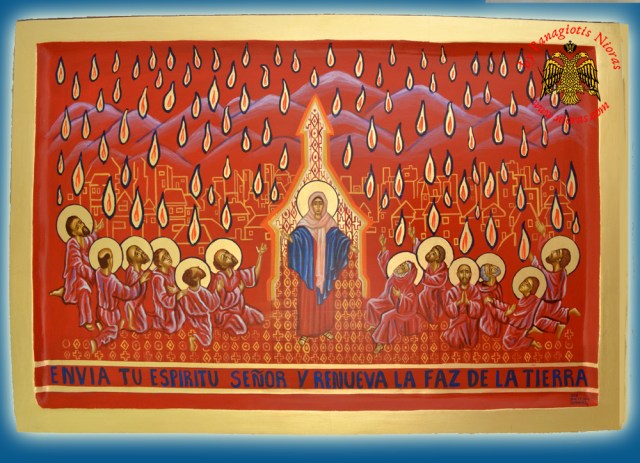
Some icons of Pentecost show Mary the Mother of God in the centre, occupying the “Teacher’s Seat”. Surviving icons of this sort are usually western (the above comes from the border between Finland and Russia). Mary was present at Pentecost, though as already mentioned, the icon is not primarily a historical snapshot of the event. The Theotokos’ presence in the centre is not problematic though, as she is the ultimate exemplar of a Christian. With Jesus Christ ascended into Heaven, the Holy Spirit acts within people, and through the Saints Christ is manifested in the world. Mary is therefore shown in the “teacher’s seat” as the best example we have, and the person on earth who most resembled Jesus Christ (both physically, as His mother, and spiritually as His disciple). Nevertheless, the “empty” seat is a more widespread and, I believe, more impressive image of both Pentecost and the Church. The Apostles are seated as equals, with no individual among them taking the central seat of authority. They don’t need to. Their unity as the Body of Christ is sustained through the real “Vicar of Christ”: the Holy Spirit.


Blessed are You, O Christ our God, who made fisherman all-wise, by sending down upon them the Holy Spirit, and through them, drawing all the world into Your net. O Loving One, glory be to You. (Apolytikion for Pentecost) More About the Feast of Pentecost>>


Source: Pentecost Icon as an Icon of the Church

The Comforter

Fascinating homily in its breadth and depth! Like all by Metropolitan Anthony of Sourozh. In it you may meditate on Nature, God’s Creation, God’s Energia in His CreationThe Little Prince by Saint-Exupery, three-fold etymology of ‘Paraklitos’, Conversion, Betrayal and Apostasy narratives, Faith and Loss of Faith, C. S. Lewis, the difference between Art and Mankind, a beautiful statues and human ‘wreckage’, Father Sergei Bulgakov’s theology, a bold, ‘heretical’, ‘syncretistic’ worship during a World Council of Churches meeting, and so much more. Enjoy!

‘The Comforter’: Our Support and Strength for Mission

I feel more than slightly apprehensive, giving this talk in the background of a very theological theme. And so, you will forgive me, if my theological statements are untheological and if the rest is very different from what you may expect.

First of all, may I make a totally non-theological statement about the Holy Spirit? When we speak of the Trinity, for people as primitive as I am, we can imagine that the old image, given centuries ago, still holds, and we can develop it on one point. Speaking of the Trinity, trying to understand the relation there is between the Father, the Son and the Holy Spirit, some writers have said that we can compare God to the sun in the sky. In its mystery, the sun is unknowable as such. No one of us will ever be able to participate in the nature of the sun, but it becomes accessible to us in its light and warmth. The light is something which we perceive with our senses, by sight, and which reveals to us everything that surrounds us. We do not see the light as such, but it is in the light that things are revealed to us. The warmth of the sun is the way in which He pervades us, and in which we can become participants — to whatever degree is accessible to us — in the life of God.

Christ the Word is an objective revelation of God. The Spirit reaches us only within our experience, in the way in which the warmth of the sun pervades us and we become aware of it, and through it of something which is of God. This is a non-theological introduction to the subject.

As an illustration of this, I would like to give you an example of a contemporary of mine, who had discovered his faith in God through an encounter with Christ. But he puzzled and puzzled about the Holy Spirit. He did not understand. One day, he found himself on a bus. It was in Paris, around the theatre of the Odeon, and he was saying to himself or to God: ‘But what does the Holy Spirit do to us? How can I know that I have had some sort of contact with the Spirit of God?’ And of a sudden he felt he was, unexpectedly to himself, filled with a love of the creation and of the human beings that were surrounding him, in a way in which he had never known he could. And he realised that, at that moment, the Holy Spirit had come to him and made him partake, to the extent to which he could, in his immaturity perhaps, in Love Divine. At that moment, he knew something about the Holy Spirit: that the Holy Spirit was communicating Himself to him by communicating to him something which could not be invented or forced, even out of his human experience.

The Holy Spirit comes to us quietly; at times unexpectedly, at times as the result of a long longing. Some of you may have read a book called The Little Prince by Saint-Exupery. There is a passage in which the Little Prince meets a little fox. Both the Little Prince and the little fox are attracted to one another, but both are desperately shy. The little fox comes and sits down at a certain distance, but whenever the boy makes a movement towards it, it runs away. Then one day the little fox says to him something like: You know, we both long to come to one another, but we are shy and afraid. So when I come, don’t make the slightest move. Look askance, so that I may imagine that you have not noticed my presence. And, not being afraid of being watched, I will come a little nearer than the day before, but don’t turn to me, because I will be afraid and run away. And then, another thing,’ he said, ‘I long to come close to you. And so, let us fix a time when you will come, because then — oh, a good hour before the time — I will know that you will be coming. I’ll come myself and wait. And I shall be filled with this expectation of the moment when you will appear. And then you will sit down and, as I said, pay no attention to me, and allow me to come nearer, and nearer, and nearer.’ This image of the little fox is something that, to me, resembles very much the way in which we relate to the Holy Spirit. Christ comes to us, proclaiming the truth. He is the Truth; He is the One who Is. He is a revelation, an unveiling. The Holy Spirit, in this sense, is not a revelation. He is the one who makes the revelation possible, by making us commune with what is the essence of this revelation: the closeness and the knowledge of God.

If we turn to what we hear in the Gospel about the Holy Spirit, I would like to attract your attention to one passage — to a word rather than a passage — that we repeat time and time again in our prayer: the Comforter. ‘Comforter” is the English translation of the word. When we look at the various languages into which it has been translated from the original, I think we can see a variety of facets in the event. First of all, the Holy Spirit, whom the Lord Jesus Christ sends us, is the one who consoles us for our loss of Christ. I am speaking of the loss of Christ, because each of us believes in Christ, each of us has had an experience of His closeness, His presence. Each of us has had, through His teaching, an experience which He conveys to us in word and in person. But, with the Crucifixion, the death of Christ and the Resurrection and Ascension, He is not present as He was present to His disciples, and He is not present in the way in which He will be present to us when all things will be fulfilled. You remember, probably, the words of Saint Paul, when he says: As long as I am in the flesh, I am separated from Christ. And yet — Christ is my life. And we are all, to a lesser degree than Paul was, of course, in the same kind of situation. On the one hand, Christ is our life; on the other hand, we are still separated from Him. We all long to be with Him, but we cannot go beyond a certain point of closeness. And Saint Paul points it out, when he says that, as long as he lives in the flesh, he is separated from Christ, and he longs for death to come. Not as an end of his earthly life, but as the moment when a veil will be torn apart and, as he puts it, he will know as he is known. He will see face to face what he can see yet only as shadows and images mirrored.

823-600x459

The Holy Spirit reveals Himself to us as our Consoler. In the sense that Christ has promised to send Him to us, He comes to us. He gives us an incipient participation in a closeness of communion with Christ, and through Christ, in Christ, with the Father. So that this is our first experience. His closeness to us consoles us for the fact that we long to meet Christ face to face, to commune with the Father in a way unutterable to us.

But the word goes beyond this. He is not only the one who comforts us; He is the one who gives us strength; strength to live in this orphaned situation in which, on the one hand, we belong to God wholeheartedly, sincerely, heroically at times, and on the other hand live in a world that has fallen away from God and in which we have a function to fulfil. He is the one who gives us strength to live in the world which at times denies everything we long for, which stands between us and our fulfilment by temptation, by beguilement.

At the same time, there is a third meaning in the word. He is not only the Consoler. He is not only the one who gives us strength to face life, in the faith and yet in the partial absence of Christ. He gives us the exulting joy of being with Christ already in this world, because, although our communion with Christ is imperfect, although it is not all-embracing, although we do not know Him as He knows us, we do know Him. And this is a miracle that we could not appreciate if we were born, as it were, in a believing family and if we had been given our faith together with our birth. But those of us who were unbelievers, the millions who believed not and have discovered, know the exulting joy of this discovery of God in Christ and through Him, of the fatherhood of God’s own Father. So that, in the Holy Spirit, we have consolation because we are orphans. We are sent into the world to conquer it for God. And in the process, at moments, we are given a sense of incredible closeness, and we can be astounded and rejoice in the way in which the young man whom I mentioned in the beginning rejoiced, having been filled, in an unutterable manner, with a love he did not know could exist; not only for humanity, not only for every concrete human person, but for the whole of creation.

We are told by Christ that He will send the Spirit to us, who will lead us into all truth. ‘All truth’ is not an intellectual situation. It is not the knowledge of the mind; it is an experiential knowledge. The truth (in Russian istina) is what is: I am He who is. And the knowledge of the truth can only be possessed in communion with Him who is. In a strange way, we have lost through the centuries this certainty that this is what the truth is. It is God Himself; it is the absolute Reality. Pavel Florensky, speaking of the truth, says: ‘Istina — eto Estina’ — the Truth is what is!’ ‘I AM’. And strangely enough, because we have moved knowledge of the truth from this existential experience onto an intellectual level, we feel that we must fight for the truth and defend it, forgetting that the Truth cannot be destroyed by any created power. The Greek word aletheia means ‘what cannot be washed away’, annihilated, even by the waters of the River of Oblivion. Nothing can do it!

If we continue to dwell on words, we could remember that the words verity, veritas, Wahrheit, derive from a Latin word meaning ‘to defend’, not ‘to be defended’. The Truth can defend us against everything, and it does not need us to defend it. This is a very important point with regard to our mission in the world, because it means that we are sent to proclaim it and reveal it, but not to defend it in argument. We cannot defend the Truth by argument. We can present another facet of things, which people can accept or not, but we cannot always defend it in the way it should be defended. I remember when I was young and began to do youth work, my father saying to me: ‘Proclaim the truth and be to people a vision of it, however dim, but do not try to convert anyone by argument, because, if you prove to be more intelligent, more well-read than another person, you will be able to defeat the other person, but you will not have changed his life. And I remember an occasion, a case in the comparatively recent history of the Russian Church in Stalin’s time. A young man called Evgraff Doulouman, who was a student at university, was looking for digs. He found a room in the house of the local parish priest. The priest was mature, ageing, with a deep and tragic experience of life: of the beginning of the Revolution and of the persecution that followed. The young man was full of his atheistic convictions, and he decided to convert the priest to what he believed to be the truth, and they engaged in conversation and discussion. The priest was an old and wise man. He did not argue point by point, but unfolded before the young man the truth as he knew it. The young man was not mature enough to go through the experience that was offered him, and he made it into an intellectual world-outlook that defeated, completely annihilated, his atheistic vision. Having been dialectically defeated, he embraced the Christian faith, asked for baptism, went to study theology in Zagorsk, was brilliant as a student, was ordained deacon and priest and was sent to Samara, I think, to a parish. It was expected that he would be a brilliant missionary, taking into account the way he had moved from refined, deep atheism into a powerful sense of Christianity. When he was in the parish, this young man discovered — in the celebration of the Liturgy, in the sacraments, in his pastoral work — that he could present the Christian truth in words, but he did not believe it all in his inner self. After a while, he renounced the Church and became an active agent of atheist propaganda. I give you this example to underline the fact that it is not in the refinement of argument in debate that one conveys one’s faith.

In the course of the whole history of Christianity, you meet people who are filled with the Holy Spirit, and whose life, whose person, whose words, in their simplicity reached others, hit them at the very core of their being and brought to life a knowledge of the divine that had been dormant. It has been for many as though the knowledge of God was like Lazarus: dead, lying in his grave, who suddenly heard a voice saying: ‘Lazarus, come out!’ And the knowledge of God, an experience that was conveyed by having heard God speak to him, made all the difference. And so, when we speak of the Holy Spirit as being the Spirit of truth, it is not the spirit of formal theological discourse or of any formal thing divorced from the inner experience. Unless it is sustained by this inner experience, it may be a convincing argument but it will not be a power that can transfigure the life of another person.

We are sent into the world to proclaim Christ, but we are not sent into the world to argue about Him. In 1943, C. S. Lewis gave a series of addresses on the English wireless, and in one of them he asks: “What is the difference between the believer that has become alive in God and any other human?’ And he says: The difference can be compared to that which there is between a statue and a living person. A statue may be of supreme beauty, but it is nothing but stone or wood. It can be looked at and admired. It can send us a message of beauty, but not of communion. This beauty will be communion with something earthly, created, but not beyond. Something must happen that will make it of the ‘beyond’. A human being may be infinitely less beautiful than a statue, but it is alive.’ And C. S. Lewis says: “When someone meets one of those statues that have become a living person, he should stop and say: “Look, this statue has come to life!” ‘ This is a challenge to each of us, because we may be satisfactory statues, but are we the kind of people whom others meet, look at and discover that there is life there and not only a shape?

It is very important for us to realise that our message to the world is not a world-outlook. It is a revelation of the presence of the Holy Spirit and of Christ. The Church is a mysterious Body, because the Church is the presence, in the midst of the fallen world, of the fullness of the divine Presence. The first member of the Church is He whom Saint Paul calls the Man Jesus Christ. He is one of us, as well as being, if I may put it that way, one of Them. He is not only One of the Trinity; He is one of humanity. Looking at Him, we can see what it means to be both totally man, human, and totally and perfectly divine. Since the Ascension and the Feast of Pentecost, the Holy Spirit has indwelt the Church totally, filled it with His presence. In the Spirit and in Christ, the whole Trinity is present in the Church. Are we Christians, Orthodox Christians, aware of this? Or is the Church a human body that looks Godward, that believes in God, that has evolved a very elaborate theology, but whose members are not limbs of Christ — as Father Sergei Bulgakov puts it: ‘an extension of the Incarnation’? Are we ‘an extension of the Incarnation’? Does anyone, meeting us, stop a minute and say: ‘In this person, there is something I have never met before. Here is a human shape, but there is something beyond it.’

I think I have mentioned a personal example which I will dare mention again. I came once to the church that became my parish for years in Paris. I aimed at being present at the Vigil, but for one reason or another I was late. The service was over. It had taken place in an underground garage, that led to ground level up a wooden staircase. I entered, and saw that everything was over. Only, there was a man coming up the stairs. It was a monk, in monastic garb, and when I looked at him I felt that I had never in my life met such total inwardness, such serenity, such peace and depth. I did not know who he was. I came up to him and said: ‘I do not know who you are, but would you become my spiritual father?’ This is a sort of central experience I had of a person in whom I saw something I had never seen to that extent: this total inwardness in the abiding presence of God, the Spirit at work, and the Incarnation in him. Years later, I received a little note from him, saying: ‘I have experienced the mystery of contemplative silence. I can now die.’ And three days later, he died. This, to me, was an example of what a Christian can be. He was not ‘impressive’ in any respect. He was not a man of superior education or of an outward holiness, but in him I could see the Incarnation and the presence of the Spirit.

When we look around, do you realise the kind of world in which we live? Bishop Basil must have talked to you about the presence of the Holy Spirit in the created world. At the moment of creation, the Holy Spirit was hovering over the newly-created world. This newly-created world, in translation, is called ‘chaos’. When we think of chaos nowadays, we think of destruction, the chaos that followed the bombing of Dresden. But chaos is something much more essential and deeper. Chaos is the sum-total of all the existing possibilities that have not yet found a shape and blossomed out. The Holy Spirit was breathing over the chaos, over all the possibilities of a world that had been called into being and had no shape yet. By breathing over this chaos, the Holy Spirit was bringing to life all its possibilities, and everything that was hidden as the possible began to emerge as reality, as you can see in the beginning of Genesis. But God did not force the shapes. He initiated the possibility for the creation to become itself more and more; to expand in depth, and in width, and in every respect

Things changed with the Fall. But what had been given first was never taken away; the created world is still that world which God created. If it is distorted, it is not because it has turned away from God, but because its guide, man, has turned away from God, has lost his way and has proved incapable of helping this chaos to become the perfect cosmos: beauty in form, in line and life, so that the world in which we live is the world which, in itself, is pure of stain except for the distortion that we have created in it. When we look at the surrounding world, we must be aware that everything that is monstrous, frightening, ugly and distorted in it is our doing. To apply to the generality a phrase that was spoken in a particular situation, one of the Fathers says: “We must remember that what we call the sins of the flesh are the sins that the spirit inflicts on the flesh. The flesh is pure.’ We make it a victim of sin. Our body says: ‘I am hungry.’ Our imagination says: ‘I want to delight in such-and-such foods.’ The natural situation of the created world is that of a victim of the human fall, of our being separated from God, of our being unable to restore, even in a small patch of land, the purity, the wholeness and the harmony that belong to it by right. This we must remember. With what veneration must we look at the cosmos and everything that is the material world around us, and what broken-heartedness we must feel when we see it distorted, broken, ugly and monstrous at times.

Again, when we turn to God, to God’s revelation and the creation of man — the Lord God breathed His own breath into man: that is the original human, the anthropos, the chelovek, and man, the total man, has remained filled with the Spirit of God. We must remember this: it is not our Christian, our Orthodox, privilege to be such. All human beings are such. Sinful, yes, but basically such. And so, when we look round at all human beings, we have no right to see good in some and evil in others. We must see victims of the human fall in one and the victory of Christ in the Spirit in the other. The saints are examples of this victory. To them, to the extent to which it is possible in a world which has not yet come to the parousia, to its end in Christ’s victory, we find, incipiently or still-surviving, true humanity. And this we must remember when we deal with whomever we deal with. Some people are ‘evil’, yes. But why are they? Have we given them newness of life by being a revelation of Christ and a gift of the Holy Spirit? It is easy, perhaps, at times to be compassionate to a person in error, but how easily do we condemn the error from the height of what we imagine to be the truth as we know it!

I have paid some attention, in the course of the last seventy years or so, to the beliefs of men, to the religions of the world. What strikes me more and more is that, however different they are from the faith of Christianity, they are all a distortion of the truth; not a straight lie against it, except for some who have chosen to be servants of Satan and not servants of Christ.

I would like to keep you a little longer than I intended: my forty-five minutes are just over. If you will allow me ten more minutes, I will let you free.

437

Many years ago, I had a conversation with Vladimir Lossky about oriental religions. He was absolutely in denial of any knowledge, any true knowledge of God, in them. I did not dare argue with a theologian of such magnitude, but what courage could not achieve, I thought cunning might. As we lived across the street from one another, I went home and copied eight passages from the Upanishads, the most ancient Indian writings, went back to Lossky and said: “Vladimir Nikolayevich, I have been reading the Fathers, and I always take down the passages that strike me particularly. I always put down the name of the author, but alas, with these eight quotations I cannot find the author’s name. Could you identify them for me?’ He looked and said: ‘Oh, yes!’, and within a minute and a half he had put eight names of the greatest Fathers of the Church under the quotations from the Upanishads. And then cunning revealed itself in false humility, and I said to him: ‘I’m afraid I have deceived you. These are from the Upanishads.’ He looked at me and said: ‘Really? Then I must read them.’ And that was the beginning of a change of mind in him with regard to the statements of other religions.

Many years ago, in 1961, I was part of the first Russian delegation to the World Council of Churches in Delhi. Among a number of us, there was a man called Father Ioann Wendland, who later became a bishop in America and in Germany. He had been a secret priest in Siberia while doing geological research during the Stalin period. We decided to go to a pagan place of worship, to see and to try to understand. We arrived there. At the door, we had to take our shoes off, which we obligingly did, and we were about to leave them there when the warden came up to us and said: ‘Oh no, sir, you do not leave your shoes here. They are new and good, and would be stolen. I’ll put them in my office.’ So our shoes went into the office and we went into the place of worship. It was a round place of worship, divided into ten or twelve sections, and in each of them there was what we would call a pagan denomination, worshipping in its own way. We sat one after the other in the ten or twelve compartments, at the back, using our rosaries and praying the Jesus Prayer, trying to commune with God and seeing if we could commune with the people there. We both came out of it with the certainty that, whatever they called their god — whether it was the god-elephant or the god-monkey or another — they were praying to the only one God there is. And we had communed in prayer with them all, in spite of the fact that, on the surface, they had been praying pagan prayers to idols. That also made me think.

I will end your torment with one more thing. What I have said should make us much more understanding and attentive in our attitude to unbelievers. Not those who are empty of belief but those who are actively godless. I will give you one example, which some of you must have heard from me, because I always repeat myself. The example is this: I was coming down the steps of the Hotel Ukrainia a number of years ago. I was wearing my cassock, as I always do. A young man came up to me and said: ‘I am an officer in the Soviet Army. You are, I presume, a believer, dressed as you are.’ I said: Yes.’ Well, I am an unbeliever. Bezbozhnik (I am godless).’ I said: That’s your loss.’ He said: ‘And why should I turn to God? What have I got in common with Him?’ I said: ‘Do you believe in anything at all?’ Yes,’ he said, ‘I believe in man and in humanity.’ I said: ‘In that, you and God share the same faith. Start at that point.’ And, I think, more often than we do, we should be aware that there is no-one who lives without a faith, without believing in something. And more often than not, we may discover that God believes in the same. Only better, deeper, more perfectly, but that this person who fears that there is nothing between God and him has something in common with Him. At this point, we may remember the passage of the Gospel in which Christ says to Nicodemus: The Spirit blows where It chooses, and no-one knows where It comes from and where It goes.

We must be infinitely reverent when we look at the world that surrounds us, which we have distorted and which suffers like a martyr under the result of human sin, and remains pure, so pure that God could become man and put on flesh; a flesh He inherited not only from the personal saintliness of the Mother of God but from the fact that she was the heir of all the saintliness of thousands of years of human life in history. We must remember that all humans are possessed of this breath of life which is God’s breath and God’s life, however distorted it may be. We must remember, as I have said, that the Spirit blows where It chooses. Without this precondition of the way in which the world, mankind, relates to God, no-one — no one of us and no-one in the world — could discover God. It is the Spirit that reaches us and that kindles in us life eternal. So, when we speak of being sent into the world, we must remember that we are unworthy messengers of a message that may be received by the created world around us, and by the humankind around us, better than we are capable of proclaiming it.

How often it happens that words of truth are said that do not reach the congregation that is there, but reach someone who by accident, or by an act of divine Providence, has entered the church. We must remember this. And go into the world, not to proclaim a theoretical theology of the mind but to grow into the life of Christ, to open ourselves to the action of the Holy Spirit, to believe that the Holy Spirit is active in the created world which is dear to God. Dear to God, because the Body of Christ belongs to this created world through the Incarnation, and to mankind — to everyone.

‘Violent’ Spirit — Viaia Pnoi

It has been such a  hectic week with me returning hastily back ‘home’ due to the sudden deterioration of my Father’s condition! A glorious week too, full of the honouring of the Holy Spirit in so many church services, the climax of the Orthodox liturgical cycle: Pentecost and the Descent of the Holy Spirit!


Giver of life: come, and abide in us


holy-spirit3


Then Father Seraphim took me very firmly by the shoulders and said “my son, we are both at this moment in the Spirit of God. Why don’t you look at me?”
“I cannot look, Father” I replied – “because your eyes are flashing like lightning – your face has become brighter than the sun, and it hurts my eyes to look at you.”

“Don’t be afraid” he said, “at this very moment you yourself have become as bright as I am. You yourself are now in the fullness of the Spirit of God; otherwise you would not be able to see me as you do.”

Then – bending his head toward me, he whispered softly in my ear: “thank the Lord God for his infinite goodness toward us… But why, my son, do you not look me in the eyes? Just look and do not be afraid; the Lord is with us.” (St Seraphim of Sarov and his encounter with Nicholas Motovilov)

holy-spirit2

Let us bow mystically to the Comforter and listen attentively to a fascinating testimony by a fascinating ‘convert’: Father Michael Harper. Crystalline Orthodox insights, such as probably only ‘converts’, or at least, they more often than ‘cradle’ Orthodox, may provide. 


And from the days of John the Baptist until now the kingdom of heaven suffereth violence, and the violent take it by force. (Matthew 11:12)

And suddenly there came a sound from heaven as of a rushing mighty wind (ie. “Kathaper feromenis Viaias [Violent] Pnois”), and it filled all the house where they were sitting. (Acts 2:2)

“Kathaper feromenis Viaias Pnois” — Violent is truly the proper translation of the original Greek word, not just ‘mighty’!


“Most will agree that the Church which through the centuries has most fully honoured the Holy Spirit, and brought Him most fully into its worship, life and ministry has been the Orthodox. Let us look briefly at five areas where this is clear:

First, there has been the strong emphasis in the whole life of the Church on the Trinity, which sees the Father, the Son and the Holy Spirit as co- equal. The Church has also condemned the insertion by the Western Church of the filioque clause into the Nicene-Constantinople Creed, which weakens the co-equalness of the Persons of the Trinity.

Secondly, the Orthodox Church has always emphasised the Incarnation and thus the work of the Holy Spirit in the conception of Christ in the womb of the Theotokos, the God-bearer.

Thirdly, the Orthodox Church has been the only Church to continue the practice of Christian baptism as the three-fold immersion of the candidate in water, followed immediately by chrismation symbolising the reception of the Holy Spirit and followed then by the candidate receiving their first communion. Again the Holy Spirit is active in the whole Baptism process.

Fourthly, in the Orthodox Eucharist (of St John Chrysostom), which is seen by the Orthodox as the heart of the Church, the service is interspersed with many references to the Holy Spirit. It begins, for example, with a prayer to the Holy Spirit which is unique in liturgical practices:

O heavenly King, Comforter, the Spirit of Truth, who art everywhere present and fillest all things, Treasury of good things and Giver of life: come, and abide in us, and cleanse us from every stain, and save our souls, O good One.


http://pemptousia.com/video/fr-michael-harper-the-holy-spirit


In the Russian tradition the following words are spoken by the Priest just before the Epiclesis: “O Lord, who at the third hour didst send down upon thine apostles thy Holy Spirit: take not the same from us, O good One, but renew him in us who pray unto Thee.”

Then follows the important epiclesis prayer which the Priest says, “send down thy Holy Spirit upon us and upon these gifts spread forth.” Notice it is a prayer for the Holy Spirit to come upon the people as well as the bread and the wine. Earlier in the service, if there is more than one Priest at the service, a dialogue takes place:

Pray for me, brother(s) and concelebrant(s)
May the Holy Spirit descend upon thee and the power of the Most High overshadow thee
May the same Spirit serve with us all the days of our life.

In another place the Priest prays that “the power of the Holy Spirit” will enable him.

holy spirit1.jpg

Fifthly,… For the rest of the article, go here

For an interview with Father Michael Harper, go here

The Pending, the Proselyte and the Prescient

Three Vignettes 


The Antiochian Orthodox Christian Archdiocese of the British Isles and Ireland held its first Archdiocesan Conference with our own resident Metropolitan, Sayedna Silouan at the Hayes Conference Centre, Swanwick, Derbyshire from Monday 23rd May to Wednesday 25th May 2016. This conference ‘welcomed’ me to the UK, initiated me to the Glory of Orthodoxy in Great Britain and drafted me to the (Antiochian) English Orthodox Church. Amidst its brilliant theological talks, its moving church services, and its heart-warming communion with my brothers and sisters in Christ, three pairs of eyes, three vignettes haunt my memory.

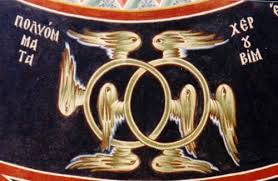
Ezekiel 1 :16—28

“The appearance of the wheels and their work was like unto the colour of a beryl: and they four had one likeness: and their appearance and their work was as it were a wheel in the middle of a wheel. When they went, they went upon their four sides: and they turned not when they went. As for their rings, they were so high that they were dreadful; and their rings were full of eyes round about them four. …. And when they went, I heard the noise of their wings, like the noise of great waters, as the voice of the Almighty … Above the vault over their heads was what looked like a throne of lapis lazuli, and high above on the throne was a figure like that of a man. … As the appearance of the bow that is in the cloud in the day of rain, so was the appearance of the brightness round about. This was the appearance of the likeness of the glory of the LORD. And when I saw it, I fell upon my face, and I heard a voice of one that spake.”


cherubim1

The Pending

1 Kings 19:11

“And he said, Go forth, and stand upon the mount before the LORD. And, behold, the LORD passed by, and a great and strong wind rent the mountains, and brake in pieces the rocks before the LORD; but the LORD was not in the wind”

His eyes were the most vibrant, fiery, scorching eyes I had ever encountered. Yet, full of Love! Our Bishop is a very young and most intense man. He took me aside and began to ask the most probing questions, piercing holes to my heart. It felt like Confession rather than conversation. I was fast reduced to tears.

‘Why are you crying?’ ‘Out of joy!’ ‘Why?’ ‘For being with you!’ How else could it be before such blazing purity?

He did not mince his words. ‘All this is a Cross to me.’ ‘Why, Sayedna?’ (It is not that I did not know that being a bishop is a cross. If a novice needs the patience of a wagon, the hegumen needs a whole train! I remember reading this in a book once.) ‘Why? What would you rather do?’ ‘I would rather be in a monastery. Any monastery. Any where. In Syria. In Greece. Any where. As long as I were in a monastery.’

(This fast became  a refrain in many conversations during the conference. So many people here would rather be in a monastery but were called by the Lord to work for Him in the world. Frustrating yes, exhausting yes- sacrificial most certainly, but could they do anything else in order to follow Jesus? No! )

‘I have come here out of love.’ ‘So many people here, Sayedna, want to go to a monastery.’ ‘Would you like that too?’ ‘Yes, but we are still young and we must work for Him’. Such prescience, such bright sorrow in his eyes!

Suddenly, out of the blue, a middle-aged Anglican kneels before him and asks for his blessing! The year he had spent during his Cambridge studies in Balamand (!), Syria, Lebanon and Turkey “was the happiest in his life!”

‘Come home!’ another ‘convert’ invites him. ‘But I am a Westerner. How can it be?’ ‘So am I.’ the other replies. ‘Why stay at the Church of England if your heart is Orthodox? Come home!’ And: ‘Why do you make further schisms rather than return back to the original faith, the source?’

He, too, is fast reduced to tears and kneels, unable to utter a word. It is not the questions themselves but the ‘authority’ and holiness of the person who is asking them. These eyes! The ‘Reluctant’, Doubting Anglican may not be ready (yet) to make the leap of faith! But a hole in his heart has been made!

The Proselyte

1 Kings 19:12

“And after the wind an earthquake; but the LORD was not in the earthquake”

She was a newly-baptised Muslim Convert. She kept telling everyone that she was only twenty days old! And indeed her eyes were the kindest, purest and brightest ones I had encountered for a very long time. ‘Please pray for us. The Holy Spirit is so near you these days!’

She is hearkening back to that “memory of the glory that I had when I was entirely with You and entirely in You, before time and temporal illusions.

When I, too, was a harmonious trinity in holy unity, just as You are from eternity to eternity.

When the soul within me was also in friendship with consciousness and life.

When my soul also was a virginal womb, and my consciousness was wisdom in virginity, and my life was spiritual power and holiness.

When I, too, was all light, and when there was no darkness within me.

When I, too, was bliss and peace, and when there were no torments of imbalance within me.

When I also knew You, even as You know me, and when I was not mingled with darkness.

When I, too, had no boundaries, no neighbors, no partitions between “me” and “you.” (St. Nikolai Velimirovich, Memories – Prayers By the Lake XXX)

Such purity and newness of Life, Light and Harmony reflected in her eyes! Indeed, “the eye is the lamp of the body; so then if your eye is clear, your whole body will be full of light.” (Matthew 6:22)

She was so eager to learn and yet she was teaching all of us! Her parents had not been told of her baptism, and there was no way she was going back to her homeland.

‘How were you drawn to the Faith?’ ‘Christ Himself appeared in person twice to me and called me, but I was not ready to take that step then. I did not have the guts. Yet in the end, I just could not ignore His calling! I had to become an Orthodox, even if that meant that I would be irreparably separated from my family and relatives and become a stranger in my own country and an exile.’

‘How are you feeling?’ ‘I am in Heaven’. (Radiant Smile) As if it did not show …

The Prescient Priest

1 Kings 19:13

“And after the earthquake a fire; but the LORD was not in the fire. And after the fire a still small voice. When Elijah heard it, he pulled his cloak over his face and went out and stood at the mouth of the cave. …”

He was a ‘convert’ too. His eyes were by far the most playful I had ever encountered! ‘Clean’ and fresh like an ocean breeze, magical, charming, fairylike, sprightly, with elfin grace, conjuring deep, green forests and starry nights! Who said that holiness is forbidding and austere? This priest is the most humble and welcoming I have ever received a blessing. You feel like an innocent small child in his presence. Still, he is so otherwordly, light and free! Literally floating!

At a break between talks, I whisper to a friend of mine: ‘Let us go and get his blessing! He is such a holy man, so special and close to God!’ She readily agrees. Before however a move is made or a look is exchanged, something most unexpected happens. He could not have listened! He is far away, across the hall! And yet, the moment my words are uttered, he suddenly fixes his eyes meaningfully on me, smiles mischievously with elfin delight, apparently most ‘proud’ at his practical joke, and starts to make a funny pantomime, as if he is ‘escaping’ from us!

Wait a minute! This cannot be happening! I run to his side and ask him: ‘How on earth, pappouli, did you hear? Or know what we were planning to do? You can’t have possibly heard us at such a distance!’ ‘Of course, I can’, he answers smiling even more elfishly. ‘I am so proud and conceited that I am always eavesdropping, eager to listen to other people’s praises!’

He is not telling the truth, of course. And his blessing is a small miracle that seals my participation at this conference. Ever since, I feel his prayers, and bless the Lord for allowing me to “see through a glass, darkly; but then face to face”, for catching a glimpse of Orthodoxy in Great Britain through the eyes of the prescient priest!


Keep Your Mind in Hell


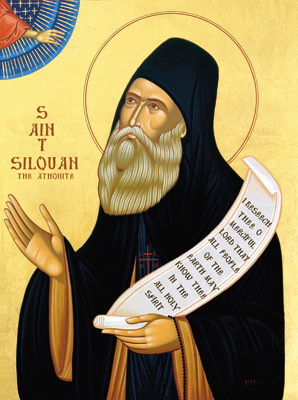
icon_st_silouan_athonite.jpg

… and Despair Not

Not for the faint-hearted!

“No one on this earth can avoid affliction; and although the afflictions which the Lord sends are not great, men imagine them beyond their strength and are crushed by them. This is because they will not humble their souls and commit themselves to the will of God.”


These words seem to sum up soberingly D. Balfour’s tumultuous life, and indeed in so many respects ours…


SPEECHLESS! “It seems ludicrous to rate a book like this according to a certain amount of stars…I searched for it after reading the book I Know a Man in Christ — a great book about our holy and blessed Elder Sophrony, which mentions this correspondence with the amazing Englishman David Balfour. I imagine that the only reason why anyone would be interested in this book would be to learn about this incredible spiritual friendship. (No! There are so many more reasons to want to study this book) And this book does allow for that — and much more besides. I’ve read letters of spiritual direction before. These letters go way beyond that. They give insights to the Elder and to St. Silouan which are simply impossible to convey otherwise. And this David Balfour — he went from Catholic hieromonk to Orthodox hieromonk to British Army major and intelligence officer to diplomatic interpreter to midlife husband and father to Oxford Byzantine scholar in old age. A biography of him wouldn’t go amiss, although I don’t think we’ll see one. And underlying his whole life is the gaining and the losing and the eventual regaining of that inestimable treasure, the Holy Orthodox Christian faith and Holy Grace. Not for the faint of heart.” (D. Kovacs )


Not for the faint of heart.” Most certainly!


What an intense book which can be read on so many levels! A heart-rending spiritual biography of a brother in Christ struggling for his faith and the salvation of his soul amidst staggering trials, temptations and tribulations! A sobering warning too to all of us to be deadly serious with our faith and never forsake our obedience to our spiritual father at any cost! Hell indeed broke loose when Balfour decided to disobey St. Silouan and use his own mind instead for his life-decisions! To give you just one example: After converting to Orthodoxy and becoming an Orthodox hieromonk, Balfour disobeyed St Silouan’s ‘suggestion’ to move to France, and then to England, and went to Greece instead. Things went well at first, but with the outbreak of the Second World War, Balfour was forced to flee Greece and started wandering all over Europe, while undergoing a very dark period of disobedience, disillusionment, doubt and eventual loss of his faith, to the extent that he decided to shave his beard and defrock himself in Cairo, Egypt! I cannot even begin to imagine how traumatic all this experiences must have been for him!

elder-sophrony


What a most sobering book! “For Whom the Bells Toll” indeed. How often have I betrayed the Lord and disobeyed my spiritual father in the past! How dire the consequences of my disobedience have always been! Indeed, how fragile our faith is, how precarious our decision to follow the Lord at any cost like a true disciple, how unpredictable our falls and how uncertain our salvation until the very last moment of our life!


Striving for Knowledge of God: Correspondence with David Balfour is a treasury of wisdom distilled from Fr. Sophrony’s reading of the Fathers of the Church, from his conversations with St. Silouan, and from his own experience. Since most of these letters were written to someone new to the Orthodox Church and to Orthodox monasticism, they are of greatest interest to anyone contemplating converting to Orthodoxy.


In particular, the correspondence touches and elaborates on the difference between Eastern Orthodox and Western thought, in both Christian and philosophical writings. Thus Fr.Sophrony mentions Schleiermacher, Spinoza and Kant, and St John of the Cross (The Dark Night of the Soul). He dedicates a few pages to the concepts of the heart and prayer. In Eastern Christianity, he argues, the spiritual heart is not an abstract notion but is linked with our material heart and has its physical location. In opposition to the Western search for some visionary mystical experience, Fr.Sophrony advocates the prayer of repentance, which is the basis of all spiritual life.


As a reply to Balfour’s doubt over the importance of specifically Eastern ascetic and dogmatic traditions, Fr.Sophrony asserts the organic integrity and integrality of ascetic life, dogma and the Church. Criticising Schleiermacher in connexion with this issue, he writes:


“There are three things I cannot take in: nondogmatic faith, nonecclesiological Christianity and nonascetic Christianity. These three – the church, dogma, and asceticism – constitute one single life for me.” – Letter to D. Balfour, August 21, 1945.


“If one rejects the Orthodox creed and the eastern ascetic experience of life in Christ, which has been acquired throughout the centuries, then Orthodox culture would be left with nothing but the Greek minor [key] and Russian tetraphony.” – Letter to D. Balfour.


Fr.Sophrony also warns against attributing to intellectual reasoning the status of being the sole basis for religious search:


Historical experience has demonstrated that natural intellectual reasoning, left to its own devices, fatally arrives at pantheistic mysticism with its particular perception of reality. If this takes place in the soul of the Christian who does not want to reject Christ (as in the case of Leo Tolstoy), he arrives at Protestant rationalism or at spiritualism, which stands mystically close to pantheism… I am convinced that the rejection of the Church will lead to the rejection of the Apostolic message about Сthat which was from the beginning, which we have heard, which we have seen with our eyes… and our hands have handled (1Jn.1:1) [148].


On a more general level, these letters are full with profound theological and spiritual insights. What a most blessed golden ‘chain’ of Grace and Sainthood! Elder Sophrony, already under consideration for glorification, was ordained to the diaconate by St Nicolai (Velimirovic) of Zicha and became a disciple of St Silouan the Athonite. Can you imagine? All these Saints were also ‘connected’ with the greatest probably Saint of our century, St. John Maximovitch! St. Nikolai Velimirovich is often referred to as Serbia’s New Chrysostom. St. John Maximovitch, who had been a young instructor at a seminary in Bishop Nikolai’s diocese of Ohrid, called him “a great saint and Chrysostom of our day [whose] significance for Orthodoxy in our time can be compared only with that of Metropolitan Anthony (Khrapovitsky). … They were both universal teachers of the Orthodox Church.”


Coming back to the book, of all theological concepts touched upon in this book, the one which most interests me  is the concept of Godforsakenness, as outlined by Fr.Sophrony, who worked out a distinction between two types:The first one is when man deserts God: To the extent that we live in this world, to that same extent we are dead in God. The second one is when God hides from man: a horrific state of Godforsakenness. When man has no more life in this world, i.e. cannot live by this world, the memory of the divine world draws him there, yet despite all this darkness encompasses his soul. He explains: these fluctuations of the presence and absence of grace are our destiny until the end of our earthly life. Fr.Sophrony saw suffering as a necessary stage in ascetic development: Divine grace comes only in the soul which has undergone suffering.


“We must have the determination to overcome temptations comparable to the sorrows of the first Christians. All the witnesses of Christ’s Resurrection were martyred. We should be ready to endure any hardship.”


“The most important thing in the spiritual life is to strive to receive the grace of the Holy Spirit. It changes our lives (above all inwardly, not outwardly). We will live in the same house, in the same circumstances, and with the same people, but our life will already be different. But this is possible only under certain conditions: if we find the time to pray fervently, with tears in our eyes. From the morning to ask for God’s blessing, that a prayerful attitude may define our entire day.”


“Whoever gives up his cross cannot be worthy of the Lord and become His disciple. The depths of the Divine Being are revealed to the Christian when he is crucified for our Savior. The Cross is the foundation of authentic theology.”


Not for the faint of heart, indeed!

The Holy and Great Synod of the Orthodox Church – Metropolitan Nikolaos of Mesogaias

metropolotan-mesogaias

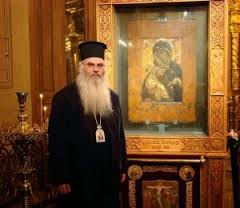
  • Theotokos of Vladimir, one of my favourite Theotokos icons, side by side with Metropolitan Nikolaos of Mesogaias, one of the most enlightened, holy and loved Hierarchs of our times, and a great favourite of mine! I had the blessing of meeting him in various church services and conferences in Greece and abroad and I have always experienced Holiness, Light and Love by his side! I would never let go of his hand!

His Eminence, Metropolitan Nikolaos of Mesogaias and Lavriotikis, recently sent the following encyclical message concerning the decision to convene the Holy and Great Synod in Crete, to the clergy and laity of the Holy Metropolis.

His Eminence’ Encyclical follows:

Dear Fathers and brothers, CHRIST IS RISEN!

I am sure you have been informed that beginning on the Sunday of Pentecost for about ten days the so called Holy and Great Synod will take place in Crete. This is a pan Orthodox Synod: in other words all the autocephalous Orthodox churches will participate, represented by arch-priests and headed by their leaders, that is to say their Patriarchs and Archbishops. Some have called it an Ecumenical Synod, although recently in particular for certain reasons they have avoided this title.

A Synod of this size is unique for the second millennium, that is it is the only one after the schism of Rome from the unit of the other Churches, namely from the body of the One, Holy, Catholic and Apostolic Church as we confess in the Creed.

The importance of this Synod and the hopes and expectations concerning it can be perceived. Therefore I consider it my pastoral responsibility to address you, to inform you of its ethos and its significance, since the laity according to our ecclesiastical tradition is not a mere spectator of events, but participates through prayer, dialogue and with their healthy reaction to the life of the Church.

A Synod of this dimension is convened in the name of the Tri-une God, chiefly for spiritual purposes, in order to unite the body of the faithful, to support them, to indicate the path of truth, to heal their perplexity and at the same time to bear witness to the contemporary world in the context of its mission, that is to say to reveal the one truth of God “to all nations” according to the exhortation of the Lord (Matthew Chapter 28, 19)

It must be done supported by the Holy Gospels, interpreted correctly, and according to the Holy Tradition of previous Synods, and to the teaching of the Holy Fathers, and of course with reference to the problems of the modern age. It is immediately obvious that the findings of this kind of Synod must be clear, very strong,prophetic and inspired by God. It is as though God opens His mouth to speak after a thousand years of Synodical silence and to a “ warped and crooked generation” (Deuteronomy 32,5), which is confused, makes compromises, reaches dead ends, makes errors, heresies, is in denial, full of atheistic madness, a generation which overthrows  basic timeless values. There is a threat from all sides to the human being, in an age of worldwide insecurity, where technology has super strength; digital imprisonment; co-ordinated insults against God; mass destruction of ancient civilizations; the violent uprooting of peoples from their historical roots; and apocalyptical persecutions of Christians.

The voice of the Church must be “the voice of the Lord is on the waters” (Psalm 29,3) or “ the noise of thy waterspouts ”.(Psalm 42,7) It must move people and resurrect dead lives. If we are not ready for something like that, then it is better to wait, better still even at the last moment to postpone the Synod for later.

If four hundred bishops are photographed together in Crete with conventional smiles, having previously stirred up nothing, or have signed texts without the blood of truth or the water of life, without the knife edge of spiritual speech or reason, with meaningless theological formalities, to camouflage the truth and beautify reality, all this will not only render the Synod meaningless, but will also, more importantly, damage the prestige of the Orthodox witness now and for ever.

The Synod must take place only if it has to say and show something so powerful that it will resurrect all our hopes, lighten our darkness, cancel out the politicians’ suspicions and the egoistic expediency of our age which reaches even to our clergy.

The whole world thirsts for truth, hope, light, strength, life and authenticity. This is what is missing in our age. We are congested by lies, compromises, mediocrity, suspicious expediency, dead religions, faith without substance, religious fanaticism without substance, shallow and ridiculous displays and shallow embraces.

We can no longer suffer the secularization, syncretism, opacity, bilingualism, and public relations theology: the degeneration of the Church from a sacrament of revelation of the true God and the manifestation of His will, to a semi –religious concoction with a worldly orientation. We hope and pray that the Synod will be a witness to unity which is certainly not something small, but also a prophetic message. Indeed the fact that all these Orthodox churches will meet and announce the fact that despite widely varying languages and mentality, despite our faults and human weaknesses, despite our misunderstandings and contrasts, our possible differences and conflicts we share this one faith in the Tri-une God and in the God-Man Lord Jesus Christ, in the sacraments of the Church and of the people and this common faith is what we confess and proclaim: this is great and holy and it alone makes the Synod Great and Holy. However its rationale must be God inspired. It must make as the other Synods did, an impression on history, and impart honour and value in our age as nothing else has done, it must make an indelible mark on the life of the Church. It will be the voice of God today! Otherwise it has no value. His silence is enough.

We do not wish to hear the human words of contemporary bishops nor to learn the thoughts of the more educated and clever than they are.

We want to hear the voice of God from the lips of our bishops and even more from the convocation of our Synod. If today’s lay Christians are not comforted, if we are not supported and illuminated, if coming ages do not have recourse to this Synod as a source of irrefutable truth, then why should it be convened? The rationale, the raison d’etre of the Church cannot be banal or a half measure or little, and what the Synod has to say and what it should say is certainly not little.

This has been a millennium inspired by theological wisdom such as that of Saint Gregory Palamas, an experience of unceasing continual worship, analysed indeed by theologian saints such as Saint Nicholas Kavasilas and Saint Symeon of Thessaloniki, a time of confession and the blood of the new martyrs, watered by the sweat of great ascetics such as Saint Seraphim of Sarov and the contemporary Saint Paisios, sealed by signs and miracles of the saints up to the present day such as Saint Nectarios and Saint Luke, bishop of Crimea, the saints of the Russian Church, of the Balkan Churches and of Greece, and of the whole world. A path through the sea of the grace of God within ecclesiastical unity must be registered as the “new rationale», the message of the Great Synod. Today when man has become a biological machine or a social unit or has degenerated into an ephemeral entity or a device for controlled thought, is it possible for the Orthodox witness of the community of God, engraved and documented through experience in our churches and monasteries in our sacraments and in our life not to be a stentorian pan Orthodox call in our times?

It is impossible to imagine that in this age of insidious and ferocious persecution of the church, unprecedented spiritual asphyxiation, confusion and “distress of nations with perplexity, the sea and the waves roaring.”(Luke 21,25), in an age full of the anguish of the last days, that this Great and unique Synod of the Orthodox will be content with a news report, a communication with photographs, bereft of meaning and dry in content. This Synod is the only one after the Schism. The secession of the West from the trunk of the ecclesiastical tree has most certainly caused errors, different teachings and heretical beliefs for which perhaps today’s Western Christians may not be so much to blame as is often presented.

The Synod has a huge responsibility to protect us from every danger of this sort, not harshly treating without pity those who unwittingly inherited the error but identifying it with pain, love and theological accuracy.

It also has the ineffable responsibility first and foremost to challenge the Orthodox to repent at the same time, so as to live consistently the truth which by the grace of God we inherited or discovered.

We must repent first if the others are to return. If we do not live this then the Orthodoxy we confess is lacking, and if the Synod does not tell us this, it may be great but it is not Orthodox.

Is ecumenism a heresy? Could it be a blessed initiative in some conditions ? Is anti-ecumenism always acceptable to God?

Can the Church be One and not Catholic and Holy, that is emphasizing the Orthodox confession and not the corresponding missionary testimony? Could it be Catholic without being one, that is to pursue the unity of Christianity, sacrificing its uniqueness, in other words its consciousness that it is the One Holy Catholic and Apostolic Church? We expect this Synod to speak persuasively about the uniqueness, holiness, Catholicity and apostolicity of the Church in an authentic dialogue full of repentance and practical holiness to the Orthodox, to speak with respect and love to those with other beliefs and not with overweening triumph or empty sweet talk to keep the worldly balance. We need to learn the traditional respect through which our ancestors in Constantinople showed that they were ready and willing to die

“We shall not deny thee, beloved Orthodoxy, nor will we be false to thee, tradition’s respect. We were born to thee, we will live in thee, and in thee we will fall asleep. If the times call for it we will die for thee many times.” Joseph Bryennios said.

If our ecumenism is not missionary or prophetic it cannot be Orthodox and ecclesiastical. Dear brothers, I ask you all to have a humble vigilance, to have heartfelt prayer, to struggle and have repentance, for God to give the Synod His voice and for the Synod’s rationale to be really God inspired, and for our hearts to be resurrected with the persuasion that “The Lord is alive” today.

We have so much need of this: everyone does! Only in this way will the Synod be Holy indeed and not by economy. If the Synod is not Holy it will not be Great either and if it is not Great then the question why it was convened will be the only thing Great about it.

St. Porphyrios and a Nightingale

My heart has been very moved by a passage from Wounded by Love, the Life and Wisdom of Saint Porphyrios. It speaks to so much of my own life and the world around me that for this post I would like to invite you in to hear his wonderful story of one lone nightingale. May the Celtic Orthodox spirit of seeing God’s energia in His creation bring peace to you. Please let it sink deep into your heart, I know that I am trying to do the same. Holy Father Porphyrios, pray to God for us!

One morning I was walking alone in the virgin forest. Everything, freshened by the morning dew, was shining in the sunlight. I found myself in a gorge. I walked through it and sat on a rock. Cold water was running peacefully beside me and I was saying the prayer. Complete peace. Nothing could be heard. After a while the silence was broken by a sweet, intoxicating voice singing and praising the Creator. I looked. I couldn’t discern anything. Eventually, on a branch opposite me I saw a tiny bird. It was a nightingale. I listened as the nightingale trilled unstintingly, its throat puffed out to bursting in sustained song. The microscopic little bird was stretching back its wings in order to find power to emit those sweetest of tones, and puffing out its throat to produce that exquisite voice. If only I had a cup of water to give it to drink and quench its thirst!

Tears came to my eyes – the same tears of grace that flowed so effortlessly and that I had acquired from Old Dimas. It was the second time I had experienced them.

I cannot convey to you the things I felt, the things I experienced. I have, however, revealed to you the mystery. And I thought, ‘Why does this tiny nightingale produce these songs? Why does it trill like that? Why is it singing that exquisite thought? Why, why, why…why is it bursting its throat? Why, why, for what reason? Is it waiting for someone to praise it? Certainly not. No one there will do that.’ So I philosophized to myself. This sensitivity I acquired after the experience with Old Dimas. Previously I didn’t have it. What did that nightingale not tell me! And how much did I say to it in silence: ‘Little nightingale, who told you that I would pass by here? No one comes here. It’s such an out-of-the-way place. How marvelously you unceasingly carry on your duty, your prayer to God! How much you tell me, and how much you teach me, little nightingale! My God, how I am moved. With your warbling, dear nightingale, you show me how to hymn God, you teach me a thousand things beyond number…’

My poor health does not allow me to narrate all this to you as I feel it. A whole book could be written about it. I loved that nightingale very much. I loved it and it inspired me. I thought, ‘Why it and not me? Why does it hide from the world and not me?’ And the thought entered into my mind that I must leave, I must lose myself, I must cease to exist. I said to myself, ‘Why? Did it have an audience? Did it know I was there and could hear it? Who heard it as it was bursting its throat in song? Why did it go to such a hidden location? But what about of all these little nightingales in the middle of the thick forest, in the ravines, night and day, at sunset and sunrise? Who heard their throat-bursting song? Why did they go to such secret places? Why did they puff out their throats to bursting?’ The purpose was worship, to sing to their Creator, to worship God. That’s how I explained it.

I regarded all of them as angels of God, little birds that glorified God the Creator of all and no one heard them. Yes, believe me, they hid themselves so that no one would hear them. They weren’t interested in being heard; but there in solitude, in peace, in the wilderness, in silence, they longed to be heard, but by whom? None other than by the Maker of everything, the Creator of all, by Him who gave them life and breath and voice. You will ask, ‘Did they have consciousness? What am I to say?’ I don’t know if they did it consciously or not. I don’t know. These, after all, are birds. It may be, as Holy Scripture says, that today they live and tomorrow exist no more. We mustn’t think differently from what Holy Scripture says. God may present to us that all these were angels of God. We don’t know about these things. At all events they hid themselves that no one would hear their doxology.

So it is also for the monks there on the Holy Mountain; their life is unknown. You live with your elder and you love him. Prostrations and ascetic struggles are all part of daily life, but you don’t remember them, nor does anyone ask about you, ‘Who is he?’ You live in Christ; you belong to Christ. You live with everything and you live God, in whom all things live and move – in whom and through whom…you enter into the uncreated Church and live there unknown. And although you devote yourself in prayer to your fellow men, you remain unknown to all men, and perhaps they will never know you.

A Gaelic Blessing

Deep peace of the running wave to you.
Deep peace of the flowing air to you.
Deep peace of the quiet earth to you.
Deep peace of the shining stars to you.
Deep peace of the gentle night to you.
Moon and stars pour their healing light on you.
Deep peace of Christ,
of Christ the light of the world to you.
Deep peace of Christ to you


nightingale.jpg

Bede’s World

Yesterday, I met Fr. John Nankivell at my hometownduring a pilgrimage in Greece! He spoke in fluent Greek! What a kind, gentle, most erudite Father, with such a fine sense of humour! May we have his blessing! Below follows a most interesting (and subversive) interview of his on Early Christianity in the British Isles.

BEDE’S WORLD: EARLY CHRISTIANITY IN THE BRITISH ISLES

Fr. John Nankivell, pastor of the Greek Orthodox Church of the Nativity of the Mother of God in Walsall, West Midlands, spent over thirty years teaching chemistry and religious studies before retiring as principal of Joseph Chamberlain College in Central Birmingham to take on a full-time ministry. His first book, Saint Wilfrid, on Wilfrid of York was published in 2002, and he has served as chaplain on a number of occasions to the annual Friends of Orthodoxy on Iona pilgrimage. In co-operation with other West Midlands parishes, the Church of the Nativity of the Mother of God houses the St. Theodore of Canterbury Study Centre, running theology courses that lead to University of Wales [Lampeter] qualifications.

RTE: Fr. John, you’ve written a fascinating book on St. Wilfrid and the world he lived in. While Venerable Bede portrays him as an able advocate of the seventh-century universal Church, modern accounts of “Celtic” versus “Roman” Christianity seem far more ready to cast him as a villain. Wouldn’t we be right, though, in saying that Wilfrid, in the eye of the storm, and Bede, our chief observer, are two pivotal figures in any discussion of early Christian Britain?

FR. JOHN: There are so many exceptional figures from the sixth and seventh centuries on these islands that it is difficult to isolate one or two of them. Without Bede, ‘the first scientific genius of the Germanic people,’ as R.W. Southern calls him, we would, of course, know very little about any of them.

His homilies on the Gospels stand beside those of St. Gregory the Great as a monument of patristic writing. He was a monk and a scholar. But his scholarship was the servant of his love for the truth and the Gospel. This is why his writings were of such value to the missionaries from these lands to Germany. And it is why they endure as devotional reading to this day.

St. Wilfrid left no writings. Like Bede, he was a devout monk, whose greatest joy was to pray continuously in his cell, singing the psalms. But his abilities and his times required of him a life of ceaseless activity as a bishop, an abbot, a missionary, and someone at the forefront in dealing with matters of Church order and organization. One physical monument he has left to our day is the crypt at Hexham. It gives us some idea of his great buildings at York and Ripon, which would have inspired generations of Christians. His foundation work as a missionary in Sussex and Frisia inspired his successors and lives on in their continuing Christianity. The great monasteries he founded in central and northern England were centres of the Christian life for generations. His Vita, the first Anglo-Saxon ‘biography,’ remains an inspiration to those modern Orthodox Christians who seek to establish and nurture the faith in our multi-ethnic, multi-faith and often hostile world. But there are so many gigantic figures from these times: Columba, Aidan, Theodore, Finan, Cuthbert….

RTE: Before we delve into the world of Venerable Bede and St. Wilfrid, perhaps we should begin at an earlier point. The notion of an Orthodox Celtic Christianity co-existing in pre-schism England alongside a more “continental” model has been embraced by quite a number of Orthodox believers over the past decades. Who were the original peoples we think of as Celts, and where did they live?FR. JOHN: As I understand it, the term “Celtic” was first used in the eighteenth century to refer to language groups. In this linguistic sense, both the inhabitants of Ireland and the inhabitants of Britannia (the “British”) were people whom we now speak of as “Celtic” folk. They were bound together by similarities in language, in which there were two distinct strands: the Gaelic Goedelic branch, and the Brythonic. The Irish and the Scots (who are Irish in origin) use the Gaelic, and the Welsh, Cornish and Bretons (of Brittany in France) use the Brythonic form.

Many people know that it was the Celts of Asia Minor, the Galatians, for whom St. Paul wrote his Epistle. There were also Celts in Galicia in northwest Spain, which had connections with the British Church. There are still many place names referring to Celts in central and western Europe: Gaul itself, Gallia, and the Pays de Galles, the French name for Wales. The name Gall (Celtic) turns up all through Europe – even today the Turkish football team Galatasaray owes its name to the Galatians.

Dates are complicated though, as there were large movements of Celtic peoples before the Romanization of Britain. No one knows when they arrived on these islands, but it was a long time before the Christian period of Venerable Bede and St. Wilfrid. Here in England we had the native British, the Irish (the Scotti) both in Ireland (Hibernia) and in northern Britain, and the Picts further north. The term Scotti came eventually to refer only to the Irish settled in north Britain. When these Scots were eventually united with the Picts, the whole area became known as Scotland.

The Picts may or may not have been Celtic. We don’t know what their language was. About the Picts themselves, very little is known, and nearly every assertion made about them is open to challenge. Their lands were never part of the Roman Empire, and the great walls of Antoninus and Hadrian were built to keep them at bay.

So, when the Romans came here to Northumbria where Bede later lived, the peoples they found were these British peoples. Although the Romans obviously structured the local government around their own cities, they also accommodated these tribal areas and some of the British names were kept by the incoming Anglo-Saxons, such as Bernicia and Deira, the two parts of Northumbria.

Roman Britain

RTE: Many of us have an idea of Roman and post-Roman Britain as being cut off from the rest of Europe, and rather wild.FR. JOHN: This is a common idea, but it’s not true. From 63 BC to 410 AD the Roman roads were open and well-traveled, and Britain was solidly a part of the Empire. A couple of hundred years ago there was a view that once the Romans withdrew, society fell into shambles and chaos under Pictish invasions. In fact, there’s evidence for marauding Picts, and also marauding Germans. There is good evidence that the British invited the Germanic tribes to help them fight the Picts in the north, and that is one way in which they came. But, there is a lot of debate about this, and some speculation that Germanic peoples came not only as military mercenaries, but also as agricultural settlers, motivated by rising sea levels which forced them to look for new land.

Of course, the Roman troops themselves were multi-ethnic, and many of them would have retired here. They would have been pensioned off with land, and married local British women. Along Hadrian’s wall you have evidence of all the religious life that was current in Rome at that time, quite substantial Mithraic temple remains, as well as Christian elements.

RTE: When the Romans withdrew in 410, did Christianity leave with them, or was there a recognizable tradition left?

FR. JOHN: Not only were things left, but Christianity was well-established.

The Romans had been in Britain about 500 years. We don’t know when Christianity arrived here, but it was certainly aided by the fact that this was part of the Roman Empire, and there is no reason to believe that it was very different from any other part of the Roman Empire, or much further behind in its Church development. We simply don’t have the names of those very early Christians and missionaries; we can’t say that a certain person is the “Apostle to Britain.” Of course, by Orthodox tradition, Aristobulus, one of the seventy disciples of the Lord, is given that title in the Orthodox Menaion, but we don’t have British sources for this, nor does Bede refer to it. It is a Greek Orthodox tradition.

RTE: Then St. Alban, the first martyr of Britain, would be one of our earliest known Christians?FR. JOHN: Yes. Some date St. Alban as early third century, some as mid-third century, some as a victim of the early fourth-century Diocletian persecutions.

A case can be made for each of the three dates, as there was an early Christian persecution in the 220’s, then the 251 Decian persecutions centered in northern Africa, followed by Diocletian’s. The weight of scholarly opinion shifts back and forth over the most likely date of Alban’s martyrdom. Presently, the later date seems to be favoured.

We also have Julian and Aaron, the martyrs of Caerleon, in what is now south Wales, who are mentioned by Bede as being martyred in the same persecution as St. Alban. Some people take the fact of the name Aaron to suggest a Jewish presence here, saying that Christianity may have come through the Jewish communities, as it did in much of the rest of the Roman Empire, but the only evidence for this is the name.

The real archaeological and historical evidence for early Christianity begins in the third century, and there are important fourth-century finds. The archaeological work that has been done in the past fifty years has very much increased our knowledge.

What is certain is that by the time of the Council of Arles in 314 there were three British bishops. We don’t know where these bishops came from, although it is possible that one came from York. We can say, though, that by the early fourth century, shortly after Constantine embraced Christianity, there was probably a full ecclesiastical and diocesan structure here, most probably based on the twelve Roman provinces.

In Ireland things were more complex and unclear. In the fifth century Pope Celestine sent Palladius to be bishop of the Irish. He appears to have been active in the South. At the same time, the Briton, St. Patrick, carried out his work in the North. By the sixth century there was an extensive and vigorous series of monasteries, around which the Church was largely organized. According to Bede, the bishops were under the authority of the abbots, and this has led some to assert that Ireland had no diocesan structure.

There were probably differences across the country, and a full traditional structure came into being only over a long period.

Evidence of Early Christianity in Britain

St. Bede
St. Bede

RTE: When you speak of archaeological evidence for early Christianity, what has been found?FR. JOHN: There are some very important things in the British Museum. From Lullingstone, a village south of London, the museum now has Christian frescoes from a house church. These excavations show an active and growing Christian community; the frescoes portray figures standing in prayer, and the Chi-Rho in plaster. It’s in an amazing state of preservation and has been moved to the British Museum.

Another important find was from Hinton St. Mary, in Dorset, a fourthcentury mosaic: the Lord with the Chi-Rho, also now in the British Museum. Other work has been done, for example, at the site of one of the main Roman cities, Uriconium in Shropshire near the Wrekin. Wrekin itself is a British pre-Roman name. It was one of the four or five largest cities in Britain and, although there is not much left above ground, recent surveys seem to show major building having been undertaken in the fourth century – either a large basilica or a Roman building turned into a basilica, which suggests the presence of an important British bishop in the fourth century.

The written evidence is actually later, in the fifth to sixth centuries. One of our earliest sources is Gildas (+c. 570), called the Wise by the Church, who is commemorated in several western Orthodox calendars. As an historical source Gildas is very frustrating because his chief concern is to berate the Christians of his time. He was a British author writing for a British audience – in Latin, of course, which was the written language of communication. Most of his work consists of Old Testament quotations, including quite a lot from the Prophet Jeremiah, that Gildas freely applies to the kings of his time, saying what terrible people they are and how destruction will come upon them. He also attacks the bishops, and the impression you get from Gildas is of a wellestablished, middle-aged, flabby church that needs sorting out. So it seems to have been a long established church by the fifth or sixth century.

St. Aidan.
St. Aidan.

Bede says that his History of the English Church and People is an attempt to give good examples of good men to improve us, so there is much there to admire, but in a private letter to Egbert, the Bishop at York, two or three years before Bede’s death, Bede, like Gildas, speaks of a similar sort of corruption and lack of interest on the part of some of the clergy for their people. This was a major source of concern for Bede, and when he writes to the bishop all these things come out. He doesn’t wash his own era’s dirty linen in public, but he makes use of Gildas’ in his history.So there was an established British Church rather early, but when we talk about what it “was like,” we are talking about a church that was the same in fundamentals as the Gallic Church or the Spanish Church, the Italian Church, or the Church in Asia Minor… What was the difference between them? What was the difference, for example, between Irenaus of Lyons and anyone else in the Christian world? Obviously there were distinctive characteristics about Irenaean theology and his link with Asia Minor, but it was all part of the universal Church.

Another thing about the British Church that shows the extent to which things had developed, was the response to the Pelagian[1] heresy. Pelagius (the only British person to turn up in early patristic literature) spent much of his time in Rome, and in fact I think it’s Jerome that talks about him being “stuffed with Irish porridge,” which has misled some into thinking that he was Irish. Bishop Germanus of Auxerre in Burgundy (+448) was sent to Britain twice to help sort out the heresy. British representatives had participated in earlier councils, as well as in the reaction to the heresy, so Britain was obviously part of the main-stream Christian world.

RTE: You have said that Bede’s History of the English Church and People is so rich that it can be read over and over again, and is our basic text for the period. By Bede’s lifetime, were the original British inhabitants still there, had they been pushed out, or did they simply intermarry with the new Angle and Saxon settlers?

FR. JOHN: The Germanic peoples settled in Britain in the fourth, fifth and sixth centuries, from tribal groups that had settled along the coasts of Scandinavia, North Germany, and the Netherlands. They came first as mercenaries and economic migrants, but increasingly as adversaries and invaders. The Welsh, Scots and Irish called them Saxons or “Sassenachs”.

The rest of the world now knows their descendants as the English. Angles and Saxons formed the major groups and “Anglo-Saxon” is the term generally used to refer to them.

In the mid-nineteenth century there was a view, sparked by a quote of Gildas about the “ferocious Saxon,” of militarily superior Germanic peoples coming in and driving the local people (the British) west into Cornwall and Wales, leaving the Angles and Saxons (the “English”). There was bitter warfare between the Anglo-Saxons and the British, and many of the British who fled before the Northumbrian sword would have seen their churches taken over by the newly converted English. Even when both the British and the Anglo-Saxon (“English”) kingdoms were Christian, there are late seventh-, early eighth-century letters showing that they so distrusted each other that they wouldn’t eat off of the same plates.

There was also a general British move westwards to the mountain fastnesses to live separately, but the situation was more complex than this. There was probably a much stronger British presence left in Northumbria than is usually assumed, and Bede himself may be partly responsible for this under-representation of the British in the development of the Church. Although he consistently attacks them for failing to evangelize the English, there is every evidence to show that the Anglo-Saxon tribes were steadily being Christianized, but we don’t know by whom. All that Bede tells us about the Hwicce people of the Severn valley, for example, is that Wilfrid consecrated Oftfor as their bishop at Worcester. So, if they weren’t yet Christian, why did they need a bishop? This is one area where the silent evidence is very strong for a British Christian presence, strong enough to lead to the conversion of the incoming Angles.

Bede leaves us with the impression that the British were pretty much gone, and that the British churches had been taken over by the English Anglo-Saxons, as they were baptized. My guess is that there were British still around and that there had been a lot of intermingling. There is also some evidence that some of the British, including a bishop, were going to Galicia. This may have been on pilgrimage, but there were also people emigrating because of the Anglo-Saxon presence.

Formative Missions and Early Liturgies

RTE: So, in the sixth to seventh centuries in which Bede is writing, it seems we have a few very visible missionaries: St. Augustine of Canterbury sent by Pope Gregory the Great from Rome to southern Britain, and St. Paulinus who, as part of that same mission, baptized in Northumbia as well; St. Columba who left Ireland to found his monastery on Iona off the west coast of Scotland, and whose disciple, St. Aidan of Iona, in turn founded the great monastery at Lindisfarne on the east coast; and St. Wilfrid, who having received his monastic formation under Aidan, went to Rome and brought back more of the practices of the world-wide Church, founding influential monasteries in Northumbria and later becoming a bishop himself.

St. Cuthbert
St. Cuthbert

FR. JOHN: Yes, and it’s important to remember that these were all strands of one intermingled Church culture. The Irish Aidan, for example, arrived in Northumbria without a knowledge of Anglo-Saxon, and in the early days the Anglo-Saxon King Oswald (who had been exiled on Iona) would interpret for him. In time, the Irish became bilingual and some of the English monks became fluent in Irish. Many Angles, including St. Chad of Mercia and his brother, St. Cedd, who brought Christianity to Essex, retained a great love for Irish ways and carried Ionan Christianity well beyond the boundaries of Northumbria. Wilfrid, who is often portrayed as an opponent of the Irish, is a more complex example of the same tradition.There is really almost nothing in the first 700 years that we can point out now that is specifically Irish or British, other than individuals. If you pick any passage from one of Bede’s sermons, for example, without knowing who had written it, you could be reading any of the Greek or Latin fathers.

Another remarkable Northumbrian Angle was St. Benedict Biscop, who was a great traveler to the Mediterranean world, where he collected books, icons, and relics for his monasteries at Wearmouth and Jarrow, Bede’s own monastery. He persuaded both cantors and icon painters to come to Northumbria and teach his monks, and Biscop created one of the West’s great libraries at Jarrow, where Bede, among others, gained encyclopedic knowledge. St. Wilfrid not only went to Rome, but was also the first missionary to Frisia (northern Holland), and his disciple St. Willibrord came after him to establish Christianity there. A century later the well-known St. Boniface of Crediton was active in Germany. There would be a huge demand for manuscripts from Bede’s Jarrow monastery by the Germans, and Boniface himself wrote saying, “Please send these, I need them.” They used Bede’s History quite extensively, and there is speculation about what its importance would have been in the Christianization of the Germanic peoples. Some of these manuscripts still exist and seem to have been done in haste, with mistakes in spelling, etc.

RTE: It’s quite common for Orthodox to speak of missionaries having consistently translated the gospels and service books into local languages, but, that wasn’t the tradition in the West, was it? There wasn’t a written British, Welsh, Breton, or Irish ecclesiastical language. The liturgy and services would have all been in Latin.

FR. JOHN: Yes, always in Latin. The many small scraps of British liturgical manuscripts that we have from those early centuries are all in Latin, and probably all follow the Roman usage. They are very recognizable: “Let us lift up our hearts,” “And with thy spirit,” “Sanctus, sanctus, sanctus…” There is nothing here that is different or distinctive. They were part of the family of early western liturgies. The earliest fairly complete liturgical manuscript we have is from the eighth century.

In studying these fragments, liturgiologists may find small differences, but it is the same with our English Orthodox liturgies now. From place to place in the English-speaking world, we have small divergences of usage or expression, but there is nothing that shows a distinctive theology. We have no records of liturgical differences or of discussions about local usages, which indicates that, liturgically, everything was settled.

The earliest bit of non-Latin writing that we have is from the eighthcentury Lichfield Gospels. It is in Welsh. There is speculation that this manuscript originated in South Wales at Llandeilo Fawr, which means “the great holy place of St. Teilo,” and was probably a church. It is called Llantwit Major in English. St. Teilo had a big school there; he was contemporary with St. David of Wales, late fifth-early sixth centuries. The book is called the Lichfield Gospels because it is presently in Lichfield, England.

Seventh-Century Ireland

RTE: And what was the relationship of the Irish to the British, Anglo- Saxons, and the Picts at this time?FR. JOHN: The Irish influence in seventh-century Northumbria was profound. The relations between Ireland and Britain go back to the earliest use of the seaways between Ulster and Argyll, between Wexford and southwest Wales, but this influence went both ways and we know that the early British (and this includes the area that is now Wales) were quite significant as missionaries, particularly along the coast of Ireland in the fourth and fifth centuries. We don’t have many details about their actual activity, but we do have names from the dedication of churches. The best-known British missionary is St. Patrick, the deacon’s son snatched by pirates from Britain and sold into slavery in fifth-century Ireland, who later returned as a free man intent on winning his pagan masters for Christ. The evidence of early churches named after certain saints links St. Patrick with Ulster and northeast Ireland. We also know of St. Patrick’s connection with Gaul, and interestingly, near St. Germanus’ relics in Auxerre, France, is an early fresco that the local people like to believe is Bishop Germanus blessing St. Patrick. In fact, there are some textual links between the two.

There were also Christians in the south of Ireland from early times. In 431 the Pope sent Bishop Palladius from Gaul to Ireland to organize an already existing church. Church dedications link this mission with Wicklow and with southwest Wales; it’s from Britain that the southern Irish had received their Christianity and learned their Latin.

Having received their faith from Britain, the Irish church became the most flourishing part of western Christendom in the sixth century. People came to Ireland from all over Europe to pray and study in the numerous monasteries, and Irish missionaries carried the faith across Europe, particularly to the Germanic kingdoms that had come into being after the collapse of Roman rule.

The great missionary movement from Ireland began in the sixth century.

The most famous examples of this are the two saints Columbanus and Columba, both named after the dove and noted for their ascetic life, but both men of authority and deep learning. Columbanus’ mission was to the Franks of Gaul and the Lombards of north Italy; Columba’s to the Picts.

St. Wilfrid
St. Wilfrid

One of the reasons St. Columba left Ireland in 563 and founded his monastery on the tiny island of Iona, off Mull, was to be a missionary to the Picts, whom St. Ninian, working from Whithorn (now southwest Scotland) had first preached to in the fourth century. In fact, Columba was going to an existing Irish kingdom, Dalriata, of which Iona was a part. Next to it was a British kingdom, Strathclyde, and north of that was the Pictish Kingdom, both southern and northern Picts. By the mid-seventh century, the Picts were Christian, and as southern Pictland was part of Northumbria for a time, St. Wilfrid served as bishop for Picts in the north of his diocese.Columba’s Iona became the centre of a major monastic commonwealth stretching from north Ireland, where daughter monasteries were founded at Derry, Durrow, Tiree in the Hebrides, Pictland and Northumbria. In 616, half a century after its foundation, the Northumbrian Prince Oswald came to live at Iona, and by Wilfrid’s time, there was no need to travel to Ireland, as Oswald had invited the Irish Aidan to Northumbria and it was at Aidan’s monastery at Lindisfarne that Wilfrid was first instructed in monasticism.

Besides the followers of Columba, such as Aidan and Cuthbert in Lindisfarne and Northumbria, there were already south Irish missionaries in Britain, such as St. Fursey in East Anglia, who were independent of Iona.

But, East Anglia was also influenced by clergy from Gaul, Northumbria, and Mercia and of course, the British, who are overlooked in all of the literature.

RTE: Authors who support the idea of very distinct differences between Celtic Christianity and that of the rest of England and the continent, often cite Egyptian and Coptic influences on art and monasticism in Christian Ireland. What do you think of this?

FR. JOHN: I think the evidence for artistic influence from the eastern Mediterranean is clear, and to be expected from the importance of the searoutes we discussed earlier on. The swirls on the cover of St. Cuthbert’s pocket Gospel book, buried with him in his coffin, are often linked with Coptic design. Monasticism had its origins in the wilderness of Palestine and the deserts of Egypt, and spread out from there. The influence of St. Athanasius’ life of St. Antony in its Latin translation was crucial in the spread of the monastic ideal to the West. Doubtless there were direct connections between the monastics of the East and the Irish, as there were with southern Gaul, for example. This is rather a point of similarity between Irish traditions and those of the Continent, than of distinctiveness.

RTE: In your book on St. Wilfrid, you mention several very influential Northumbrian women. Did the role of women in Northumbria and Ireland differ from the rest of the Church?

FR. JOHN: Women were of the utmost importance in the Church of seventhcentury Britain. I tried to bring this out in the book on St. Wilfrid. Queen Eanfled was very much St. Wilfrid’s spiritual mother in his formative years, and continued to influence him throughout her life. Queen Bertha probably did as much to bring the Gospel to the Germanic people of Kent as did Augustine. The role of these powerful queens in the policy of the newlyformed Anglo-Saxon kingdoms was substantial. Better known, of course, is St. Hilda, whose monastery at Whitby was a training ground for future clergy, including bishops; she was very much a teacher of the teachers. There are other examples of such ‘double’ monasteries, that is both a monastery for women and one for men, under the joint direction of an abbess. And it was always an abbess, not an abbot. These occurred in the Frankish areas of the continent. Other examples of such important women leaders were St. Mildred on the isle of Thanet in Kent, and St. Milburgha in Shropshire. This leadership role of women seems to have been a particular feature of the Anglo-Saxon and other Germanic Christians. They also played an important part in the Anglo-Saxon missions to Germany.

RTE: What can we say about the early Church in the area that is now Wales?

FR. JOHN: We know of St. Samson, St. Beuno, St. David, St. Illtyd and St. Petroc, and others who were active in Wales, Cornwall and Brittany (northern France) in the sixth to seventh centuries. When the Anglo-Saxon pagans arrived in Britain, they found a well-established British church with its bishops, martyrs, monastics, missionaries, its hermitages, monasteries, parish churches, liturgical traditions, relics and iconography.

This we discussed earlier. Increasingly, the centre of gravity of the ancient British church shifted towards the West. There was little Anglo-Saxon influence on Wales and Cornwall. But, as I said before, the British presence in ‘England’ continued.

Orthodox Rome

Lastingham Crypt
Lastingham Crypt

RTE: In your writing and talks you identify seventh- and eighth-century Rome as part of the Byzantine world, and have remarked that Rome was actually holding Orthodoxy in a purer form than in the East, where iconoclasm was steadily taking root. This is something to ponder, that Rome was guarding the Orthodox tradition…FR. JOHN: …as Rome always had to. Most of the heresies were eastern inventions, weren’t they? Rome might not have been as inventive as eastern Christendom, but it held a clear Orthodox traditional position.

Going back for a moment to the previous century, St. Augustine of Canterbury had come in 597, sent by St. Gregory the Great (+603). Gregory was an important and major figure, who reformed the whole of northern Italy after the Lombard invasions. Virtually all of Europe was under Germanic influence: the Lombards in north Italy, the Anglo-Saxons and Jutes in Britain, the Franks in France, and the Visigoths in Spain. Following the Lombard invasions came famine and plague; everything fell apart. It was St. Gregory, as pope of Rome and of patrician background, who was able to bring about the revival of Italy – through the movement of grain, the feeding of the people, the rebuilding of cities and churches. He not only gave all of his family wealth for this physical revival, but he took a very active interest in the liturgical and monastic life of Rome and the development of the Church’s mission.

The Persian invasions of the Holy Land (they took Jerusalem in 614) led to a large number of Syrian, Palestinian and Greek exiles seeking refuge in Rome, where they established monasteries and other institutions. Rome became a place of great ethnic and linguistic diversity, with a variety of liturgical and ecclesiastical traditions.

Also, 621 marked the flight of Mohammed from Mecca to Medina, which was the beginning of Muslim influence. Within a decade of his death, Muslims had moved through the Middle East and North Africa. This is when many Christians, including Theodore of Tarsus, the Syrian monk whom the pope named the first archbishop of Canterbury, fled to Italy. In 641 a Greek from Jerusalem became pope, and many of the popes of the following century were also Greek or Syrian. There were quite important Greek and Syrian monasteries in Rome at this time, and Greek elements were introduced into the Roman liturgy.

There were also theological exiles in Rome from the East. In his attempts to reconcile the Monophysite Christians of Egypt and gain their support in his conflicts with the Persians and Arabs, Emperor Heraclius involved himself in theology by attempting to impose an unorthodox, compromise doctrine known as Monothelitism[2] on the Church. He persecuted the doctrine’s opponents, such as the great theologian of the seventh century, Maximus the Confessor, and many of them also made their way to Rome. The Lateran Council of 649 in Rome dealt with the question of Monothelitism, which was condemned in 681 in Constantinople by the Sixth Ecumenical Council.

Many of the seventh-century popes used their position to create impressive churches, such as St. Pancras. St. Peter’s was refurbished and great secular buildings like the Senate house were converted into churches. Much of the architecture and iconography of these new buildings was the work of Byzantine artists, and the city took on an appearance not unlike Ravenna and Constantinople.

When Wilfrid went to Rome in 702-3 to plead his case over his uncanonical deposition, he appeared in front of Pope John, a Greek. The Greek fathers of the council discussed the charges in Greek, in proceedings lasting over seventy sessions and four months. His appeal to Rome was fitting.

If Wilfrid had been in Asia Minor, he would have appealed to Constantinople; a bishop in his position in Syria would have appealed to Antioch. Protestant historians who posit an early British church independent of Rome and castigate Wilfrid for seeking to bring Britain into subservience to the pope are as far from the mark as those Roman Catholics who use Wilfrid’s appeal to Rome as evidence for a full-blown doctrine of papal primacy in the seventh century.

There was a unity of practice and understanding in the seventh century that’s difficult for us to appreciate now. It was possible for someone holding the office of bishop to be an Irishman in Gaul, a Syrian in Rome, or a Greek in Britain. For instance, Bishop Agilbert, a Frank who became a bishop in Gaul, then went to Ireland to study the Scriptures. From Ireland he went to England as bishop to the kingdom of the West Saxons, and later returned to Gaul to accept the bishopric of Paris, which he held from 664 until his death. His life is an example of the rich diversity of Christian influence on Britain – Irish, Gallic, Frankish, and Roman.

Agilbert was also the bishop who ordained Wilfrid to the priesthood in his own monastery at Ripon and brought him to the fore at the meeting often called the Synod of Whitby in 664.

The Synod of Whitby

Escomb Church
Escomb Church

RTE: That brings us to the Synod itself, which seems to be what most contemporary writings about a Celtic church call its “death knell.” What were the real differences between the Irish-British-Welsh churches and the Roman or Anglo-Saxon usage that were settled at the Council?FR. JOHN: They were two of the three things that Augustine of Canterbury had brought up at his meeting with the British bishops: the dating of Easter and the form of the monastic tonsure – that is, the way in which monks cut their hair after taking their vows. The completion of baptism by the bishop, probably meaning chrismation, was the third thing, but that was not raised at Whitby. The dating of Easter was by far the most serious issue.

In regards to chrismation, what is fairly clear from the texts we do have from the West, and in the Byzantine rite for baptism, is that virtually all of the churches allowed the priest to administer chrismation, in fact they expected it to be so. But Rome was distinct in saying that the sacrament should be given by the bishop.

RTE: As it remains today. A Catholic bishop administers confirmation parish by parish, to groups of young people around age 12-14.

FR. JOHN: Yes. The Anglicans follow this as well, and it’s quite easy to see how this came about. No bishop could attend every baptism, so they had to split the sacrament and put the chrismation off until he came around. Over the centuries, it was pushed further and further back.

That was the third point and interestingly, at the Synod of Whitby where the first two practices were decided, this third question was not even mentioned. Yet, we find Cuthbert, who is often claimed as an honorary Celt, going around and completing baptisms following the Roman practice. Ireland itself didn’t change to the Roman confirmation practice until the eleventh or twelfth centuries. This is another instance where the divisions between the “Celtic” and “Roman” contingents were not so clear-cut.

The main purpose of the Synod of Whitby was to resolve the question of the date of Easter. It was important that the unity of the Church should be particularly clear on the most important festival of the year. As it was, those who followed the “Irish” calendar – and they included King Oswy of Northumbria and the monastics of Lindisfarne and Whitby, whom his father King Oswald had brought from Iona – could be celebrating the Resurrection, while those who followed the “Roman” date, including Oswy’s queen, Eanfled, were still keeping the Lenten fast. This was bad for the unity of the Church, but it also caused political disunity in Northumbria.

Oswy summoned both political and religious leaders to the Synod, as Constantine and other Christian rulers had before him.

Bede gives us a rather full account of the proceedings, with St. Wilfrid acting as spokesman for the universal “Roman” date kept by the Church throughout the world, and St. Colman, Bishop of Northumbria, for the “Irish” date, which traditionally had the authority of the Apostle and Evangelist John, and was used by the northern Irish, St. Columba, and the Iona monastics. (Although, even within the “Irish” usage, there were a variety of observances.) Interestingly, this was not the practice of all of the Irish. The southern Irish had already changed to the universal Church dating of Easter. St. Wilfrid did not deny the sanctity of Columba, nor did he think that the Ionan way of keeping Easter was seriously harmful if they were unaware of the rest of the Church’s unanimity in observing the universal date. Once they were aware, however, that they alone were keeping another date, they should acquiesce.

Whitby Abbey
Whitby Abbey

Most of those on the “Irish” side agreed to use the universal date of Easter, including St. Cuthbert, St. Hilda, St. Bosa, Sts. Cedd and Chad. Only Bishop Colman and his monks (both English and Irish), out of loyalty to St. Columba and their tradition, could not submit to the decision and left for Ireland. This wasn’t a matter of ethnicity, but of where people stood on the calendar question.It wasn’t an issue after that. Even the northern Irish, to whom Colman and his monks went after leaving Northumbria, voluntarily changed their practice within fifty years. Iona itself adopted the universal dating of Easter in 716 and Whitby was only resurrected as an issue by Protestant reformers at the time of the Reformation.

It’s extraordinary how people now get so worked up about the Synod of Whitby. It would be understandable if it were about something fundamental, like the sermons that have gone on in Durham in recent years, with an Anglican bishop speaking of the Resurrection as “a conjuring trick with bones.” This is an important divergence from the fundamentals of the Faith, but how a monk cuts his hair is not.

RTE: Orthodox Christians who see the Council of Whitby as an Armageddon that stifled a great spiritual tradition often don’t know that after the Russian Revolution in 1917, one of the conditions set by the newly independent state of Finland to recognize Orthodoxy as one of its national churches, was that the Finnish Orthodox would exclusively use the Gregorian calendar.

FR. JOHN: Which is a radical change because the Gregorian calendar is now in conflict with Nicea, although that wasn’t done deliberately. Still, once or twice a decade, Pascha celebrated according to the Gregorian calendar falls either on or before the Jewish Passover, not after, as the Nicean Council decreed it must. Pascha must follow the Old Passover. It cannot coincide or precede it. Moving Pascha to the Gregorian calendar was a fundamental change, it broke the ancient practice of the Church, whereas Whitby brought all into unity.

The Idea of a Celtic Church

RTE: Why do you think people are so drawn to this idea of a Celtic church that had a separate, almost otherworldly, existence? Is it because we live in a technological age that we long for a more wholesome and natural way of life?FR. JOHN: I think there is a lot in that, and if you read the Frenchman Ernest Renan and the Englishman Matthew Arnold, they make a radical distinction between the Celts and the Anglo-Saxons – the Celt being nature-loving, mystical, spiritual and the Anglo-Saxon being organized, efficient and technocratic.

They even talk about industrialization, but from the standpoint of their own nineteenth-century anti-industrialization movement, which they project back onto these two peoples. What’s even more bizarre, of course, is that St. Cuthbert is always presented as a great representative of the Celtic tradition, but in fact, he was an Englishman, an Anglo-Saxon…

RTE: …who was quite in agreement with the Synod of Whitby.

FR. JOHN: Yes. And Aidan, on the other hand, who was one of the “real Celts” from Iona, was running around the peninsula organizing: converting kings, baptizing people, setting up churches, like any good “Anglo-Saxon.”

If you adhere to this notion of “Anglo-Saxon” versus “Celtic” Christianity, then you also have to decide what to think about Irish and British Christianity. Are they, or are they not the same thing? There was a definite relationship between Britain and Ireland but the Irish practices weren’t always the same as the British, but they were both Celts…. So what is this “Celtic Christianity?” It’s a confusing and not very helpful term. Neither the Irish/Scotti, nor the British/Welsh/Bretons would have ever thought of themselves as belonging to a “Celtic church” that was somehow separate from the rest of the Church.

So this is partly unclear thinking, and partly a creation of Anglican reformers in the sixteenth century who had to demonstrate a pre-Roman Church in Britain of which they were the continuation, in order to show that the medieval Catholic period had been a disruption of that. So Wilfrid, who was the spokesman for the Orthodox Easter at Whitby, was seen as “Roman” and demonized. The Celtic overlay came later.

RTE: A strong affinity with nature, and a less austere, more “warm-hearted” approach often glosses our modern view of the Celtic-speaking monks, but when one reads the early penitentials and monastic rules, there was also a rigorous asceticism – monks standing in prayer through the night up to their necks in ice-cold water, arduous fasting and strict penance for sin.

And, their prayers and poetry often seem to be a request for protection against the forces of nature. It wasn’t an endless summer.

FR. JOHN: Yes. Some of the earliest poetry we have is British, from the eighth, ninth, tenth centuries, although it could be based on something earlier.

In this, there is a strong emphasis on nature, on the Incarnation and the Resurrection, all of which makes them particularly close to the Fathers of the East. But, there is nothing in the documents up to the time of Bede that tells us much about them. As you say, we have these monastic rules which are very austere, and say traditional sorts of things about humility and so on, just as you would find in the sayings of the Egyptian desert fathers. Also, you had the centrality of the office, and above all, the psalms.

In many monasteries and hermitages the entire psalter was said twice a day, often from memory.

All of these things differ from this modern view that they were rather relaxed about rules. Nor, of course, was St. Cuthbert, who is often held up as a prototype Celtic monk. In Bede’s life of Cuthbert, Bede describes his very firm treatment of the monks when he becomes abbot of Lindisfarne.

He expected the monks to follow a much stricter rule than they had up to that time and there was a great deal of animosity towards him because of the changes he was demanding. When things got very fierce in the chapter meeting, he just got up and walked out. And he did that every day – walked out of the meeting – until they capitulated. Although there is a great emphasis on his hermit life, he was quite an attentive abbot.It’s a little upsetting to find our own Orthodox people taking these passionate and one-sided views. It doesn’t really matter if a saint is Celtic, British, Anglo-Saxon, Roman, Greek or Syrian, if there is something in his life we can learn from. There’s a new book out, The Lost Saints of Britain by Ian Thompson, about the “Celtic” saints who have been lost because of the nasty Anglo-Saxons and a horrible Greek named Theodore who tried to destroy the Celtic tradition!

And why was it so important in this new book to vilify St. Wilfrid, for example, to the extent of putting a special appendix, a psychoanalysis saying he suffered from sexual repression as evidenced by his cold baths? Even if it were true, does this mean that everyone who takes a cold bath is repressed? The greatest cold bather was Cuthbert, standing up to his neck in freezing water. So did many of the Irish ascetics and one of the Jarrow monks who stood in the Tyne with ice floating around him.

RTE: Could you say a bit more about this horrible Greek? We often miss the point that possibly the greatest archbishop of Canterbury was neither British nor Roman, but a Syriac-speaking monk from Antioch – a highly educated and saintly eastern Church Father.

FR. JOHN: Theodore was born in Tarsus, educated in Antioch, probably studied in Constantinople and later emigrated to Rome after the Persian invasions. He was sixty-six or sixty-seven when he was sent by the pope to be the archbishop of Britain, and he died twenty-one years later. He was the expert in the west on Monothelitism.

The Lateran Council that dealt with the Monothelite heresy, had been called in 649, and the Pope assembled evidence from all over the western world. He asked Theodore to draw up a statement of faith for the council. He set up a famous school in Canterbury that Bede is very complimentary about, where he taught Greek and Latin.

We have fragments of some of his learned biblical commentaries and analysis. We are sure they are his because they were written by someone writing in Latin as a second language, who knew Syriac and the eastern Christian world. His geographical and horticultural notes about the Near East are unmistakable.

He had great authority with the Anglo-Saxon kings, and he created a diocesan structure here, to properly attend to people’s spiritual needs. In his twenty- one years as archbishop, he created a diocesan structure so well-tuned to the diverse cultural and geographical realities of the country that many of the dioceses he created remain in place to this day. He was the first primate of England to hold councils of the whole church to establish an ordered and common pattern of life in all the disparate kingdoms of the land.

RTE: And taking into account what Gildas, and later Bede in his letter to the bishop, said about the state of the Church, perhaps this was necessary.

FR. JOHN: Yes. Of course, you can also find evidence for some for the things people sometimes criticize, because Archbishop Theodore was trying to bring about a uniform ecclesiastical practice among these small kingdoms and diverse peoples, and there were quite strong rules and canons.

RTE: Going back to claims for a distinctly separate Celtic church, I remember Dr. Tarek Mitri, an Orthodox professor from Lebanon, saying that while we seem to be growing more alike in our tastes and preferences on a global level, we are actually breaking down into smaller and smaller groups as a way to locate ourselves, and this often results in a search for ambiguous “roots” or identities. For instance, now in the Balkans, there are ethnic groups which are trying to reconstruct their histories to reflect what they would like to believe about themselves.

FR. JOHN: And, of course, the internet makes it possible to create a substantial community of one or two thousand people without actually meeting them. Some people inhabit that world.

RTE: Also, after Protestant reformers minimized prayer to the Mother of God and the saints and prohibited the veneration of relics and prayers for the dead, it is understandable that some contemporary Protestants feel the need to compensate for this lost spiritual contact by emphasizing the “warm-hearted” and “green” aspects of early British and Irish Christianity.

We often don’t realize that early texts such as Bede’s History of the English Church and People, or the Life of St. Columba by Adamnan, are richer and more satisfying than what has been written about as “Celtic” in the past fifty years. Going back to these contemporary writings is a tonic, like refreshing oneself with the Gospel after a spell of cloudy theology.

FR. JOHN: I think you have touched on another very important source for these romantic views of the ‘Celtic church.’

RTE: Yet it is difficult to completely renounce this sense of “differentness” that many of us have felt in what we’ve thought of as the Celtic church.

Although the romantic view has been overstated, can you sum up the truly distinctive characteristics of Christianity in Celticspeaking lands?

FR. JOHN: I think most of them have arisen in our discussions: a love of the monastic life with all its rigours, its discipline, and its harmony with the created world; the centrality of a life of prayer, based on the psalms; a commitment to the spreading of the faith; an emphasis on the Incarnation and the Resurrection of our Lord; a devotion to learning; and a creative and open artistic imagination that was able to develop a rich harmony of its own traditions with those of the wider Christian world.

But I think that if one dips into those great illuminated manuscripts, they show the unity and harmony of the northern Christian world in Bede’s time. For instance, some of the wellknown “Celtic” pages in the Lindisfarne Gospel are not Irish, but Anglo- Saxon, and the monks producing these illuminated manuscripts in monastery workshops would have known and included earlier Christian styles, such as in the Roman mosaics along Hadrian’s Wall.

There was also a strong seventh-century Mediterranean influence on the texts that I mentioned earlier; some of this influence was from Rome and Gaul, and some from Middle Eastern and North African exiles who had gathered in Rome. Also, you’ve got the strange depictions of animals, elongated dogs and other creatures that are quite distinctly Germanic, and the threelegged, so-called, triskeles that are Irish. There was mutual influence here. There is uncertainty about where many of these manuscripts actually originated.

The Book of Kells could have come from a Northumbrian workshop via Iona. It contains an icon of the Mother of God that is pure Byzantine. So, in all these illuminated manuscripts you have the Romano-Greek Mediterranean influence, the Germanic influence, and the Irish influence, all beautifully synthesized. That is the reality and the beauty of the Church in this country – it had all of these elements.
30 / 03 / 2009

[1]Pelagianism: A heresy constructed by Pelagius, a fifth -century British lay ascetic, and Celestius, a priest, who denied the inheritance of the sin of Adam by his descendants, considering that each man is born innocent, and only thanks to moral freedom does he fall into sin. Pelagianism was condemned at the Third Ecumenical Council, along with Nestorianism.
 
[2]Monothelitism: Monothelitism was a softened form of Monophysitism. While acknowledging two natures in Christ, the Monothelites taught that in Christ there was only one will – namely the Divine will. Adherents of the doctrine included several patriarchs of Constantinople who were later excommunicated (Pyrrhus, Paul, Theodore) and Honorius, Pope of Rome. The teaching was rejected as false at the Sixth Ecumenical Council.

Monastic Tonsure


tonsure.jpg

Every monastic calling is a falling asleep, like that which Adam underwent. God does this to us, and simultaneously pierces our side, next to our heart. This is the meaning of the corresponding verse [Genesis 2 :21] God takes our heart, our will, our dreams, our hopes, our everything and He offers us His Church as the New Eve. He is telling us that from now on, our body and our future is owned by the Church!

Gerondas Aimilianos

Genesis 2 :21
And the Lord God caused a deep sleep to fall on Adam, and he slept; and He took one of his ribs, and closed up the flesh in its place. 22 Then the rib which the Lord God had taken from man He made into a woman, and He brought her to the man.


On Friday March 30 2012 after the Matins service Riassaphore monks Laurence and Dionysios were tonsured to the Lesser Schema by Archimandrite Luke. At the end of Matins they entered the Altar were they received the blessing of the Abbot and then proceeded to venerate the holy icons. During the First Hour they put on white gowns as one does when they are to be baptized and when the service finished they were led by the hieromonks of the monastery to the middle of the Church were they prostrated themselves to the ground three times during which the choir sung the sessional hymn after the Third Ode of the Canon from the Prodigal Son “Thy fatherly embrace hasten to open to me, for like  the prodigal have I spent my life. Disdain not a heart now impoverished O Savior, Who hast before Thine eyes the inexpressible riches of Thy mercies. For to Thee, O Lord, in compunction I cry: Father, I have sinned against Heaven, and before Thee”.

When they reached the front of the ambon the Abbot signaled them to get up and read the prayers of the tonsure and  exchanged in a dialog questions and answers as to the purpose of coming to the  monastic life.  Below are some of the exchanges that took place:

Question: Why hast thou come hither, Brother, falling down before the Holy Altar and before this Holy Assembly?
Answer: I am desirous of the life of asceticism, Reverend Father.
Question: Of thine own willing mind comest thou unto the Lord?
Answer: Yes, God helping me, Reverend Father.
Question: Not by any necessity, or constraint?
Answer: No, Reverend Father.
Question: Dost thou renounce the world, and the things belonging to the world, according to the commandment of the Lord?
Answer: Yes, Reverend Father.
Question: Wilt thou endure all the strain tribulation belonging to the monastic life, for the Kingdom of Heaven’s sake?
Answer: Yes, God helping me, Reverend Father.

Fr. Laurence was tonsured with the name of St John  of St. Fransisco and and Fr. Dionysios received the name of St. Seraphim of Sarov. May our Lord help the newly tonsured monks to live steadfastly their monastic vocation  by a “pure and virtuous life” so that their life becomes a light to the world.

Archimandrite Luke counseled the newly tonsured monks to become imitators of the lives of the saints whose names they received and to struggle in humility enduring all afflictions for the salvation of their souls. At the end of this very moving service everyone went up to the newly tonsured monastics and greeted them with the traditional greeting, “What is your name father?” to which they replied  “sinful monk John and Seraphim” and all wished them many years and God’s blessing in their struggles.

Source: Holy Trinity Monastery