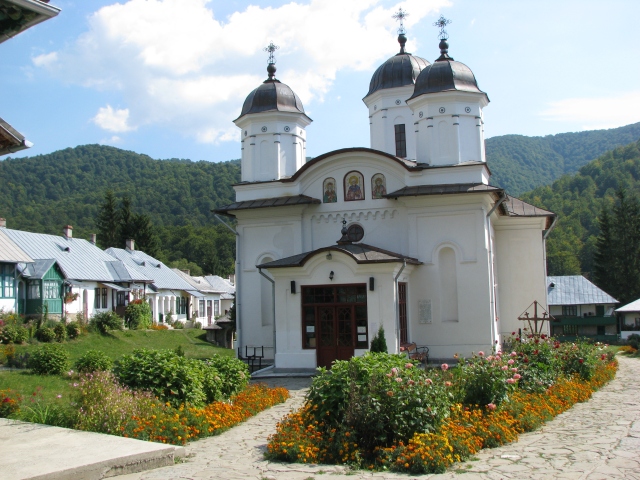
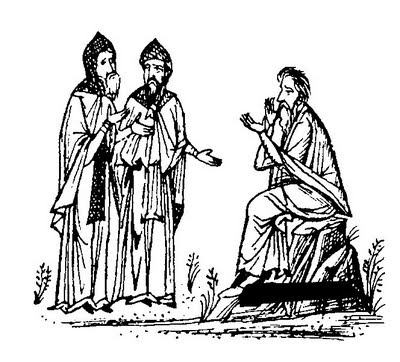
Suzana Monastery Retreat I


SONY DSC


Part A: How the little city hermit became a bird, a fountain, a tree and a pearl!


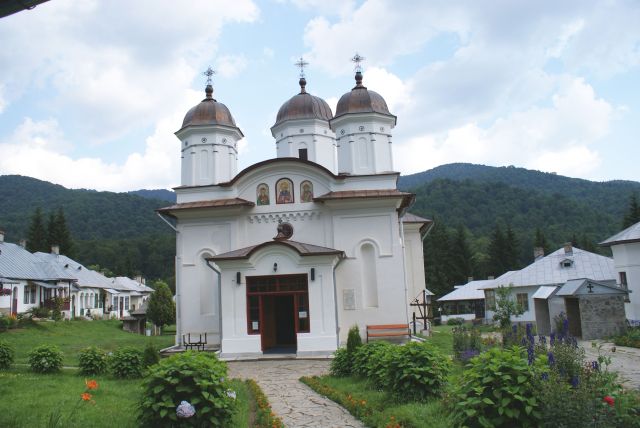
Deep peace of Christ, silence, hesychia, these are the words that come to my mind when I remember Suzana monastery and my three-day retreat there this summer. Also, self-emptying, kenosis. But above all, silence!


Only through poetry can such silence be conveyed, so I will paraphrase a favourite poet of mine, Rumi, to convey to you what I experienced here.


I had begged the Wise One to tell me
 the secret of my existence, my calling in this world.
 Gently, gently, He whispered at Suzana monastery “Be quiet,
the secret cannot be spoken,
 It is wrapped in silence.”


I ground myself, strip myself down, to this overpowering Silence. I feel spiraling into a void of silence where a hundred voices thundered messages I longed to hear.


At its unfathomable bottom I encounter a vast fullness, the Spark of LIFE and LOVE, a secret passage to the WAY which wandering talk blocks, a dimension where HE was waiting for me, for my soul to shake.


I was carrying so much baggage while seeking the signs of the Way.


But at Suzana* monastery, I am ‘forced’ to stop, open up, surrender to this thundering silence, be invaded by ‘It’, and 
stay there until I Saw, until I looked at this blinding Light 
with infinite eyes.


This overpowering Silence kidnaps me to the core of Life. There is a sacredness in it. Silence is indeed the language of God, and all else is poor translation.


This is exactly what I experience when I am trying to write a poem, how I feel especially when I finish a poem. A great silence overcomes me and I wonder why I ever thought to use language.

suzana6

Silence is indeed the sea, and speech is like the river. The sea is seeking you: don’t seek or walk into the river. Don’t turn your head away from the signs offered by the sea. Listen to the ocean.


The sound of Waters and the sound of Silence is a motif in Suzana monastery. At least for me. Everywhere the sound of waters reaches you, so overwhelmingly that I often feel the need to stay in my ‘cell’ and not even venture out.


Just listening to that sound was so overwhelming! The very moment I set my foot on this monastery, the sound of Living waters immobilized me, an ocean wave, a mighty river in flood, a cascading waterfall, a fountain of benediction, a Life- Giving spring, welling up to Eternity.


Isaiah 43:19

19 Behold, I will do a new thing,
Now it shall spring forth;
Shall you not know it?
I will even make a road in the wilderness
And rivers in the desert.


John 7:38

38 He who believes in Me, as the Scripture has said, out of his heart will flow rivers of living water.”


Kenosis is also another state I suffered there:

“And they shall build the old wastes,

they shall raise up the former desolations,

and they shall repair the waste cities,

the desolations of many generations.” (Isaiah 61:4)


I needed so desperately such ‘Decluttering’ in my life, a Relentless Focus, a Subtraction, Becoming ‘poor’, an Unburdening, a Curtail, a Reduction and Emptying, Until my rebellious bones sore.


suzana1

This silence, this moment, every moment, this silence brought all what I needed. I sat quietly, and listened for a voice which told me ‘Be more silent.’ ‘Die’ and be quiet. Maybe quietness is the surest sign that you’ve ‘died’. My old life was such a frantic running from silence. Suzana monastery moved me, even for a little, outside the tangle of fear-thinking.


In the end, I became a pearl!


“And since I have wandered in thee, pearl,

I will gather up my mind

And by having contemplated thee,

Would become like thee,

In that thou art all gathered up into thyself;

And as thou in all times art one,

One let me become by thee!” (St Ephraim, The Pearl)


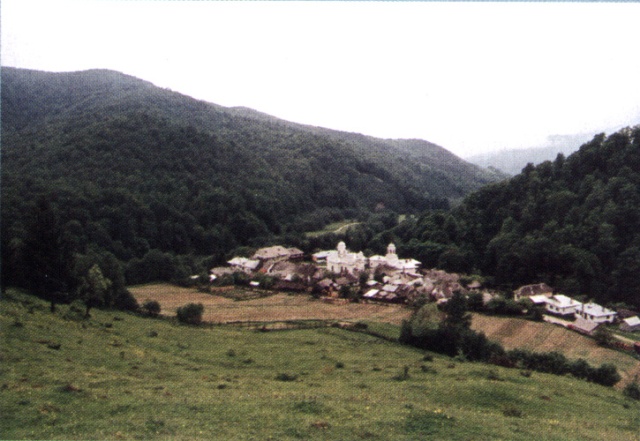
This very old, poor, secluded, fairy-tale monastery, surrounded by forests, mountains and springs, and steeped in holiness, is most certainly God’s special Providence for my tired, exhausted self.


I feels like coiling in a virginal womb, unwinding time, beholding


“The memory of the glory that I had when I was entirely with You and entirely in You, before time and temporal illusions.


When I, too, was a harmonious trinity in holy unity, just as You are from eternity to eternity.


When the soul within me was also in friendship with consciousness and life.


When my soul also was a virginal womb, and my consciousness was wisdom in virginity, and my life was spiritual power and holiness.


When I, too, was all light, and when there was no darkness within me.


When I, too, was bliss and peace, and when there were no torments of imbalance within me.


When I also knew You, even as You know me, and when I was not mingled with darkness.


When I, too, had no boundaries, no neighbors, no partitions between “me” and “you.” (St. Nikolai Velimirovich, Memories – Prayers By the Lake XXX)


Even the very fact that I cannot not speak Romanian, just barely understand it, is an added blessing, an extra ‘precaution’, a ‘just in case’ … Speaking all too often impoverishes, drenches us. As St. Seraphim of Sarov wisely urges us, “Keep away from the spilling of speech”.


Hesychia, Deep peace of Christ wrapped me in green leaves like a tree;

I breathed like a tree in the quiet light!


* Suzana Monastery is a Romanian monastery about 5.5 to 6 hours away from Rasca monastery in Bucovine, North Moldavia, where Fr. Seraphim Aldea was tonsured as a monk in 2005. After my retreat here I have a slightly better, more ‘intimate’ understanding of ‘Romanian’ Orthodoxy and Fr. Seraphim’s calling to found the first Orthodox monastery, Mull monastery, in the Hebrides in over a millennium. In a sense only a Romanian hieromonk would be really equipped, spiritually, emotionally, as well as intellectually, to undertake such a huge task! Glory to God for everything!


Continue to Part II

The Comforter

Fascinating homily in its breadth and depth! Like all by Metropolitan Anthony of Sourozh. In it you may meditate on Nature, God’s Creation, God’s Energia in His CreationThe Little Prince by Saint-Exupery, three-fold etymology of ‘Paraklitos’, Conversion, Betrayal and Apostasy narratives, Faith and Loss of Faith, C. S. Lewis, the difference between Art and Mankind, a beautiful statues and human ‘wreckage’, Father Sergei Bulgakov’s theology, a bold, ‘heretical’, ‘syncretistic’ worship during a World Council of Churches meeting, and so much more. Enjoy!

‘The Comforter’: Our Support and Strength for Mission

I feel more than slightly apprehensive, giving this talk in the background of a very theological theme. And so, you will forgive me, if my theological statements are untheological and if the rest is very different from what you may expect.

First of all, may I make a totally non-theological statement about the Holy Spirit? When we speak of the Trinity, for people as primitive as I am, we can imagine that the old image, given centuries ago, still holds, and we can develop it on one point. Speaking of the Trinity, trying to understand the relation there is between the Father, the Son and the Holy Spirit, some writers have said that we can compare God to the sun in the sky. In its mystery, the sun is unknowable as such. No one of us will ever be able to participate in the nature of the sun, but it becomes accessible to us in its light and warmth. The light is something which we perceive with our senses, by sight, and which reveals to us everything that surrounds us. We do not see the light as such, but it is in the light that things are revealed to us. The warmth of the sun is the way in which He pervades us, and in which we can become participants — to whatever degree is accessible to us — in the life of God.

Christ the Word is an objective revelation of God. The Spirit reaches us only within our experience, in the way in which the warmth of the sun pervades us and we become aware of it, and through it of something which is of God. This is a non-theological introduction to the subject.

As an illustration of this, I would like to give you an example of a contemporary of mine, who had discovered his faith in God through an encounter with Christ. But he puzzled and puzzled about the Holy Spirit. He did not understand. One day, he found himself on a bus. It was in Paris, around the theatre of the Odeon, and he was saying to himself or to God: ‘But what does the Holy Spirit do to us? How can I know that I have had some sort of contact with the Spirit of God?’ And of a sudden he felt he was, unexpectedly to himself, filled with a love of the creation and of the human beings that were surrounding him, in a way in which he had never known he could. And he realised that, at that moment, the Holy Spirit had come to him and made him partake, to the extent to which he could, in his immaturity perhaps, in Love Divine. At that moment, he knew something about the Holy Spirit: that the Holy Spirit was communicating Himself to him by communicating to him something which could not be invented or forced, even out of his human experience.

The Holy Spirit comes to us quietly; at times unexpectedly, at times as the result of a long longing. Some of you may have read a book called The Little Prince by Saint-Exupery. There is a passage in which the Little Prince meets a little fox. Both the Little Prince and the little fox are attracted to one another, but both are desperately shy. The little fox comes and sits down at a certain distance, but whenever the boy makes a movement towards it, it runs away. Then one day the little fox says to him something like: You know, we both long to come to one another, but we are shy and afraid. So when I come, don’t make the slightest move. Look askance, so that I may imagine that you have not noticed my presence. And, not being afraid of being watched, I will come a little nearer than the day before, but don’t turn to me, because I will be afraid and run away. And then, another thing,’ he said, ‘I long to come close to you. And so, let us fix a time when you will come, because then — oh, a good hour before the time — I will know that you will be coming. I’ll come myself and wait. And I shall be filled with this expectation of the moment when you will appear. And then you will sit down and, as I said, pay no attention to me, and allow me to come nearer, and nearer, and nearer.’ This image of the little fox is something that, to me, resembles very much the way in which we relate to the Holy Spirit. Christ comes to us, proclaiming the truth. He is the Truth; He is the One who Is. He is a revelation, an unveiling. The Holy Spirit, in this sense, is not a revelation. He is the one who makes the revelation possible, by making us commune with what is the essence of this revelation: the closeness and the knowledge of God.

If we turn to what we hear in the Gospel about the Holy Spirit, I would like to attract your attention to one passage — to a word rather than a passage — that we repeat time and time again in our prayer: the Comforter. ‘Comforter” is the English translation of the word. When we look at the various languages into which it has been translated from the original, I think we can see a variety of facets in the event. First of all, the Holy Spirit, whom the Lord Jesus Christ sends us, is the one who consoles us for our loss of Christ. I am speaking of the loss of Christ, because each of us believes in Christ, each of us has had an experience of His closeness, His presence. Each of us has had, through His teaching, an experience which He conveys to us in word and in person. But, with the Crucifixion, the death of Christ and the Resurrection and Ascension, He is not present as He was present to His disciples, and He is not present in the way in which He will be present to us when all things will be fulfilled. You remember, probably, the words of Saint Paul, when he says: As long as I am in the flesh, I am separated from Christ. And yet — Christ is my life. And we are all, to a lesser degree than Paul was, of course, in the same kind of situation. On the one hand, Christ is our life; on the other hand, we are still separated from Him. We all long to be with Him, but we cannot go beyond a certain point of closeness. And Saint Paul points it out, when he says that, as long as he lives in the flesh, he is separated from Christ, and he longs for death to come. Not as an end of his earthly life, but as the moment when a veil will be torn apart and, as he puts it, he will know as he is known. He will see face to face what he can see yet only as shadows and images mirrored.

823-600x459

The Holy Spirit reveals Himself to us as our Consoler. In the sense that Christ has promised to send Him to us, He comes to us. He gives us an incipient participation in a closeness of communion with Christ, and through Christ, in Christ, with the Father. So that this is our first experience. His closeness to us consoles us for the fact that we long to meet Christ face to face, to commune with the Father in a way unutterable to us.

But the word goes beyond this. He is not only the one who comforts us; He is the one who gives us strength; strength to live in this orphaned situation in which, on the one hand, we belong to God wholeheartedly, sincerely, heroically at times, and on the other hand live in a world that has fallen away from God and in which we have a function to fulfil. He is the one who gives us strength to live in the world which at times denies everything we long for, which stands between us and our fulfilment by temptation, by beguilement.

At the same time, there is a third meaning in the word. He is not only the Consoler. He is not only the one who gives us strength to face life, in the faith and yet in the partial absence of Christ. He gives us the exulting joy of being with Christ already in this world, because, although our communion with Christ is imperfect, although it is not all-embracing, although we do not know Him as He knows us, we do know Him. And this is a miracle that we could not appreciate if we were born, as it were, in a believing family and if we had been given our faith together with our birth. But those of us who were unbelievers, the millions who believed not and have discovered, know the exulting joy of this discovery of God in Christ and through Him, of the fatherhood of God’s own Father. So that, in the Holy Spirit, we have consolation because we are orphans. We are sent into the world to conquer it for God. And in the process, at moments, we are given a sense of incredible closeness, and we can be astounded and rejoice in the way in which the young man whom I mentioned in the beginning rejoiced, having been filled, in an unutterable manner, with a love he did not know could exist; not only for humanity, not only for every concrete human person, but for the whole of creation.

We are told by Christ that He will send the Spirit to us, who will lead us into all truth. ‘All truth’ is not an intellectual situation. It is not the knowledge of the mind; it is an experiential knowledge. The truth (in Russian istina) is what is: I am He who is. And the knowledge of the truth can only be possessed in communion with Him who is. In a strange way, we have lost through the centuries this certainty that this is what the truth is. It is God Himself; it is the absolute Reality. Pavel Florensky, speaking of the truth, says: ‘Istina — eto Estina’ — the Truth is what is!’ ‘I AM’. And strangely enough, because we have moved knowledge of the truth from this existential experience onto an intellectual level, we feel that we must fight for the truth and defend it, forgetting that the Truth cannot be destroyed by any created power. The Greek word aletheia means ‘what cannot be washed away’, annihilated, even by the waters of the River of Oblivion. Nothing can do it!

If we continue to dwell on words, we could remember that the words verity, veritas, Wahrheit, derive from a Latin word meaning ‘to defend’, not ‘to be defended’. The Truth can defend us against everything, and it does not need us to defend it. This is a very important point with regard to our mission in the world, because it means that we are sent to proclaim it and reveal it, but not to defend it in argument. We cannot defend the Truth by argument. We can present another facet of things, which people can accept or not, but we cannot always defend it in the way it should be defended. I remember when I was young and began to do youth work, my father saying to me: ‘Proclaim the truth and be to people a vision of it, however dim, but do not try to convert anyone by argument, because, if you prove to be more intelligent, more well-read than another person, you will be able to defeat the other person, but you will not have changed his life. And I remember an occasion, a case in the comparatively recent history of the Russian Church in Stalin’s time. A young man called Evgraff Doulouman, who was a student at university, was looking for digs. He found a room in the house of the local parish priest. The priest was mature, ageing, with a deep and tragic experience of life: of the beginning of the Revolution and of the persecution that followed. The young man was full of his atheistic convictions, and he decided to convert the priest to what he believed to be the truth, and they engaged in conversation and discussion. The priest was an old and wise man. He did not argue point by point, but unfolded before the young man the truth as he knew it. The young man was not mature enough to go through the experience that was offered him, and he made it into an intellectual world-outlook that defeated, completely annihilated, his atheistic vision. Having been dialectically defeated, he embraced the Christian faith, asked for baptism, went to study theology in Zagorsk, was brilliant as a student, was ordained deacon and priest and was sent to Samara, I think, to a parish. It was expected that he would be a brilliant missionary, taking into account the way he had moved from refined, deep atheism into a powerful sense of Christianity. When he was in the parish, this young man discovered — in the celebration of the Liturgy, in the sacraments, in his pastoral work — that he could present the Christian truth in words, but he did not believe it all in his inner self. After a while, he renounced the Church and became an active agent of atheist propaganda. I give you this example to underline the fact that it is not in the refinement of argument in debate that one conveys one’s faith.

In the course of the whole history of Christianity, you meet people who are filled with the Holy Spirit, and whose life, whose person, whose words, in their simplicity reached others, hit them at the very core of their being and brought to life a knowledge of the divine that had been dormant. It has been for many as though the knowledge of God was like Lazarus: dead, lying in his grave, who suddenly heard a voice saying: ‘Lazarus, come out!’ And the knowledge of God, an experience that was conveyed by having heard God speak to him, made all the difference. And so, when we speak of the Holy Spirit as being the Spirit of truth, it is not the spirit of formal theological discourse or of any formal thing divorced from the inner experience. Unless it is sustained by this inner experience, it may be a convincing argument but it will not be a power that can transfigure the life of another person.

We are sent into the world to proclaim Christ, but we are not sent into the world to argue about Him. In 1943, C. S. Lewis gave a series of addresses on the English wireless, and in one of them he asks: “What is the difference between the believer that has become alive in God and any other human?’ And he says: The difference can be compared to that which there is between a statue and a living person. A statue may be of supreme beauty, but it is nothing but stone or wood. It can be looked at and admired. It can send us a message of beauty, but not of communion. This beauty will be communion with something earthly, created, but not beyond. Something must happen that will make it of the ‘beyond’. A human being may be infinitely less beautiful than a statue, but it is alive.’ And C. S. Lewis says: “When someone meets one of those statues that have become a living person, he should stop and say: “Look, this statue has come to life!” ‘ This is a challenge to each of us, because we may be satisfactory statues, but are we the kind of people whom others meet, look at and discover that there is life there and not only a shape?

It is very important for us to realise that our message to the world is not a world-outlook. It is a revelation of the presence of the Holy Spirit and of Christ. The Church is a mysterious Body, because the Church is the presence, in the midst of the fallen world, of the fullness of the divine Presence. The first member of the Church is He whom Saint Paul calls the Man Jesus Christ. He is one of us, as well as being, if I may put it that way, one of Them. He is not only One of the Trinity; He is one of humanity. Looking at Him, we can see what it means to be both totally man, human, and totally and perfectly divine. Since the Ascension and the Feast of Pentecost, the Holy Spirit has indwelt the Church totally, filled it with His presence. In the Spirit and in Christ, the whole Trinity is present in the Church. Are we Christians, Orthodox Christians, aware of this? Or is the Church a human body that looks Godward, that believes in God, that has evolved a very elaborate theology, but whose members are not limbs of Christ — as Father Sergei Bulgakov puts it: ‘an extension of the Incarnation’? Are we ‘an extension of the Incarnation’? Does anyone, meeting us, stop a minute and say: ‘In this person, there is something I have never met before. Here is a human shape, but there is something beyond it.’

I think I have mentioned a personal example which I will dare mention again. I came once to the church that became my parish for years in Paris. I aimed at being present at the Vigil, but for one reason or another I was late. The service was over. It had taken place in an underground garage, that led to ground level up a wooden staircase. I entered, and saw that everything was over. Only, there was a man coming up the stairs. It was a monk, in monastic garb, and when I looked at him I felt that I had never in my life met such total inwardness, such serenity, such peace and depth. I did not know who he was. I came up to him and said: ‘I do not know who you are, but would you become my spiritual father?’ This is a sort of central experience I had of a person in whom I saw something I had never seen to that extent: this total inwardness in the abiding presence of God, the Spirit at work, and the Incarnation in him. Years later, I received a little note from him, saying: ‘I have experienced the mystery of contemplative silence. I can now die.’ And three days later, he died. This, to me, was an example of what a Christian can be. He was not ‘impressive’ in any respect. He was not a man of superior education or of an outward holiness, but in him I could see the Incarnation and the presence of the Spirit.

When we look around, do you realise the kind of world in which we live? Bishop Basil must have talked to you about the presence of the Holy Spirit in the created world. At the moment of creation, the Holy Spirit was hovering over the newly-created world. This newly-created world, in translation, is called ‘chaos’. When we think of chaos nowadays, we think of destruction, the chaos that followed the bombing of Dresden. But chaos is something much more essential and deeper. Chaos is the sum-total of all the existing possibilities that have not yet found a shape and blossomed out. The Holy Spirit was breathing over the chaos, over all the possibilities of a world that had been called into being and had no shape yet. By breathing over this chaos, the Holy Spirit was bringing to life all its possibilities, and everything that was hidden as the possible began to emerge as reality, as you can see in the beginning of Genesis. But God did not force the shapes. He initiated the possibility for the creation to become itself more and more; to expand in depth, and in width, and in every respect

Things changed with the Fall. But what had been given first was never taken away; the created world is still that world which God created. If it is distorted, it is not because it has turned away from God, but because its guide, man, has turned away from God, has lost his way and has proved incapable of helping this chaos to become the perfect cosmos: beauty in form, in line and life, so that the world in which we live is the world which, in itself, is pure of stain except for the distortion that we have created in it. When we look at the surrounding world, we must be aware that everything that is monstrous, frightening, ugly and distorted in it is our doing. To apply to the generality a phrase that was spoken in a particular situation, one of the Fathers says: “We must remember that what we call the sins of the flesh are the sins that the spirit inflicts on the flesh. The flesh is pure.’ We make it a victim of sin. Our body says: ‘I am hungry.’ Our imagination says: ‘I want to delight in such-and-such foods.’ The natural situation of the created world is that of a victim of the human fall, of our being separated from God, of our being unable to restore, even in a small patch of land, the purity, the wholeness and the harmony that belong to it by right. This we must remember. With what veneration must we look at the cosmos and everything that is the material world around us, and what broken-heartedness we must feel when we see it distorted, broken, ugly and monstrous at times.

Again, when we turn to God, to God’s revelation and the creation of man — the Lord God breathed His own breath into man: that is the original human, the anthropos, the chelovek, and man, the total man, has remained filled with the Spirit of God. We must remember this: it is not our Christian, our Orthodox, privilege to be such. All human beings are such. Sinful, yes, but basically such. And so, when we look round at all human beings, we have no right to see good in some and evil in others. We must see victims of the human fall in one and the victory of Christ in the Spirit in the other. The saints are examples of this victory. To them, to the extent to which it is possible in a world which has not yet come to the parousia, to its end in Christ’s victory, we find, incipiently or still-surviving, true humanity. And this we must remember when we deal with whomever we deal with. Some people are ‘evil’, yes. But why are they? Have we given them newness of life by being a revelation of Christ and a gift of the Holy Spirit? It is easy, perhaps, at times to be compassionate to a person in error, but how easily do we condemn the error from the height of what we imagine to be the truth as we know it!

I have paid some attention, in the course of the last seventy years or so, to the beliefs of men, to the religions of the world. What strikes me more and more is that, however different they are from the faith of Christianity, they are all a distortion of the truth; not a straight lie against it, except for some who have chosen to be servants of Satan and not servants of Christ.

I would like to keep you a little longer than I intended: my forty-five minutes are just over. If you will allow me ten more minutes, I will let you free.

437

Many years ago, I had a conversation with Vladimir Lossky about oriental religions. He was absolutely in denial of any knowledge, any true knowledge of God, in them. I did not dare argue with a theologian of such magnitude, but what courage could not achieve, I thought cunning might. As we lived across the street from one another, I went home and copied eight passages from the Upanishads, the most ancient Indian writings, went back to Lossky and said: “Vladimir Nikolayevich, I have been reading the Fathers, and I always take down the passages that strike me particularly. I always put down the name of the author, but alas, with these eight quotations I cannot find the author’s name. Could you identify them for me?’ He looked and said: ‘Oh, yes!’, and within a minute and a half he had put eight names of the greatest Fathers of the Church under the quotations from the Upanishads. And then cunning revealed itself in false humility, and I said to him: ‘I’m afraid I have deceived you. These are from the Upanishads.’ He looked at me and said: ‘Really? Then I must read them.’ And that was the beginning of a change of mind in him with regard to the statements of other religions.

Many years ago, in 1961, I was part of the first Russian delegation to the World Council of Churches in Delhi. Among a number of us, there was a man called Father Ioann Wendland, who later became a bishop in America and in Germany. He had been a secret priest in Siberia while doing geological research during the Stalin period. We decided to go to a pagan place of worship, to see and to try to understand. We arrived there. At the door, we had to take our shoes off, which we obligingly did, and we were about to leave them there when the warden came up to us and said: ‘Oh no, sir, you do not leave your shoes here. They are new and good, and would be stolen. I’ll put them in my office.’ So our shoes went into the office and we went into the place of worship. It was a round place of worship, divided into ten or twelve sections, and in each of them there was what we would call a pagan denomination, worshipping in its own way. We sat one after the other in the ten or twelve compartments, at the back, using our rosaries and praying the Jesus Prayer, trying to commune with God and seeing if we could commune with the people there. We both came out of it with the certainty that, whatever they called their god — whether it was the god-elephant or the god-monkey or another — they were praying to the only one God there is. And we had communed in prayer with them all, in spite of the fact that, on the surface, they had been praying pagan prayers to idols. That also made me think.

I will end your torment with one more thing. What I have said should make us much more understanding and attentive in our attitude to unbelievers. Not those who are empty of belief but those who are actively godless. I will give you one example, which some of you must have heard from me, because I always repeat myself. The example is this: I was coming down the steps of the Hotel Ukrainia a number of years ago. I was wearing my cassock, as I always do. A young man came up to me and said: ‘I am an officer in the Soviet Army. You are, I presume, a believer, dressed as you are.’ I said: Yes.’ Well, I am an unbeliever. Bezbozhnik (I am godless).’ I said: That’s your loss.’ He said: ‘And why should I turn to God? What have I got in common with Him?’ I said: ‘Do you believe in anything at all?’ Yes,’ he said, ‘I believe in man and in humanity.’ I said: ‘In that, you and God share the same faith. Start at that point.’ And, I think, more often than we do, we should be aware that there is no-one who lives without a faith, without believing in something. And more often than not, we may discover that God believes in the same. Only better, deeper, more perfectly, but that this person who fears that there is nothing between God and him has something in common with Him. At this point, we may remember the passage of the Gospel in which Christ says to Nicodemus: The Spirit blows where It chooses, and no-one knows where It comes from and where It goes.

We must be infinitely reverent when we look at the world that surrounds us, which we have distorted and which suffers like a martyr under the result of human sin, and remains pure, so pure that God could become man and put on flesh; a flesh He inherited not only from the personal saintliness of the Mother of God but from the fact that she was the heir of all the saintliness of thousands of years of human life in history. We must remember that all humans are possessed of this breath of life which is God’s breath and God’s life, however distorted it may be. We must remember, as I have said, that the Spirit blows where It chooses. Without this precondition of the way in which the world, mankind, relates to God, no-one — no one of us and no-one in the world — could discover God. It is the Spirit that reaches us and that kindles in us life eternal. So, when we speak of being sent into the world, we must remember that we are unworthy messengers of a message that may be received by the created world around us, and by the humankind around us, better than we are capable of proclaiming it.

How often it happens that words of truth are said that do not reach the congregation that is there, but reach someone who by accident, or by an act of divine Providence, has entered the church. We must remember this. And go into the world, not to proclaim a theoretical theology of the mind but to grow into the life of Christ, to open ourselves to the action of the Holy Spirit, to believe that the Holy Spirit is active in the created world which is dear to God. Dear to God, because the Body of Christ belongs to this created world through the Incarnation, and to mankind — to everyone.
‘Violent’ Spirit — Viaia Pnoi

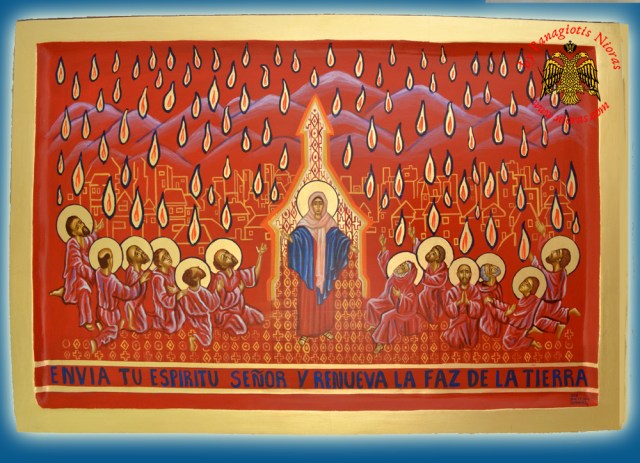
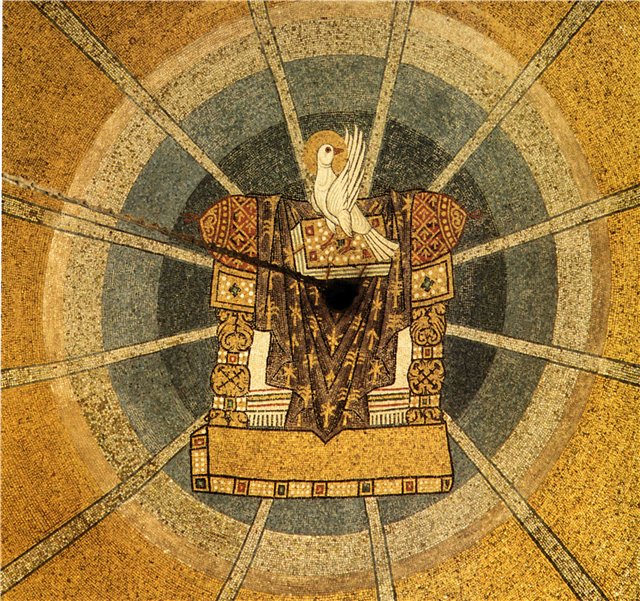
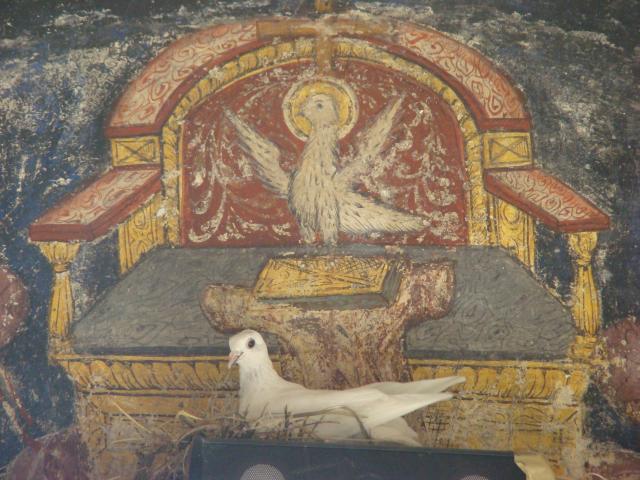
It has been such a  hectic week with me returning hastily back ‘home’ due to the sudden deterioration of my Father’s condition! A glorious week too, full of the honouring of the Holy Spirit in so many church services, the climax of the Orthodox liturgical cycle: Pentecost and the Descent of the Holy Spirit!


Giver of life: come, and abide in us


holy-spirit3


Then Father Seraphim took me very firmly by the shoulders and said “my son, we are both at this moment in the Spirit of God. Why don’t you look at me?”
“I cannot look, Father” I replied – “because your eyes are flashing like lightning – your face has become brighter than the sun, and it hurts my eyes to look at you.”

“Don’t be afraid” he said, “at this very moment you yourself have become as bright as I am. You yourself are now in the fullness of the Spirit of God; otherwise you would not be able to see me as you do.”

Then – bending his head toward me, he whispered softly in my ear: “thank the Lord God for his infinite goodness toward us… But why, my son, do you not look me in the eyes? Just look and do not be afraid; the Lord is with us.” (St Seraphim of Sarov and his encounter with Nicholas Motovilov)

holy-spirit2

Let us bow mystically to the Comforter and listen attentively to a fascinating testimony by a fascinating ‘convert’: Father Michael Harper. Crystalline Orthodox insights, such as probably only ‘converts’, or at least, they more often than ‘cradle’ Orthodox, may provide. 


And from the days of John the Baptist until now the kingdom of heaven suffereth violence, and the violent take it by force. (Matthew 11:12)

And suddenly there came a sound from heaven as of a rushing mighty wind (ie. “Kathaper feromenis Viaias [Violent] Pnois”), and it filled all the house where they were sitting. (Acts 2:2)

“Kathaper feromenis Viaias Pnois” — Violent is truly the proper translation of the original Greek word, not just ‘mighty’!


“Most will agree that the Church which through the centuries has most fully honoured the Holy Spirit, and brought Him most fully into its worship, life and ministry has been the Orthodox. Let us look briefly at five areas where this is clear:

First, there has been the strong emphasis in the whole life of the Church on the Trinity, which sees the Father, the Son and the Holy Spirit as co- equal. The Church has also condemned the insertion by the Western Church of the filioque clause into the Nicene-Constantinople Creed, which weakens the co-equalness of the Persons of the Trinity.

Secondly, the Orthodox Church has always emphasised the Incarnation and thus the work of the Holy Spirit in the conception of Christ in the womb of the Theotokos, the God-bearer.

Thirdly, the Orthodox Church has been the only Church to continue the practice of Christian baptism as the three-fold immersion of the candidate in water, followed immediately by chrismation symbolising the reception of the Holy Spirit and followed then by the candidate receiving their first communion. Again the Holy Spirit is active in the whole Baptism process.

Fourthly, in the Orthodox Eucharist (of St John Chrysostom), which is seen by the Orthodox as the heart of the Church, the service is interspersed with many references to the Holy Spirit. It begins, for example, with a prayer to the Holy Spirit which is unique in liturgical practices:

O heavenly King, Comforter, the Spirit of Truth, who art everywhere present and fillest all things, Treasury of good things and Giver of life: come, and abide in us, and cleanse us from every stain, and save our souls, O good One.


http://pemptousia.com/video/fr-michael-harper-the-holy-spirit


In the Russian tradition the following words are spoken by the Priest just before the Epiclesis: “O Lord, who at the third hour didst send down upon thine apostles thy Holy Spirit: take not the same from us, O good One, but renew him in us who pray unto Thee.”

Then follows the important epiclesis prayer which the Priest says, “send down thy Holy Spirit upon us and upon these gifts spread forth.” Notice it is a prayer for the Holy Spirit to come upon the people as well as the bread and the wine. Earlier in the service, if there is more than one Priest at the service, a dialogue takes place:

Pray for me, brother(s) and concelebrant(s)
May the Holy Spirit descend upon thee and the power of the Most High overshadow thee
May the same Spirit serve with us all the days of our life.

In another place the Priest prays that “the power of the Holy Spirit” will enable him.

holy spirit1.jpg

Fifthly,… For the rest of the article, go here

For an interview with Father Michael Harper, go here

On the Holy and Great Synod of the Orthodox Church — Archmandrite Vasileios, Hegumen of the Iviron Monastery, Mount Athos

A WORD OF CAUTION 

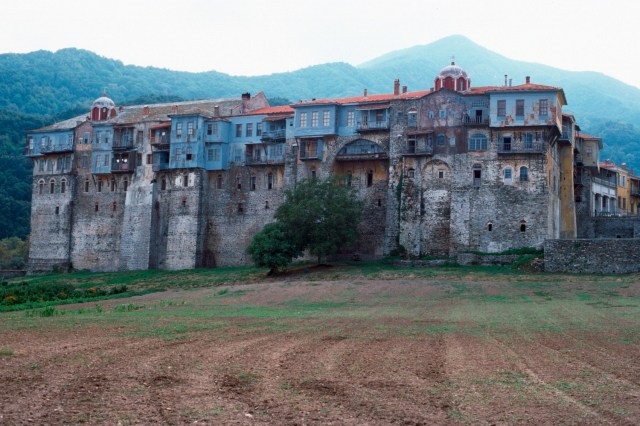
iviron

No matter if it seems (at first sight) that irresponsible ecumenists and fanatical zealots hold opposite views, in reality they share the same poverty; they are imprisoned in the same cell. They begin and end with their own opinion. They lack the courage of faith and the truth of love which liberate man.


They torment and are tormented, they hurl threats without meaning or courtesies without essence. The presence of the first breeds the existence of the other. The rumpus of the conflict of both ‘authorities’ (by imagination) never ceases!


To both sides the Word of God proclaims: “The prophets are prophesying lies in my name. I have not sent them or appointed them or spoken to them. They are prophesying to you false visions, divinations, idolatries[a] and the delusions of their own minds. (Jeremiah 14:14)

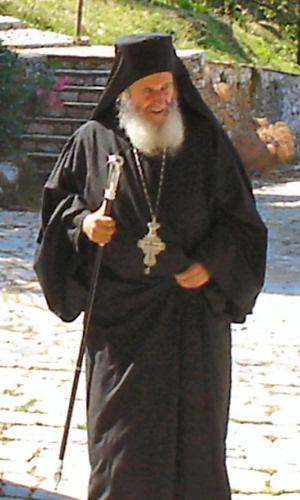
basileios_gontikakis_iveron2

By Archmandrite Vasileios, Hegumen of Iviron Monastery

βιβλιο

Drop Your Baggage


Reflections on Pilgrimages by three fellow ‘Pilgrims

pilgrim3.jpg

“No one descends from the Cross, but they take him down” Christ to Elder Sophrony (Sakharov)

[My interposed or ‘highlighted’ comments  are in brackets and in blue] 

“I had made grand plans [Oh yes! Sooo me!! Throw caution to the wind!]  this past summer. My goal was to retrace Paul’s first missionary journey. I would start in Antalya, shoot past Perge up north through the Taurus Mountains until I was just north of Yalvac (Antioch of Pisidia). From there I would swing west to Konya (Iconium) and do a quick circle hitting the ruins that were Lystra and Derbe before finishing back up at Konya. Unfortunately, just three days into this journey I ended up spraining my ankle. Even though that random injury shortened my planned 500+ mile journey down to seventy, it was still the longest I had ever walked in one setting and it was a great experience.

From start to finish I did that walk with this big black bag. In this bag I carried a tent and small blanket, some clothes, a Bible and a notebook, some food, and water. I carried lots of water. I would much rather not have the need, but I was going through some uninhabited mountains and near desert in weather that was in the nineties and sunny every single day. You might not think of it but water is heavy. Very heavy. As I was walking this bag gave me bruises on my shoulders. When I tried to loosen the straps to relieve them, it would end up chafing my lower ribs and back. [And blisters, corns and callouses on my feet]

[I have moved to the UK since May 20, ‘moved’ by a ‘similar’ missionary impulse. Little did I know that I would spend so much of my day walking from place to place, since I am not in possession of  a car (yet?) and my lodgings appropriately ‘primitive’ and remote, often getting lost in unfamiliar surroundings, carrying, more often than I would have liked, heavy objects in my backpack and bags. Never would I have grasped how spoilt and what a creature of comfort I am if I had not been restricted to such old, poorly maintained, cramped, uncomfortable, poor lodgings!]

There was no escaping the pain. This thing hurt and it was preventing me from being able to walk the walk I wanted to. It was a beautiful moment when I was able to hobble into my hotel in Isparta, drop my bag, and say, “I am done with you.” Like me dropping that bag, there are some things we will need to let go of if we are to chose to walk the life Jesus has called us to. 

 Mark 10:46 – Then they reached Jericho, and as Jesus and his disciples left town, a large crowd followed them. A blind beggar named Bartimaeus (son of Timaeus) was sitting beside the road.

The first set of baggage Bartimaeus need to drop is the Baggage of his background.What is your background? What is your cultural heritage? One of the popular memes floating around on the internet are those “Keep calm and _______” Keep calm and pray. Keep calm and drink starbucks. Keep calm and eat a cookie. Keep calm and kill zombies. Keep calm and watch gossip girl. You name it, they’ve “keep calmed” it. One of my favorite “Keep calm’s” is a T-shirt I have seen a few times: “I can’t keep calm. I’m Turkish.” Every culture has it’s own distinctions, some would say stereotypes, and there will always be some who will use one of those cultural distinctions, or their family upbringing, as an excuse for their behavior. “I cant help being an alcoholic, I’m…” Or, “I can’t control my temper. It is the ______ in me coming out.” Or “You think I’m rude? I’m _____. We’re all rude. Deal with it.”

Although our cultural background and family background might make us more likely to act in certain ways, ultimately we are all responsible for our own behavior. [I would have never been made so intensely aware of my own cultural/ family background, had I not moved to a ‘foreign’ country and being ‘forced’ to communicate all the time, in writing and in speaking, in a language which is not my mother tongue. Can you imagine? Two conferences in just two weeks! Most fascinating but forcing me to struggle as they were not in my mother tongue. We never realise how deeply rooted we are in an ‘environment’ until we are completely removed from it] Bartimaeus could have said his background was a blessing or a curse. On the one hand since Timaeus means “highly favored”, Bartimaeus would mean “highly favored son”. He was not born blind and so the name “favorite son” was probably not an ironic misnomer. On the other hand, Timaeus is a Greek name. Those who like philosophy might recognize that it was Timaeus who debated Socrates in Plato’s dialogues. Bartimaeus was a mixed blood in a very racist society. Whether you come from a home of abuse, shame, and poverty or whether you had an incredibly blessed and very loving background, there comes a point when you just need to let go. Leave it behind you. Walk your own walk.

 Mark 10:46 – Then they reached Jericho, and as Jesus and his disciples left town, a large crowd followed them. A blind beggar named Bartimaeus (son of Timaeus) was sitting beside the road.

In addition to the baggage of his background, Bartimaeus needed to drop the baggage of his disability. Bartimaeus was a blind beggar. In modern society being blind is not as crippling as it was in his day. We have books in braille. I have even been through a drive through for McDonalds where a sign says that they have braille menus available. I really hope no blind driver is ever pulling up to ask for one while I am anywhere near. We also have audio books and a program that will read any PDF file in a reasonably normal voice. We also have medical advances where many who would once have gone blind can now get surgery and see perfectly fine. Bartimaeus had none of that. He had no hope.

What is your disability? Most people would say I am average height, but in my family my shortness is a disability. All of my cousins and siblings, even most of the girls, are taller than me. Our family loves basketball. I love basketball, but I have a permanent unfixable disability against others in my family.  No matter how hard I try, I will never grow taller. It just won’t happen. But then I think of pros like Spud Webb and Mugsy Bogues. These guys were much shorter than I was and yet they played well against others who were far taller and better than anyone in my family. Just like our background, we need to drop the baggage of our supposed disabilities if we are to experience our miracle. If God calls us, He will enable us. [I have repeatedly felt so incompetent, weak, discouraged, vulnerable, frustrated, inadequate, struggling, the last three weeks, even while trying to accomplish such basic tasks, as moving, unpacking, struggling to have a reliable Wi-Fi connection–still a struggle!–registering at NHS, opening bank accounts, securing a variety of official documents …] 

Mark 10:47 – When Bartimaeus heard that Jesus of Nazareth was nearby, he began to shout, “Jesus, Son of David, have mercy on me!”

In addition to his background and disability, Bartimaeus needed to drop the baggage of his respectability. [Oh yes! Can you imagine what friends, relatives back in Greece think of me when they ask about what on earth I am doing here at the UK? Re-discovering Orthodoxy in a ‘secular’, ‘pagan’, ‘depraved’ country?! Certainly a country that is not God’s ‘chosen nation’ such as Greece!!??] In Mark 10:47 it says that Bartimaeus began to shout. There are two different Greek words that are both translated “shout” in the New Testament. One of those shouts is the cry of joy or greeting. When I am watching Real Madrid in football and Cristiano Ronaldo scores again, I am shouting right along with that announcer, “GOOOOOOOOOOAAAAAAAAAAAALLLLLLLLL!!!!!!!” When I spot an unexpected friend walking along at the far end of Sultanahmet Square, I will be shouting out their name. This type of shout is very different from the type of shout I would be proclaiming if I was in a car that just crashed off the side of a bridge. As that sinking car started to fill up with water and I was still trapped inside, my shout would become louder and louder as I grew more and more desperate.

The truth is, the more joyful or desperate we become, the less concerned we are with those around us. Joy and desperation both expose the fear of respectability as the shadow it really is. The rest of the time, most of us are far too concerned with our respectability. “What would they think if…” is a thought we all think much too often. Think about it. Ninety percent of the time we think about someone else, we are really only wondering what they are thinking about us. On the flip side, those same people, if they think of us at all,  are spending ninety percent of those thoughts wondering what we think of them. We are all trapped in a web of false respectability and we need to drop that baggage off and come to Jesus.

Mark 10:48 – “Be quiet!” Many of the people yelled at him. But he only shouted louder, “Son of David, have mercy on me!”

Very similar to that baggage of respectability that Bartimaeus had to drop was the baggage of others expectations of him. As much as I just said people don’t often think about you, on those rare moments when they do, they are sure to let you know just exactly what they think. When I first told a certain friends that I was moving to Turkey, they told me I was being stupid. [Likewise] They said I was doing a lot of good work right where I was and that I had no business giving all that up, and leaving my family and friends to go to the other side of the world. It hurt. I knew that I was doing the right thing, and others who I trust their voice in my life agreed, but to hear this person say those things even though I knew they were wrong really hurt.

Everybody around Bartimaeus told him to shut up. They wanted to silence him, but he wasn’t screaming for the crowd. His voice was aimed only at Jesus and he would not be quiet until he received his answer. Sometimes, pursuing our miracle means those around us might end up getting angry or confused. They might not understand what God has called us to or they might become disappointed because we are not following their dreams for our life. Oh well. We need to drop the baggage of other’s expectations if we are going to walk the life Jesus has called us to.[Precisely, ‘crazy’ though that ‘calling’ may appear]

Mark 10:49-50 – When Jesus heard him, he stopped and said, “Tell him to come here.” So they called the blind man. “Cheer up,” they said. “Come on. He’s calling you!” Bartimaeus threw aside his coat, jumped up, and came to Jesus.

The next thing Bartimaeus had to throw off was the baggage of his security.[Oh yes! To be sure, Jesus has blessed my every single day here with new friends, new ‘signposts’, caring, clairvoyant elders, miracles, Sants’ relics, you name it, but every single day I had also to learn the hard lesson to rely only on Him] Bartimaeus threw aside his coat. We hear that and think, “so what?” What we do not realize is how much of a big deal this would be for a poor person at that time. Bartimaeus was most likely homeless and, if so, that coat was his most prized possession. The poor man’s coat was also his blanket. In the hot summer days, it was his only protection from the sun. During the cloudless chilly nights, it was his shelter from the cold.

Following Jesus is not safe. [No ‘plans’ or comfortable old habits will do here] I am currently reading a book that is a collection of stories about people who have left their former religion to become followers of Christ. Every single one of them is using a fake name for the book. Most of them had to leave their homes and even their countries to become God followers. I have a friend who is in Bible college now who still has not told his family that he has become a follower of Jesus. He fears that when his father finds out, he will hire someone to forcefully bring him back to his home country or, failing that, just kill him.

I cannot imagine that but I can imagine giving away a thousand book library. For me those books were my security. They were my prized possession. But when Jesus said, “come here” they did not matter. Those things we hold dear, those things that make us feel safe, can be very good or decent things. There was nothing evil about Bartimaeus’s coat but when it weighed him down from coming to Jesus, it had to go. If there is anything in my life that I trust or value more than following Christ, it is baggage that needs to be dropped.

Mark 10:51-52 – “What do you want me to do for you?” Jesus asked him. The blind man said, “Rabbi, I want to see.” “Go,” said Jesus, “your faith has healed you.” Immediately he received his sight and followed Jesus along the road.

He received his sight and followed Jesus. His eyes were opened and his path was set.

So what is our baggage? Jesus is calling us today. He is asking us to come, follow him. What baggage do we need to leave by the roadside in order to obey? For some reading this, it might be the first time you have ever seriously considered following Him. What is holding you back? Is it a fear of losing your respectability? Do the expectations of your family and friends hold you back? Maybe there is something you have done in your past, or something that was done to you, which makes you believe you are not worthy. Drop the baggage.

Others reading this have been following after Jesus for a while now. He is asking you to come a little higher. What would that take? Do you fear you are unfit because of some disability or struggle? Are you unwilling to just let loose and scream? Does the next step that you already know he is calling you to take seem just a little too unsafe?

When Bartimaeus met Jesus, the Messiah was on His way to the cross. This was the last time he would ever pass through Jericho. He did not know it at the time but if Bartimaeus passed up this opportunity, he would never have another. We might think there is all the time in the world to let go of that painful baggage which we consider so dear. We think that, but we certainly do not know it. This might be the last such opportunity you will ever have to grab hold of your miracle. This could be your final opportunity. Will you drop the baggage and step out? Will you be willing to lay everything down at the roadside and begin walking in the footsteps of Jesus?”

Source: Between Two Seas

“It is later than you think. Hasten, therefore, to do the work of God”.” as my spiritual great-grandfather Blessed Seraphim Rose would say.

Keep Your Mind in Hell


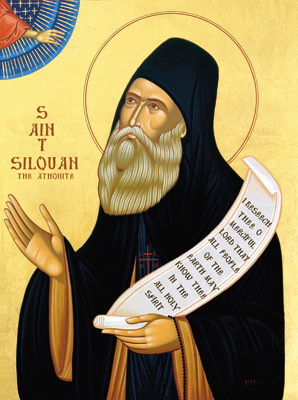
icon_st_silouan_athonite.jpg

… and Despair Not

Not for the faint-hearted!

“No one on this earth can avoid affliction; and although the afflictions which the Lord sends are not great, men imagine them beyond their strength and are crushed by them. This is because they will not humble their souls and commit themselves to the will of God.”


These words seem to sum up soberingly D. Balfour’s tumultuous life, and indeed in so many respects ours…


SPEECHLESS! “It seems ludicrous to rate a book like this according to a certain amount of stars…I searched for it after reading the book I Know a Man in Christ — a great book about our holy and blessed Elder Sophrony, which mentions this correspondence with the amazing Englishman David Balfour. I imagine that the only reason why anyone would be interested in this book would be to learn about this incredible spiritual friendship. (No! There are so many more reasons to want to study this book) And this book does allow for that — and much more besides. I’ve read letters of spiritual direction before. These letters go way beyond that. They give insights to the Elder and to St. Silouan which are simply impossible to convey otherwise. And this David Balfour — he went from Catholic hieromonk to Orthodox hieromonk to British Army major and intelligence officer to diplomatic interpreter to midlife husband and father to Oxford Byzantine scholar in old age. A biography of him wouldn’t go amiss, although I don’t think we’ll see one. And underlying his whole life is the gaining and the losing and the eventual regaining of that inestimable treasure, the Holy Orthodox Christian faith and Holy Grace. Not for the faint of heart.” (D. Kovacs )


Not for the faint of heart.” Most certainly!


What an intense book which can be read on so many levels! A heart-rending spiritual biography of a brother in Christ struggling for his faith and the salvation of his soul amidst staggering trials, temptations and tribulations! A sobering warning too to all of us to be deadly serious with our faith and never forsake our obedience to our spiritual father at any cost! Hell indeed broke loose when Balfour decided to disobey St. Silouan and use his own mind instead for his life-decisions! To give you just one example: After converting to Orthodoxy and becoming an Orthodox hieromonk, Balfour disobeyed St Silouan’s ‘suggestion’ to move to France, and then to England, and went to Greece instead. Things went well at first, but with the outbreak of the Second World War, Balfour was forced to flee Greece and started wandering all over Europe, while undergoing a very dark period of disobedience, disillusionment, doubt and eventual loss of his faith, to the extent that he decided to shave his beard and defrock himself in Cairo, Egypt! I cannot even begin to imagine how traumatic all this experiences must have been for him!

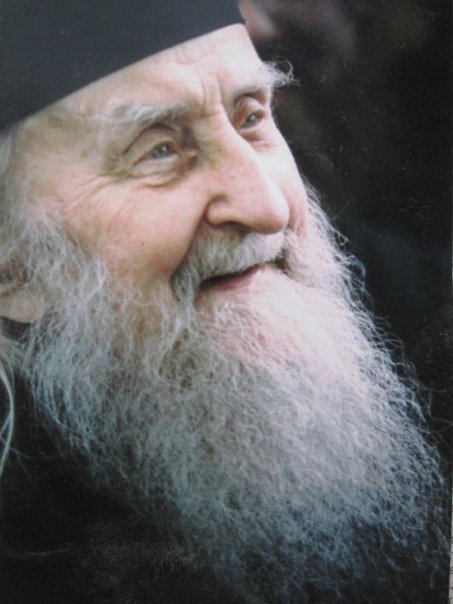
elder-sophrony


What a most sobering book! “For Whom the Bells Toll” indeed. How often have I betrayed the Lord and disobeyed my spiritual father in the past! How dire the consequences of my disobedience have always been! Indeed, how fragile our faith is, how precarious our decision to follow the Lord at any cost like a true disciple, how unpredictable our falls and how uncertain our salvation until the very last moment of our life!


Striving for Knowledge of God: Correspondence with David Balfour is a treasury of wisdom distilled from Fr. Sophrony’s reading of the Fathers of the Church, from his conversations with St. Silouan, and from his own experience. Since most of these letters were written to someone new to the Orthodox Church and to Orthodox monasticism, they are of greatest interest to anyone contemplating converting to Orthodoxy.


In particular, the correspondence touches and elaborates on the difference between Eastern Orthodox and Western thought, in both Christian and philosophical writings. Thus Fr.Sophrony mentions Schleiermacher, Spinoza and Kant, and St John of the Cross (The Dark Night of the Soul). He dedicates a few pages to the concepts of the heart and prayer. In Eastern Christianity, he argues, the spiritual heart is not an abstract notion but is linked with our material heart and has its physical location. In opposition to the Western search for some visionary mystical experience, Fr.Sophrony advocates the prayer of repentance, which is the basis of all spiritual life.


As a reply to Balfour’s doubt over the importance of specifically Eastern ascetic and dogmatic traditions, Fr.Sophrony asserts the organic integrity and integrality of ascetic life, dogma and the Church. Criticising Schleiermacher in connexion with this issue, he writes:


“There are three things I cannot take in: nondogmatic faith, nonecclesiological Christianity and nonascetic Christianity. These three – the church, dogma, and asceticism – constitute one single life for me.” – Letter to D. Balfour, August 21, 1945.


“If one rejects the Orthodox creed and the eastern ascetic experience of life in Christ, which has been acquired throughout the centuries, then Orthodox culture would be left with nothing but the Greek minor [key] and Russian tetraphony.” – Letter to D. Balfour.


Fr.Sophrony also warns against attributing to intellectual reasoning the status of being the sole basis for religious search:


Historical experience has demonstrated that natural intellectual reasoning, left to its own devices, fatally arrives at pantheistic mysticism with its particular perception of reality. If this takes place in the soul of the Christian who does not want to reject Christ (as in the case of Leo Tolstoy), he arrives at Protestant rationalism or at spiritualism, which stands mystically close to pantheism… I am convinced that the rejection of the Church will lead to the rejection of the Apostolic message about Сthat which was from the beginning, which we have heard, which we have seen with our eyes… and our hands have handled (1Jn.1:1) [148].


On a more general level, these letters are full with profound theological and spiritual insights. What a most blessed golden ‘chain’ of Grace and Sainthood! Elder Sophrony, already under consideration for glorification, was ordained to the diaconate by St Nicolai (Velimirovic) of Zicha and became a disciple of St Silouan the Athonite. Can you imagine? All these Saints were also ‘connected’ with the greatest probably Saint of our century, St. John Maximovitch! St. Nikolai Velimirovich is often referred to as Serbia’s New Chrysostom. St. John Maximovitch, who had been a young instructor at a seminary in Bishop Nikolai’s diocese of Ohrid, called him “a great saint and Chrysostom of our day [whose] significance for Orthodoxy in our time can be compared only with that of Metropolitan Anthony (Khrapovitsky). … They were both universal teachers of the Orthodox Church.”


Coming back to the book, of all theological concepts touched upon in this book, the one which most interests me  is the concept of Godforsakenness, as outlined by Fr.Sophrony, who worked out a distinction between two types:The first one is when man deserts God: To the extent that we live in this world, to that same extent we are dead in God. The second one is when God hides from man: a horrific state of Godforsakenness. When man has no more life in this world, i.e. cannot live by this world, the memory of the divine world draws him there, yet despite all this darkness encompasses his soul. He explains: these fluctuations of the presence and absence of grace are our destiny until the end of our earthly life. Fr.Sophrony saw suffering as a necessary stage in ascetic development: Divine grace comes only in the soul which has undergone suffering.


“We must have the determination to overcome temptations comparable to the sorrows of the first Christians. All the witnesses of Christ’s Resurrection were martyred. We should be ready to endure any hardship.”


“The most important thing in the spiritual life is to strive to receive the grace of the Holy Spirit. It changes our lives (above all inwardly, not outwardly). We will live in the same house, in the same circumstances, and with the same people, but our life will already be different. But this is possible only under certain conditions: if we find the time to pray fervently, with tears in our eyes. From the morning to ask for God’s blessing, that a prayerful attitude may define our entire day.”


“Whoever gives up his cross cannot be worthy of the Lord and become His disciple. The depths of the Divine Being are revealed to the Christian when he is crucified for our Savior. The Cross is the foundation of authentic theology.”


Not for the faint of heart, indeed!

The Holy and Great Synod of the Orthodox Church – Metropolitan Nikolaos of Mesogaias

metropolotan-mesogaias

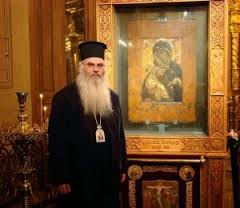
  • Theotokos of Vladimir, one of my favourite Theotokos icons, side by side with Metropolitan Nikolaos of Mesogaias, one of the most enlightened, holy and loved Hierarchs of our times, and a great favourite of mine! I had the blessing of meeting him in various church services and conferences in Greece and abroad and I have always experienced Holiness, Light and Love by his side! I would never let go of his hand!

His Eminence, Metropolitan Nikolaos of Mesogaias and Lavriotikis, recently sent the following encyclical message concerning the decision to convene the Holy and Great Synod in Crete, to the clergy and laity of the Holy Metropolis.

His Eminence’ Encyclical follows:

Dear Fathers and brothers, CHRIST IS RISEN!

I am sure you have been informed that beginning on the Sunday of Pentecost for about ten days the so called Holy and Great Synod will take place in Crete. This is a pan Orthodox Synod: in other words all the autocephalous Orthodox churches will participate, represented by arch-priests and headed by their leaders, that is to say their Patriarchs and Archbishops. Some have called it an Ecumenical Synod, although recently in particular for certain reasons they have avoided this title.

A Synod of this size is unique for the second millennium, that is it is the only one after the schism of Rome from the unit of the other Churches, namely from the body of the One, Holy, Catholic and Apostolic Church as we confess in the Creed.

The importance of this Synod and the hopes and expectations concerning it can be perceived. Therefore I consider it my pastoral responsibility to address you, to inform you of its ethos and its significance, since the laity according to our ecclesiastical tradition is not a mere spectator of events, but participates through prayer, dialogue and with their healthy reaction to the life of the Church.

A Synod of this dimension is convened in the name of the Tri-une God, chiefly for spiritual purposes, in order to unite the body of the faithful, to support them, to indicate the path of truth, to heal their perplexity and at the same time to bear witness to the contemporary world in the context of its mission, that is to say to reveal the one truth of God “to all nations” according to the exhortation of the Lord (Matthew Chapter 28, 19)

It must be done supported by the Holy Gospels, interpreted correctly, and according to the Holy Tradition of previous Synods, and to the teaching of the Holy Fathers, and of course with reference to the problems of the modern age. It is immediately obvious that the findings of this kind of Synod must be clear, very strong,prophetic and inspired by God. It is as though God opens His mouth to speak after a thousand years of Synodical silence and to a “ warped and crooked generation” (Deuteronomy 32,5), which is confused, makes compromises, reaches dead ends, makes errors, heresies, is in denial, full of atheistic madness, a generation which overthrows  basic timeless values. There is a threat from all sides to the human being, in an age of worldwide insecurity, where technology has super strength; digital imprisonment; co-ordinated insults against God; mass destruction of ancient civilizations; the violent uprooting of peoples from their historical roots; and apocalyptical persecutions of Christians.

The voice of the Church must be “the voice of the Lord is on the waters” (Psalm 29,3) or “ the noise of thy waterspouts ”.(Psalm 42,7) It must move people and resurrect dead lives. If we are not ready for something like that, then it is better to wait, better still even at the last moment to postpone the Synod for later.

If four hundred bishops are photographed together in Crete with conventional smiles, having previously stirred up nothing, or have signed texts without the blood of truth or the water of life, without the knife edge of spiritual speech or reason, with meaningless theological formalities, to camouflage the truth and beautify reality, all this will not only render the Synod meaningless, but will also, more importantly, damage the prestige of the Orthodox witness now and for ever.

The Synod must take place only if it has to say and show something so powerful that it will resurrect all our hopes, lighten our darkness, cancel out the politicians’ suspicions and the egoistic expediency of our age which reaches even to our clergy.

The whole world thirsts for truth, hope, light, strength, life and authenticity. This is what is missing in our age. We are congested by lies, compromises, mediocrity, suspicious expediency, dead religions, faith without substance, religious fanaticism without substance, shallow and ridiculous displays and shallow embraces.

We can no longer suffer the secularization, syncretism, opacity, bilingualism, and public relations theology: the degeneration of the Church from a sacrament of revelation of the true God and the manifestation of His will, to a semi –religious concoction with a worldly orientation. We hope and pray that the Synod will be a witness to unity which is certainly not something small, but also a prophetic message. Indeed the fact that all these Orthodox churches will meet and announce the fact that despite widely varying languages and mentality, despite our faults and human weaknesses, despite our misunderstandings and contrasts, our possible differences and conflicts we share this one faith in the Tri-une God and in the God-Man Lord Jesus Christ, in the sacraments of the Church and of the people and this common faith is what we confess and proclaim: this is great and holy and it alone makes the Synod Great and Holy. However its rationale must be God inspired. It must make as the other Synods did, an impression on history, and impart honour and value in our age as nothing else has done, it must make an indelible mark on the life of the Church. It will be the voice of God today! Otherwise it has no value. His silence is enough.

We do not wish to hear the human words of contemporary bishops nor to learn the thoughts of the more educated and clever than they are.

We want to hear the voice of God from the lips of our bishops and even more from the convocation of our Synod. If today’s lay Christians are not comforted, if we are not supported and illuminated, if coming ages do not have recourse to this Synod as a source of irrefutable truth, then why should it be convened? The rationale, the raison d’etre of the Church cannot be banal or a half measure or little, and what the Synod has to say and what it should say is certainly not little.

This has been a millennium inspired by theological wisdom such as that of Saint Gregory Palamas, an experience of unceasing continual worship, analysed indeed by theologian saints such as Saint Nicholas Kavasilas and Saint Symeon of Thessaloniki, a time of confession and the blood of the new martyrs, watered by the sweat of great ascetics such as Saint Seraphim of Sarov and the contemporary Saint Paisios, sealed by signs and miracles of the saints up to the present day such as Saint Nectarios and Saint Luke, bishop of Crimea, the saints of the Russian Church, of the Balkan Churches and of Greece, and of the whole world. A path through the sea of the grace of God within ecclesiastical unity must be registered as the “new rationale», the message of the Great Synod. Today when man has become a biological machine or a social unit or has degenerated into an ephemeral entity or a device for controlled thought, is it possible for the Orthodox witness of the community of God, engraved and documented through experience in our churches and monasteries in our sacraments and in our life not to be a stentorian pan Orthodox call in our times?

It is impossible to imagine that in this age of insidious and ferocious persecution of the church, unprecedented spiritual asphyxiation, confusion and “distress of nations with perplexity, the sea and the waves roaring.”(Luke 21,25), in an age full of the anguish of the last days, that this Great and unique Synod of the Orthodox will be content with a news report, a communication with photographs, bereft of meaning and dry in content. This Synod is the only one after the Schism. The secession of the West from the trunk of the ecclesiastical tree has most certainly caused errors, different teachings and heretical beliefs for which perhaps today’s Western Christians may not be so much to blame as is often presented.

The Synod has a huge responsibility to protect us from every danger of this sort, not harshly treating without pity those who unwittingly inherited the error but identifying it with pain, love and theological accuracy.

It also has the ineffable responsibility first and foremost to challenge the Orthodox to repent at the same time, so as to live consistently the truth which by the grace of God we inherited or discovered.

We must repent first if the others are to return. If we do not live this then the Orthodoxy we confess is lacking, and if the Synod does not tell us this, it may be great but it is not Orthodox.

Is ecumenism a heresy? Could it be a blessed initiative in some conditions ? Is anti-ecumenism always acceptable to God?

Can the Church be One and not Catholic and Holy, that is emphasizing the Orthodox confession and not the corresponding missionary testimony? Could it be Catholic without being one, that is to pursue the unity of Christianity, sacrificing its uniqueness, in other words its consciousness that it is the One Holy Catholic and Apostolic Church? We expect this Synod to speak persuasively about the uniqueness, holiness, Catholicity and apostolicity of the Church in an authentic dialogue full of repentance and practical holiness to the Orthodox, to speak with respect and love to those with other beliefs and not with overweening triumph or empty sweet talk to keep the worldly balance. We need to learn the traditional respect through which our ancestors in Constantinople showed that they were ready and willing to die

“We shall not deny thee, beloved Orthodoxy, nor will we be false to thee, tradition’s respect. We were born to thee, we will live in thee, and in thee we will fall asleep. If the times call for it we will die for thee many times.” Joseph Bryennios said.

If our ecumenism is not missionary or prophetic it cannot be Orthodox and ecclesiastical. Dear brothers, I ask you all to have a humble vigilance, to have heartfelt prayer, to struggle and have repentance, for God to give the Synod His voice and for the Synod’s rationale to be really God inspired, and for our hearts to be resurrected with the persuasion that “The Lord is alive” today.

We have so much need of this: everyone does! Only in this way will the Synod be Holy indeed and not by economy. If the Synod is not Holy it will not be Great either and if it is not Great then the question why it was convened will be the only thing Great about it.

Stopped by Some Force


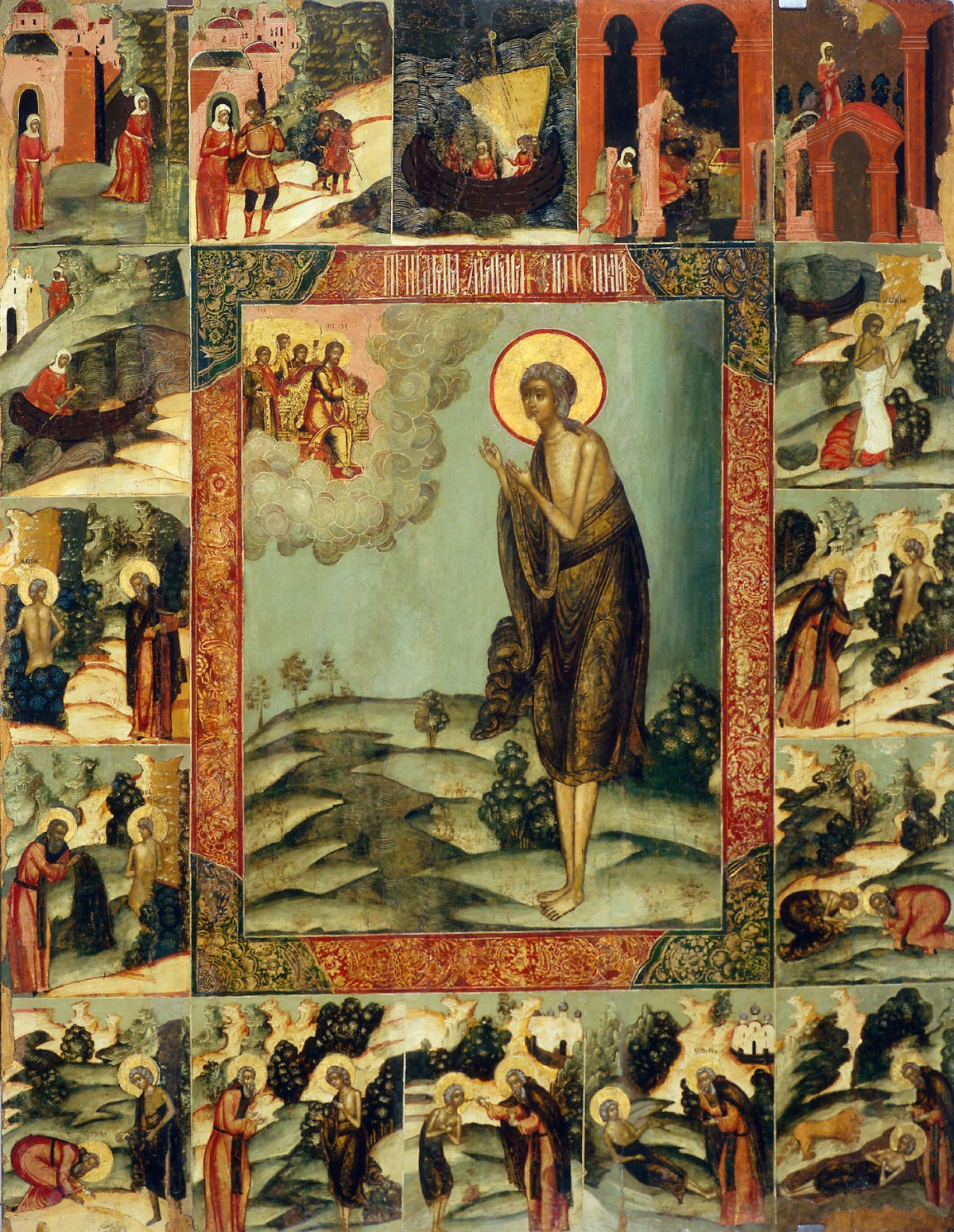
mary_of_egypt2.jpg


But when I trod on the doorstep which everyone passed, I was stopped by some force which prevented by entering. Meanwhile I was brushed aside by the crowd …


If we were in that mood we would, when we come to the doors of the church, be, however little, like Mary of Egypt. We would stop and say, ‘How can I come in?’ And if we did that with our whole heart, broken-heartedly, with a sense of horror of the fact that we are so distant from God, so alien, so unfaithful to Him, then the doors would open and we would see that we are not simply in a big space surrounded with walls but we are in a space which is God’s Heaven come to earth.
 Let us ask ourselves freely today how do we resemble, or not, Mary of Egypt

Mary of Egypt went through a tragedy before she met Christ. She was a sinner. She was a harlot. She was unfaithful to God in her soul and in her body. She had no reverence for this body which God had created and this soul. And yet she was tragically confronted with the fact that there was no way for her into the temple of God unless she rejected evil and chose purity, repentance, newness of life.

Let us ask ourselves freely today how do we resemble, or not, Mary of Egypt – Mary who had lived her life according to her own ways and desires, followed all temptations of her body and soul; and one day realised that as she was, she could not enter the temple of God.

So easily do we enter the divine temple, forgetting so easily that the church into which we come is a small part of a world that has chosen to be alien to God, that has rejected God, lost interest in Him; and that the few believers have created for God a place of refuge – yes, the church is the fullness of Heaven, and at the same time a tragic place of refuge, the only place where God has a right to be because He is wanted. And when we come here, we enter into the divine realm. We should come into it with a sense of awe, not just walk into it as into a space but walk into it as a space which is already the divine Kingdom.

Holy Week: How Can I Prepare Worthily For Easter?

If we were in that mood we would, when we come to the doors of the church, be, however little, like Mary of Egypt. We would stop and say, ‘How can I come in?’ And if we did that with our whole heart, broken-heartedly, with a sense of horror of the fact that we are so distant from God, so alien, so unfaithful to Him, then the doors would open and we would see that we are not simply in a big space surrounded with walls but we are in a space which is God’s Heaven come to earth.

Let us therefore learn from this experience what it means to go step by step towards the Resurrection, because in order to reach the Resurrection we must go through Calvary, we must go through the tragedy of Holy Week and make it our own, partaking with Christ and His disciples and the crowds around in the horror, the terror of it; and also experience it as a scorching fire that will burn in us all that is unworthy of God and make us clean. And perhaps one day, when the fire will have burnt everything which is not worthy of God, each of us may become an image of the burning bush, aflame with divine fire and not consumed, because only that which could survive the fire of God would have remained is us. Amen.

burning.jpg

A Sermon on St. Mary of Egypt by METROPOLITAN ANTHONY OF SOUROZH

Holy Week: How Can I Prepare Worthily For Easter?

Monastic Tonsure


tonsure.jpg

Every monastic calling is a falling asleep, like that which Adam underwent. God does this to us, and simultaneously pierces our side, next to our heart. This is the meaning of the corresponding verse [Genesis 2 :21] God takes our heart, our will, our dreams, our hopes, our everything and He offers us His Church as the New Eve. He is telling us that from now on, our body and our future is owned by the Church!

Gerondas Aimilianos

Genesis 2 :21
And the Lord God caused a deep sleep to fall on Adam, and he slept; and He took one of his ribs, and closed up the flesh in its place. 22 Then the rib which the Lord God had taken from man He made into a woman, and He brought her to the man.


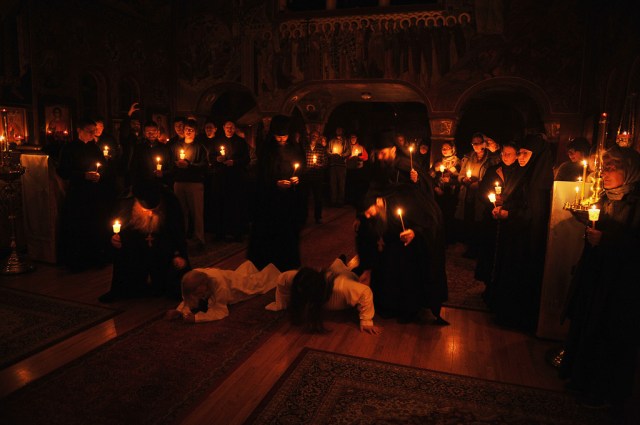
On Friday March 30 2012 after the Matins service Riassaphore monks Laurence and Dionysios were tonsured to the Lesser Schema by Archimandrite Luke. At the end of Matins they entered the Altar were they received the blessing of the Abbot and then proceeded to venerate the holy icons. During the First Hour they put on white gowns as one does when they are to be baptized and when the service finished they were led by the hieromonks of the monastery to the middle of the Church were they prostrated themselves to the ground three times during which the choir sung the sessional hymn after the Third Ode of the Canon from the Prodigal Son “Thy fatherly embrace hasten to open to me, for like  the prodigal have I spent my life. Disdain not a heart now impoverished O Savior, Who hast before Thine eyes the inexpressible riches of Thy mercies. For to Thee, O Lord, in compunction I cry: Father, I have sinned against Heaven, and before Thee”.

When they reached the front of the ambon the Abbot signaled them to get up and read the prayers of the tonsure and  exchanged in a dialog questions and answers as to the purpose of coming to the  monastic life.  Below are some of the exchanges that took place:

Question: Why hast thou come hither, Brother, falling down before the Holy Altar and before this Holy Assembly?
Answer: I am desirous of the life of asceticism, Reverend Father.
Question: Of thine own willing mind comest thou unto the Lord?
Answer: Yes, God helping me, Reverend Father.
Question: Not by any necessity, or constraint?
Answer: No, Reverend Father.
Question: Dost thou renounce the world, and the things belonging to the world, according to the commandment of the Lord?
Answer: Yes, Reverend Father.
Question: Wilt thou endure all the strain tribulation belonging to the monastic life, for the Kingdom of Heaven’s sake?
Answer: Yes, God helping me, Reverend Father.

Fr. Laurence was tonsured with the name of St John  of St. Fransisco and and Fr. Dionysios received the name of St. Seraphim of Sarov. May our Lord help the newly tonsured monks to live steadfastly their monastic vocation  by a “pure and virtuous life” so that their life becomes a light to the world.

Archimandrite Luke counseled the newly tonsured monks to become imitators of the lives of the saints whose names they received and to struggle in humility enduring all afflictions for the salvation of their souls. At the end of this very moving service everyone went up to the newly tonsured monastics and greeted them with the traditional greeting, “What is your name father?” to which they replied  “sinful monk John and Seraphim” and all wished them many years and God’s blessing in their struggles.

Source: Holy Trinity Monastery


On the Silent and Invisible Warfare


e

Way of the Ascetics 

By Tito Colliander


Chapter One: On a Resolute and Sustained Purpose


IF you wish to save your soul and win eternal life, arise from your lethargy, make the sign of the Cross and say:

In the name of the Father, and of the Son and of the Holy Ghost. Amen.

Faith comes not through pondering but through action. Not words and speculation but experience teaches us what God is. To let in fresh air we have to open a window; to get tanned we must go out into the sunshine. Achieving faith is no different; we never reach a goal by just sitting in comfort and waiting, say the holy Fathers. Let the Prodigal Son be our example. He arose and came (Luke 15:20).

However weighed down and entangled in earthly fetters you may be, it can never be too late. Not without reason is it written that Abraham was seventy-five when he set forth, and the labourer who comes in the eleventh hour gets the same wages as the one who comes in the first.

Nor can it be too early. A forest fire cannot be put out too soon; would you see your soul ravaged and charred?

In baptism you received the command to wage the invisible warfare against the enemies of your soul; take it up now. Long enough have you dallied; sunk in indifference and laziness you have let much valuable time go to waste. Therefore you must begin again from the beginning: for you have let the purity you received in baptism be sullied in dire fashion.

b

Arise, then; but do so at once, without delay. Do not defer your purpose till “tonight” or “tomorrow” or “later, when I have finished what I have to do just now.” The interval may be fatal.

No, this moment, the instant you make your resolution, you will show by your action that you have taken leave of your old self and have now begun a new life, with a new destination and a new way of living. Arise, therefore, without fear and say: Lord, let me begin now. Help me! For what you need above all is God’s help. . Hold fast to your purpose and do not look back. We have been given a warning example in Lot’s wife, who was turned into a pillar of salt when she looked back (Genesis 19:26). You have cast off your old humanity; let the rags lie. Like Abraham, you have heard the voice of the Lord: Get thee out of thy country, and from thy kindred, and from thy father’s house, into a land that I will show thee (Genesis 12:1). Towards that land hereafter you must direct all your attention.

a

Chapter 2: On The Insufficiency Of Human Strength


THE holy Fathers say with one voice: The first thing to keep in mind is never in any respect to rely on yourself. The warfare that now lies before you is extraordinarily hard, and your own human powers are altogether insufficient to carry it on. If you rely on them you will immediately be felled to the ground and have no desire to continue the battle. Only God can give you the victory you wish.

This decision not to rely on self is for most people a severe obstacle at the very outset. It must be overcome, otherwise we have no prospect of going further. For how can a human being receive advice, instruction and help if he believes that he knows and can do everything and needs no directions? Through such a wall of self-satisfaction no gleam of light can penetrate. Woe unto them that are wise in their own eyes, and prudent in their own sight, cries the prophet Isaiah (5:21), and the apostle St. Paul utters the warning: Be not wise in your own conceits (Romans 12:16). The kingdom of heaven has been revealed unto babes, but remains hidden from the wise and prudent (Matthew 11:25).

We must empty ourselves, therefore, of the immoderately high faith we have in ourselves. Often it is so deeply rooted in us that we do not see how it rules over our heart. It is precisely our egoism, our self-centeredness and self-love that cause all our difficulties, our lack of freedom in suffering, our disappointments and our anguish of soul and body.

d

Take a look at yourself, therefore, and see how bound you are by your desire to humour yourself and only yourself. Your freedom is curbed by the restraining bonds of self-love, and thus you wander, a captive corpse, from morning till eve. “Now I will drink,” “now I will get up,” “now I will read the paper.” Thus you are led from moment to moment in your halter of preoccupation with self, and kindled instantly to displeasure, impatience or anger if an obstacle intervenes.

If you look into the depths of your consciousness you meet the same sight. You recognize it readily by the unpleasant feeling you have when someone contradicts you. Thus we live in thralldom. But where the Spirit of the Lord is, there is liberty (11 Corinthians 3:17).

How can any good come out of such an or biting around the ego? Has not our Lord bidden us to love our neighbour as ourselves, and to love God above all? But do we? Are not our thoughts instead always occupied with our own welfare?

No, be convinced that nothing good can come from yourself. And should, by chance, an unselfish thought arise in you, you may be sure that it does not come from you, but is scooped up from the wellspring of goodness and be stowed upon you: it is a gift from the Giver o life. Similarly the power to put the good thought into practice is not your own, but is given you by the Holy Trinity.

f

Chapter Three: On The Garden Of The Heart

THE new life you have just entered has often been likened to that of a gardener. The soil he tills he has received from God, as well as the seed and the sun’s warmth and the rain and the power to grow. But the work is entrusted to him.

If the husbandman wishes to have a rich harvest, he must work early and late, weed and aerate, water and spray, for cultivation is beset by many dangers that threaten the harvest. He must work without ceasing, be constantly on watch, constantly alert, constantly prepared; but even so, the harvest ultimately des wholly on the elements, that is, on God.

The garden that we have undertaken to tend watch over is the field of our own heart; the harvest is eternal life.

Eternal, because it is independent of time and space and other external circumstances: it is the true life of freedom, the life of love and mercy and light, that has no bounds whatever, and for just that reason is eternal. It is a spiritual life in a spiritual dominion: a state of being. It begins here, and has no end, and no earthly power can coerce it; and it is to be found in the human heart.

Persecute yourself, says St. Isaac of Syria, and your enemy is routed as fast as you approach. Make peace with yourself, and heaven and earth make peace with you. Take pains to enter your own innermost chamber and you will see the chamber of heaven, for they are one and the same, and in entering one you behold them both. The stairway to the kingdom is within you, secret in your soul. Cast off the burden of sin and you will find within you the upward path that will make your ascent possible.

The heavenly chamber of which the saint speaks here is another name for eternal life. It is also called the kingdom of heaven, the kingdom of God, or quite simply, Christ. To live in Christ is to live in eternal life.

c

Chapter Four: On the Silent and Invisible Warfare

NOW that we know where the battle we have just begun is to be fought, and what and where our goal is, we also understand why our warfare ought to be called the invisible warfare. It all takes place in the heart, and in silence, deep within us; and this is another serious matter, on which the holy Fathers lay much stress: keep your lips tight shut on your secret! If one opens the door of the steam bath the heat escapes, and the treatment loses its benefit.

Thus say nothing to anyone of your newly conceived purpose. Say nothing of the new life you have begun or of the experiment you are making and experiences you expect to have. All this is a matter between God and you, and only between you two. The only exception might be your father-confessor.

g

This silence is necessary because all chatter about one’s own concerns nourishes self-preoccupation and self-trust. And these must be stifled first of all! Through stillness one’s trust grows in Him who sees what is hidden; through silence one talks with Him who hears without words. To come to Him is your endeavour, and in Him shall be all your confidence: you are anchored in eternity, and in eternity there are no words.

Hereafter you will consider that everything that happens to you, both great and small, is sent by God to help you in your warfare. He alone knows what is necessary for you and what you need at the moment: adversity and prosperity, temptation and fall. Nothing happens accidentally or in such a way that you cannot learn from it; you must understand this at once, for this is how your trust grows in the Lord whom you have chosen to follow.

Still another piece of information the saints offer on the way: you should see yourself as a child who is setting out to learn the first sounds of letters and who is taking his first tottering steps. All worldly wisdom and all the skills you may have are totally worthless in the warfare that awaits you, and equally without value are your social standing and your possessions. Property that is not used in the Lord’s service is a burden, and knowledge that does not engage the heart is barren and therefore harmful, because it is presumptuous. It is called naked, for it is without warmth and fosters no love. You must thus abandon all your knowledge and become a dunce in order to be wise; you must become a pauper in order to be rich, and a weakling if you wish to be strong.