Unaccepted By The Church


“If You Cross The Jordan, …
… You Will Find Glorious Rest”
mary1

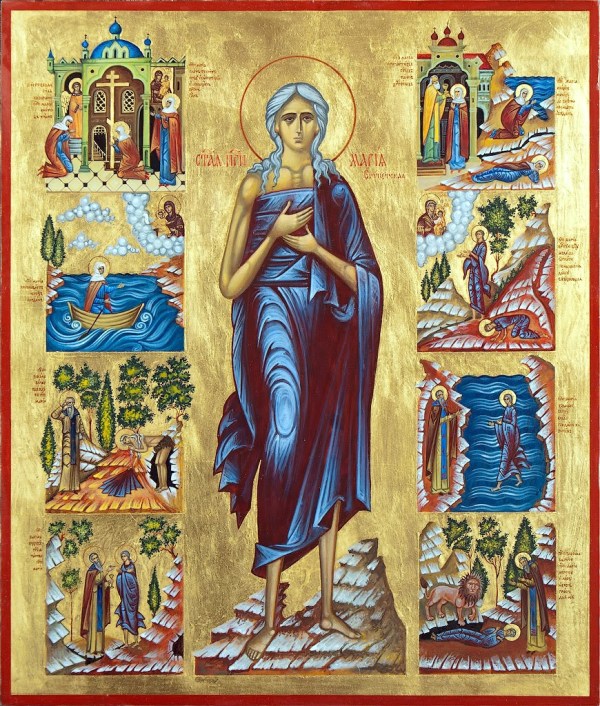
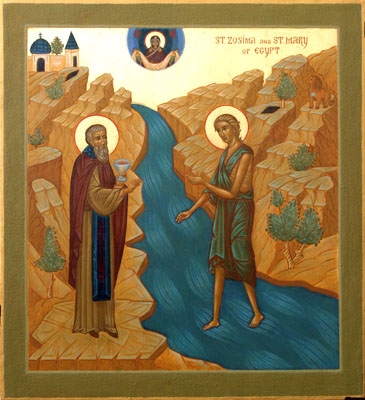
The holy day of the Exaltation of the Cross dawned while I was still flying about — hunting for youths. At daybreak I saw that everyone was hurrying to the church, so I ran with the rest. When the hour for the holy elevation approached, I was trying to make my way in with the crowd which was struggling to get through the church doors. I ad at last squeezed through with great difficulty almost to the entrance of the temple, from which the lifegiving Tree of the Cross was being shown to the people. But when I trod on the doorstep which everyone passed, I was stopped by some force which prevented by entering. Meanwhile I was brushed aside by the crowd and found myself standing alone in the porch. Thinking that this had happened because of my woman’s weakness, I again began to work my way into the crowd, trying to elbow myself forward. But in vain I struggled. Again my feet trod on the doorstep over which others were entering the church without encountering any obstacle. I alone seemed to remain unaccepted by the church. It was as if there was a detachment of soldiers standing there to oppose my entrance. Once again I was excluded by the same mighty force and again I stood in the porch. 
mary2

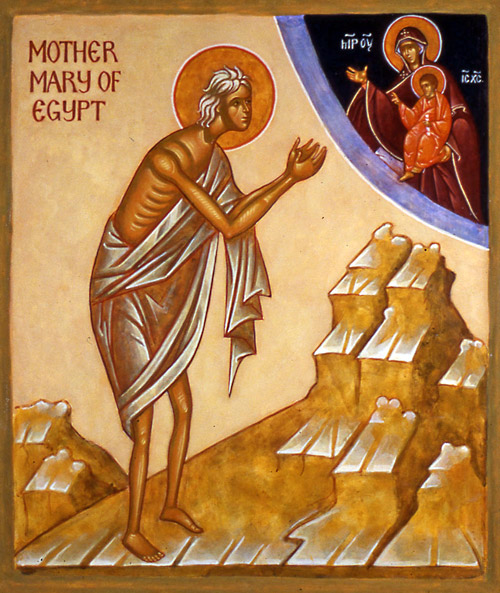
Having repeated my attempt three or four times, at last I felt exhausted and had no more strength to push and to be puched, so I went aside and stood in a corner of the porch. And only then with great difficulty it began to dawn on me, and I began to understand the reason why I was prevented from being admitted to see the life-giving Cross. The word of salvation gently touched the eyes of my heart and revealed to me that it was my unclean life which barred the entrance to me. I began to weep and lament and beat my breast, and to sigh from the depths of my heart. And so I stood weeping when I saw above me the ikon of the most holy Mother of God. And turning to her my bodily and spiritual eyes I said: 

`O Lady, Mother of God, who gave birth in the flesh to God the Word, I know, O how well I know, that it is no honour or praise to thee when one so impure and depraved as I look up to thy ikon, O ever-virgin, who didst keep thy body and soul in purity. rightly do I inspire hatred and disgust before thy virginal purity. But I have heard that God Who was born of thee became man on purpose to call sinners to repentance. Then help me, for I have no other help. Order the entrance of the church to be opened to me. Allow me to see the venerable Tree on which He Who was born of thee suffered in the flesh and on which He shed His holy Blood for the redemption of sinners an for me, unworthy as I am. Be my faithful witness before thy son that I will never again defile my body by the impurity of fornication, but as soon as I have seen the Tree of the Cross I will renounce the world and its temptations and will go wherever thou wilt lead me.’
mary5

Thus I spoke and as if acquiring some hope in firm faith and feeling some confidence in the mercy of the Mother of God, I left the place where I stood praying. And I went again and mingled with the crowd that was pushing its way into the temple. And no one seemed to thwart me, no one hindered my entering the church. I was possessed with trembling, and was almost in delirium. Having got as far as the doors which I could not reach before — as if the same force which had hindered me cleared the way for me — I now entered without difficulty and found myself within the holy place. And so it was I saw the lifegiving Cross. I saw too the Mysteries of God and how the Lord accepts repentance. Throwing myself on the ground, I worshipped that holy earth and kissed it with trembling. The I came out of the church and went to her who had promised to be my security, to the place where I had sealed my vow.
mary4

And bending my knees before the Virgin Mother of God, I addressed to her such words as these: 

`O loving Lady, thou hast shown me thy great love for all men. glory to God Who receives the repentance of sinners through thee. What more can I recollect or say, I who am so sinful? It is time for me, O Lady to fulfil my vow, according to thy witness. Now lead me by the hand along the path of repentance!’ And at these words I heard a voice from on high: 

`If you cross the Jordan,

you will find glorious rest.’

Hearing this voice and having faith that it was for me, I cried to the Mother of God: 

`O Lady, Lady, do not forsake me!’

With these words I left the porch of the church and set off on my journey. As I was leaving the church a stranger glanced at me and gave me three coins, saying: 

`Sister, take these.’
mary6

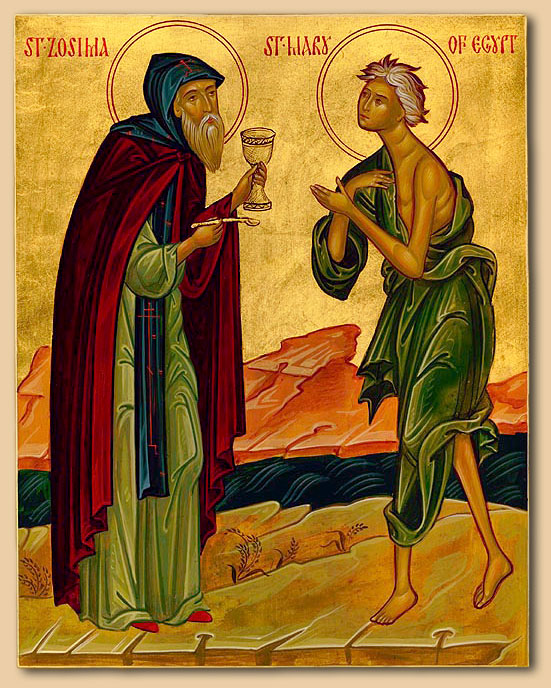
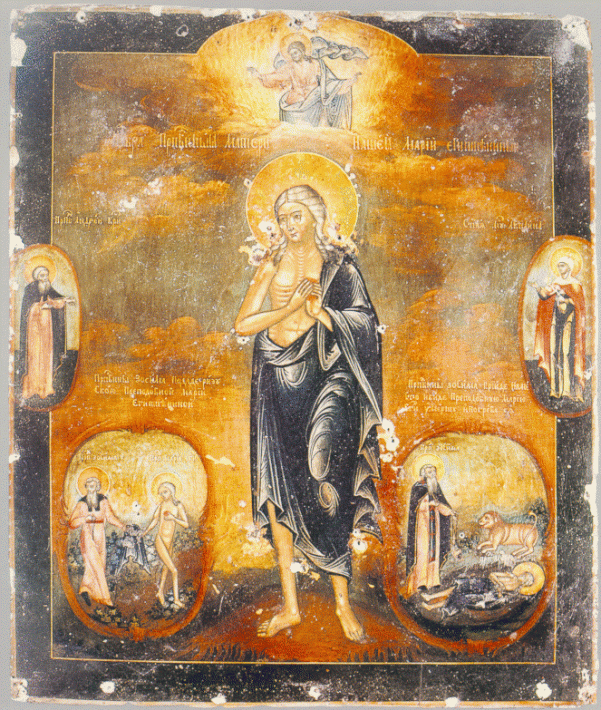
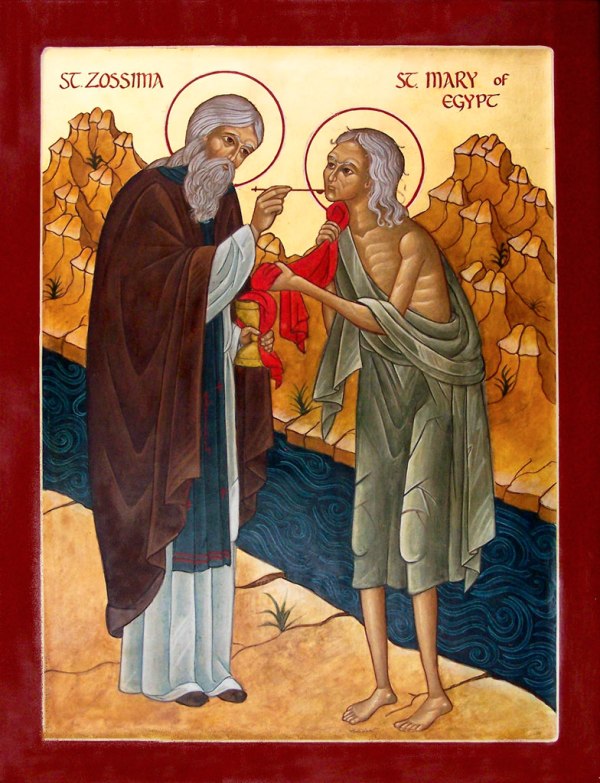
And, taking the money, I bought three loaves and took them with me on my journey, as a blessed gift. I asked the person who sold the bread: `Which is the way to the Jordan?’ I was directed to the city gate which led that way. Running on I passed the gates and still weeping went on my journey. Those I met I asked the way, and after walking for the rest of that day (I think it was nine o’clock when I saw the Cross) I at length reached at sunset the Church of St. John the Baptist which stood on the banks of the Jordan. After praying in the temple, I went down to the Jordan and rinsed my face and hands in its holy waters. I partook of the holy and life-giving Mysteries in the Church of the Forerunner and ate half of one of my loaves. Then, after drinking some water from Jordan, I lay down and passed the night on the ground. In the morning I found a small boat and crossed to the opposite bank. I again prayed to Our Lady to lead me whither she wished. Then I found myself in this desert and since then up to this very day I am estranged from all, keeping away from people and running away from everyone. And I live here clinging to my God Who saves all who turn to Him from faintheartedness and storms.” 
mary3

If You Cross The Jordan, You Will Find Glorious Rest [True Peace]

Committing Sins and Committing to God

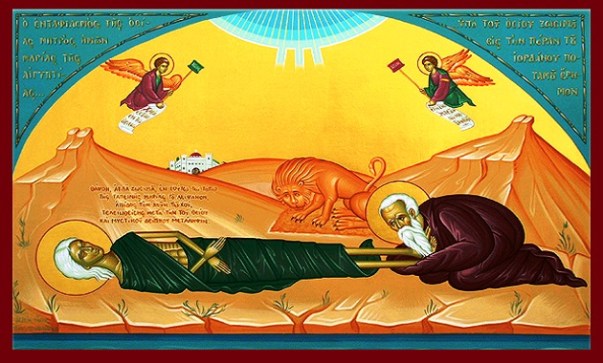
“Tomorrow heralds the end of Great Lent, since it is the ‘First Resurrection’, Lazarus Saturday, which is followed by Palm Sunday, the Entry of our Lord into Jerusalem, and then by Passion Week will be over. Let us ponder still, once more, on another entry into Jerusalem, not the Entry into Jerusalem of our Lord, but the entry into Jerusalem of Mary of Egypt. What is her significance today?

Let us ponder on the words of the Mother of God, which led Mary to her salvation through repentance and her greatness: ‘If you cross the Jordan, you will find true peace’. These mysterious words are mystically addressed to each of us; the interpretation of their mystery is open to the souls of each of us, but only if we ask the Mother of God and St Mary to guide us. And then we shall find our own ‘entry into Jerusalem’.”

(Based on A Sermon on St. Mary of Egypt by Archpriest Andrew Philips)

Holy Mother Mary, pray to God for us!
mary7

Rejected By The Church


“If You Cross The Jordan, …
… You Will Find Glorious Rest”

mary1

The holy day of the Exaltation of the Cross dawned while I was still flying about — hunting for youths. At daybreak I saw that everyone was hurrying to the church, so I ran with the rest. When the hour for the holy elevation approached, I was trying to make my way in with the crowd which was struggling to get through the church doors. I ad at last squeezed through with great difficulty almost to the entrance of the temple, from which the lifegiving Tree of the Cross was being shown to the people. But when I trod on the doorstep which everyone passed, I was stopped by some force which prevented by entering. Meanwhile I was brushed aside by the crowd and found myself standing alone in the porch. Thinking that this had happened because of my woman’s weakness, I again began to work my way into the crowd, trying to elbow myself forward. But in vain I struggled. Again my feet trod on the doorstep over which others were entering the church without encountering any obstacle. I alone seemed to remain unaccepted by the church. It was as if there was a detachment of soldiers standing there to oppose my entrance. Once again I was excluded by the same mighty force and again I stood in the porch. 

mary2

Having repeated my attempt three or four times, at last I felt exhausted and had no more strength to push and to be puched, so I went aside and stood in a corner of the porch. And only then with great difficulty it began to dawn on me, and I began to understand the reason why I was prevented from being admitted to see the life-giving Cross. The word of salvation gently touched the eyes of my heart and revealed to me that it was my unclean life which barred the entrance to me. I began to weep and lament and beat my breast, and to sigh from the depths of my heart. And so I stood weeping when I saw above me the ikon of the most holy Mother of God. And turning to her my bodily and spiritual eyes I said: 

`O Lady, Mother of God, who gave birth in the flesh to God the Word, I know, O how well I know, that it is no honour or praise to thee when one so impure and depraved as I look up to thy ikon, O ever-virgin, who didst keep thy body and soul in purity. rightly do I inspire hatred and disgust before thy virginal purity. But I have heard that God Who was born of thee became man on purpose to call sinners to repentance. Then help me, for I have no other help. Order the entrance of the church to be opened to me. Allow me to see the venerable Tree on which He Who was born of thee suffered in the flesh and on which He shed His holy Blood for the redemption of sinners an for me, unworthy as I am. Be my faithful witness before thy son that I will never again defile my body by the impurity of fornication, but as soon as I have seen the Tree of the Cross I will renounce the world and its temptations and will go wherever thou wilt lead me.’

mary5

Thus I spoke and as if acquiring some hope in firm faith and feeling some confidence in the mercy of the Mother of God, I left the place where I stood praying. And I went again and mingled with the crowd that was pushing its way into the temple. And no one seemed to thwart me, no one hindered my entering the church. I was possessed with trembling, and was almost in delirium. Having got as far as the doors which I could not reach before — as if the same force which had hindered me cleared the way for me — I now entered without difficulty and found myself within the holy place. And so it was I saw the lifegiving Cross. I saw too the Mysteries of God and how the Lord accepts repentance. Throwing myself on the ground, I worshipped that holy earth and kissed it with trembling. The I came out of the church and went to her who had promised to be my security, to the place where I had sealed my vow.

mary4

And bending my knees before the Virgin Mother of God, I addressed to her such words as these: 

`O loving Lady, thou hast shown me thy great love for all men. glory to God Who receives the repentance of sinners through thee. What more can I recollect or say, I who am so sinful? It is time for me, O Lady to fulfil my vow, according to thy witness. Now lead me by the hand along the path of repentance!’ And at these words I heard a voice from on high: 

`If you cross the Jordan,

you will find glorious rest.’

Hearing this voice and having faith that it was for me, I cried to the Mother of God: 

`O Lady, Lady, do not forsake me!’

With these words I left the porch of the church and set off on my journey. As I was leaving the church a stranger glanced at me and gave me three coins, saying: 

`Sister, take these.’

mary6

And, taking the money, I bought three loaves and took them with me on my journey, as a blessed gift. I asked the person who sold the bread: `Which is the way to the Jordan?’ I was directed to the city gate which led that way. Running on I passed the gates and still weeping went on my journey. Those I met I asked the way, and after walking for the rest of that day (I think it was nine o’clock when I saw the Cross) I at length reached at sunset the Church of St. John the Baptist which stood on the banks of the Jordan. After praying in the temple, I went down to the Jordan and rinsed my face and hands in its holy waters. I partook of the holy and life-giving Mysteries in the Church of the Forerunner and ate half of one of my loaves. Then, after drinking some water from Jordan, I lay down and passed the night on the ground. In the morning I found a small boat and crossed to the opposite bank. I again prayed to Our Lady to lead me whither she wished. Then I found myself in this desert and since then up to this very day I am estranged from all, keeping away from people and running away from everyone. And I live here clinging to my God Who saves all who turn to Him from faintheartedness and storms.” 

mary3

If You Cross The Jordan, You Will Find Glorious Rest [True Peace]

Committing Sins and Committing to God

“Tomorrow heralds the end of Great Lent, since it is the ‘First Resurrection’, Lazarus Saturday, which is followed by Palm Sunday, the Entry of our Lord into Jerusalem, and then by Passion Week will be over. Let us ponder still, once more, on another entry into Jerusalem, not the Entry into Jerusalem of our Lord, but the entry into Jerusalem of Mary of Egypt. What is her significance today?

Let us ponder on the words of the Mother of God, which led Mary to her salvation through repentance and her greatness: ‘If you cross the Jordan, you will find true peace’. These mysterious words are mystically addressed to each of us; the interpretation of their mystery is open to the souls of each of us, but only if we ask the Mother of God and St Mary to guide us. And then we shall find our own ‘entry into Jerusalem’.”

(Based on A Sermon on St. Mary of Egypt by Archpriest Andrew Philips)

Holy Mother Mary, pray to God for us!

mary7

To Thee, the Champion Leader

The Akathist Hymn, chanted and in Icons, together with the Miraculous Athonite Akathist icon “Panagia of the Salutations the Myrrhgusher” at Holy Monastery Dionysiou 

akathist1

To Thee, the Champion Leader, we Thy servants dedicate a feast of victory and of thanksgiving as ones rescued out of sufferings, O Theotokos: but as Thou art one with might which is invincible, from all dangers that can be do Thou deliver us, that we may cry to Thee: Rejoice, O Unwedded Bride!

While the Emperor of Byzantium Heracleios was on an expedition to fight the aggression of the Persians on their own grounds, there appeared outside the walls of Constantinople barbaric hordes, mostly Avars. The siege lasted a few months, and it was apparent that the outnumbered troops of the Queen City were reaching desperation. However as history records, the faith of the people worked the impossible. The Venerable Patriarch Sergius with the Clergy and the Official of Byzantium Vonos, endlessly marched along the great walls of Constantinople with an Icon of the Theotokos in hand, and bolstered the faith of the defenders of freedom. The miracle came soon after. Unexpectedly, as the chronicler narrates, a great storm with huge tidal waves destroyed most of the fleet of the enemy, and full retreat ensued. The faithful of Constantinople spontaneously filled the Church of the Theotokos at Vlachernae on the Golden Horn, and with the Patriarch Sergius officiating, they prayed all night singing praises to the Virgin Mary without sitting. Hence the title of the Hymn “Akathistos”, in Greek meaning ‘not seated’.

*

The Akathist Hymn is chanted in all Orthodox Churches throughout the world during the five Fridays in the Great Lent, and constitutes a very concrete spiritual preparation for the Holy Week and Easter Services; a ‘staff’ to help us ascend the spiritual steps of the lengthy Lenten period, to finally reach the peak with our Lord’s Glorious Resurrection. 

*

Panagia herself, appearing to the Saints has said: “I will love, I will protect, and I will shelter every faithful person who greets me every day with the beautiful hymns of My Salutations, and who lives in accordance with the law of God. And on the last day of his life, I will defend him before My Son.”

The Akathist Hymn in Icons

The Laudations of Our Lady of the Akathist

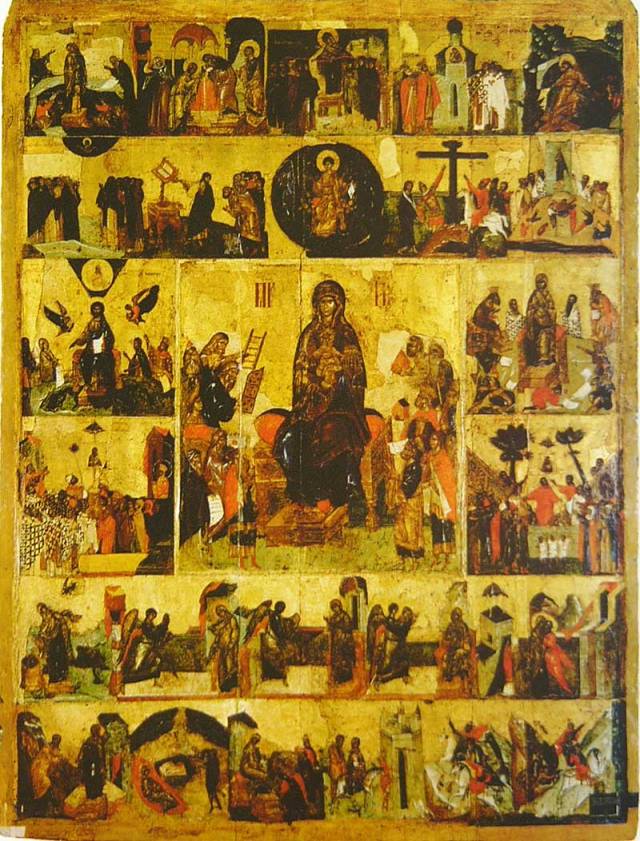
The Akathist to the Mother of God was most probably written by Roman the Melodist in the 6th century and has inspired Iconographers to depict the Akathist in images no less beautiful than the words which inspired them.


Structure of the Hymn; Structure of the Icon


akathist3


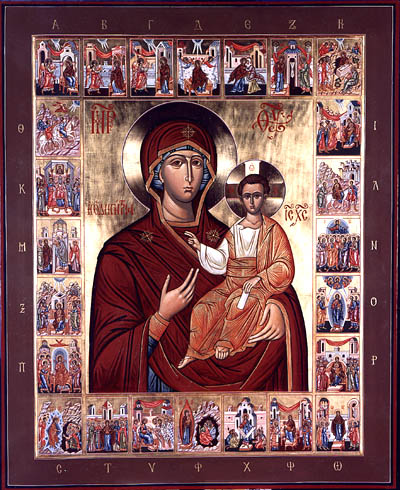
American Icon, bordered by the 24 Stanzas and their corresponding Greek letter


akathist4

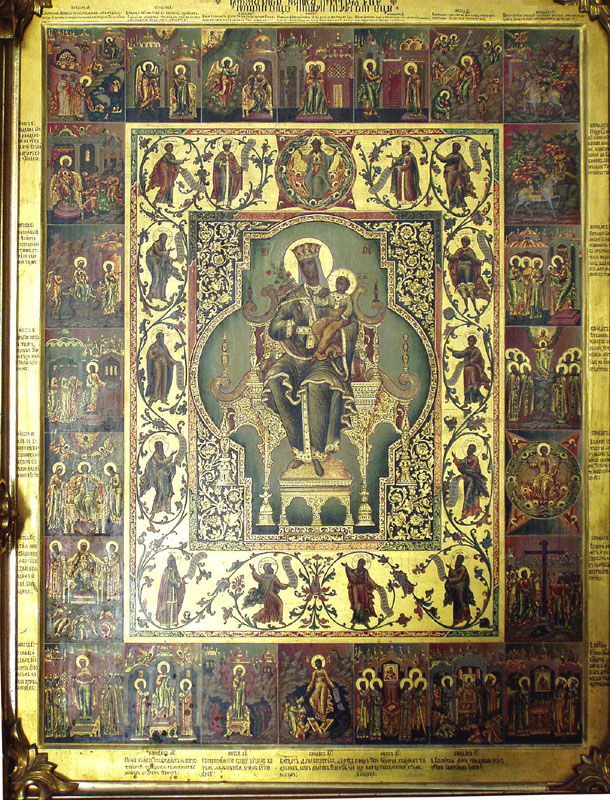
Outer border shows 24 Stanzas; Inner border shows Old Testament Prophecies


The Main part of the Akathist Hymn is comprised of 24 stanzas. The stanzas alternate between long and short. Each short stanza is written in prose and ends with the singing of “Alleluia.” Each longer stanza ends with the refrain: “Rejoice, O Bride Unwedded.”Sometimes “Rejoice” is translated as “Hail”; this is probably closer to the Greek word used (Chaíre – Χαῖρε) and explains the name for the service based on this Hymn (and another name for the Icon): the Salutations of the Theotokos.


The stanzas are arranged in an acrostic following the Greek alphabet. Thus, the first stanza, “An Archangel was sent…”, begins with alpha: “γγελος πρωτοστάτης…” whilst the final stanza, “O All-Praised Mother…”, begins with omega: “ πανύμνητε Μῆτερ…”


Each stanza presents us with a scene, which as they progress cover the themes of the Annunciation, the Nativity, Christ, and the Theotokos herself, in that order. It is these scenes which are depicted around the outer border of most “Akathist Icons”.


The Mother of God: at the centre, but not the focus, of the Icon

Yaroslav, 18th Century


At the centre of the Icon is the Mother of God to whom the Akathist is dedicated. She is surrounded by a number of people, usually between 11 and 15, who hold appear to be bowing down before her, holding scrolls and other objects. These men are various Old Testament Prophets, and the scrolls they hold are their prophecies relating to the Mother of God. The objects they hold are prefigurations of Mary found in the Old Testament Scriptures, but are also some of the titles given to Mary in the Akathist Hymn.

Despite the honour given to her, Mary sits at the centre of the icon directing us to her Son, our God, sitting in her lap.

As in the Icon at the top of the page, where Mary is not holding the infant Christ (Immanuel), then she is sat amid the praise with her hands held deferentially, palms outward, imploring us to give all honour and glory to God. Surrounding Mary’s seat is a mandorla-shaped wreath representing the Tree of Jesse, which climbs up over the Mother of God’s head to blossom forth an image of Christ Immanuel: God Incarnate. (The use of a “mandorla-wreath” to represent the Tree of Jesse is seen in this painted wall of the Sucevita Monastery, built in the 16th century in Romania).

Thus the Theotokos is the subject of the Icon, just as the Akathist is dedicated to her; however, just as the Akathist glorifies God, the focus of the Icon always leads us back to Jesus Christ. In the Akathist, Mary is not just called “All-glorious temple” but “All-glorious temple of Him Who is above the Seraphim” (from Oikos 8, i.e. the 16th Stanza of the Akathist). The praises of Mary are devoid of meaning without Jesus Christ, the Word of God, Who was incarnate within her. Likewise in the Icon inspired by the Akathist, Mary cannot be separated from her Son, shown either seated upon her, or blossoming above her.

Russian Icon (probably 19th Century)


While singing in honour of Your Son, O Mother of God, we all praise you as a living temple; for the Lord who holds all things in His hand dwelt in your womb, and He sanctified and glorified you, and taught all to cry to you: Hail, O Bride unwedded!

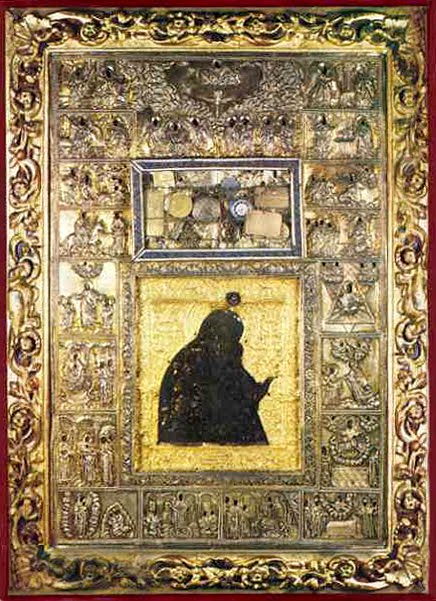
Miraculous icon of Panagia of the Salutations, Dionysiou Monastery, Mount Athos  

akathist5.jpg

Holy Monastery Dionysiou – Panagia of the Salutations the Myrrhgusher
“According to an inscription on the back of this icon, it was given as a gift to Saint Dionysius, founder of the Holy Monastery of Dionysiou on Mount Athos, by Emperor Alexios Komnenos, upon his visit to Trebizond in Asia Minor. According to Holy Tradition, this is the same icon that Patriarch Sergius processed around the walls of Constantinople in 626 A.D. during the reign of Emperor Heraclius. At that time Constantinople was attacked by the Persians and “Scythians” (Avars and Slavs) but saved through the intervention of the Most Holy Theotokos. A sudden hurricane dispersed the fleet of the enemy, casting the vessels on the shore near the great Church of the Theotokos at Blachernae near the Golden Horn. The people spent the whole night in front of this icon thanking her for the unexpected deliverance. In memory of this event the Akathist Hymn is chanted in the Orthodox Church.
In 1592 Algerian pirates stole the icon, but after a fierce storm, a frightening dream, and a great miracle, the leader of the pirates was forced to return it to the monastery. They had hid it in a chest, but the icon shattered it and it was drenched in myrrh. Because of this miracle, some pirates repented and entered the monastery to become monastics.
In 1767 certain theives from Dalmatia stole the icon, and upon their return to Dalmatia were apprehended by Greek shepherds who took the icon and brought it to Skopelos. On Skopelos island the Greek community leaders elected by the Turks, known as Dimogerontes, denied to the Dionysian monks from Mount Athos the return of the icon when they came to request its return. After three months Skopelos was punished by a plague which brought great tragedy to the island, and the Dimogerontes repented and had the icon returned to Dionysiou Monastery and also established a metochion for the monastery on the island.
The icon is small and darkened by time. It is housed in a chapel dedicated to the icon at Dionysiou Monastery where the Akathist Hymn is sung daily.” 
  
Panagia herself, appearing to the Saints has said: “I will love, I will protect, and I will shelter every faithful person who greets me every day with the beautiful hymns of My Salutations, and who lives in accordance with the law of God. And on the last day of his life, I will defend him before My Son.”


Source: iconreader.wordpress.com


Meditation on Epiphany

Epiphany, Easter and Pentecost

Or Meditation on Light(s), Baptism(s) and Conversions in our inner life

theophany.jpg

Epiphany is not only the feast of the waters. Ancient Greek tradition calls it ‘the feast of lights’. This feast brings us, not only the grace of purification, but also the grace of illumination (in fact baptism itself was formerly called ‘illumination’). The light of Christ at Christmas was but a star in the dark night; at Epiphany it appears to us as the rising sun; it will grow and, after the eclipse of Holy Friday, burst forth yet more splendid, on the morning of Easter; and finally, at Pentecost, it will reach its full zenith. It is not only the divine light, manifested objectively in the person of Jesus Christ and in the pentecostal flame that we are concerned with; it is also the inner light, for, without absolute faithfulness to this, spiritual life wold be nothing but illusion and falsehood.

God, who had sent the Precursor to baptise with water, had said to him: “Upon whom thou shalt see the Spirit descending, and remaining on him, the same is he which baptiseth with the Holy Ghost”. The baptism by water is but one aspect of total baptism. Jesus himself says to Nicodemus: “Except a man be born of water and of the Spirit, he cannot enter into the kingdom of God”. The baptism of the Spirit is superior to the baptism by water. It constitutes an objective gift and a different inner experience. …


One could say that Epiphany — the first public manifestation of Jesus to men — corresponds in our inner life to the ‘first conversion‘ (or ‘purification’). This must be understood as the first conscious meeting of the human soul with its Saviour, the moment when we accept Jesus as Master and as friend, and at which we take the decision to follow him. Easter (both the death and the resurrection of the Lord) corresponds to a ‘second conversion‘ (or ‘illumination‘) in which, confronted with the mystery of the cross, we discover what kind of death and what kind of new life this implies, and we consecrate ourselves more more deeply to Jesus Christ, through a radical change in ourselves. Pentecost is the time of the ‘third conversion‘ (or ‘union‘), which is the baptism and fire of the Spirit, the entry into a life of transforming union with God. It is not given to every Christian to follow this itinerary. Nonetheless, these are the stages which the liturgical year sets out for our endeavour.


By a Monk of the Eastern Church

The Year of Grace of the Lord

Censers of Flesh and Bones

nativity1.jpeg

I behold a strange, most glorious mystery: heaven- the cave, the cherubic throne-the Virgin, the manger-the place where Christ lay. The uncontained God whom we magnify in song”.

In a manger of love our Jesus was born, and in a cave he chose to visit our humanity.

By his descending, the Lord experienced all our weaknesses except for the sin. He did not chose the scepters or the sofas of the rich in order to preach the salvation, but the womb of a Virgin. He put us on so that we could put Him on. He dwelt in a cave so we may become citizens of Heavens. Jesus came looking for the humanity that was wounded with Adam and strayed with Eve. His incarnation reminds us of dispensation. It is the stamp of the divine love that looks for censed souls, like Mary’s, that spread  Creator’s scent worldwide. This is the case of Virgin Mary, the censor that spread the light of God for the mankind.

Let us put ourselves, just once, and see how this girl fulfilled the will of God, and how She became an example for us in all our troubles, even 2000 years after the coming of our Lord.

Mary was not one of those earthly “mighties”. But She was a mighty in Her prayer. She was not of a high class, but a girl of a humble love Who obeyed God’s order. She did not complain thinking about Her reputation, and She was not ashamed of getting pregnant of the Holy Spirit. Mary, the Galilaean, did not complain of the distress that happened in those days, which  looks like the distress that takes place nowadays. On the Contrary, She was armored with God. She was not ashamed of Her Son’s Cross, but She accompanied Him to the Golgotha, and She cried, just like us, over the tyranny of the falsehood.

Mary is one of many, who see the nails of falsehood being beaten in truth’s body just like those nails which were beaten in Jesus’s hands. But Mary did not deny Her God the way how some of us do today seeing how darkness overwhelming the light. She did not ask: where is God? Cannot He watch the sorrow of my heart? But, She said: God is the strength of my heart. Surely, Mary is a human, just like us. And surely, we may cry just like Her. But the strength and the uniqueness of this Virgin is the fact that She did not let the sorrow to overcome the hope. She was not afraid of putting her hope in God. And we are called upon to behave the same way in these difficult days in which we pass as humans, community, country and the whole East.

We are called upon nowadays to be united, and to follow the example of Virgin Mary and all the disciples. Their unity was mixed with an undoubted hope in God Who had victory over death. They buried fear because of their unity and love. And we are called upon, as much as possible, to bury our afflictions by keeping the unity of souls and hearts regardless of the geographical distances. Antioch is those hearts that are tied to Jesus. Before these bounds egoism, races, cracks and disputed melt out in order to make Jesus shine on the front.

We, as the Christians of the East, are called upon to contemplate in Jesus Who did not incarnate in days better than ours. Because of His love we put on His name first in Antioch, and with the power of His Cross our ancestors lived on this land. We are on it and we come from it. We were born from its womb and we will be buried in it. We are staying here, and we will carry our cross following the example of our Lord. And to those who abduct our people and bishops we say: We are a part of this East. In it we live together with our brothers from all religions. We won’t spare an effort to remain in this land defending our history and existence.

We pray today for the peace in Syria, and for stability in Lebanon. We pray for the suffering East, for the bleeding Palestine. We pray for the homeless, for the displaced, for the lost, for the abducted and for the martyr. We pray to Virgin Mary to send peace to the souls, because it is the seed of peace on earth. We pray to protect all Her abducted children, amongst them the two bishops of Aleppo Youhanna Ibraheem and Boulos Yazigi. We pray to Her to be with our people everywhere bestowing humanity the mercy of the Child of peace and the father of mercies.

Oh Jesus, Who descended to us as a Child. Come and fill us with the abundance of your mercy, keep our children and parents. Come and stay in the cave of our souls and trim our thoughts with Your holy light. Oh Jesus, whose presence filled us with peace, bless our life. Calm with the power of Your silence every disorder, fear and turbulence. Teach us to chant together: “Glory to God in the highest, and on earth peace, good will toward men”.

 
free-decorative-line-divider-clip-art-582650
Appropriately, the most soul moving Christmas messages this year have been issued from the parts of our planet where Christians are most prosecuted!


Waiting For God

Amidst wars, violence, refugee crises, terrorism, upheavals and worldwide Christian persecution, Christmas 2015 is so similar in so many respects to the very first Christmas and to the dark, hostile, unfriendly world Christ was born!

Panagia.jpg


“This has been such a tough year – not only for so many of us, but for the world as a whole. Like never before, I long for Christ to come and turn this dust we are made of into Divine Flesh once again. The Nativity Fast never felt so difficult for me, I went through it with such a heavy heart. Everywhere you look, you see war and terror, bombings, torture, extremism of all sorts.

Now, Christmas is almost here. Christ will descend again upon the world, and the world will once again open up to His presence. Deep down, the earth changes. Deep down, we all change. I have never longed for Him as I do now. I have never felt as thirsty for His presence as I am now. The world itself never felt so dry and empty and lost without Him.”(*)

free-decorative-line-divider-clip-art-582650

For detailed data on how Christians clearly represent the most persecuted people on earth in the 21st century, go to 2015 World Watch List, Overview

And we are not talking here of a bit of ridicule or silly marginalisation. We are talking about men, women and children being singled out because of their Christian faith or identity and put to an unimaginably cruel death. Or being driven out of home, away from livelihood, deprived of identity and dignity. Or, for women and girls, being forced into sexual slavery and subjected to rape-at-will. … http://www.thetimes.co.uk/tto/opinion/thunderer/article4649135.ece

free-decorative-line-divider-clip-art-582650

(*) For Father Seraphim’s moving blog entry in full, go to http://www.mullmonastery.com/monastery-blog/waiting-for-christ/