Day 7 Hidden in Christ

Some reflections on “hiding” and “hiddeness” in God, on holy obedience, on the force of the preposition ‘in’, and lovely, amplifying words by George Herbert, my favourite metaphysical poet (1593 – 1633), in his poem ‘Colossians 3:3’

Eothinon VII

Mode grave

“Ἰδοὺ σκοτία καὶ πρωΐ… Lo, darkness and early dawn. And why, Mary, are you standing by the grave, your mind full of darkness? Why do you seek where Jesus has been laid? But see the disciples running together, see how they have realised the Resurrection from the grave clothes and the napkin, and have remembered the Scripture concerning this. With whom and through whom we too have believed and sing your praise O Christ, the Giver of Life.”

*

“For you have died, and your life has been hidden with Christ in God.” (Col 3:3)

*

It is probably my first ever Sunday Holy Liturgy at about 02:00!! Other than Easter Sunday of course. Only “one worth comes to mind with the chanting,…ethereal! I meant word but indeed it is worth in the true sense of a noun … the level at which someone or something deserves to be valued or rated.”

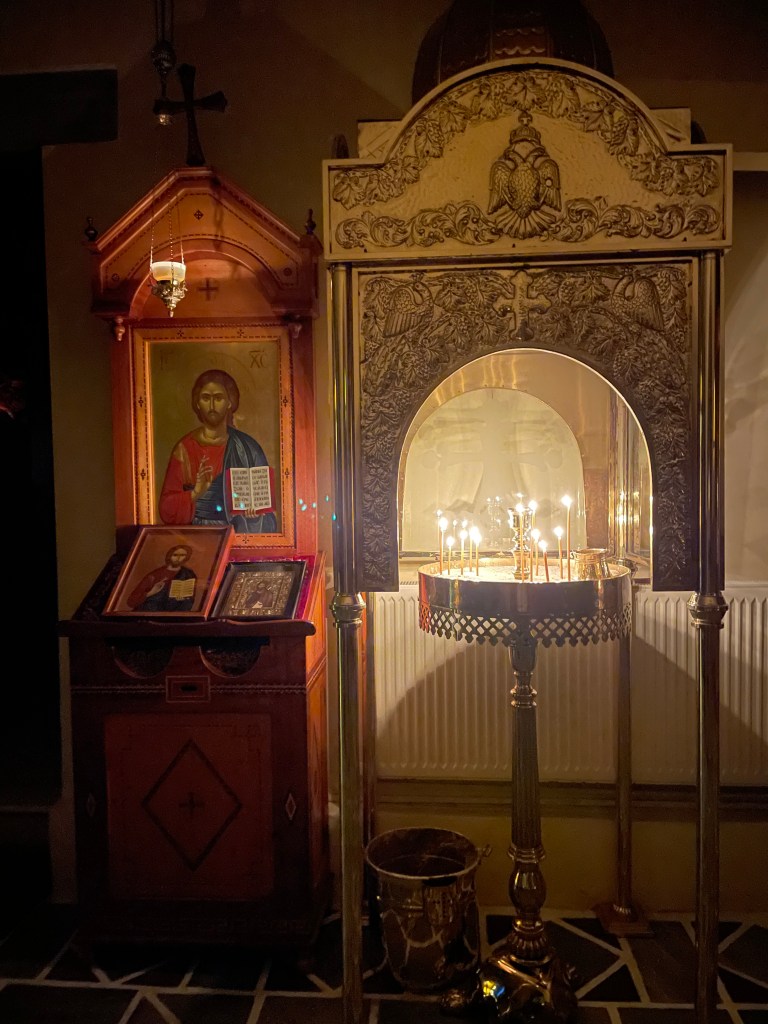
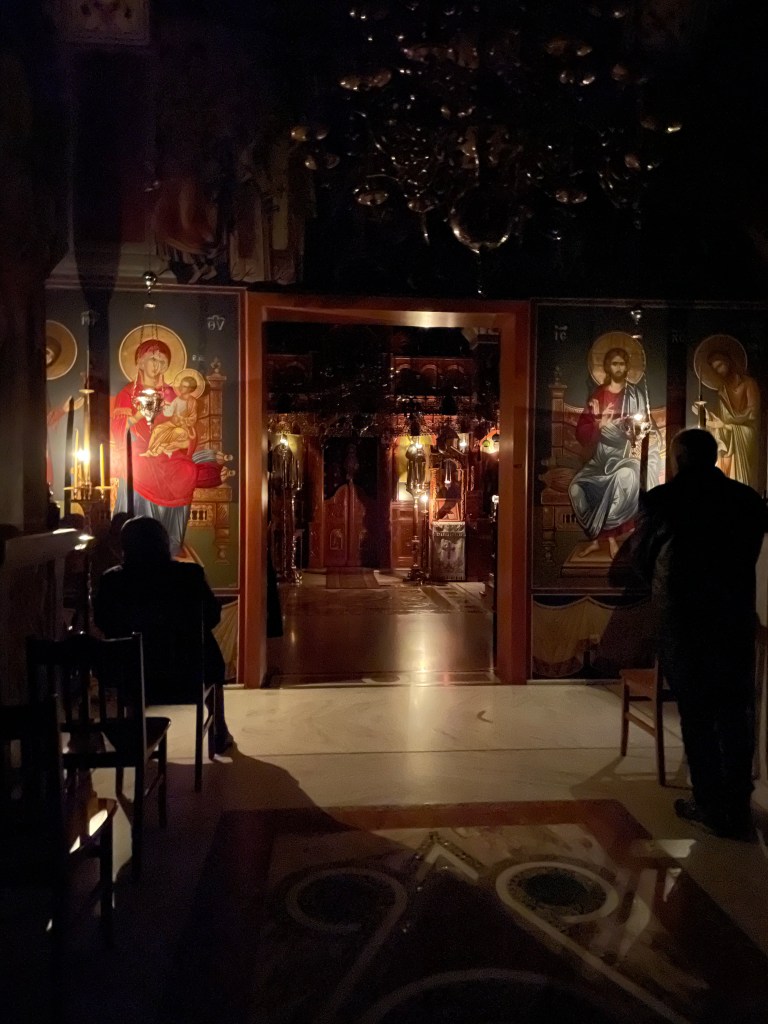
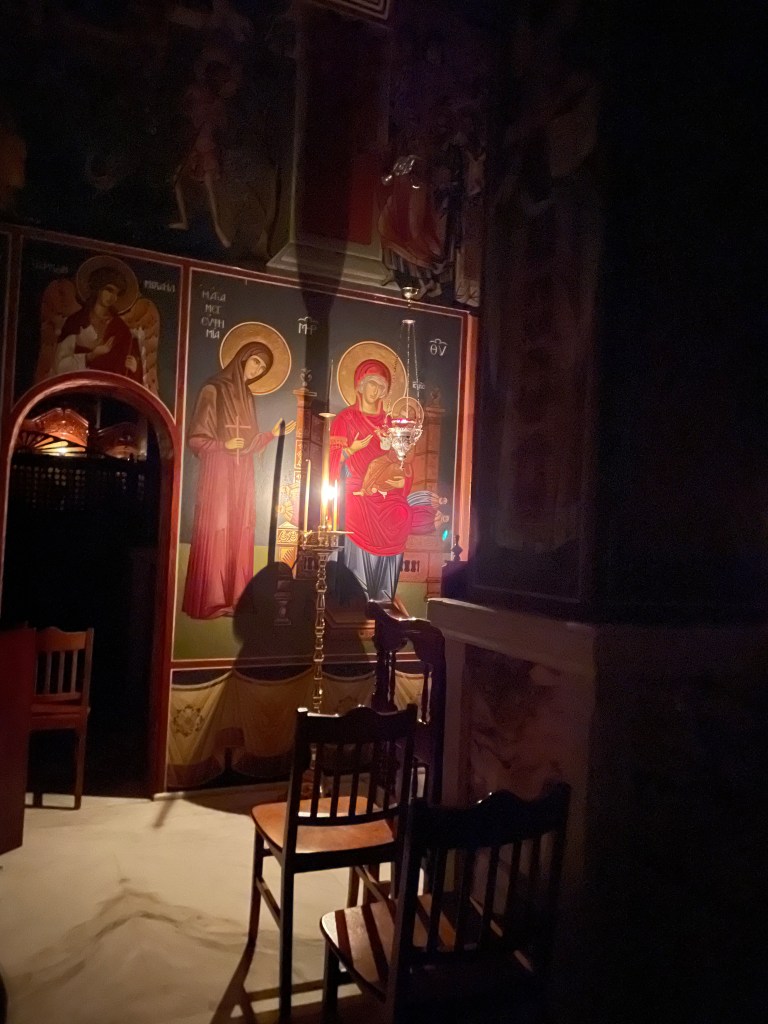
I feel surrounded by angels, not monastics. These sisters never sleep! They pray all the time and they are hidden from the world.

I kneel to receive the blessing of Gerondissa Mariam before Holy Communion and she tells me that she has read my note and gives me her blessing to come as often as I want, unconditionally… What a gift! Such undeserved mercy and graciousness!

Inside the church, other than the sisters and the priest, it is only the five of us, fellow pilgrims. How strange for a Sunday Holy Liturgy even in a monastery, let alone a parish in the world, to be so “empty” at the Sunday Holy Liturgy!

After the dismissal of the Liturgy, silently we retire to our cells for some rest and hesychia, and then proceed to the morning common meal where we eat while listening to a sister reading Saint Gregorios Palamas’ homily on Nestor. Then Gerondissa Mariam takes the floor and offers a homily on the mystery of holy obedience to our spiritual father: (Just in case, we had missed that key point in all the sisters’ words yesterday: that Holy Obedience is the “one thing needful … that good part which shall not be taken away” ,Luke 10:41–42).

St Nestor first received the blessing from his spiritual father, St Demetrios in the prison “bath-house” where he was chained, and then contested and defeated Lyaeus. This is so revealing of the power of holy obedience. St Demetrios blessed Nestor and in fact told him that he would be victorious but would then be martyred. Receiving the Saint’s blessing and sealing himself with the sign of the precious Cross, Nestor presented himself in the arena, and prayed, “O God of Demetrios, help me!” –“Ο Θεός του Δημητρίου βοήθει μοι”, uniting his will with that of his spiritual father, and ultimately with God’s Will.

Straightway he engaged Lyaeus in combat, and much to everyone’s surprise, the stripling novice smote Lyaeus with a mortal blow to the heart, leaving the former boaster lifeless upon the earth, and defeating the previously undefeated imperial champion. Nestor thus stroke a blow against idolatry. Many of the spectators believed that “the God of Dimitrios” had, indeed, helped him. This infuriated Galerius, who must have suffered considerable loss of face, and he ordered the decapitation of the young man. See the fruit of holy obedience? This we must all imitate!”

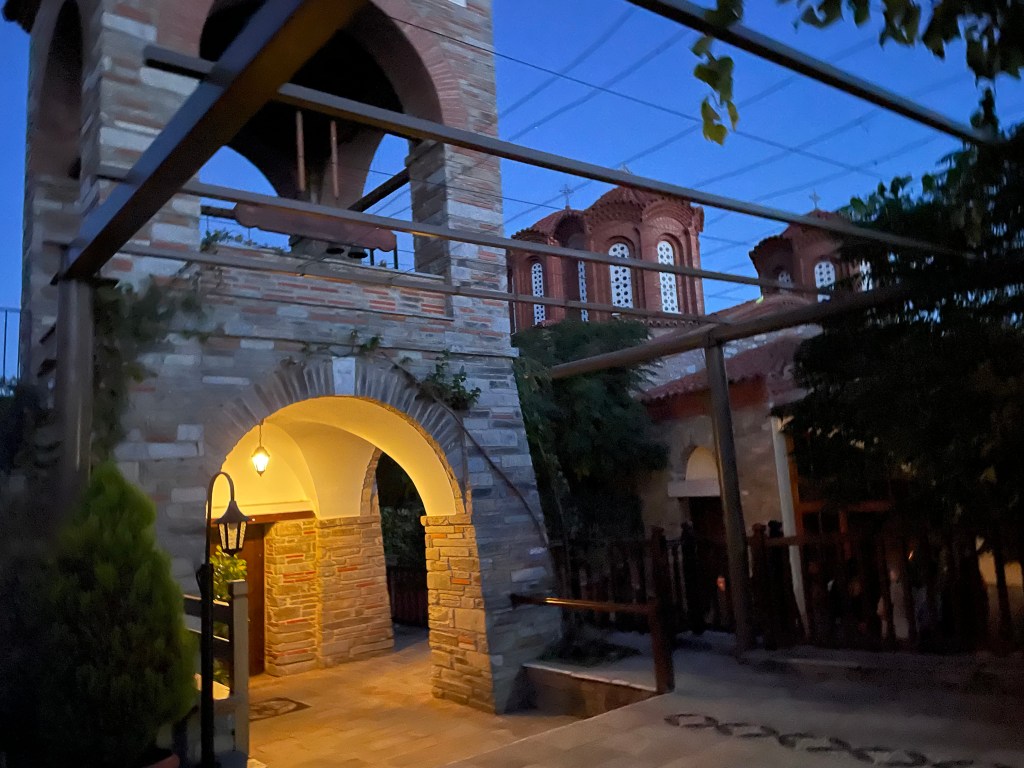
Our morning common meal comes to an end, prayers are said, and all nuns swiftly disappear back to their cells to pray, other than the very few ones whose obedience are the guests. No visitors yet, as the monastery gates are still closed and will open up only much later in the afternoon.

If yesterday it was the silence of the monastery which struck me, that true hesychasm, today it was the mystery of its hiddeness which permeated me. Certain experiences are so difficult to express in words.

The rest of the morning is spent in silent strolls, the Jesus prayer and quiet conversations with a few nuns around us, “pondering the mystery of “hiddeness” in our heart” (Luke 2:19). A different ‘spiritual surgical procedure’ in the “Antechambers of paradise”.

St. Paul says that “our true life is hid with Christ in God” (Col. 3:3). Such a rich verse that apophatically speaks of theosis, true mysticism! The sisters humbly admit that these lines are beyond their understanding.

It is this preposition “in” that makes all the difference. I don’t believe that there is a God, intellectually; I believe in God empirically. I believe you….or should I say …I believe in you. What force this has! “I believe in one God ….”

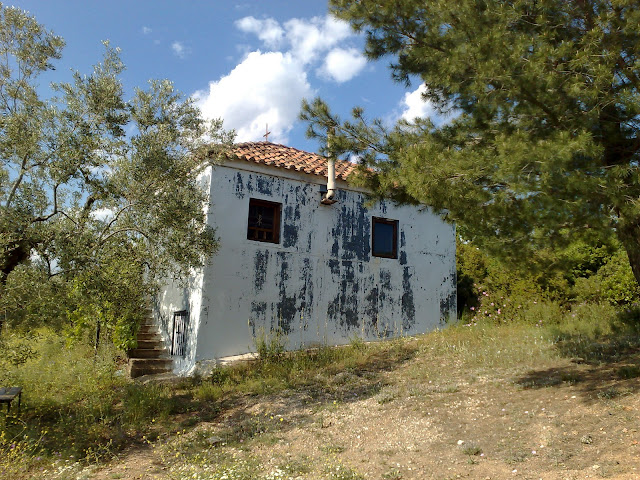
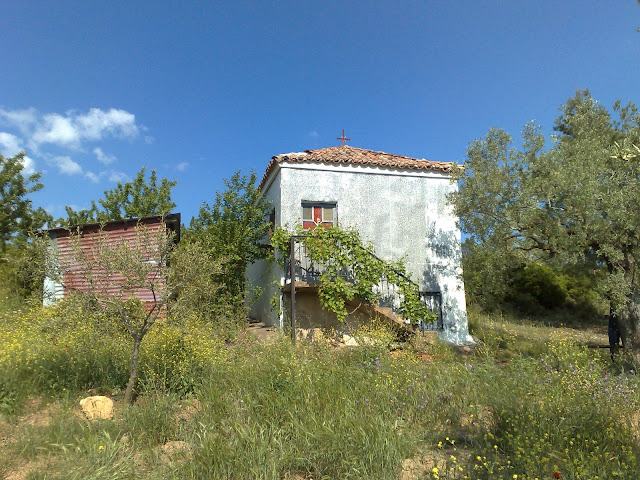
+ Gerondas Gregorios’ cell outside the monastery

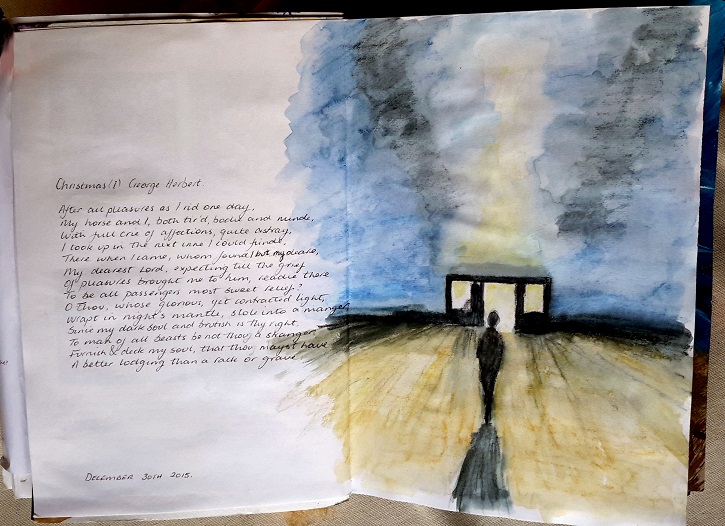
Let us now see how George Herbert, a favourite metaphysical poet of mine, expands these Bible words ‘Our life is hid with Christ in God’, taken from St. Paul’s letter to the Colossians and how these words are themselves hidden within this poem. Pay attention also to how he personalises the words– ‘our’ is changed to ‘my’.

Colossians 3:3′

My words and thoughts do both express this notion,
That Life  hath with the sun a double motion.
The first Is straight, and our diurnal friend,
The  other  Hid,  and doth obliquely bend.
One life is wrapped In flesh, & and tends to earth:
The other winds towards Him, whose happy birth
Taught me to live here so, That  still one eye
Should aim and shoot at that which Is on high:
Quitting with daily labour all My pleasure,

To gain at harvest an eternal Treasure.

Isn’t this beautiful? As in many of his poems, Herbert uses pattern and shape to explore his theme. The expanded line runs diagonally through the poem, creating a tension which is only resolved in the final line. Double meanings help to create the tension. On the one hand, we live our everyday, earthly lives. On the other hand, we live our eternal, heavenly lives. Our life ‘wrapt in flesh’ pulls us down to earthly things: the upward movement ‘winds towards Him’. Christ himself experienced a double motion. Not only did he come down to earth from heaven in his human birth, but he was raised to heaven in his resurrection.

As in other poems by Herbert, ‘sun’ and ‘Son’ are punned. The movement of the sun is used to shine light on the movement of the Son of God. For the sun has a double motion – we are most familiar with its daily east to west motion, ‘our diurnal friend’. However the sun moves annually from west to east, and this pattern was illustrated by an oblique or diagonal band around the globe. ‘It doth obliquely bend’.

There is a hidden quality to the ways in which people live out their faith in God, for there is a hidden quality in the way God is active in the lives of people. We do not always recognise God’s purposes and ways of working in the world. We do not see the whole until the end, but for Herbert, the treasure to be found during earthly and eternal life is Christ.

The day is coming to a close. At long last, the monastery is full of pilgrims, even if briefly. Vespers follow, coffee, and social time for everybody. Then obediences for us in the kitchen, washing and tidying. The kitchen seems to be always the busiest area in any “home” 🙂

Love Bade Me Welcome


herbert1

“Love Bade Me Welcome” is an exceptionally poignant poem by George Herbert – seventeenth century English parson and poet – about the Lord’s Supper at which we sit as guests, served by the Lord himself,  given a musical setting, along with four others, in Ralph Vaughan Williams’ 1911 masterpiece “Five Mystical Songs of George Herbert.”


During the final lines, a choir emerges out of the orchestral accompaniment and sings without words the Gregorian Chant melody of the Latin eucharistic hymn, “O Sacrum Convivium”: “O sacred banquet, wherein Christ is received…”

LOVE bade me welcome; yet my soul drew back,

Guilty of dust and sin.

But quick-eyed Love, observing me grow slack

From my first entrance in,

Drew nearer to me, sweetly questioning

If I lack’d anything.

‘A guest,’ I answer’d, ‘worthy to be here:’

Love said, ‘You shall be he.’

‘I, the unkind, ungrateful? Ah, my dear,

I cannot look on Thee.’

Love took my hand and smiling did reply,

‘Who made the eyes but I?’

‘Truth, Lord; but I have marr’d them: let my shame

Go where it doth deserve.’

‘And know you not,’ says Love, ‘Who bore the blame?’

‘My dear, then I will serve.’

‘You must sit down,’ says Love, ‘and taste my meat.’

So I did sit and eat.

—“Love” George Herbert (1593–1632)

rublev1

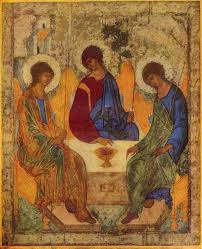
George Herbert’s “Love Bade Me Welcome” and the Lord’s Supper always remind me of Rublev’s Holy Trinity, inviting the faithful in the Divine Circle of Love.

https://www.youtube.com/watch?v=Ib88DsgDvYM

The Five Mystical Songs are a musical composition by English composer Ralph Vaughan Williams (1872–1958), written between 1906 and 1911.[1] The work sets four poems (“Easter” divided into two parts) by seventeenth-century Welsh-born English poet and Anglican priest George Herbert (1593–1633), from his 1633 collection The Temple: Sacred Poems. While Herbert was a priest, Vaughan Williams himself was an atheist at the time (he later settled into a “cheerful agnosticism”), though this did not prevent his setting of verse of an overtly religious inspiration.

“Easter”
“I got me flowers”

1. Easter – from Herbert’s Easter

Rise heart; thy Lord is risen.
Sing his praise without delayes,
Who takes thee by the hand,
that thou likewise with him may’st rise;
That, as his death calcined thee to dust,
His life may make thee gold, and much more, just.

Awake, my lute, and struggle for thy part with all thy art.
The crosse taught all wood to resound his name, who bore the same.
His stretched sinews taught all strings, what key
Is the best to celebrate this most high day.

Consort both heart and lute, and twist a song pleasant and long;
Or since all musick is but three parts vied and multiplied.
O let thy blessed Spirit bear a part,
And make up our defects with his sweet art.

2. I Got Me Flowers – from the second half of Easter

I got me flowers to strew thy way;
I got me boughs off many a tree:
But thou wast up by break of day,
And brought’st thy sweets along with thee.

The Sunne arising in the East.
Though he give light, and th’East perfume;
If they should offer to contest
With thy arising, they presume.

Can there be any day but this,
Though many sunnes to shine endeavour?
We count three hundred, but we misse:
There is but one, and that one ever.

Vaughan Williams “Five Mystical Songs” (part 2):
“Love bade me welcome”
“The Call”
“Antiphon”

3. Love Bade Me Welcome – from Love (III)

Love bade me welcome: yet my soul drew back.
Guiltie of dust and sinne.
But quick-ey’d Love, observing me grow slack
From my first entrance in,
Drew nearer to me, sweetly questioning
If I lack’d anything.

A guest, I answer’d, worthy to be here:
Love said, You shall be he.
I the unkinde, ungrateful? Ah, my deare,
I cannot look on thee.
Love took my hand, and smiling did reply,
Who made the eyes but I?

Truth Lord, but I have marr’d them: let my shame
Go where it doth deserve.
And know you not, sayes Love, who bore the blame?
My deare, then I will serve.
You must sit down, sayes Love, and taste my meat:
So I did sit and eat.

4. The Call – from The Call

Come, my Way, my Truth, my Life:
Such a Way, as gives us breath:
Such a Truth, as ends all strife:
Such a Life, as killeth death.

Come, my Light, my Feast, my Strength:
Such a Light, as shows a feast:
Such a Feast, as mends in length:
Such a Strength, as makes his guest.

Come, my Joy, my Love, my Heart:
Such a Joy, as none can move:
Such a Love, as none can part:
Such a Heart, as joyes in love.

5. Antiphon – from Antiphon (I)

Let all the world in ev’ry corner sing:
My God and King.
The heavens are not too high,
His praise may thither flie;
The earth is not too low,
His praises there may grow.

Let all the world in ev’ry corner sing:
My God and King.
The Church with psalms must shout,
No doore can keep them out;
But above all, the heart
Must bear the longest part.

Let all the world in ev’ry corner sing:
My God and King.