Born for Eternity

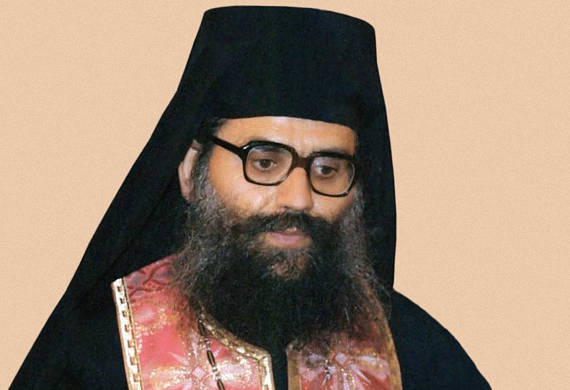
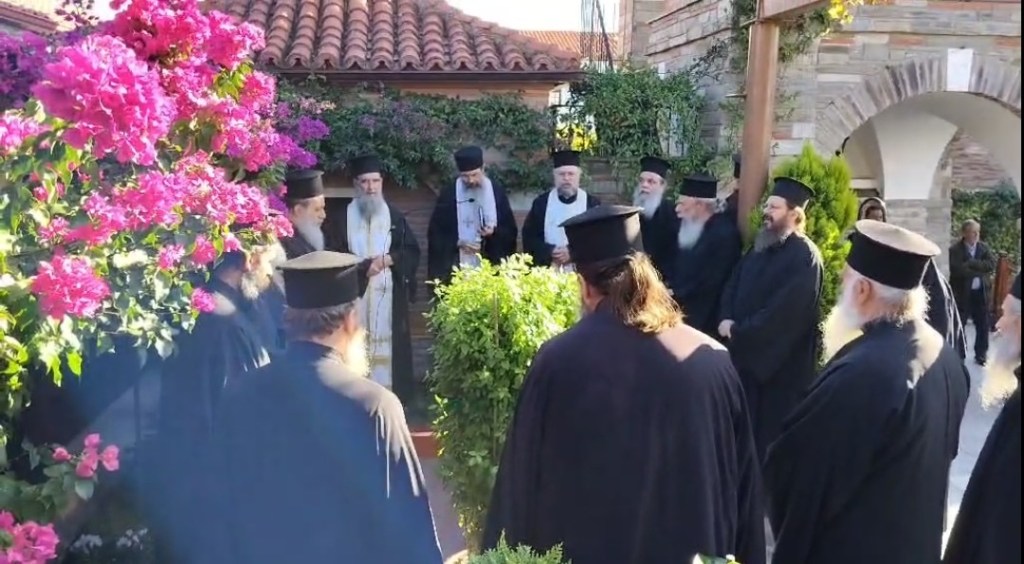
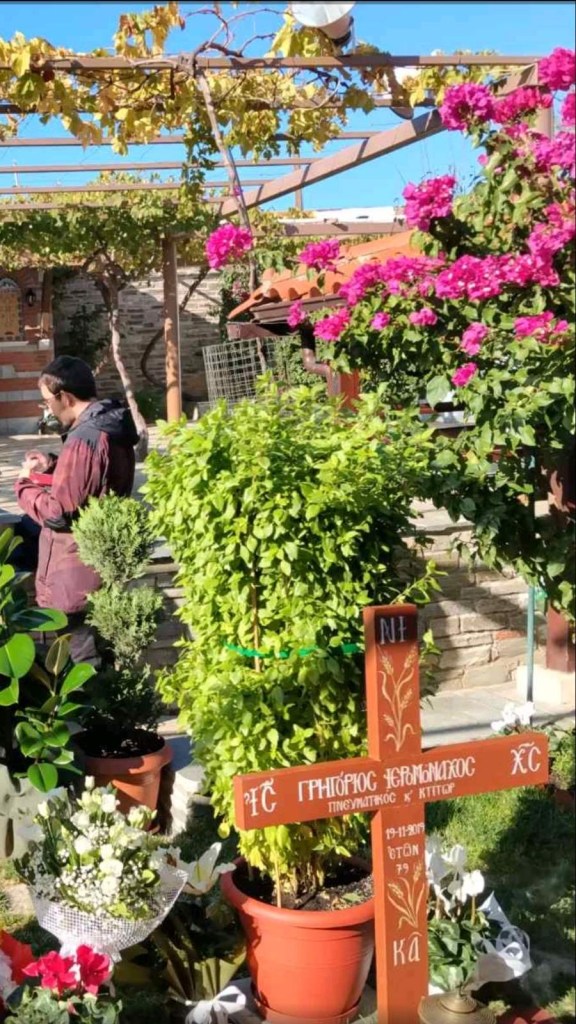
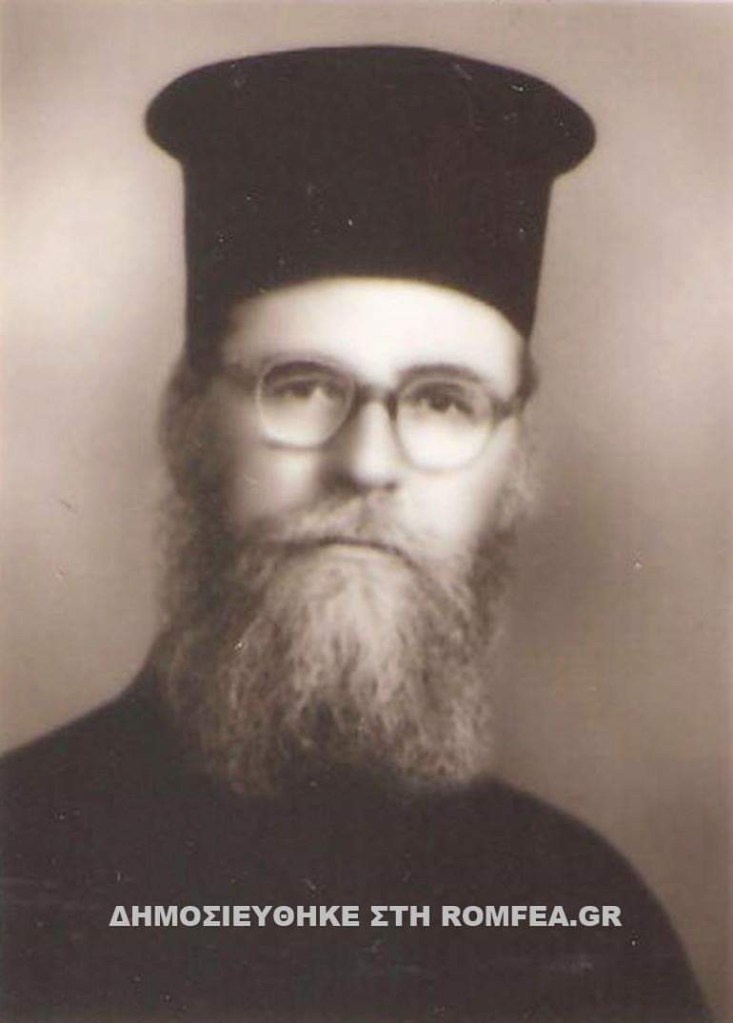
+ Father Gregorios, 19 November, 2019 — 6th year Memorial service

Memory Eternal, dearest Father!

“Love in Christ is a sacrificial Love, a self-sacrificing, self-denying Love, Agape. You sacrifice everything for the person you love, “your neighbour”. By “our neighbour”, we mean every person as God’s Image, even our enemy. By “love” we do not mean that we should do whatever the other person wants us to do, but to love him with Christ’s burning and flaming Heart, for his salvation” (+ Elder Gregorios Papasotiriou)

*

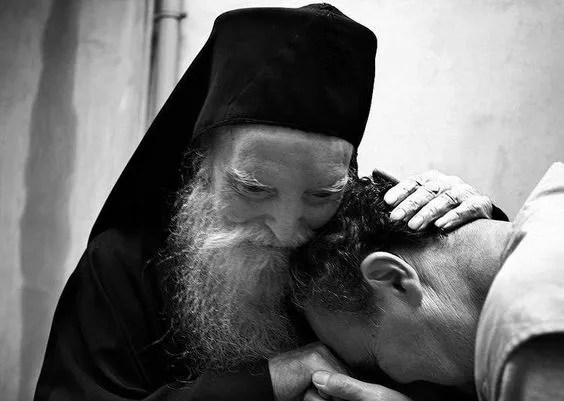
This is how we have always felt his love! For yearsGerondas Gregorios of blessed memory offered his prayers with tears and his never-to-be-forgotten spiritual guidance. My rebirth in Christ ((John 3:4), my new life literally started with his guidance about 40 years ago. I feel so unworthy of such a blessing!

*

Father Gregorios, born Dimitrios Papasotiriou, was born on February 16, 1940 in Paleokomi, Serres, to pious parents, Alexios and Efthymia.

From his childhood, he was characterized by an inclination for life in Christ and very early he felt the divine call for the priesthood and complete dedication to the Lord through the monastic calling. Thus, after completing his studies at the Theological School of Aristotle University of Thessaloniki, he came to the Holy Metropolis of Kassandria, where he was ordained a deacon and priest by the blessed Metropolitan Synesios Visvinis. During his stay in Polygyros, the Elder, together with other fathers under the guidance of Fr. Spyridon Trantelis (later Metropolitan of Lagadas), formed a group that served the people of God, as well as the children of the Polygyros boarding school for boys, with much love and self-sacrifice.

From his student years, the Elder particularly loved Mount Athos. He visited it very often and was particularly associated with the Holy Monastery of Saint Dionysios and the blessed Hegumen Fr. Gabriel, who became his spiritual father for a number of years. However, the main turning point in the Elder’s spiritual journey was his acquaintance with Saint Paisios the Athonite. He became connected to him with an unbreakable spiritual bond, becoming his disciple and striving throughout his life to imitate his holy life. In fact, Saint Paisios also became his godfather during the monastic tonsure of Elder Gregory in the cell of the Holy Cross in the year 1977.

In the year 1970, the flame of hesychia led Father Gregory to the then dilapidated Metochion of the Holy Monastery of Saint Dionysios in Metamorphosis, Chalkidiki, where, with the blessing of the local Bishop, he settled in a monastic cell-barn next to the Church of the Holy Forerunner.

This place from then on became the arena of his great ascetic struggles and the base for his priestly-pastoral ministry here in Chalkidiki. Only God knows his ascetic labors and efforts in order to serve the people of God with the pilgrimages, the preaching, the confession, the holy services, the vigils, the divine Liturgies. Saint Porphyrios, who attended a divine Liturgy in 1974, commented: “When Father Gregory serves the Holy Liturgy, all of God is within him and all of Father Gregory is within God.”

With the encouragement or rather the command of Saint Paisios, the life of the Monastery begins in 1975. The Holy Monastery of Dionysios grants the necessary area for the construction of the Holy Hesychasterion. The blessed Abbots Fr. Gabriel and Fr. Charalambos supported Elder Gregory with great love, foreseeing that the now deserted place of the old Metochion would be transformed into a spiritual oasis. Then the first group of spiritual children of the Elder was established, which formed the nucleus of the later sisterhood. The first Abbess was Eleni Paschaloglou from Rodolivos, Serres – herself a spiritual child of Elder Gregory -, later Elder Ephemia, who passed away to the Lord almost five months after the Elder’s “fallen asleep” after 45 years of sacrificial ministry in the Monastery.

The life of Father Gregory is henceforth spent in material and spiritual labours for the construction of the Hesychastirion, for the guidance of the Monastics, but also in his great offering as a priest, preacher and above all a spiritual father to the people of God. The Elder who abhorred worldly prominence and loved humility and obscurity, is now becoming well known as Father Gregory the Spiritual Father. Hundreds of souls found the path to salvation with him, thousands rested under his rock, countless were helped by his spiritual guidance.

The blessed Elder suffered from many illnesses throughout his life, which he bore with great patience and a doxological disposition as if someone else were suffering. Especially the last few years were a cross of painful trials and a life of patience, because the pain and illnesses reached their peak.

The good God, wanting to rest the good shepherd and His faithful steward, called him to Himself after a sudden stroke on November 19, 2019. The funeral service and burial were held on November 21, the day of the Feast of the Entrance into the Temple of Our Most Holy Lady the Theotokos and Ever-Virgin Mary, the birthday of the Monastery, when 45 years ago Saint Paisios gave the blessing and the command to Father Gregory to begin the great work for which he sacrificed his life.” (Ραδιοχρηστότητα, by his spiritual son and priest Father Nikolaos at St. Palnteleimon, Mesimeri )

May we have his prayers! “Kai sta dika mas.” “And to our own!”  May we be reunited with you dearest Father in Heaven in God’s Kairos!

From Singer to Monk, From Cancer to His Kingdom

“We pray again for the repose of the soul of your servant Dionysios the Monk… † October 19, 1993

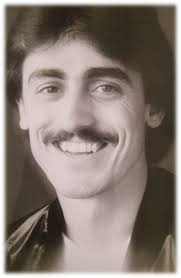
The famous and great singer Dionysios Theodosis who became a monk at Mikra Agia Anna on Mount Athos, shortly before cancer led him to Christ at the age of 35…

No one knew his secret throughout his battle with the incurable disease, until at his funeral procession at the Church of St Thomas the Apostle in Goudi, his spiritual director, Fr. Spyridon Mikragiannanitis, mentioned:
“We pray again for the repose of the soul of your servant Dionysios the Monk!”
Everyone was speechless.

Dionysios Theodosis (June 16, 1958 – October 19, 1993) was a Greek singer.
During his career, he collaborated with well-known Greek composers including Yiannis Spanos, Giorgos Hatzinasios and Marios Tokas and with singers such as Giorgos Dalaras, Dimitra Galani and Haris Alexiou.

He was experiencing great existential impasses, until he met Saint Paisios, who discerned his pain and said:
“You, my child, are bringing me a lot of pain, you need to confess, and to a good spiritual father.
Go to the Mikra Agia Anna and talk to Father Dionysios, he is good and will help you”.

Dionysis followed the advice and set off by boat for Mikra Agia Anna.
A monk next to him struck up a conversation and introduced himself: “Father Dionysios Mikragiannanitis”.
After the initial surprise, they struck up a conversation for a while, but Dionysis thought he was a “jester” since this was not the image he had had until then of a spiritual person:
that is, a serious, perhaps even grim old man.
His illness, however, came to radically change the landscape.
He began chemotherapy in London.
His visits to Mikra Agia Anna intensified and he announced to the Fathers that he wanted to become a monk!
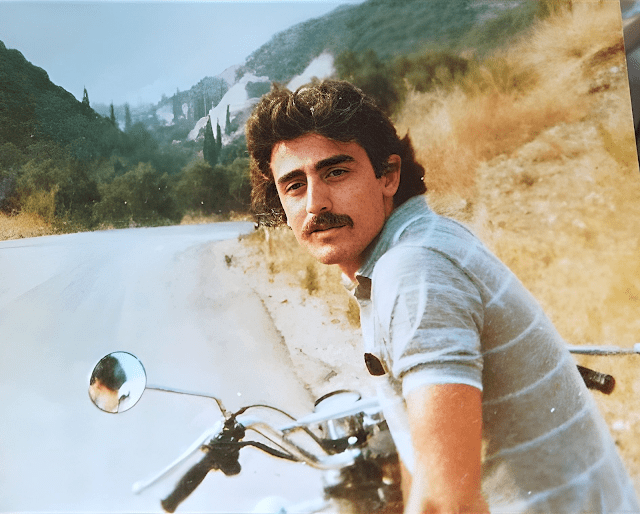
At least once a month when he finished at dawn his work he would take his motorcycle and travel to Mount Athos.

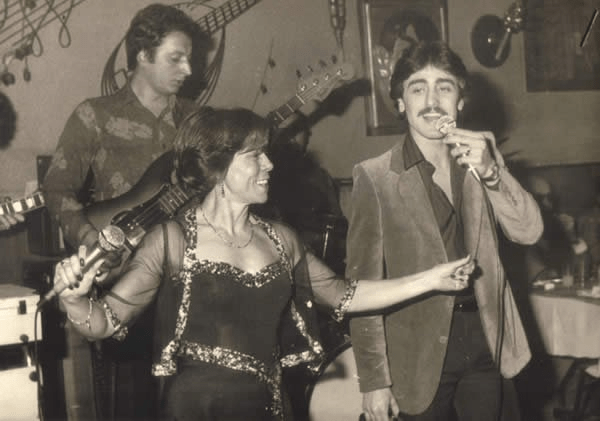
With his mother, also a singer, in a shop somewhere in Istanbul…

During that time, the song “As Long as a Coffee Lasts” was also written, which he performed himself and which few know that he dedicated to his Elder!

He wished to get well and dedicate his life to hesychasm.
His elder, Dionysios, before leaving for treatment abroad, shaves his head and allows him to visit the hospital in England without his cassock.

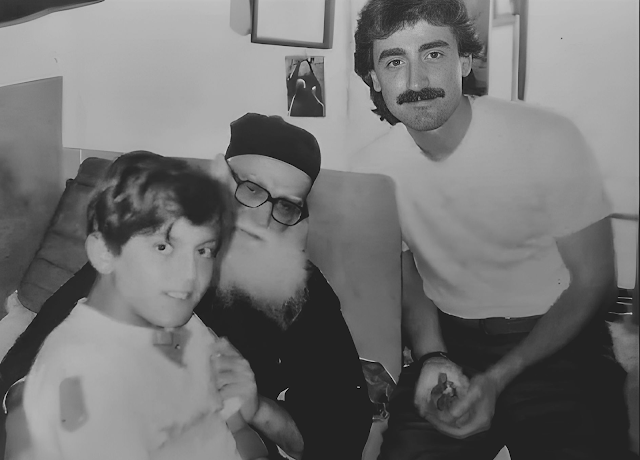
On Mount Athos, together with Elder Efraim Katounakia

No one knows his secret, not even his mother Despo, who stands by his side in his last moments and reads a book he gave her about the garden of the Virgin Mary.

She is impressed by what he tells her about Mount Athos.

She prays to God in her heart:
“May my son get well and with my blessing come to serve you.”

Dionysios says his prayers in the bed of the hospital and she does not know that those prayers are his monastic rule!
One day, the English nurse tells Dionysis’ mother in a lacklustre voice, lacking any real emotion: «he died».

The funeral took place in Greece.
Among other relatives, friends, well-known singers, actors and musicians, his elder, Dionysios, also attended.

Fr. Spyridon revealed the secret at the ceremony when he said the name of the deceased: “the servant of God, monk Dionysios”(!)
The congregation was amazed.

Immediately after the ceremony the Fathers took his body, wrapped it in a sheet and monk Dionysios was buried in Mikra Agia Anna, in the place where he wanted to become a monk.

His stepfather and godson Benjamin Koul, a person who converted to Orthodoxy by Dionysis often visited his grave, knowing the people of Mikra Agia Anna.
(Benjamin was a Turk and was baptized in Greece.
His son, Dionysis Theodosis, was his godfather in the Sacrament…)

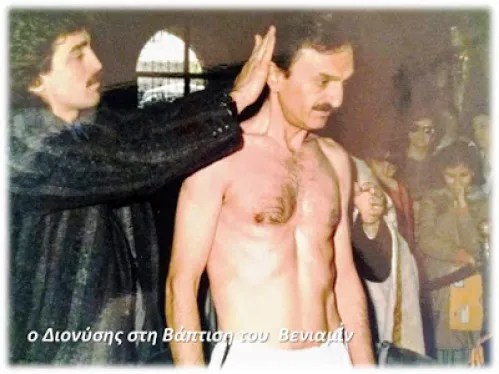
At the baptism of his step-father and godson


His wish was to be buried next to his child when he departed this life.

His wish was fulfilled.
He fell ill a few years later and also departed this life, adding another painful loss to the lady-Despo who, when the three years of his burial had passed, took the bones and brought them to Ouranoupoli.

There the monks received them and buried them next to those of his spiritual father, godfather and child, monk Dionysis.

From the page, “Dionysis Theodosis / DionisisTheodosis” and Amfoterodexios

Please watch monk Dionysis sing the song he dedicated to his spiritual father. At first sight, it looks erotic but it is about Agape!

As long as a coffee lasts

Dedicated to his spiritual father

Don’t leave me alone this night,
I am roaming in a minefield
When I drink you up and dry up this night
Either I’ll be saved or I’ll be lost

Stay a little longer
Until I escape
And if you want, hold me
As long as a coffee lasts
Stay a little longer
Until I escape
And then say bye
And that you will come again

Don’t leave me alone this night
My mind turns to evil
Comfort my pain this night
Lead me on with your love, like a baby

Stay a little longer
Until I escape
And if you want, hold me
As long as a coffee lasts
Stay a little longer
Until I escape
And then say bye
And that you will come again (2)

Memory Eternal! Christ is Risen!

The Thebaid Desert Fathers Death to the World

Dear brothers and sisters,

Christ is in our midst.

An interim to all these prophesies I have recently posted. Kindly have a look at this conclusion of a chapter I am in the process of translating for Gregoriou monastery of Mount Athos.

“Here is a beautiful summary of spiritual work left to us by Abba John the Dwarf, one of the most discerning and holy ascetics. With this we end this brief presentation.

Every morning, make a beginning with every virtue and commandment of God.

And strive

With much patience,

With fear and long-suffering,

With love of God,

With all the readiness of soul and body,

With much humility,

With patience bearing the sorrow of the heart and carefully guarding it,

With much prayer,

With prayer for others with sighs,

With purity of tongue,

With watchfulness over the eyes.

Do not be angry,

even if you are insulted,

but have peace within yourself;

Do not return evil for evil;

Do not pay attention to the mistakes of others;

Do not give value to yourself, who is below all creation;

Oppose and renounce the material world

and everything that has to do with the flesh.

Live:

With a willingness to take up your cross,

With a fighting spirit,

With poverty of spirit,

With askesis and spiritual determination,

With repentance and tears,

With a warlike struggle,

With discernment,

With purity of soul, With food as much as it should be,

Working quietly at your handiwork,

With night vigils,

Enduring hunger and thirst, cold and nakedness,

By toiling.

And above all and with all these together:

To seal yourself your coffin lid as if you have died,

Bearing in mind that death is near you every minute … ( Abba John the Dwarf, 34).

“Will modern man want to hear these messages sent to us by the ancient ascetics of Thebaid and their other peers? Will he want to?” (+ Elder Eusevios Vittis of blessed memory)

St Porfyrios’ unknown Father Confessor: Father Antonios Gikizas

The ‘hidden’ Fr Antonio’s Gikizas and his close relationship with St Porfyrios –he even knew St Nektarios! — was another mystery revealed to us during our recent pilgrimage to Athens and Aegina, another link in the chain of holiness to His Kingdom, another stepping-stone on the Way! Glory to God for all things! What a Joy on Heaven and earth when a new Saint reveals himself to the Church, when new “living stones of His Temple” are revealed. “Ye also, as lively stones, are built up a spiritual house, an holy priesthood, to offer up spiritual sacrifices, acceptable to God by Jesus Christ.” (1 Peter 2:5)

*

Who would have imagined that on one of Athens’ busiest avenues, at 59 Alexandras Avenue, in the semi-basement of an apartment building, lived an elder like those we read in the Desert Fathers, with profound humility, compassion and great discernment! It was to this humble, ‘hidden’ priest, Saint Porfyrios would regularly go for Confession, a fact not widely known. One would lay hands on the other and they would confess. One wonders what it was that tied these two elders together.

*

This venerable cleric, Father Antonio’s Gikizas, was born in Kranidi, Argolis, on January 7, 1910, and died in Athens, at the age of 89, on September 30, 1999. His academic knowledge was admirable not only for his time but also for ours with his four bachelor degrees and six foreign languages and many more. This academic excellence should normally separate him from the illiterate St Porphyrios, but Father Antonios, despite his great qualifications, always tried to avoid the high offices that were offered to him throughout his life. His humility was profound. When he was still a small child, he met Saint Nektarios, for whom he had a special reverence. And later in his life, he met St Porfyrios. His acquaintance with the elder – and later Saint of the Church – Porphyrios took place when he served for a short time as a preacher in Kymi of Evia.

*

So, what was it that tied these two elders together? Fathers believe that it was their profound humility and their focus on repentance and the Sacrament of Confession throughout their lives. Father Antonios of blessed memory insisted that what we all need, more than anything else, is “repentance, this gift from God. … Repentance is the key for our entry into the heavenly world, in His Uncreated Church…”. Clearly this was the focus of Saint Porphyrios’ life too, as revealed in his Testament to his Spiritual children, six months before he fell asleep in the Lord: “From a small child I was in sins——But the world thought I was good and everyone shouts that I am a saint. As for me, I feel that I am the most sinful person in the world.——whatever I remembered, of course I have confessed —-But now I have a feeling that my spiritual sins are too many and I ask those of you who have known me to pray for me because I too humbly prayed for you while I lived!” I truly wonders why would such holy men feel that sinful and regularly go to Confession until old age… To confess what? And if they felt and acted thus, what about us?

*

How inter-connected Holiness, Saints are in God’s Providence! Glory to God for all things! “That they all may be one; as thou, Father, art in me, and I in thee, that they also may be one in us” (John 17:21)

For Granted

Taking things for granted is a trap most of us fall into. It is easy to get used to things and to stop noticing. We stop noticing God’s little gifts, little gestures of love of those around us, our comforts and advantages. The last four weeks, since Father J. has been taken gravely ill, have been a time of deep sadness but also of reflection and hopefully of growth.


Familiarity is a dangerous element in our spiritual life. I have spent so much time with Father J. over the last 18 years, I have relied so much on his advice, prayers, lifts to church, on his love, tolerance and good will that I think I have come to take it all for granted. In any crisis, I assume that he will be there to guide me and especially pray for me. In this crisis, for the first time, I had to pray for him and couldn’t ask for his guidance. I felt lost, but I also felt more than ever the power of prayer, the strengthening bonds of fellowship and I experienced once again the manifold grace of brothers and sisters in Christ praying together. For years now, I have felt that father joyfully carried me and every single person in his church on his back like a cross. His care and prayers make up for our negligence and lack of zeal, for all our lack of love towards God, the church and others.

As a community, especially the cradle Orthodox, we always take for granted that we shall have a church where the Holy Liturgy will be served every Sunday (take it or leave it as it suits us), that there will be a Father to come bless our house, cars, food and visit us when we are ill, that there will be a Father to sign the papers of church attendance for our children to get a place at a desired school and give us a reference of good character, that this Father will pray for us whenever we ask him, that he will be there to hear our confession whenever
we feel burdened, that he will settle our little squabbles, that he will baptise our children and read us the prayers on our death bed and serve at our funeral. In the case of our parish, we take for granted even more than that, that our Father will make sure everyone has transport to get to church, that he will answer the phone to hear our little troubles at any hour of the day or night, that he will arrive first in church and leave last and generally make sure that everything is well with the church and in our life. The last weeks have forcefully reminded me that all these are not our due or by any means guaranteed to be there and that we are blessed to have had all these for so many years through God’s grace and Father J.’s love, faith and energy.

Umberto Eco said: “Absence is to love as wind is to fire: it extinguishes the little flame, it
fans the big.” I cannot exactly quantify my affection for Father J., but I have thought
of him more over the last month than ever before. In his absence, so many touching memories and images came flooding in bringing along both sadness and joy. One of my favourite mental snapshots is of Father looking up to see somebody come through the church door. Every time his eyes light up with joy when his gaze rests on you as you come in through the door and I noticed that Father’s joy is even greater when someone comes who has not been to the church in months or years. This joyful, loving gaze makes you feel so welcome and loved and somehow special. It makes you feel that you are coming home. And this image lead on to another memory of Father crying when he reads the Gospel of the Return of the prodigal son. I cannot remember him ever reading it without tears in his eyes. His love for all these many prodigal children that we are is so great that he stands by us in prayer before God no matter what we are or have done. I know for sure he has stood by me with gentleness and patience even when I disobeyed his spiritual guidance or I argued back or wanted to leave the church.

St John of the Ladder teaches that it is more fearful to anger your Spiritual Father than to
disobey and anger God himself. If we anger God, our spiritual father has the grace to pray for us, to intercede and obtain forgiveness for us, but if our spiritual father turns away from us, we have no defence or advocate before God. This is how I have felt about my Spiritual Father, about Father J. He has been my advocate before God, my safety rope for the rock climbing. This rope has kept me connected to the rock when I fell, it stopped me from walking away and giving up when the going got too hard.

Fr Seraphim of Mull Monastery tells the story of the advice he received from his spiritual
father just before he was ordained. He told him that the value of his priesthood will be measured in the madness of his love for every single human being who will stand before him irrespective of what they look like, who they are, where they come from, what they have done.

This is exactly how I see Father’s ministry. In his love of all people and in his joyful daily sacrifices for us, I see the reflection of God’s love for all his children. By knowing Father, I feel I have come a step closer to understanding God’s love for every single one of us.


The church or monastery is like a beehive. The spirit of the queen permeates the whole hive and sets the tone for all the bees. If the queen bee is aggressive the whole hive will be an aggressive one, just so when a community has a very loving father, like us, the whole community is loving and gentle. And if at times this isn’t the case, Father dissipates all tension by his prayers and mild spirit.


As Father is recovering from his illness and there is a general sigh of relief in the community and a sense of joy and expectation, I have made a vow not to take my spiritual father for granted ever again or any of God’s gifts to our community, but rejoice in each of them and see them for what they are – signs of God’s love: the beautiful church filled with the gifts from Old parishioners, the people who have prepared the prosphoro, brought the wine, oil and candles and cleaned the church, the people who have come to give and receive and most of all the presence of a father through whose hand a gentle and humble God reaches out to his people. None of my or anyone’s giving of time, money or energy can match the wonder of these gifts.

A. McC.

* Kalo Stadio! A blessed Great Lent!

The Blind Aspassia

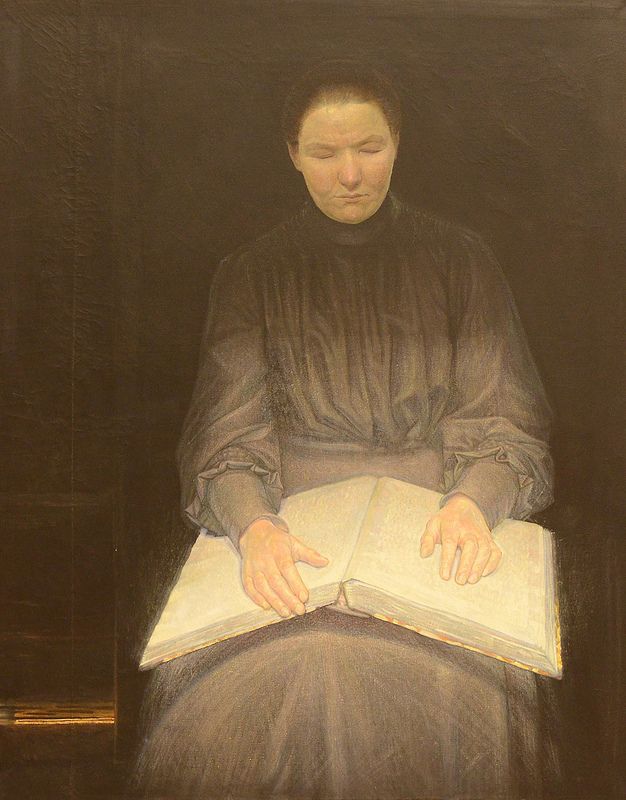
blind girl reading

The story of an everyday Saint in my hometown!

In a small town in northern Greece, there lived a blind girl named Aspasia. She was orphaned, very poor and abandoned by all. That’s why she grew up without being able to learn letters.

She was about 18-20 years old when a preacher of the metropolitan area passed by and saw her, took her with him and put her in the School for the Blind in Thessaloniki, so she learned reading through the blind system. Then, after learning to read braille well, the New Testament, written in the same scripture, was given to her in braille.

So the girl started reading it by touching it with her fingers. And as she studied it, she both learned what Christ was and what He did for her personally as well as for the whole world. And as she learned, she was so peaceful and so moved. The pain of so much tormenting years passed, softened through the study of the New Testament. And not only this, but filled with joy and peace. Flooded by happiness. “I found the joy” she said. “Now the eyes of my soul opened! And if the eyes of the body are missing, I do not mind. With the eyes of the soul I can see the whole world. ” She saw the light of God in every Divine Liturgy. (We who are “open-minded” are seeing this Light?).

But once she suffered a terrible skin disease that even touched her hands, which were “burned”, so she lost the touch of her fingers. She could no longer read the Holy Bible nor any other sacred book.

Her sorrow and her pain was indescribable. She was crying day and night. She had lost the ability to take power and joy through the Holy Book. But she had a prayer left. Because when she was in Thessaloniki, at the Blind School, a monk from Mount Athos taught her how to say “Lord Jesus Christ, have mercy on me”. So she did a lot of prayer for Jesus Christ to give a good solution. And God answered.

One day she gladly took the Holy Book, the New Testament, and brought it to her mouth, to kiss the letters, which these letters convey to us the wisdom of God, redemption and salvation. And then she discovered something strange: She understood she could read the letters with her lips! And her life was replenished by joy, which was again given to her by the study of the word of God. And through this paradoxical study, praise came, thanksgiving came, the living prayer came.

She was studying and then praying with tears for those who had the same problems with physical disabilities and diseases, and especially prayer for those who were blind of the soul from sin. Through her prayer she saw the throne of God and begged Him and prayed to Him for the poor, the orphans, the unemployed, the homeless, for all the sick. For the good and bad, for the good and the wicked, for the righteous and the unjust, but also for those who continue to offend the world … for the lords and the beginners. All of them are enlightened and all of them can see the true Light, Christ, the Savior of the world!

One day she got sick. She confessed for the last time and communed the Holy Mysteries. And she asked for the New Testament, said to open it to her lips.

Aspasia stretched out her hands and held it firmly, but she died. Her relatives, according to divine providence, opened it to the first chapter of John the Evangelist. And constantly repeating the words “In the beginning was the Word, and the Word was with the God”, she raised her little soul high in the sky, while at the same time flooded her room with an unspoken sweet fragrance.

She is a silent saint!

Source: PROTOPRESVYTEROS STEFANOU K. ANAGNOSTOPOULOU. Piraeus 2011.
PUBLICATION OF ISICHASTIRIO “TO GENETHLIO TIS THEOTOKOU”, SERGOULA DORIDOS 2011

Spirit-Born(e)

spirit4

On Being Spirit-Born(e), the Cost of Discipleship  — Grace is free but it is not cheap! — and Two Questions

spirit3

Acts of the Apostles 19:1-8

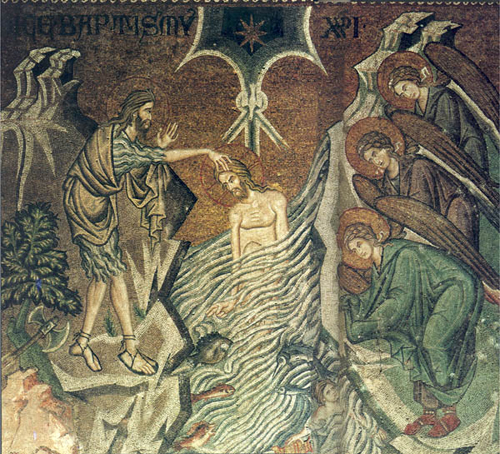
In those days, while Apollos was at Corinth, Paul passed through the upper country and came to Ephesus. There he found some disciples. And he said to them, “Did you receive the Holy Spirit when you believed?” And they said, “No, we have never even heard that there is a Holy Spirit.” And he said, “Into what then were you baptized?” They said, “Into John’s baptism.” And Paul said, “John baptized with the baptism of repentance, telling the people to believe in the one who was to come after him, that is, Jesus.” On hearing this, they were baptized in the name of the Lord Jesus. And when Paul had laid his hands upon them, the Holy Spirit came on them; and they spoke with tongues and prophesied.

spirit2

Some say of Saint Antony that he was “Spirit-borne”, that is, carried along by the Holy Spirit, but he would never speak of this to men. Such men see what is happening in the world, as well as knowing what is going to happen. (Desert Fathers or Gerontikon, Sayings Of Anthony of Egypt, XXX)

spirit7

The presence of the All Holy Spirit in and behind the Acts of the Apostles and within the life of the Early Church is all pervasive and an impelling force. It is apparent that Christians in the Apostolic era were Spirit-borne and full of power to heal the sick and preach the Gospel within the living tradition. St. Paul in his missionary travels encounters at Ephesus some disciples of John the Baptist (Chapter 19:2) who had never heard of the Holy Spirit. He asks them directly: “Did you receive the Holy Spirit when you believed?” They answered: “We have not so much as heard whether there is a Holy Spirit!”

Archpriest Michael Harper of blessed memory observes: “Why is that somewhat brusque question Paul’s first remark to them? There can surely be only one answer. They did not look as if they had! (received the Holy Spirit) Something was missing that ought to have been there, something that men were beginning to look for as  a distinctive mark of those who had had the characteristic vitalising experience of becoming Christians.” (Revd. Fr. Jonathan Hemmings, Fountains in the Desert, 85-6)

spirit5

Why would St. Anthony never speak of this Spirit-borne quality among men? 

Why today these miraculous gifts seem less evident in the Church?


“Christ’s Nativity” by John Milton and Wiliam Blake

A few decades prior to writing his famous epic, Paradise LostJohn Milton composed this thirty-one-stanza ode—his first major work in English. Written in 1629 when he was just 21, the poem examines the cosmic significance of the incarnation, celebrating Christ’s triumph over the gods of paganism from the manger.

Regarding the poem’s composition, Milton wrote to his friend Charles Diodati,

I am singing the King of Heaven, bringer of peace, and the fortunate days promised by the Holy Book, the wanderings of God and the stabling under a poor roof of Him who rules with his Father the realms above; the star that led the wizards, the hymning of angels in the air and the gods flying to theirendangered fanes. This poem I made as a birthday gift for Christ; the first light of Christmas dawn brought me the theme.” (qtd. by Walter Taylor Field, 1907)

Between 1803 and 1815, visionary poet and visual artist William Blake painted on commission two sets of watercolors to illustrate the poem—one for the Rev. Joseph Thomas (the “Thomas set”), and one for Thomas Butts (the “Butts set”). Each set contains six watercolors which are very similar to one another, though not identical. The list of illustrations is as follows. (You’ll notice that not all the stanzas are illustrated.)

  1. The Descent of Peace (stanzas 1-3)
  2. The Annunciation to the Shepherds (stanzas 8-12)
  3. The Old Dragon (stanza 18)
  4. The Overthrow of Apollo and the Pagan Gods (stanzas 19-23)
  5. The Flight of Moloch (stanza 23)
  6. The Night of Peace (stanza 27)


“On the Morning of Christ’s Nativity”

THE HYMN

I.
It was the winter wild,
While the heaven-born child
All meanly wrapt in the rude manger lies;
Nature, in awe to him,
Had doffed her gaudy trim,
With her great Master so to sympathize:
It was no season then for her
To wanton with the Sun, her lusty Paramour.

II.
Only with speeches fair
She woos the gentle air
To hide her guilty front with innocent snow,
And on her naked shame,
Pollute with sinful blame,
The saintly veil of maiden white to throw;
Confounded, that her Maker’s eyes
Should look so near upon her foul deformities.

III.
But he, her fears to cease,
Sent down the meek-eyed Peace:
She, crowned with olive green, came softly sliding
Down through the turning sphere,
His ready Harbinger,
With turtle wing the amorous clouds dividing;
And, waving wide her myrtle wand,
She strikes a universal peace through sea and land.

Blake nativity

The Descent of Peace (stanzas 1-3)

William Blake, “The Descent of Peace” (Thomas set), 1809. Watercolor on paper, 19.4 x 25.5 cm. Whitworth Art Gallery, Manchester, England. Description: Peace breaks through the heavenly spheres, dispersing the clouds and waving her myrtle wand, while Nature (below) covers her nakedness with a snowy veil as she pays reverence to her Lord.

VIII.
The Shepherds on the lawn,
Or ere the point of dawn,
Sat simply chatting in a rustic row;
Full little thought they than
That the mighty Pan1
Was kindly come to live with them below:
Perhaps their loves, or else their sheep,
Was all that did their silly thoughts so busy keep.

IX.
When such music sweet
Their hearts and ears did greet
As never was by mortal finger strook,
Divinely-warbled voice
Answering the stringèd noise,
As all their souls in blissful rapture took:
The air, such pleasure loth to lose,
With thousand echoes still prolongs each heavenly close.

X.
Nature, that heard such sound
Beneath the hollow round
Of Cynthia’s seat2 the airy Region thrilling,
Now was almost won
To think her part was done,
And that her reign had here its last fulfilling:
She knew such harmony alone
Could hold all Heaven and Earth in happier union.

XI.
At last surrounds their sight
A globe of circular light,
That with long beams the shamefaced Night arrayed;
The helmèd Cherubim
And sworded Seraphim
Are seen in glittering ranks with wings displayed,
Harping in loud and solemn quire,
With unexpressive3 notes, to Heaven’s newborn Heir.

XII.
Such music (as ’tis said)
Before was never made,
But when of old the Sons of Morning sung,
While the Creator great
His constellations set,
And the well-balanced World on hinges hung,
And cast the dark foundations deep,
And bid the weltering waves their oozy channel keep.

William Blake, "The Annunciation to the Shepherds," 1809. Watercolor on paper, 19.3 x 25.5 cm. Whitworth Art Gallery, Manchester, England. The Annunciation to the Shepherds (stanzas 8-12)

William Blake, “The Annunciation to the Shepherds” (Thomas set), 1809. Watercolor on paper, 19.3 x 25.5 cm. Whitworth Art Gallery, Manchester, England.

XVIII.
And then at last our bliss
Full and perfect is,
But now begins; for from this happy day
The Old Dragon under ground,
In straiter limits bound,
Not half so far casts his usurpèd sway,
And, wroth to see his Kingdom fail,
Swindges6 the scaly horror of his folded tail.

The Old Dragon by William Blake

William Blake, “The Old Dragon” (Thomas set), 1809. Watercolor on paper, 19.3 x 25.3 cm. Whitworth Art Gallery, Manchester, England.

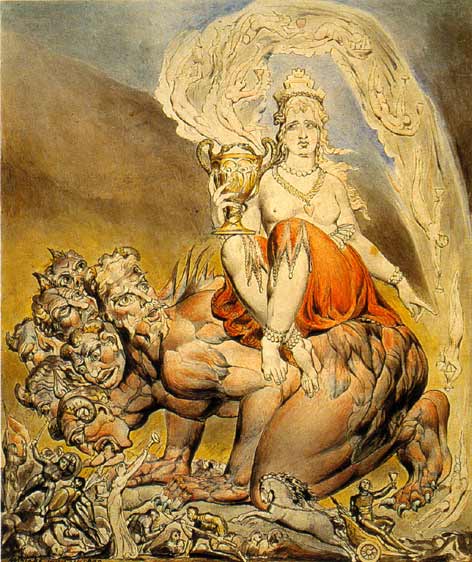
blake7

The Beast and the Whore of Babylon, elsewhere associated with institutionalized religion by Blake, are here overthrown along with Satan

The Overthrow of Apollo by William BlakeThe Overthrow of Apollo and the Pagan Gods (stanzas 19-23)

William Blake, “The Overthrow of Apollo and the Pagan Gods” (Thomas set), 1809. Watercolor on paper, 19.3 x 25 cm. Whitworth Art Gallery, Manchester, England. Description: Pagan worshipers burn an offering to Apollo as his spirit flees its statue in fear. (The statue depicts Apollo’s defeat of the giant serpent Python, who had tormented his mother during her pregnancy.) To the right, a disheveled Nymph hides in a thicket to mourn, while above her, a train of refugee gods and goddesses fills the sky.

XIX.
The Oracles are dumb;
No voice or hideous hum
Runs through the archèd roof in words deceiving.
Apollo from his shrine
Can no more divine,
Will hollow shriek the steep of Delphos1 leaving.
No nightly trance, or breathèd spell,
Inspires the pale-eyed Priest from the prophetic cell.

XX.
The lonely mountains o’er,
And the resounding shore,
A voice of weeping heard and loud lament;
Edgèd with poplar pale,
From haunted spring, and dale
The parting Genius2 is with sighing sent;
With flower-inwoven tresses torn
The Nymphs in twilight shade of tangled thickets mourn.

XXI.
In consecrated earth,
And on the holy hearth,
The Lars3 and Lemures4 moan with midnight plaint;
In urns, and altars round,
A drear and dying sound
Affrights the Flamens5 at their service quaint;
And the chill marble seems to sweat,
While each peculiar power forgoes his wonted seat.

XXII.
Peor and Baalim6
Forsake their temples dim,
With that twice-battered god of Palestine;7
And moonèd Ashtaroth,8
Heaven’s Queen and Mother both,
Now sits not girt with tapers’ holy shine:
The Libyc Hammon9 shrinks his horn;
In vain the Tyrian maids their wounded Thammuz10 mourn.

XXIII.
And sullen Moloch,11 fled,
Hath left in shadows dread
His burning idol all of blackest hue;
In vain with cymbals’ ring
They call the grisly king,
In dismal dance about the furnace blue;
The brutish gods of Nile as fast,
Isis,12 and Orus,13 and the dog Anubis,14 haste.

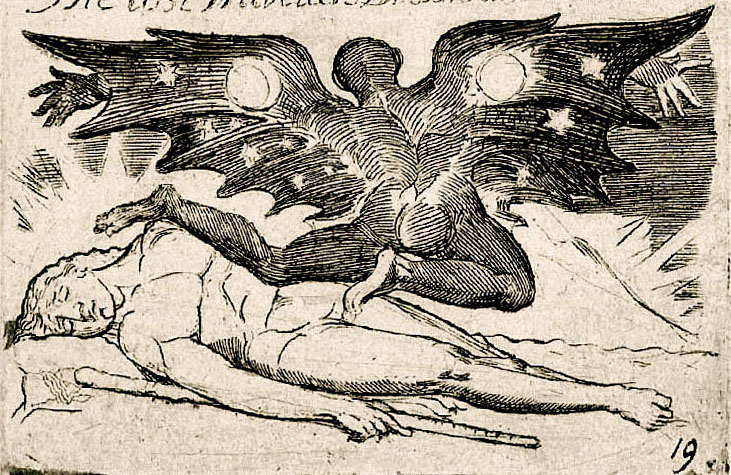
The Flight of Moloch by William Blake

The Flight of Moloch (stanza 23)

William Blake, “The Flight of Moloch” (Thomas set), 1809. Watercolor on paper, 19.7 x 25.7 cm. Whitworth Art Gallery, Manchester, England. Description: Worshipers of Moloch clang together cymbals and blow on trumpets as part of their infant sacrifice ritual. As they do, Moloch’s winged spirit departs from the molded image. The advent of his enemy, Jesus, has scared him away.

blake8

The winged figure of the accuser, so like the spirit of Moloch, cements that god’s identification with Blake’s Spectre

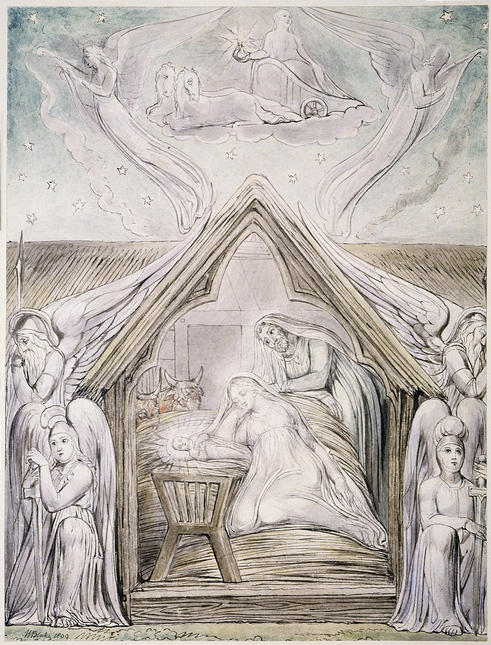
XXVII

But see the Virgin blest,
Hath laid her Babe to rest.
Time is our tedious Song should here have ending,
Heav’ns youngest-teemed Star [ 240 ]
Hath fixt her polisht Car,
Her sleeping Lord with Handmaid Lamp attending.
And all about the Courtly Stable,
Bright-harnest Angels sit in order serviceable.

blake6The Night of Peace (stanza 27)

Posted on December 14, 2012by Victoria Emily Jones

Also see “Winged Life” at https://orthodoxcityhermit.com/2015/09/12/william-blakes-mystic-visions-stunning-paintings/


The Art of Spiritual Reading

An Introduction to the Art of Reading God’s Word accompanied by some of the most beautiful medieval manuscripts

Top 10 Most Beautiful Medieval Manuscripts

Black Hours (M. 493 › Morgan Library & Museum)

The Black Hours is a product of unequalled luxury. All 121 vellum folios are stained in black. To make the writing stand out against the dark background, only white lead and opaque paints were used for the miniatures, and gold and silver ink for the script. Only three of these black parchment manuscripts survive to this day.
*


WE BELIEVE THAT THE SCRIPTURES constitute a coherent whole. They are at once divinely inspired and humanly expressed. They bear authoritative witness to God’s revelation of Himself – in creation, in the Incarnation of the Word, and the whole history of salvation. And as such they express the word of God in human language. We know, receive, and interpret Scripture through the Church and in the Church. Our approach to the Bible is one of obedience.

We may distinguish four key qualities that mark an Orthodox reading of Scripture, namely

Top 10 Most Beautiful Medieval Manuscripts

Prayerbook of Claude de France (MS M. 1166 › Morgan Library & Museum)

In the words of Roger Wieck, curator of manuscripts at the Morgan Library: “An artistic triumph…” The personalized prayer book of the French queen Claude de France enchants us especially by its delicate paintings in a charmingly small format of 69 x 49 mm, and even more so by the unusual wealth of illustration it contains.

*

Reading the Bible with Obedience

FIRST OF ALL, when reading Scripture, we are to listen in a spirit of obedience. The Orthodox Church believes in divine inspiration of the Bible. Scripture is a “letter” from God, where Christ Himself is speaking. The Scriptures are God’s authoritative witness of Himself. They express the Word of God in our human language. Since God Himself is speaking to us in the Bible, our response is rightly one of obedience, of receptivity, and listening. As we read, we wait on the Spirit.

But, while divinely inspired, the Bible is also humanly expressed. It is a whole library of different books written at varying times by distinct persons. Each book of the Bible reflects the outlook of the age in which it was written and the particular viewpoint of the author. For God does nothing in isolation, divine grace cooperates with human freedom. God does not abolish our individuality but enhances it. And so it is in the writing of inspired Scripture. The authors were not just a passive instrument, a dictation machine recording a message. Each writer of Scripture contributes his particular personal gifts. Alongside the divine aspect, there is also a human element in Scripture. We are to value both.

Each of the four Gospels, for example, has its own particular approach. Matthew presents more particularly a Jewish understanding of Christ, with an emphasis on the kingdom of heaven. Mark contains specific, picturesque details of Christ’s ministry not given elsewhere. Luke expresses the universality of Christ’s love, His all-embracing compassion that extends equally to Jew and to Gentile. In John there is a more inward and more mystical approach to Christ, with an emphasis on divine light and divine indwelling. We are to enjoy and explore to the full this life-giving variety within the Bible.

most beautiful medieval manuscripts lindisfarne gospels

Lindisfarne Gospels (Cotton MS Nero D IV › British Library)

The Lindisfarne Gospels doesn’t need many words of introduction: it’s one of the finest works in the unique style of Hiberno-Saxon or Insular art, combining Mediterranean, Anglo-Saxon and Celtic elements.

*

Because Scripture is in this way the word of God expressed in human language, there is room for honest and exacting inquiry when studying the Bible. Exploring the human aspect of the Bible, we are to use to the full our God-given human reason. The Orthodox Church does not exclude scholarly research into the origin, dates, and authorship of books of the Bible.

Alongside this human element, however, we see always the divine element. These are not simply books written by individual human writers. We hear in Scripture not just human words, marked by a greater or lesser skill and perceptiveness, but the eternal, uncreated Word of God Himself, the divine Word of salvation. When we come to the Bible, then, we come not simply out of curiosity, to gain information. We come to the Bible with a specific question, a personal question about ourselves: “How can I be saved?”

As God’s divine word of salvation in human language, Scripture should evoke in us a sense of wonder. Do you ever feel, as you read or listen, that it has all become too familiar? Has the Bible grown rather boring? Continually we need to cleanse the doors of our perception and to look in amazement with new eyes at what the Lord sets before us.

We are to feel toward the Bible with a sense of wonder, and sense of expectation and surprise. There are so many rooms in Scripture that we have yet to enter. There is so much depth and majesty for us to discover. If obedience means wonder, it also means listening.

Hours of Jeanne d’Evreux (Acc., No. 54.1.2 › Metropolitan Museum of Art) 

All miniatures are in demi-grisaille, a painting technique using mainly shades of grey and coloring for the figures’ face and hands. The surprising amount of details that can be fit in such small space is outstanding.

*

We are better at talking than listening. We hear the sound of our own voice, but often we don’t pause to hear the voice of the other person who is speaking to us. So the first requirement, as we read Scripture, is to stop talking and to listen – to listen with obedience.

When we enter an Orthodox Church, decorated in the traditional manner, and look up toward the sanctuary at the east end, we see there, in the apse, an icon of the Virgin Mary with her hands raised to heaven – the ancient Scriptural manner of praying that many still use today. This icon symbolizes the attitude we are to assume as we read Scripture – an attitude of receptivity, of hands invisibly raised to heaven. Reading the Bible, we are to model ourselves on the Blessed Virgin Mary, for she is supremely the one who listens. At the Annunciation she listens with obedience and responds to the angel, “Be it unto me according to thy word” (Luke 1:38). She could not have borne the Word of God in her body if she had not first, listened to the Word of God in her heart. After the shepherds have adored the newborn Christ, it is said of her: “Mary kept all these things and pondered them in her heart” (Luke 2:19). Again, when Mary finds Jesus in the temple, we are told: “His mother kept all these things in her heart” (Luke 2:5l). The same need for listening is emphasized in the last words attributed to the Mother of God in Scripture, at the wedding feast in Cana of Galilee: “Whatsoever He saith unto you, do it” (John 2:5), she says to the servants – and to all of us.

In all this the Blessed Virgin Mary serves as a mirror, as a living icon of the Biblical Christian. We are to be like her as we hear the Word of God: pondering, keeping all these things in our hearts, doing whatever He tells us. We are to listen in obedience as God speaks.

Westminster Abbey Bestiary

Westminster Abbey Bestiary (Ms. 22 › Westminster Abbey Library)

Out of all the Bestiaries, the Westminster is considered to be one of the most beautiful and richly decorated bestiaries in the world, and is full of all kinds of incredible descriptions, legends and myths.

*

Understanding the Bible Through the Church

IN THE SECOND PLACE, we should receive and interpret Scripture through the Church and in the Church. Our approach to the Bible is not only obedient but ecclesial.

It is the Church that tells us what is Scripture. A book is not part of Scripture because of any particular theory about its dating and authorship. Even if it could be proved, for example, that the Fourth Gospel was not actually written by John the beloved disciple of Christ, this would not alter the fact that we Orthodox accept the Fourth Gospel as Holy Scripture. Why? Because the Gospel of John is accepted by the Church and in the Church.

It is the Church that tells us what is Scripture, and it is also the Church that tells us how Scripture is to be understood. Coming upon the Ethiopian as he read the Old Testament in his chariot, Philip the Apostle asked him, “Understandest thou what thou readest?” And the Ethiopian answered, “How can I, unless some man should guide me?” (Acts 8:30-31). We are all in the position of the Ethiopian. The words of Scripture are not always self-explanatory. God speaks directly to the heart of each one of us as we read our Bible. Scripture reading is a personal dialogue between each one of us and Christ – but we also need guidance. And our guide is the Church. We make full use of our own personal understanding, assisted by the Spirit, we make full use of the findings of modern Biblical research, but always we submit private opinion – whether our own or that of the scholars – to the total experience of the Church throughout the ages.

The Orthodox standpoint here is summed up in the question asked of a convert at the reception service used by the Russian Church: “Do you acknowledge that the Holy Scripture must be accepted and interpreted in accordance with the belief which has been handed down by the Holy Fathers, and which the Holy Orthodox Church, our Mother, has always held and still does hold?”

We read the Bible personally, but not as isolated individuals. We read as the members of a family, the family of the Orthodox Catholic Church. When reading Scripture, we say not “I” but “We.” We read in communion with all the other members of the Body of Christ, in all parts of the world and in all generations of time. The decisive test and criterion for our understanding of what the Scripture means is the mind of the Church. The Bible is the book of the Church.

godescalc-evangeliary

Godescalc Evangelistary (Ms. Nouv. acq. lat. 1203 › Bibliothèque Nationale de France)

Why is this manuscript so important? In the words of Godescalc himself:

Golden words are painted [here] on purple pages,
The Thunderer’s shining kingdoms of the starry heavens,
Revealed in rose-red blood, disclose the joys of heaven,
And the eloquence of God glittering with fitting brilliance
Promises the splendid rewards of martyrdom to be gained. 

*

To discover this “mind of the Church,” where do we begin? Our first step is to see how Scripture is used in worship. How, in particular, are Biblical lessons chosen for reading at the different feasts? We should also consult the writings of the Church Fathers, and consider how they interpret the Bible. Our Orthodox manner of reading Scripture is in this way both liturgical and patristic. And this, as we all realize, is far from easy to do in practice, because we have at our disposal so few Orthodox commentaries on Scripture available in English, and most of the Western commentaries do not employ this liturgical and Patristic approach.

As an example of what it means to interpret Scripture in a liturgical way, guided by the use made of it at Church feasts, let us look at the Old Testament lessons appointed for Vespers on the Feast of the Annunciation. They are three in number: Genesis 28:10-17; Jacob’s dream of a ladder set up from earth to heaven; Ezekiel 43:27-44:4; the prophet’s vision of the Jerusalem sanctuary, with the closed gate through which none but the Prince may pass; Proverbs 9:1-11: one of the great Sophianic passages in the Old Testament, beginning “Wisdom has built her house.”

These texts in the Old Testament, then, as their selection for the feast of the Virgin Mary indicates, are all to be understood as prophecies concerning the Incarnation from the Virgin. Mary is Jacob’s ladder, supplying the flesh that God incarnate takes upon entering our human world. Mary is the closed gate who alone among women bore a child while still remaining inviolate. Mary provides the house which Christ the Wisdom of God (1 Cor. 1:24) takes as his dwelling. Exploring in this manner the choice of lessons for the various feasts, we discover layers of Biblical interpretation that are by no means obvious on a first reading.

The Grimani Breviary

Grimani Breviary (Ms. Lat. I, 99=2138 › Biblioteca Nazionale Marciana) 

A monumental witness to the splendor of Flemish art produced during the Renaissance. Perhaps an outstanding features of this manuscript is the choice of motifs, which alternate between religious and lay themes.

*

Take as another example Vespers on Holy Saturday, the first part of the ancient Paschal Vigil. Here we have no less than fifteen Old Testament lessons. This sequence of lessons sets before us the whole scheme of sacred history, while at the same time underlining the deeper meaning of Christ’s Resurrection. First among the lessons is Genesis 1:1-13, the account of Creation: Christ’s Resurrection is a new Creation. The fourth lesson is the book of Jonah in its entirety, with the prophet’s three days in the belly of the whale foreshadowing Christ’s Resurrection after three days in the tomb (cf. Matthew 12:40). The sixth lesson recounts the crossing of the Red Sea by the Israelites (Exodus 13:20-15:19), which anticipates the new Passover of Pascha whereby Christ passes over from death to life (cf. 1 Corinthians 5:7; 10:1-4). The final lesson is the story of the three Holy Children in the fiery furnace (Daniel 3), once more a “type” or prophecy of Christ’s rising from the tomb.

Such is the effect of reading Scripture ecclesially, in the Church and with the Church. Studying the Old Testament in this liturgical way and using the Fathers to help us, everywhere we uncover signposts pointing forward to the mystery of Christ and of His Mother. Reading the Old Testament in the light of the New, and the New in the light of the, Old – as the Church’s calendar encourages us to do – we discover the unity of Holy Scripture. One of the best ways of identifying correspondences between the Old and New Testaments is to use a good Biblical concordance. This can often tell us more about the meaning of Scripture than any commentary.

In Bible study groups within our parishes, it is helpful to give one person the special task of noting whenever a particular passage in the Old or New Testament is used for a festival or a saint’s day. We can then discuss together the reasons why each specific passage has been so chosen. Others in the group can be assigned to do homework among the Fathers, using for example the Biblical homilies of Saint John Chrysostom (which have been translated into English). Christians need to acquire a patristic mind.

Morgan-Crusaders-Bible

Morgan Crusader Bible (Ms M.638 › Morgan Library & Museum; Ms Nouv. Acq. Lat. 2294 › Bibliothèque Nationale de France; Ms Ludwig 16 83. M.A. 55 › Getty Museum)

In this manuscript history is depicted in great detail, without any text and recalls the Creation of the world, the Righteous Wars and the deeds of the most important characters of the Old Testament. The Crusader’s Bible fascinates through its rich and refined gold embellishment which comes to enhance the luminosity of the colors.

*

Christ, the Heart of the Bible

THE THIRD ELEMENT in our reading of Scripture is that it should be Christ-centered. The Scriptures constitute a coherent whole because they all are Christ-centered. Salvation through the Messiah is their central and unifying topic. He is as a “thread” that runs through all of Holy Scripture, from the first sentence to the last. We have already mentioned the way in which Christ may be seen foreshadowed on the pages of the Old Testament.

Much modern critical study of Scripture in the West has adopted an analytical approach, breaking up each book into different sources. The connecting links are unraveled, and the Bible is reduced to a series of bare primary units. There is certainly value in this. But we need to see the unity as well as the diversity of Scripture, the all-embracing end as well as the scattered beginnings. Orthodoxy prefers on the whole a synthetic rather than an analytical approach, seeing Scripture as an integrated whole, with Christ everywhere as the bond of union.

Always we seek for the point of convergence between the Old Testament and the New, and this we find in Jesus Christ. Orthodoxy assigns particular significance to the “typological” method of interpretation, whereby “types” of Christ, signs and symbols of His work, are discerned throughout the Old Testament. A notable example of this is Melchizedek, the priest-king of Salem, who offered bread and wine to Abraham (Genesis 14:18), and who is seen as a type of Christ not only by the Fathers but even in the New Testament itself (Hebrews 5:6; 7:l). Another instance is the way in which, as we have seen, the Old Passover foreshadows the New; Israel’s deliverance from Pharaoh at the Red Sea anticipates our deliverance from sin through the death and Resurrection of the Savior. This is the method of interpretation that we are to apply throughout the Bible. Why, for instance, in the second half of Lent are the Old Testament readings from Genesis dominated by the figure of Joseph? Why in Holy Week do we read from the book of Job? Because Joseph and Job are innocent sufferers, and as such they are types or foreshadowings of Jesus Christ, whose innocent suffering upon the Cross the Church is at the point of celebrating. It all ties up.

A Biblical Christian is the one who, wherever he looks, on every page of Scripture, finds everywhere Christ.

Wiener-Genesis

Vienna Genesis (Codex Theol. Gr. 31 › Österreichische Nationalbibliothek)

It is the most ancient purple manuscript surviving today. The fragment of the Genesis (from the Greek Septuagint translation) is compiled in golden and silver ink, on a beautifully purple-dyed calfskin vellum. Each page contains a lavish miniature depicting the text, for a total of 48 well-preserved images.

*

The Bible as Personal

IN THE WORDS of an early ascetic writer in the Christian East, Saint Mark the Monk: “He who is humble in his thoughts and engaged in spiritual work, when he reads the Holy Scriptures, will apply everything to himself and not to his neighbor.” As Orthodox Christians we are to look everywhere in Scripture for a personal application. We are to ask not just “What does it mean?” but “What does it mean to me?” Scripture is a personal dialogue between the Savior and myself – Christ speaking to me, and me answering. That is the fourth criterion in our Bible reading.

I am to see all the stories in Scripture as part of my own personal story. Who is Adam? The name Adam means “man,” “human,” and so the Genesis account of Adam’s fall is also a story about me. I am Adam. It is to me that God speaks when He says to Adam, “Where art thou?” (Genesis 3:9). “Where is God?” we often ask. But the real question is what God asks the Adam in each of us: “Where art thou?”

When, in the story of Cain and Abel, we read God’s words to Cain, “Where is Abel thy brother?” (Genesis 4:9), these words, too, are addressed to each of us. Who is Cain? It is myself. And God asks the Cain in each of us, “Where is thy brother?” The way to God lies through love of other people, and there is no other way. Disowning my brother, I replace the image of God with the mark of Cain, and deny my own vital humanity.

In reading Scripture, we may take three steps. First, what we have in Scripture is sacred history: the history of the world from the Creation, the history of the chosen people, the history of God Incarnate in Palestine, and the “mighty works” after Pentecost. The Christianity that we find in the Bible is not an ideology, not a philosophical theory, but a historical faith.

Then we are to take a second step. The history presented in the Bible is a personal history. We see God intervening at specific times and in specific places, as He enters into dialogue with individual persons. He addresses each one by name. We see set before us the specific calls issued by God to Abraham, Moses and David, to Rebekah and Ruth, to Isaiah and the prophets, and then to Mary and the Apostles. We see the selectivity of the divine action in history, not as a scandal but as a blessing. God’s love is universal in scope, but He chooses to become Incarnate in a particular comer of the earth, at a particular time and from a particular Mother. We are in this manner to savor all the uniqueness of God’s action as recorded in Scripture. The person who loves the Bible loves details of dating and geography. Orthodoxy has an intense devotion to the Holy Land, to the exact places where Christ lived and taught, died and rose again. An excellent way to enter more deeply into our Scripture reading is to undertake a pilgrimage to Jerusalem and Galilee. Walk where Christ walked. Go down to the Dead Sea, sit alone on the rocks, feel how Christ felt during the forty days of His temptation in the wilderness. Drink from the well where He spoke with the Samaritan woman. Go at night to the Garden of Gethsemane, sit in the dark under the ancient olives and look across the valley to the lights of the city. Experience to the full the reality of the historical setting, and take that experience back with you to your daily Scripture reading.

Then we are to take a third step. Reliving Biblical history in all its particularity, we are to apply it directly to ourselves. We are to say to ourselves, “All these places and events are not just far away and long ago, but are also part of my own personal encounter with Christ. The stories include me.”

Betrayal, for example, is part of the personal story of everyone. Have we not all betrayed others at some time in our life, and have we not all known what it is to be betrayed, and does not the memory of these moments leave continuing scars on our psyche? Reading, then, the account of Saint Peter’s betrayal of Christ and of his restoration after the Resurrection, we can see ourselves as actors in the story. Imagining what both Peter and Jesus must have experienced at the moment immediately after the betrayal, we enter into their feelings and make them our own. I am Peter; in this situation can I also be Christ? Reflecting likewise on the process of reconciliation – seeing how the Risen Christ with a love utterly devoid of sentimentality restored the fallen Peter to fellowship, seeing how Peter on his side had the courage to accept this restoration – we ask ourselves: How Christ-like am I to those who have betrayed me? And, after my own acts of betrayal, am I able to accept the forgiveness of others – am I able to forgive myself? Or am I timid, mean, holding myself back, never ready to give myself fully to anything, either good or bad? As the Desert Fathers say, “Better someone who has sinned, if he knows he has sinned and repents, than a person who has not sinned and thinks of himself as righteous.”

Have I gained the boldness of Saint Mary Magdalene, her constancy and loyalty, when she went out to anoint the body of Christ in the tomb (John 20:l)? Do I hear the Risen Savior call me by name, as He called her, and do I respond Rabboni (Teacher) with her simplicity and completeness (John 20:16)?

Reading Scripture in this way – in obedience, as a member of the Church, finding Christ everywhere, seeing everything as a part of my own personal story – we shall sense something of the variety and depth to be found in the Bible. Yet always we shall feel that in our Biblical exploration we are only at the very beginning. We are like someone launching out in a tiny boat across a limitless ocean.

“Thy word is a lamp unto my feet, and a light unto my path” (Psalm 118 [119]:105).

*

Lectio Divina  is a four-part way of reading Scripture:
Lectio. Read. God is speaking, so I listen intently to what he says.
Meditatio. Engage. God is speaking to me, so I listen personally.
Oratio. Pray. God is speaking to me, so I listen personally and reply personally in prayer.
Contemplatio. Live. God is speaking to me, so I listen personally and reply in prayerful living.

*

By Bishop Kallistos Ware: “How to Read the Bible” at http://orthodoxeurope.org/page/11/1/4.aspx#obedience


Source: MEDIEVALISTS.NET, “Top 10 Most Beautiful Medieval Manuscripts” http://www.medievalists.net/2015/10/03/top-10-most-beautiful-medieval-manuscripts/
Balinese ‘Dancing’ Jesus

asian200

I have long been eager to get acquainted with nonwestern Christian art, especially artworks representing Christ and Bible themes by Asian artists. So, I got very excited when I discovered the Asian Christian Arts Association or the ACAA, established in Bali, where Christian artists and theologians from all over Asia meet, exchange ideas and inspire each other. Nyoman Darsane, a fascinating Balinese artist who depicts Biblical characters as traditional Balinese dancers, employing various Balinese symbolisms in his images, was one of the first Asian ‘Christian’ artists to attract my attention. Then, I came across Victoria Jones’ post at The Jesus Question about him. Darsane is an incredibly talented painter who masterfully combines the joy of the Gospel with his Balinese culture, and Victoria’s post is thoroughly researched, offers excellent commentary and insights and does him justice!

Victoria Emily Jones's avatarThe Jesus Question

Balinese artist Nyoman Darsane was born in 1939 and raised as a Hindu.  At age seventeen, he became a Christian and as a result was ostracized by his family and village community.  But because he so persistently strove, through his art, to give Christianity a Balinese shape, they eventually decided to accept him back in.  They saw that he still loved and respected the culture; he was still “one of them,” even though his religious beliefs took a different turn.  Does he feel that, as a Balinese Christian, his identity is divided, that he cannot fully embrace both at once?  Not at all.  “Bali is my body; Christ is my life,” he says.  In other words, Jesus Christ is his all, but can he not pray to and worship and express his love for Jesus Christ in a Balinese fashion?  And can he not picture Jesus as a fellow Balinese…

View original post 1,605 more words