Divine Providence in a Convert’s Journey

Divine Providence in a Convert’s (*) Journey

ORTHODOXY IS A WAY OF LIFE

A talk with Marilyn Swezey, the secretary of Bishop Basil (Rodzianko)


My interviewee has had an extremely interesting and unusual life for an American woman. Charming, intelligent, she looks some 15 years younger than she really is. And behind her there is a long life full of the hard labors of a noble, self-sacrificing person who seeks to see Divine providence in every turn of her life. Here she is: secretary of Bishop Basil (Vasily) Rodzianko, assistant to Metropolitan Jonah (Paffhausen), an expert in the Russian literature and arts, honorable parishioner of the Cathedral of St. Nicholas the Wonderworker, Marilyn Pfeifer Swezey.

    Marilyn, how did you happen to get interested in Russia, in our country’s art?

—In the 1960s as a young woman I studied at a small Catholic college for women in New York. I studied classical art. Apart from the compulsory program we were to choose some optional subjects. I did not know why but I chose the Russian language course. That was the starting point for all the subsequent events in my life.

The paths we choose… Did you enjoy learning Russian?

—Yes, I had a wonderful teacher—Olga Constantinovna Voronova (1894-1981), former lady in waiting to the empress. She was a daughter of the councilor of state and master of the hunt of the court of His Imperial Highness, Count Constantine Petrovich Kleinmichel and Yekaterina Nikolaevna Bogdanova—the daughter of the marshal of the nobility of Kursk province.Olga Constantinovna’s husband, Pavel Voronov, a navy officer, served on the imperial yacht, the Standart, with the royal family for four years. The blessed memories of his service with the royal family remained with Pavel forever. The little Tsarevich Alexei loved him dearly—once the empress told Olga Constantinovna that the tsarevich used to keep her husband’s photograph at his bed. And, undoubtedly, Pavel Voronov was entirely devoted to the boy.

Olga Constantinovna testified: “I think it was impossible not to come to love this child who, besides his natural charm, gained the hearts of everybody by his kindness, his sympathy for others’ troubles—he was always the first to help and console—and by the patience with which he endured his illness, which at times made him a real sufferer.”

Before the departure of Pavel Voronov to war the Grand Duchess Olga gave him and Olga Constantinovna icons—one icon for each of them. From that day on they always had these icons with them—it was the only material remainder of the royal family that the couple managed to preserve during the years of the Revolution.

Let me cite you several extracts from the reminiscences by Olga Constantinovna:In January 1917 my husband began to have heart problems and he was returned from the front to St. Petersburg, or Petrograd, to be more exact. After the council of physicians at Maritime Hospital he was sent for two months to a spa resort in the Caucasus for treatment. Before our departure we were invited by the Empress to spend an evening together with her and the children. I had not seen them for a while and found a great change in Grand Duke Alexei. When I had visited the palace the previous time, the empress received me in one of its nurseries and the Tsarevich was delivered there to his bed. At the time he was recovering from a fit of his terrible disease and looked very pale and thin. All tried to cheer him up, and it was so moving to see the tender love with which his sisters played with him and cared for him. The Tsarina was knitting something for the Committee of temporary assistance to wounded soldiers headed by Grand Duchess Tatiana; from time to time she smiled to her son, though her look remained sad and anxious.

But I had never seen Grand Duke Alexei in such good shape before. He had grown up appreciably, transparency disappeared from his face, he had ruddy cheeks and looked absolutely healthy. Every time when the empress looked at him, a happy radiant smile lit up her face. The Tsarevich stayed near her all the time, sometimes kissed her face and hands, stroked her hair. This scene of the close, united, happy family remained in my memory forever. I was seeing them thenfor the last time.

The Nativity and New year of 1918 went of without joy, but quietly. I was melancholy but very delighted to receive a letter from Grand Duchess Tatiana in Tobolsk, Siberia, where the imperial family had been exiled…

Two days before the murder of the royal family, a priest was allowed to celebrate a Divine Liturgy in their prison (they had been deprived of such a consolation for a long time). Later he remembered how much he had been impressed by the depth of their spirit and the spiritual level the royal family had reached. He said he felt that they did not belong to this world any longer…

The memory of them will always support me on the path I have been walking in my life.”

—Yes, Olga Constantinovna was a wonderful person. She spoke such beautiful Russian… Her English was fluent and with a slight accent, and her French was excellent.

Our college was small, and the girls who learned Russian in the group numbered only six or seven, so we had a close communication with our teacher. Not only did Olga Voronova teach us Russian, but she also taught culture and history, especially the history of the Imperial court. And she loved the royal family—sincerely, faithfully. She passed this love on to us! I began to feel that the royal family became very close to my heart as well, as if I knew them personally! Later I gave my own children the names of the Holy Royal Martyrs.

And this is all thanks to Olga Constantinovna! Then I did not very clearly understand what a person I had met by Divine providence. I came to understand it later, after many years… Olga and Pavel Voronov were genuine Orthodox people. My acquaintance with Orthodoxy began precisely through them.

The stories of Olga Constantinovna about Orthodox Russia contained such a beauty and spiritual depth, that I wanted to become familiar with this country.

And did you succeed in this?

—Oh, yes! After being taught for a year by Olga Constantinovna, I set off travelling around Europe and spent three weeks in Russia. Russia and America were officially enemies, but the Russian common folk turned out to be such open-hearted people. I visited Leningrad, Moscow, Kiev… When I came to Moscow, I was a Protestant. But that trip changed my life radically!

What happened to you in Russia?

—I travelled with my friend. We were both aged 19. Now, when we freely travel from Russia to the USA and back, it is hard to imagine what an unusual experience it was for two American young ladies to travel to the USSR in the 1960s… My friend’s parents recommended us to visit a Catholic priest in Moscow. There were few of them in the capital—only for English-speaking and French-speaking diplomats.

    I remember Fr. Louis Dion very well. He served at a chapel attached to the embassy in Moscow. And he advised us that we should visit the Holy Trinity-St. Sergius Lavra. He said it was necessary for us to do it. He explained us the route. So we took a suburban train to Zagorsk, now Sergiyev Posad. There were four of us. I could speak little Russian, while all my companions did not know a word of it. The stations flew past the window and the train hurried through the little Russian halts. We thought, how do we know when it’s Zagorsk?

I asked an elderly woman, a babushka, who was sitting next to me, and she understood me and replied: “Of course, I will let you know. Don’t worry!” And she told us the right station. We alighted and found ourselves alone on a platform with no people around. Then we saw a handsome young officer nearby. He gave us a smile and I asked him in broken Russian, “How can I get to the monastery?” He answered, but I understood only half of what he said.

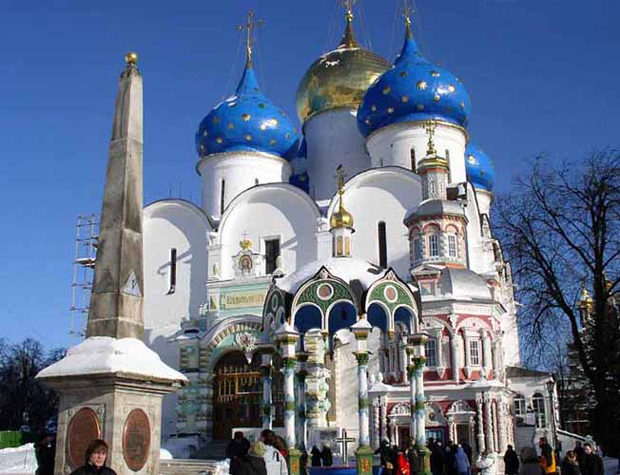
We started our way and were soon helped. We met a young man who led us up to the monastery’s gate. We looked around and saw amazing churches. I will remember forever the moment we entered the Holy Trinity Cathedral—I found myself in another world! Then I knew nothing of Venerable Sergius of Radonezh

There was nobody inside the church, except for a hieromonk who was reading an akathist to St. Sergius. We stood for a long time, listening to prayer, which was heard in total silence. I began to feel that wonderful atmosphere, which was not of this world. There was deep love and warmth. Peace. It was a gift of the Holy Spirit.

At that time I was already aware of the persecutions against the faithful in the Soviet Union, of the repressed and murdered clergy, of those who were left to rot in jails and mental hospitals. And—such beauty of Orthodoxy!

I don’t know how, I thought by myself there, before the relics of St. Sergius: “If I have an opportunity to help the faithful in Russia, then I must become Orthodox.” At that moment it was just in my thoughts. And even these thoughts were odd for a young American woman. It was many years later that I came to understand that St. Sergius heard my thought, my desire and helped it to come true.

And how did it happen?

—At first I decided to master my Russian and to study the Russian literature and history more thoroughly. After four years at college I enrolled in a two-year course at Harvard University. We studied Russian history, Russian literature; it was Prof. George Florovsky who gave us seminars. There were only 20 students in our course, which was very intensive. We read War and Peace by Leo Tolstoy, compared the legal systems of the USSR and America. Two years later I received a Master of Arts degree. We were trained as specialists who would work for the American government and they were going to offer me a job. Pending the invitation, I went to visit my parents, and soon I indeed received an invitation, but it was not a job offer—it was an invitation to the annual dinner party at Harvard University. My year of graduation was 1965—it was the year when women first acquired degrees at Harvard. That invitation was obviously God’s Providence for me, because it was at that dinner party that I met my future husband Robert Swezey.On the day of our engagement I finally received an invitation for work for the U.S. government in Washington, but it was too late: I was going to get married and live with my husband in Chicago and so could not work in Washington.

Although we did move to Washington with my husband—only four years later. It was there that I met Vladimir Tolstoy. We talked about Russia with him and everything at once came alive in my memory: the dreams, desires and prayer before St. Sergius’ relics. When Vladimir invited me to join the Christian Committee in Defense of the Rights of Persecuted Orthodox Christians in USSR, I accepted it without hesitating.

What can you say about the work in that Committee?

—The Committee’s chairman was Archpriest Victor Potapov, and I worked as its secretary: I helped, translated materials, organized meetings, and prepared articles for publication in defense of the persecuted. We gave coverage to cases of persecution of believers, raised and sent money, wrote protests to the Soviet embassy, did our best to inform the world public of the persecutions against the faithful in USSR. I think my trip to the Holy Trinity-St. Sergius Lavra was the crucial moment in choosing my path of life.

One day Vladimir Tolstoy asked me to become a godmother to his son Nikolai. And I answered: “But I am not Orthodox.” He said in reply: “So the time has come for you to become Orthodox!”

Maria Potapova, wife of Archpriest Viktor Potapov, was an active member of the Committee. She was the only Orthodox woman I knew at that time and so I asked her to be my godmother. She introduced me to her uncle, Bishop Basil (Rodzianko).

    In 1981, Bishop Basil received me into the Orthodox Church. And I became one of those who were concerned for Orthodox Russia with all their hearts. The Lord provided meetings with wonderful people for me, and it was the grace of God for me. I also became the secretary to Bishop Basil (Rodzianko) in 1981 and remained such until his repose in 1999. He introduced me to the world of Orthodoxy.

The bishop was experiencing material difficulties and I wrote a letter to my father: “Dad, could you possibly help Bishop Basil?” And in 1986 my father bought a flat for him where he lived and worked all his subsequent years. And this is the very flat—which later became a museum—where you and I are now.

And what did your parents think of your work and Orthodoxy?

—My parents were cradle Catholics but as the years went by they became Protestants. They were surprised with the path of life I chose and could not understand why they had such a “Russian” daughter! But they loved me very much and trusted my choice. Dad met with my dear teacher—Olga Voronova—and was deeply impressed.

Once, during one of my trips to my parents’ home in Florida, I advised them to have their house blessed according to the Orthodox rite—to call for an Orthodox priest, to celebrate a prayer service… My parents had no objections. At that time Bishop Basil was staying in Florida, too. I called him and he along with Fr. Michael blessed my parents’ house together with my parents themselves, as they were celebrating their golden wedding anniversary.

My father was very impressed by the blessing of the house. He was moved by it and told me: “This was like a baptism of our house!”

    A month later my father had a heart attack; he was 75. I believe it was the Lord Who had given me the idea to have my parents’ house blessed, because my father was thus prepared for what was to happen with him soon afterwards, during his illness. And this is what happened to him: he became Orthodox!

I asked him at hospital: “What if I invite an Orthodox priest, Fr. Michael, who together with Bishop Basil blessed your house?”

And my dad agreed! He was received into the Orthodox Church, took Communion and six hours later passed away. He reposed in the Lord very peacefully. I was at his bedside and saw his eyes shining with joy! Before the end he seemed to have seen someone near him—and his eyes began to shine! He wanted to greet joyfully the one whom he saw at the final moment of his life. Then he had another sigh—and passed on.

I think Bishop Basil prayed for him. Mom wanted that a funeral service be performed for dad in Washington. She knew she would move there to live close to me. And Bishop Basil performed a funeral service for him.

Did your mother become Orthodox as well?

—A wonderful story happened to my mom as well. Several years after my father’s death, also at the age of 75, she was taken to the hospital. A surgical operation on her stomach followed, with liquid in the lungs, and a grave condition… I asked her permission to call the same priest, Fr. Michael, and she agreed. Inspired by my father’s example, she too became Orthodox and took Communion. Fr. Michael, looking at her after Communion, said, “Your mother is like a flower which suffered from drought and now feeling the influence of life-giving water!”

Indeed it was so, and one could even see it with physical eyes—not only spiritually. After Communion mother began to feel better at once. An instantaneous relief! I believe Bishop Basil prayed for my mother as well.

Soon she was discharged from the hospital and lived for twenty-one more years, reposing at the age of 96. And all those years she was an active parishioner of the Orthodox Church! And one more amazing thing! Bishop Basil continued to care for my parents even after their death! My father died in 1990 and was buried in the cemetery, in that part of it which belonged to the St. Nicholas Church. When the bishop reposed, the cathedral provided him space there and so he was buried next to my father’s grave. My mother was buried beside them.

    I feel the providence of God, telling you all this, Olga! One thing follows another! Everything is interconnected!

Yes, Marilyn, I feel this too. Your story touches me to the heart!

—My father’s Orthodox name is Vladimir, my mother’s is Elisabeth.

Eternal memory to Vladimir and Elisabeth!

Marilyn, can you tell us about your years spent near Bishop Basil?

—You must know that he hosted programs for the faithful in Russia on the BBC. I recorded his sermons and helped him with everything. He was also my spiritual father. He led me to the Orthodox way of life, because Orthodoxy is a way of life!

    Every piece of furniture in this flat, except for these chairs, was brought here by the bishop from London. The flat is relatively small, but he arranged here a home church, a bedroom, and an office. Bishop Basil was very tall and used to sleep on a folding bed with his legs partly in the corridor… The kitchen was tiny but meals were arranged there regularly, and all visitors were accommodated with love. This flat reflects his way of life. It looks very simple, but it is filled with “treasures”: relics, writings of sermons, icons…

Many of the icons were painted in London by Tamara Elchaninova (widow of the famous Russian Orthodox priest and spiritual writer Fr. Alexander Elchaninov: 1881-1934, who emigrated to France). The bishop related that T. Elchaninova would spend summers in the 1960s with their family and painted these icons.

A cross is kept in the altar of the home church. This is the cross from the grave of the bishop’s wife (she was his wife when he was a priest). She was a very talented choir director, and she led the choirs of all the churches where he served.

Bishop Basil had been a married priest for many years. His wife died in 1978, and in the following year he became a monk. Then he was invited to the USA where he was raised to the rank of archimandrite, and then consecrated a bishop. It was the first and (to date) the only consecration of a bishop at the St. Nicholas Cathedral.

    There is a story associated with each photograph and each item in this flat. Here is the photo of the bishop’s grandfather, Michael Rodzianko, chairman of the Russian State Duma of the third and the fourth convocations (1911-1917). Here is photo of two grandsons who live in England. This is his niece, Mother Marina, who became a nun in Jerusalem. She is elder sister of Maria Potapova, the wife of Archpriest Victor Potapov. Maria Potapova is my godmother. Do you see how all is interconnected?

Metropolitan Jonah (Paffhausen) weekly serves a Liturgy in the house church. Now I am helping Metropolitan Jonah—it appears that Bishop Basil has “passed” me on to him. When Metropolitan Jonah serves here, Bishop Basil invisibly serves too because he is spiritually with us. The people who never saw Bishop Basil come here, feel his presence and get moved, tears began to flow and you do not know why…

    Do you feel spiritually connected with Bishop Basil?

—Beyond a doubt! I feel his support! He is like a part of my mind!… I feel his presence when I pray and always understand his answer. He helps, comforts…

I had two surgical operations in 1994 and 2006 and asked for his prayers so that the operations would go well and not be too painful. And both operations went very well!

The bishop had a spiritual intuition, a pastoral intuition. He opened an opportunity for me to sense the other world—the spiritual world. Here, in the West, people do not understand this; awareness of the spiritual world is not characteristic of the Western way of thinking, it was lost centuries ago. When the bishop received me into the Orthodox Church on the feast of Annunciation, 1981, I began to feel a new, spiritual dimension beside me which had not existed for me before. He developed in me the awareness of this inner, spiritual dimension.

    Bishop Basil experienced many miraculous events in his life and he used to share them with me. He and his wife deeply venerated St. Seraphim of Sarov. In Yougoslavia bishop Vasily, then still Fr. Vladimir, was arrested by the Communists and sentenced to eight years in prison. In jail he once was very exhausted, despondent and fell asleep without prayer for the first time in his life. And in a dream he saw St. Seraphim of Sarov who consoled him and said that his situation would improve soon.

Fr. Vladimir wrote this to his wife and the latter was very surprised as she was praying for her husband to St. Seraphim of Sarov, felt his presence, and the saint predicted her speedy help. And Fr. Vladimir was released after two years instead of eight!

The bishop was a very intelligent man and highly educated; he was versed in European languages. He knew English, French, and some German. He had a beautiful voice. In 1955 he was looking for a job and so he offered to the BBC: “I am a priest and I wish to do programs for believers.” He was answered: “No, programs for believers are not a part of the BBC policy.” But he changed this policy! Already after the first program a great number of letters were received from around Russia! And people thanked him!

Was Bishop Basil a strict spiritual father?

—The bishop used to say: “A loving father is he who finds a path appropriate for each spiritual child.” And his attitude to each person was defined by their spiritual strength, understanding the context of one’s life. He possessed an excellent pastoral intuition in understanding the people who came to him.

One of those people was Bishop Tikhon (Shevkunov). I first met him when he was still a layman, a graduate from the Gerasimov Institute of Cinematography called Gosha (a diminutive form of Georgy) Shevkunov. He also visited us as an archimandrite, while Bishop Basil was still alive. He also came several years ago with his book, Everyday Saints and Other Stories, translated into English.

I love his book very much! And love Bishop Tikhon himself. He is an extraordinary man. He was born to perform great deeds in the life of the Church.

Let me tell you this interesting story. Regarding the link between the spiritual world with our world.

    When Bishop Tikhon visited the previous time, still as an archimandrite, I wanted to give him something to remember Bishop Basil by. I am in charge of Bishop Basil’s archives, and I thought, “What will I give him as a present?”

I looked around in this flat-museum. I could give him an icon, a book, a photograph, any of the relics. But suddenly I felt something, as if Bishop Basil himself told me: “Give him my bishop’s miter.”

I came up to the wardrobe in which several bishop’s miters were stored. I chose a dark red one which was the most beautiful: Bishop Basil loved it and wore it often. And I gave it to Fr. Tikhon. He put it on. He could have worn it before, as an archimandrite, but nevertheless it was a bishop’s cap which had belonged to Bishop Basil…

Maybe you can remember any other episode from Bishop Basil’s life that you witnessed?

—One day Bishop Basil learned that his sister who lived in Russia was dying of liver cancer. He wanted to see her for the last time very much and tried to get a visa to Russia. But he was refused a visa for four times. At that time the Madrid visa treaty was signed: in case of an illness of family members visas were granted. I was aware of this and wrote a complaint against the violation of the treaty.

Two weeks passed and I was called from the consulate—they suggested I make an appointment with the ambassador Anatoly Dobrynin (1919-2010). I called to the USSR embassy and told them the bishop’s surname. “Oh, Rodzianko?” I heard the reply, and I was at once put through to the ambassador. This seemed impossible, but it did happen. The ambassador made an appointment through me as the bishop’s secretary.

And so I took Bishop Basil from New York where a meeting of the Synod was then beginning. When we approached the embassy I started looking for a parking lot, and the bishop asked me, “Will you join me? I do not want to go there alone.” “Sure,” I answered.

And we entered the embassy. The embassy workers saw the bishop: tall, with his fluffy white beard, in full monastic clothing: a cassock, black klobuk and veil, and was wearing a large panagia. He was a true Russian bishop!

    We were led to the ambassador. Anatoly Dobrynin served as the USSR ambassador to America for 24 years: over that time five General Secretaries succeeded each other in USSR and in the USA—six presidents. Dobrynin was an extraordinary figure and he played an important role in the resolution of the Cuban Missile Crisis along with stabilization of relations between the Soviet Union and the USA. He met us and cordially greeted the bishop; the latter introduced me to him and I became a witness of this historic conversation.

They spoke in Russian for about an hour. Dobrynin said to the bishop: “I feel certain you will not do anything in the USSR we don’t want you to do.” He also said: “My mother was a believer. She always blessed me when I returned to Russia from America. And she prayed for me. But now she is dead.”

The bishop replied, “She is still praying for you in heaven.” A pause followed. It lasted several moments. The ambassador’s face completely transformed. It was clear that the bishop’s words impressed him very much. Dobrynin was silent for some time and then pronounced in a changed voice, “Of course, I will grant you a visa.” And he personally gave the bishop a visa. It was evident that the words of Bishop Basil touched him deeply.

I was looking at these two mighty Russian men. And one of them really was stronger. I think the bishop was stronger.

    Were you together with the bishop until his final days?

—On the evening of September 16, 1999, I saw him alive for the last time. We drank tea together and talked. In the following morning I came back to him with the view of accompanying him to the migration service for the American citizenship ceremony (this event is usually fixed a month before). But by that moment he had already been granted another citizenship—the heavenly one. At night he had a stroke and died.

Bishop Tikhon (Shevkunov) wrote a preface to the book by Bishop Basil, My Life. Reminiscences. I would like to cite a few words by Bishop Tikhon from that preface:

On September 17, 1999, Russian Bishop Basil (Rodzianko) reposed in Washington. The bishop had reached the hour from which he would embark on a journey for which he had been seriously preparing all his life… He was a true bishop and master (in Russian: ‘vladyka’)! Indeed he infinitely ruled over human souls. His unforgettable and inimitable kindness, faith and love were his indestructible and wonderful power that even today reaches over those who were vouchsafed to know Bishop Basil personally.

Thank you for your marvelous talk, dear Marilyn! What would you say in conclusion to our website’s readers?

—May the Lord help and keep you, my dears!

Source: Pravislavie.ru

*In truth, aren’t we all converts to Christ, and received into His Church?


SergiyevPosad4.jpg


Princess Turned Nun

Princess Turned Nun: Life of Princess Ileana of Romania then Mother Alexandra
Ileana as a young woman

Princess Ileana

Ileana as a young woman

‘But I felt I had to stand on my own feet and learn the hard way, for the hard way is the only way. I know from bitter experience where it leads to, to lean on others. It is only when one has learned to stand on one’s own feet, when one has found a solid foundation, that it is wise or good to accept help.’ (I Live Again)

Here’s an unconventional life:  A princess, great-grand daughter of Queen Victoria of England and Czar Alexander II of Russia, twice divorced (!), founder of the European equivalent of the Girls’ Scouts, gives up her pampered princess life to found and direct the first English-language Orthodox monastery in rural Pennsylvania.  Although she passed away in 1982, her life still inspires, serving as a testament to the attractiveness of the ascetic life that Orthodox theology encourages.  Her worldly name was Princess Ileana of Romania, but her tonsured name was Alexandra, eventually she became known as Mother Alexandra as the igoumeni, Abbes, Mother Superior of the Monastery of the Transfiguration in Ellwood City, Pa.

Princess Ileana

    Princess Ileana of Roumania as a teen

a real beauty in body and soul Princess Ileana of Romania

A real beauty in body and soul Princess Ileana of Romania

principesa Printesa_Ileana_de_Romania

Ileana of Romania as a young child

Ileana of Romania as a young child

Princess Ileana Red Cross

Ileana with her work in the Red Cross during the War

In my opinion, Princess Ileana’s story is a A Blessed Life of Extremes on so many levels. I have personally found Bev. Cooke’s narrative chronicle Royal Monastic: Princess Ileana of Romania: The Story of Mother Alexandra, a most fascinating account of the life of one of the twentieth centuries most unheralded, yet fascinating, persons. Mother Alexandra, formerly Princess Ileana of Romania, lived through two world wars, the communist takeover of her country, and finally saw its liberation. She lived a life of royalty and privilege, yet knew poverty, encountered opulent materialism, yet lived as an Orthodox nun founding a monastery in Pennsylvania in the later years of her life, married twice (!), yet became nun! Mother Alexandra’s experiences were varied and deep to the extent few others can claim. She was, by birth, related to some of the most powerful and historically significant people in modern history, yet never sought celebrity status. If you seek an inspirational biography, read this thrilling tale of love and loss, danger and rescue, sacrifice and reward. For all her shortcomings and ‘falls’, Mother Alexandra’s life stands in so many ways as a beacon of faith and holiness for women of all times and nations to follow. 

Life & Adventures: Birth and early life

Ileana was born in Bucharest on 5 January 1909, the youngest daughter of Queen Marie of Romania and King Ferdinand I of Romania. Although it was rumored that Ileana’s true father was her mother’s lover, Prince Barbu Ştirbey, the king admitted paternity. Ileana had four older siblings: CarolElisabeth – later Crown Princess of Greece, Princess Maria – later Queen of Yugoslavia – and Nicholas. Her younger brother Mircea was also claimed to be the child of Prince Ştirbey even though the king also claimed to be his father.

Girl Guiding

Before her marriage, Ileana was the organizer and Chief of the Romanian Girl Guide MovementLater Princess Ileana was involved in Guiding in Austria and served as president of the Austrian Girl Guides[1][2] from 1935 until Girl Guiding and Scouting were banned in 1938 after the Anschluss.

Other achievements

Ileana was the organizer of the Girl Reserves of the Red Cross, and of the first school of Social Work in Romania.

She was an avid sailor: she earned her navigator’s papers, and owned and sailed the “Isprava” for many years.

Before King Michael’s abdication

Marriage

In Sinaia on 26 July 1931, Ileana married the Archduke Anton of Austria, Prince of Tuscany. This marriage was encouraged by Ileana’s brother, King Carol II, who was jealous of Ileana’s popularity in Romania and wanted to get her out of the country.[3] After the wedding, Carol claimed that the Romanian people would never tolerate a Habsburg living on Romanian soil, and on these grounds refused Ileana and Anton permission to live in Romania.[3]

After her husband was conscripted into the Luftwaffe, Ileana established a hospital for wounded Romanian soldiers at their castle, Sonneburg, outside Vienna, Austria. She was assisted in this task by her friend Sheila Kaul. In 1944, she and the children moved back to Romania, where they lived at Bran Castle, near Brasov.[4] Archduke Anton joined them but was placed under house arrest by the Red Army. Princess Ileana established and worked in another hospital in Bran village, which she named the Hospital of the Queen’s Heart in memory of her beloved mother Queen Maria of Romania.

After exile

After Michael I of Romania abdicated, Ileana and her family were exiled from the newly Communist Romania. They escaped by train to the Russian sector of Vienna, then divided into three parts. After that they settled in Switzerland, then moved to Argentina and in 1950, she and the children moved to the United States, where she bought a house in Newton, Massachusetts.

The years from 1950 to 1961 were spent lecturing against communism, working with the Romanian Orthodox Church in the United States, writing two books: I Live Again, a memoir of her last years in Romania,[5] and Hospital of the Queen’s Heart, describing the establishment and running of the hospital. [For an introduction to her memoir go here and for the full text here.]

On 29 May 1954, Ileana and Anton officially divorced and she married secondly in NewtonMassachusetts, on 20 June 1954, to Dr. Stefan Nikolas Issarescu (Turnu-Severin, 5 October 1906 – Providence, 21 December 2002).

In 1961, Princess Ileana entered the Orthodox Monastery of the Protection of the Mother of God, in Bussy-en-OtheFrance. Her second marriage ended in divorce in 1965. On her tonsuring as a monastic, in 1967, Sister Ileana was given the name Mother Alexandra. She moved back to the United States and founded the Orthodox Monastery of the Transfiguration in Ellwood City, Pennsylvania, the first English language Orthodox monastery in North America. She was the third female descendant of Queen Victoria to become a Mother Superior in a convent of her own foundation. She served as abbess until her retirement in 1981, remaining at the monastery until her death.

She visited Romania again in 1990, at the age of 81 in the company of her daughter, Sandi.

In January 1991, she suffered a broken hip in a fall on the evening before her eighty-second birthday, and while in hospital, suffered two major heart attacks. She died four days after the foundations had been laid for the expansion of the monastery.

book tour photo I live again

Ileana on book tour with memoir “I Live Again”

For more photographs about this extraordinary woman and her amazing story of courage and conviction go here.

An Associated Press article about Mother Alexandra

FORMER ROMANIAN PRINCESS FINDS LIFE IS RICHER AS A NUN


motheralexandra motheralex2

“I did my duty as princess. And now I’m doing my duty as a nun.”
The Rev. Mother Alexandra

By Marcia Dunn
Associated Press Writer

ELLWOOD CITY—Her family jewels are gone and her castle is property of the Communist state, but Romania’s Princess Ileana believes her life is blessed in far greater, grander ways.

The princess, 79, has found peace as the Rev. Mother Alexandra, one of 12 nuns who share food, work and prayer at an Orthodox monastery in rural Western Pennsylvania.

“One’s objects stand in the way,” she said. “I’m freer and richer spiritually, and mentally, too, I hope.”

The nun of 27 years has long since buried her royal roots as founder of The Orthodox Monastery of the Transfiguration, the, first English-speaking Orthodox monastery in the United States.

But vestiges of those days remain, even at the monastery.

Portraits of her parents, Romania’s King Ferdinand and Queen Marie, hang in the living room of the A-frame house she shares with another nun.

Gold and silver icons dating back to the 15th century fill a corner of her bedroom. Antique icons also decorate the monastery’s small, candlelit chapel as do crosses and triptychs, some of which she brought from Europe.

A small, gold container on a bed stand holds her most precious possession, a handful of Romanian soil snatched during her escape from Russian Communism in World War II. She wants it buried with her.

“There’s a big gap between then and now. So much has happened in between,” Mother Alexandra said.

“It’s been different so many times over,” she said. “But you see, one lives day by day, doesn’t one? So that really it becomes a sequence of its own and you take it as it comes. Thank God, I always had a really strong faith that carried me through everything.”

She refuses to compare her regal and- religious lifestyles.

“There is no, point,” she said. “I did my duty as a princess. And now I’m doing my duty as a nun.”

Her superiors, nonetheless, are impressed by her example.

“As a person, as an individual, I have admiration because even not having a position, she could have had a social life, which would be much more in keeping with other people of her background,” said Bishop Nathaniel Popp, 47, head of the Romanian Orthodox Episcopate of America.

“Instead of saying she was a princess who became a nun, I think it was more she was a nun coming through the life of a princess,” he said.

Although just a child during the German invasion of World War I, Princess Ileana accompanied her mother, the queen, from hospital to hospital, administering to Romania’s wounded and hungry. By World War II, her parents were dead, her older brother, Carol, had ascended the throne, one sister had become queen of Yugoslavia and another queen of Greece.

Princess Ileana lived in a castle near Vienna, wife of an archduke of Austria and mother of six.

Fearful of the Nazi regime, Princess Ileana and her family moved in 1944 to Romania. There, she set up hospitals and did what she could for her suffering compatriots despite Russia’s growing threat.

On Dec. 30, 1947, her nephew, King Michael, forced by the Communists to abdicate. The next week, Princess Ileana and the rest of the royal family were exiled.

Princess Ileana immigrated with her family to Switzerland then Argentina before settling in 1950 in the United States, a move that ultimately led to divorce. To support her children, she sold her diamond and sapphire tiara, lectured about life behind the Iron Curtain, and wrote the autobiography “I Live Again.”

In 1961, after her children were grown, the 52-year-old princess became a postulant. She ended a second marriage to do so.

“In my heart, I have always wanted to become a nun,” she said. “But there was so much to be done in Romania when I was young.”

Princess Ileana took the monastic vows of stability, obedience, poverty and chastity in 1967 and, with that profession, became Mother Alexandra. Later that year, she put up a trailer on 100 acres of farmland outside Ellwood City and began building an English-speaking monastery for Orthodox women of all ethnic backgrounds.

Even though she has stepped down as the monastery’s abbess, Mother Alexandra’s work goes on. She oversees construction of a new complex to accommodate more activities and the growing number of women drawn to the cluster of redwood buildings on a hill.

Her royal background, surprisingly, has helped her cope with the austerity of monastic life: two-hour prayer sessions three times a day, black habits and headdress, renunciation of the temporal world and ail its trappings.

“As a royal person, you have to be very disciplined,” she said. “From the beginning of your life, you are a public person. You belong to the country. Your own personal amusement does not play any part. Your duty comes first.

From that point of view… I’ve watched the other sisters, the struggles they have I don’t. For me, it isn’t difficult.

What is difficult for her is dealing with the strangers who periodically show up at monastery, hoping for a glimpse of a real-life princess.

“It’s my cross I have to bear,” she said, sighing.

To her sisters in spirit, she is just another nun.

“We live quite equally here,” said the Very Rev. Mother Christophora, the monastery’s abbess.

“Each of us has a background and a past. It’s there and you think about it occasionally,” said the 34-year-old abbess, a former alcoholism counselor from Lopez, Sullivan County. “But most of the time, we’re just getting along, surviving, loving our faith. Of course, that’s the way it should be. We should leave our past behind.”

“Mother Alexandra is a nun, sure. She’s in the garden, in the flowers, digging like everybody else,” said the Rev. Roman Braga, 65, the monastery’s chaplain.

Although she treasures her secular past, Mother Alexandra has no desire to resurrect it by visiting Romania, even if she could. Her passport, British because of her House of Hanover ancestry, is stamped: “You have no right to return.”

“I couldn’t bear to see everything that my parents did, we all did and worked for, destroyed,” she said.

Still, there are times, especially around Romania’s National Day on May 10, when her heart longs for the land she left behind.

“I’ll always be homesick,” she said. “I think that’s an illness of which one is never cured. You accept it like one accepts anything else.

“Besides, what I’m homesick for doesn’t exist anymore. That’s the tragedy.”

Source: Greek American Girl

‘For they shall see God’: Elder Eusebios Vittis (+2009)

Toward the last years of his life, I had the blessing to speak with him in private and pray together. Elder Eusebios, the mystic, the poet, the Seer of God, as they called him! This Meeting burns still in my heart!  May we have his blessing!” (Little city hermit)
 *

“Prior to his [ie. Elder Eusevios] death he was sought after by many souls seeking comfort and consolation. I, though unworthy, was  granted the blessing of not only meeting him but hearing a homily he gave and of speaking with him very briefly in private. The memory of his soft hands and piercing eyes have remained forever in my heart.

Since my feeble words cannot properly convey his holiness, nor his pure and all-consuming love for Christ our God, I have taken the liberty of copying a translation of one of his poems for our spiritual benefit. It was translated by a fellow-student of mine, Michael Tishel. May God grant him many blessings for his effort in bringing the inspiring writing of a contemporary saint to the English-speaking world!

Before the Crucified One by Elder Evsevios Vittis (+2009)                                                                                                     Translation © by M. Tishel taken from his blog One Pilgrim to Greece…

O soul, you who are weary and saddened by many things that, out of politeness, you would rather not mention. Instead, you hold them within you, not wanting to offend, hurt or scandalize any other soul around you–from near or far. You, o restless soul, who search for peace, run to the Crucified One, the Sweet Jesus; kneel before Him with contrition. Tell Him the following words with courage, slowly, purely, and honestly, and with steadfast faith that you will be heard:

O Lord my Jesus, meek and humble in heart, I wholeheartedly beg and beseech You:

Release me from the desire to be admired by others.
Release me from the desire to be loved by others.
Release me from the desire to be sought out by others.
Release me from the desire to be honored by others.
Release me from the desire to be praised by others.
Release me from the desire to be preferred by others.
Release me from the desire to give advise to others.
Release me from the desire to be commended by others.
Release me from the desire to be cared for by others.

Release me from the fear that they will humiliate me.
Release me from the fear that they will scorn me.
Release me from the fear that they will reject me.
Release me from the fear that they will slander me.
Release me from the fear that they will forget me.
Release me from the fear that they will offend me.
Release me from the fear that they will suspect me.

***

Lord, grant me to desire that others be loved more than me.
Lord, grant me to desire that others be esteemed more than me.
Lord, grant me to desire that the good view of others increase, and that my own decrease.
Lord, grant me to desire that others be put to use more than me.
Lord, grant me to desire that others be praised more than me.
Lord, grant me to desire that others be remembered, and not me.
Lord, grant me to desire that others be preferred and chosen over me.
Lord, grant me to desire that others make progress in virtue more than me, if of course I could achieve something like that on my own.

O soul, you who art hurt and wounded by that which you have inflicted on yourself, if the Lord hears you–and He will hear you if your prayer is genuine, honest, fervent and comes from the depths of who you are–

–how much peace will reign in your heart!
–how much serenity will take root inside of you!
–how much tranquility will be painted on your face!
–and amongst all of the events of your life, how many blissful moments will you experience, both large and small!

Don’t forget, beloved soul, that most of the offenses that we experience stem from the exaggerated concept that we have of ourselves. They have their beginning when we overestimate what we do and offer, with the hidden intention of increasing our status in the world, however possible.

The greatest thing in the world is to be forgotten by everyone, except by those who we love and who love us (even if we find that those who we love very much do not respond in like manner). Maybe you think, blessed soul, that your love for others is greater than theirs is for you. How can you truthfully measure this? The Holy Spirit through the Apostle says: ”owe no man anything, except to love one another“ (Romans 13:8). In other words, your debt is always unpaid! So how are you so bold as to make demands as if you’d paid it? Love, therefore, without waiting for some sort of response. Love the following truth, and carry it in your heart: that anything, except for our ”debt“, creates within us

restlessness, instead of joy,
agitation, instead of peace,
anxiety, instead of certainty,

Don’t ever forget this!
Let’s allow this attitude, therefore to be implanted within us. Let’s not stop walking this road. Let’s not allow prideful thoughts to trick us, such as the following:

I could be doing something else, much more important than what I am doing,

It is a thought, seduced by deceptive aspirations, desires and unfounded zeal to leave our everyday work, as we quite ridiculously want our virtuousness to blossom more than that of our neighbor’s.

Rather, let us keep busy with what we are doing, because that is what God has given us to do.

Let us occupy ourselves by doing it as best as we can.

This means, in short, to do it
with clarity.
with energy.
with joy.
completely.

This is how the Elder looked the two times I met him, like a little angel.

May we have his blessing!”

September 24, 2011 by matushka constantina


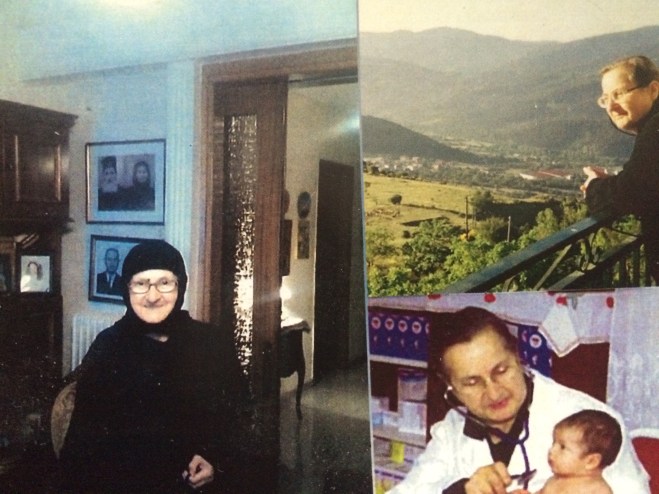
In Memoriam: Sister Aggeliki Tsaousi the Unmercenary Paediatrician (1932-2015)

 memoriam2.jpg

+ Memory Eternal!  Καλόν Παράδεισον! + Theophany 2015

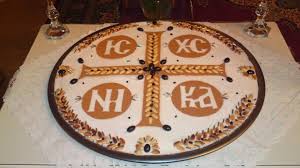
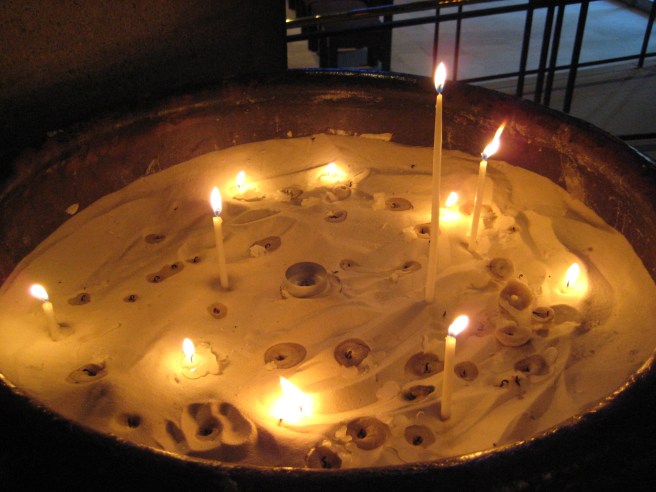
Today I have been to the Annual Greek Memorial Service for a very special person, one I consider my spiritual mother.  On the anniversary of the repose the tradition is for members of the church to pray for the reposed during Holy Liturgy, at the very centre of the temple, with  Koliva, accompany the relatives to the graveside with flowers, candles, incense, prayers and singing … and follow these prayers by a special meal with the family and friends.

memoriam5


IMG_2766

After Meeting such a Person, how can you not change? 

St. Porphyrios once told a Pediatrician: “Listen to what I have to say to you. Every time you examine a child*** you should offer a fervent prayer with love: Lord Jesus Christ have mercy on your servant.”

As he said this he took a deep breath while he opened his hands. “It is in this way that you should pray for every child. God has sent a precious soul into your hands. As you place your hands on them pray fervently within yourself that the grace of God will be transfused into the soul of the child. 

“Do all this things spiritually and in secret. The others who are present won’t understand anything. You will prescribe to them medicines which science dictates but in the final analysis Christ will heal the child.” (source)

* This is exactly how Sister Aggeliki lived and ministered the needs of her younger (and older) patients. She was a true Child of God, taking care of all of us, children of God. She was a paediatrician for “paedia” (children) from newborn to 99+ years old  😊

 memoriam4

IMG_2768-2

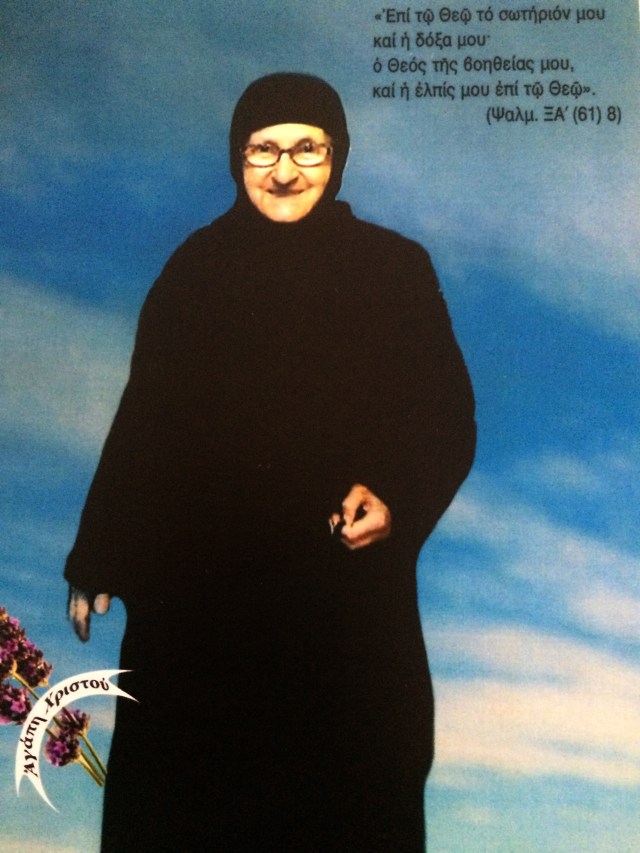
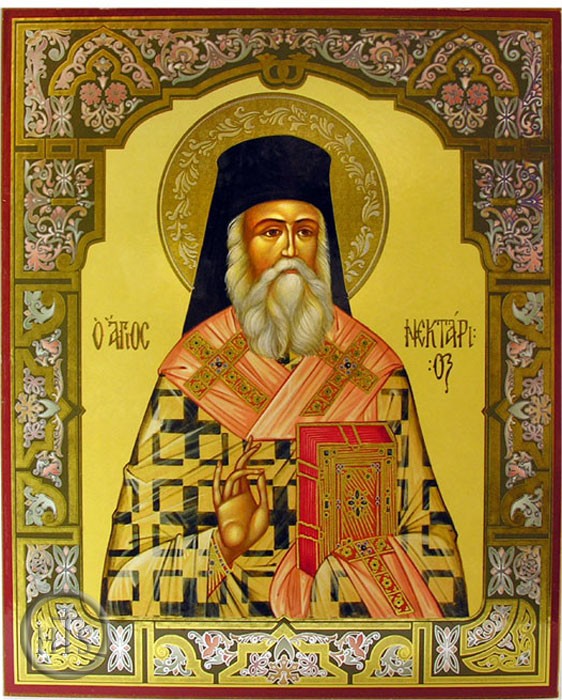
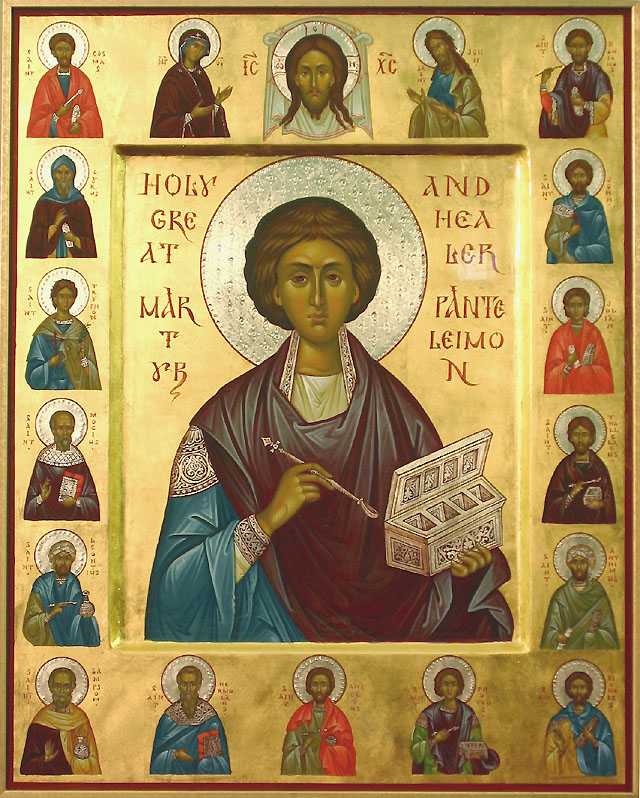
Sister Aggeliki Tsaousi slept in Christ last year amidst the Lights of Theophany, having lived a long life of poverty for Christ, of sacrifice and prayer, dedicated to the ministering of the poor, the sick, the needy, the addicted, the refugees, families in crises, all her brethren in Christ, no matter what their country of origin was and what their religion. She established a charitable organization “Love of Christ”, recruited other like-minded volunteer doctors and founded an ‘international’ humanitarian-aid non-governmental organization (NGO), a model Doctors Without Borders, before that term was even invented. The fact that the doors of her clinic remained open 24/7 and welcomed everybody drew upon her the criticism, even wrath  of some of Thessaloniki’s local society, who could  not understand why she bothered with gypsies, Muslims, drug addicts, Albanians or atheists. She often got into trouble for being no respecter of persons, but the Lord did not abandon this handmaiden who trusted in Him and lived a life of holiness and humility. She was a woman of integrity, great strength and faith, and pursued the path of the Cross, of sacrifice, with the Holy Unmercenary St. Panteleimon and St. Nektarios of Pentapolis by her side, making their presence most  powerfully  felt in her daily ministry with great miracles of healing.


After Meeting such a Person, how can you not change? 


st nektarios

St. Nektarios of Pentapolis (Sister Aggeliki’s Patron Saint)

st panteleimon

Holy Unmercenary St. Panteleimon (Sister Aggeliki’s ‘Medical Assistant’)

I have never written before in my life an obituary, especially in a language which is not my mother tongue! but I feel deeply moved to make a humble attempt for Sister Aggeliki, since I have been blessed to be on her side for more than 2 decades.

Sister Aggeliki was truly, genuinely ecumenical. She “incarnated” John Donne’s Meditation:

No man is an island,
Entire of itself,
Every man is a piece of the continent,
A part of the main.
If a clod be washed away by the sea,
Europe is the less.
As well as if a promontory were.
As well as if a manor of thy friend’s
Or of thine own were:
Any man’s death diminishes me,
Because I am involved in mankind,
And therefore never send to know for whom the bell tolls; 
It tolls for thee. 

Sister Aggeliki’s  love for God and her ‘neighbour’ was proverbial, unwavering, selfless, unconditional and boundless. She was special and she made everybody feel special and loved!  She became a legend all over Greece! A doctor who was never granted her degree, because as a University student she refused to take the oath, which was  the custom of Greek universities back in those days, since she felt it contradicted God’s law: “But I say unto you, Swear not at all …” (Matthew 5:34).

A doctor whose career collapsed before its beginning, but not her calling! A doctor who never “earned” any salary for her services, who worked as a volunteer in all major hospitals, clinics, charitable and missionary organisations, in Greece and abroad, a doctor who was eventually hired as a cleaning lady (!) but was never paid, again (!), and even her “pension” as a cleaning lady went straight to the poor, the church and various charitable organisations, as we all found out after her repose. So, how on earth did she make it? This remains still a mystery to everyone but God!

Dear Sister Aggeliki, such zeal, such a pure spirit and love for Christ! She strove so hard to remain invisible, hidden, but God’s Grace “betrayed” her … She would make it a point to frequent ‘anonymous’ chapels to hide herself from people and their praise — indeed I remember her ‘confessing’ this ‘secret’ to me — yet, everybody recognised her everywhere and sought her blessing and her prayers! She was the families’ refuge and strength, a proverbial Rock in times of distress, always present in times of need, always preferring fasts to feasts, when faced with conflicting demands in her hectic schedule.


Serving as the doctor of ‘Love for Christ’, assisting administratively nearby and far monasteries , supporting charitable/missionary organisations, ministering the needs of the poor who flocked around her, had Sister Aggeliki working from dawn to midnight each day. In the midst of her exhausting ministry she devoted careful time to her inner life of prayer, composed Christian poetry and wrote Christian plays, kept a diary in which she set down her thoughts, feelings, and prayers, and systematically recorded Patristic teachings on monasticism together with her broad experience in contemporary monasticism, encoding them in her voluminous work, her magnum opus (in the editing process; under publication) Rule of Love for Christ: A Set of (Spiritual) Articles of ‘Incorporation’ For a Woman’s Monastery.

So, let me eventually dare upon a few vignettes …

Αγγελικη.jpg

Vignette1: It all started very unexpectedly, back to the days when my son was a toddler, and undergoing from one medical complication to another, being sent from one hospital to another, with doctors at their wits’ ends, experimenting on all sorts of medication on him, without being able to diagnose, let alone treat, his health problem, whatever that was. In despair, always in search for a paediatrician who could assist us in our impasse and bring our woes to an end, God took care of us and I was given her telephone number, I cannot recall by whom …

I remember our first telephone call in full detail. I was very upset and frustrated and all she did was calmly ask a couple of questions to understand what the problem was and then she paused! I thought the line was broken, but she was still there on the other side; she told me she had to pray so that she would not pile error upon error on this chain of medical misjudgments to avoid further jeopardising my son’s health. So, I waited and … waited in silence … Finally, she told me in full detail what we had to do, until she would examine our son, which she promptly did, once she was available, and then treated him for just one week, and do I need to add that she was correct 100% in her “diagnosis” and that this was the end to my son’s  health problems?

You would not want to let such a paediatrician disappear from your life, would you? The fact that you would not have to  pay anything for such treatment, or  travel all the way  to hospitals or wait long hours in queues outside surgeries, was the least for such a Godsend present. Even the fact that she never erred, even in the most difficult cases, never! , was a “minor” detail to what just a single visit to this amazing woman offered you. Really, could it be that people like her truly existed? Indeed, she was in “possession” of something which none or very few other paediatricians or doctors, or indeed anybody, could offer, and that was nothing less than a  glimpse to another world, a beautiful world full of Serenity, Love, Compassion, Light, Peace, Hope and true Healing.

memoriam1

She was such a magnet and we soon got stuck to her, like practically anybody else who got to know her better. One could not help but be drawn into her strong, warm, calm, prayerful, charismatic circle of grace- and be changed! Gradually we even began to fathom the depths of her life and ministry  if that could ever be possible ! Because you have to somehow be spiritually similar  to such a person to be able to understand or describe her by any means. And we most surely were not. But we were blessed to be next door neighbours (😊), so we would regularly visit her at her home-clinic, and spend hours and days talking, praying, helping, planning … Yes, planning! Because during these intimate visits, we eventually became attracted to her vision and started ourselves volunteering to help other people

All these long days of ministry, of driving her to homes in need, of visiting terminal patients, orphans, of children summer camps and soup kitchens, of concerts and plays, of sharing the holiness of fellowship in Christ and bringing the Church to the Laity of God, to give you just a few examples, would not only not tire us, but on the contrary would help us forget or deal better with “our” problems, would most deeply refresh us. She had such a fine sense of humour and was always so cheerful! So many memories, dear Sister Aggeliki, a true Angel, Messenger of God, so many words of yours still echoing in my ears, so many pieces of invaluable spiritual advice. May you remember us in your prayers now that you are face to face to God and behold His Glory in the company of His Saints.

After Meeting such a Person [Προς-Ωπο, Prosopon (/ˈprɒsɵpɒn/[1] or /prɵˈspən/;[2] from Ancient Greekπρόσωπον, πρός ‎(próstowards) + ὤψ ‎(ṓpseye), most often translated as “person”, and as such is sometimes confused in translation with hypostasis, which is also translated as “person.”, but  pros-opon originally meant a Person whose eyes are directed Up-wards, to Heaven — Sister Aggeliki’s eyes were most certainly directed Up-wards!

Vignette2: Preparations for a feast for the children’s summer camp were under way and a volunteer got very tired, lost its temper, started shouting at Sister Aggeliki and insulting her, and eventually slammed the door in her face! As if all this exhaustion had triggered an explosion of deep-rooted rivalry, jealousy, pride and resentment! She wanted so desperately to be in charge and lead! And what did most patient Sister Aggeliki do? Did she lose her temper? She was older, exhausted after all and suffering from cancer too. No, she just took a deep breath and started praying spiritually and in secret. I was stupefied !! What was that woman thinking?! Just the age, frailty and the habit that Sister Aggeliki was wearing should be more than enough to teach her to behave herself and show more respect! I rushed downstairs to try to appease her (to no avail), as she was still shouting at the top of her voice that she was right and that Sister Aggeliki was to blame for all this!  So what did Sister Aggeliki decide to do? Magnanimous Sister Aggeliki, generous in forgiving an insult or injury, free from petty resentfulness or vindictiveness. She “punished” herself just like St. Nektarios, who rather than punish two students of his, when they misbehaved, when he served as the headmaster of the Rizarion Ecclesiastical School,  he ‘punished’ himself and started fasting (ie. eating nothing!) and praying for their sake. Likewise, Sister Aggeliki repented, fasted, prayed and refrained from Holy Communion that Sunday until she confessed to her spiritual father and asked for forgiveness for a wrong she had not committed! Needless to add, she forgave that woman wholly and unconditionally that very moment and never entertaining any bad thought (logismos).  Sister Aggeliki would always, very humbly, like her patron Saint, Saint Nektarios, endure injustice  slanders and meekly face temptations

Vignette 3: She was on her deathbed, facing terminal cancer, and stifling her moans with Hymns and Martyrs’ Apolytikia. To her very last day, she examined sick children and ministered people’s needs. Just to remember her hoarse from pain voice singing a hymn a day before her end reduces me to tears. 

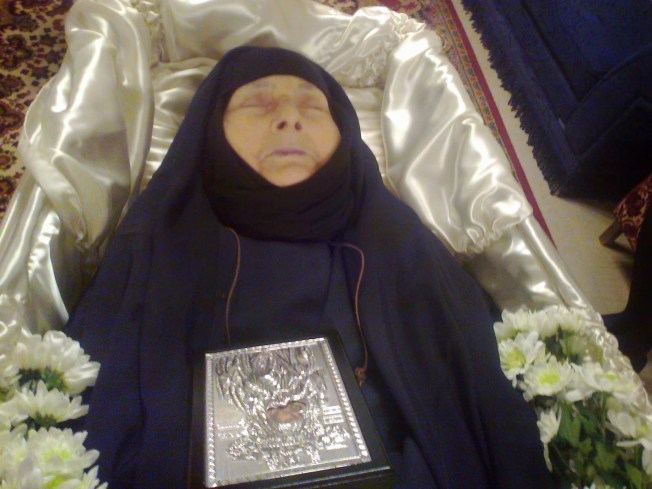
Vignette 4: The minute her pure soul flew to her Maker, Sister Aggeliki’s face glowed; she raised her hand with her prayer rope, and blessed everybody at her side, leaving this world with ineffable Joy!

After Meeting such a Person, how can you not change? 

–– Geronda [ie. Saint Paisios], the final diagnosis has been made. Your tumor is cancerous and it’s aggressive. 

–– Bring me a handkerchief so that I may dance to the song: “I bid farewell to you, O poor world!” I have never danced in my life, but now I will dance for joy as my death approaches. [Dialogue With Elder Paisios as He Faces Death at http://orthodoxwayoflife.blogspot.gr/2014/10/ dialogue-with-elder-paisios-as-he-faces.html

And so, she danced her way to Heaven! Sister Aggeliki had always wanted to become a nun; she fasted and prayed like a nun; she owned nothing, gave away everything, and wore a habit all her life, but she stayed in the desert of the cities instead, because she sacrificed her “calling” in order  to take care of her blind sister, who was suffering from a very serious mental disorder and was dangerous to herself, her environment and Sister Aggeliki of course. Humbly she would confess that this cross was for the expiation of her sins! She did not want to commit het to a mental institution, because this sister was simultaneously a fool for Christ, and wanted to spend endless hours in Church and in prayer. Sister Aggeliki knew that she could not lead  such a church life in a mental hospital, where they would ‘sedate’ her with heavy medication, so she ‘waited’ by her side for 50+ years and would walk her to church whenever there was a service. Sister Aggeliki received tonsure only a few months before her death, when her sister had died. And yet, how moving it was today to hear her commemorated in Church as a “Sister”, because if there was any woman who deserved to be thus commemorated as a nun, if not on Earth, then surely in Heaven, this was most certainly her!

IMG_2771


Today, during the Memorial Service, it suddenly occurred to me that rather than praying for her, we ought to pray to her, and ask her blessing from “above”!

https://www.youtube.com/watch?v=4ZRrbixpVV0

Why these bitter words of the dying, o brethren,
which they utter as they go hence?
I am parted from my brethren.
All my friends do I abandon and go hence.
But whither I go, that understand I not,
neither what shall become of me yonder;
only God who hath summoned me knoweth.
But make commemoration of me with the song:
Alleluia! Alleluia! Alleluia!

But whither now go the souls?
How dwell they now together there?
This mystery have i desired to learn; but none can impart aright.
Do they call to mind their own people, as we do them?
Or have they forgotten all those who mourn them and make the song:
Alleluia! Alleluia! Alleluia!

We go forth on the path eternal, and as condemned,
with downcast faces, present ourselves before the only God eternal.
Where then is comeliness? Where then is wealth?
Where then is the glory of this world?
There shall none of these things aid us, but only to say oft the psalm:
Alleluia! Alleluia! Alleluia!

If thou hast shown mercy unto man, o man,
that same mercy shall be shown thee there;
and if on an orphan thou hast shown compassion,
the same shall there deliver thee from want.
If in this life the naked thou hast clothed,
the same shall give thee shelter there, and sing the psalm:
Alleluia! Alleluia! Alleluia!

Youth and the beauty of the body fade at the hour of death,
and the tongue then burneth fiercely, and the parched throat is inflamed.
The beauty of the eyes is quenched then, the comeliness of the face all altered,
the shapeliness of the neck destroyed; and the other parts have become numb,
nor often say: Alleluia! Alleluia! Alleluia!

With ecstasy are we inflamed if we but hear that there is light eternal yonder;
that there is Paradise, wherein every soul of Righteous Ones rejoiceth.
Let us all, also, enter into Christ, that we may cry aloud thus unto God:
Alleluia! Alleluia! Alleluia!