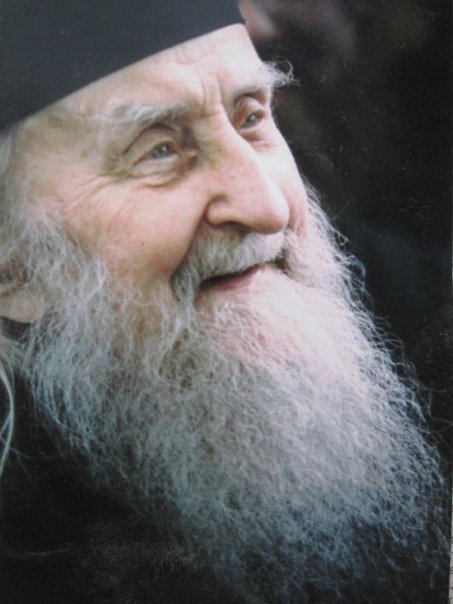
A Servant of the Holy Mystery of Confession

 Father Symeon : A Servant of the Holy Mystery of Confession

Father Symeon : A Servant of the Holy Mystery of Confession

In confession, as in the whole of his everyday behaviour, Fr. Symeon was all love. Love overflowed from within him. He radiated love, not with words, nor with actions, but with his mere gaze, his smile, with a single word. He was formal, but not a slave to formalities. I remember one incident in particular. He’d given me the number of his personal telephone, the one in his room. I would usually phone him between 11-12 in the evening, which was the best time for him because, as he explained: ‘Now it’s the afternoon for me’.

We’d speak without restraints of time, but he would still be up in the morning for his rule. One evening, around midnight, the son of a friend of mine, a spiritual son of Fr. Symeon’s, who was studying abroad, telephoned me. He was very upset and asked for help with a really important problem which needed to be resolved immediately. I was in no position to advise him. Only the Elder could do so, but how? At that time of night nobody would have answered a telephone call to the monastery. I hesitated to give his confidential telephone number, because he’d told me not to give it to anyone at all. The case was such, however, that I decided that I’d just have to go against his instructions. So I gave it. And the boy was saved. The father saved his son.  The next day I asked forgiveness for the infraction, but he told me not to worry and that I’d done the right thing.

That was Father Symeon. A discerning, consoling and enlightened advisor to whom we had recourse and to whom we referred people with difficulties, so they could find refuge.

*

In his sermons, in his discussions, in confession, Fr. Symeon didn’t avoid taking a position on burning questions which others didn’t dare to touch on so as not to come into conflict with the prevailing, unhealthy atmosphere. Let me explain. There was at one time much ado generated over 666 and this was an issue that threw people into turmoil. Father Symeon did not leave his spiritual children in the dark over this. He clarified the issue in a series of talks, reassuring those who were worried. He did the same for bar codes and other similar issue which aggravated ill-informed believers. In general, he dealt with important ecclesiastical and theological issues with clear thinking, theological depth and knowledge of the Patristic tradition. And all of this with sobriety, without any spirit of contention.  If ever I wanted a second opinion on my own articles on Church matters, I would submit them to him and he would always make useful observations. For example, if I used acerbic language, he would suggest I tone it down.

In general, his discourse was prophetic. He did not ignore dogma, he was never restricted to dry moralizing, he used neither clichés nor soaring rhetoric. Well-grounded, comprehensible, he spoke in the name of God, telling the truth, castigating lies and thus bringing the faithful to his way of thinking. Listening to him, you felt that you were listening to the word of God, that his discourse was official, authentic and valid. He didn’t impose himself through human coercion, but spoke rather ‘in the Holy Spirit’. Without prevarication, he went straight to the heart of the matter and didn’t mince his words in order to please people. He told the truth of the Church, without pulling any punches, however hard this seemed to many people. He was a prophet in the Biblical sense, shaking people up to get them to cast off the fripperies with which their egotism had burdened them, so that they could see naked reality clearly.

*

Pain is a shortcut to salvation

Father Symeon : A Servant of the Holy Mystery of Confession

It says in the Gerondikon: “In the morning you may be in hell and in the evening you can be in paradise”. What is meant is that in the morning man may have committed sins, but, as in the course of the day he came to his senses, showed reverence, repented and wept for his sins. As the sun sets, it is no big deal for God to place him in paradise. Things are easy and the road to salvation is short. We, by having the wrong attitude, make things hard and the road to salvation “un-short”.

Whatever your condition is, if you repent, God welcomes you and you are saved. All you need is to repent truly.

You may repent for something you have done, but you repent because your egoism has been hurt. You go to confession, for the one and only reason that your egoism has been wounded. Not because you have sinned in the eyes of God. You had a good impression of yourself. As you have sinned though, you can no longer have it. And that makes you suffer. This is not repentance, though.

*

(To be continued)

For Fr. Symeon Kragiopoulos: The Portrait of a Spiritual Father – IIThe ‘Silent’ Assemblies of Father Symeon Kragiopoulos, (his famous silent sessions of the Jesus prayer), go here

For Fr. Symeon Kragiopoulos: The Portrait of a Spiritual Father – I, The Theologian and the ‘Liturgical’ Being (his famous church services and vigils), go here

His ‘Silent’ Assemblies

Father Symeon Kragiopoulos, the Jesus Prayer and his ‘Silent’ Assemblies

As well as the liturgy and other services, Fr. Symeon also held ‘silent’ assemblies. No-one spoke. Or rather, no-one heard because everybody was speaking mystically to God, using a prayer-rope and saying the Jesus Prayer: ‘Lord Jesus Christ, Son of God, have mercy upon me’. The church of Saint Athanasios was completely full. Everyone seated, heads bowed, holding a prayer-rope and seeking God’s mercy. These assemblies also lasted an hour. [Ed. In this, Elder Sophrony’s influence, fruit of Elder Symeon’s frequent visits to Essex Monastery and meetings with its abbot, cannot be exaggerated.]

Fr. Symeon laid great stress on sermons. He considered it as importance as a service, as indeed it is. The Word of God must first be received through the hearing, as the proclamation of the Gospel, so that people will believe and then receive Him as Holy Communion. The Elder spoke not only at the liturgy but on many other occasions as well. His discourse was always original. I asked him once: ‘How do you manage it? You’ve spoken for so many years and yet you don’t repeat yourself’. He laughed and I don’t remember his reply, but Fr. Symeon certainly spoke from his overflowing heart. His heart must have been overflowing, because he wouldn’t otherwise have been able to say new things all the time or he’d have addressed the brain rather than the heart. The Elder’s heart was always filled to overflowing because he nourished it continually with study, prayer and spiritual experiences. He told me once that, in confession, he heard problems that bothered a lot of people, but he didn’t have time to go into them in detail with each person. He spoke about them in his sermons. In the end, however, he always left the final word with God. ‘Let’s see what God will enlighten us to say today’, careful always that what he said was not his own words, but those of God.

Fr. Symeon’s sermons weren’t oratory. There were no well-turned phrases, rhetorical figures, great eloquence or any of the things that people admire in a fine speaker. His manner was simple, though he could be intense when the subject moved him to be. Fr. Symeon loved preaching. He went to great effort to get across to his audience not ideas but his very soul. A profound anatomist of the human soul, he analyzed issues clearly, as if he were holding a scalpel, cutting to the bone. He helped his listeners to understand the depths of their soul and brought them from there to repentance. Under his stole, they felt the love of God. And these souls multiplied when, on the initiative of the nuns of the monastery of The Birth of the Mother of God, in collaboration with other spiritual children of Fr. Symeon’s, his sermons began to be circulated more widely, first as recordings and then as a long series of volumes.

After services and preaching, the third main thrust of Fr. Symeon’s work was confession. What started with a few, later became a great number. How many days, and how many hours a day, do you need to confess a thousand, a thousand five hundred people? Where would they even have room to wait? The Elder found a solution. He gave out numbers.  He reckoned on seeing fifty a day. So, depending on the number they were given, each person knew which day, and roughly what time, the Elder would see them. Fr Symeon, closed all day within the confessional, would forget to eat, listening to the pain and shouldering the burden of the penitents. He gave remission, advice, directions, courage for the struggle and strength so that people could, by God’s grace, kill off their old self, so that new person could arise, walking in ‘the newness of life’.

In confession, he wasn’t a harsh judge. Nor was he a chastiser or punisher. You weren’t afraid, you didn’t despair. You felt he put himself in your position and understood you completely, was deeply empathetic and suffered with you. He was the doctor who cured you, the father who loved you, the friend who accompanied you. Confession wasn’t depressing, formal or legalistic. It happened once that we were together at a conference for confessors in the Monastery of the Comforter in Attica. Most of the time he listened without speaking. One spiritual guide asked him: ‘How is it, Father Symeon, that you have such success at confession?’. ‘I try to make sure’, he replied, ‘to be as low as possible, so that, however low people fall, I’ll be even lower and I’ll be there to catch them’. Wise words which embrace the whole meaning, the whole practice of the sacrament.

*

The Myrrhbearing Women approach the Lord with the logic of the heart

Father Symeon Kragiopoulos, the Jesus Prayer and his ‘Silent’ Assemblies

The Myrrhbearing women, despite knowing they were unable to roll the stone from the tomb, they decided to.  And as a result of this, they were first both to see and to learn of the Resurrection of the Lord. Moved by love (the logic of the heart, as Pascal says) they desired with great boldness to go again to the tomb, to anoint Christ’s lifeless body with myrrh. And just like that, they neither thought of what would happen next, nor whether they’d be able to enter or not. Along the way, they said only this: “Who will roll away the stone for us?” Despite all this, they did not stop, nor did they turn back, but instead kept going. This wealth of the emotional world, the all-consuming love belonging to the female nature, is a good characteristic. However, one must not rely on this alone.

It is not enough for the inside of an automobile to have only the steering wheel: what is needed is the driving force. It is necessary, therefore, for man to reach that point where the world of his heart, that sentimental treasure, becomes one with his nous. And this, as the Fathers say, is something achieved by the Jesus prayer.With the Jesus prayer, the nous descends into the heart and man’s powers are made one (just as sin has brought the division of his powers). For this reason, a saint moves simply, as he has only a conscious mind –not a subconscious nor an unconscious.

Therefore, the Myrrhbearing Women were animated by a simple, humble method. Putting their nous in their hearts –burning with the love of God– they succeeded in approaching the Risen Christ, and naturally were made holy.

*

Neptic ‘Psychotherapy’

The three levels of the soul

Father Symeon Kragiopoulos, the Jesus Prayer and his ‘Silent’ Assemblies

Conscious, subconscious, unconscious

The three levels of the soulAccording to what the expert scientists, the psychologists, say, our soul is divided into three levels. It is somewhat like an edifice which is filled with much unknown material.

The topmost part of the mind is the conscious, namely the part with which we understand ourselves.  This is where we become aware of our thoughts, our feelings, our entire disposition, and where we control and know these things. Beneath this level is the subconscious. The content of our subconscious is unknown. However, on occasion, because it is close to the conscious mind, it allows us to sense what it might contain.  Now and then, something springs from the subconscious and enters our conscious mind.

Even lower, in the deepest regions, or what we might call the basement of our soul, is the unconscious. The content of the unconscious is terra incognita, unknown land, and it is entirely unknowable to us. And so it is there, deep within us, that exist our personal experiences, our personal conditions. However, because these exist in the unconscious –in this dark basement- we neither know what exactly exists there nor can we control this content. According to the language of psychology, these experiences are repressed emotions and impulses that are pushed into the depths of the unconscious mind. According to the psychologists, this content of the unconscious gains autonomy and does whatever it wants. It doesn’t consider, nor does it ask, us.

That this is autonomic, all of us know. The moment you want to do the right thing, another power comes over you and forces you to do something else, something you don’t want to do, but which you do anyway.

Certainly these things were known to the fathers of the Church, and in particular the neptic fathers. For this reason, they preferred first that they themselves  –and later also advised others to –stay in the silence of the desert, and say the Jesus prayer (noetic prayer), trying to plummet the deepest depths of their souls, and in this way to start to know the content of the subconscious, and the unconscious,  in order to control it, and not allow it be autonomic and to do whatever it desired.

Because of this, a saint does not have a conscious, a subconscious, and an unconscious. The whole content of his soul is conscious. The saint controls it, and is not at the beck and call of repressed emotions and impulses.

We will see how man can become simple, and not be led blindly by the content which exists in the basement of his soul.

Holy Hesychasterion “The Nativity of Theotokos” Publications.

Archimandrite Symeon Kragiopoulos

For The Portrait of a Spiritual Father – I, The Theologian and the ‘Liturgical’ Being (his famous church services and vigils), go to here

 (To be continued)

A Man of God

The Portrait of a Spiritual Father

A Man of God, Father Symeon Kragiopoulos, The Theologian and the 'Liturgical' Being

In Memoriam

+ Father Symeon Kragiopoulos

“It is with some trepidation that I set pen to paper to record -what? What can one write about a personality whose holiness and spiritual wisdom stretched over many decades, who was shepherd to thousands of souls, saving them from destruction and bringing them into ‘a place of verdure’? About the comforter, the advisor, the father, the refuge of every soul in pain and every confused thought? About the last person who walked and strove in the ascetic life with the holy fathers whom God was pleased to give our generation, those who died to live, because, in living they were dead to the world. ‘so that the world may live’ through Christ, to Whom he brought it through his way of life, his teaching and his prayers? What can one say about a man who rivalled Saint Païsios in his humility, Saint Porfyrios in his discernment, Father Sophrony in his wisdom and Elder Iakovos in his love?

Considering all the above, when I was asked by the spiritual children and heirs to the holy legacy of Elder Symeon to write something In Memoriam, I initially declined for fear that I would not be able to paint a proper picture of him in words, that I would diminish his spiritual stature by not being able to render, even faintly, what the late father really was. What only made me agree to write was the fact that I’d known him for almost half a century and that our relationship was not merely one of spiritual fatherhood, but also one of close friendship. So, with the proviso that I will mention only my personal experiences,  let me begin. (*)

A Man of God

In September of 1969, I’d just taken up a position at the University of Thessaloniki. I visited the Pournaras bookshop, which was at that time not merely a place for selling books but somewhere where colleagues could meet. It was a reference point, you might say. Browsing through the new books spread out on the counter, I heard someone ask Panayiotis Pournaras. ‘I’ve heard that there’s a new professor at the university. A Mister Galitis. Do you know him?’ I turned and saw a pleasant-looking figure, a priest with a red beard, a tranquil look about him, kindly eyes and a bright smile, just at the moment when Panayiotis was pointing to me, ready to make introductions. We chatted for a while and I was impressed by his interest in the new books and also by how well he was up in theological matters. He was following the current theological situation, which was hardly common among priests dedicated to their pastoral work.

I saw Fr. Symeon shortly afterwards at the headquarters of the Metropolis. He’d been appointed a member of the Supervisory Committee of the Seminary, where he’d been Director. The Chairman of the Supervisory Committee, a highly placed cleric, with all the exuberance he could command behaved towards Fr. Symeon with excessive familiarity, with his teasing and slightly ironic and disdainful manner, which made me, at least, feel awkward.  But Fr. Symeon was undisturbed and behaved like an ‘altar-boy’. He made an obeisance and remained silent. My discomfort then became admiration for the wonder of humility.

The Theologian and the ‘Liturgical’ Being

Fr. Symeon’s office in Saint Theodora’s was in the right wing, on the first floor. He asked me to visit him there, which I often did, most gladly. He came to my office, too, but not so often because he couldn’t leave the School much. I recall with nostalgia our long discussions on spiritual, theological and ecclesiastical matters. He was a profound anatomist of the soul and, at the same time, an erudite theologian with rare learning, which he was always trying to increase. He discussed well, had a clear mind, breadth of spirit and a particular sharpness. He would grasp a subject quickly and was comfortable even talking about secular education.

Later, he began vigils at Saint Theodora’s. At one of these he had the joy of tonsuring one of his spiritual children. Fr. Symeon was the person who introduced this new form of vigil, which did not last all night, but covered two or three hours before midnight, and about an hour after, with a half-hour homily. In this way, people who were working and couldn’t get to a liturgy in the morning and for whom an all-night vigil would have been too much had the chance to participate in liturgical life. This practice found many admirers and is now popular in many parts of Greece and abroad.

Every liturgy Fr. Symeon served was a real and literal initiation into the sacrament. It was solemn, neither drawn out nor hurried, without highlights, but not monotonous. At first, he didn’t have chanters. Anybody who could would do their bit. Even I chanted on occasion. These first impromptu chanters usually sang poorly and this created the impression that Fr. Symeon actually wanted this: low profile, no special effects. This would encourage contrition. A friend of mine told me off once when I departed from this ‘rule’.  But soon proper chanters began to appear and the cultivation of music became part of the whole training the people acquired by being close to the blessed Elder.

*

At church … twice as healed

At church, man is freed from the demonic influence

and the traps the devil sets.

At church, man is healed.

These are not just words. It’s the truth.

The sacrament of the Anointing of the Sick

is for the healing of our illnesses.

If we are not healed,

we don’t need to be healed,

that’s why we aren’t.

If you take it this way, you are already healed.

You know very well that an illness which lingers

and doesn’t go is precious.

Whatever needs to go, God will take away.

Whatever doesn’t need to stay, God will take away

be it an illness or demonic influence.

And for whatever stays on and hurts us

we pray to God.

We should pray many a time,

time and again should we beg,

not only for deliverance from soul illnesses

and the demonic influence

but also for deliverance from body illnesses, as well.

Let us pray to God for everything time and again.

Not because God needs us to pray to him again and again.

We need to do this again and again,

because, precisely, God wants to see our faith.

Man, especially today,

gets used to something by repeating it,

learns something by reapeating it.

If you pray time and again

–you need to do this–

and God doesn’t relieve you of your illness, know that:

either you have not shown

as much faith as He wants and expects from you,

or that the illness should not go

because it is necessary.

If you take your illness issue according to God,

then, by it remaining,

you feel twice healed.

If He heals you, you are healed once.

If the illness lingers,

you feel healed twice.

Because both when time comes

 will you be healed from your illness

and until the right time comes to be healed

will your soul be healed, too.

Your inner person will be healed,

this person who suffers from illness,

from the leprosis of sin.

The same goes for all mental illness

and whatever else hurts us.

If man sees all his issues

within the providence of God,

he will feel such a relief,

as if all his problems are solved.

Because in God

all is resolved!

Holy Hesychasterion “The Nativity of Theotokos” Publications.

Archimandrite Symeon Kragiopoulos


 (*) This tribute was written by Professor Georgios Ant. Galitis and offered to the faithful in the Holy Trinity Monastery, Panorama, at the end of the 6 months Memorial Service for Fr. Symeon. The poetry/homilies excerpts are from orthodox path.org

(To be continued)


Christians of Comfort


fr-symeon1

Annual Memorial Service of Father Symeon Kragiopoulos

Last month in Greece, I had the blessing to attend Church services at both the women’s Monastery of the Nativity of the Theotokos  and at its twin ‘brother’, the men’s Monastery of the Holy Trinity, at Panorama, the suburbs of my hometown, Thessaloniki.  Elder Symeon Kragiopoulos was their spiritual father and abbot. He  passed away last year, at 6:00 a.m. on September 30, 2015, but even after a year, his presence is still felt everywhere in both monasteries.

He was known throughout as a true elder and teacher. I would like to acknowledge here his zeal, patience, kindness and loving example. He has been in so many ways a spiritual signpost of the faith for my own journey through the desert. What an authentic, uncompromising, and yet gentle, loving, kind, compassionate contemporary Elder, what a  heaven-endowed, grace-filled rock of Faith and consolation, a true voice in the wilderness in our times of apostasy! Oh I have been so blessed to hear him preach in my youth, probe into the Niptic Fathers and the Bible, and have attended for years his church services, especially ‘his’ vigils, and his famous silent assemblies, dedicated to the Jesus Prayer, when I was not studying or working abroad.  I even had the blessing to spend invaluable, private time with him as a spiritual father, helping me prepare for my postgraduate studies, work and life at the U.S.A.

In recent years he largely kept silence due to his failing health but he was known throughout as a God-bearing elder and teacher of the true faith. Throughout his life-long ministry, culminating in the prayerful silence of his final, ‘hermit’ years, Elder Symeon has been a rare gift of God, especially for us Thessalonians. In so many respects, Thessaloniki will never be the same after his humble, God-fearing ministry, and we can never thank enough God for the blessing of walking along the Way with such a venerable Elder by our side. His tomb is already a pilgrimage site, and his spiritual children kneel and pray there for hours for his guidance, fully aware that now he is closer to us in the Holy Spirit. Whenever I read his books, or listen to his recorded homilies, the joy and jubilation of Resurrection warms my heart and tears are streaming from my eyes, for the Venerable Elder who was our staff, for the Man of God whom we knew and loved and in whom we placed, after God, so many of  our hopes. We felt so loved and so safe in his presence!

The elder leaves behind many soul-profiting words, and the faithful invariably testify to a presence in Holy Spirit of the Elder, even while ‘simply’ reading or listening to his homilies:

Like the deep sea…

Spiritual work happens secretly in the heart. Externally, let everything else threaten us, like the sea: the wind blows, waves rise. But deep down it’s all quiet, peaceful, serene.

This is how a man who trusts in God lives. There might be a wild rage out there, but deep down nothing hinders the soul from having mystical communion with God, mystical love for God. Quietly and mystically, in a special way that the heart perceives, the Lord is whispering: “Don’t be afraid. I am here. Keep walking this path. Keep loving Me, keep believing in Me, keep following Me.”

It’s not enough to suffer myriad things in life. When, though, you believe in God and accept all these—whatever it is that happens to you—accept all these gladly, for the love of God, God will make a saint out of you.

Man will find all, but after he has lost all, after he has deprived himself of all. It matters greatly for a man to deprive himself of the most beautiful, the best, the most innocent, the purest things, which the Lord Himself has deprived himself of.

It matters greatly for man to deprive himself of things because he loves God.


We run to the Lord with pain 

However, we know that we have a Saviour, we know that Christ came to earth. Then we start to understand what it means that he came to save us, and we run to the Saviour. We run to the Lord with pain, with prayer, with a cry, with faith, with hope and a firm conviction that the Lord will accept us and will save us. The Lord wants us to approach things exactly like this. This is not our own daring or our own boldness. He wants us to act just like that, to entrust ourselves in this way, and for this reason he gave us promises. So someone does this work, and little by little the decay of his soul, that lies in the subconscious and the unconscious, emerges.

* * *

Self-worship lives and reigns …

For us to have right communion with Christ, it is necessary that our entire soul becomes conscious, that it comes into the light, into the grace of God, and that nothing remains in darkness. However, no matter how much someone believes, no matter how much he, every day, makes a new start in the true life and struggles to give himself and devote himself to God, he must realize this vital point: that within him, the ego, pride, and selfishness, live and rule. This self-love, this self-worship, lives and reigns. Therefore, man must become humble: every day, he must increase in humility. We have many things, many realities from our everyday life that help us with this work.

He who truly loves humility, and desires to become humble, begs God for this. In this way, in the beginning, and imperceptibly –later perhaps more truly—he starts, little by little, to feel this, the emptying of the soul from the ego, from selfishness, from the idol which we have installed within us. And so if one is completely humbled, he surrenders himself to God and is devoted to him—meaning that every day he makes a new beginning, from which the whole object of his soul will finally come into the light of God—in truth, man will arrive at this state which the Lord promises to us.

           But what is this state?

The Lord didn’t come simply to die Himself. Rather, He said that we will also die with Him. And in the same way that He Himself resurrected, we will also be resurrected. Whatever Christ is after the resurrection, this man also becomes when he is united to Christ. He is not simply a good man who thought up some good things. Christian means little Christ. In the end, Christ will make each one of us whatever He is himself. He does not simply advise us from the outside, but enters into us and takes us into Himself. We are united and become like unto Him. Even from this life we become like unto Christ, but this will become complete in the next life.

I pray this for all of us.


Christians of comfort

We are Christians of comfort. That’s why the Lord will let us struggle a lot.

Don’t expect salvation with certainty, unless all comforts are abolished in you.

Our whole Christian mentality functions wrongly.  On the one hand, we want to avoid suffering. On the other, we take great care not to lose or deprive ourselves of anything. And we “walk” in the wrong manner.

In the long run, whether we like it or not, we will have suffering. And indeed, when we have a fake impression that we are enjoying the goods of this world, our life is often like hell.

***

These words, and many more can be found here.


Memory Eternal, dearest pappouli! May we meet you in Heaven!

*  *  *

In the following days, I am going to present a tribute to Father Symeon, together with excerpts from his homilies and a few recordings, for those of you who are hearing about this venerable elder here for the first time. Even if the recordings are in Greek, I trust the spirit of this man of God can be felt through and richly bless us all.


Anastasios Yannoulatos: Modern-Day Apostle

Indifference to mission is a denial of Orthodoxy


anastasios-yannoulatos-modern-day-apostle


Anastasios Yannoulatos: Modern-Day Apostle. An amazing person  my family has been honoured to collaborate with in his missionary endeavours. An apostle of peace and reconciliation, since meeting him in 1997, he is one of my greatest role models.

For the first half of the twentieth century, the Orthodox Church was relatively inactive in missions. The great missionary efforts of the Russian church came to a close as the Communist curtain placed the church in bondage. Meanwhile, the Orthodox churches of the Balkans struggled to overcome the effects of the previous five centuries of Muslim subjugation. Although the Orthodox lands of Greece, Romania, Bulgaria, and Serbia gained their independence, a strong sense of nationalism prevailed within the churches, and the idea of outreach beyond the borders of their own countries was a concept to which few gave much thought.


“Inertia in the field of mission means, in the last analysis, a negation of Orthodoxy, a backslide into the practical heresy of localism”

It was not until the late 1950s that a number of young Orthodox theologians began to raise their voices about the need for external missions. From an international Orthodox youth conference held in 1958 in Athens, a call toward missions began to develop. These young people expressed the idea that the church’s responsibility toward missions was not simply some­ thing of the past but a call for the contemporary church as well. Despite the struggling situation of a poor church just freed from bondage, the apostolic call of the Lord demanded a response. The leader of this fledgling group was Anastasios Yannoulatos, a young Orthodox theologian from Greece. He challenged the Church of Greece, as well as the Orthodox Church at large, to recover its long-held missionary tradition.


In 1959 Yannoulatos helped found Porefthentes (“Go ye”), a missionary movement whose goal was to rekindle the mission­ary conscience of the Orthodox Church, as well as to educate the non-Orthodox world about the rich missionary heritage of the Church of Greece, as well as the Orthodox Church at large, to recover its long­ held missionary tradition.


Yannoulatos challenged the Church of Greece, as well as the Orthodox Church at large, to recover its long-held missionary tradition.


Yannoulatos challenged the Eastern Church. This movement began to produce a journal in Greek and English called Porefthentes. In its inaugural issue, Yannoulatos wrote a provocative article entitled “The Forgotten Commandment,” which challenged the church to rediscover the missionary zeal of previous generations. In this article, Yannoulatos questioned the accepted apathy toward missions that prevailed in the contemporary Orthodox Church:


“It is not a question of ‘can we?’ but of an imperative command “we must.” “Go ye therefore and teach all nations.” “Go ye into all the world and preach the Gospel to every creature.” There is no “consider if you can,” there is only a definite, clear cut command of Our Lord…. If we let ourselves rest peacefully in this habitual inertia in the matter of foreign missions, we are not simply keeping the pure light of the Faith “under the bushel,” but we are betraying one of the basic elements of our Orthodox tradition. For missionary work has always been a tradition within the Orthodox Church…. Missionary activity is not simply something “useful” or just “nice,” but something imperative, a foremost duty, if we really want to be consequent to our Orthodox Faith.”


As Christians we do believe in miracles.


Yannoulatos emerged as a leading missions advocate in the following years. He dared the Orthodox faithful to recover the authentic meaning of the “one holy catholic and apostolic Church,” in the words of the Nicene Creed. He even hoped to establish some type of external Orthodox mission center. His enthusiasm, however, was derided within most Orthodox circles as an unrealistic goal. Following an address he gave on this issue to theological students at the University of Athens in January 1959, someone in the audience remarked skeptically that “the organization of an Orthodox External Mission is tantamount to a miracle.” To this Yannoulatos responded, “We fully agree. But as Christians we do believe in miracles.”


Mission was not the duty of only the first generation of Christians. It is the duty of Christians of all ages … It is an essential expression of the Orthodox ethos.


The life and work of Anastasios Yannoulatos, probably the foremost Orthodox missiologist in the world today, exemplifies the realization of this miracle in the contemporary Orthodox Church.


His Early Life


Anastasios Yannoulatos was born on November 4, 1929, to a pious Orthodox family in Greece. Raised within the faith, he participated actively in the church during his formative years. His first great interest was in mathematics, and throughout his teenage years Yannoulatos thought of pursuing a career in this field. His views changed with the coming of World War II. During the war years, Yannoulatos began to experience his faith in a very personal way. He witnessed much suffering and disas­ter from the war and could make sense of the chaos only by delving deeper into his faith. For the world and for his own country to recover from the evil of both the Second World War and the ensuing Greek Civil War, Yannoulatos understood the urgent need for a message of eternal peace, the peace that comes through Jesus Christ.


This experience led Yannoulatos to abandon his interest in other disciplines and to pursue theology. So fervent was his desire that he has said, “It was not enough for me to give something to God, I had to be given totally to Him. I wanted to live with my whole being in Christ.”  Thus, in 1947 he entered the Theological School of the University of Athens. He graduated with highest honors in 1952.


Following two years of service in the army, Yannoulatos joined the brotherhood of ZOE, a religious organization focused on the spiritual renewal of the church in Greece. Yannoulatos’s personal responsibilities included missions to the youth of his country. He became the leader of student movements and teen­ age camps and strove to make the Orthodox faith real and concrete to his young charges. Through these experiences, Yannoulatos discovered the impact such outreach programs had on the church at large. He realized that without such missionary outreach, the church loses its focus and ultimately diminishes.


During these years, Yannoulatos also participated in an international Orthodox youth movement called Syndesmos. He served as the general secretary of the Committee for Missions during 1958-61, and as vice-president of the whole movement from 1964 to 1977. Here he met other young leaders with a similar zeal for proclaiming the Gospel. Together they began to realize how Christ could never be satisfied with proclaiming the Gospel simply within the church. His original command was to go to”all nations.” Thus missions are not merely internal, but external as well. The Great Commission of the past is an imperative respon­sibility for the present. Yannoulatos wrote at the time:


“Church without mission is a contradiction in terms…. If the Church is indifferent to the apostolic work with which she has been entrusted, she denies herself, contradicts herself and her essence, and is a traitor in the warfare in which she is engaged.A static Church which lacks vision and a constant endeavor to proclaim the Gospel to the oikoumene could hardly be recognized as the one, holy, catholic and apostolic Church to whom the Lord entrusted the continuation of His Work.”


The 1960s-Following the Call of God


This understanding of the importance of external missions for the church filled the heart of Yannoulatos. Following his ordina­tion to the diaconate in 1960, Yannoulatos proceeded to found the inter-Orthodox mission center Porefthentes. The goal of this center was to educate the church in the area of missions, as well as to motivate and send missionaries throughout the world.


Church without mission is a contradiction in terms…. If the Church is indifferent to the apostolic work with which she has been entrusted, she denies herself, contradicts herself and her essence, and is a traitor in the warfare in which she is engaged.


Yannoulatos himself planned on becoming a ‘foreign’ mis­sionary. In fact, immediately following his ordination to the priesthood on May 24, 1964, he left for East Africa and celebrated his first liturgy in Uganda. Shortly after his arrival, however, the young priest contracted malaria and returned to Greece. Despite the doctors’ recommendation that he not return to Africa, Yannoulatos was not daunted by the setback. He realized more than ever the importance of increasing the missionary awareness in the church and sought new ways to fulfill the Great Commis­sion of Christ. Following the advice of one of his professors, Yannoulatos decided the best way he could influence the church was by making a significant contribution in the academic world. He believed that if he could not directly work in the mission field, he could still try to pave the way for others to go. Thus, he decided to pursue further studies in missiology and the history of religions.


From 1965 to 1969, Yannoulatos studied the history of reli­gions at the universities in Hamburg and Marburg in Germany, with an emphasis on religious plurality and the Orthodox Church. His work focused on the general history of religions, African religions, missiology, and ethnology. He traveled to Makerere University in Kampala, Uganda, to conduct field research and collect material for his doctoral thesis, entitled “The Spirit Mbandwa and the Framework of Their Cults: A Research of Aspects of African Religion.” Overall, he desired to establish a basis for the whole process of a serious study of missions in the Orthodox Church. Through this research, he sought support for his original thesis that it was impossible to truly be Orthodox without having an interest in missions.


Along with his studies, Yannoulatos actively participated in the worldwide ecumenical movement. By taking part in the Commission on World Mission and Evangelism (CWME) of the World Council of Churches (WCC), the budding missiologist felt that he could both learn from other Christian traditions as well as introduce these members to the rich missionary heritage of the Orthodox Church. In 1963, Yannoulatos became the youngest member of the CWME at a conference in Mexico City. He has continued to play a pivotal role in this ecumenical setting and ultimately served as its moderator from 1984 to 1991, the first Orthodox missiologist to hold such a place of leadership.


The 1970s-Planting Missionary Foundations Within the Church


During the following decade, the Church of Greece began to hear and respond to the voice of this bold visionary. In 1968 Yannoulatos and his Porefthentes staff established the frame­ work of the Bureau of External Missions within Apostoliki Diakonia (the service branch of the Church of Greece). The establishment of a permanent missionary organization within the official Orthodox Church in Greece was a milestone. The church recognized the work of Yannoulatos by elevating him on November 19, 1972, to the episcopacy with the title “Bishop of Androussa” and making him general director of the whole department of Apostoliki Diakonia. Through Bishop Anastasios’s leadership, this commission of the Church of Greece acted as the main body for all the missionary efforts of the church both within Greece and abroad.


Along with his ecclesiastical responsibilities, Bishop Anastasios continued to be active on the academic level. In 1972 the University of Athens elected him as associate professor of the history of religions. At the university, he established and di­rected a centre for missionary studies during 1971-76. This center paved the way for another landmark, when a chair of missiology was finally created in 1976. In this academic atmosphere Bishop Anastasios continued to proclaim his “wake-up” call to the church, challenging its complacency in missionary outreach:


It was Yannoulatos’s thesis that it was impossible to be truly Orthodox without having an interest in missions.


“Inertia in the field of mission means, in the last analysis, a negation of Orthodoxy, a backslide into the practical heresy of localism…. It is unthinkable for us to speak of “Orthodox spirituality,” of “a life in Christ,” of emulating the Apostle Paul, founder of the Greek Church, while we stay inert as to mission; it is unintelligible to write about intense liturgical and spiritual living of the Lord’s Resurrection by us, while we abide slothful and indifferent to the call of ecumenical missions, with which the message of the Resur­rection is interwoven.”

Bishop Anastasios continually tried to educate the Orthodox faithful to a fuller understanding of the Nicene Creed, which proclaimed the belief in “one, holy, catholic and apostolic Church.” Professing such a creed while staying indifferent to missions, Yannoulatos held, was hypocrisy. As he noted,


“Only when it is realized that worldwide ecumenical mission is an initial and prime implication in a fundamental article of the “Credo,” elemental for the Orthodox comprehension of what the Church is, and that what is termed “foreign mission” is not an “external” matter but an inner need, a call to repentance and aligning ourselves with the spirit of the Gospel and the tradition of our Church, only then shall we have the proper and hope­ bearing theological start for what comes next.”

Foreign missions is not simply a branch of authentic Ortho­dox life, or even Orthodox theology, but rather is central to a proper understanding of the church. When Orthodox Christians confess, “I believe in one … apostolic Church,” “apostolic” does not refer only to apostolic succession. More important, it implies having an “apostolic fire and zeal to preach the gospel ‘to every creature’ (Mk 16:15), because it nurtures its members so that they may become ‘witnesses in Jerusalem and in Judea and Samaria, and to the end of the earth’ (Acts 1:8).”


Bishop Anastasios continued to challenge the apathetic atti­tude of the church toward missions by writing:


“The Gospel is addressed to all peoples, and therefore the work of the Church remains incomplete as long as it is restricted to certain geographical areas or social classes. Its field of action is universal and is active both in sectors that welcome the good tidings and those which at first may reject them. Mission was not the duty of only the first generation of Christians. It is the duty of Christians of all ages.... Witness is the expression of the vitality of the Church as well as a source of renewal and renewed vigor…. Everyone should contribute to and participate in it, whether it be directly or indirectly. It is an essential expression of the Orthodox ethos.”


Along with influencing the academic world in Greece and abroad, Bishop Anastasios had an impact on other areas of church life as well. In 1972 the bishop worked together with Fr. Anthony Romeos and founded a monastery of nuns whose emphasis would be on external missions. This group became the Convent of St. John the Forerunner in Kareas, Greece. Bishop Anastasios helped guide these women to become nuns who would actively participate in missionary work throughout the world. The convent also welcomed women from foreign lands to join their community and learn the monastic way of life, with the goal of carrying the monastic lifestyle back to their home coun­tries.


The 1980s-Theory Becomes Practice


In the 1960s,when Yannoulatos first fell ill to malaria, his doctors told him that he would never be able to work overseas as a missionary. The providence of God spoke differently. In 1980 the Orthodox Church of East Africa faced great difficulties. The region had been the most active Orthodox mission field in the world over the past two decades. The church’s footing, however, was jeopardized by internal problems that ultimately led to the defrocking of a Kenyan bishop by the Patriarchate of Alexandria. The East African Orthodox Church seemed to be on the verge of collapse.


During this time Patriarch Nicholas, the head of the Ortho­dox Church in Africa, invited Bishop Anastasios to become acting archbishop of the Archdiocese of East Africa. The bishop consented but continued to keep his responsibilities both at the University of Athens and in Apostoliki Diakonia. During this transitional period, Yannoulatos saw his role as one of reorganiz­ing the Church of East Africa. His main priority was to create a strong Orthodox community led by local leaders.


“By focusing on the training and establishing of indigenous leaders, Bishop Anastasios remained faithful to Orthodox mis­sions tradition. As he noted in an earlier writing, “The incarna­tion of God’s Word in the language and customs of a country has been and must be the first concern of all Orthodox mission. Its intent is the planting and growth of a native Church, self­ powered and self-governing, able to turn to account all the genuine strands of national tradition, transforming and hallow­ing them in harmony with the people’s nature, to the glory of God.”

In 1972, Archbishop Makarios III of Cyprus built an Ortho­dox Seminary in Nairobi, Kenya, but political instability in Cyprus prevented the archbishop from completing his project. The school remained vacant for ten years. Bishop Anastasios’s first action as the new leader of the church was to finish the seminary and open it immediately. During the 1970s, many of the faithful within the African Orthodox Church became disillu­sioned and disheartened with the floundering church and began to leave. Yannoulatos realized that the only way to bring these people back, as well as to bring new converts into the faith, was through the training of local leaders and priests.


Hence, Bishop Anastasios officially opened the Archbishop Makarios III Orthodox Patriarchal Seminary in 1982. Over the following decade, the school averaged 45 students annually, using 12 professors from East Africa, Europe, and the United States. The acting archbishop eventually ordained 62 priests and deacons, as well as 42 readers and catechists, from the school’s graduates. These indigenous leaders came from eight different tribes in Kenya, Uganda, and Tanzania and provided the founda­tion for the renewal of the church in East Africa.


Along with training local leaders, the acting archbishop also supported the Orthodox missionary tradition of translation, which he believed was sanctioned by Christ during the event of Pentecost. Thus, he concentrated on publications, organizing the translation of services into seven different languages.


Bishop Anastasios also tried to establish a sense of perma­nency in the structures of the church by guiding the construction of 67 new church buildings, 23 of them stone, and 44 wooden and mud. He also helped renovate 25 existing church buildings. His construction accomplishments included seven mission stations, seven health-care stations, five primary schools, and twelve nursery schools.


His work in Africa drew worldwide attention. The Greek Orthodox Church in America assisted him by sending mission­aries to East Africa. The impact of these missionaries was felt not only within the Church of East Africa but also throughout America. Many of the short-term missionaries, returning to their homes in the United States, helped increase a missionary aware­ness and consciousness within their own parishes. The Orthodox Church in Greece and Finland also responded to a series of lectures the bishop gave on the imperative of missions by send­ ing missionary teams of their own to Kenya.


The most important aspect of Bishop Anastasios’s work in East Africa, however, was not the ordinations, the publications, or the missionary interest created by the mission teams. It was instead his efforts to assimilate with the indigenous Christians. By identifying closely with the Orthodox Christians of this region, he encouraged and empowered them to embrace the faith as authentically their own. As a result, the Church of East Africa continued to mature even after his departure as acting arch­bishop in 1991.


In addition to his achievements in Africa, Bishop Anastasios has left his mark in other ways. In 1981, the bishop began editing, through the auspices of Apostoliki Diakonia, the first official missionary magazine of the Church of Greece, entitled Panta ta Ethne (All nations). This magazine continues to disseminate mission information and challenge Orthodox Christians throughout Greece to respond to the missionary mandate.


The 1980s also saw Bishop Anastasios intensify his activity in the WCC. After participating in the World Mission Conference at Melbourne in 1980, as well as the general assembly of the WCC at Vancouver in 1983, the bishop became the moderator of CWME during 1984-91 and presided at the World Mission Conference at San Antonio in 1989. His missiological impact not only influenced the Orthodox world but also touched broad ecumenical circles. As the prominent Protestant theologian and missionary David J. Bosch noted,

“Anastasios has remained the driving force behind the missionary movement in Orthodoxy. And since the Orthodox churches joined the WCC in 1948, he and others have made a major contribution to missionary thinking and practice in ecumenical circles…. The cross-fertilization in the area of Missiology between Orthodoxy and Protestantism has indeed been a major area of theological renewal in the ecumenical movement since 1961. Only three papers were read in the conference plenary during the first few days. . . . Whereas the first two papers were interesting and challenging, it was Anastasios’ presentation that provided the theological framework for the conference theme “Your Will Be Done” … its overall thrust was truly ecumenical in the best sense of the word.”


The 1990s-the Culmination of His Work


A new challenge confronted Bishop Anastasios with the coming of a new decade. In January 1991, the Patriarchate of Constantinople elected Anastasios to go to Albania as “Patriarchal Exarch” with a mandate to contact and organize Orthodox people irrespective of their ethnic origin. On June 24,1992, he was unanimously elected Archbishop of Tirana and All Albania. His task then became one of reestablishing the Orthodox Autocephalous Church of Albania. The Orthodox Church in Albania had been decimated after forty years of the most severe persecution. During the years of Communist control the number of Orthodox clergy had diminished from 450 in 1945 to 22 in 1990. All the surviving clergy were over the age of seventy. A new opportunity to revive life into a church that had been almost destroyed confronted Archbishop Anastasios.


Anastasios saw this new challenge as an opportunity to synthesize the elements of his life. Before Communism, Albania was a country with a 69 percent Muslim population. Archbishop
Anastasios had written a book and many articles on Islam. The uncertainties that the church faced with various political groups was something familiar for him from his work in East Africa. The challenge to resurrect a local church from an atheistic abyss would require a miracle, more radical than the miracle required initiatives on four different frontiers. But as his life has shown, Archbishop Anastasios believes in miracles.


Overall, Archbishop Anastasios’s priorities in Albania during his first three years of episcopacy were to train local leaders, perform responsible pastoral work to approximately one quarter of the population that claimed an Orthodox heritage, and to open dialogue and bridges to people of other faiths or no faith. In response to his leadership, the church quickly established the Resurrection of Christ Orthodox Seminary in a rented hotel building in the city of Durres. The school presently has a three-year program, with each class containing approximately thirty students. Through this seminary sixty new priests and deacons have joined the ranks of clergy within the first three years of Archbishop Anastasios’s episcopacy. The archbishop’s latest plans include moving the seminary into a new two million dollar spiritual center by the end of 1995.


Along with training local spiritual leaders, Archbishop Anastasios has mobilized the laity through various intellectual, youth, and women’s groups. These organizations have participated in the overall ministry of preaching, teaching, and sharing the good news of Jesus Christ to believers in cities and villages throughout Albania. The archbishop has also organized work in a variety of other areas. He is helping to reestablish the physical presence of Orthodoxy by building and renovating churches throughout Albania. At present, thirty-eight new churches have been built, and forty-three others have been renovated. Sixty other projects, which include church centers and a medical clinic, are in progress. A printing house produces the monthly newspaper Ngjallja (Resurrection), along with Orthodox books and various catechetical materials. Its goal is to disseminate church news and religious education throughout the country. Another office, called Service of Love, is devoted to a social outreach ministry, which helps distribute humanitarian aid and cultivate long-term developmental projects.


During this short period of reestablishment, the Orthodox Church has quickly left its former isolation and joined the world- wide Christian community. Efforts have been made for official relationships not only within pan-Orthodox circles but also within ecumenical organizations as well. In fact, the church has already become a full member in both the Conference of European Churches and the World Council of Churches.


Despite obstacles and restrictions placed upon the church from various sources within Albania, the future looks bright. The reawakening of Orthodox faithful combined with the influx of converts are a result of Archbishop Anastasios’s holistic outreach to nominal Christians, non-Christians, and atheists alike.


To resurrect the Church from its atheistic abyss would require a miracle, but Archbishop Anastasios believes in miracles.

Conclusion


Over the past thirty years, the impact and influence of Anastasios Yannoulatos cannot be overstated. As a young theologian in the 1950s, he had a vision to rekindle the missionary spirit of the Orthodox Church. Thirty-five years later, it is clear he has achieved his goal. Indeed, missions has truly become part of the basic life of twentieth-century Orthodoxy. As the archbishop notes himself, “Here is the first and major contribution I have made-a theological contribution to help the church rediscover who she really is. It was a contribution of LIFE. My theological position has always been to live the mystery of the one holy catholic and apostolic Church. To live the mission of the Church with its proper universal and eschatological perspective.”


A summary of the archbishop’s life can be seen in his initiatives on four different frontiers. First, out of concern for the Orthodox Church itself, he sought to revive missionary interest and consciousness that has been a part of its tradition throughout the ages.

Second, he has made significant contributions to the field of missiology. Archbishop Anastasios has written nine scholarly books, five catechetical books, over sixty treatises, and more than eighty articles. He founded and published two mission maga­ zines, Porefthentes (1960-70) and Panta ta Ethne (1981-92), and since 1981 he has been a contributing editor of the INTERNATIONAL BULLETIN OF MISSIONARY RESEARCH. Along with this, he has ap­peared numerous times on television, appealing to the public to embrace the eternal message of Jesus Christ and his holy church. In 1989, the Holy Cross Greek Orthodox School of Theology in Brookline, Massachusetts, granted an honorary Doctor of Theol­ogy degree to the archbishop. And in 1993, Archbishop Anastasios was unanimously elected correspondent member of the Acad­emy of Athens, which is the highest academic society of Greece. And in 1995, the Theological School of Thessalonika awarded him an honorary Doctor of Theology degree and the Historical Archeological School of loannina gave him an honorary Doctor of Philosophy degree.

The third frontier has been his life in East Africa and Albania. He desired to live the life and share in external missions of the church. He wished to show all people of the world, regardless of their origin, that God loves and cares for them.

Finally, the last frontier has been in ecumenical circles.Through the WCC, Archbishop Anastasios has given witness to Orthodox mission theology and spirituality to the non-Orthodox world. He has worked together with his Christian contemporar­ies to define missions in the twentieth century and to witness effectively to other faiths and traditions.

Archbishop Anastasios Yannoulatos’s life and work can be summarized in his own words. Throughout his sixty-five years of life, he has tried to live and proclaim the mystery of the “one, holy, catholic and apostolic Church,” that is, to live the mission of the church within its proper universal perspective. “Mission is an essential expression of Orthodox self-consciousness, a cry in action for the fulfillment of God’s will’on earth as it is in heaven.’ … Indifference to mission is a denial of Orthodoxy.”


Indifference to mission is a denial of Orthodoxy

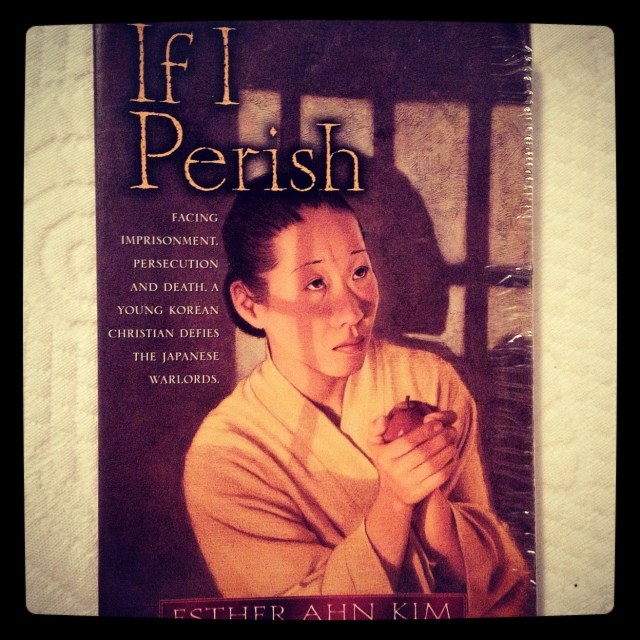
If I Perish

if I perish.jpg

Esther Ahn Kim

If I Perish

Korea 1929

Esther Ahn Kim walked slowly up the hill to the shrine, with her students following silently behind her. The young teacher knew that when she arrived at the place of worship she would be forced to make a life-altering choice. The Japanese, who had taken control of Korea, were forcing everyone to bow at the shrine of their “sun god.” The punishment for refusing was imprisonment, torture and possibly even death. Fearing for their lives, many Christians had already given in to the Japanese soldier’s demands. And now it was Esther’s turn to make her decision. She fixed her eyes on the vast sky beyond the hills and thought of Shadrach, Meshach, and Abed-nego, when they were commanded to bow to the statue of the Babylonian king, Nebuchadnezzar. The three young men had decided that even if God did not choose to save them from the burning fire, they would die honoring Him.

At that moment, Esther knew what she would do. Even though so many other Christians had decided that outwardly bowing to the idol was acceptable as long as they continued to worship Christ in their hearts, Esther could make no such compromise. She would not bow to any other but the one true God. Defying the Japanese warlords would most likely mean torture and imprisonment, but Esther decided that she would not live her youthful life for herself. She would offer it fully to her Prince, Jesus Christ. She said a silent prayer to Him. Today on the mountain, before the large crowd, I will proclaim that there is no other god but You, she declared.

christian persecution orthodox city hermit

Esther’s group was the last to arrive at the shrine. A huge crowd had gathered, standing in straight, respectful lines, afraid to move because of the cruel gazes of the Japanese policemen. A few of the authorities eyed Esther and her students with disapproval as they joined the rest of the worshipers. Esther’s heart began to pound with dread for what she was about to do. A sense of uneasiness swept over her, and she silently repeated the Lord’s Prayer over and over. Lord, she prayed, I am so weak! Please help me do this— watch over me as I stand for You.

“Attention!” came the commanding voice of one of the officials. The crowd stood in silence and submission. “Our profoundest bow to Amaterasu Omikami!” As he shouted the words, the entire group bent the upper half of their bodies, bowing solemnly before the shrine. Esther was the only one who remained standing, looking up at the sky. The fear and uncertainty that had gripped her just moments before had vanished. Calmness and peace flooded her. She had done what she knew God wanted her to do. On the long walk back to the school, Esther continued her dialogue with God. I have done what I should have done, she told Him. Now, I commit the rest to You. I died today on that mountain—now it is only You who lives through me. I leave everything in Your hands.

For several months, Esther lived in hiding. She knew it was only a matter of time before she was found and imprisoned for the stand that she had taken against the Japanese. But instead of cowering in fear and worry about what her future held, she decided to prepare her heart and her body to suffer for Christ. Just as Paul said, “I buffet my body and make it my servant,” (1 Cor 9:27) Esther decided to train for prison life, just as an athlete might train for competitive sports. She counted it a great honor to suffer for Christ, but she also knew she was weak and unready for all that lay ahead.

If I Perish

“I knew it would be impossible for me to keep my faith in my own power,” Esther wrote later. “God would have to work through me if I was to stand firm. I decided to fast.” Many times before, Esther had fasted for three days without difficulty. Now, she was determined to go without food or drink while she prayed for an entire week. The fast was extremely difficult. By the sixth and seventh day Esther’s lips were dry and her chest was in an iron vise, causing her to fight to breathe. But when the fast was finally over and water was poured into her mouth, she raised her hands in victory, thanking God for being with her.

“Although I had not expected it, after the fast I was able to understand the Scriptures better and I felt a new power in my prayer. Now I felt I could leave the fear of torture in the Lord’s hands.”

More time went by and more fearful news of prison life reached Esther’s ears. As anxiety crept back in, she fasted once more – this time for ten days.

“Again I found a peace I had never known before,” she wrote. “I read the Bible earnestly and had a new concern to memorize important chapters against the day when I would be in prison without my Bible.”

Esther also began sleeping on the floor, learning to live in a state of poverty, and going without all the comforts she had grown up with, so that she would be prepared for the harsh conditions of prison. When she went to the market to buy produce, she bought ripe fruit for her family members but rotten fruit for herself. When her mother and sister saw the decaying food she selected for herself, they cried, but soon they understood. This was the kind of food Esther would be forced to eat in prison.

Months of faithful, diligent preparation—fasting, memorizing Scripture, tirelessly praying, and training to endure harsh conditions – transformed Esther from a weak, frail, faltering young woman to a bold and confident ambassador for Christ. Instead of fearing torture, she now faced it boldly in the power and grace of God.

Esther felt God calling her to come out of hiding and boldly proclaim the truth of the Gospel among the Japanese. She knew that this would likely lead to her death, but she was determined to follow the Lamb wherever He led her.

Her courageous stand for Christ led to six harrowing years in Japanese prisons. During that time, though her body grew week with suffering, she shone with supernatural love toward her persecutors and fellow prisoners. Even through torture, she refused to deny the name of Christ. Her astounding example of “suffering hardship as a good solider for Christ” brought many into the Kingdom who would never have heard the Gospel otherwise. After she was released, the story of her imprisonment and unwavering faith became the all-time religious bestseller in Korea, inspiring countless thousands to stand strong in their faith.

If I perish Taking up our Cross orthodox city hermit

Gleaning From Esther’s Example

Modern Christianity often encourages us to chase after achievements and accolades; to develop skills and pursue accomplishments that will be applauded and esteemed by this world. Some even go so far as to say that the more impressive we are to pop-culture, the greater our witness for Christ will be. The hip, trendy, pop-culture style of many modern worship services illustrate how far we have come from the days of the apostles, when Paul proclaimed, “If I must boast, I will boast in the things which concern my infirmity.” (2 Cor. 11:20)

Though Paul had plenty of human skills and achievements he could have emphasized or built upon, he chose to treat those things as “rubbish.” (Phil 3:8) His greatest accomplishments; his most powerful witness, came from the incredible suffering he endured for Christ’s sake: “Three times I was beaten with rods; once I was stoned; three times I was shipwrecked; a night and a day I have been in the deep; in journeys often, in perils of waters, in perils of robbers, in perils of my own countrymen, in perils of the Gentiles, in perils in the city, in perils in the wilderness, in perils in the sea, in perils among false brethren; in weariness and toil, in sleeplessness often, in hunger and thirst, in fastings often, in cold and nakedness…” (2 Cor. 11:27-29).

And so it was in the life of Esther Ahn Kim. It wasn’t her accomplishments, personality, money, or skills that caused the nation of Korea to be forever changed. It was her shining example of suffering for Christ’s sake.

One time in prison, her arms were handcuffed behind her back for days until she passed out from the relentless pain. The intent was to torture her until she finally denied Christ. But even though her mind and body were broken, her spirit remained strong, rooted and grounded in Truth. She would not relent, no matter how horrible the pain became. She emerged from the torture victorious in her faith.

Another time, she gave up her meager prison food for several days to a woman who was filthy, insane, and sentenced to death for murdering her husband. Instead of being repulsed by the woman as all the other prisoners were, Esther prayed relentlessly for her, sacrificing her own comforts to reach the woman’s heart. The woman died in her right mind, knowing Jesus Christ, with a hope and a future.

Such sacrifice and personal suffering for Christ’s sake is only possible through the supernatural grace of God. Only one who has truly given up everything to follow Jesus can exude such grace in the face of such hardship.

Esther’s story challenges me to ask the question – am I prepared to suffer for Jesus Christ? In the midst of our comfortable … lifestyles, it’s easy to think, “Of course, if persecution came, I would never deny the name of Christ. Of course if I were thrown into prison, I’d remain strong in my faith.”

But we must ask ourselves – are we truly “dying to self” daily, as Esther did, or are we more concerned with protecting our own comforts and interests than in consecrating our lives fully to Jesus Christ? The only way to be a true follower of Christ is to willingly give up everything; to take up our cross and follow Him (Matt. 10:38, Lk. 9:23).

… We will never gain Esther Ahn Kim’s version of supernatural boldness and sacrificial love by coddling our own self interests and protecting our own comforts. … We are not walking the narrow way of the cross anymore. We are merely living selfish lives with a “Christian label” over them.

Esther Ahn Kim counted the cost of following Jesus – not only on the day when she refused to bow at the shrine, but every day thereafter. She counted the cost when she willingly and gladly gave up comforts and trained her body to endure hardship for the sake of Christ. She counted the cost when she came out of hiding and boldly proclaimed the Gospel among the Japanese who had the power to torture and kill her. She counted the cost when, in prison, she endured horrible misery rather than deny her faith in Christ. She counted the cost when she sacficially loved a filthy, repulsive woman and gave of what little she had in order to win her to Christ. Esther’s life was no longer her own—and every outward decision she made reflected that inner reality. If you desire to do “big things” for God—ask yourself today whether you have truly counted the cost of following Christ.

Many of us think that in order to prepare for an effective ministry, we must gain a large following, write a book, gain worldly accolades, or make a lot of money. But the best way to prepare for a world-changing ministry is to ‘die’ – so that Christ may live through us. Remember that Paul had every reason to boast in his earthly accomplishments, and yet he threw them aside as worthless and counted his suffering for Christ’s sake as his greatest, most important acheivments. (See 2 Cor. 11:30 and Phil. 3:8.)

When self is at the center of our lives, the only impact we will have on this world will be shallow and human-scripted rather than eternal and God-scripted. We may make a temporary splash, but if we do not take up our cross and truly follow Him, we will never reflect the supernatural radiance and grace of Heaven.

If I perish Taking up our Cross orthodox city hermit

Taking up our Cross

… It may take a few days, weeks, or months for those old habits to fully die. But if you allow Him to re-train your daily decisions and enable you to “deny yourself, pick up your Cross, and follow Him” you will soon understand from firsthand experience what Paul meant when he said, “it is no longer I who live, but Christ who lives in me.” (Gal 2:20)

This world needs more young women like Esther Ahn Kim—young women who unreservedly take up their cross and follow Him, no matter what the cost. May it be our greatest desire to follow such a path, and joyfully suffer any hardship for the One who gave everything to us. The world will never be the same when they encounter such a life.

*Story of Esther Ahn Kim taken from If I Perish by Esther Ahn Kim

‘Violent’ Spirit — Viaia Pnoi

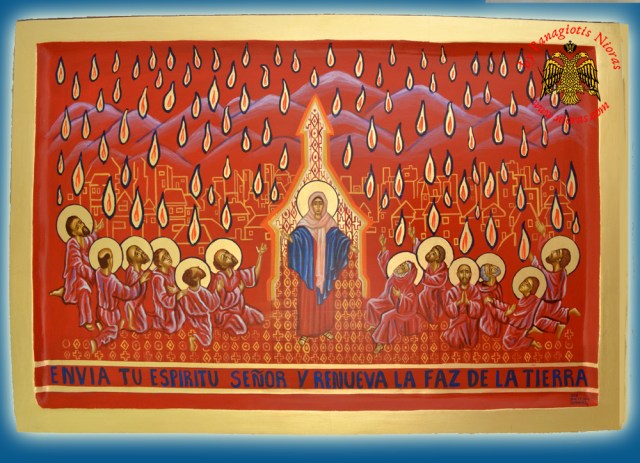
It has been such a  hectic week with me returning hastily back ‘home’ due to the sudden deterioration of my Father’s condition! A glorious week too, full of the honouring of the Holy Spirit in so many church services, the climax of the Orthodox liturgical cycle: Pentecost and the Descent of the Holy Spirit!


Giver of life: come, and abide in us


holy-spirit3


Then Father Seraphim took me very firmly by the shoulders and said “my son, we are both at this moment in the Spirit of God. Why don’t you look at me?”
“I cannot look, Father” I replied – “because your eyes are flashing like lightning – your face has become brighter than the sun, and it hurts my eyes to look at you.”

“Don’t be afraid” he said, “at this very moment you yourself have become as bright as I am. You yourself are now in the fullness of the Spirit of God; otherwise you would not be able to see me as you do.”

Then – bending his head toward me, he whispered softly in my ear: “thank the Lord God for his infinite goodness toward us… But why, my son, do you not look me in the eyes? Just look and do not be afraid; the Lord is with us.” (St Seraphim of Sarov and his encounter with Nicholas Motovilov)

holy-spirit2

Let us bow mystically to the Comforter and listen attentively to a fascinating testimony by a fascinating ‘convert’: Father Michael Harper. Crystalline Orthodox insights, such as probably only ‘converts’, or at least, they more often than ‘cradle’ Orthodox, may provide. 


And from the days of John the Baptist until now the kingdom of heaven suffereth violence, and the violent take it by force. (Matthew 11:12)

And suddenly there came a sound from heaven as of a rushing mighty wind (ie. “Kathaper feromenis Viaias [Violent] Pnois”), and it filled all the house where they were sitting. (Acts 2:2)

“Kathaper feromenis Viaias Pnois” — Violent is truly the proper translation of the original Greek word, not just ‘mighty’!


“Most will agree that the Church which through the centuries has most fully honoured the Holy Spirit, and brought Him most fully into its worship, life and ministry has been the Orthodox. Let us look briefly at five areas where this is clear:

First, there has been the strong emphasis in the whole life of the Church on the Trinity, which sees the Father, the Son and the Holy Spirit as co- equal. The Church has also condemned the insertion by the Western Church of the filioque clause into the Nicene-Constantinople Creed, which weakens the co-equalness of the Persons of the Trinity.

Secondly, the Orthodox Church has always emphasised the Incarnation and thus the work of the Holy Spirit in the conception of Christ in the womb of the Theotokos, the God-bearer.

Thirdly, the Orthodox Church has been the only Church to continue the practice of Christian baptism as the three-fold immersion of the candidate in water, followed immediately by chrismation symbolising the reception of the Holy Spirit and followed then by the candidate receiving their first communion. Again the Holy Spirit is active in the whole Baptism process.

Fourthly, in the Orthodox Eucharist (of St John Chrysostom), which is seen by the Orthodox as the heart of the Church, the service is interspersed with many references to the Holy Spirit. It begins, for example, with a prayer to the Holy Spirit which is unique in liturgical practices:

O heavenly King, Comforter, the Spirit of Truth, who art everywhere present and fillest all things, Treasury of good things and Giver of life: come, and abide in us, and cleanse us from every stain, and save our souls, O good One.


http://pemptousia.com/video/fr-michael-harper-the-holy-spirit


In the Russian tradition the following words are spoken by the Priest just before the Epiclesis: “O Lord, who at the third hour didst send down upon thine apostles thy Holy Spirit: take not the same from us, O good One, but renew him in us who pray unto Thee.”

Then follows the important epiclesis prayer which the Priest says, “send down thy Holy Spirit upon us and upon these gifts spread forth.” Notice it is a prayer for the Holy Spirit to come upon the people as well as the bread and the wine. Earlier in the service, if there is more than one Priest at the service, a dialogue takes place:

Pray for me, brother(s) and concelebrant(s)
May the Holy Spirit descend upon thee and the power of the Most High overshadow thee
May the same Spirit serve with us all the days of our life.

In another place the Priest prays that “the power of the Holy Spirit” will enable him.

holy spirit1.jpg

Fifthly,… For the rest of the article, go here

For an interview with Father Michael Harper, go here

The Mystery of Tomorrow

A dear sister in Christ, a nun in a Greek monastery, recommended Mother Gavrilia’s book to me a month ago, to study again, and draw inspiration and courage and faith in my poor, little missionary endeavours, by that Missionary and Unmercenary Giant. I am so grateful for this Holy Mother and her book. I have had it for many years and read it many times. Each time it goes deeper, deeper. I am reading this again after many years of traveling and the book was packed away. She always, through the message of the Holy Spirit-alive in her, has a word or two about my/your struggles. Especially now. I feel her so close to my side. Mother Gavrilia is such a role model in her fearlessness, her humility and obedience to God’s Will, her dedication to the service of all mankind, her Faith! May we have her blessing!


A poem in the book touched my heart so deeply: 


THOU HAST made me known to friends

whom I knew not.

Thou hast given me seats in homes not my own.


Thou hast brought the distant near

and made a brother of the stranger.

I am uneasy at heart

when I have to leave my accustomed shelter;

I forget that there abides the old in the new,

and that there also thou abidest.


Through birth and death,

in this world or in others,

wherever thou leadest me, it is thou the same,

the one companion of my endless life,

who ever linkest my heart

with bonds of joy to the unfamiliar.


When one knows thee,

then alien there is none,

then no door is shut.


Oh, grant me my prayer

that I may never lose the bliss

of the touch of the one

in the play of the many.


 [R. Tagore, Gitanjali, LXIII]

This poem, dated March 24, 1964, exactly ten years after she was “reborn”, was found among her papers. On the top of that page, she made the sign of the Cross

ic xc ni ka

and added:

24-3-1954

Athens-Israel-Cyprus-Lebanon-Jordan-Syria-Iraq-Iran-Pakistan-INDIA

24-3-1964

Jordan-Greece-Turkey-France-Switzerland-USA-France-Belgium-Danemark-Sweden-Germany-Greece-Lebanon-INDIA


Arvo Pärt – And then came the evening and the morning (1990)


 Mother gavrilia orthodox pilgrim missionary

“God is Love” … and Mother Gavrilia‘s entire life, which was a hymn to the Lord, became thanks to Him, a burnt offering, a holocaust to His Love.


mother-gavrilia orthodox pilgrim missionary


“Only one thing do I know that I have always, and it is not pride, nor fantasy, but that which I have day and night, wherever I find myself–three things: first, Faith; second, Faith; third, Faith. That’s all! Nothing else can I say to you. It has directed all my life.”


The Pending, the Proselyte and the Prescient

Three Vignettes 


The Antiochian Orthodox Christian Archdiocese of the British Isles and Ireland held its first Archdiocesan Conference with our own resident Metropolitan, Sayedna Silouan at the Hayes Conference Centre, Swanwick, Derbyshire from Monday 23rd May to Wednesday 25th May 2016. This conference ‘welcomed’ me to the UK, initiated me to the Glory of Orthodoxy in Great Britain and drafted me to the (Antiochian) English Orthodox Church. Amidst its brilliant theological talks, its moving church services, and its heart-warming communion with my brothers and sisters in Christ, three pairs of eyes, three vignettes haunt my memory.

Ezekiel 1 :16—28

“The appearance of the wheels and their work was like unto the colour of a beryl: and they four had one likeness: and their appearance and their work was as it were a wheel in the middle of a wheel. When they went, they went upon their four sides: and they turned not when they went. As for their rings, they were so high that they were dreadful; and their rings were full of eyes round about them four. …. And when they went, I heard the noise of their wings, like the noise of great waters, as the voice of the Almighty … Above the vault over their heads was what looked like a throne of lapis lazuli, and high above on the throne was a figure like that of a man. … As the appearance of the bow that is in the cloud in the day of rain, so was the appearance of the brightness round about. This was the appearance of the likeness of the glory of the LORD. And when I saw it, I fell upon my face, and I heard a voice of one that spake.”


cherubim1

The Pending

1 Kings 19:11

“And he said, Go forth, and stand upon the mount before the LORD. And, behold, the LORD passed by, and a great and strong wind rent the mountains, and brake in pieces the rocks before the LORD; but the LORD was not in the wind”

His eyes were the most vibrant, fiery, scorching eyes I had ever encountered. Yet, full of Love! Our Bishop is a very young and most intense man. He took me aside and began to ask the most probing questions, piercing holes to my heart. It felt like Confession rather than conversation. I was fast reduced to tears.

‘Why are you crying?’ ‘Out of joy!’ ‘Why?’ ‘For being with you!’ How else could it be before such blazing purity?

He did not mince his words. ‘All this is a Cross to me.’ ‘Why, Sayedna?’ (It is not that I did not know that being a bishop is a cross. If a novice needs the patience of a wagon, the hegumen needs a whole train! I remember reading this in a book once.) ‘Why? What would you rather do?’ ‘I would rather be in a monastery. Any monastery. Any where. In Syria. In Greece. Any where. As long as I were in a monastery.’

(This fast became  a refrain in many conversations during the conference. So many people here would rather be in a monastery but were called by the Lord to work for Him in the world. Frustrating yes, exhausting yes- sacrificial most certainly, but could they do anything else in order to follow Jesus? No! )

‘I have come here out of love.’ ‘So many people here, Sayedna, want to go to a monastery.’ ‘Would you like that too?’ ‘Yes, but we are still young and we must work for Him’. Such prescience, such bright sorrow in his eyes!

Suddenly, out of the blue, a middle-aged Anglican kneels before him and asks for his blessing! The year he had spent during his Cambridge studies in Balamand (!), Syria, Lebanon and Turkey “was the happiest in his life!”

‘Come home!’ another ‘convert’ invites him. ‘But I am a Westerner. How can it be?’ ‘So am I.’ the other replies. ‘Why stay at the Church of England if your heart is Orthodox? Come home!’ And: ‘Why do you make further schisms rather than return back to the original faith, the source?’

He, too, is fast reduced to tears and kneels, unable to utter a word. It is not the questions themselves but the ‘authority’ and holiness of the person who is asking them. These eyes! The ‘Reluctant’, Doubting Anglican may not be ready (yet) to make the leap of faith! But a hole in his heart has been made!

The Proselyte

1 Kings 19:12

“And after the wind an earthquake; but the LORD was not in the earthquake”

She was a newly-baptised Muslim Convert. She kept telling everyone that she was only twenty days old! And indeed her eyes were the kindest, purest and brightest ones I had encountered for a very long time. ‘Please pray for us. The Holy Spirit is so near you these days!’

She is hearkening back to that “memory of the glory that I had when I was entirely with You and entirely in You, before time and temporal illusions.

When I, too, was a harmonious trinity in holy unity, just as You are from eternity to eternity.

When the soul within me was also in friendship with consciousness and life.

When my soul also was a virginal womb, and my consciousness was wisdom in virginity, and my life was spiritual power and holiness.

When I, too, was all light, and when there was no darkness within me.

When I, too, was bliss and peace, and when there were no torments of imbalance within me.

When I also knew You, even as You know me, and when I was not mingled with darkness.

When I, too, had no boundaries, no neighbors, no partitions between “me” and “you.” (St. Nikolai Velimirovich, Memories – Prayers By the Lake XXX)

Such purity and newness of Life, Light and Harmony reflected in her eyes! Indeed, “the eye is the lamp of the body; so then if your eye is clear, your whole body will be full of light.” (Matthew 6:22)

She was so eager to learn and yet she was teaching all of us! Her parents had not been told of her baptism, and there was no way she was going back to her homeland.

‘How were you drawn to the Faith?’ ‘Christ Himself appeared in person twice to me and called me, but I was not ready to take that step then. I did not have the guts. Yet in the end, I just could not ignore His calling! I had to become an Orthodox, even if that meant that I would be irreparably separated from my family and relatives and become a stranger in my own country and an exile.’

‘How are you feeling?’ ‘I am in Heaven’. (Radiant Smile) As if it did not show …

The Prescient Priest

1 Kings 19:13

“And after the earthquake a fire; but the LORD was not in the fire. And after the fire a still small voice. When Elijah heard it, he pulled his cloak over his face and went out and stood at the mouth of the cave. …”

He was a ‘convert’ too. His eyes were by far the most playful I had ever encountered! ‘Clean’ and fresh like an ocean breeze, magical, charming, fairylike, sprightly, with elfin grace, conjuring deep, green forests and starry nights! Who said that holiness is forbidding and austere? This priest is the most humble and welcoming I have ever received a blessing. You feel like an innocent small child in his presence. Still, he is so otherwordly, light and free! Literally floating!

At a break between talks, I whisper to a friend of mine: ‘Let us go and get his blessing! He is such a holy man, so special and close to God!’ She readily agrees. Before however a move is made or a look is exchanged, something most unexpected happens. He could not have listened! He is far away, across the hall! And yet, the moment my words are uttered, he suddenly fixes his eyes meaningfully on me, smiles mischievously with elfin delight, apparently most ‘proud’ at his practical joke, and starts to make a funny pantomime, as if he is ‘escaping’ from us!

Wait a minute! This cannot be happening! I run to his side and ask him: ‘How on earth, pappouli, did you hear? Or know what we were planning to do? You can’t have possibly heard us at such a distance!’ ‘Of course, I can’, he answers smiling even more elfishly. ‘I am so proud and conceited that I am always eavesdropping, eager to listen to other people’s praises!’

He is not telling the truth, of course. And his blessing is a small miracle that seals my participation at this conference. Ever since, I feel his prayers, and bless the Lord for allowing me to “see through a glass, darkly; but then face to face”, for catching a glimpse of Orthodoxy in Great Britain through the eyes of the prescient priest!


Keep Your Mind in Hell


icon_st_silouan_athonite.jpg

… and Despair Not

Not for the faint-hearted!

“No one on this earth can avoid affliction; and although the afflictions which the Lord sends are not great, men imagine them beyond their strength and are crushed by them. This is because they will not humble their souls and commit themselves to the will of God.”


These words seem to sum up soberingly D. Balfour’s tumultuous life, and indeed in so many respects ours…


SPEECHLESS! “It seems ludicrous to rate a book like this according to a certain amount of stars…I searched for it after reading the book I Know a Man in Christ — a great book about our holy and blessed Elder Sophrony, which mentions this correspondence with the amazing Englishman David Balfour. I imagine that the only reason why anyone would be interested in this book would be to learn about this incredible spiritual friendship. (No! There are so many more reasons to want to study this book) And this book does allow for that — and much more besides. I’ve read letters of spiritual direction before. These letters go way beyond that. They give insights to the Elder and to St. Silouan which are simply impossible to convey otherwise. And this David Balfour — he went from Catholic hieromonk to Orthodox hieromonk to British Army major and intelligence officer to diplomatic interpreter to midlife husband and father to Oxford Byzantine scholar in old age. A biography of him wouldn’t go amiss, although I don’t think we’ll see one. And underlying his whole life is the gaining and the losing and the eventual regaining of that inestimable treasure, the Holy Orthodox Christian faith and Holy Grace. Not for the faint of heart.” (D. Kovacs )


Not for the faint of heart.” Most certainly!


What an intense book which can be read on so many levels! A heart-rending spiritual biography of a brother in Christ struggling for his faith and the salvation of his soul amidst staggering trials, temptations and tribulations! A sobering warning too to all of us to be deadly serious with our faith and never forsake our obedience to our spiritual father at any cost! Hell indeed broke loose when Balfour decided to disobey St. Silouan and use his own mind instead for his life-decisions! To give you just one example: After converting to Orthodoxy and becoming an Orthodox hieromonk, Balfour disobeyed St Silouan’s ‘suggestion’ to move to France, and then to England, and went to Greece instead. Things went well at first, but with the outbreak of the Second World War, Balfour was forced to flee Greece and started wandering all over Europe, while undergoing a very dark period of disobedience, disillusionment, doubt and eventual loss of his faith, to the extent that he decided to shave his beard and defrock himself in Cairo, Egypt! I cannot even begin to imagine how traumatic all this experiences must have been for him!

elder-sophrony


What a most sobering book! “For Whom the Bells Toll” indeed. How often have I betrayed the Lord and disobeyed my spiritual father in the past! How dire the consequences of my disobedience have always been! Indeed, how fragile our faith is, how precarious our decision to follow the Lord at any cost like a true disciple, how unpredictable our falls and how uncertain our salvation until the very last moment of our life!


Striving for Knowledge of God: Correspondence with David Balfour is a treasury of wisdom distilled from Fr. Sophrony’s reading of the Fathers of the Church, from his conversations with St. Silouan, and from his own experience. Since most of these letters were written to someone new to the Orthodox Church and to Orthodox monasticism, they are of greatest interest to anyone contemplating converting to Orthodoxy.


In particular, the correspondence touches and elaborates on the difference between Eastern Orthodox and Western thought, in both Christian and philosophical writings. Thus Fr.Sophrony mentions Schleiermacher, Spinoza and Kant, and St John of the Cross (The Dark Night of the Soul). He dedicates a few pages to the concepts of the heart and prayer. In Eastern Christianity, he argues, the spiritual heart is not an abstract notion but is linked with our material heart and has its physical location. In opposition to the Western search for some visionary mystical experience, Fr.Sophrony advocates the prayer of repentance, which is the basis of all spiritual life.


As a reply to Balfour’s doubt over the importance of specifically Eastern ascetic and dogmatic traditions, Fr.Sophrony asserts the organic integrity and integrality of ascetic life, dogma and the Church. Criticising Schleiermacher in connexion with this issue, he writes:


“There are three things I cannot take in: nondogmatic faith, nonecclesiological Christianity and nonascetic Christianity. These three – the church, dogma, and asceticism – constitute one single life for me.” – Letter to D. Balfour, August 21, 1945.


“If one rejects the Orthodox creed and the eastern ascetic experience of life in Christ, which has been acquired throughout the centuries, then Orthodox culture would be left with nothing but the Greek minor [key] and Russian tetraphony.” – Letter to D. Balfour.


Fr.Sophrony also warns against attributing to intellectual reasoning the status of being the sole basis for religious search:


Historical experience has demonstrated that natural intellectual reasoning, left to its own devices, fatally arrives at pantheistic mysticism with its particular perception of reality. If this takes place in the soul of the Christian who does not want to reject Christ (as in the case of Leo Tolstoy), he arrives at Protestant rationalism or at spiritualism, which stands mystically close to pantheism… I am convinced that the rejection of the Church will lead to the rejection of the Apostolic message about Сthat which was from the beginning, which we have heard, which we have seen with our eyes… and our hands have handled (1Jn.1:1) [148].


On a more general level, these letters are full with profound theological and spiritual insights. What a most blessed golden ‘chain’ of Grace and Sainthood! Elder Sophrony, already under consideration for glorification, was ordained to the diaconate by St Nicolai (Velimirovic) of Zicha and became a disciple of St Silouan the Athonite. Can you imagine? All these Saints were also ‘connected’ with the greatest probably Saint of our century, St. John Maximovitch! St. Nikolai Velimirovich is often referred to as Serbia’s New Chrysostom. St. John Maximovitch, who had been a young instructor at a seminary in Bishop Nikolai’s diocese of Ohrid, called him “a great saint and Chrysostom of our day [whose] significance for Orthodoxy in our time can be compared only with that of Metropolitan Anthony (Khrapovitsky). … They were both universal teachers of the Orthodox Church.”


Coming back to the book, of all theological concepts touched upon in this book, the one which most interests me  is the concept of Godforsakenness, as outlined by Fr.Sophrony, who worked out a distinction between two types:The first one is when man deserts God: To the extent that we live in this world, to that same extent we are dead in God. The second one is when God hides from man: a horrific state of Godforsakenness. When man has no more life in this world, i.e. cannot live by this world, the memory of the divine world draws him there, yet despite all this darkness encompasses his soul. He explains: these fluctuations of the presence and absence of grace are our destiny until the end of our earthly life. Fr.Sophrony saw suffering as a necessary stage in ascetic development: Divine grace comes only in the soul which has undergone suffering.


“We must have the determination to overcome temptations comparable to the sorrows of the first Christians. All the witnesses of Christ’s Resurrection were martyred. We should be ready to endure any hardship.”


“The most important thing in the spiritual life is to strive to receive the grace of the Holy Spirit. It changes our lives (above all inwardly, not outwardly). We will live in the same house, in the same circumstances, and with the same people, but our life will already be different. But this is possible only under certain conditions: if we find the time to pray fervently, with tears in our eyes. From the morning to ask for God’s blessing, that a prayerful attitude may define our entire day.”


“Whoever gives up his cross cannot be worthy of the Lord and become His disciple. The depths of the Divine Being are revealed to the Christian when he is crucified for our Savior. The Cross is the foundation of authentic theology.”


Not for the faint of heart, indeed!