Flying in Love

A couple of terns at the lake of Kastoria, dying together from exhaustion, in each other’s wings, after their last migration journey back from Africa. Source: Time Machine

Dear Friends and spiritual children in Christ,

I was praying for you and I offer three of my poor poems in humility for your strengthening! Two of them are directly related to the Feast of the Transfiguration on 6th. the first for spiritual sons (and daughters).


But first some words from St Porphyrios:

“Whoever wants to become a Christian must first become a poet. That’s what it is! You must suffer. You must love and suffer–suffer for the one you love. Love makes effort for the loved one. She runs all through the night; she stays awake; she stains her feet with blood in order to meet her beloved. She makes sacrifices and disregards all impediments, threats, and difficulties for the sake of the loved one. Love towards Christ is something even higher, infinitely higher.

And when we say ‘love’, we don’t mean the virtues that we will acquire, but the heart that is pervaded by love towards Christ and others. We need to turn everything in this direction. Do we see a mother with her child in her arms and bending to give the child a kiss, her heart overflowing with emotion? Do we notice how her face lights up as she holds her little angel? These things do not escape a person with love of God. He sees them and is impressed by them and he says, ‘If only I had those emotions towards my God, towards my Holy Lady and our saints!’ Look, that’s how we must love Christ our God. You desire it, you want it, and with the grace of God you acquire it.”

― Saint Porphyrios, “Wounded by love “
 
The Kite

John 3:8 “The wind blows where it wishes, and you hear the sound of it, but cannot tell where it comes from and where it goes. So is everyone who is born of the Spirit.”

Look upward to the sky

And allow your wings to fly

Upon the glorious breath of God

In the sunrise of your youth.

Soar swiftly with an eagle’s strength,

Measure the height, breadth, depth and length.

Reach heavenward, dear son by the sacramental

strings on earth,

Hold firm to the lifeline and anchor of new birth.

Let the Holy Spirit lift you high

And allow your wings to fly

Upon the glorious breath of God

In the sunrise of your youth.

+

+

+

+

Amma Syncletica said, “In the beginning there are a great many battles and a good deal of suffering for those who are advancing towards God and, afterwards, ineffable joy. It is like those who wish to light a fire. At first they are choked with smoke and cry, until they obtain what they seek. As it is written, “Our God is a consuming fire” (Hebrews 12:24); so we also must kindle the divine fire in ourselves through tears and hard work.”

The Transfiguration

Mark 9:2 “Now after six days Jesus took Peter, James and John and led them up on a high mountain apart by themselves; and he was transfigured before them.”

Possess your soul with patience,

Let the seasons bear their own time.

Lighten your heart with love,

For passion beats to an uncertain pulse.

Provide your mind with peace

Since idle imagination is a deadly weapon.

Still your tongue with silence

So that you may allow the Word to speak to you.

Open your hands to offerings

In order to give generously and to receive gracefully.

Guard your eyes with goodness

To become a pupil of Light.

Place your feet in poverty.

That you may walk in the way of the saints.

Feed your stomach with friendship

So that you may nourish and sustain the lonely.

Breathe into your nostrils the air of beauty

For the Holy Spirit gives life to the canvass of creation

Humble your ears to holiness

That you may become deaf to the whispers of pride.

Wash your skin with wisdom

That you may be clean from the accretions of the world.

Commend your life to Christ

So that you may be transfigured into His likeness.

“My soul, seek the Only One . . . My soul, you have no part with the earth; for you are from heaven. You are the image of God: seek your First Image. For like strives after like. Each object finds its rest in its centre and element — fish in water, fire in its upward movement everything strives to its centre. My soul, you are
an immaterial spirit, immortal. . . In Him alone you will find your rest.”

St. Tikhon of Voronezh

Changed

Luke 9:29: 

“As He prayed, the appearance of His face was altered and His robe became white and glistening.”

They ascended Tabor’s mountain heights, to contemplate and pray,

But Peter James and John, the friends, had a revelation on that day.

Blazing glory in the flesh of Christ, they saw the uncreated Light

Which was hidden for a season, now clear within their sight.

Blinding, glistening, ultra- white was the appearance of His face,

The splendour of the Godhead could be seen within our race.

Moses and Elijah from of old appeared full bright within the cloud,

Peter said  “Let’s  build three booths, if we are allowed!?”

He was silenced by the Father’s voice and filled with holy fear.

The friends shine in glory now like Christ and with Him appear

In heaven: the blessed communion is transferred to us on earth

To help us scale the heights of Tabor and to aid our spiritual birth.

May we indeed acquire the Spirit and grow into the likeness of the Son

May we be changed to shine like Him, and them, when our earthly course is run.

Abba Pachomius said, 

”A sinner like me does not ask God that he will see visions, for that is against His will and wrong. Hear all the same about a great miracle: if you see a man pure and humble, that is a great vision; for what is greater than such a vision, to see the invisible God in His temple, a visible man?”


With love and prayers

To Bear The Beams of Love

solitude_photography4

After Epiphany  — Yearning for a Retreat

 retreat.jpg

Yearning for ‘Thin Places’ where Cassocks can by Hung on the Rays of the Sun


Remove The Sandals From Your Feet

land1

Hurt not the earth, neither the sea, nor the trees.

— Revelation 7:3

trees50

The saints embrace the whole world with their love.

— St. Silouan the Athonite

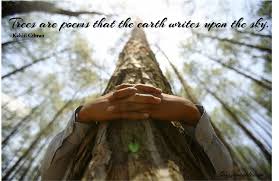
On the Holy Mountain of Athos, the monks sometimes put up beside the forest paths special signposts, offering encouragement or warning to the pilgrim as he passes. One such notice used to give me particular pleasure. Its message was brief and clear: “Love the trees.”

tree63

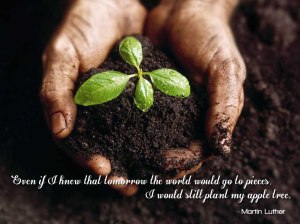
Fr. Amphilochios, the geronta or “elder” on the island of Patmos when I first stayed there, would have been in full agreement. “Do you know,” he said, “that God gave us one more commandment, which is not recorded in Scripture? It is the commandment “love the trees.” Whoever does not love trees, so he believed, does not love God. “When you plant a tree,” he insisted, “you plant hope, you plant peace, you plant love, and you will receive God’s blessing.” An ecologist long before ecology had become fashionable, when hearing confessions of the local farmers he used to assign to them a penance, the task of planting a tree. During the long summer drought, he himself went round the island watering the young trees. …

tree11

Fr. Amphilochios was by no means the first spiritual teacher in the modern Greek tradition to recognize the importance of trees. Two centuries earlier, the Athonite monk St. Kosmas the Aetolian, martyred in 1779, used to plant trees as he traveled around Greece on his missionary journeys, and in one of his “prophecies” he stated, “People will remain poor, because they have no love for trees.” We can see that prophecy fulfilled today in all too many parts of the world. …

tree13

“Love the trees.” Why should we do so? Is there indeed a connection between love of trees and love of God? How far is it true that a failure to reverence and honor our natural environment — animals, trees, earth, fire, air, and water — is also, in an immediate and soul-destroying way, a failure to reverence and honor the living God?

tree12

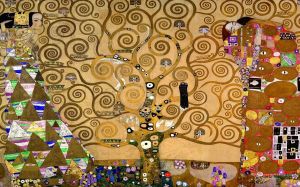
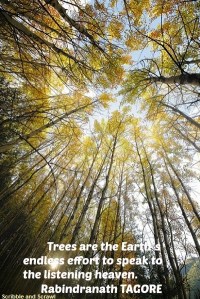
Let us begin with two visions of a tree. Edward Carpenter, in Pagan and Christian Creeds [records] a partial vision of a tree. “It was a beech, standing somewhat isolated, and still leafless in quite early Spring. Suddenly, I was aware of its skyward-reaching arms and up-turned finger-tips, as if some vivid life (or electricity) was streaming through them far into the spaces of heaven, and of its roots plunged in the earth and drawing the same energies from below. The day was quite still and there was no movement in the branches, but in that moment the tree was no longer a separate or separable organism, but a vast being ramifying far into space, sharing and uniting the life of Earth and Sky, and full of amazement.”

tree1              tree2

… Two things above all are noteworthy in Edward Carpenter’s “partial vision.” First, the tree is alive, vibrant with what he calls “energies” or “electricity”; it is “full of most amazing activity.” Second, the tree is cosmic in its dimensions: it is not “a separate or separable organism” but is “vast” and all-embracing in its scope, “ramifying far into space … uniting the life of Earth and Sky.” Here is a vision of joyful wonder, inspired by an underlying sense of mystery. The tree has become a symbol pointing beyond itself, a sacrament that embodies some deep secret at the heart of the universe. The same sense of wonder and mystery — of the symbolic and sacramental character of the world — is strikingly manifest in Peaks and Llamas , the master-work of that spiritual mountaineer, Marco Pallis.

tree61

Yet there are at the same time certain limitations in Carpenter’s tree-vision. The mystery to which the tree points is not spelt out by him in specifically personal terms. He makes no attempt to ascend through the creation to the Creator. …

tree100

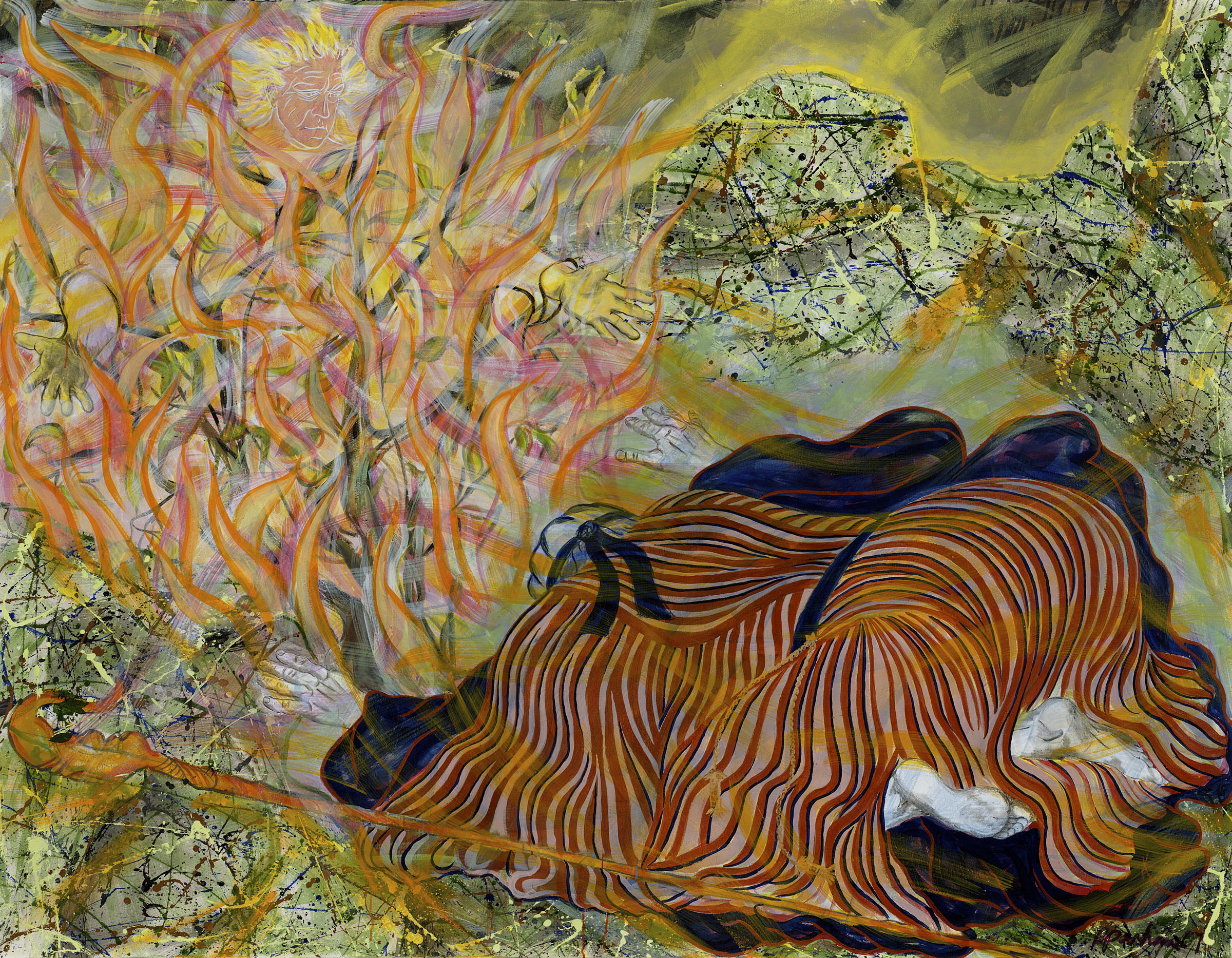
Let us turn to a second tree-vision, which is by contrast explicitly personal and theophanic: “Moses was keeping the flock of his father-in-law Jethro, the priest of Midian; he led his flock beyond the wilderness, and came to Horeb, the mountain of God. There the angel of the Lord appeared to him in a flame of fire out of a bush; he looked, and the bush was blazing, yet it was not consumed. Then Moses said, “I must turn aside and look at this great sight, and see why the bush is not burned up.” When the Lord saw that he had turned aside to see, God called to him out of the bush, “Moses, Moses!” And he said, “Here I am.” Then He said, “Come no closer! Remove the sandals from your feet, for the place on which you are standing is holy ground.” He said further, “I am the God of your Father, the God of Abraham, the God of Isaac, and the God of Jacob.” And Moses hid his face, for he was afraid to look at God.”  (Ex 3:1-6)

tree68

Comparing the experience of Moses with that of Carpenter, we observe three things: in the first place, the vision described in Exodus reaches out beyond the realm of the impersonal. The burning bush at Horeb acts as the locus of an interpersonal encounter, of a meeting face-to-face, of a dialogue between two subjects. God calls out to Moses by name, “Moses, Moses!” and Moses responds, “Here I am.” “Through the creation to the Creator”: in and through the tree he beholds, Moses enters into communion with the living God.

land2

In the second place, God does not only appear to Moses but also issues a practical command to him: “Remove the sandals from your feet.” According to Greek Fathers such as St. Gregory of Nyssa, sandals or shoes — being made from the skins of dead animals — are something lifeless, inert, dead and earthly, and so they symbolize the heaviness, weariness, and mortality that assail our human nature as a result of the Fall.

tree99

“Remove your sandals,” then, may be understood to signify: Strip off from yourself the deadness of familiarity and boredom; free yourself from the lifelessness of the trivial, the mechanical, the repetitive; wake up, open your eyes, cleanse the doors of your perception, look and see! And what, in the third place, happens to us when in this manner we strip off the dead skins of boredom and triviality? At once we realize the truth of God’s next words to Moses: “The place on which you are standing is holy ground.” Set free from spiritual deadness, awakening from sleep, opening our eyes both outwardly and inwardly, we look upon the world around us in a different way.

tree6

So we enter the dimensions of sacred space and sacred time. We discern the great within the small, the extraordinary within the ordinary, “a world in a grain of sand … and eternity in an hour,” to quote Blake once more. This place where I am, this tree, this animal, this person to whom I am speaking, this moment of time through which I am living: each is holy, each is unique and unrepeatable, and each is therefore infinite in value.

tree8

Combining Edward Carpenter’s living tree, uniting earth and heaven and the burning bush of Moses, we can see emerging a precise and distinctive conception of the universe. Nature is sacred. The world is a sacrament of the divine presence, a means of communion with God. The environment consists not in dead matter but in living relationship. The entire cosmos is one vast burning bush, permeated by the fire of divine power and glory. …

*

For more Orthodox ecology of Transfiguration, theophanic transparency, pellucid double vision and Zen ‘haeccitas’, read the full article THROUGH CREATION TO THE CREATOR by Bishop Kallistos of Diokleia

 at http://incommunion.org/2004/12/11/through-creation-to-the-creator/