At the recommendation of my spiritual father, I have been watching two exceptional documentaries on monastic life: Athos – Mount Athos Monks’ Republic Documentary and The Good Struggle: Life In A Secluded Orthodox Monastery. Interestingly enough, I found all their insights pertinent not only to monastics, but to laymen too. What truly struck a chord in my heart was their emphasis on the transience and ‘futility’ of our ‘ordinary’ lives, and a remarkable miracle entitled “Christ is Risen”, the first documentary records.
Athos, the first documentary is exceptional partly because for the first time, a filmmaker was given access to all forms of monastic life on the holy mountain (ie. cenobitic monasteries, sketes and monastic cells).
The Good Struggle, the second documentary, is about a monastic community thriving within the confines of a Greek Orthodox Christian monastery, high up in the mountains of Lebanon. The documentary offers rare insight to their almost silent way of life.
What I found most moving in both documentaries is the “school of philosophy” in the Gerondes’ own words: the insights into the monks’ burial place, their bones eventually stored in a separate charnel house, within the consecrated grounds of the cemetery (20:06–21:28 and 1:25:38—1:28:10 — first documentary), or under the church (23:35–24:36 –second documentary).
“So we can always pray for them and join them. This is due to the church’s belief that those who depart are not removed from us, but we are always connected through prayer. We don’t see them but they are connected to us through prayer. They pray for us and we pray for them. We always visit them to encourage ourselves that death is not a calamity but a meeting with the Lord Jesus Christ. We honour and greet them because they have done the good struggle and God has accepted them in His Kingdom.”
So moving and at the same time so sobering for “our [vain] affection for earthly things”! “And once again I looked with attention on the tombs, and I saw the bones therein which of flesh were naked; and I said, … Where is the pleasure in life which is unmixed with sorrow? … All things are weaker than shadow, all more illusive than dreams; comes one fell stroke, and Death in turn, prevails over all these vanities. … All is dust, all is ashes, all is shadow. … Like a blossom that wastes away, and like a dream that passes and is gone, so is every mortal into dust resolved… ” (St. John of Damascus, Orthodox Funeral Service Troparia)
*
Christ is Risen! He is Risen Indeed!
*
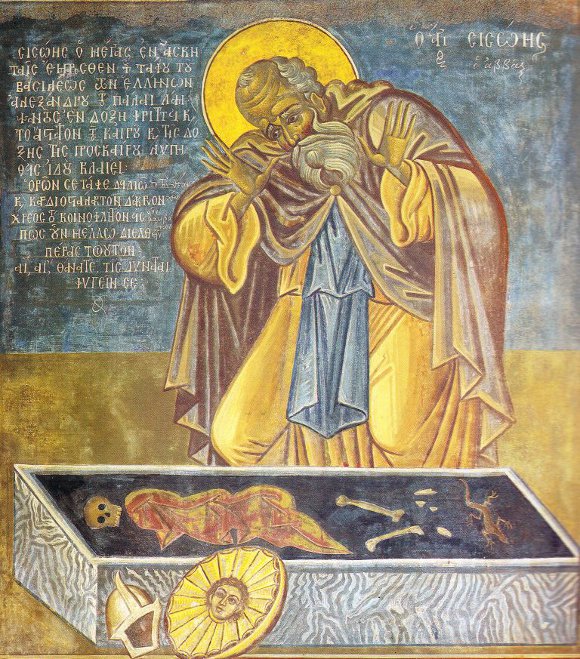
(*) “Sisoes, the great ascetic, before the tomb of Alexander, king of the Greeks, who was once covered in glory. Astonished, he mourns for the vicissitudes of Time and the transience of glory, and tearfully declaims thus: ‘The mere sight of your tomb, dismays me and causes my heart to shed tears, as I contemplate the debt we, all men, owe. How can I possibly stand it? Oh Death! Who can evade you?’


 ORTHODOX CHRISTIAN FAITH AND LIFE