In a Grave For Three Years

The monasteries of Mt. Athos are hundreds of years old, and hundreds and thousands of monks have ended their earthly lives in them. But where are all of the graves of the reposed? Can it really be that the monks just don’t consider it necessary to take care to preserve the memory of their deceased brothers?

Purity of soul

Anyone that visits Mt. Athos’ monasteries will notice two peculiar things: first, even large monasteries have small cemeteries with only a few wooden crosses mounted in the ground; second, the oldest burials in these cemeteries are, at best, twenty or so years old. But how could that be?

First of all, let’s take note of the fact that Athonite monks are usually always buried on Mt. Athos itself. However, it does sometimes happen though that an Athonite monk due to various circumstances may end up living in another monastery outside of Mt. Athos and thus will be buried there instead. For example, at the Danilov cemetery in Moscow can be found the revered grave of the Athonite monk Aristoklis (Amvrosiev), who for many years had presided over the Athonite metochion in Moscow and thus was buried in Moscow after he reposed. However, any monk that reposes on Mount Athos, even if he had come to the Holy Mountain from another country for the first time, is not taken to his homeland to be buried, but is buried at the same Athos monastery in which he had reposed.

To repose on the Holy Mountain, in fact, is actually considered a kind of recognition of the deceased’s righteousness and almost a guarantee of the salvation of his soul. An Athonite monk of our time, hieromonk Gabriel, would always say, “What a joy it is to die on Athos! Here, the Mother of God herself meets the monk after his death, guiding his soul on its way from Earth to Heaven…”

On Mt. Athos, according to tradition, the burial of the deceased is preceded by a special rite. Also, the deceased monk’s clothes will not be changed and neither will his body be washed before burial. On the one hand, proper hygiene is, of course, always maintained; on the other, too much care for the body and health in general is considered an unnecessary occupation, not worthy of a monk’s time. And in fact, this manner of burial is not exactly something unique to Athonite monasticism. For example, in the “Monastic Rite of Burial” we read the following: “When a monk reposes in the Lord, it is not appropriate for his body to be washed or be seen unclad.”

The deceased instead will first be clothed in a “schema” and his head will be covered with a “koukoulion” (attire worn by schemamonks). Afterwards, a cassock is sewn over the body, serving as a coffin for the deceased, and an icon of the Holy Virgin Mary is placed on his chest. It’s worth noting that usually during burial procedure the icon of the Virgin Mary is only given to women, while men are given the icon of the Savior. But, since Mt. Athos is considered to be a place where the Mother of God is especially present, and according to belief, is the first to meet the souls of the deceased, the funeral traditions that have formed here are unique.

Generally burial takes place on Mount Athos on the day of death and without a coffin, so that the body may return unto the ground as soon as possible. Such a burial practice is actually common in many religions and cultures. In particular, Abrahamic religions adhere to this rule in accordance with the words that God addressed to Adam before his exile from Paradise: In the sweat of thy face shalt thou eat bread, till thou return unto the ground; for out of it wast thou taken: for dust thou art, and unto dust shalt thou return (Gen. 3:19).

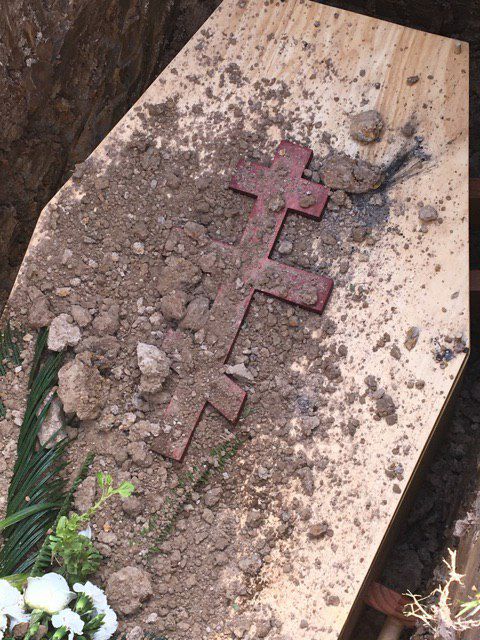
After the customary prayer rule is read, the deceased monk is carried by his fellow brethren to his place of rest and is buried. Afterwards, on top of the grave the brethren mount a low four-pointed wooden cross on which, using simple paint, is made the most concise inscription: the name of the monk and the date of his death.

Stone after stone

It should be noted that the Athonite grave, that is, the very ground that the body is buried under, is much different than it is elsewhere. For example, the ground in Russia, which is mostly flatland, does not share in common any of the burial-related problems that inhabitants of the Mediterranean and other mountainous areas face. In Russia, the usual environment where the body of the deceased is placed is usually a homogeneous, soft, crumbly mass: at best, it is soil or sand; at worst—clay. On Mount Athos however there is nothing of the sort. Mt. Athos is all stone. Sometimes the ground is just a single stone mass, but more often it consists of cobblestones and large gravel. Soil on Mount Athos is in deficit even more than wood is. Therefore, agriculture on the peninsula is practically absent—there are no appropriate conditions for it. By the way, some time ago in the past, the Russian Panteleimon monastery on Mt. Athos had soil delivered to it by sea so that the monks, despite harsh conditions, would nonetheless be able to plant a few gardens. During our trip we happened to see some monasteries that had a bit of farmland, which at best had a few dozen rows of cabbages and some kind of gourds. The largest garden we saw was at the Great Lavra monastery, which had about 40 yards of land. And, no doubt, the soil for this garden was also brought from elsewhere, for the ground around the monastery is mostly all stone. As for the ground of the surrounding roads, it is either siliceous or consists of dense red soil resembling something like grated brick.

Now let’s take a look at the following scenario: a monk in one of the Athonite monasteries reposes in the Lord. In order to bury him, the brethren of the monastery have to urgently fulfill an extremely laborious obedience—prepare the place of burial for their deceased brother. Let us not forget that the deceased, according to monastic customs, are buried as soon as possible, usually on the very day of their death. Little by little, or rather, stone by the stone, the hardworking monks, with their shovels ringing, dig through the rough terrain of Mt. Athos. Finally, the grave is complete and the body of the deceased brother is gently placed within. But now what? Will they really fill the grave back up with all those stones and boulders they just dug up?! Of course not—for a cause such as this they can’t find enough soil. Now let us again keep in mind the deficit of soil on Mt. Athos, as this circumstance will soon help us understand the reason behind other important burial customs on the Holy Mountain.

With the grave now covered and topped off with a small mound of earth, and the wooden cross with its inscription mounted in place, the burial is complete. Now, here is the incomprehensible part of the procedure to one who is not familiar with Athonite burial customs: In just three years’ time the grave will be dug up, and the deceased brother’s bones will never again return to their former place of rest!

On Mt. Athos, a monastery brotherhood prays for newly-reposed monks with especial assiduousness. For the first 40 days, the entire brotherhood of the monastery reads the customary prayer rule for the reposed, repeating it according to the amount of knots on their prayer ropes. Also, in memory of the reposed monk, the monastery prepares “kolivo” (also called “kutia” in Russia), a ritual memorial dish which consists of some grain such as wheat, rye, oat, or rice, as well as honey, raisins and nuts. Furthermore, for the following three years the deceased is commemorated at every Liturgy during the proskomedia. Now bearing in mind that the Divine Liturgy in the monasteries is served daily, this means that the deceased monk receives commemoration every day and for quite a long time. Finally, the name of the deceased is also recorded in a special memorial monastery book, the so-called “Kuvaras”, which bears record of the names of all the deceased monks that have lived in the monastery from the time of its very foundation. For example, the “Kuvaras” of the Great Lavra monastery, read during special memorial days, has been recording the names of its brethren to this very day since the 10th century!

The ossuary

After three years have passed, the grave of the newly-reposed monk is carefully dug up and the brethren now examine the remains of the deceased to see what state they are in. If the soft tissues of the body are not completely decomposed yet, the grave will be covered up in likewise manner and the following procedure will be repeated again until it is clear that only the bones remain. By the way, according to Athonite tradition, a body that is not “accepted by the earth”, i.e., doesn’t decompose, is regarded as a sign that the monk did not make the effort to lead a proper monastic way of life and that his soul has not found rest in Heaven. In such case, the entire brotherhood begins to pray even more diligently, beseeching the Lord for the forgiveness of sins and purification of their fellow brother’s soul.

If the bones of the deceased are completely free from flesh (and this, under the Athos climate, while also taking into account the terrain, occurs most often in just about three years), they are taken out of the grave, and after being thoroughly washed with water and wine are transferred to the ossuary, which is a building that resembles a chapel and is usually located somewhere nearby, outside the walls of the monastery. As for the empty grave, it’s now ready to grant rest for another three years to someone else after his repose.

So now we know how Mt. Athos manages to solve the problem of soil deficit and why there are so few graves in the cemeteries of these ancient monasteries. As it turns out, there can’t possibly be too many graves, as there is a constant “rotation” going on that many at first aren’t aware of.

Now an ossuary is, in essence, a crypt. But the peculiarity of this crypt lies in the fact that the deceased, or rather, their remains, are not hidden there, but are in plain sight: the skulls are lined up in rows along the shelves, while the other bones are neatly laid right on the floor along the walls. The names of the monks and the date of their death are usually found written on each skull. Here is how the well-known Russian writer Boris Zaitsev, who visited Mount Athos at the beginning of the 20th century, described the ossuary of the Skete of Saint Andrew: “The ossuary of St. Andrew’s Skete is a rather large, secluded and well-lit room on an underground floor. Inside the ossuary is found a cupboard with five human skulls. On each is inscribed a name and a date. These were the abbots of the skete. Then on the shelves lay the skulls (about seven hundred) of ordinary monks, which also have inscriptions. And, finally, what to me seemed most incredible—small bones (the hands and feet) were neatly put together in stacks near the wall, reaching up almost to the ceiling. All this was done with the most profound care that is inherent to this kind of burial tradition. It seemed to me that the only thing missing from this whole picture was a monk that would spend time here keeping record of things and compiling biographies of the reposed brethren. There is some literature present here as well. On the wall here, by the way, hangs a saying that the brethren themselves composed: “Remember, O brethren, that we were once like you, and you will once become like us.”

Thus, in such a manner do the Athonite monks lay at rest after reposing in the Lord, with the ossuary basically serving them as a common mass grave. It’s also worth noting that on Athos it is thought that the color of the skull of a reposed monk is a sure sign of whether or not the monk’s life was well-pleasing to God. Thus, according to this belief, the skulls of the righteous have a beautiful yellowish shade—they look as though they are emitting light, and, sometimes even produce a sweet-smelling scent; the monks that have honestly carried out their monastic vows have white-colored skulls; and a dark colored skull, on the other hand, signifies that the judgment of the departed monk’s soul due to his sins did not have a positive outcome. The last case, however, is quite rare on Mt. Athos.
Mt. Athos’ ossuaries are never locked. Any inhabitant of the monastery can at any time can enter the ossuary and in solitude reflect on the transience of life. Looking at the bones of monks whom one once knew, or of those who had reposed centuries ago, it is unlikely that one would not come to the thought that they themselves will one day also find rest here along with their fellow brethren. Now that is truly something to ponder for the monk… However, monks do not at all fear ending up here in this gloomy house of bones, knowing for certain that there is no need to fear death, for it has already been defeated by the Risen Christ!

Yuri Ryabinin

7/7/2017


Twelve Recommendations on How to Prepare Yourself for Confession

confession3

Confession is a sacrament of reconciliation of a man with God, which occurs in the Church. Through the sin a person losses the Kingdom of Christ, shown in numerous sacraments of the Church. Thanks to repentance, which makes a person reborn, we have an opportunity to enter the spiritual life of the Church again. When a priest is accepting someone’s repentance, he becomes a witness on behalf of the Church and at the same time a guarantor who states that this person was dead, and is alive again; and was lost, and is found (Luke 15:32). What is more, a priest proclaims before God that this person is going to reconcile with the Church. At the end of Confession, a priest reads a special prayer, in which he asks God to unite the person with the Church – just like the broken brunch which can take on the tree and bear fruit.

It is better to discuss the frequency of Confession with your parish priest. He serves in the church you usually attend, and this is why it is exactly him who should know about your spiritual life.

Anyway, if you confess from time to time but do not analyze regularly your condition in terms of the New Testament, then your Confession is not full. The less attentive we are the worse we realize our sins.

confession4

Here are the general tips for preparing for Confession:

  1. You should confess everything you have committed. To do this you need to think about it and recall everything in advance. The newcomers can use special spiritual literature such as “The Experience of Confession” by Archimandrite John (Krestyankin). Such literature can help to recall something we have forgotten or have not considered a sin.
  1. Confession means that we spell out certain sins. What is not spelled out is not healed. And this “spelling” begins even before your Confession. It is an inner dialogue with your conscience in terms of the Gospel. On the other hand, if a person begins to confess with the words “I’m sinful, just like all the others”, that means he has not prepared for the sacrament, and he does not recognize the sins of his life.

Another problem is that a person learns that something in his life is a sin, but he himself does not recognize that as a sin, and does not see the point of confessing such things. The thing is that in such case a person lies when he says, “I repent”. Hiding is not an option. It would be better to say about this to the priest: “I have learnt that from the Christian point of view this is a sin, but I still cannot understand this with my own mind”. Then the priest can help to make certain steps, which will help you to recognize your sin. Perhaps, he will decide to accept your Confession as it is and let you partake of the Holy Communion so that your soul can be warmed by the sacraments, by the meeting with Christ.

confession1

  1. It is better to confess to your local priest, especially if it is not another “regular” Confession, but the first Confession in your life or in a long time. It is much easier to confess to a priest from a far monastery, because you possibly will not see him in the future. However, it is much harder to tell everything the priest from the local parish. This means you are ready to overcome your pain and shame, to drop your “shell” off.  This will be the opposite of what Adam has done. The process of our healing starts only when we make this step of revealing ourselves.
  1. At Confession we should avoid general phrases such as “I have sinned by condemnation, negligence, deception” and so on. The meaning of these words is too abstract, which means that one can hide anything behind them.  Under “condemnation” one can understand just fleeting thoughts, while the other one falls asleep and wakes up condemning his colleague or supervisor and suffers from this himself as well. I think, there is a big difference.
  1. The best way to prepare for Confession so that it become more specific, is self-examination. If a Christian is getting used to such everyday analysis and begins to analyze each day from the spiritual view point, his Confession become full.
  1. If you are not experienced enough, then you can put down your Confession. Making such notes is quite useful for it helps to avoid unnecessary words and details while speaking. At the same time, our memory works better when we write, and thus it becomes easier for us to analyze our life. The text of your Confession will help you not to get lost or to forget something you want to confess. As a rule, the necessity of such notes declines with time.
  1.  The sins which are most difficult to speak about should be spoken at first. I think, it is clear that hiding the sins at Confession causes harm to our souls. Sometimes people hide them indirectly. For example, one can confess a grave sin with general words using mild synonyms (“got involved with a woman” instead of recognizing it as “fornication”) or puts it between typical sins (“slander, impatience… adultery, gluttony”). You see, a person puts one of the most destructive sins in one line with the sins, to which the priest is usually less attentive. Perhaps, this is exactly what this person is counting on. But this is a slyness caused by the false hope that the sacrament will “work automatically”; that there will be no need to blush, that the priest will not ask for details to find the root of the sin, that he will not demand to acknowledge the sin unconditionally. Such Confession will not heal your soul. It will weight you down at best, and thus it will make you come once again for a true Confession. In the worst case, a person will “sedate” his conscience.

    confession2

Unfortunately, people often come to Confession with exactly that aim – to sedate their conscience. To set free from the questions it asks them. They want it happen easily and without any difficulty. But my purpose at Confession is not to sedate your conscience, but to awake it.

  1. Do not justify yourself. When you confess you have been aggressive towards your family members, do not say that they have caused your anger with their behavior. My feelings are my feelings. This is my responsibility. It depends on me how to react on this or that event in my life.
  1. Confession needs from you to be ready for penitential work. The sins, and especially the grave sins, will not fall behind. In my opinion, it is a mistake when a priest accepts too easily the Confession in which the deadly sins were eliminated. Quite often, the following situations can take place. A woman confessed the sin of abortion, but she did not receive any penance. Soon her conscience begins to torment her again. She repeats this sin again and again at every Confession, but she cannot find peace. Why? Deadly sins are just like cancer, and in this case, we need chemotherapy. We need work a lot to heal ourselves. Usually I suggest to read a short penitential prayer for committed abortions. At the same time, a person should make bows and pray the Lord that He forgive both of the child’s partners for their sin, as well as pray for the unborn children.

In addition to this one can visit hospitals and serve there as a volunteer to help other people to avoid this dreadful decision. One can simply visit children’s hospice and read the children different bedtime stories. And then such work will help to heal your wound and get free. What is more, it will become the proof of your sincerity.

  1. You should not solve your life problems at Confession. Confession is a sacrament of reconciliation of a man with God, but not the sacrament of guidance. A priest should not interfere with people’s personal affairs until it concerns the issues of sin and virtues. To buy a car or not, how to divide the inheritance between the relatives and so on – such problems should not be solved at Confession. The aim of the priest as a pastor is to help a Christian to learn how to coordinate his life circumstances with the Holy Gospel.

Of course, it is possible to ask for advice. But such conversation should occur outside the sacrament of Confession. Another important point is the following: if a priest gives you a piece of “spiritual” or “everyday” advice, it does not mean you must obey it blindly. If the pastor does not know much about certain circumstances and the peculiarities of the person, he can be wrong. He can recommend, but it is up to you to decide whether to follow his advice or not.

  1. Do not speak about third parties at Confession. Sometimes, when people begin to explain the details of certain sins, begin to gossip about other people. This is a mockery of Confession. It is not that “They make me feel aggrieved”, but “I feel aggrieved”; not “They annoy me”, but “I get annoyed”. What is more, outer circumstances do not provoke us, but help us to reveal our passions. Thanks to this, I can see my weaknesses and fight against them. Otherwise, they would “sleep” in me, and I would not be able to notice them. Then at the Last Judgement, I would see that there is so much sin in my soul. But it would be too late, because the time of repentance has passed.
  1. Sin is an illness. Healing this illness is the work of the whole life.

There is no case when it is impossible to repent. A soul can be tough, but there is a disciplinary system of fasts, home prayers and other church prescriptions, which help to awake the soul. There are many examples when people confessed and partook of the Holy Communion without any feelings. With time, their souls were warmed by the light of God’s grace, and that led them repent for real.

The path to God is open. There is no sin, which cannot be forgiven or healed. “Jesus Christ the same yesterday, and to day, and for ever” (Hebrews, 13:8).

By Hieromonk Agapius (Golub)

Children of the Cross

isis1

The Christian Response to ISIS – Fr Matthew the Poor – Coptic Orthodox Abbot and Theologian

 
See also 
at “Paris Massacre’s “Act of War” and Islam’s New Martyrs’ ‘Army'”  — In Memoriam  —  A Video, Liturgic Chant and Iconography Tribute

isis.jpg


He Had to Bury His Own Son


daniel.jpg

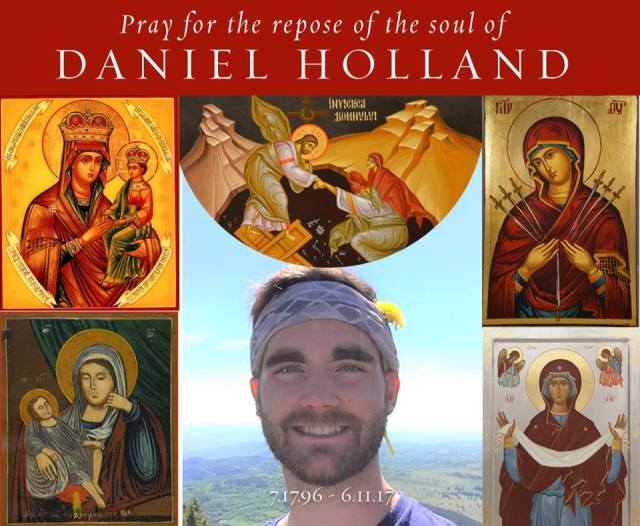
+DANIEL reposed on Sunday, June 11, 2017, while trying to swim across the Spree river near the Ebertbrücke, 10117 Berlin. He was on a college trip, studying abroad.


resurrection.jpg

“Until the resurrection, son.” His father, Father Seraphim Holland

May God hear his prayer and send comfort!

This beautiful young man, Daniel Holland, died tragically at the age of 20. Listen here  to the words of love, life, and hope, offered by his father, Priest Seraphim Holland, at his funeral service,where he had to bury his own son. These 20 minutes could turn out to be life-changing for you.

At the funeral for Daniel: about his deep heart and how and why we pray for the dead, and how to properly keep his memory.

http://www.orthodox.net/ser…/funeral_2017+daniel-holland.mp3

How and why Orthodox pray for the dead
The deep heart

SYNOPSIS:Remarks at the funeral of Daniel Holland (+Sunday of All Saints, 2017), from his

father. His deep heart, and how and why we pray for the dead, and how we should

remember him. It is with actions, not words.


In memory of +Daniel, our son/brother/uncle/friend and for those in need
 

https://www.dropbox.com/s/fit5c573wxrpsh5/dyptichs-daniels-list.doc?dl=


The Shroud and the Furnace

patriarch_pavle


“The priest’s cassock is the flag of the Church of our Christ: for this reason we must try hard to honor it, we who wear it, with a holy life, so that those who don’t wear it will honor and respect it.”

Blessed Elder Amphilokhios of Patmos (1889-1970)

*

The first day he put on a cassock, a seminarian got a letter from a friend, a few years his senior. This is what he learned about his cassock:

A cassock. Today in your eyes it is more beautiful than a bride’s dress. You are truly and rightfully happy wearing it; after all, you have been waiting for it since the time you entered the seminary.

I can only hope that you will be equally happy when it has come to be what its color implies, i.e. a deadly shroud and a dying uniform. Today it is a bride’s dress you enthuse over, along with your family and friends. Be as enthusiastic about it when it starts to be your solitary confinement, cage and furnace where God will melt and purify you, an uncomfortable hermitage.

This bride’s dress, when necessary, will be your armor, provided you care to remember and use it this way. Wearing a cassock can and should be a form of prayer in itself, but it does not become a prayer just by putting it on.

Pockets. The deep ones are meant to store all the things you will share with others. Always have something to give away to the needy and children. Remember that they will appreciate a little money, your smile, and a word of solace more than your impeccable hymn singing. This is because people need first and foremost to hear that they are loved, and even more so to feel that this is true.

An inside breast pocket. It is not meant for holding an expensive pen. Carry in it letters you do not know how to answer, notes with the names of those you have promised to pray for, other people’s bills you have decided to pay, addresses you know should be visited, as their occupants will never come to you on their own, pictures of dogs, cats, grandchildren, and people in love as well as tree leaves and drawings nursery students have offered you. Keep this pocket filled at all times.

May your cassock always be a nuisance and a stumbling block when you start putting on airs and strutting like a peacock, falling prey to your vaulting ambitions. May you always stumble on it when you are led astray. Do not worry – it will stick in your way.

Do not be afraid to tuck it up and run to help your neighbor, even if you will look like a clown.

Sleeves can be rolled up. The cuff reminds you that a cassock is no dress uniform, but work clothes. But roll up your sleeves only to do the work He wants you to do, never to further your own agenda.

I sincerely wish that your cassock would show white salt marks: the ones on the back will be the signs of your sweat, the ones on the chest will be the marks of tears, both yours and those who, hugged by you, will confide in you their hundreds of worries big and small, grave and frivolous. I wish that these white salt marks would appear sooner than the first streaks of grey in your hair.

Do not be afraid to crumple and soil your cassock, coming to the rescue of the needy and wounded. Do not hesitate to tear it up to make bandage and dressing for human wounds. Remember that, if need be, it can be converted into a cloak or a tent.

May it quickly show traces of wear and tear on the knees and shoulders, signs of your prayer and bearing other people’s burdens. May it not show such signs on the behind and elbows, indicatorsthat you have sat down a lot or elbowed your way through the crowd.

Love your cassock but do not love yourself in it.

First and foremost, love the Church who has given it to you. And love Jesus, who has offered you the Church and who has offered you to the Church, for which I am myself so grateful to Him.

Remember that passengers on a bus or on the metro believe they have more right to take a seat than a priest. Frankly speaking, it is immaterial whether they are right or not. What matters is that even when people hate you, they must not hate God.

More and more people will look at you; after all, your cassock gives you a lot of visibility. It also intimidates, and there will be fewer people brave enough to criticize you. This does not mean, however, that there will be no grounds for criticism.

Remember that your cassock is not the packaging of a completed product. The Lord has clothed you in it to mercifully hide your inadequacies and deficiencies. Now that you know this, blessed are you if you behave accordingly (John 13:17).


By Dk. Michał Lubowicki

~

Shedding Blood

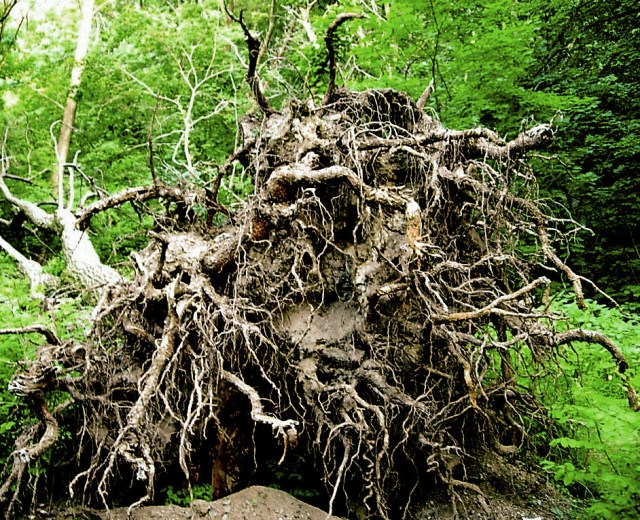
Uprooted_tree_001

On the need to cut off the passions quickly before the soul becomes used to them


Set your minds, brethren, to the examination of your affairs and don’t neglect yourselves, because even a little neglect can lead us into great danger. I lately paid a visit to a monk and found him recovering from an illness. As we were talking I learned that he’d been alone and had contracted a fever that lasted seven days. It was then forty days since the fever had left him and he still hadn’t regained his former strength. You see, brethren, what a trial it is if something goes wrong with you. People usually dismiss a small disorder and don’t realize that if a little thing happens to injure their body, especially if it’s weak to start with, they’re going to need a great deal of time and effort to put it right again. In this case, the poor man had a temperature for only seven days, and look how many days he suffered without recovering. It’s the same with the soul: you commit a small sin and you spend a lot of time, shedding blood, before it’s put right.

We find a variety of reasons for illnesses of the body: it may be that the medicines were old and therefore didn’t work; the doctor wasn’t experienced and tried the wrong remedy; or patients lacked the discipline to comply with what the doctor told them. Now we can’t say this about the soul- that the Doctor lacks experience or doesn’t prescribe the right medicine- since Christ is the Doctor Who knows everything and applies the proper remedy for every sickness: for empty ambition, humility; for love of pleasure, temperance; for avarice, almsgiving. In other words, each disease of the soul has a commandment which is the appropriate remedy. The Doctor’s not incompetent and the remedies are never out-of-date or ineffective, because the more Christ’s commandments are applied, the fresher they become. So, the only impediment to the soul’s healing is our own recalcitrance.

We should attend to ourselves and be vigilant while there’s still time. Why do we neglect ourselves? We should be doing good, so that we’ll find help in time of trial. Why do we fritter away our lives? We’re always hearing this, but we don’t care much about it and are indifferent to it. We see our brothers [in the monastery] snatched away from the midst of us and it doesn’t put us on our mettle, even though we know that, in a little while, we too will be facing death. Since the moment we sat down to talk, we’ve used up two or three hours of our time and are that much closer to death. We see that our time’s running out, but that doesn’t frighten us. Why don’t we remember the saying of that Elder that, if you lose gold or silver you can always find more to replace it, but time, once lost to idleness and negligence, can never be found again? No matter how hard we try to regain one hour of this time, we’ll never do so. How many people long to hear the word of God and don’t find it, yet we who hear it are indifferent to it and aren’t roused by it. God knows, I’m astonished at the callousness of our souls, by the fact that we can be saved, yet don’t want to be. Because we could cut off our passions at birth but we don’t bother to. We allow them to grow and harden, so that we make the last evil greater than the first. As I’ve told you often enough, it’s one thing to pull up a blade of grass and another to uproot a great tree…

I’ve told you the different ways that people fall into bad habits. If someone loses their temper once, this doesn’t make them irascible; if they fornicate once, this doesn’t make them fornicators, nor, if they give alms once, are they charitable. Virtue and vice are formed in the soul by repeated actions, and ingrained habits bring with them peace or punishment. We speak of virtue bringing rest to the soul and vice bringing punishment. Why is there this difference? Because virtue is natural and inherent in us; the seeds of virtue within us are ineradicable… The case of vice is entirely different. By doing repeatedly something which is wicked, we’ll acquire a habit which is foreign to us, which isn’t natural….

There’s one more thing you ought to know about this, though, which is that it sometimes happens that a soul has an ingrained tendency towards one particular passion. If it indulges that passion even only once there’s an immediate danger that it’ll turn into a fixed habit…

So there’s a need for great vigilance and zeal, plus fear, if we’re to avoid falling into bad habits. Believe me, brothers, anyone with a single passion that’s become a habit is destined for punishment. Even if you do ten good works for every one resulting from a bad habit, the latter will prevail over the good actions. If an eagle almost escapes a snare but is held fast by a single claw, it’s lost the power to get away. It’s outside the net, but is still half-held by it. The hunter can strike it down at will. So it is with the soul: if it has one passion set into a bad habit, the enemy can strike it whenever he pleases, because he has the upper hand over the soul through that passion. This is why I’m always telling you not to allow a passion to take root in your soul. We have to struggle, and pray to God night and day, lest we fall into temptation. As people, we’ll be defeated and slip into sin, but if so, let’s get up again quickly, do penance and weep when we’re faced with God’s goodness. Let us be vigilant and continue to strive. Then, seeing our good intentions, our humility and our contrition, God will give us a helping hand and extend His mercy to us. Amen.


Abba Dorotheos

Healing Fear

Year: 2013 (released 2014)
Running time: 110 minutes
Director: Oleg Sytnik
Cast: Vitaly Bezrukov (Luke), Ekaterina Guseva, Andrew Saminin, Alexander Jacko, Vladimir Gostyukhin, Alex Shevchenkov
Manufacturer: “Patriot Film” (Ukraine, Belarus), with the support of the State Agency of Ukraine for movies and the Ministry of Culture of the Republic of Belarus
Synopsis:
The film “Luka” is the dramatic destiny of of the world famous surgeon who would become St. Luke of Crimea, the great surgeon and priest — V. Voyno-Yasenetsky (Luka).
The year was 1917. Young doctor Valentin Voyno-Yasenetsky with his wife and four children moved to Tashkent, beset by civil war. Voyno-Yasenetsky became head physician in the city hospital. He not only saved hundreds of patients every day, operating under the bullets of the permanent street battles, but he fought for his life and the life of his beloved wife, dying of TB. In the midst of communist persecution, he was alone with four children on the outskirts of the former empire, so he decides to become a priest. And since then, he never gave up either scalpel or cross, and he went with them through all their hard exiles and arduous life, treating both body and soul.


St. Luke of Crimea was an Archbishop in the Russian Orthodox Church during Soviet times and an occasional prisoner on account of his faith, suffering extended physical torture in Soviet gulags for as long as 2 years at a time.

He is called the “Blessed Surgeon” because in addition to his work in the Church he was also a practicing doctor and professor of medicine, known internationally for his research on anesthesia and his innovative surgical techniques. St. Luke reposed in the Lord in 1961, and his prayers and relics are known to heal many people today of physical maladies.

Come To Me….

athoniada

Athonite Film Wins Award at International Film Competition

 
Monks and students at Athoniada Ecclesiastical Academy participated in the 3rd International Cinema Competition with a short film titled Come To Me….
 
The final ranking was announced in Athens on May 25, 2017 at the Michael Kakoyannis Foundation during the award ceremony. It was one of seven films awarded out of 290.
 
Athoniada Academy is a school that operates out of Karyes on Mount Athos. It was originally founded in 1749 by Ecumenical Patriarch Cyril V and housed in a building of Vatopaidi Monastery.
 
The school provides a junior high school and high school education, with free housing, schooling and food, and the students live a common life.
 
All the necessary facilities for living such as washing machines, dryers, sports, table games, books from its modern library, computer room with modern computers, etc. are available.
 
All the students are taught what is also taught in public schools, and additionally there is offered Ecclesiastical Music, Iconography, Liturgics, Teleliturgics, Athonite History, Interpretation of Gospel Passages and Patristic Texts, Ethics, and other things.
 
See the award-winning short film prepared by the Athoniada Academy students:


A Smile from Eternity

Honorable Mr. Papanikolaou,

A few hours after the entombment of elder Joseph, you posted at your website an article with the title «Funeral of Blessed Elder Joseph of Vatopedi – A Smile From Eternity«, describing in a few words the event aided by a few pictures.

The photograph of the reposed, who is smiling not only with his lips but with all the expression of his face, made  a great impression on people, which we can see  from the articles and comments in numerous web-sites.

One can indeed come across dead people with a glowing face, a peaceful expression, but with never a smile. On the one hand all the spiritual fathers say that the time of death is horrifying for man. On the other hand we read in the book of the Sayings of the Desert Fathers that even the most advanced ones , out of humility, did not let down their guard before entering eternal life, where there is no longer any danger.

In addition, Elder Joseph had a major heart problem and he was very debilitated by this illness. So how did he repose smiling?

The answer is: NO, he didn’t repose smiling, but HE SMILED AFTER HIS REPOSE.

After a conversation of us with some fathers of the monastery, we convey to you the story of the event.

The two monks that were with him until the very last moment, sprinted to the abbot, Elder Ephraim, to let him and the rest of the fathers know about the repose of Elder Joseph and the former two didn’t pay attention to the reposed, who was left with his mouth half-open.

1

2

3

Thus, they came back to the cell, to prepare the reposed according to the monastic order. Elder Ephraim ordered them to leave his face uncovered. The fathers tried to close his mouth, but as it was quite late, his mouth remained open. They even tied a gauze around his head, so that his mouth would remain closed, but after they removed it his mouth opened up again. About 45 minutes had already gone by, since he had passed away.

-Elder, what should we do, it looks bad with the  mouth open?

-Leave him as he is, do not cover his face!

5

6

They sewed him inside his monastic mantle as according to monastic custom. The whole procedure so that he was put inside the mantle and sewed in took another 45′. Then, they cut off the cloth around his face –according to the order- and found the elder as everybody can see him now, smiling.

Did he listen to them and granted them this litle favour, so that he didn’t hurt their feelings? Or, was it that he wanted to grant us an indication what he saw and let us know the state in which he is now?

7

The smile of elder Joseph of Vatopedi, is the First supernatural event after his repose and has become a great consolation for everybody.

8

keidia 1

dsc_0982

dsc_0988

Panayiotis Koutsou

Source: Diakonima