Veiled Before God

little_russian_girl_orthodox

Because of the Angels

For 2000 years in the Orthodox Church, the tradition has been for women and girls to veil their heads during worship, whether at church for the liturgy, or at home for family prayer time.

What is the Scriptural and Patristic evidence for this tradition, and why is it important?

In this article, we will take a look at headcoverings in the Old Testament, headcoverings in the New Testament, headcoverings according to the early Church, headcoverings in icons, and headcoverings today. At the end of the article there are links to additional resources for learning about Christian headcoverings.

Headcoverings in the Old Testament

Centuries before the birth of Christ, women’s headcoverings were an accepted practice for God’s people. It was not merely an option for those who wished to be holy. Rather, it was a matter-of-fact expectation that all women would cover their heads.

When the Holy Spirit inspired Moses to pen the first five books of Scripture, women’s headcoverings were simply assumed to be the normal practice. In the book of Numbers, when a unique ceremony is performed that requires an uncovered head, Scripture makes a point to say that the woman’s headcovering needs to be removed:

the priest shall stand the woman before the Lord, uncover the woman’s head, and put the offering for remembering in her hands” (Numbers 5:18)

Of course, such a requirement would make little sense, if women did not normally keep their heads covered.

Even earlier than this, in the book of Genesis, we read about Rebekah, on a journey to meet her future husband, Isaac:

Then Rebekah lifted her eyes, and when she saw Isaac she dismounted from her camel; for she had said to the servant, “Who is this man walking in the field to meet us?” The servant said, “It is my master.” So she took a veil and covered herself.
(Genesis 24:64-65)

Christian girls worshiping in traditional headcoverings at a Russian Orthodox Church

Her godly discretion is a model for women today. She did not flaunt her physical beauty. Rather, she veiled herself, increasing her allure through an outward display of modesty.

Women’s headcoverings can also be found in the story of Susanna. It is the captivating story of a beautiful, virtuous woman who was falsely accused, and later vindicated by the wisdom of young Daniel. Susanna wore a veil that covered not only her head, but her face as well. Scripture looks disapprovingly upon the removal of her veil:

Now Susanna was exceeding delicate, and beautiful to behold. But those wicked men commanded that her face should be uncovered, (for she was covered,) that so at least they might be satisfied with her beauty. Therefore her friends and all her acquaintance wept. (The Story of Susanna / Daniel 13:31-33)

In this passage of Scripture, virtuous people approve of women’s headcoverings and veils, while ungodly men seek their removal.

Headcoverings in the New Testament

Women’s headcoverings are one of the many points of similarity between Israel and the Church. Godly women had covered their heads for thousands of years prior to the advent of Christ. And when the New Testament Church was born, godly women continued the practice.

Women’s Head Coverings in the Orthodox Church

In St. Paul’s first epistle to the church in Corinth, he instructs everyone to follow the holy traditions which have been received:

Now, I praise you, brethren, that you remember me in all things and keep the traditions just as I delivered them to you. (1 Corinthians 11:2)

Women’s headcoverings are one of the holy traditions which the Church had received, and St. Paul spends the next several paragraphs discussing them. He says that headcoverings manifest honor, in the context of worship:

  1. Every man praying or prophesying, having his head covered, dishonors his head.
    (1 Corinthians 11:4)
  2. Every woman who prays or prophesies with her head uncovered dishonors her head.
    (1 Corinthians 11:5)

The message is pretty clear:  It is honorable for a woman to wear headcoverings during worship, but it is dishonorable for men to wear them. This is why men remove their hats for prayer, even to this day.

Not content to make his point only once, St. Paul reiterates himself a few verses later. Women are to cover their heads, and men are not to do so:

  1. A man indeed ought not to cover his head, since he is the image and glory of God; but woman is the glory of man. (1 Corinthians 11:7)
  2. The woman ought to have a symbol of authority on her head, because of the angels.
    (1 Corinthians 11:10)

Catacomb of Priscilla

The Old Testament reveals that this holy tradition is ancient, but it only begins to hint at the reasons.

Here in the New Testament, we are given some reasons for the practice. According to 1 Corinthians 11, headcoverings manifest a woman’s honor. They also are important “because of the angels”.

Angels are present with us when we pray, and when we worship. While we may not fully understand why headcoverings are important to the angels, it is sufficient for us to know that this reason is given in Scripture. If Scripture says that women’s headcoverings are important to the angels, then it is something we should take seriously.

Headcoverings according to the Early Church Fathers

St. Mary Magdalene, wearing a headcovering

St. John Chrysostom (d. A.D. 407), in a sermon at the Feast of the Ascension, spoke both of angels and the veiling of women:

The angels are present here . . . Open the eyes of faith and look upon this sight. For if the very air is filled with angels, how much more so the Church! . . . Hear the Apostle teaching this, when he bids the women to cover their heads with a veil because of the presence of the angels.

Origen, another prominent teacher in the early Church, said,

There are angels in the midst of our assembly . . . we have here a twofold Church, one of men, the other of angels . . . And since there are angels present . . . women, when they pray, are ordered to have a covering upon their heads because of those angels. They assist the saints and rejoice in the Church.

The Apostolic Tradition was written in the second century, and the author is believed to be St. Hippolytus of Rome. This book has instructions for catechumens, including this:

And let all the women have their heads covered with an opaque cloth . . .

Myrrh Bearing Women

And St. Cyril of Alexandria, commenting on First Corinthians, wrote:

The angels find it extremely hard to bear if this law [that women cover their heads] is disregarded.

Headcoverings in Icons

Icons in the Orthodox Church are a visual guide to the Faith, a sort of “picturebook” of Christianity. Icons teach us about the life, death, and resurrection of Christ, and about the lives of many Christians who have gone before us.

Icons also teach us about headcoverings.

The Mothers of Modern Medicine

Virtually every icon of an Orthodox woman displays her wearing a headcovering. As far as I know, the only exception is St. Mary of Egypt, and she was a solitary saint who lived alone in the desert, far away from any people.

Among the female saints who participated in society, all of them wore headcoverings, and their headcoverings are shown in icons.

Even Mary the Mother of God–the most blessed woman in the entire universe–is shown in icons, wearing a headcovering.

Can you think of a better role-model for women?

Headcoverings Today

In our church, all women and girls are asked to wear headcoverings, in obedience to God’s command in Scripture, and out of respect for the holy traditions of the Orthodox Church. Just inside the front door of the church, we keep a basket of headcoverings, just in case a woman forgets hers at home and needs to borrow one for the day. Headcoverings are also worn at home, during family prayer time.

While honoring God’s direction is a reward unto itself, there are many other benefits as well. For example:

Headcoverings manifest a woman’s honor. As St. Paul points out in Scripture, a woman brings honor to herself by covering her head during prayer.

Headcoverings encourage humility. Godly women come to church to focus on worship, not to draw attention to themselves. A girl may be tempted to show off an attractive hairdo. When a woman wears a headcovering, this temptation is removed. She can focus on prayer, instead of on hair.

Headcoverings save time. In today’s culture, it can be tempting to spend a lot of time and energy on hairstyles. But headcoverings are quick and easy. It takes a lot less time to put on a headcovering, than it does to prepare a hairdo for display.

Headcoverings help us show love and consideration for our brothers. Godly men come to church to focus on worship. But the flowing locks of beautiful woman can be distracting. By veiling her hair, a woman can display her modesty, and remove an unnecessary distraction.

A mainstream theological journal recently published an article about women’s headcoverings. Soon after, the author of the article became a member of the Orthodox Church. In the article, she beautifully illustrates the iconic purpose of headcoverings:

My wearing a head covering is not only a symbol or sign that I am in agreement with His order, but that I visibly, willingly submit to it. With submission comes blessing.
~ Christa Conrad

Theotokos Tender Mercy Icon

In an issue of The Handmaiden, a lady named Elizabet gives her testimony about wearing headcoverings:

For twelve years I have worn a scarf [headcovering] at all times. I now perceive that it has been—and continues to be—essential for the pilgrim journey and salvation of my soul. The bottom line for me—and a growing number of my sisters—remains obedience. And with it comes a sense of being in our rightful place in God’s ordered universe, rejoicing with the angels. Now I gratefully say, “I am!” in the presence of the great I AM—at prayer and in church, surrounded by the angelic host, worshipping our Lord and King. To God, Father, Son, and Holy Spirit, be the glory, now and ever and unto ages of ages. Amen!

Reference: Women’s Headcoverings

I’ll take it on

takeon

“Leave this problem that you have to me, son. I’ll deal with it. You pray, stay calm, have peace within you and be careful how you live. Everything will turn out in accordance with Christ’s will.”

Archimandrite Symeon Krayiopoulos

The Broken Priest

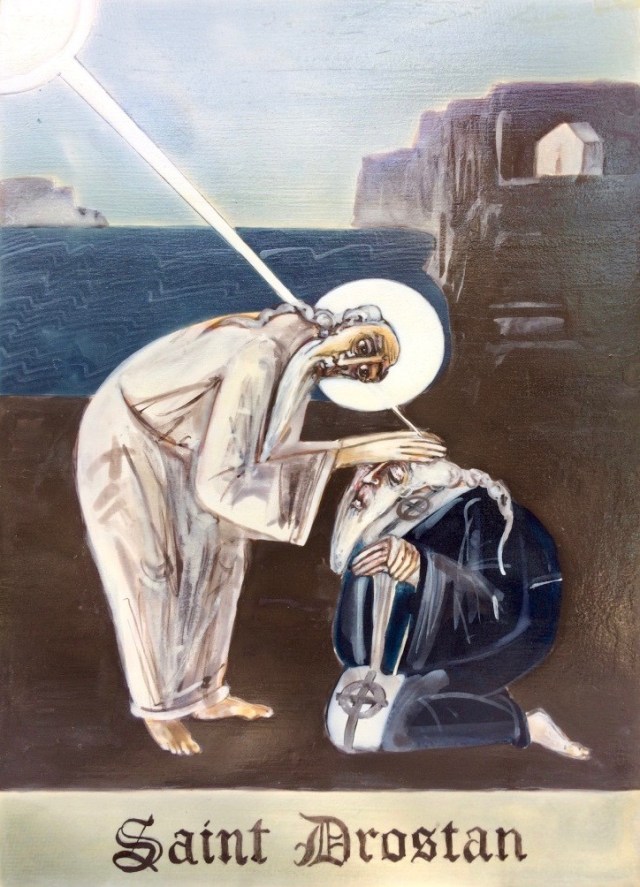
Saint Drostan.jpg

Such insight and perception of the all too frail human priest from Father Seraphim Aldea!

St. Drostan — Spiritual Fatherhood

Bishops, priests and monastics – male and female – can suffer (God willing, maybe not all of us do) from a type of loneliness that comes from the responsibility of always comforting (without being comforted), always forgiving (without ever being forgiven), always getting everyone back on their feet and spiritually renewed (while hardly ever receiving any spiritual support themselves). Yes, this is the cross we were given; and yes, this is the path we have taken. And yet, we are all human – clergy and monastics included – and like all humans, we need forgiveness, we need light, we need support, we need to be allowed to get up and start again. We need what all humans need – to feel loved.
There is so much I love about St Drostan, yet I suppose it is this particular miracle – the healing of a priest called Symon – that brings him instantly close to my heart. There is something special to me, a priest, about this story. St Drostan’s miracle speaks loudly about a suffering which is rarely talked about in the Church, a kind of suffering that goes mostly unnoticed by all except those who are affected by it – the clergy of the Church.
Because of this perception – that clergy should never need any help – priests and monastics tend not to ask for help when they suffer. And they do suffer, for it can be very lonely as a priest. It can be depressing. Life can get very dark. People forget that our bishops, priests and monastics are the most exposed among us – spiritually, they are on the front line, they are the ones under the greater attacks, they are the ones both God and the devil test most. God does it out of an excess of love; the devil – out of an excess of hatred.
St Drostan’s miracle spoke to me because it envolved the healing of a priest, but also because of the nature of that healing. Symen, the priest, needed light. The priest had lost his sight, had lost his direction, had lost his hope. When darkness engulfs the heart of a priest, that is no ordinary darkness, but the deepest of the deep. Symeon, the priest, goes to St Drostan to ask for light, and St Drostan opens his spiritual eyes to the Light of Christ.
When we were working on the compostion of this icon, there were a number of things I wanted it to convey. Priest Symeon (note his epitrachilion, a symbol of his priesthood) has his eyes closed, as a sign of the spiritual darkness which is fighting him. There is complete abandonment on his face. St Drostan is his last hope, and he places his soul in the hands of this holy man. I know from my own experience how much a priest longs to be blessed himself, to feel a hand over his own head taking away his sins, forgiving him, granting him light and the hope of a new beginning. A priest can hold his hands over hundreds of heads in a week, praying for all, absolving all, while his heart longs for a loving hand above his own head.
St Drostan does precisely that. His expression is loving, but focused and deep in prayer. He does not look at the kneeling priest, but at the Light pouring through his hands over Symeon’s hands, completely aware that this Light (not himself) is the source of all healing and salvation. Like all confessions, this icon depicts the meeting of three Persons, not two: the spiritual father, the son and God Himself. Symeon’s humility (he is kneeling before the saint) comes from his need and despair, but St Drostan’s humility (note his posture) comes from his awareness that he is doing God’s work, in His Maker’s presence (which is why is is slightly bowing, as if standing before Christ). I purposely chose not to depict St Drostan as a priest (although he was ordained), because I wanted to signify that spiritual fatherhood is not an exclusive charisma of the ordained clergy – the Tradition of the Church has kept the memory of simple monks (and, indeed, nuns) whom Christ had blessed for this particular work.
Finally, pay attention to the Light that crosses the icon diagonally, from the upper right corner to the lower left one. This Light, the Uncreated Divine Light, God Himself, descends from Heavens and first rests on the spiritual father. St Drostan’s hallo is ‘fed’ by the divine Light, as a sign that his holiness is God’s holiness – God and Man become one in His Divine Light. The Light then travels from the spiritual father onto his hands, as a sign that holiness is always translated into holy works. In this case, the holy deed is the healing, the restauration of Symeon’s sight, the very gift of the Divine Light from the spiritual father to his spiritual son, who have now become as one. in God’s Light.
… As I prayed for an understanding, for a vision of what this icon should look like, I was reminded once again of how much I owe my own spiritual father. I am totally aware that all I received through him came from Christ; I am aware he is only human. But for me, this ‘only human’ man has kept me spiritually alive (and has spiritually resurrected me many times).  … for one’s spiritual father, the most simple and direct way to tell him that nothing of his sacrifice is forgotten. It lives on through me. I am alive through this sacrifice.

When Christ Found Me in the Himalayas


Impossibility of Aloneness


I’m an Orthodox Christian living in Homer, Alaska and experienced Jesus Christ in the Himalayas, in India.

I listen to the heartbeat of rain outside…

Cold, Alaskan fog blowing in off the bay, emerald hills now that autumn is here and summer chased away into the mountains. But a milky white fog spreads over the bay like a silken ghost. I used to visit Trappist monasteries, back when I was Catholic, at the beginning of high school, and searching for a relationship of love. I read plenty of philosophy then to know that knowing isn’t enough, that having a realization in the mind is entirely different from experiencing a revelation of the heart.

I spent two birthdays in the Himalayas…

Traveling along gravel roads that drop deep into icy gulches where the Ganges river rages below not yet packed with the filth and mud and newspapers of villages, not yet carrying remainders of Indians in her current, I found Christ found me. It’s a difficult and strangely compelling atmosphere to confront oneself, – – India, – – sandwiched with black corpses, white snow, pagan fires and virulent animals.

I took a bus north from Delhi. It was crowded, tight and cramped, flies buzzed between my face and the windows smeared with brown slime. It’s so polluted in Delhi, so much coffee-colored smoke, so much steam that you really can’t see the sun. You saw it, a rising orange-reddish ball burning over the horizon fifteen minutes in the morning, but then fifteen minutes slouching back down again, an exhausted head over the mountains.

I grew up Catholic but turned to Buddhism when introduced to a self-hypnosis class at my Catholic high school, experimenting with meditation and ‘mindfulness.’ I experienced serious symptoms of manic depression then, partially because I’d consciously turned away from the Judeo-Christian God, and also because life at home was very, very difficult for me. I grew anxious and got into extremely self-destructive habits, and so Buddhism seemed a perfect door to address – or not address – my turning from God and family, and focusing my energy toward dissolving into a Void, a dissolving bubble on an endless and personless river, Tathāgatagarbha. The element that got me is to dissolve my desire, and abandon my selfhood, in order to avoid suffering. But desire doesn’t seem so bad, especially when it is for love, which requires more than one person, and thereby voids any notion of abandoning self, – – and to love, to truly love, is to give, which may require sacrifice, and suffering – –

So Tibetan Buddhism kept coming up, because the meditation helped calm my anxieties and depression, and because the culture proved highly engaging, what with all her colorful flags, her skulls, and metaphysical explanations of things, – – but what is left, when ‘I’ disappear, and there is no one else for whom a relationship of the heart can exist? Not to mention, what did the experiences of the Gospels, the Cloud of Witnesses, the Holy Church, amount to? I knew nothing of Orthodoxy when I reached into the closet of Buddhism, but in light of it, now, what does it all add up to?

33190003
Joseph in Gangotri, where he met Christ in a cave.

Mindfulness worked as far as cleansing the window, the mind, is concerned, which is important, but then many of its doctrines, – and I explored countless doctrines, – really stop here. Clear sky. But what it did not do, and could not, really, is orient me toward the sun, and the warmth of the sun, and the sunlight – – all religions seem to contain some seed of truth, but fail in witnessing to the Triadic God…and all my destructive habits, and relationships, and every mantra, and yoga, all of which I’ve had my fill…this is how Christ brought me to Him.

Back to the story, I’m in Delhi, on a bus. And after an hour or two of sitting in that cramped, stuffy and urine-soured air you hear the front breaks release, the bus finally stretching her arthritic joints and creak slowly forward. She rolls, head first, toward the busy main road. For fifteen minutes we cough and pop down the road, away from my filthy, but greatly lovable refuge of Manju Ka Tilla, a sort of Tibetan refugee camp criss-crossed with telephone wire, wet and narrow alleyways packed with dogs and diapered babies, and polio. Cobblestone streets and bakeries, copper trinkets and arms, this is the first place on earth I met leprosy, and her sister polio. The beginning of my spiritual warfare.

I usually saw them together, these two, – polio and leprosy – crowding in around a barrel of fiery rags, in the crayon-black darkness hands like chewed-up bread, teeth pencil yellow and cracked. I see a boy attacked by a skinny, vicious-looking dog with long, wet fur and crazy eyes – it looks like a red and yellow fox, – – a tangle of fur and blood and whimper. The taxi cab drivers, waiting on their afternoon customers near the stinking, feathered dumpsters launch after the monster in a terrible raid of madness and darkness. They chase the thing down with bricks loosened from neighboring grocery store steps leaving the boy warm and wet with his own blood, a hound’s tooth broken off inside his leg.

Here is suffering, and personhood, and sacrifice…

He looks young but his face shows no signs of innocence. His dark eyes follow me as I run a few feet away to pick up a bottle of water, then return. We look at each other. His long, dangling arms and fingers started rubbing the area of skin that have broken open and gush a strange, purple fluid.

Wet, mossy feet and the bitter odor of trash hang in the air. Cows streaked with vomit pick through spoiled food and milk cartons nearby at the dumpsters. He waits for a doctor but one never arrives. I don’t know what else to do. The boy looks through me, limping into an alley and disappearing in the terrible darkness.

I will live here a total of five and a half months. I will have arrived here practicing Buddhism and Hinduism for eleven years, and leave Christian…

I thought maybe I’d join a Buddhist monastery, or be discovered by wise sage in the mountains, spend the rest of my life in the Himalayas experiencing exotic mystery and enlightenment. I read dozens of sutras by various Buddhas, had an underlined and well-worn copy of the Bhagavad-Gita and Upanishads, and was reading all the California guys, Bhagavan Das, Ram Das, Krishna Das, and even met most of them, all the 60s ‘hippy’ idols who dropped acid and flew to India to go ‘find the guru.’ I read Be Here Now and did the whole drug scene, but despite all the colorful statues and marijuana and tantra, no matter how ‘empty’ I became, there wasn’t enough and I sensed…how can I say this…something was wrong.

I worked as a wilderness guide for at-risk youth in the sage deserts of Idaho. Teaching primitive skills, meditation and mantra, and working with psychologists to develop methods of emotional and behavioral therapy – – I was chased by a wolf, I killed a rattlesnake. And while out there, – this is in the middle of my life before Christ, – – toward the end of it, actually, – – I began experiencing strange things – not only while traveling through India, but before that, and not only me, but my girlfriend. We saw, and everyone involved with this recipe of mantra, meditation, yoga, – and a lot of it sober, – – we saw shadows and demons, experienced trembling and ungodly anxiety and fear. So I knew something was strange, something was going on. It is not all opinion, all belief, for if I have freewill, and exist outside the body, – and I had plenty experiences where I knew I was more than my body, – – and this is one of the things that helped me dismiss and eventually leave the bag of eastern religions, – in addition to God’s grace, – – that if I am more than my body, and I have free will, and can choose to either accept or reject love, then others can too, and this brought up the issue of good versus evil, of right and wrong.

Was what I was doing, right? Who was I following? Are these things, these deities, just archetypes, and if not, if they are ‘real,’ are they ‘good?’ It like jumping into an ocean and realizing there are many different things floating around in there, harmless creatures, some of them beautiful, and some, in fact, that will attack you, that are poisonous, and the astral life, the spiritual life, is like that. Very quickly, once I got to India, I understood this. And was scared.

The boy with the watermelon disease, his head swollen on a piece of cloth outside my guest room door, a cloud of black flies wriggling over an empty ribcage and hollow eyes, a human Jack-O-lantern, his mother’s long brown arm rung with silver jewelry begging for rupees.

So why did I leave a supportive and beautiful girlfriend behind in Oregon to experience this? I was beginning to mend my relationship with my parents, gain more confidence, and had read Way of the Pilgrim a number of months before, but it was with all my California stuff, and I never saw any relation to that and Orthodoxy, never once asked, where is a church that deepens one’s relationship with the living, loving, Truth? Where truth is a Person, as I’d later read from Father Seraphim Rose?

I’d head up to the mouth of the Ganges River, to Gangotri, – – into a mountain. On my 28th birthday, I listened to the heartbeat of the wind on the cliffs, on the water, and experience not a realization of the mind, though that did happen, sure enough, but only once the heart was struck by a sort of cherubim’s sword in my heart, experiencing a revelation occurring in meeting the living God, Jesus Christ, and myself peeling away from itself.

What can I say?

snow1
After Baptism Into the Holy Orthodox Church

Everything I’d learned, practiced, experienced for all of eleven years poured out from my head, in one ear and out the other, replaced by their approximate Christian terms, fulfilled, actually, and I knew reincarnation is impossible through the resurrection, because I am a self, a soul, and I knew karma is impossible because it operates independently of ‘God’ and there is Divine Intervention, I’ve witnessed it, and experienced it. In the cave, a joyous ache in my heart, and in the cave, no more aloneness, no more aloofness. In the Himalayas, and I mean immediately, like I was zapped, I really met Christ, and was dumb for a moment, and in Eternity I saw in my heart the Person of God as Christ, and I could never, ever be alone. Maybe I’d FEEL alone, sure, (doubtful) but I ought to remember, the impossibility of aloneness. Maybe that should be the title of this letter.

So what happened after? I picked up a Bible and read the thing in a guest house back in Dharamsala, over 12 hours away, and then I’d return to America, after the shaking bus trips and gargantuan ceremonies of burning bodies and yellow and black gods and goddesses, and and I’d fall into the lap of the Orthodox Church, in Eugene, and, I’m only skimming over it now, due to time constraints, and I’d visit St Anthony’s Monastery, in Arizona, and all the monasteries and churches in between, long enough to fill a book, and pray to St Herman who could, by his intercessions, bring me straight to Spruce Island, and to where, kneeling before his relics, find home. In Homer. There is more, but I’ll write later. So much has happened to my heart. Forgive me for rambling, and going on. May the Father of Lights enlighten us, and have mercy on us. Amen.


“It is one thing to believe in God, and another to know Him.” + St Silouan


By Magnus

February 18, 2013 

Printed in Issue 24

Editors Note: Joseph Magnus now lives in Port Townsend, Washington. He is a writer of children’s books and helps the Father Lazarus Moore Foundation. To visit his blog and read more of his poetry, short stories, and other writings, visit here: Servant of Prayer

A Prayer for All Time

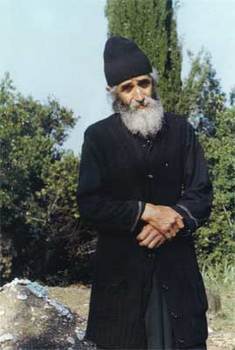
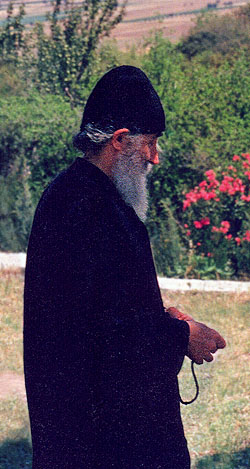
st paisios

Elder Paisios: Say this prayer every day and God will always be at your side.

    The love of the Elder Paisios for the whole world is well known.  The Elder has helped a whole host of people before and after his physical death.  But the question is from where did he receive his ability to help people and to perform miracles?  He received this heavenly power through his fervent prayers to God.

   The following prayer of his was given to a convent which had asked the Elder for a prayer rule that could be used by the nuns in their evening vigils.  This directive was given to the nuns during the final years of his life.  The main emphasis of this prayer is his profound love for all of humanity.

  This prayer can be used by every Christian believer since it takes in all the issues of life that need our prayers.  Even the children can understand it easily since it is expressed in simple words.  It can be used by families during their evening prayers.

Prayer

Our Lord Jesus Christ:

Do not abandon your servants who live far away from the Church.   May your love convict them and bring them back to you.

Lord have mercy on your servants who are suffering from cancer.

On your servants who suffer either from small or serious ailments.

On your servants who suffer from physical infirmities.

On your servants who suffer from spiritual infirmities.

Lord have mercy on our leaders and inspire them to govern with Christian love.

Lord have mercy on children who come from troubled homes.

On troubled families and those who have been divorced.

Lord have mercy on all the orphans of the world, on all those who are suffering pain and injustices since losing their spouses.

Lord have mercy on all those in jail, on all anarchists, on all drug abusers, on all murderers, on all abusers of people, and on all thieves.  Enlighten these people and help them to straighten out their lives.

Lord have mercy on all those who have been forced to emigrate.

On all those who travel on the seas, on land, in the air,  and protect them.

Lord have mercy on our Church, the bishops, the priests and the faithful of the Church.

Lord have mercy on all the monastic communities, male and female, the elders and eldresses and all the brotherhoods of Mt. Athos.

Lord have mercy on your servants who find themselves in the midst of war.

On your servants who are being pursued in the mountains and on the plains.

On your servants who are being hunted like birds of prey.

Lord have mercy on your servants who were forced to abandon their homes and their jobs and feel afflicted.

Lord have mercy on the poor, the homeless and the exiled.

Lord have mercy on the nations of the world.  Keep them in your embrace and envelope them with your holy protection.  Keep them safe from every evil and war.  Keep our beloved Greece (we can add here all countries, all mankind) in your protective embrace day and night.  Embrace her with your holy protection defending her from all evil and war.

Lord have mercy on those who have been abandoned and have suffered injustice.  Have mercy on families that are going through trying times.  Pour your abundant love upon them.

Lord have mercy on your servants who suffer from spiritual and bodily problems of all kinds.

Lord have mercy on those who are despairing.  Help them and grant them peace.

Lord have mercy on those that have requested that we pray for them.

Lord grant eternal rest to all those who have passed on to eternal life throughout the ages.


Saint Paisios the Hagiorite (1924-1994) – II

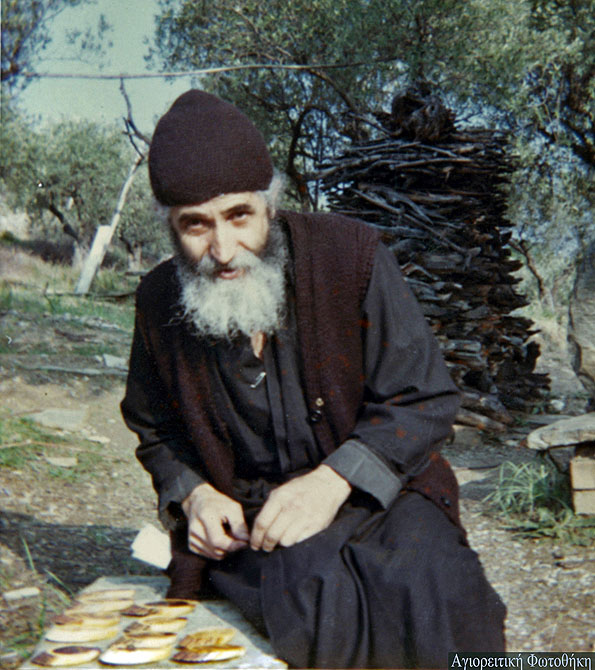
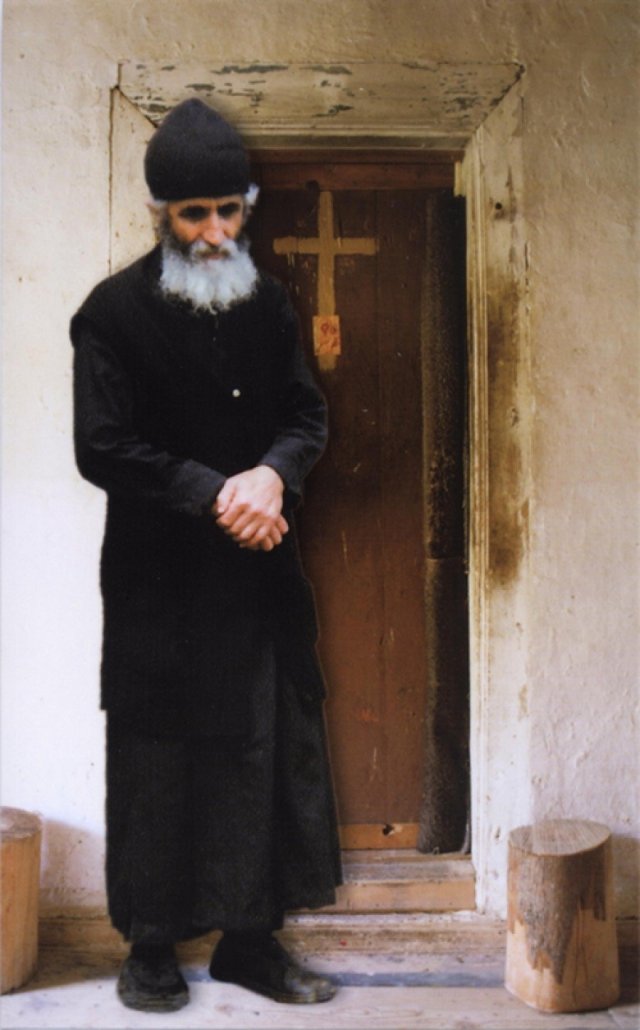
At some point, the Cell’s door, of the old and poor building, would open and the Elder, who had been inside involved in discipline and heart prayer for the salvation of his soul and the souls of his brothers, would appear. His face was always exhilarated and his attitude cordial. He would receive us and ask us to sit in the “outdoors dorter” on seats made of pieces from tree trunks. He would shake our hands and at the same time offer us loukoumia and water according to the tradition of Mt. Athos.

Paisios at Kelli Panagouda

There, under the trees, with the songs of the birds “as the vocal drone”, the Elder would start talking to us with “the words of eternal life” (John 6:68) either answering our questions or making comments on his own on the basis of information from “above” about the needs of each one of us. Here is the miraculous thing! The pilgrims were of various ages, professions, characters, spiritual and intellectual levels. Some of them were conscious of who was sitting in front of them and exactly what they were looking for. Some were there because they had heard something about him. Others were there with an ill-tempered and negative mood. He, guided by the Holy Spirit, offered “as every man had need” (Acts 2:45 ).

I will never forget, in relation to the above, the Elder’s behaviour towards a Spanish student of Fine Arts, follower of the Pope, who happened to be amongst us in the “outdoors dorter” at some visit. At some point, the Elder turned to him with affection and interest making use of some Italian words and phrases he remembered from the Italian occupation so that he could communicate with him. Then, he gave him many pieces of advice in the Greek language and revealed to him many truths that, as he explained to us, the Holy Spirit would help him feel regardless of the fact that the different language would not allow him to understand. More specifically, when another visitor made the comment that “the foreign student does not understand what you are saying to him in Greek”, he answered that “he will understand what he is meant to understand”.

His advice to all his visitors was to have a spiritual father. This is why after giving answers and advice to questions or problems put forward by the people, he would finally send them to their spiritual fathers to lay the burden of their sins, which were the cause of all problems, under their stoles.

Many Christians, therefore, leading autonomous lives, selfishly, as orphans, “as sheep having no shepherd” (Matthew 9:36 ) took his advice, found a spiritual father and started living according to the Church. Their lives and the lives of the ones around them changed. Here I would like to mention something that the Elder always recommended for his wedded visitors. “Have the same spiritual father with your wife. Because as the carpenter uses the same plane to work on two pieces of wood and make them fit, the same way the spiritual father will use the same “plane” to work on the character of both spouses so as to make them fit. Whereas if you have different spiritual fathers, you will face difficulties.”

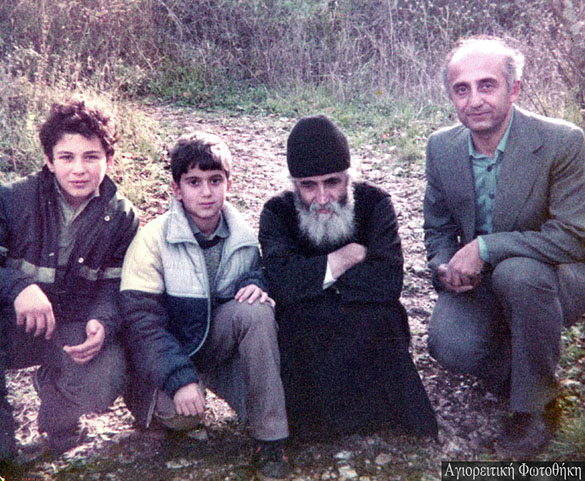
Paisios monachos Agioreitis26

I would like to mention something else extremely important that the Elder said on another occasion. I was with a group of people in the “outdoors dorter”, when another group came, amongst whom there was an assistant professor of the Medical School of the University of Athens who held the Elder in great veneration. The professor asked Fr. Paisios at some point with pain, interest and love: “There are, Elder, many colleagues of mine, doctors, who have good intentions, good feelings, “bowels of mercies” (Colossians 3:12 ) but do not believe. What can we do for them?” “Listen,” says the Elder”, “pray for them because under these circumstances they deserve God’s mercy.” He had said the same about some teachers and professors on another occasion.

The Elder, as a genuine man of God, had consolidated and immovable ideas “in the things he hast learned and hast been assured of” (2 Timothy 3:14 ). He knew and taught “by word and deed” (Romans 15:18 ) that in the issues of faith there is no swaying, negotiation or compromise. He clearly knew that there is no greater unhappiness and bigger danger for the Christian than to deny his faith and accept deceit. As we know, many deceived people, people that did not feel rest, urged by his reputation, went to meet him and discuss their existential problems. It is true that many of those people went there full of delusions and left repented, seeking then guidance in their spiritual fathers.

If, therefore, someone gets involved with some of the heresies and para-religions that have flooded our country mainly in recent years as well as if someone advances in the initiations, rites and other demonic activities imposed in order to become a member, this means a conscious or unconscious negation of the faith to the Trinitarian God, Christ, the Church and the Baptism, I once asked the Elder: “What should we do with these people when they repent and want to return to the Church?” “You will say,” he said, “the Service for the One that returns to the Orthodox Church. The people that return will denounce the bad faith with libel, they will confess the faith of the Church by reciting the Symbol of Faith and then you will anoint them with the holy unction.”

All of us are very much concerned about our dear departed, their state and what we can do about them. We used to ask the Elder about this and wanted really convincing answers. He would emphatically advise us to pray a lot for them. “Prayers,” he said, “memorial services, liturgies, mercies are very much to the benefit of the departed ones.” “You should pray more,” he added, “for the departed ones than the living. Because there is nothing they can do on their own any more, but we can help them attracting God’s mercy through praying and the other means we have mentioned so that their state can be improved or even change, because they are still under judgment.” And he concluded by saying in his characteristic way: “Is it a small thing to take our departed one from a sunless basement to a sunny apartment through our prayers?”

At some point, I remember, he mentioned something overwhelming as regards the departed ones and our stance for them. There was a suicide once, a person who put an end to his life by falling from a bridge into a river. This man, as the Elder said, repented while he was falling, asked for forgiveness, his repentance was accepted and his soul was received by a Lord’s angel. We must learn not to despair; and pray for our brethrens asking for God’s mercy and according to the words of St. Isidoros Pilousiotis: “do not forerun God’s judgment.” (P. G. 78, 377) and be judges of the others.

Georgios Chr. Efthymios

Source: Pemptousia

Saint Paisios the Hagiorite (1924-1994) – I

+ 12 July 

St. Paisios of Mount Athos, my spiritual grandfather and my patron Saint

paisios 2

In the summer of 1975, I was blessed with going for the first time to the Garden of the Mother of God, Mount Athos (Agion Oros). I visited various age-long monasteries; I paid my respects to many of the priceless treasures of the Holy place, that is, holy remnants of martyrs and saints of our faith as well as holy icons. I participated in the daily all-night long masses which are concluded with the Divine Service early in the morning. I sat at the simple monastery table, where everything reminds you that you eat in order to survive and fight for your salvation and you do not live in order to eat, where the reading of the devout patristic text aims at transporting the minds of the table companions to heaven. I associated with conscientious monks who, inspired by the divine love and obeying the urging of Basil the Great, “take care of thy self”, have denied the world, but not man for whom they pray unfailingly with love and “with many tears” (Act. 20:19) in their cells and the church during the sacred vigils.

During my visit, I did not succeed, despite my wish, to meet Elder Paisios who was then an ascetic at the Stavronikita cell of the Holy Cross. This came later, “when the time was mature” (Gal. 4:4). What I realized about this full-of-grace person during my first pilgrimage to Mount Athos were the characteristic words of another co-pilgrim, today an assistant professor at the Medical School of the University of Thessaloniki, who had met him and told me that “his love breaks you apart”, something I verified myself later on.

I will deal with this genuine man of God briefly, as I had the opportunity to do in the past with my dear spiritual fathers, Elder Porfyrios and Elder Iakovos Tsalikis.

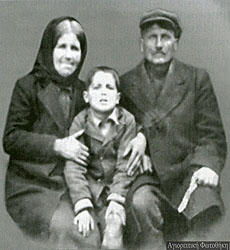
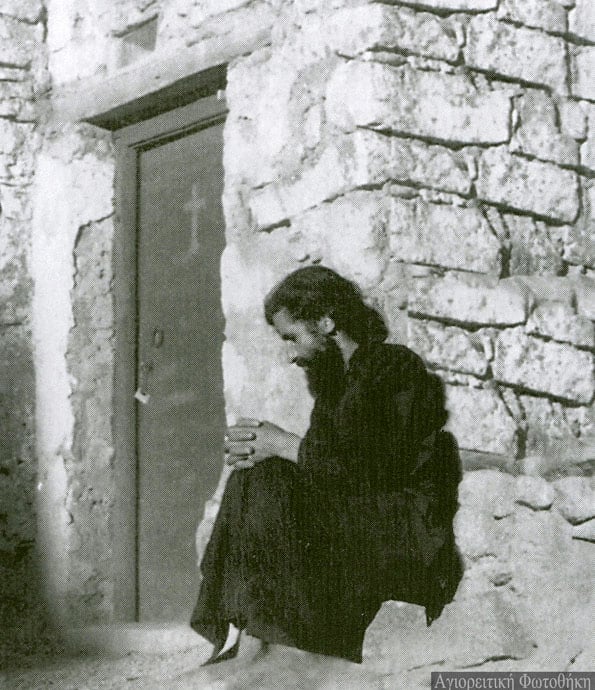
Paisios 5 years old, with his parents

On Tuesday, July 12, 1994 , the late Elder Paisios, the Hagiorite, rested in the Lord, at the Holy Cemetery of St. John the Theologian, in Souroti of Thessaloniki.

***

This genuine man of God, whose secular name was Arsenios Eznepides, was born to pious parents, Prodromos and Eulabia, at Farasa, Cappadocia on the 25 th of July, 1924.

Due to the extraordinary and harsh conditions, he was baptized a few days later at Farasa, on the 7 th of August, by St. Arsenios Chatziefentis and was given the name “Arsenios”.

Barely a month after his birth, he was driven along with his parents, relatives and other citizens of Farasa away from his paternal home and became a refugee.

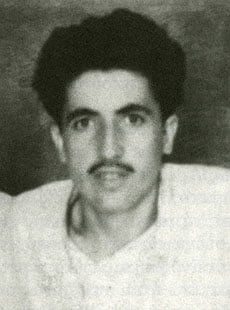
Paisios while serving in the army

The boat with the refugees arrived in metropolitan Greece on September 14. The Elder’s family lived for a little while first in Piraeus , then in Castro of Corfu and in a small village near Igoumenitsa prior to settling down in Konitsa in 1926.

He finished the Konitsa Elementary School and, then, he worked as a carpenter until 1945 when he was enlisted in the army. His military service, during those unlucky years of the civil war, lasted for approximately four years, until 1949, when Arsenios Eznepides, the radio operator, received his discharge certificate marked with “excellent” conduct.

In 1950, he went to Mt. Athos aiming at realizing the dream of his life; that is to receive the angelic schema.

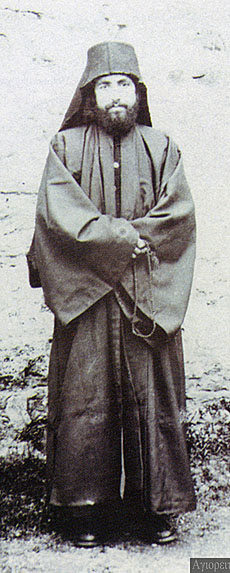
In 1954, he was tonsured at the Monastery of Esphigmenou where he was serving as a novice as a rasophoros monk with the name of Averkios.

Paisios just tonsured

In 1956, he was tonsured to the “Small Schema” in Philotheou Monastery taking the name “Paisios”.

In 1958, after being asked by the people of Konitsa who were spiritually in danger by a “raid” of Protestants who had managed to proselytize eighty poor families, he went to the Monastery of the Theotokos Birthday, at Stomio, next to the Aos River. He stayed there for four years and greatly helped the inhabitants of the area who visited the Monastery.

In 1962, we find him as an ascetic at the Cell of Saints Galaktionas and Episteme, in the desert of Mt. Sinai.

In 1964, he returned to Mt. Athos and took up residence at the Archangels’ cell, at the Scete of Ivira.

In 1966, he was operated on and had part of his lungs removed due to a serious illness.

In 1967, he settled down at Katounakia, at the Cell of Ypatios of Lavra, for more intense discipline.

In 1968, Papa-Tychon clothed him in the “Great and Angelic Schema”, at the Holy Cross Cell of Stavronikita Monastery. He remained in the Cell after the repose of Papa-Tychon on the 10 th of September, 1968, and stayed there until 1979.

Paisios while staying in Mount Sinai

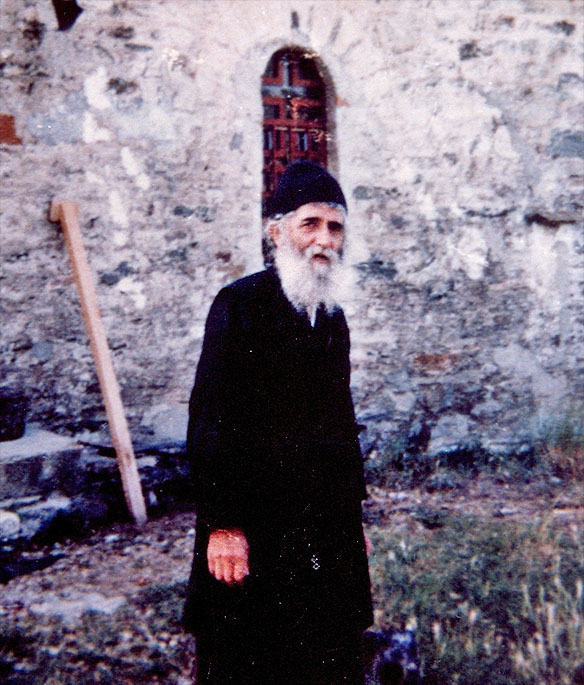
In 1979, he moved on to his final home, the Panagouda Cell of the Monastery of Koutloumousiou, near Karyes. He stayed there until 1993 receiving many thousands of people who visited him in order to share their pain with him and ask his advice and prayer.

I was blessed by God to manage to visit him and talk with him during that blessed and fruit-bearing period of fifteen years that he lived in the Panagouda Cell.

paisios 3

I remember my eagerness when I went down the path that led from Karyes, the administrative centre of the Athos State , to the Elder’s cell. The sweet expectation of my meeting with this true man of God flooded my heart and gave wings to my feet.

The waiting in front of the yard’s gate at the Cell was short or long depending on the case. The Elder took good care to “make this waiting sweeter” having always in the Cell loukoumia or other sweets and water to offer to the pilgrims. The inscription written by him “to eat is a blessing” is characteristic. Apart from all the above, there were also makeshift seats so that the waiting pilgrims could rest and various articles of clothing to be worn by them so that they would not get cold as they were sweaty. Such affection, such love, such providence for everybody!

Georgios Chr. Efthymios

Source: Pemptousia

St Paisios and the woman in Hell

st paisios.jpg

* I really do not know what ‘impresses’ me the most in this story: the role of St Paisios or that of the Guardian Angel. May the Lord have mercy on our souls and may we never give such a hard time to our Guardian Angels!

A soul in Hell

The Elder related: ”I knew an old woman who was very stingy. Her daughter was very good, and whatever she wanted to give as alms she would throw out the window so she could leave the house with empty hands, because her mother would always check to see if she was taking anything. But if she told her mother that ‘the monk’ [that is me] had asked for something, then her mother would be willing to give it up. ”After her death, I saw a young man [her guardian angel], and he said to me, ‘Come-so-and-so wants you.’ I couldn’t understand what happened to me, but we were standing in front of a grave in Konitsa. He moved his hand, like this, and the grave opened. Inside, I saw a grimy mess and the old woman, who had started to decay. She was calling out, ‘Monk, save me.’ ”My heart went out to her. Feeling sorry for her, I climbed down inside and without being repulsed I embraced her and asked, ‘What’s wrong?’ ”She said, ‘Tell me, didn’t I always give you anything you asked, willingly?’ ”Yes,’ I said, ‘that’s true.’ ”All right,’ said the young man, soothing her. He moved his hand like this again and closed the grave like a curtain, and I was back in my cell. ”The sisters from Souroti asked me, ‘What happened to you on the feast day of Saint Andrew?’ I answered, ‘Pray for so-and-so’s soul.’ Two months later, I saw her again. High above an abyss, there was a plateau with places, a lot of houses, and many people. The old woman was up there. She was very happy with the face of a small child that had just a tiny spot that her angel was also scrubbing to clean off. In the abyss, in the distance, I saw people being beaten and harassed, and trying to climb up. ”I embraced her out of joy. I took her aside a little, so the people in the abyss wouldn’t see us and be hurt. She said to me, come on, let me show you the place where the Lord has put me.’ ”

From the book, Elder Paisios of Mount Athos by Hieromonk Isaac