‘For they shall see God’: Elder Eusebios Vittis (+2009)

Toward the last years of his life, I had the blessing to speak with him in private and pray together. Elder Eusebios, the mystic, the poet, the Seer of God, as they called him! This Meeting burns still in my heart!  May we have his blessing!” (Little city hermit)
 *

“Prior to his [ie. Elder Eusevios] death he was sought after by many souls seeking comfort and consolation. I, though unworthy, was  granted the blessing of not only meeting him but hearing a homily he gave and of speaking with him very briefly in private. The memory of his soft hands and piercing eyes have remained forever in my heart.

Since my feeble words cannot properly convey his holiness, nor his pure and all-consuming love for Christ our God, I have taken the liberty of copying a translation of one of his poems for our spiritual benefit. It was translated by a fellow-student of mine, Michael Tishel. May God grant him many blessings for his effort in bringing the inspiring writing of a contemporary saint to the English-speaking world!

Before the Crucified One by Elder Evsevios Vittis (+2009)                                                                                                     Translation © by M. Tishel taken from his blog One Pilgrim to Greece…

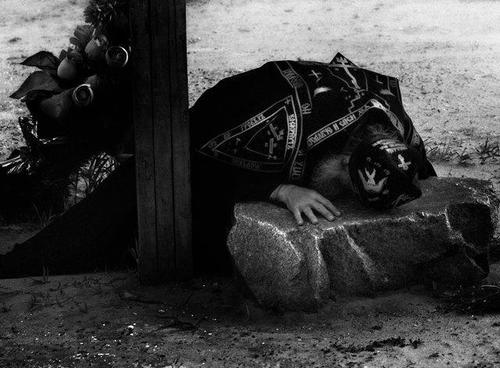
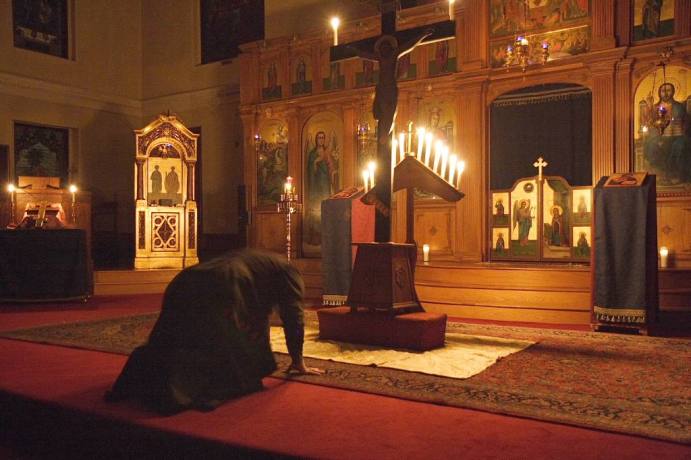
O soul, you who are weary and saddened by many things that, out of politeness, you would rather not mention. Instead, you hold them within you, not wanting to offend, hurt or scandalize any other soul around you–from near or far. You, o restless soul, who search for peace, run to the Crucified One, the Sweet Jesus; kneel before Him with contrition. Tell Him the following words with courage, slowly, purely, and honestly, and with steadfast faith that you will be heard:

O Lord my Jesus, meek and humble in heart, I wholeheartedly beg and beseech You:

Release me from the desire to be admired by others.
Release me from the desire to be loved by others.
Release me from the desire to be sought out by others.
Release me from the desire to be honored by others.
Release me from the desire to be praised by others.
Release me from the desire to be preferred by others.
Release me from the desire to give advise to others.
Release me from the desire to be commended by others.
Release me from the desire to be cared for by others.

Release me from the fear that they will humiliate me.
Release me from the fear that they will scorn me.
Release me from the fear that they will reject me.
Release me from the fear that they will slander me.
Release me from the fear that they will forget me.
Release me from the fear that they will offend me.
Release me from the fear that they will suspect me.

***

Lord, grant me to desire that others be loved more than me.
Lord, grant me to desire that others be esteemed more than me.
Lord, grant me to desire that the good view of others increase, and that my own decrease.
Lord, grant me to desire that others be put to use more than me.
Lord, grant me to desire that others be praised more than me.
Lord, grant me to desire that others be remembered, and not me.
Lord, grant me to desire that others be preferred and chosen over me.
Lord, grant me to desire that others make progress in virtue more than me, if of course I could achieve something like that on my own.

O soul, you who art hurt and wounded by that which you have inflicted on yourself, if the Lord hears you–and He will hear you if your prayer is genuine, honest, fervent and comes from the depths of who you are–

–how much peace will reign in your heart!
–how much serenity will take root inside of you!
–how much tranquility will be painted on your face!
–and amongst all of the events of your life, how many blissful moments will you experience, both large and small!

Don’t forget, beloved soul, that most of the offenses that we experience stem from the exaggerated concept that we have of ourselves. They have their beginning when we overestimate what we do and offer, with the hidden intention of increasing our status in the world, however possible.

The greatest thing in the world is to be forgotten by everyone, except by those who we love and who love us (even if we find that those who we love very much do not respond in like manner). Maybe you think, blessed soul, that your love for others is greater than theirs is for you. How can you truthfully measure this? The Holy Spirit through the Apostle says: ”owe no man anything, except to love one another“ (Romans 13:8). In other words, your debt is always unpaid! So how are you so bold as to make demands as if you’d paid it? Love, therefore, without waiting for some sort of response. Love the following truth, and carry it in your heart: that anything, except for our ”debt“, creates within us

restlessness, instead of joy,
agitation, instead of peace,
anxiety, instead of certainty,

Don’t ever forget this!
Let’s allow this attitude, therefore to be implanted within us. Let’s not stop walking this road. Let’s not allow prideful thoughts to trick us, such as the following:

I could be doing something else, much more important than what I am doing,

It is a thought, seduced by deceptive aspirations, desires and unfounded zeal to leave our everyday work, as we quite ridiculously want our virtuousness to blossom more than that of our neighbor’s.

Rather, let us keep busy with what we are doing, because that is what God has given us to do.

Let us occupy ourselves by doing it as best as we can.

This means, in short, to do it
with clarity.
with energy.
with joy.
completely.

This is how the Elder looked the two times I met him, like a little angel.

May we have his blessing!”

September 24, 2011 by matushka constantina


Weakness at the Beginning of Lent

depression10

I am tired. I feel tired and afraid, with no control over anything. At my best moments, I realise that this is a gift – the gift of awareness, of truth. Because the truth is we are never in control over anything. We invent little worlds (our group of friends; our family; our parish; our monastery) over which we may claim some sort of dominion. We invent silly games (our careers, the rules of our society) which we can win. We upgrade or downgrade these games carefully, so that we are never pushed beyond what we feel we can control.

depression6

But look up, look beyond the borders of these silly little kingdoms where we rule. Lent is a horrid period. Year by year, Lent is when some force within me pushes me out of my comfort zones, and I find myself in a lions’ den, face to face with the beasts, utterly unprepared to fight, totally helpless, fully aware that the only possible outcome is to be slaughtered.

This is nothing new. This happens every year. Yet, I somehow survive, because the same Force that pushes me out of my self-created kingdoms, out of my self-created games – that same Force saves me from those wild beasts at the last moment.

depression7

And this changes everything.

Perhaps I should not share this with you. Perhaps it would help the monastery more if I kept my weakness to myself and pretended to be someone I am not. This would be the proper thing to do – but I have never tried to be proper; I have never cared to replace my honest, weak self with the false image of a man who is in control. Those who play this game are one step away from a type of suicide – not to allow yourself to be seen, to cover yourself under the expectations of others, to betray the feeble, yet precious being that you are out of fear that you will not stand up to the standards of others… This is the definition of hell, the betrayal of one’s deepest, most intimate self. I don’t want to leave this world having played a respectable part, yet knowing that who-I-am was never visible. What can be worse than to go though life as someone else?  What bigger failure than to sell out your own self?

depression8

If you don’t live as yourself – weak and fallen, as you are – how can you love? Whose love is it that you feel? With whose love do you embrace the world around you? Whose good deeds and whose sins are your good deeds and your sins? When you hide yourself under an image, you basically step aside and die – all that is left is the image you created. It is this image – not yourself – who loves and hates, who lives and dies. You will never experience love – your love – until you own up to your true self. You will never experience life – not even death, ultimately – until you settle down in your own life and accept yourself as you are. I don’t mean this in the sense of ‘this is who I am and there is no reason to change’, but in the sense of ‘this is who I am, this is the real starting point of any change’.

depression9

No healing is possible. No repentance is possible. No prayer is possible, until the heart that heals, repents and prays is your sinful, fallen, yet beating heart. False images do not have hearts. False images do not love. Most painful than all, false images will never reflect Christ, because there is nothing false in Christ, nothing common between Life and void. Prayer begins with pain at one’s fallen nature; it grows out of this pain, and its flowers bloom out of it.

By Father Seraphim Aldea


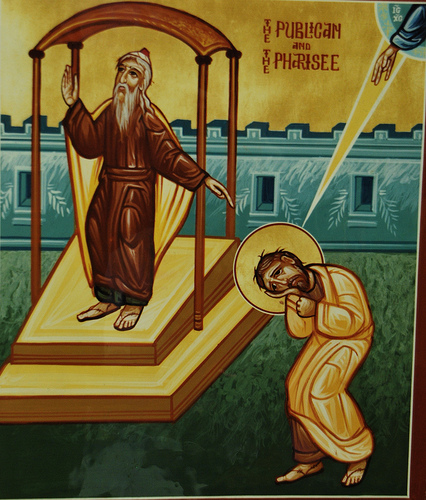
The Gratitude Of The Publican


publicanandpharisee

In the Name of the Father, the Son, and the Holy Spirit.

How short, and how well known today’s parable, and yet, how intense its message, how challenging…

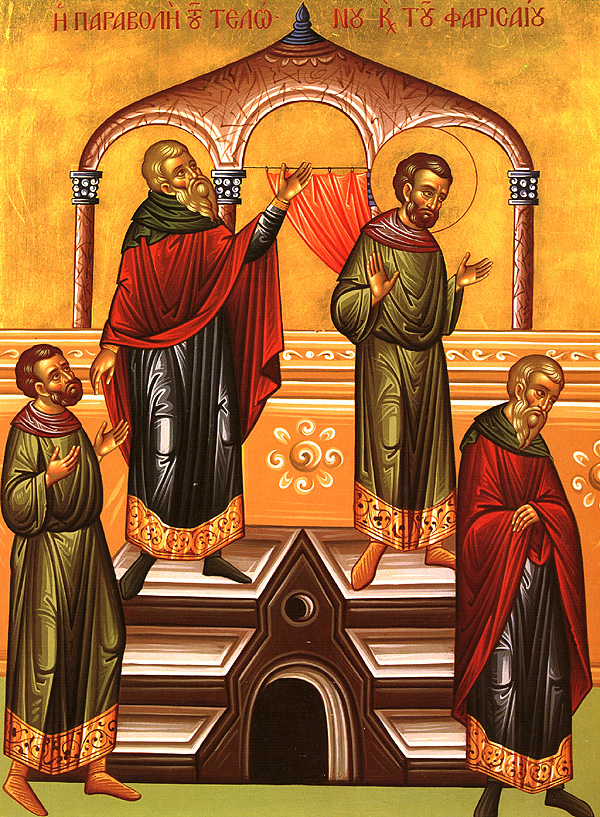
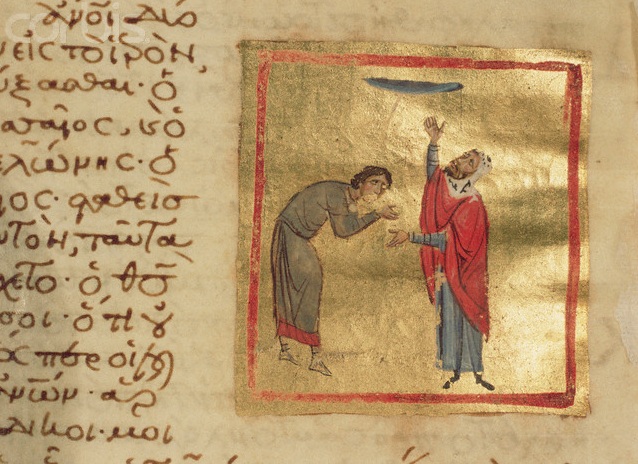
It is intense in its very words: two men come into the church of God, into a sacred realm—which belongs to Him unreservedly in a world that is otherwise lost to Him. They enter His Divine Realm. And one of the men walks boldly into it and takes a stand before God. The other one comes, and doesn’t even dare cross the threshold—he is a sinner, and the Realm is holy, like the space around the Burning Bush in the desert that Moses could not enter without unshod feet, in adoration and the fear of God.

And how different are the words they speak! Apparently the Pharisee praises God, he gives Him glory—but for what? Because He has made a man like him, a man so holy, so worthy of Him, of God; a man who not only keeps all the commandments of the Law, but goes beyond what God Himself has commanded, and can expect of man. Indeed, he stands before God praising Him that he, the Pharisee, is so wonderful that he is God’s own glory, the shining, the revelation of God’s holiness…

The Publican does not dare enter into the holy Realm of God.

publican

And the parable is clear: the man who came and stood brokenhearted, ashamed of himself, knowing that he is unworthy of entering this sacred space goes back home forgiven, loved, indeed: accompanied by God Himself Who came into the world to save sinners and Who stands by everyone who needs Him, who recognizes his need—or not—for salvation.

The Pharisee goes home, but he goes home less forgiven; his relationship with God is not the same—he is at the center, God is peripheral to him, He is at the heart of things, and God is subservient to him. It does not mean that what he did was worthless; it simply means that as far as he is concerned, it has born no fruit of holiness in him. The deeds were good, but they were spoiled, poisoned by pride, by self-assertion. The beauty of what he did was totally marred because it was addressed neither to God nor to his neighbor—it was turned in on his own self. And we are told that this pride has despoiled this man, has taken away from him the fruits of his good works, the fruit of his outward faithfulness to the law of God; that only humility could have given him and his action full meaning; that only humility could have made his actions into life, into the waters of life gushing into eternity.

But then, the question is before us: how can we learn anything about humility if that is theabsolute condition to be not like the barren fig tree, but fruitful, to be a rich harvest which people may be fed.


publican5.jpg

I do not know that we can move from pride and vanity into humility in a moment unless something so tragic happens to us that we see ourselves and discover that we are completely bereft of everything that supported our sinful, destructive, barren condition. But there is one thing we can do: however much we think that we are possessed of all sorts of gifts of heart, mind, body, and soul, however fruitful our action may be, we can remember the words of Saint Paul: O, man! What have you got which was notgivenyou?! And indeed, he echoes at this point what Christ said in the first Beatitude, the Beatitude that opens the door to all other Beatitudes; the Beatitude that is the beginning of understanding: Blessed are the poor in spirit… Blessed are those who know, not only with their intellect—but at least with their intellect!—that they are nothing, and they possess nothing which is not a gift of God.

We were called into being out of naught, without our participation; our very existence is a gift! We were given life, which we could not create or call out of ourselves. We have been given the knowledge of the existence of God, and indeed, a deeper, more intimate knowledge of God. All this is gift! And then, all that we are is a gift of God: our body, our heart, our mind, our soul. What power do we have over them when God no should longer sustain them? The greatest intelligence can suddenly be swallowed into darkness by a stroke; there are moments when we are confronted with a need that requires all our sympathy, all our love—and we discover that our hearts are made of stone and of ice… We want to do good, and we cannot; Saint Paul knew this already when he said: The good which I love, I don’t do, and the wrong which I hate I do continuously… And our body depends on so many things!

pharisee-publican


And what of our relationships, of the friendships that are given us, the love that sustains us, the comradeship—everything that we are and possess is a gift. What is the next move: isn’t it gratitude? Can’t we turn to God not as a pharisee, priding ourselves in what we are and forgetting that all of it is his, but turning to God and saying, “O, God! All this is a gift from You! All that beauty, intelligence, sensitive heart, all the circumstances of life are a gift! Indeed, all those circumstances, even those that frighten us, are a gift because God says to us: I trust you enough to send you into the darkness to bring light! I send you into corruption to be the salt that stops corruption! I send you where there is no hope to bring hope, where there is no joy to bring joy, no love to bring love… and one could go on, on, on, seeing that when we are sent into the darkness it is to be God’s presence and God’s life. And that means that He trusts us—He trusts us, He believes in us, He hopes everything for us: isn’t that enough to be grateful for?

But gratitude is not just a cold word of thanks. Gratitude means that we wish to make Him see that it was not all given in vain, that He did not become man, live, and die in vain. Gratitude means a life that could give joy to God. This is the challenge of this particular parable…

Yes, the ideal would be for us to be humble. But what is humility? Who of us knows the answer, and if someone does know it, who can communicate it to everyone who doesn’t know? But we all know gratitude; we know the small ways and aspects of it! Let us reflect on it, and let us in an act of gratitude recognize that we have no right to be in God’s own realm, and yet He lets us in! We have no right to commune with Him either in prayer, or in the sacrament and yet He calls us to commune with Him! We have no right to be His children, to be brothers and sisters of Christ, to be the dwelling place of the Spirit, and yet He grants it all in an act of love!

Let each of us reflect and ask himself: in what way can we be so grateful that God might rejoice that He has not given these gifts in vain, that He has not lived and died in vain, that we have received the message. And if we grow in a true depth of gratitude, at the depth of gratitude we will fall down, adore the Lord, and learn what humility is—not in abasement but adoration, in the awareness that He is all we possess, all that we are, and that we are open to Him as the rich earth is open to the plough, to the sowing, to the seed, to the sunshine, to the rain—to everything in order to bring forth fruit. Amen!


Mitras.ru

Edited by OrthoChristian.com

Metropolitan Anthony of Sourozh

Prayer and the Absence of God


There is a situation in which we have no right to complain of the absence of God, because we are a great deal more absent than He ever is. 

At the outset of learning to pray there is one very important problem: God seems to be absent. Obviously I am not speaking of a real absence—God is never really absent—but of the sense of absence which we have. We stand before God and we shout into an empty sky, out of which there is no reply. We turn in all directions and He is not to be found. What ought we to think of this situation?
schema

First of all, it is very important to remember that prayer is an encounter and a relationship, a relationship which is deep, and this relationship cannot be forced either on us or on God. The fact that God can make Himself present or can leave us with the sense of His absence is part of this live and real relationship. If we could mechanically draw Him into an encounter, force Him to meet us, simply because we have chosen this moment to meet Him, there would be no relationship and no encounter. We can do that with an image, with the imagination, or with the various idols we can put in front of us instead of God; we can do nothing of the sort with the living God, any more than we can do it with a living person.

A relationship must begin and develop in mutual freedom. If you look at the relationship in terms of mutual relationship, you will see that God could complain about us a great deal more than we about Him. We complain that He does not make Himself present to us for the few minutes we reserve for Him, but what about the twenty-three and a half hours during which God may be knocking at our door and we answer, ‘I am busy, I am sorry,’ or when we do not answer at all because we do not even hear the knock at the door of our heart, of our minds, of our conscience, of our life. So there is a situation in which we have no right to complain of the absence of God, because we are a great deal more absent than He ever is.


The second very important thing is that a meeting face to face with God is always a moment of judgment for us. We cannot meet God in prayer or in meditation or in contemplation and not be either saved or condemned. I do not mean this in major terms of eternal damnation or eternal salvation already given and received, but it is always a critical moment, a crisis. ‘Crisis’ comes from the Greek and means ‘judgment.’ To meet God face to face in prayer is a critical moment in our lives, and thanks be to Him that He does not always present Himself to us when we wish to meet Him, because we might not be able to endure such a meeting. Remember the many passages in Scripture in which we are told how bad it is to find oneself face to face with God, because God is power, God is truth, God is purity. Therefore, the first thought we ought to have when we do not tangibly perceive the divine presence, is a thought of gratitude. God is merciful; He does not come in an untimely way. He gives us a chance to judge ourselves, to understand, and not to come into His presence at a moment when it would mean condemnation.

Look at the various passages in the Gospel. People much greater than ourselves hesitated to receive Christ. Remember the centurion who asked Christ to heal his servant. Christ said, ‘I will come,’ but the centurion said, ‘No, don’t. Say a word and he will be healed.’ Do we do that? Do we turn to God and say, ‘Don’t make yourself tangibly, perceptively present before me. It is enough for You to say a word and I will be healed. It is enough for You to say a word and things will happen. I do not need more for the moment.’ Or take Peter in his boat after the great catch of fish, when he fell on his knees and said, ‘Leave me, O Lord, I am a sinner.’ He asked the Lord to leave his boat because he felt humble—and he felt humble because he had suddenly perceived the greatness of Jesus. Do we ever do that? When we read the Gospel and the image of Christ becomes compelling, glorious, when we pray and we become aware of the greatness, the holiness of God, do we ever say, ‘I am unworthy that He should come near me?’ Not to speak of all the occasions when we should be aware that He cannot come to us because we are not there to receive Him. We want something from Him, not Him at all. Is that a relationship? Do we behave in that way with our friends? Do we aim at what friendship can give us or is it the friend whom we love? Is this true with regard to the Lord?

Let us think of our prayers, yours and mine; think of the warmth, the depth and intensity of your prayer when it concerns someone you love or something which matters to your life. Then your heart is open, all your inner self is recollected in the prayer. Does it mean that God matters to you? No, it does not. It simply means that the subject matter of your prayer matters to you. For when you have made your passionate, deep, intense prayer concerning the person you love or the situation that worries you, and you turn to the next item, which does not matter so much—if you suddenly grow cold, what has changed? Has God grown cold? Has He gone? No, it means that all the elation, all the intensity in your prayer was not born of God’s presence, of your faith in Him, of your longing for Him, of your awareness of Him; it was born of nothing but your concern for him or her or it, not for God. It is we who make ourselves absent, it is we who grow cold the moment we are no longer concerned with God.

From Beginning to Pray by Met. Anthony of Sourozh (Bloom)

Preparing for Lent


orthodox-prostration

Contrary to what many think or feel, Lent is a time of joy. It is a time when we come back to life. It is a time when we shake off what is bad and dead in us in order to become able to live, to live with all the vastness, all the depth, and all the intensity to which we are called. Unless we understand this quality of joy in Lent, we will make of it a monstrous caricature, a time when in God’s own name we make our life a misery. This notion of joy connected with effort, with ascetical endeavour, with strenuous effort may indeed seem strange, and yet it runs through the whole of our spiritual life, through the life of the Church and the life of the Gospel.

The Kingdom of God is something to be conquered. It is not simply given to those who leisurely, lazily wait for it to come. To those who wait for it in that spirit, it will come indeed: it will come at midnight; it will come like the Judgement of God, like the thief who enters when he is not expected, like the bridegroom, who arrives while the foolish virgins are asleep. This is not the way in which we should await Judgement and the Kingdom. Here again we need to recapture an attitude of mind which usually we can’t manage to conjure up out of our depth, something which had become strangely alien to us: the joyful expectation of the Day of the Lord – in spite of the fact that we know this Day will be a Day of judgement. It may strike us as strange to hear that in Church we proclaim the Gospel – the ‘good news’ – of judgement, and yet we do. We proclaim that the Day of the Lord is not fear, but hope, and declare together with the spirit of the Church: ‘Come, Lord Jesus, and come soon’ (cf. Rev. 22.20).

So long as we are incapable of speaking in these terms, we lack something important in our Christian consciousness. We are still, whatever we may say, pagans dressed up in evangelical garments. We are still people for whom God is a God outside of us, for whom his coming is darkness and fear, and whose judgement is not our redemption but our condemnation, for whom to meet the Lord is a dread event and not the event we long and live for.

Unless we realise this, then Lent cannot be a joy, since Lent brings with it both judgement and responsibility: we must judge ourselves in order to change, in order to become able to meet the Day of the Lord, the Resurrection, with an open heart, with faith, ready to rejoice in the fact that he has come.

Every coming of the Lord is judgement. The Fathers draw a parallel between Christ and Noah. They say that the presence of Noah in his generation was at the same time condemnation and salvation. It was condemnation because the presence of one man who remained faithful, of just one man who was a saint of God, was evidence that holiness was possible and that those who were sinners, those who had rejected God and turned away from him, could have done otherwise. So the presence of a righteous man was judgement and condemnation upon his time. Yet it was also the salvation of his time, because it was only thanks to him that God looked with mercy on mankind. And the same is true of the coming of the Lord.

There is also another joy in judgement. Judgement is not something that falls upon us from outside. Yes, the day will come when we will stand before God and be judged; but while our pilgrimage still continues, while we still live in the process of becoming, while there still lies ahead of us the road that leads us towards the fullness of the stature of Christ, towards our vocation, then judgement must be pronounced by ourselves. There is a constant dialogue within us throughout our lives. You remember the parable in which Christ says: ‘Make your peace with your adversary while you are on the way’ (Mt. 5.25). Some of the spiritual writers have seen in the adversary not the devil (with whom we cannot make our peace, with whom we are not to come to terms), but our conscience, which throughout life walks apace with us and never leaves us in peace.

Our conscience is in continuous dialogue with us, gainsaying us at every moment, and we must come to terms with it because otherwise the moment will come when we finally reach the Judge, and then our adversary will become our accuser, and we will stand condemned. So while we are on the road, judgement is something which goes on constantly within ourselves, a dialogue, a dialectical tension between our thoughts and our emotions and our feelings and our actions which stand in judgement before us and before whom we stand in judgement.

But in this respect we very often walk in darkness, and this darkness is the result of our darkened mind, of our darkened heart, of the darkening of our eye, which should be clear. It is only if the Lord himself sheds his light into our soul and upon our life, that we can begin to see what is wrong and what is right in us. There is a remarkable passage in the writings of John of Kronstadt, a Russian priest of the 19th and the beginning of the 20th century, in which he says that God does not reveal to us the ugliness of our souls unless he can see in us sufficient faith and sufficient hope for us not to be broken by the vision of our own sins.

In other words, whenever we see ourselves with our dark side, whenever this knowledge of ourselves increases, we can then understand ourselves more clearly in the light of God, that is, in the light of the divine judgement. This means two things: it means that we are saddened to discover our own ugliness, indeed, but also that we can rejoice at the same time, since God has granted us his trust. He has entrusted to us a new knowledge of ourselves as we are, as he himself always saw us and as, at times, he did not allow us to see ourselves, because we could not bear the sight of truth.

Here again, judgement becomes joy, because although we discover what is wrong, yet the discovery is conditioned by the knowledge that God has seen enough faith, enough hope and enough fortitude in us to allow us to see these things, because he knows that now we are able to act. All this is important if we want to understand that joy and Lent can go together. Otherwise the constant, insistent effort of the Church – and of the word of God – to make us aware of what is wrong in us can lead us to despair and to darkness, until finally we have been brought so low that we are no longer capable of meeting the Resurrection of Christ with joy, because we realise – or imagine that we realise – that the Resurrection has nothing to do with us. We are in darkness, God is in light. We see nothing but our judgement and condemnation at the very moment when we should be emerging out of darkness into the saving act of God, which is both our judgement and our salvation.

* This talk was given by Metropolitan Anthony to the London Group of the Fellowship of Saint Alban and Saint Sergius and their friends on Saturday, 17 February 1968. It was taken down in shorthand, transcribed, corrected by Metropolitan Anthony and published at the time in booklet form by the Fellowship, but has long been out of print. The editor of the original booklet mentioned in his introduction that ‘because of the large crowds the meeting at Saint Basil’s House (the London centre of the Fellowship) had to be transferred to the Church of Saint John the Baptist, Notting Hill.’

Thin Places, Where Heaven Reveals Its Violence

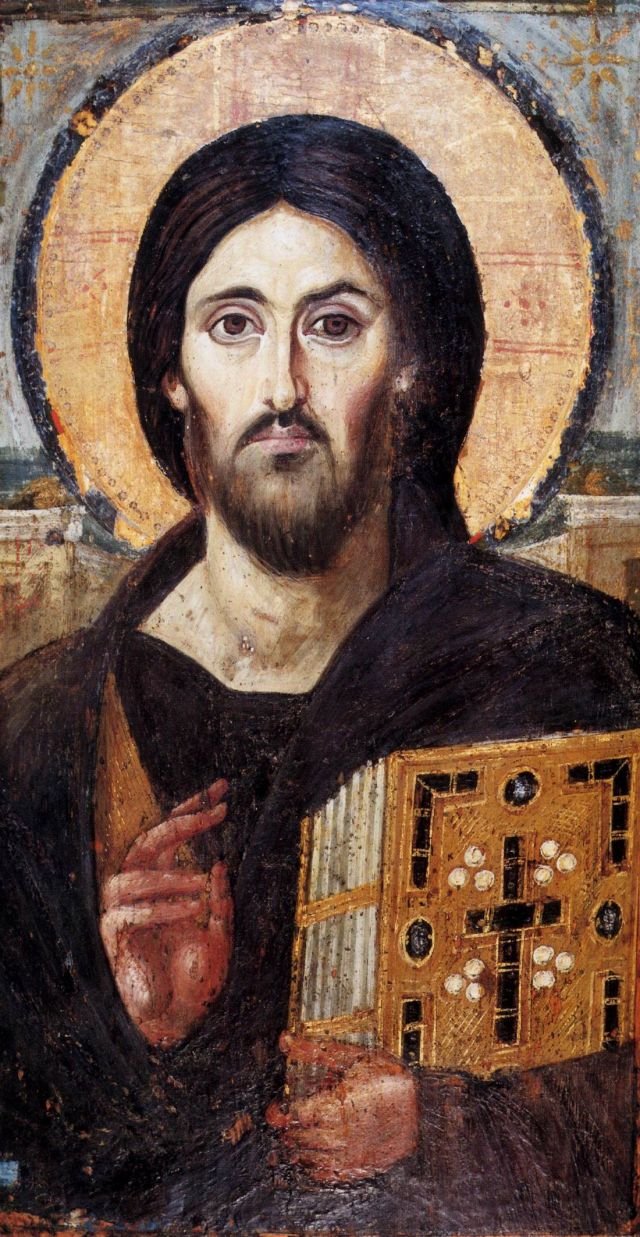
Christ_Pantocrator_Sinai

Christ Pantocrator 6th St. Catherine’s Monastery Mount Sinai Egypt 

Two weeks of no posting … Please forgive me for this ‘break’ but things have been so hectic here, with my father seriously ill, in hospital. Taking the wrong medication can cause serious side effects and even result in death, especially if the patient is 86 years old! Thanks be to God, the doctors saved my father’s life the very last minute! It was such a heart-rending experience watching him collapse …

This whole experience, as was to be expected, shook us deeply and intensified our prayer life. We were literally (and figuratively) all the time on our knees before Him.This is why I have decided to resume my posts with Father Seraphim Aldea‘s,  Metropolitan Anthony of Sourozh, and Lev Gillet‘s reflections on Meeting the Living God, Entering Into a  Relationship With Him in Prayer.

These meditations strangely match a recent experience of mine with an Icon of the Saviour I was offered as a blessing. What an icon! I cannot even begin to stare at His Eyes! As if the icon ‘itself’ ought to be “tamed” … Just staring at this ‘Icon’ feels like a Meeting face to face with Him, a moment of Judgment for me … to be either saved or condemned …

praying

“People are right, Iona truly is ‘a thin place’, a great Celtic expression, describing special places where Heaven and earth are drawn together. What I didn’t know before I came for this week (and perhaps, what many of us do not feel) is how dreadfully frightening Heaven is. Perhaps frightening is not the right word: awe-some, full of awe, entirely alien to us and frightening because of its alien nature – these are all weak descriptions, but they are as good as I’m able to make.

Iona is a thin place, but through the thin veil one can see a frightening revelation. It is precisely because these are thin places that they are frightening, too. What we see through them, what we see through their transparence is the real Face of God: not a tame God, a domesticated God; not a God taken to pieces and rebuilt to fit our sinfulness and weakness; not a God shaped against our emotions and cheap piety; not a God of human traditions and cult; not a God of political correctness or incorrectness – but the LIVING God. The Being beyond being, the Uncreated Creator of everything that is, the untouchable One, indescribable by any of our created words, philosophies and concepts. The frightening God, the crushing God, the God Who utters His voice and the earth melts; the God Who commands: Be still, and know that I am God.

To be in a thin place like Iona is frightening because of the Frightening Being Who suddenly becomes visible and Whom you must now face. I’ve learnt that to face God is frightening, because every meeting with God is a moment of total exposure and Judgement: exposure and judgement of ourselves, of our carefully assembled idols and our horrid manipulations of the Divine realities. God is an alien Being to us, because we have turned ourselves in alien beings to Him. Thin places are dangerous places; approach them with fear, as you approach the Face of God. You are in a moment of Judgement.”

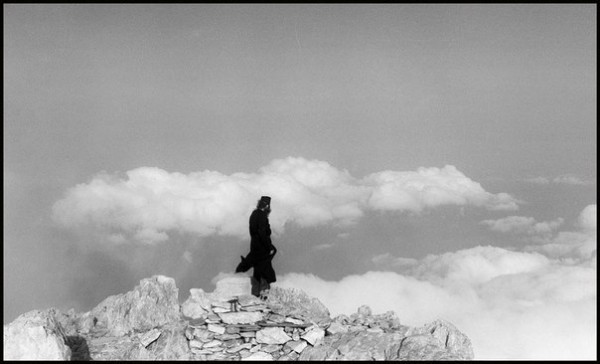
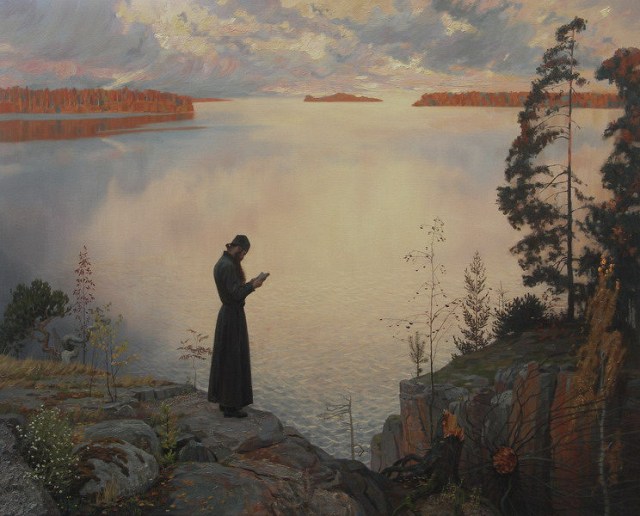
Monk-at-Lake.jpg


Metropolitan Anthony of Sourozh adds to a similar vein: “a Meeting face to face with God is always a moment of Judgment for us. We cannot meet God in prayer or in meditation or in contemplation and not be either saved or condemned. I do not mean this in major terms of eternal damnation or eternal salvation already given and received, but it is always a critical moment, a crisis. ‘Crisis’ comes from the Greek and means ‘judgment.’ To meet God face to face in prayer is a critical moment in our lives, and thanks be to Him that He does not always present Himself to us when we wish to meet Him, because we might not be able to endure such a meeting. Remember the many passages in Scripture in which we are told how bad it is to find oneself face to face with God, because God is power, God is truth, God is purity.”

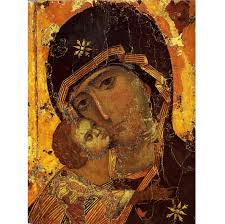
vladimir

Turn to me,
In your good favor, all praise-worthy Theotokos;

Yet, Lev Gillet adds a different dimension, encouraging if I may add, to this discussion: “What does this manifestation [the solemn manifestation of Christ in His baptism in the Jordan] consist of? It is made up of two aspects. On the one hand, there is the aspect of humility represented by the baptism to which our Lord submits: on the other hand, there is the aspect of glory represented by the human witness that the Precursor bears to Jesus, and, on an infinitely higher plane, the divine witness which the Father and the Spirit bear to the Son. We shall look at these aspects more closely. But first of all, let us bear this in mind: every manifestation of Jesus Christ, both in history and in the inner life of each man, is simultaneously a manifestation of humility and of glory.Whoever tries to separate these two aspects of Christ commits an error which falsifies the whole of spiritual life. I cannot approach the glorified Christ without, at the same time, approaching the humiliated Christ, nor the humiliated Christ without approaching the glorified Christ. If I desire Christ to be manifested in me, in my life, this cannot come about except through embracing Him whom Augustine delighted to call Christus humilis, and, in the same upsurge, worshipping Him who is also God, King, and Conqueror.

*

13 And ye shall seek me, and find me, when ye shall search for me with all your heart.

Jeremiah 29:13 (KJV)


  • Thin Places: “Thin Places,” comes from a Celtic Christian concept. The Celts believed that physical locations existed in which God’s presence was more accessible than elsewhere, places where heaven and earth seemed to touch, where the line between holy and human met for a moment, “the places in the world where the walls are weak”, “those rare locales where the distance between heaven and Earth collapses”, as Eric Weiner puts it in his spirituality travelogue, Man Seeks God. For such a ‘thin place’ for me visit my blog post on the Holy and Life-Giving Cross Orthodox parish at Lancaster.


Confessing to Grow Closer to God

confession.jpg

“Confessing to Grow Closer to God” Fr. Seraphim reflects on his experiences confessing, the role of a spiritual father, and he gives three recommendations to help get the most out of each confession. Podcast here

“Continuing in Confessional Growth”Fr. Seraphim continues his discussion from last week on how to get more out of each confession, by recommending three more exercises to help grow closer to both the spiritual father and Christ. Podcast here

“Confessing to Grow Closer to God”
In the name of the Father, the Son, and the Holy Spirit. Amen.
While I have done my best to record these podcasts in silence and moments of the day, or rather moments of the night, when there is silence, enough silence for me to focus on the things I want to talk to you about and also enough silence for you to be able to hear me, I do live in England, so it is almost always impossible to hide from rain. We’ll just have to live with that.I have mentioned in some of the previous podcasts that the monastery has started writing and publishing a series of booklets on various subjects. We have one booklet published on the topic of prayer, and it will be followed by a second one on the subject. There is one which we have published on the island of Iona, including a small guide, a sort of spiritual guide, to St. Columba’s isle. And I’m now working on a booklet on confession and the role of the father-confessor in monastery life.I have decided to write this particular booklet because the questions surrounding a monastic father-confessor and the way one relates to a spiritual father are very frequent. Everywhere I go and meet people to talk to them about the monastery, this is one of the central questions I get asked. So as I am preparing this booklet, I would like to discuss with you some of the topics and some of the ideas I am considering to include into the final form of the booklet. If you feel that there are other aspects you would like covered, if you feel I have not properly addressed or have not addressed at large some of the aspects I am discussing, please feel free to send me an email, and I shall do my best to either reply to you personally or in future podcasts.What I would like to tell you today is just a tiny bit of my own experience with confession. I remember when I started confessing that I was quite puzzled about the whole ritual. I didn’t quite understand what I was supposed to talk about. I didn’t quite understand to whom I was confessing—if it was the priest, if it was Christ, if I was actually simply there to acknowledge things in front of my own conscience. Then I went through a series of more or less difficult experiences with my father-confessor. I had to change my spiritual father when I went to the monastery, and that was a nightmare. Other times I felt that my spiritual father did not have enough time or he didn’t pay enough attention to what I was saying. There were instances when he felt rushed or even almost annoyed and upset for the things I was telling him.But through it all, I kept going. I kept confessing. And as a general attitude, I often thought that the more difficult it feels, the more distant my father-confessor seems, the more useless, pointless the whole experience may feel—the more it is worth doing it, almost like hitting a wild animal when you are attacked. You’re not supposed to simply lie down and be eaten alive because you are attacked. If you are under attack, you fight back. So the more difficult confession felt to me, the more determined, almost stubborn I was to make it work.

Once you have decided, once you have chosen your father-confessor, your spiritual father, my advice is to trust him more than you trust yourself, at least for the first years. When I say “the first years,” I do not mean one or two years; I mean the first ten years at least. Trust him more than you trust yourself. After these ten, fifteen years, there may be the case that you should start placing your trust more in Christ than in yourself. With that general rule, you should be right.

Now let us turn back to confession. Confession can simply be a listing of your sins or your weaknesses, but it can be a lot more. It is entirely up to you to make it more, to make it better. Confession can indeed simply be an encounter between you and your spiritual father during which you tell him of your weaknesses and your sins and the ways in which you have failed God and yourself and your neighbors, but it can be much more if you put a bit of work into it. I am going to list a few exercises for you to consider trying out during your confession. These are things I have discovered simply through experience, and I have learned that, as a general rule, anything can be useful, anything can be turned into a useful experience from which you can learn something. I will give you only one example of what I mean by this, and then we’ll turn to the exercises.

The best thing to do when you prepare for confession, the best practical thing you can do, is to allow your father-confessor time. Never go for confession at the end of Lent or at the end of the fasting period before Christmas or Dormition. Never go and confess at the end of a long queue of 20 or 30 people. If your father-confessor has the time to hear you, if you allow him the time to hear you, he will be paying much more attention to you than if he feels pressed to hear 20 more confessions after you or if he feels exhausted for having heard 50 confessions prior to yours.

And that does happen. I remember in the monastery in Moldavia that we would be for hours, every day, especially during long periods of fasting, hearing the confession of people coming from the villages and the towns nearby. After five or six hours of hearing confessions, all you wanted to do is hide somewhere, find some sort of hole and crawl into it and never come out again, because the confessor is also a human being, and you take all that negativity, all those negative experiences, all the pain, all the failure, all the things that weigh so heavily on the shoulders of all those people whose confessions you’re hearing—it all ends up weighing down on your own shoulder. If you plan your time, if you plan your confession properly, you will be the one who benefits from it.

Now, this is the general rule. That being said, I have once noticed that if I went to my father-confessor when he was absolutely exhausted, the experience of confession felt entirely different. Yes, he as a human being was clearly not paying as much attention as he could have. He simply wasn’t able to any more. He wasn’t there any more. His attention wasn’t there any more. He was simply exhausted. But somehow, from that hollow being, from that exhausted person, came the most extraordinary advice I could possibly hope for, and these were not things my father-confessor would have normally said. After 15 years of confessing to the same person, you end up eventually knowing more or less what to expect. But I have noticed that if I want to hear not my father-confessor’s voice but somehow the voice of his conscience or his heart—I wouldn’t say God’s voice through him, but that is what I’m thinking—if I wanted a clearer view of that, then I should approach him when he, as a human being, is exhausted, when he has reached his limits.

All I wanted to say by giving you this example is that if you want to hear God, if you want to grow, anything can be turned into a positive, useful tool. If you allow the time for your father-confessor to hear your confession properly, you will definitely benefit from it, because your father-confessor understand the context, and he has the ability to think through all possible implications, and he will give you the best possible advice. So take that and use it for your salvation and rejoice in this gift.

On the other hand, though, if you ended up confessing at the end of a long period of fasting or when your father-confessor is simply tired or just not there, for any reason, known or unknown to you, then even that can be turned into a positive experience. The golden rule is that if you tell Christ in your heart, “I want to hear you. Please speak to me,” Christ will speak to you, regardless whether your father-confessor is tired or not, whether he is paying attention or not, whether he’s wholly entirely there or not. The sacrament—you must remember this—the sacrament is between you and Christ. The confessor, the spiritual father, is merely a tool. If there are problems in confession, they are never because of the spiritual father; they are always because something is not working between you and Christ, something is not working, something is not right in the way you have approached confession.

That being said, I just want to list a few exercises for you, and feel free to pick and choose which of these you think may benefit your confession. But I do encourage you to try them at least once. The first and most useful one is to try to reduce your confession as much as possible. Try to keep it under three minutes, for example. The way to do that is to look for the source of evil. I mean, do not make philosophy. Do not be expanding your confession. Do not give any sort of context. Be as simple and plain as you possibly can. Just list the things you need to confess: “I lied.” Full stop. “I am lazy and waste time.” Full stop. “I am proud and yet envious.” Full stop. And so on.

When you cut away the context, there is no way for you to use that context to justify your sinfulness. If you keep it very simple and try to go back to the source of evilness, things become very clear to you. It is the first step you must take. You must understand that there is evilness in you, or that you are fighting evilness. This is not about you selling an image to your father-confessor. This is not about you playing a game or putting on a show: the pious Christian show or the rebel Christian show or whatever else attracts you. This is simply about you being as naked as possible before Christ. Try to limit your confession under three minutes. Try to list, for instance, all your sins on a piece of paper before you go to confession, and then group them into categories, and try to see what is the source of each category. What is that initial mistake, that initial thing that generates all the visible outcomes, so to say? You may have yelled at your brother and your sister, and that is a sin, but what lies underneath that reaction? You may have wasted time, and that is a sin, but what lies underneath that behavior? And so on and so forth.

Really, this simply helps you to understand the depths of our sinfulness and not focus merely on the surface of it. If you simply list the mistakes you’ve made, you are really just focusing on the visible side of your sinfulness, but the depth of it, the heaviness of it lies hidden.

A second thing I try to do from time to time—and again, these are things I do on purpose—is to confess one thing that is extremely disturbing to me, even if it’s not necessarily heavy or as heavy as other things, but it is the sort of thing that, in my mind, will make my father-confessor think less of me, something that I feel horribly guilty for or disgusted. To do that is an exercise of humility, of forced humility. It is a way to empty yourself as much as you can before your spiritual father. It is a way to be as naked, spiritually naked, as you can before him and Christ.

I remember that the first time I’ve done this was after reading the Life of one of those Russian fools-for-Christ. You know who they are. They purposely commit some sort of horrible, disgusting thing in front of people, just so they feel lower and more humble than everyone else. It is useful to do that in front of your father-confessor because it is fighting your pride, and this is one of the best ways of fighting your pride. When you feel pride in your heart, always commit something stupid, on purpose, and do it in front of the people whose opinion counts most for you.

I know of monks in my monastery in Moldavia who would fast according to the strictest of rules, but then when they had guests coming over, they would always behave as if they had entirely forgotten that it was a fasting day. And this is not something that was invented by the Russian fools-for-Christ. You find this type of behavior even in the lives and the stories of the Desert Fathers, the Fathers from Egypt, the first generations of monks. There are these stories of some of the Desert Fathers going and wandering through the desert to collect leftovers or empty bowls which they would then carry to their cells and spread all around, and they did that so that the people who came to visit them would think, “Oh, what a gluttonous monk! He is good for nothing! We should move forward, as nothing good… there’s no good advice we can get from him.”

You can do the same thing in confession, and the experience of grace which you shall receive will be more than you can imagine. In a way, this will help you face your own emptiness, your own nothingness. It is a way to crush these idols we all construct of ourselves. It is also a way to test the love of your father-confessor, because the one thing that you must look for in your father-confessor is his love for you. I remember once that my father-confessor told me, “You do realize that I shall have to stand before Christ on the Judgment Day and protect you against all those who accuse you of your sins?” And that was the day I understood that that man loved me more than anyone has ever loved me. Love is what makes a priest into a spiritual father, not the ability to apply rules, not the ability to build for himself the image of an elder, not his intellectual wisdom, but simply his love.

I think I shall stop now. I’ve listed really three things you could try out. Try to confess when your father-confessor has the time, and then try to confess when he is absolutely exhausted, but in both cases keep in mind that the conversation happens between you and Christ, and he is merely a tool, a channel. Secondly, try to reduce your confession to the absolute minimum, because that will help you see the source of your failures; that will help you move from focusing on the tip of the iceberg to the real depths of it. Once you understand, once you face the roots of your sinfulness, your healing can properly begin. And thirdly, try to systematically, almost like a ritual, crush this idol we all build of our own person, and the best way to do that is to confess something that feels horribly intimate, almost disgusting, to your father-confessor.

There are some other things, some other exercises we could talk about, and perhaps I shall mention them in a second podcast on this subject. Remember to pray for me. Remember to pray for the Monastery of the Celtic Saints in Scotland. And remember to support us if you can. May God bless you and this whole world, now and forever. Amen.”

The Ill, the Weak And The Mortal

MY ‘LESSER’ VERSIONS: The Ill, the Weak And The Mortal,

Or, In Search of True Personhood

2

All my life I have been surrounded by family members, suffering with one of the forms of dementia and psychiatric disorders. Rare is the time that I meet someone who doesn’t have a loved one likewise. I hope this blogpost by Father Seraphim Aldea can be of some help, even for a brief moment. May God’s love and strength protect us all …


3


I have seen people die. I have seen people suffer. I have seen the anguish in their eyes. Most times, it comes from a combination of fear of the weak beings they have become, and regret for the strong being they once were. Fear of turning into something we no longer recognise as ourselves, and regret for losing something we perceived as our ‘correct’ selves.

We only think of ourselves as ‘whole’ when we fit into a wellness norm fed by the idolatric attitude we have for the society we are part of. This society – here and now – tells me that I am all right when I am healthy; therefore, I am my ‘proper’ version, I am my ‘correct’ self, I am who I am supposed to be only when I am healthy. This society tells me that illness and sadness and all forms of weakness are wrong; therefore, I am no longer my ‘proper’ version when I am ill – my ‘correct’ self has become corrupted, infested, compromised.

IMG_5323

But society changes its mind, because it is empty, devoid of meaning, and – like any form without substance – it takes in whatever substance fits its purpose. To be healthy once meant to be chubby and live the sort of life that gave you gout. To be your true self meant at different times to die young, to suffer from melancholia, and to kill yourself in the name of honour. Things have changed. Today (and mostly here, in the West), we worship the healthy, strong, optimist being. Anything else is not properly human.

The implications are the same, though: only when we fit these norms we think of ourselves as being ‘ourselves’. Whatever does not fit these norms is not part of us, it is us being ‘someone else’, a lesser version of myself, an amputated, decayed version of myself, which either has lost things proper to my true self (‘I cannot move anymore’) or has taken over and incorporated things that are alien to my true self, things from the outside, things that entered my true self and diseased it (illness; sadness; death).

We have this perfect version of who we are supposed to be, and we define our happiness depending on the level of conformity to that ideal. We replace the living being that we are – changing, evolving and discovering oneself from all perspectives, including the ‘negative’ ones (illness; old age) – with the immobile poster-like image of the ‘healthy young man’. There is not much difference in essence between the tyranny of this healthy young idol and other tyrannies we have seen in the recent past: the arian man of the second world war, the new man of communism, the jihad man of terrorism. They all want to eradicate what they perceive as corrupted, lesser versions of humanity.

In some way, the tyranny of our idol is even more violent, because we not only enforce it upon others, but we internalise it and we end up inflicting it upon ourselves. A Nazi criminal could never become a Jew himself; his idol never reflected its hatred against himself. We, on the other hand, we all shall as some point feel weak, we all shall get sick, we all shall become old and face the reality of our mortality. To shy away from these ‘lesser’ versions of ourselves, to reject and to fight against them is to reject and fight against ourselves. To run away from them is to run away from myself. To fear and hate them is to fear and hate myself.

Source: The Mull Monastery Blog

Rage, Rage At the Dying of the Light

Or, The Hollow Gaze Of a  Beast

holoow3

I am beginning to think that I am secretly a bear. I definitely have the social skills of one. I am as voluble as a bear during hibernation, and as attached to my room as a bear to its cave. In all honesty, I am continuously amazed anyone still wants to talk to me given how bad I am at keeping in touch. The simple reality is that I function in a state of amazement. I have rewritten this paragraph so many times; I can find no better way to describe this. I function like a stunned being. I go through the motions I see in other people; I do what it takes to be functional in this world. But deep down, I am paralysed.

I once saw a huge bull being taken to the slaughterhouse. I was in my monastery in Moldavia at the time. The animals know. The know perfectly well that behind that big door there is death. Many of them go wild, and desperation takes over. Some times, their hearts fail and they collapse, so they have to be dragged inside. I remember this bull: a huge, beautiful animal. I remember its stare. Its muscles had completely frozen; there was no movement at all – not a blink, not a sound. At the centre of that heard of bellowing animals, fighting to escape death, I remember that hollow, frozen gaze as the bull was pushed by three men towards the gate, inside the slaughterhouse.

Icon 1

I function very much like that stunned animal. When I look in the mirror (which I purposely try not to do) I recognise that gaze. There is something of that in everyone. Often times, I switch off as people talk to me about their holidays and homes and plans. I switch off and I try to recognise that frozen gaze in their eyes: beyond the noise, beyond the superficial glitter of life, that hollowness is always there. It is imprinted in us. It is part of what makes us who we are, part of what makes us human.

I suppose this is my apology for failing to always keep ‘on schedule’ with posting here, recording our podcasts and so on. I am sorry. I am aware I should be doing more, especially as many of you continue to support the monastery even through these periods of silence. Perhaps you feel something. Perhaps you yourselves recognise something in this silence.

I have prayed to make sense of this desperation. I live with a perfect hope that we shall all survive the slaughterhouse, but this hope comes with an equally perfect awareness of the hollowness of this life. I have prayed to make sense of this. I have also prayed that I loose neither the hope, nor the desperation; living with both creates an intense tension, and that tension feeds my heart. I have an intuition that this tension will lead me to Life.

If I have learned something so far, it is that I must protect and treasure this life, because the seed of Life is buried in it. The hollowness of this life, its senselessness, its pain have taught me that I myself can only get as far as the gate of the slaughterhouse. If there is any hope to make it beyond that gate, if there is any hope to survive it, it does not come from me. I cannot be my own saviour. I cannot be anyone’s saviour. This is a tough lesson to learn and impossible to fully accept without the grace of God. I am nothing without a Saviour. It is a tough lesson, but we cannot run away from it. Horrid as it feels, this is the foundation of all our hope.

Just think how different things could have been, had Adam stared into his own hollowness and accepted it, instead of collapsing at the feet of the devil. Had Adam accepted this truth, had he accepted that he cannot be his own saviour, has he reached out for a Saviour, this world would have known a different history. Perhaps this is the point of it all: to learn the lesson Adam has not; to stare into the hollowness of our being and not despair, to not collapse as he did, because we know that a Saviour has taken on the form of this hollowness and lifted it up to Life.

http://www.mullmonastery.com/monastery-blog/the-hollow-gaze-of-a-beast/

holllow6

The Hollow Men by T.S. Eliot

Mistah Kurtz – he dead.

A penny for the Old Guy

I

We are the hollow men
We are the stuffed men
Leaning together
Headpiece filled with straw. Alas!
Our dried voices, when 
We whisper together
Are quiet and meaningless
As wind in dry grass
or rats’ feet over broken glass
In our dry cellar

Shape without form, shade without colour, 
Paralysed force, gesture without motion;

Those who have crossed
With direct eyes, to death’s other kingdom 
Remember us – if at all – not as lost
Violent souls, but only
As the hollow men 
The stuffed men. 

Picture

 
IIEyes I dare not meet in dreams
In death’s dream kingdom
These do not appear: 
There, the eyes are
Sunlight on a broken column 
There, is a tree swinging
And voices are 
In the wind’s singing 
More distant and more solemn 
Than a fading star.Let me be no nearer
In death’s dream kingdom 
Let me also wear
Such deliberate disguises
Rat’s coat, crowskin, crossed staves
In a field
Behaving as the wind behaves
No nearer – 

Not that final meeting 
In the twilight kingdom

Picture


III

This is the dead land
This is cactus land
Here the stone images
Are raised, here they receive
The supplication of a dead man’s hand
Under the twinkle of a fading star.

Is it like this
In death’s other kingdom 
Waking alone
At the hour when we are
Trembling with tenderness
Lips that would kiss
Form prayers to broken stone. 

Picture


IV

The eyes are not here
There are no eyes here
In this valley of dying stars
In this hollow valley
This broken jaw of our lost kingdoms

In this last of meeting places 
We grope together
And avoid speech
Gathered on this beach of this tumid river

Sightless, unless
The eyes reappear
As the perpetual star
Multifoliate rose
Of death’s twilight kingdom
The hope only
Of empty men. 

Picture


V

Here we go round the prickly pear
Prickly pear prickly pear
Here we go round the prickly pear
At five o’clock in the morning. 

Between the idea
And the reality
Between the motion 
And the act
Falls the Shadow

For Thine is the Kingdom 

Between the conception
And the creation 
Between the emotion 
And the response
Falls the Shadow

Life is very long

Between the desire
And the spasm 
Between the potency
And the existence
Between the essence
And the descent
Falls the Shadow

For Thine is the Kingdom 

For Thine is
Life is
For Thine is the

This is the way the world ends
Not with a bang but with a whimper. 

holoow3

Because I Could Not Stop For Death


People are so beautiful it hurts. We all have this beauty in us, this otherworldly potential to be so much more than what we settle for. At times, this awareness is the only thing that makes sense of this senseless existence, its very foundation, the star calling us forward, the purpose of this flesh. Most of the times, though, it makes life ever more painful, because it throws light upon the dark truths we have spent a lifetime learning to ignore.

Someone’s asked in an email from where I get the strength to keep going. The raw answer is: fear. Fear and desperation and the knife-like breath of death I see slowly and implacably eating me from the inside, consuming the beauty within myself, the beauty within you. I look in the mirror and I see a caged animal, waiting in line to be sacrificed. I live with the awareness that none of the breaths I’ve taken, none of the things I’ve felt and done have life within themselves.

The most painful thing I live with, the heaviest weight I carry is the total, perfect knowledge that there is no memory here to preserve even the slightest trace of our sparks of life.

I look in the mirror and I see nothing that will survive death. I stare at this nothingness and life becomes a desperate attempt to outrun death. At times, this turns into pure isolation, and no island can be far enough; no darkness thick enough to cover me. Other times, for very few and rare moments, this turns into white silence. A bright blanket of silence that covers my mind like rarefied air. Up there, in those rarefied clouds, floating high above death, there is Rest, there is Peacefulness.


Source: Father Seraphim –The Mull Monastery at http://www.mullmonastery.com/uncategorized/someones-asked-in-an-email-from-where-i-get-the-strength-to-keep-going/