In Love, For Love, and By Love: Missionary Series I


In Love, For Love, and By Love -- Missionary Series and orthodox city hermit


I. The Making of a Missionary


For over a decade, Fr. Luke and Presbytera Faith Veronis served as Orthodox missionaries in Albania under the spiritual leadership of Archbishop Anastasios (Yannoulatos), with Fr. Luke directing the Holy Resurrection Theological Seminary in Durres. The Veronis family has now returned to the U.S., where Fr. Luke pastors Sts. Constantine and Helen Greek Orthodox Church in Webster, Massachusetts, and is Adjunct Professor of Missiology at Holy Cross Greek Orthodox Theological School and St. Vladimir’s Seminary. Below, Fr. Luke offers an invigorating account of life in the mission field and what it takes to be a long-term missionary: In Love, For Love, and By Love. 


In Love, For Love, and By Love -- Missionary Series and orthodox city hermit


Do everything in love, for love, and by love.

RTE: Father Luke, what makes a good missionary?

LUKE: Something obvious but central, and that is love. I once spoke with an old Greek monk, Fr. Antonios, from St. John the Forerunner Monastery in Kareas, near Athens. The Kareas Monastery has sent out missionary-nuns for over twenty years and when he came to Albania, I asked him, “Give me some advice on being a good missionary. What should I remember from you?” He said, “If you remember this you will do well. Do everything in love, for love, and by love. If you do this, you will be a great missionary.” This sounds simplistic but it is absolutely central to what a true missionary wants to be. Everything that you do when you are trying to adapt to a culture, struggling to learn a language, or understand a people, you do out of love for them.


One of the first things a missionary must do is to learn the language, no matter how hard it is. This is a sign of love for the people, a sign that you respect the dignity of their culture, and this respect must be communicated before you ever proclaim the gospel. His Beatitude, Archbishop Anastasios of Albania says that when you go into a country, you keep whatever is good in the culture, even if it is different from the way you do things. Anything that is completely incompatible with the gospel you have to reject, but there are many things that can be baptized and given new meaning.


 An ambassador of God’s love


Also, you need to enter the mission field with extreme humility. You are not going to “save” these people, and you are not going simply to teach. First and foremost, you are going as an ambassador of God’s love, to offer a witness of His love in concrete ways. Your emphasis should be, “I’m on a journey – let me show you where I am going, and if you are interested, join me on this journey.” I may be leading the journey for part of the way but there are going to be times when the indigenous Christians will lead me; I will be learning from them, even about spiritual life. We are taking each other’s hands and walking towards the Kingdom of God.

This is extremely important because too often I see western missionaries come with extreme arrogance, ignorant of the culture they are entering and uninterested in learning about it. They are arrogant in thinking that they are bringing the gospel for the first time, as if they are the saviour. They forget that Jesus Christ is the Saviour; we are simply His ambassadors. We must always remember that we are still working out our own salvation, but along the way we can invite others to join us on this journey, to travel together.


Archbishop Anastasios In Love, For Love, and By Love -- Missionary Series and orthodox city hermit

I’m on a journey

Archbishop Anastasios gives a great example when he says about himself, “I am simply a candle that is lit in front of an icon. I shine so that people can see the icon. One day my candle will be snuffed out. When my candle goes out, someone else will have to come and let their light shine before the icon. The important thing is the icon, not the candlelight.”

Archbishop Anastasios In Love, For Love, and By Love -- Missionary Series and orthodox city hermit

My suggestion for new missionaries is to spend the first year just learning the language, the culture, the ways of the people, and not focus too much on preaching the gospel. Of course, you preach first and foremost with your life. Francis of Assisi once said, “Preach the gospel at all times, and if necessary, use words.” By focusing on the language, culture and individuals, you show that you are interested in them as people, not solely in making them converts.

Archbishop Anastasios In Love, For Love, and By Love -- Missionary Series and orthodox city hermit

RTE: In your book, Missionaries, Monks, and Martyrs, you included St. Macarius (Gloukharev) of Altai, who is a fascinating example of preaching with one’s life. He went to a remote part of Siberia, where he taught in village after village, with no success. After years of fruitless labor, he left and returned later to go at it differently, through active service with homeopathic medicines and simple offers of help. Only then, was his gospel message received.

Archbishop Anastasios In Love, For Love, and By Love -- Missionary Series and orthodox city hermit


in love orthodoxy missions city hermit

Another aspect that is extremely important for missionaries in the field is to identify as best they can with the people, to live at the level of the indigenous people. Now, this isn’t always possible. We from the West may give up a lot of our comforts and live at a level far lower than in our home country, but still live far above their means. We have to struggle with this, and like many things in our faith, we have to live in the tension between the goal and what we can actually do. Constant effort and growth are the keys.

in love orthodoxy missions city hermit

I remember asking Archbishop Anastasios what he considered his greatest contribution to the mission field – and we know that he has made many significant contributions as a churchman, a hierarch, a professor at the University of Athens, a missiologist, and as a missionary. Reflecting on his achievements, he said, “I feel that the greatest contribution I’ve made in Africa and in Albania is that I’ve lived among the people and tried to identify with them.” In Africa, he traveled to the most remote, poverty-stricken communities, visiting and encouraging people. In Albania, he flies by helicopter to inaccessible villages far up in the mountains. He wants to be close to his flock, and he always feels at ease with everyone. More importantly, the people are at ease with him, and see him as someone who loves and identifies with them.

in love orthodoxy missions city hermit

When Albania fell into anarchy in 1997, the army storage facilities were broken into and the anarchists stole machine guns and hand arms. You could buy a Kalashnikov on the street for five dollars, and little kids were shooting Kalashnikovs into the air outside my apartment and all over the city. Total anarchy reigned throughout the country, and the embassies began evacuating their citizens. Almost every foreigner left. Although the archbishop is Greek, and could have been evacuated with the Greek Embassy, the thought never crossed his mind. He was the archbishop, and he had to stay with his people. I also stayed, along with a handful of other missionaries. We wondered how we would protect the archbishop if armed bandits broke into the  archdiocese – and we were pretty sure this would happen. We watched one day, as ten armed and masked men broke into and looted an electronics store across the street. We expected the same thing to happen to us.

He was the archbishop, and he had to stay with his people

archbishop anastasios missionary city hermit orthodoxy

orthodoxy missions city hermit

We understood what a terrible message this would give

People often ask us if we considered leaving with those who were evacuated. To be honest, we didn’t. We understood what a terrible message this would give. People would think, “Look at these missionaries. At the first sign of danger, they abandon us.” We had to show them that we would stay with them in times of danger, in the midst of anarchy and chaos. We were one with them, and the love of God knows no bounds! We may never be able to identify completely with the indigenous people, but we must show them, as much as possible, “We are with you!”

orthodoxy missions city hermit

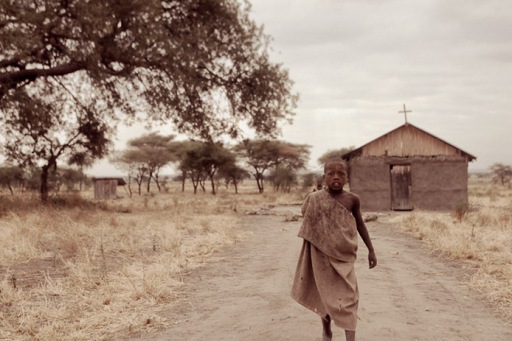
I remember another story of the archbishop’s that exemplifies this missionary outlook.  When Archbishop Anastasios was archbishop of East Africa, he often served in simple village churches with mud walls, tin roofs, and paper icons on the mud iconostasis. In the early 1980’s he was invited to attend a conference in Leningrad, and for the Sunday liturgy, he served in one of the beautiful Russian cathedrals, perhaps St. Isaac’s.  He celebrated liturgy surrounded by magnificence, and he began to wonder, “Where is God? In the midst of this opulence, or in the little mud chapel in Africa?”

orthodoxy missions city hermit

orthodoxy missions city hermit

orthodoxy missions city hermit

God is wherever the Eucharist is

So when it came time to preach the sermon he raised this question: “Is God in the mud churches of Africa with their paper icons, or is He in these magnificent cathedrals in Russia?” When he asked this, the translator was a little embarrassed to repeat the question, but Fr. Anastasy continued, “As I travel throughout the world and worship in many different types of church structures, I understand that God is wherever the Eucharist is. He is in both the mud churches of Africa and the beautiful cathedrals of Russia.

RTE: Also, these cathedrals were built with sacrifice and love by thousands of people, rich and poor, who wanted to give the best they had to beautify God’s house.

FR. LUKE: Right, and the point is that we have to feel comfortable everywhere, and realize that Christ works everywhere. It is not our role to judge, but to offer a witness for Christ.

orthodoxy missions city hermit


 Continued to Part II

Source: EVERYTHING IN LOVE: THE MAKING OF A MISSIONARY


Anastasios Yannoulatos: Modern-Day Apostle

Indifference to mission is a denial of Orthodoxy


anastasios-yannoulatos-modern-day-apostle


Anastasios Yannoulatos: Modern-Day Apostle. An amazing person  my family has been honoured to collaborate with in his missionary endeavours. An apostle of peace and reconciliation, since meeting him in 1997, he is one of my greatest role models.

For the first half of the twentieth century, the Orthodox Church was relatively inactive in missions. The great missionary efforts of the Russian church came to a close as the Communist curtain placed the church in bondage. Meanwhile, the Orthodox churches of the Balkans struggled to overcome the effects of the previous five centuries of Muslim subjugation. Although the Orthodox lands of Greece, Romania, Bulgaria, and Serbia gained their independence, a strong sense of nationalism prevailed within the churches, and the idea of outreach beyond the borders of their own countries was a concept to which few gave much thought.


“Inertia in the field of mission means, in the last analysis, a negation of Orthodoxy, a backslide into the practical heresy of localism”

It was not until the late 1950s that a number of young Orthodox theologians began to raise their voices about the need for external missions. From an international Orthodox youth conference held in 1958 in Athens, a call toward missions began to develop. These young people expressed the idea that the church’s responsibility toward missions was not simply some­ thing of the past but a call for the contemporary church as well. Despite the struggling situation of a poor church just freed from bondage, the apostolic call of the Lord demanded a response. The leader of this fledgling group was Anastasios Yannoulatos, a young Orthodox theologian from Greece. He challenged the Church of Greece, as well as the Orthodox Church at large, to recover its long-held missionary tradition.


In 1959 Yannoulatos helped found Porefthentes (“Go ye”), a missionary movement whose goal was to rekindle the mission­ary conscience of the Orthodox Church, as well as to educate the non-Orthodox world about the rich missionary heritage of the Church of Greece, as well as the Orthodox Church at large, to recover its long­ held missionary tradition.


Yannoulatos challenged the Church of Greece, as well as the Orthodox Church at large, to recover its long-held missionary tradition.


Yannoulatos challenged the Eastern Church. This movement began to produce a journal in Greek and English called Porefthentes. In its inaugural issue, Yannoulatos wrote a provocative article entitled “The Forgotten Commandment,” which challenged the church to rediscover the missionary zeal of previous generations. In this article, Yannoulatos questioned the accepted apathy toward missions that prevailed in the contemporary Orthodox Church:


“It is not a question of ‘can we?’ but of an imperative command “we must.” “Go ye therefore and teach all nations.” “Go ye into all the world and preach the Gospel to every creature.” There is no “consider if you can,” there is only a definite, clear cut command of Our Lord…. If we let ourselves rest peacefully in this habitual inertia in the matter of foreign missions, we are not simply keeping the pure light of the Faith “under the bushel,” but we are betraying one of the basic elements of our Orthodox tradition. For missionary work has always been a tradition within the Orthodox Church…. Missionary activity is not simply something “useful” or just “nice,” but something imperative, a foremost duty, if we really want to be consequent to our Orthodox Faith.”


As Christians we do believe in miracles.


Yannoulatos emerged as a leading missions advocate in the following years. He dared the Orthodox faithful to recover the authentic meaning of the “one holy catholic and apostolic Church,” in the words of the Nicene Creed. He even hoped to establish some type of external Orthodox mission center. His enthusiasm, however, was derided within most Orthodox circles as an unrealistic goal. Following an address he gave on this issue to theological students at the University of Athens in January 1959, someone in the audience remarked skeptically that “the organization of an Orthodox External Mission is tantamount to a miracle.” To this Yannoulatos responded, “We fully agree. But as Christians we do believe in miracles.”


Mission was not the duty of only the first generation of Christians. It is the duty of Christians of all ages … It is an essential expression of the Orthodox ethos.


The life and work of Anastasios Yannoulatos, probably the foremost Orthodox missiologist in the world today, exemplifies the realization of this miracle in the contemporary Orthodox Church.


His Early Life


Anastasios Yannoulatos was born on November 4, 1929, to a pious Orthodox family in Greece. Raised within the faith, he participated actively in the church during his formative years. His first great interest was in mathematics, and throughout his teenage years Yannoulatos thought of pursuing a career in this field. His views changed with the coming of World War II. During the war years, Yannoulatos began to experience his faith in a very personal way. He witnessed much suffering and disas­ter from the war and could make sense of the chaos only by delving deeper into his faith. For the world and for his own country to recover from the evil of both the Second World War and the ensuing Greek Civil War, Yannoulatos understood the urgent need for a message of eternal peace, the peace that comes through Jesus Christ.


This experience led Yannoulatos to abandon his interest in other disciplines and to pursue theology. So fervent was his desire that he has said, “It was not enough for me to give something to God, I had to be given totally to Him. I wanted to live with my whole being in Christ.”  Thus, in 1947 he entered the Theological School of the University of Athens. He graduated with highest honors in 1952.


Following two years of service in the army, Yannoulatos joined the brotherhood of ZOE, a religious organization focused on the spiritual renewal of the church in Greece. Yannoulatos’s personal responsibilities included missions to the youth of his country. He became the leader of student movements and teen­ age camps and strove to make the Orthodox faith real and concrete to his young charges. Through these experiences, Yannoulatos discovered the impact such outreach programs had on the church at large. He realized that without such missionary outreach, the church loses its focus and ultimately diminishes.


During these years, Yannoulatos also participated in an international Orthodox youth movement called Syndesmos. He served as the general secretary of the Committee for Missions during 1958-61, and as vice-president of the whole movement from 1964 to 1977. Here he met other young leaders with a similar zeal for proclaiming the Gospel. Together they began to realize how Christ could never be satisfied with proclaiming the Gospel simply within the church. His original command was to go to”all nations.” Thus missions are not merely internal, but external as well. The Great Commission of the past is an imperative respon­sibility for the present. Yannoulatos wrote at the time:


“Church without mission is a contradiction in terms…. If the Church is indifferent to the apostolic work with which she has been entrusted, she denies herself, contradicts herself and her essence, and is a traitor in the warfare in which she is engaged.A static Church which lacks vision and a constant endeavor to proclaim the Gospel to the oikoumene could hardly be recognized as the one, holy, catholic and apostolic Church to whom the Lord entrusted the continuation of His Work.”


The 1960s-Following the Call of God


This understanding of the importance of external missions for the church filled the heart of Yannoulatos. Following his ordina­tion to the diaconate in 1960, Yannoulatos proceeded to found the inter-Orthodox mission center Porefthentes. The goal of this center was to educate the church in the area of missions, as well as to motivate and send missionaries throughout the world.


Church without mission is a contradiction in terms…. If the Church is indifferent to the apostolic work with which she has been entrusted, she denies herself, contradicts herself and her essence, and is a traitor in the warfare in which she is engaged.


Yannoulatos himself planned on becoming a ‘foreign’ mis­sionary. In fact, immediately following his ordination to the priesthood on May 24, 1964, he left for East Africa and celebrated his first liturgy in Uganda. Shortly after his arrival, however, the young priest contracted malaria and returned to Greece. Despite the doctors’ recommendation that he not return to Africa, Yannoulatos was not daunted by the setback. He realized more than ever the importance of increasing the missionary awareness in the church and sought new ways to fulfill the Great Commis­sion of Christ. Following the advice of one of his professors, Yannoulatos decided the best way he could influence the church was by making a significant contribution in the academic world. He believed that if he could not directly work in the mission field, he could still try to pave the way for others to go. Thus, he decided to pursue further studies in missiology and the history of religions.


From 1965 to 1969, Yannoulatos studied the history of reli­gions at the universities in Hamburg and Marburg in Germany, with an emphasis on religious plurality and the Orthodox Church. His work focused on the general history of religions, African religions, missiology, and ethnology. He traveled to Makerere University in Kampala, Uganda, to conduct field research and collect material for his doctoral thesis, entitled “The Spirit Mbandwa and the Framework of Their Cults: A Research of Aspects of African Religion.” Overall, he desired to establish a basis for the whole process of a serious study of missions in the Orthodox Church. Through this research, he sought support for his original thesis that it was impossible to truly be Orthodox without having an interest in missions.


Along with his studies, Yannoulatos actively participated in the worldwide ecumenical movement. By taking part in the Commission on World Mission and Evangelism (CWME) of the World Council of Churches (WCC), the budding missiologist felt that he could both learn from other Christian traditions as well as introduce these members to the rich missionary heritage of the Orthodox Church. In 1963, Yannoulatos became the youngest member of the CWME at a conference in Mexico City. He has continued to play a pivotal role in this ecumenical setting and ultimately served as its moderator from 1984 to 1991, the first Orthodox missiologist to hold such a place of leadership.


The 1970s-Planting Missionary Foundations Within the Church


During the following decade, the Church of Greece began to hear and respond to the voice of this bold visionary. In 1968 Yannoulatos and his Porefthentes staff established the frame­ work of the Bureau of External Missions within Apostoliki Diakonia (the service branch of the Church of Greece). The establishment of a permanent missionary organization within the official Orthodox Church in Greece was a milestone. The church recognized the work of Yannoulatos by elevating him on November 19, 1972, to the episcopacy with the title “Bishop of Androussa” and making him general director of the whole department of Apostoliki Diakonia. Through Bishop Anastasios’s leadership, this commission of the Church of Greece acted as the main body for all the missionary efforts of the church both within Greece and abroad.


Along with his ecclesiastical responsibilities, Bishop Anastasios continued to be active on the academic level. In 1972 the University of Athens elected him as associate professor of the history of religions. At the university, he established and di­rected a centre for missionary studies during 1971-76. This center paved the way for another landmark, when a chair of missiology was finally created in 1976. In this academic atmosphere Bishop Anastasios continued to proclaim his “wake-up” call to the church, challenging its complacency in missionary outreach:


It was Yannoulatos’s thesis that it was impossible to be truly Orthodox without having an interest in missions.


“Inertia in the field of mission means, in the last analysis, a negation of Orthodoxy, a backslide into the practical heresy of localism…. It is unthinkable for us to speak of “Orthodox spirituality,” of “a life in Christ,” of emulating the Apostle Paul, founder of the Greek Church, while we stay inert as to mission; it is unintelligible to write about intense liturgical and spiritual living of the Lord’s Resurrection by us, while we abide slothful and indifferent to the call of ecumenical missions, with which the message of the Resur­rection is interwoven.”

Bishop Anastasios continually tried to educate the Orthodox faithful to a fuller understanding of the Nicene Creed, which proclaimed the belief in “one, holy, catholic and apostolic Church.” Professing such a creed while staying indifferent to missions, Yannoulatos held, was hypocrisy. As he noted,


“Only when it is realized that worldwide ecumenical mission is an initial and prime implication in a fundamental article of the “Credo,” elemental for the Orthodox comprehension of what the Church is, and that what is termed “foreign mission” is not an “external” matter but an inner need, a call to repentance and aligning ourselves with the spirit of the Gospel and the tradition of our Church, only then shall we have the proper and hope­ bearing theological start for what comes next.”

Foreign missions is not simply a branch of authentic Ortho­dox life, or even Orthodox theology, but rather is central to a proper understanding of the church. When Orthodox Christians confess, “I believe in one … apostolic Church,” “apostolic” does not refer only to apostolic succession. More important, it implies having an “apostolic fire and zeal to preach the gospel ‘to every creature’ (Mk 16:15), because it nurtures its members so that they may become ‘witnesses in Jerusalem and in Judea and Samaria, and to the end of the earth’ (Acts 1:8).”


Bishop Anastasios continued to challenge the apathetic atti­tude of the church toward missions by writing:


“The Gospel is addressed to all peoples, and therefore the work of the Church remains incomplete as long as it is restricted to certain geographical areas or social classes. Its field of action is universal and is active both in sectors that welcome the good tidings and those which at first may reject them. Mission was not the duty of only the first generation of Christians. It is the duty of Christians of all ages.... Witness is the expression of the vitality of the Church as well as a source of renewal and renewed vigor…. Everyone should contribute to and participate in it, whether it be directly or indirectly. It is an essential expression of the Orthodox ethos.”


Along with influencing the academic world in Greece and abroad, Bishop Anastasios had an impact on other areas of church life as well. In 1972 the bishop worked together with Fr. Anthony Romeos and founded a monastery of nuns whose emphasis would be on external missions. This group became the Convent of St. John the Forerunner in Kareas, Greece. Bishop Anastasios helped guide these women to become nuns who would actively participate in missionary work throughout the world. The convent also welcomed women from foreign lands to join their community and learn the monastic way of life, with the goal of carrying the monastic lifestyle back to their home coun­tries.


The 1980s-Theory Becomes Practice


In the 1960s,when Yannoulatos first fell ill to malaria, his doctors told him that he would never be able to work overseas as a missionary. The providence of God spoke differently. In 1980 the Orthodox Church of East Africa faced great difficulties. The region had been the most active Orthodox mission field in the world over the past two decades. The church’s footing, however, was jeopardized by internal problems that ultimately led to the defrocking of a Kenyan bishop by the Patriarchate of Alexandria. The East African Orthodox Church seemed to be on the verge of collapse.


During this time Patriarch Nicholas, the head of the Ortho­dox Church in Africa, invited Bishop Anastasios to become acting archbishop of the Archdiocese of East Africa. The bishop consented but continued to keep his responsibilities both at the University of Athens and in Apostoliki Diakonia. During this transitional period, Yannoulatos saw his role as one of reorganiz­ing the Church of East Africa. His main priority was to create a strong Orthodox community led by local leaders.


“By focusing on the training and establishing of indigenous leaders, Bishop Anastasios remained faithful to Orthodox mis­sions tradition. As he noted in an earlier writing, “The incarna­tion of God’s Word in the language and customs of a country has been and must be the first concern of all Orthodox mission. Its intent is the planting and growth of a native Church, self­ powered and self-governing, able to turn to account all the genuine strands of national tradition, transforming and hallow­ing them in harmony with the people’s nature, to the glory of God.”

In 1972, Archbishop Makarios III of Cyprus built an Ortho­dox Seminary in Nairobi, Kenya, but political instability in Cyprus prevented the archbishop from completing his project. The school remained vacant for ten years. Bishop Anastasios’s first action as the new leader of the church was to finish the seminary and open it immediately. During the 1970s, many of the faithful within the African Orthodox Church became disillu­sioned and disheartened with the floundering church and began to leave. Yannoulatos realized that the only way to bring these people back, as well as to bring new converts into the faith, was through the training of local leaders and priests.


Hence, Bishop Anastasios officially opened the Archbishop Makarios III Orthodox Patriarchal Seminary in 1982. Over the following decade, the school averaged 45 students annually, using 12 professors from East Africa, Europe, and the United States. The acting archbishop eventually ordained 62 priests and deacons, as well as 42 readers and catechists, from the school’s graduates. These indigenous leaders came from eight different tribes in Kenya, Uganda, and Tanzania and provided the founda­tion for the renewal of the church in East Africa.


Along with training local leaders, the acting archbishop also supported the Orthodox missionary tradition of translation, which he believed was sanctioned by Christ during the event of Pentecost. Thus, he concentrated on publications, organizing the translation of services into seven different languages.


Bishop Anastasios also tried to establish a sense of perma­nency in the structures of the church by guiding the construction of 67 new church buildings, 23 of them stone, and 44 wooden and mud. He also helped renovate 25 existing church buildings. His construction accomplishments included seven mission stations, seven health-care stations, five primary schools, and twelve nursery schools.


His work in Africa drew worldwide attention. The Greek Orthodox Church in America assisted him by sending mission­aries to East Africa. The impact of these missionaries was felt not only within the Church of East Africa but also throughout America. Many of the short-term missionaries, returning to their homes in the United States, helped increase a missionary aware­ness and consciousness within their own parishes. The Orthodox Church in Greece and Finland also responded to a series of lectures the bishop gave on the imperative of missions by send­ ing missionary teams of their own to Kenya.


The most important aspect of Bishop Anastasios’s work in East Africa, however, was not the ordinations, the publications, or the missionary interest created by the mission teams. It was instead his efforts to assimilate with the indigenous Christians. By identifying closely with the Orthodox Christians of this region, he encouraged and empowered them to embrace the faith as authentically their own. As a result, the Church of East Africa continued to mature even after his departure as acting arch­bishop in 1991.


In addition to his achievements in Africa, Bishop Anastasios has left his mark in other ways. In 1981, the bishop began editing, through the auspices of Apostoliki Diakonia, the first official missionary magazine of the Church of Greece, entitled Panta ta Ethne (All nations). This magazine continues to disseminate mission information and challenge Orthodox Christians throughout Greece to respond to the missionary mandate.


The 1980s also saw Bishop Anastasios intensify his activity in the WCC. After participating in the World Mission Conference at Melbourne in 1980, as well as the general assembly of the WCC at Vancouver in 1983, the bishop became the moderator of CWME during 1984-91 and presided at the World Mission Conference at San Antonio in 1989. His missiological impact not only influenced the Orthodox world but also touched broad ecumenical circles. As the prominent Protestant theologian and missionary David J. Bosch noted,

“Anastasios has remained the driving force behind the missionary movement in Orthodoxy. And since the Orthodox churches joined the WCC in 1948, he and others have made a major contribution to missionary thinking and practice in ecumenical circles…. The cross-fertilization in the area of Missiology between Orthodoxy and Protestantism has indeed been a major area of theological renewal in the ecumenical movement since 1961. Only three papers were read in the conference plenary during the first few days. . . . Whereas the first two papers were interesting and challenging, it was Anastasios’ presentation that provided the theological framework for the conference theme “Your Will Be Done” … its overall thrust was truly ecumenical in the best sense of the word.”


The 1990s-the Culmination of His Work


A new challenge confronted Bishop Anastasios with the coming of a new decade. In January 1991, the Patriarchate of Constantinople elected Anastasios to go to Albania as “Patriarchal Exarch” with a mandate to contact and organize Orthodox people irrespective of their ethnic origin. On June 24,1992, he was unanimously elected Archbishop of Tirana and All Albania. His task then became one of reestablishing the Orthodox Autocephalous Church of Albania. The Orthodox Church in Albania had been decimated after forty years of the most severe persecution. During the years of Communist control the number of Orthodox clergy had diminished from 450 in 1945 to 22 in 1990. All the surviving clergy were over the age of seventy. A new opportunity to revive life into a church that had been almost destroyed confronted Archbishop Anastasios.


Anastasios saw this new challenge as an opportunity to synthesize the elements of his life. Before Communism, Albania was a country with a 69 percent Muslim population. Archbishop
Anastasios had written a book and many articles on Islam. The uncertainties that the church faced with various political groups was something familiar for him from his work in East Africa. The challenge to resurrect a local church from an atheistic abyss would require a miracle, more radical than the miracle required initiatives on four different frontiers. But as his life has shown, Archbishop Anastasios believes in miracles.


Overall, Archbishop Anastasios’s priorities in Albania during his first three years of episcopacy were to train local leaders, perform responsible pastoral work to approximately one quarter of the population that claimed an Orthodox heritage, and to open dialogue and bridges to people of other faiths or no faith. In response to his leadership, the church quickly established the Resurrection of Christ Orthodox Seminary in a rented hotel building in the city of Durres. The school presently has a three-year program, with each class containing approximately thirty students. Through this seminary sixty new priests and deacons have joined the ranks of clergy within the first three years of Archbishop Anastasios’s episcopacy. The archbishop’s latest plans include moving the seminary into a new two million dollar spiritual center by the end of 1995.


Along with training local spiritual leaders, Archbishop Anastasios has mobilized the laity through various intellectual, youth, and women’s groups. These organizations have participated in the overall ministry of preaching, teaching, and sharing the good news of Jesus Christ to believers in cities and villages throughout Albania. The archbishop has also organized work in a variety of other areas. He is helping to reestablish the physical presence of Orthodoxy by building and renovating churches throughout Albania. At present, thirty-eight new churches have been built, and forty-three others have been renovated. Sixty other projects, which include church centers and a medical clinic, are in progress. A printing house produces the monthly newspaper Ngjallja (Resurrection), along with Orthodox books and various catechetical materials. Its goal is to disseminate church news and religious education throughout the country. Another office, called Service of Love, is devoted to a social outreach ministry, which helps distribute humanitarian aid and cultivate long-term developmental projects.


During this short period of reestablishment, the Orthodox Church has quickly left its former isolation and joined the world- wide Christian community. Efforts have been made for official relationships not only within pan-Orthodox circles but also within ecumenical organizations as well. In fact, the church has already become a full member in both the Conference of European Churches and the World Council of Churches.


Despite obstacles and restrictions placed upon the church from various sources within Albania, the future looks bright. The reawakening of Orthodox faithful combined with the influx of converts are a result of Archbishop Anastasios’s holistic outreach to nominal Christians, non-Christians, and atheists alike.


To resurrect the Church from its atheistic abyss would require a miracle, but Archbishop Anastasios believes in miracles.

Conclusion


Over the past thirty years, the impact and influence of Anastasios Yannoulatos cannot be overstated. As a young theologian in the 1950s, he had a vision to rekindle the missionary spirit of the Orthodox Church. Thirty-five years later, it is clear he has achieved his goal. Indeed, missions has truly become part of the basic life of twentieth-century Orthodoxy. As the archbishop notes himself, “Here is the first and major contribution I have made-a theological contribution to help the church rediscover who she really is. It was a contribution of LIFE. My theological position has always been to live the mystery of the one holy catholic and apostolic Church. To live the mission of the Church with its proper universal and eschatological perspective.”


A summary of the archbishop’s life can be seen in his initiatives on four different frontiers. First, out of concern for the Orthodox Church itself, he sought to revive missionary interest and consciousness that has been a part of its tradition throughout the ages.

Second, he has made significant contributions to the field of missiology. Archbishop Anastasios has written nine scholarly books, five catechetical books, over sixty treatises, and more than eighty articles. He founded and published two mission maga­ zines, Porefthentes (1960-70) and Panta ta Ethne (1981-92), and since 1981 he has been a contributing editor of the INTERNATIONAL BULLETIN OF MISSIONARY RESEARCH. Along with this, he has ap­peared numerous times on television, appealing to the public to embrace the eternal message of Jesus Christ and his holy church. In 1989, the Holy Cross Greek Orthodox School of Theology in Brookline, Massachusetts, granted an honorary Doctor of Theol­ogy degree to the archbishop. And in 1993, Archbishop Anastasios was unanimously elected correspondent member of the Acad­emy of Athens, which is the highest academic society of Greece. And in 1995, the Theological School of Thessalonika awarded him an honorary Doctor of Theology degree and the Historical Archeological School of loannina gave him an honorary Doctor of Philosophy degree.

The third frontier has been his life in East Africa and Albania. He desired to live the life and share in external missions of the church. He wished to show all people of the world, regardless of their origin, that God loves and cares for them.

Finally, the last frontier has been in ecumenical circles.Through the WCC, Archbishop Anastasios has given witness to Orthodox mission theology and spirituality to the non-Orthodox world. He has worked together with his Christian contemporar­ies to define missions in the twentieth century and to witness effectively to other faiths and traditions.

Archbishop Anastasios Yannoulatos’s life and work can be summarized in his own words. Throughout his sixty-five years of life, he has tried to live and proclaim the mystery of the “one, holy, catholic and apostolic Church,” that is, to live the mission of the church within its proper universal perspective. “Mission is an essential expression of Orthodox self-consciousness, a cry in action for the fulfillment of God’s will’on earth as it is in heaven.’ … Indifference to mission is a denial of Orthodoxy.”


Indifference to mission is a denial of Orthodoxy

Is “Orthodox Missions” an Oxymoron?

 Is “Orthodox Missions” an Oxymoron? The Purpose and Motive of Mission


Is “Orthodox Missions” an Oxymoron? Is missionary work an Orthodox practice? Should our Faith be earned to all peoples of the globe? Can all Orthodox Christians participate in mission work? The answer to each of these questions is a resounding, “Yes!” In this article we will explore the history, methods, and motivation behind Orthodox missions, arriving at the conclusion that not only can we participate in missionary work, but as children of God, the spreading of His love is a part of our very nature!

Is “Orthodox Missions” an Oxymoron?

Early on in my experience as a missionary to Albania, I had an encounter with a Protestant missionary which was soon to become commonplace. We had been having a pleasant conversation when the topic turned to our respective ministries. When I told him that I was an Orthodox missionary, his expression turned to one of utter astonishment. All he could manage to blurt out was, “I didn’t know the Orthodox Church did missionary work!”

Actually, I was not offended by his candor. I soon discovered that many missionaries assigned top Albania had little if any knowledge of Orthodoxy. A much more distressing reaction came from Orthodox Christians themselves.

I first encountered this reaction while a student at seminary in preparation for the priesthood. As a member of the campus missions committee, I often spoke about mission work. On more than one occasion in this capacity, I was confronted by a man or woman emphatically telling me that mission activity was unorthodox. “Foreign missions,” I was told, “is a Protestant concept!”

To be fair, it is easy to see where both these misconceptions originated. While Orthodoxy has made a powerful missionary effort through much of its history, it was as recently as 1962 that Orthodox scholar Nikita Struve observed pointedly: “Strictly speaking, the Orthodox Church has no longer any organized mission.” ‘


A Temporary Period of Decline

Without question, the Orthodox Church has been active in missions from its very beginning—from the Apostolic and Early Church period, through the Byzantine and Russian eras, and now in the present day. Any reading of the history books will clearly substantiate the fact that each century has brought forth vibrant Orthodox mission activity.

Two factors, however, greatly thwarted the Church’s missionary efforts in recent centuries: (1) the Turkish occupation of the Balkans, lasting four centuries; and (2) the communist seizure of power in many other Orthodox countries. Between these two events, the ability of the Orthodox Church to do missionary work was repressed at a time when the churches of the West were free to expand. These events “forced the Orthodox to withdraw temporarily into themselves in order to preserve their faith and to form, to a certain extent, closed groups.”2

Praise be to God, that period came to an end around the middle of the twentieth century. Following the 1958 Fourth General Assembly of Syndesmos in Thessaloniki,Greece, the newly arising Porefthentos movement brought forth an Orthodox revival in the area of external mission. If one sorts through the various documents written after that period, the growth of this revival becomes clear. The call to the Church to return to its task has appeared over and over again in conferences and articles during the last forty years.

In addition, the severe communist rule that repressed Orthodoxy in so many other countries of the world has now collapsed, and we can expect to see this same reawakening of missions in these countries as well.

A Survey of Mission Activity 

In looking back, one can see that this call to return to missions has borne fruit. The Orthodox, after decades of repression, once more have begun witnessing to Christ to the “ends of the earth.” The number of Orthodox missionaries, in comparison to those of other churches, is not spectacular. Yet a survey of current Orthodox mission activity reveals that the Church is on the move once again. Let me outline some of the main regions of Orthodox mission work that I have explored.

• The Ecumenical Patriarchate of Constantinople covers a number of missionary regions. The largest is the Metropolitanate of Hong Kong and Southeast Asia, established in November, 1996. Metropolitan Nikitas, from Tarpon Springs,Florida, was enthroned to this See in 1997. The jurisdiction covers a large territory, and mission efforts include Indonesia, India, the Philippines, Hong Kong,Korea, and Singapore. The Metropolitan writes that there are also possibilities waiting to begin inChina (Beijing),Taiwan, and Thailand (Bangkok).3

• The Orthodox communities of Central and South America also carry on local missionary activities. Efforts in these areas are led by Constantinople and by other jurisdictions as well.

• The Patriarchate of Alexandria and All Africa is responsible for the mission efforts in Africa. The Orthodox churches of Africa are growing daily. The main missionary efforts are in Kenya, Uganda, Tanzania, Madagascar, Zaire, Cameroon, Ghana, and Nigeria. In all of these churches there are indigenous clergy. Some have seminaries, and many have schools and clinics as well.

• The Autocephalous Church of Albania. A new situation in Orthodox missions arose in this decade. With the collapse of the communist regimes in countries that had previously been predominantly Orthodox , the Church often found itself with the task of rebuilding its foundations from the ground up. This is especially true in the Church of Albania, where religion was constitutionally illegal and the infrastructure of the Church had been totally destroyed. In this situation, the only way the Church could be resurrected was through outside assistance, reaching across cultural and geographical boundaries.

At the head of the effort in Albania is Archbishop Anastasios Yannoulatos, the Orthodox Church’s foremost living missionary and missiologist. Archbishop Anastasios was elected to lead this Church and has done an outstanding job in applying the best of Orthodox mission strategy over the past eight years. It is one of the few countries where Orthodox can freely witness to a Muslim majority, and many are turning to the Faith.

• Mission Centers: Another development in Orthodox mission work of the past decades has been the revival of the idea of mission centers to support external mission. We have seen the first of these (Porefthentos) in Greece, beginning in the 1960s. Since this time other movements also have begun in Greece. The Orthodox Christian Mission Center represents all the canonical Orthodox jurisdictions in the United States. A third movement came into existence in Finland in 1981 (Mission Office of the Finnish Orthodox Church, Ortodoksinen Lahertysry). The Moscow Patriarchate has also recently revived its Office of Missions.

If we look back through the history of Orthodoxy until today, we can see that the Orthodox Church has been involved in mission work from its very beginning. Though there was a time of inactivity due to external political persecution, when freedom was restored the Orthodox Church again applied itself to the Great Commission to go to all nations.

The Principles of Orthodox Mission Work 

What are the principles of Orthodox mission work? Can a common thread be found in the many efforts throughout the centuries? If so, how does this compare to contemporary Protestant mission strategies?

While attending Fuller School of World Missions, I was given a wonderful opportunity to sift through different Protestant strategies of missions. These strategies are in a constant state of development. As I applied them to my own context, I soon realized that the best of many of these theories in modern missiology could be found already existing in my own Orthodox tradition. Additionally I realized that some of the great mistakes of missionary history were absent in the Orthodox approach. Let me illustrate what I mean by briefly outlining just a few of the more popular contemporary mission theories, and then contrasting them to the Orthodox approach.

• The Three-Self Church. The first theory is called the “Three-Self Strategy ” It represents the realization that missionary work should ultimately lead to the development of an indigenous church. According to this theory, an indigenous church is described as one that is self-governing, self-supporting, and self-propagating. Henry Venn and Rufas Anderson developed this emphasis to correct the negative results of nineteenth century mission work, which had resulted in paternalism by the missionaries and the establishment of churches that were totally dependent on the foreign missionary bodies. As one missionary put it, a scaffolding was being built around the churches, but it remained as a permanent fixture, rather than being a temporary aid towards creating a self-standing structure. In the Three- Self model , an emphasis was placed on the indigenization of the local church: it must incorporate and fully function within the local, indigenous culture to be authentic.

• Contextualization. As the Three-Self model was applied, however, certain weaknesses surfaced. It was found to be too simplistic to consider a church mature when it contained the three “selves” and functioned within the local culture. The contextualization model accepts the Three-Self presuppositions, but also points out that in certain situations a church could be indigenous without one of these aspects. It also reveals that a church could contain the Three-Self dimensions but still be a totally foreign entity in its culture, even though it is run by the indigenous people.

Thus the contextualization model looks to deeper issues to determine that a church is firmly rooted in the culture and life of a people and has become contextualized, in addition to being indigenous.

• Translation of the Bible and use of local language. Another related emphasis of Protestant mission strategy involves the issues of Bible translation and the use of the local languages. A people must be able to read and worship in the “language of their heart.” The Bible must be made available to form a mature church. These are commonly accepted principles today that are found across the spectrum of almost all Protestant missionary efforts.

An Orthodox Perspective 

It is interesting to note that most of these models were formulated in response to weaknesses in historical Protestant missionary efforts. Too many missionary efforts denied or repressed the culture of the people being reached. Others neglected to translate the Bible, or use the local language or music in worship. How then does the Orthodox Church relate to these principles in its missionary work, and what has its practice been throughout the ages?

In an article published in 1989, Archbishop Anastasios outlines the key emphasis in the Byzantine and Russian Orthodox missions. The Byzantine missions, he states, were based on clear-cut essential principles:

At the forefront was a desire to create an authentic local eucharistic community. Thus precedence was given to translating the Holy Scriptures, [and] liturgical texts … as well as to the building of beautiful churches which would proclaim—with the eloquent silence of beauty—that God had come to live amongst humanity— [There was also an] interest in the social and cultural dimensions of life At the same time, the development of the vernacular and of a national temperament . . . helped preserve the personality of the converted peoples. Far from indulging in an administrative centralization . . . the Byzantine missionaries saw the unity of the extended church in its joint thanksgiving, with many voices but in one spirit.4 

He goes on to outline the Russian missions:

The Russian missionaries were inspired by the principles of Byzantine Orthodoxy and developed them with originality . . . the creation of an alphabet for unwritten languages; the translation of biblical and liturgical texts into new tongues, the celebration of the liturgy in local dialects, . . . the preparation of a native clergy as quickly as possible; the joint participation of clergy and laity, with an emphasis on the mobilization of the faithful; care for the educational, agricultural, and artistic or technical development of the tribes and peoples drawn to Orthodoxy. 

In summing up the many principles of Orthodox mission strategy, Archbishop Anastasios states, “Certain fundamental principles, only now being put into use by western missions, were always the undoubted base of the Orthodox missionary efforts.” 6

This is a key point in understanding historical missionary activity. Many of the current missiological principles just now being discovered by Protestant missionary studies can actually be found in practice throughout centuries of Orthodox missions!

Even more encouraging, however, is the fact that the strategies adopted by historical Orthodox figures—from Ss. Cyril and Methodios to St. Nicholas of Japan and St. Innocent of Alaska—are also practiced in the present day.

Having served under Archbishop Anastasios for the past ten years, I have personally witnessed the same spirit, direction, and integrity in the mission work he has led in East Africa and now in Albania. Each of these traditional Orthodox emphases has been present: translation, worship in the local language of the people, indigenous leadership, participation of laity, incorporation of cultural elements into the life of the Church, building of churches that witness to the glory of God, and an emphasis on the whole person by addressing the needs of society both through education and charitable institutions.

These are the threads of Orthodox mission practice that are woven throughout its history. These are the ideals that the Orthodox strive for when carrying the gospel to new lands and peoples. While they have not always been present in each and every movement, they are an undeniable part of Orthodox history stretching from the first centuries until today.

Why Should We Do Mission Work? 

I would like to address one final question before concluding this article: Why should we do mission work?

I will never forget my first flight to Africa. Newly married and ordained, I had become a missionary overnight. One moment I was a priest in California. It only took a split second, though, for my foot to step through the threshold of the 747 that was to carry us to Kenya. With that magic step our family became missionaries.

Now, as we were flying over the Atlantic, a flight attendant saw my collar and asked where I was going. I proudly explained that our family was traveling to East Africa to be missionaries. “Oh,” she replied. “I don’t believe in that. We should not interfere in people’s lives. We should just leave them alone to continue on their own happy way.”

How do you answer a statement like that? Where do you begin? In fact, this challenge is one that came up time and again and gradually forced me to think, analyze, and study the very bedrock motivations for doing missionary work. Why don’t we just leave the world alone? Why do we try to spread our Faith to people who have their own beliefs?

Somewhere along my journey toward the missionary vocation, I came across an Orthodox perspective presented by Archbishop Anastasios in a paper called, The Purpose and Motive of MissionThis paper became a watershed for me, since it seemed to encompass everything I had been learning and experiencing as a student and missionary. With this in mind. I can think of no better way to conclude this article than with a brief summation of the excellent points made by Archbishop Anastasios in his paper.

Without question, the foundation for mission is the glory of God and the redemption of all creation. The Scriptures emphasize this theme over and over again, beginning with Creation itself, and leading us through the rejection of that glory and the subsequent entrance of death into the world. Jesus’ life, from this perspective, is a manifestation of the glory of God. In Christ, human nature is redeemed and the universal order restored. Finally, the Church becomes a participant in proclaiming this redemption until the Parousia, when the glory of God is fully revealed.

Participation in spreading the glory of God is so basic to the Christian spirit that it may be called an inner necessity. Archbishop Anastasios explains:

The question of the motive of mission can be studied from several angles: love of God and men, obedience to the Great Command of the Lord (Matthew 28:19), desire for the salvation of souls, longing for God’s glory. All these surely, are serious motives. . . . However, we think that the real motive of mission, for both the individual and the Church, is something deeper. It is not simply obedience, duty or altruism. It is an inner necessity. “Necessity is laid upon me,” said St. Paul, “Woe to me if I do not preach the gospel” (1 Corinthians 9:16). All other motives are aspects of this need, derivative motives. Mission is an inner necessity (i) for the faithful and (ii) for the Church. If they refuse it, they do not merely omit a duty, they deny themselves.7 

This inner necessity is an outgrowth of our being made in God’s image. Throughout history, we can clearly see God’s purpose in the revelation of His glory, the drawing of all things to Himself, and the establishment of His Kingdom. In addition, we can see that God has shared this mission with humanity, from Abraham to Jesus’ disciples and on to the Church today.

Thus mission work is not a task which is simply imposed upon us; nor is it rooted solely in our obedience, respect, or even love of God. Rather it is the actualization of our inherent nature to participate in the fulfillment, destiny, and direction of humanity and all creation as it is drawn back to God and towards the coming of His Kingdom.

Conclusion 

In this article, we have considered the longstanding and sometimes forgotten tradition of Orthodox missionary work. Space has not allowed us to explore in depth the loving characters, the powerful visions, the solid strategies, and the intensely sacrificial lives of so many Orthodox missionaries.

But in this broad overview of Orthodox mission history, strategy, and motives, I have attempted to give a taste—if ever so faint—of the rich flavor of a vibrant history that continues in the present and which is at the very heart of our being. As Orthodox, we have been, and must be, involved in missionary work. We have a firm historical tradition and developed principles which tell us this.

Most importantly, we have an understanding that bringing God’s love, compassion, and message to the world, drawing people to Him and establishing worshipping communities among all nations and in all cultures is not merely an imposed command or a religious principle—it is a part of our own nature as we are created in the image and likeness of God.

Participation in missions, both as individuals and as a Church, is an action necessary to our fully being who we are. Without it something will be lacking. With two-thirds of our world still missing the love and joy of being in Jesus Christ, we have much to do. May the Lord guide us to actualize this dimension of ourselves so that His saving power may be known among all nations.

1 Nikita Struve, “Orthodox Missions: Past and Present,” St. Vladimir’s Theological Quarterly 6:1, pp. 40, 41.

2 Yannoulatos, Anastasios, “Orthodoxy and Mission,” St. Vladimir’s Theological Quarterly 8:3. p. 139.

The Censer, Jan. 99, Vol. 3, Issue 1.

4 Yannoulatos, Anastasios, “Orthodox Mission—Past, Present, and Future,” Your Will Be

Done, Orthodoxy in Mission, George Lempoulos ed.,Geneva: WCC. 1989, pp. 65,66.

5 Ibid., p. 68

6 Ibid., p. 68

7 Yannoulatos, Anastasios, The Purpose and Motive of Mission: from an Orthodox Theological Point of View. Athens: Typo-Tcchniki-Offset, Ltd.. 1968, (3rd edition) p. 32.

By Fr. Martin Ritsi
This article originally appeared in Conciliar Media Ministries’ Again Magazine, Vol. 22.1, and is posted here with permission.  Be sure to visit Conciliar Media at either Conciliar Press or Ancient Faith Radio. 
 
The What Where, When, and Why of Orthodox Missions
 
http://www.youtube.com/watch?v=YPvcFQ1Yb4k